Produced water disposition costs swing from $0.50/bbl (injection) to $14/bbl (beneficial reuse). Here is how to pick the right route against basin geology, regulator, and water-stress context.
Every barrel of oil pulled from a producing well comes with somewhere between 2 and 12 barrels of produced water, and the cost of doing something with that water has become a strategic variable in upstream economics. In the Permian Basin, where the average water cut is 4 to 7 barrels per barrel of oil, produced water handling alone runs $0.50 to $14 per barrel depending on whether the operator injects, discharges, or treats for beneficial reuse. Across a 100,000 BOPD operation with a 5:1 water cut, that range translates to between $90 million and $2.5 billion of cumulative produced water OPEX across a 10-year field life, and the spread is driven almost entirely by upfront engineering and regulatory choices made in the first 18 months of basin development.
The default assumption that produced water is a waste stream to be disposed of as cheaply as possible held up until roughly 2020. It does not hold up now. Disposal-well-induced seismicity in Oklahoma and Texas has shut down or restricted hundreds of Class II injection wells. The North Sea OSPAR convention has tightened oil-in-water (OIW) discharge limits and is moving toward a "reduce or replace" trajectory for hormone-disrupting compounds. California, MENA, and Australia have all opened beneficial reuse pathways that did not exist five years ago. The operators that adapted early are now paying $3.50 per barrel for treatment and reusing 60% of their produced water; the operators that did not are paying $8 per barrel to truck water to ever-more-distant disposal wells and watching the regulator approach.
This article covers the chemistry and volumes that define produced water, the four-stage treatment train that handles it, the four disposition routes (deepwell injection, surface discharge, frac reuse, beneficial reuse) and their cost and regulatory profiles, where projects most often go wrong, and the decision framework operators should run before any treatment package is procured.
## The decision in brief
- Put one number in front of the CFO. On a 100,000 BOPD operation with a 5:1 water cut, the difference between a well-architected and a poorly-architected produced water disposition strategy typically swings $80 million to $400 million in net present cost across a 10-year field life. - Split the swing three ways. It is $30M to $180M of operating cost differential, $20M to $130M of avoided regulatory retrofit, and $10M to $90M of optionality value when the basin's regulatory or seismicity envelope shifts. - Make the decision in the first 18 months of basin development. The decision is made on chemistry samples and regulatory analysis, before a single pad-scale treatment package is procured, and it settles which side of the $80 million to $400 million swing the field lands on.
Operators who treat the analysis as a paid-for engineering deliverable rather than an operational afterthought consistently land on the right side of that swing.
## What produced water actually is
Produced water is not a single waste stream. Its chemistry varies by basin, depth, formation, and well age, and the engineering envelope for treating it varies accordingly. A useful first-order classification splits produced water into three families: offshore conventional (low TDS, hydrocarbon-rich, OSPAR-discharge envelope), onshore conventional (moderate TDS, high in dissolved organics, often injectable), and onshore unconventional (extreme TDS up to 250,000 mg/L, frac chemistry residuals, NORM, dissolved methane).
Across all three families, the operationally consequential parameters are oil and grease (OIW or TPH), total dissolved solids (TDS), dissolved organics including benzene-toluene-ethylbenzene-xylenes (BTEX) and naphthenic acids, scale-forming ions (calcium, [barium](/elements/barium), sulphate), heavy metals (iron, manganese, sometimes [strontium](/elements/strontium)), and naturally-occurring radioactive material (NORM) where the formation runs hot. Hydrogen sulphide and dissolved methane add safety dimensions that single-stream treatment plants are not designed to handle.
The volumes are large enough to dominate every other water-cycle decision on the asset. A Permian completion at year 3 typically produces 1,500 to 4,000 bbl/day per well of water at a 4:1 to 7:1 water-cut ratio, and a 200-well pad runs 300,000 to 800,000 bbl/day of produced water against 60,000 to 110,000 BOPD of oil. Produced water logistics, not oil logistics, is what limits production growth in mature unconventional plays. The operators who think of produced water as a finance line item rather than an engineering problem typically pay 30 to 60% more than necessary across the asset's life.
The chemistry also evolves with field maturity. Early-life production water is dominated by frac flowback chemistry (high TSS, polyacrylamide friction reducers, biocides). Mid-life water is closer to formation water with more uniform TDS and ionic composition. Late-life production water often returns to higher TDS as the reservoir depressurises. A treatment train designed against year-1 chemistry usually fails against year-5 chemistry without retrofit, which is one of the most expensive operational mistakes in the upstream water space.
## The four-stage treatment train and what it costs
The treatment train scales with the disposition route. Operators heading to a Class II injection well need primary separation only; operators targeting beneficial reuse need all four stages plus advanced oxidation. The economics flip at each stage transition.
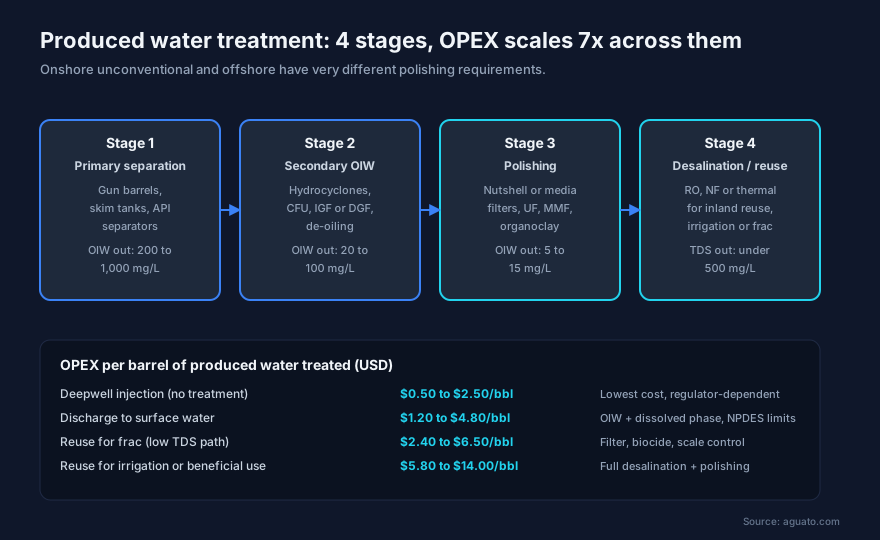
Stage 1: primary separation. Three-phase separators (oil, water, gas) at the wellhead, followed by gun barrel tanks or American Petroleum Institute (API) gravity separators. Output OIW typically 200 to 1,000 mg/L. CAPEX is bundled into the production facility; incremental cost is minimal. This stage is mandatory for any disposition; even injection wells need free oil removed to prevent plugging the disposal formation.
Stage 2: secondary OIW removal. Hydrocyclones for offshore and high-volume onshore, induced gas flotation (IGF) or dissolved gas flotation (DGF) for higher-rate skids, and corrugated plate interceptors (CPI) as a low-cost option for moderate flows. Output OIW 20 to 100 mg/L, low enough for most injection-well permits and approaching offshore discharge limits. CAPEX runs $80 to $260 per bbl/day of capacity; OPEX is power and chemistry ($0.80 to $2.40 per 1,000 bbl).
Stage 3: polishing. Nutshell media filters, multimedia filters (MMF), ultrafiltration (UF), or organoclay-based polish for dissolved organics. Output OIW under 15 mg/L, which meets OSPAR's 30 mg/L offshore limit comfortably and the more stringent California ocean discharge limit (15 mg/L oil and grease in daily maximum). CAPEX $180 to $480 per bbl/day; OPEX $1.20 to $4.20 per 1,000 bbl, dominated by filter backwash and replacement media.
Stage 4: desalination / advanced reuse. Reverse osmosis for low-to-medium TDS feed (under 60,000 mg/L), nanofiltration for selective ion removal, mechanical vapor compression (MVC) or multi-effect distillation (MED) for high-TDS streams above the RO osmotic-pressure limit. Output TDS under 500 mg/L for irrigation-grade reuse, or under 1,000 mg/L for industrial cooling reuse. CAPEX $1,800 to $4,500 per bbl/day, dominated by membrane area or evaporator surface; OPEX $3.20 to $9.50 per 1,000 bbl on RO, $8 to $22 per 1,000 bbl on thermal. Detailed cost benchmarks for the desalination layer are covered in the [desalination energy consumption guide](/resources/desalination-energy-consumption).
The right train depth depends on disposition. Operators who specify all four stages when only Stages 1 to 2 are needed for injection overspend by 60 to 80%; operators who skip Stage 3 polishing when targeting beneficial reuse fail their permit on first audit. The first decision in the project is not which equipment to buy; it is which disposition route fits the basin, regulator, and economics.
The provider mix on a produced water project is also a signal of how the operator is thinking about disposition. A project that contracts only with disposal-well specialists is implicitly locked into a single-route strategy. A project that includes a Stage 2 to 3 treatment vendor and a frac-reuse logistics partner from the start has built optionality into the architecture before a single barrel of water moves. The cost of that optionality is rarely above 15 to 20% of Day 1 CAPEX; the value when a state regulator restricts injection or an OSPAR member tightens its alkylphenol limit is typically 5 to 12 times that figure across the asset's remaining life.
## The four disposition routes
Once the chemistry is characterised, the disposition choice typically collapses to one of four routes. Each has a different cost-per-barrel envelope, regulator, and risk profile, and the right answer is rarely the cheapest one at the moment of sanction.
The most consequential framing for any operator is that disposition is not a fixed decision; it is a position in an evolving regulatory and water-stress landscape. The Permian basin operator who optimised in 2014 for the lowest possible disposal cost ($0.40 to $0.60 per barrel into a saturated injection-well market) discovered in 2017 that state seismicity restrictions had eliminated 30 to 50% of their disposal capacity inside a 60-mile radius, pushing trucking costs to $2.50 per barrel within months. The operators who had built in some optionality (a Stage 2 to 3 treatment skid sized for partial discharge or partial frac reuse) absorbed that shift with minimal operational disruption.
The mirror-image case is offshore. North Sea operators who optimised in 2015 for the OSPAR 30 mg/L OIW limit on existing equipment found themselves needing $40 million to $180 million per platform in retrofit CAPEX five years later when alkylphenol monitoring became part of the Risk Based Approach. The platforms that had been designed with a Stage 3 organoclay or biological-polish footprint absorbed the new substance limit by adding a polishing skid to a pre-built tie-in point, at one third the cost of a full retrofit.
Both cases produce the same operational learning: the disposition route that minimises lifecycle cost is rarely the one that minimises Day 1 cost. The four routes below should be evaluated against the operator's projected regulatory trajectory and basin water-stress envelope, not against the spot price of injection in the current quarter.
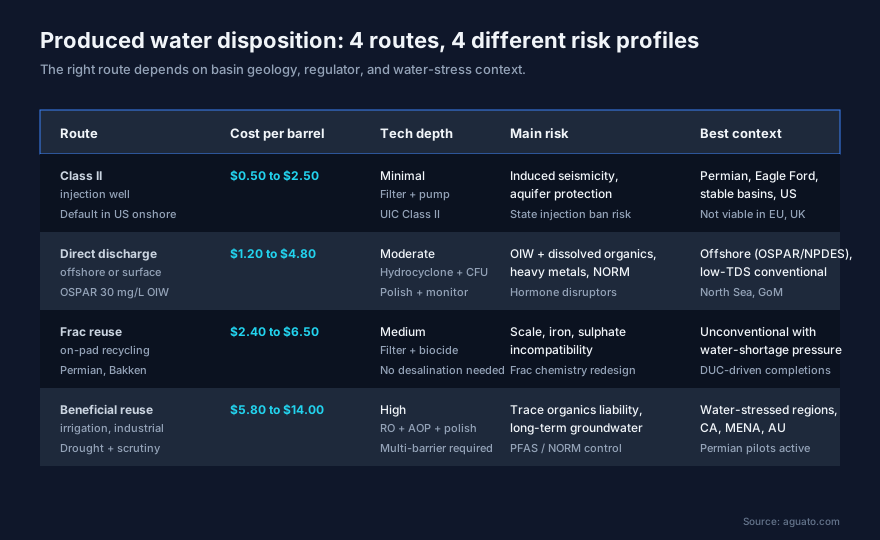
Class II injection wells (US onshore default). Under the [EPA Underground Injection Control programme](dofollow:https://www.epa.gov/uic/class-ii-oil-and-gas-related-injection-wells), Class II wells receive about 90% of US onshore produced water. Cost is $0.50 to $2.50 per barrel including trucking, well fees, and minimal pre-treatment. The catch is induced seismicity. The Oklahoma Corporation Commission ordered shut-ins or volume reductions on hundreds of disposal wells after the 2014 to 2016 seismicity peak, and the Texas Railroad Commission has done similar moves since 2022 in the Permian. Disposal well availability is no longer a constant in active basins, and operators relying on a single disposal-pad assumption are exposed to step-function cost increases when a state regulator restricts injection volumes mid-field-life.
Direct surface or marine discharge. Standard practice offshore (North Sea OSPAR, Gulf of Mexico NPDES) and some onshore conventional plays with permit. Cost $1.20 to $4.80 per barrel, dominated by Stage 2 to 3 treatment. The regulatory envelope is tightening: OSPAR's [Recommendation 2012/05 on a risk-based approach to the management of produced water discharges](dofollow:https://www.ospar.org/work-areas/oic/produced-water) is being supplemented by member-state limits on hormone-disrupting compounds (alkylphenols, BTEX speciation), which adds Stage 3 organoclay or AOP polish to most offshore installations by 2030. Onshore discharge is rare in the US under NPDES outside agricultural beneficial-use exemptions (see Subpart E).
Frac reuse / on-pad recycling. Recycle produced water back into the next completion's frac fluid. Cost $2.40 to $6.50 per barrel, dominated by filtration, biocide, and scale-control chemistry. The big advantage is that desalination is not required if frac chemistry tolerates the source TDS (most modern friction-reducer systems do tolerate up to 100,000 mg/L TDS). Operators in the Permian, Bakken, and parts of the Eagle Ford are now running 40 to 70% recycle rates, which materially reduces both injection volume and freshwater procurement cost. The catch is frac chemistry redesign, which adds CAPEX upfront but lowers cost per completed lateral.
Beneficial reuse (irrigation, industrial, recharge). The most expensive route, $5.80 to $14.00 per barrel, requires all four treatment stages plus AOP or biological polishing for trace organics. Currently active in pilot or limited commercial scale in California (Kern County agricultural reuse), MENA (oilfield-to-irrigation projects in Oman and Saudi Arabia), and Australia (Cooper Basin). Beneficial reuse is the only route that converts produced water from a liability into a revenue or offset asset, but the trace-organic and NORM characterisation requirements are stringent enough that most operators run small-scale pilots for 18 to 36 months before committing.
## Regulatory framing: NPDES, OSPAR, EPA Subpart S
US onshore produced water management is governed by EPA's effluent guidelines for the oil and gas extraction industry (40 CFR Part 435), which sets a zero-discharge standard for onshore facilities east of the 98th meridian and allows beneficial use west of that boundary under Subpart E. Subpart S (recently expanded) frames specific reuse pathways. The state oil and gas regulator (Texas Railroad Commission, Oklahoma Corporation Commission, North Dakota Industrial Commission) then writes the local permit envelope on top of the federal floor.
Offshore is OSPAR (Northeast Atlantic) plus national implementations, MARPOL Annex IV worldwide, and US NPDES general permits for the Gulf of Mexico (Region 6 GP) and Pacific OCS (Region 9 GP). The OIW limit is typically 30 mg/L daily maximum / 42 mg/L instantaneous, with a clear ratcheting trajectory toward 20 mg/L by 2030 in EU and UK waters. Hormone-disrupting compound monitoring under OSPAR's Risk Based Approach (RBA) is the next constraint many existing platforms will need to retrofit against.
Internationally, the regulatory map is more fragmented. Russia, China, and parts of Latin America have looser produced water discharge limits than OSPAR or EPA but tighten case-by-case where pipelines or refineries cross national borders. MENA operators face fewer national regulations but increasing local water-stewardship pressure from sovereign-fund investors, ESG funds, and host-government water ministries. Operators with multi-basin portfolios face the practical problem of harmonising their disposition strategy across very different regulatory regimes.
[cta:nepti-dark]
The forward-looking question for any operator is which constraints are tightening fastest. EU and UK offshore: hormone disruptors. US onshore: injection-well capacity and induced seismicity. California and Texas: state-level water-reuse pressure. MENA and Australia: ESG-driven reuse for irrigation and industrial water trades. The right disposition strategy is not the cheapest one today; it is the cheapest one that survives the next regulatory cycle without a six-figure-per-pad retrofit.
## Where produced water projects go wrong
Five failure modes account for most of the cost overrun and post-commissioning regret in upstream produced water management.
Single-route disposition with no fallback. Operators committed to Class II injection at field sanction, with no surface-discharge or reuse fallback, who get hit by a state injection ban at year 3. The mid-field retrofit to add Stage 3 polishing or beneficial reuse infrastructure typically costs $2.40 to $6.80 per barrel of incremental OPEX plus $40M to $180M of CAPEX, against a baseline cost case that assumed $1.20 per barrel for injection forever.
Treatment design against year-1 chemistry. A treatment train sized against flowback chemistry (high TSS, frac chemistry residuals, lower TDS) cannot handle year-5 formation water (lower TSS, much higher TDS, different organics speciation). The retrofit is often a full skid swap, $8M to $35M per pad against a Day 1 spec that should have included the chemistry trajectory.
Underestimating NORM. Naturally-occurring radioactive material concentrates in scale and biofilm during treatment, particularly in any sulphate-reducing-bacteria-active section of the train. Operators who do not measure NORM on a quarterly basis discover it at decommissioning, when the disposal cost of a contaminated filter skid is 8 to 25× the cost of the same equipment if it had been managed across its service life.
Sulphate compatibility mismatch in frac reuse. Produced water from one formation often contains sulphate; the next formation's frac may use barium-based or strontium-bearing weighting agents. Mixing them creates barium sulphate or strontium sulphate scale that plugs the formation. A single mismatched reuse cycle can sterilise a completed lateral, which is a $4M to $12M loss against a $20K to $80K saving in not running a sulphate-compatibility test.
Treating produced water as an environmental cost rather than a water-stewardship asset. In water-stressed basins (Permian, MENA, parts of Australia), operators who reframe produced water as a potential reuse resource gain stakeholder and regulator goodwill, sometimes monetised as water credits or as preferential permit timelines. The operators who continue to frame it as waste pay the same OPEX without the upside.
For mid-life retrofit decisions, operators typically need to compare 2 to 4 disposition architectures across cost, regulatory exposure, and basin water-stress projections. [Nepti](/nepti) takes the produced water chemistry trajectory, regulatory regime, and disposition options and ranks the 10-year NPC of each architecture, surfacing the option that minimises both first-cost OPEX and downside retrofit risk.
## Decision framework: picking the right disposition
Apply these steps in order before any treatment package is procured. Each step has a numeric or regulatory trigger that swings the disposition choice.
1. Characterise produced water across field life. Sample at month 1, month 6, and year 2; project to year 7 and year 10 based on analogue wells in the same formation. Note OIW, TDS, BTEX, naphthenic acids, scale-formers, NORM, and dissolved organic carbon (DOC). 2. Map the regulatory envelope. Federal floor (EPA, OSPAR), state or national limits, and projected tightening trajectory over the asset's life. Note which limits are within 50% of the projected as-produced water profile. 3. Inventory injection-well capacity. For US onshore: state injection limits, historical seismicity, distance to existing disposal infrastructure, projected basin growth over the next 5 years. 4. Score frac reuse fit. Lateral drilling cadence, frac chemistry tolerance for produced-water-derived friction reducer systems, sulphate-barium compatibility, on-pad surface-water storage capacity. 5. Evaluate beneficial reuse pathways. Local water demand (irrigation, industrial cooling, dust suppression), regulator willingness to write a beneficial-use permit, public scrutiny around groundwater contact, and the cost of full polishing relative to alternative disposition. 6. Pick the disposition that survives the worst case. Not the cheapest case. Operators who picked cheap (single-route injection in 2014) found themselves with stranded assets in 2018. Operators who picked resilient (multi-route capability with frac reuse infrastructure) are still in business at the same field today.
A properly executed framework typically narrows the architecture to one primary disposition and one or two contingency paths within 6 to 8 weeks of analytical and regulatory work. The cost of doing the analysis is rarely above $250,000 for a basin-scale assessment; the cost of skipping it routinely runs into nine figures of avoidable OPEX or stranded CAPEX across an asset life.
The most common reason operators end up overpaying is not lack of analysis but lack of competing proposals scoped against a common architectural framing. A well-defined RFP that sets out the basin chemistry trajectory, the regulatory tightening envelope, and the disposition options on the table typically yields proposals within a 15 to 22% spread on lifecycle cost. A poorly-defined RFP yields a 45 to 80% spread, which guarantees that someone is either underpricing the scope or overengineering it; in either case, the operator loses on signing day. The numbers below collapse that spread into a single CFO-defensible figure.
## FAQ
What is the typical produced water to oil ratio?
Globally, the average produced water to oil ratio is 3:1 by volume, with significant variation by basin and asset age. Mature conventional fields can run 8:1 to 12:1; new unconventional wells often start at 2:1 in the first 6 months and climb to 4:1 to 7:1 by year 3. Offshore platforms typically range 2:1 to 5:1 over field life. The water ratio almost always increases as the asset matures.
What is the cheapest way to handle produced water?
In US onshore basins with available Class II injection well capacity, deepwell injection at $0.50 to $2.50 per barrel is the cheapest route. Offshore, overboard discharge after Stage 2 to 3 treatment is typically cheapest at $1.20 to $4.80 per barrel. The "cheapest" answer is highly basin- and regulator-dependent and can change in 12 to 24 months under seismicity restrictions, OSPAR tightening, or beneficial-reuse mandates.
When does frac reuse pay off?
Frac reuse pays off when (a) the operator has a continuous drilling and completion cadence on the asset (no extended pauses), (b) the formation chemistry tolerates produced-water-derived friction reducers, (c) sulphate-barium compatibility is verified, and (d) on-pad storage is feasible. Where all four conditions hold, reuse rates of 40 to 70% are achievable and CAPEX paybacks of 2 to 4 years are typical.
What is the difference between produced water and flowback water?
Flowback water is the portion of fracturing fluid that returns to the surface in the first 2 to 4 weeks after well completion. Produced water is the formation-derived water that flows continuously over the asset's life. Flowback chemistry is dominated by frac additives; produced water chemistry reflects the formation. Operators typically segregate the two streams for the first 14 to 30 days to manage chemistry exposure on treatment equipment.
How is NORM managed in produced water?
Naturally-occurring radioactive material concentrates in scales and biofilms during treatment. NORM is measured by gamma spectrometry against background and managed under state regulations (Texas TCEQ, Louisiana DEQ, North Dakota DH) plus federal NORM guidance. Disposal of NORM-contaminated equipment can cost 8 to 25 times the cost of normal scrap; the right approach is proactive measurement, segregated handling of NORM-positive components, and a documented chain-of-custody for any equipment leaving the asset.
What is the offshore OSPAR oil-in-water limit?
The OSPAR Recommendation 2012/05 oil-in-water limit is 30 mg/L monthly average for produced water discharged to the North Sea. Many member states (UK, Norway, Netherlands) operate to more stringent national limits with daily maximums and ratcheting toward 20 mg/L over the next 5 years. The Risk Based Approach (RBA) adds substance-specific monitoring for hormone-disrupting compounds.
Can produced water be reused for drinking water?
In principle yes, in practice almost never. The treatment train required (full primary, secondary, polishing, RO, AOP, plus extensive trace-organic and NORM characterisation) is feasible and pilot-proven, but no major jurisdiction has approved direct produced water reuse for drinking water as of 2026. Indirect potable reuse via groundwater recharge is being piloted in California and parts of MENA; outcomes will shape regulator stance over the next 5 to 10 years.
The [US Department of Energy's National Energy Technology Lab produced water treatment review](dofollow:https://netl.doe.gov/coal/crosscutting/upstream-oil-and-gas/produced-water) provides additional technical background on emerging treatment options for high-salinity feed water.