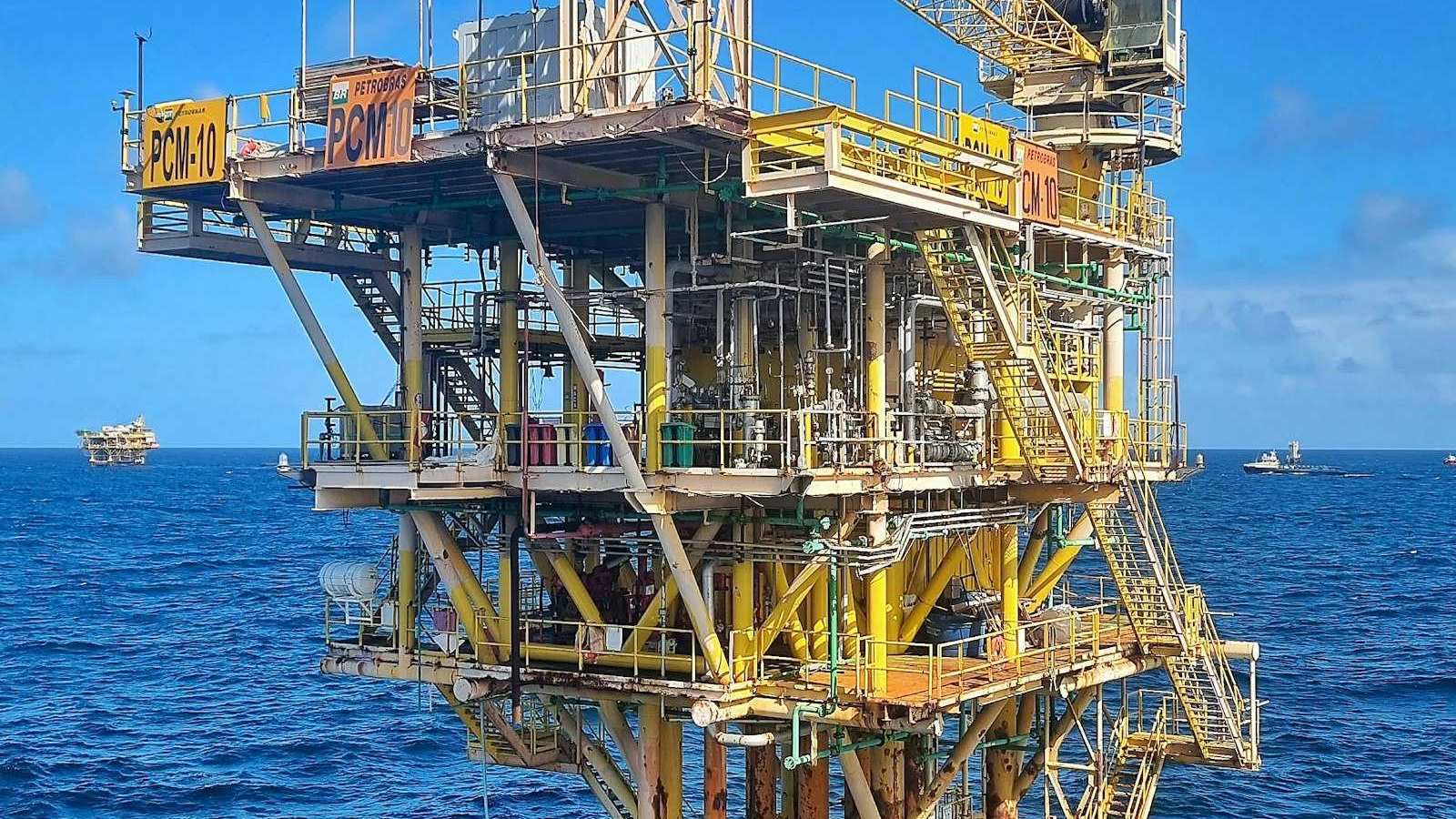
Offshore platforms produce 3 to 10 barrels of water for every barrel of oil. Missing the OSPAR 30 mg/L oil-in-water monthly average or the EPA Region 6 NPDES 29 mg/L daily max on an FPSO with 25,000 bbl/day production exposes USD 250,000 to 2,500,000 per non-compliant month. This guide covers the five-stage treatment train, hydrocyclones vs IGF vs nutshell vs MPPE vs ceramic UF, reinjection vs overboard discharge economics, and the failure modes that put platforms on regulator watchlists.
Offshore produced water is the largest waste stream the oil and gas industry generates, and the most-regulated discharge in industrial water. A mature offshore field produces 3 to 10 barrels of water for every barrel of oil. On a 25,000 bbl/day FPSO, that is 24,000 to 110,000 m³ of contaminated water every day that has to leave the platform within hours of being separated from the hydrocarbon stream. Miss the OSPAR 30 mg/L oil-in-water monthly average on a North Sea platform, or the EPA Region 6 NPDES 29 mg/L daily maximum on a US Gulf of Mexico platform, and the exposure runs USD 250,000 to 2,500,000 per non-compliant month in production curtailment, regulator-mandated downtime, civil penalties, and the slow-burn reputational damage that follows any operator onto its next permit application.
The decision is not "buy a hydrocyclone." It is: at what design flow, on what oil-class mix, into what downstream polish, discharged through what route, sampled under what protocol, and reported to which regulator. Get those six answers right and produced water is a managed line item under USD 1/m³. Get any of them wrong on a weight-constrained platform and the cost compounds across three lines procurement teams rarely connect, production deferment when discharge windows close, capital retrofit when a polish stage was undersized, and the compliance overhead of a regulator who has stopped trusting the operator's self-reports.
This guide covers the contaminant chemistry that actually shows up in produced water, the five-stage treatment train and where each technology wins, the reinjection-versus-overboard economics that drive total cost of disposal, the regulatory perimeter across OSPAR / EPA / NOPSEMA / BSEE jurisdictions, the failure modes that put platforms on regulator watchlists, and the short decision framework that lets ops directors, FPSO engineers, and ESG leads land a defensible specification before tendering.
## The decision in brief
- Price the three CFO-visible cost lines first. Regulatory penalties and production deferment run USD 250,000 to 2,500,000 per non-compliant month on a 25,000 bbl/day asset, and lifecycle OPEX on chemicals, polish-stage replacement and analytical chemistry runs USD 0.50 to 4.50/m³ across the disposal-route spectrum. - Budget 8 to 15% more CAPEX than a first-oil-spec train. A polish-train retrofit when the first-oil specification missed the dissolved-organics or end-of-field chemistry curve costs USD 1.5M to 8M, typically required twice over a 25-year field life on under-spec'd platforms. - Engineer the train correctly. Full chemistry characterisation at concept select, the right Stage 2 / Stage 3 sequence for the actual feed, polish capacity for end-of-field-life chemistry and an online analyser with grab-sample audit trail save 12 to 28% of lifecycle OPEX and eliminate 90% of avoidable consent-breach exposure.
The payback against a single avoided production-deferment month is 10 to 40 times, and the train spec belongs against end-of-field chemistry on the actual produced water, not the design-basis chemistry assumed in FEED.
## What's actually in produced water
Produced water is the formation water that comes up the wellbore with the hydrocarbon stream, plus any injection water that has broken through from secondary recovery, plus condensed water from the gas phase. It is the geologic water the reservoir has held for millions of years, equilibrated with hydrocarbons under pressure and temperature, and now suddenly decompressed across the topsides separation train. The chemistry that arrives at the produced-water treatment skid is fundamentally different from any wastewater an onshore plant has ever seen, and it is the reason offshore operators cannot lift onshore-refinery [oily wastewater treatment](/resources/oily-wastewater-treatment) designs and bolt them onto a deck.
Five contaminant classes dominate produced water and each one defines a treatment-stage decision:
- Dispersed oil, droplets between 1 and 150 µm carrying total petroleum hydrocarbons at 100 to 2,000 mg/L at the outlet of the production separator. This is the regulated parameter under OSPAR (monthly average) and the EPA Region 6 NPDES (daily max). It is what the entire downstream train exists to remove. - Dissolved hydrocarbons, BTEX (benzene, toluene, ethylbenzene, xylene), naphthalene, phenols, and polycyclic aromatic hydrocarbons (PAHs) at 1 to 50 mg/L. These do not separate by physical means, they require adsorption, extraction, or biodegradation. Discharge limits on dissolved aromatics are tightening across every jurisdiction; in some North Sea sectors the limit is now below 1 mg/L for combined BTEX. - Dissolved inorganics and salts, chloride at 30,000 to 250,000 mg/L (formation water is typically more saline than seawater), divalent cations (Ca, Mg, Ba, Sr) that precipitate as scale during pressure and temperature shifts, and naturally occurring radioactive material (NORM, [radium](/elements/radium)-226, radium-228) that concentrates in scale deposits. - Production chemistry, corrosion inhibitors, scale inhibitors, demulsifiers, biocides, oxygen scavengers, methanol or glycol from hydrate management. These were dosed upstream for asset protection and now ride through the treatment train, sometimes interfering with the chemistry the treatment train needs. - Solids, formation sand, scale fragments, iron sulphide, biofilm, asphaltenes. The solids loading determines backwash frequency on every filter stage and is the silent driver of OPEX on the polish train.
The mix shifts as the field ages. Early in field life, the produced-water cut is low, dispersed oil dominates, and the train runs comfortably below permit. As the field matures and water cut climbs above 70%, dissolved-organics break through, scale tendency rises with breakthrough of injection water, and the polish stages start running closer to their limits. A treatment train spec'd for first oil that is never re-designed during field life is the most common engineering mistake on mature offshore assets, and the operators who survive 25-year field campaigns are the ones who re-baseline the design every five years against current produced-water chemistry.
Per the [International Association of Oil & Gas Producers (IOGP) report on the produced-water management spectrum](dofollow:https://www.iogp.org/bookstore/product/produced-water-management-the-state-of-the-art/), discharge to sea remains the dominant disposal route globally, but reinjection is rising rapidly as both fields mature and discharge consents tighten. The geographic split matters: North Sea operators discharge overboard against OSPAR's regional regime; US Gulf of Mexico operators discharge against EPA Region 6 NPDES; Norwegian Continental Shelf operators face the strictest dissolved-organics limits in the world; Brazilian pre-salt operators reinject by default because of formation pressure-support economics. Spec the train for the regulator that owns the lease.
## The five-stage treatment train
The dominant industry architecture is a five-stage train running from the production separator's water outlet to the discharge or reinjection header. Each stage targets a specific contaminant class and assumes a feed quality the previous stage was designed to deliver, exactly the same sequencing logic that drives [the industrial wastewater treatment process](/resources/industrial-wastewater-treatment-process) onshore, but compressed onto a deck where weight, footprint, and personnel exposure dominate every design choice.
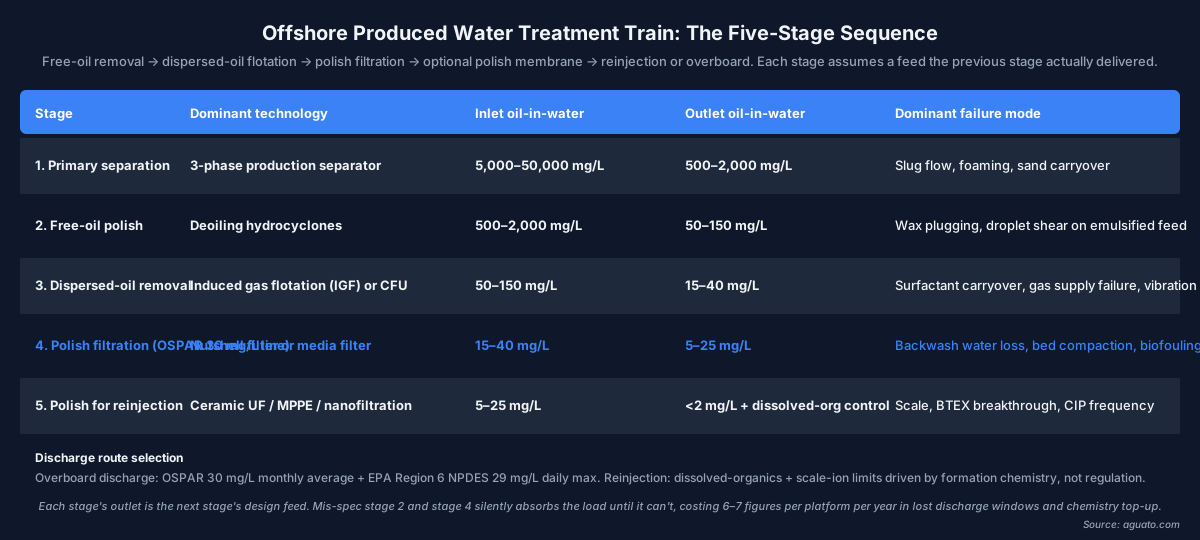
Stage 1, Primary separation. The three-phase production separator is where oil, gas, and water first part company. Inlet oil-in-water from the wellhead manifold runs 5,000 to 50,000 mg/L; outlet from a properly designed separator with sufficient residence time runs 500 to 2,000 mg/L. Failure modes here are slug flow that disrupts the gravity field, foaming on heavy-asphaltene crudes, and sand carryover that loads downstream stages with abrasive solids. The treatment-stage cost of getting this wrong is huge, every milligram per litre the separator fails to deliver is a milligram per litre the downstream train has to remove, at 5 to 20× the cost per milligram.
Stage 2, Free-oil polish via deoiling hydrocyclones. Static hydrocyclones use centrifugal force generated by tangential flow to drive oil droplets to a central core and reject them upward through a reject port while heavy water exits downward. They are the offshore industry's default first treatment stage because they have no moving parts, occupy almost no footprint, and tolerate the slugging and pressure swings that any other technology hates. CAPEX is USD 250,000 to 800,000 for a complete bank. The outlet is typically 50 to 150 mg/L oil-in-water, already inside the OSPAR 30 mg/L line for the monthly *average* but not consistently below the daily maximum on its own.
Stage 3, Dispersed-oil removal via induced gas flotation (IGF) or compact flotation units (CFU). Gas bubbles introduced into the water stream attach to dispersed oil droplets and lift them to a froth layer that is mechanically skimmed. IGF is the compliance backbone for most North Sea and Gulf of Mexico platforms, it is what reliably drops oil-in-water from the 50 to 150 mg/L band into the 15 to 40 mg/L band where a 30 mg/L monthly average becomes mathematically defensible. Failure modes are surfactant carryover from upstream demulsifier overdose (which stabilises the very droplets the flotation cell is trying to capture), gas-supply interruptions, and vibration on weight-constrained decks that disturbs the froth layer.
Stage 4, Polish filtration via nutshell filters or media filters. A nutshell filter, a bed of crushed walnut or pecan shells, captures residual oil droplets and solids below the 15 mg/L mark. Backwash is automated and the dirty backwash water typically returns to the production separator inlet for re-treatment. Outlet runs 5 to 25 mg/L oil-in-water, comfortably below the OSPAR limit and the EPA Region 6 NPDES 29 mg/L daily max. Failure modes are bed compaction from inadequate backwash, biofouling on warm produced water, and backwash water volume that consumes 5 to 15% of throughput and has to be reprocessed.
Stage 5, Polish for reinjection via ceramic UF, MPPE, or nanofiltration. Required only where the water is destined for reinjection (which has tighter spec than overboard discharge, the formation does not tolerate plugging) or where dissolved-organics limits below the standard 30 mg/L apply. Ceramic ultrafiltration with 0.05 µm pore size delivers sub-2 mg/L oil-in-water and absolute solids removal; MPPE (macro-porous polymer extraction) removes dissolved aromatic hydrocarbons via adsorption onto polymer beads, regenerated by steam stripping. Both are CAPEX-intensive (USD 1.5M, 5M) but mandatory where the regulation or the reservoir formation pressure-support spec demands them.
## Technology matrix: hydrocyclones, IGF, nutshell, MPPE, ceramic UF
No single technology covers the offshore produced-water envelope. The right answer is always a train, but the order and the technology choice at each stage depends on the discharge route, the dissolved-organics spec, and, uniquely on offshore, the deck weight and footprint budget. CAPEX on offshore equipment is dominated by installed weight, not the equipment box price, because every tonne on a platform reduces variable-deck-load margin and on an FPSO directly displaces production capacity.
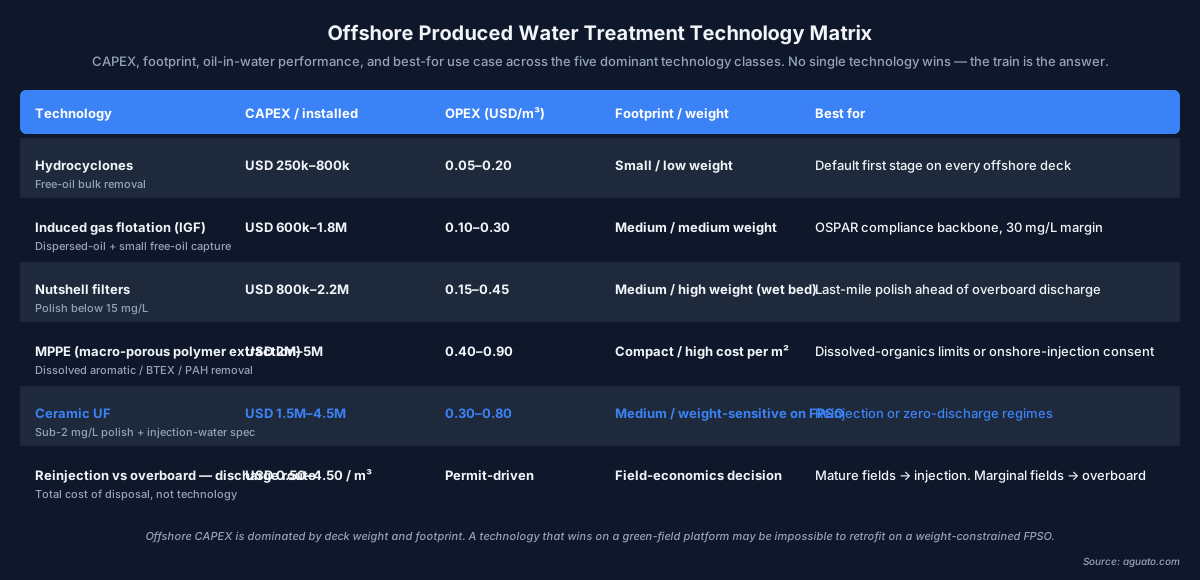
The choice between hydrocyclones and IGF as the lead removal stage is the most common procurement-level mistake. Hydrocyclones cannot break emulsions; they can only separate free oil that has already separated chemically. A platform with a high demulsifier overdose, or a platform with heavy asphaltene crude that naturally generates micro-emulsions, will see hydrocyclone outlet stay above 200 mg/L regardless of how many cyclone elements are installed. The right answer in those cases is IGF or CFU as Stage 2, with hydrocyclones moved into a polishing or recycle role. Getting this wrong on a green-field platform costs USD 1.5 to 4M to retrofit when the operator discovers it cannot meet OSPAR after first oil.
| Technology | CAPEX (installed) | OPEX (USD/m³) | Best for | Risk if mis-spec'd | |---|---|---|---|---| | Hydrocyclones | USD 250k, 800k | 0.05 to 0.20 | Default Stage 2 on light crudes with low surfactant carryover | Cannot break emulsions; outlet stays >200 mg/L on demulsifier-heavy fields | | Induced gas flotation (IGF) | USD 600k, 1.8M | 0.10 to 0.30 | OSPAR compliance backbone on most platforms | Vibration-sensitive on FPSO; froth-layer integrity is the operator-skill-dependent variable | | Nutshell filters | USD 800k, 2.2M | 0.15 to 0.45 | Polish ahead of overboard discharge | Bed compaction and biofouling silently raise outlet over months | | MPPE | USD 2M, 5M | 0.40 to 0.90 | Dissolved-organics or BTEX limits below 1 mg/L | Regeneration steam supply must be guaranteed; loss-of-utility = loss-of-discharge | | Ceramic UF | USD 1.5M, 4.5M | 0.30 to 0.80 | Reinjection-quality water or zero-discharge regimes | CIP frequency on warm produced water can erase the OPEX advantage |
For platforms operating against tightening dissolved-organics limits, particularly on the Norwegian Continental Shelf and in some North Sea sectors, MPPE has emerged as the technology of choice for BTEX and PAH removal. The trade is CAPEX and a hard dependency on regeneration utilities. Lose your steam supply and the MPPE skid becomes a single-pass adsorber with a finite breakthrough horizon. Specify utility redundancy on day one.
Where reinjection is the discharge route, increasingly common on mature fields where formation pressure support is the dominant disposal economic, [ceramic ultrafiltration](/resources/ceramic-membranes) is the polish of choice because the reinjection-water spec is set by the formation, not by a regulator, and ceramic survives the dispersed-oil-and-asphaltene chemistry that destroys polymeric in months. A formation with 50 mD permeability will plug at 20 mg/L oil-in-water within months even though the regulator would accept 30 mg/L for overboard. The reservoir engineer's spec is the binding constraint here, not the environmental permit.
[cta:nepti-dark]
## Reinjection vs overboard discharge: the disposal economics
The discharge-route decision is the single highest-leverage choice in produced-water management. It rewrites every line in the OPEX model and almost every line in the CAPEX model. Reinjection costs USD 1.50 to 4.50/m³ in capacity-loaded total cost of disposal. Overboard discharge costs USD 0.50 to 1.80/m³ when the regulatory permit is straightforward and rises to USD 3 to 6/m³ when polish or dissolved-organics treatment is required. The split has nothing to do with technology elegance; it has everything to do with field economics.
Reinjection wins when:
- Reservoir pressure support is needed. Most mature waterflood fields hit a point where injection-water demand exceeds available seawater treatment capacity. Reinjecting produced water displaces seawater injection and protects field oil-recovery factors. The avoided cost of seawater treatment + the avoided revenue loss from reduced recovery often dominates the disposal economics. - Discharge consent is restrictive or unavailable. Some Norwegian Continental Shelf blocks and most Arctic-region permits do not allow overboard discharge at all. Reinjection is the only legal disposal route. CAPEX is mandatory and the cost goes into the field development plan. - Formation chemistry is compatible. Not every reservoir will accept its own produced water back without scaling, souring (sulphate-reducing bacteria), or formation damage. A scaling tendency analysis against the target injection zone is mandatory before commitment. - The treatment polish is already required for some other reason. If MPPE or ceramic UF is already on the deck for a dissolved-organics consent, the marginal CAPEX to step up to reinjection-quality is small.
Overboard discharge wins when:
- The regulator permits it at the relevant oil-in-water spec. OSPAR and EPA Region 6 NPDES both permit overboard discharge at well-established limits that the standard treatment train can meet. - Field life is short. Marginal fields under 10-year horizons cannot amortise reinjection CAPEX; overboard discharge is the only economic option. - Formation injectivity is poor. Some reservoirs will not accept reinjection at any practical rate. Tight, low-permeability formations require extreme polish to reinject, and the cost can exceed regulated discharge total cost. - The platform has zero footprint margin for additional polish equipment. On weight-constrained brownfield assets, the physical impossibility of installing reinjection-grade polish equipment forces overboard as the only available route.
The shift toward [zero liquid discharge](/resources/zero-liquid-discharge) configurations is still rare offshore, the energy and footprint cost of evaporation on a deck makes it uneconomic versus reinjection or compliant overboard discharge, but onshore-injection of produced water transported from offshore to land-based disposal wells has emerged as a third option in the US Gulf of Mexico and Australia. Total cost is comparable to high-end overboard discharge plus shipping; the regulatory advantage is the elimination of marine-discharge sampling and reporting overhead.
The decision belongs in the field development plan, not in the late-stage detail design where most operators currently make it. Operators who run the reinjection-versus-overboard analysis at concept select save 12 to 28% of lifecycle produced-water OPEX versus operators who default to overboard and retrofit reinjection later. Run the math early and run it on the actual produced-water chemistry, not on the design-basis chemistry that was assumed in the FEED study.
## The regulatory perimeter: OSPAR, EPA Region 6, NOPSEMA, BSEE
Produced water is the most-regulated industrial discharge in offshore operations and the regulatory perimeter is jurisdiction-specific. Operators with assets in multiple regions cannot apply a single compliance template across the portfolio; each platform sits inside its host regulator's specific parameter list, sampling frequency, and reporting cadence.
- OSPAR Recommendation 2001/1 (North-East Atlantic, UK, Norway, Netherlands, Denmark, Germany). Monthly average dispersed oil-in-water of 30 mg/L is the headline limit. Performance-standard reporting (PSR) submitted monthly per platform; aggregated regional reporting annually. The Recommendation also commits operators to continuous improvement, annual platform totals expected to decline. Norwegian sector layers on additional dissolved-organics and chemical-discharge limits via Klima- og miljødepartementet (KLD) consents. - EPA Region 6 NPDES (US Gulf of Mexico). Daily maximum dispersed oil-in-water of 29 mg/L; monthly average of 42 mg/L. Sampling protocol prescribed in the permit; method 1664B (n-hexane extractable material) is the standard analytical reference. Penalties under the [Clean Water Act civil-penalty schedule](dofollow:https://www.epa.gov/enforcement/water-enforcement) escalate per day per violation, currently above USD 64,000/day for ordinary violations and over USD 250,000/day for knowing violations. - NOPSEMA (Australia). Performance-based regime under the Environment Plan; operators specify their own discharge limits within an "acceptable level of environmental impact" framework approved by the regulator. In practice this drives toward parity with OSPAR or stricter, particularly on the North-West Shelf. - BSEE (US Outer Continental Shelf, beyond NPDES boundary). Safety-and-environmental oversight of the platform's production-water management system; layered on top of EPA discharge permitting. Inspection-driven and findings can drive enforcement action. - Other jurisdictions. UK Offshore Petroleum Regulator for Environment and Decommissioning (OPRED); Brazilian IBAMA for pre-salt; Saudi Aramco internal standards on Aramco-operated assets often exceed regulatory minima.
The compliance trap is that operators design for the host regulator and then move the platform, or sell the asset, to a different jurisdiction where the design spec no longer holds. A platform that runs comfortably at 25 mg/L oil-in-water under EPA Region 6 NPDES will fail OSPAR in three months out of any rolling year because the monthly *average* limit forces tighter discipline than a daily *maximum*. Acquirers in offshore M&A typically discover this gap in due diligence; the seller's reported daily averages look fine but the buyer's regulator will measure monthly averages on rolling windows.
For platforms downstream of any chemical-injection programme, scale inhibitor, corrosion inhibitor, biocide rotation, the produced-water discharge perimeter overlaps with the [industrial water pollution](/resources/industrial-water-pollution) regulatory frame on chemical residues. Operators carrying production chemicals through to discharge need a chemical-by-chemical compliance assessment, not a generic oil-in-water focus.
## Five failure modes that put platforms on watchlists
Five recurring patterns dominate produced-water non-compliance investigations. Each is a recognised mistake, each has a defined regulatory consequence, and each has a documented corrective action. Operators who get put on a regulator watchlist see inspection frequency rise 3 to 5× for 12 to 24 months, with the operational overhead of every inspection running USD 50,000 to 200,000 in deferment and crew time.
1. Demulsifier overdose in the production train. The upstream demulsifier dose was tuned for emulsion-breaking on the production separator and is too high for the produced-water treatment train. Surfactant carries through and stabilises the very droplets the downstream IGF or hydrocyclone is trying to capture. Oil-in-water at the polish-train outlet climbs from 15 mg/L to 60 mg/L over weeks. The cost is OSPAR or NPDES breach plus production curtailment to bring the train back into compliance. Corrective action: adjust the demulsifier dose against produced-water-treatment-train performance, not just against separator water-cut numbers; specify a chemical-injection programme that treats the upstream and downstream as a system.
2. Slug-flow disruption on a deepwater asset. Subsea tieback or multi-well manifold produces slugging flow that overloads the production separator and pushes oil-in-water carryover into the treatment train spike-loading every stage. The polish train cannot recover within a 24-hour discharge window. The cost is daily-max breach under EPA Region 6 NPDES plus a regulator who notes the platform cannot ride through normal upstream variability. Corrective action: design surge capacity into the treatment train inlet; install slug-catcher upstream of the production separator on tieback wells.
3. Backwash-water reprocessing overload. Nutshell filter or media filter backwash returns to the production separator inlet for re-treatment. As field water cut rises and treatment volumes climb, the backwash-water fraction rises with it, eventually exceeding the separator's capacity to handle the recycle plus the live production flow. The separator water-quality cascades upstream and the train enters compliance failure. Corrective action: design backwash handling as a parallel skid sized for end-of-field-life conditions, not for first-oil conditions.
4. Dissolved-organics breakthrough at field maturity. First-oil produced water had negligible BTEX and PAH; mid-field water has 5 to 20 mg/L of dissolved aromatics. The treatment train was spec'd for dispersed oil only and has no dissolved-organics polish stage. Discharge fails dissolved-organics consent in jurisdictions that limit it. The cost is consent renegotiation under regulator pressure, often forcing CAPEX for MPPE or activated-carbon retrofit. Corrective action: spec the train against worst-case field-life chemistry, not first-oil chemistry; re-baseline chemistry every five years.
5. Sampling-and-reporting integrity failure. The compliance numbers reported to the regulator are calculated from grab samples taken once per shift on a 4-hour basis. A regulator audit pulls the sample-collection log and finds samples taken from the wrong point, at the wrong frequency, or analysed using the wrong method. The platform's entire discharge record is challenged. The cost is regulator-mandated re-baselining of compliance, often with the platform's discharge volume halved or stopped while the audit completes. Corrective action: implement a written sampling protocol matching the permit's parameter list, frequency, and method exactly; train operations crew on the protocol; document every sample with date, time, location, operator, and analytical method.
## Sampling, reporting, and the audit trail
Produced-water compliance fails silently. The oil-in-water analyser drifts; the polish train slowly fouls; the monthly average creeps from 18 mg/L to 27 mg/L without crossing the daily max. The first visible failure is the regulator's three-month rolling report.
The defence against silent failure is sampling and reporting discipline:
- Continuous, online oil-in-water analyser (fluorescence or scattering principle) at the discharge header, logged every minute. Alarms at 80% of permit limit; auto-recirculation at 95%. - Daily, grab sample from the discharge header analysed by method 1664B (US) or equivalent OSPAR-approved method (typically infrared after solvent extraction, or GC-FID). Cross-check against the online analyser; discrepancy >15% triggers analyser calibration. - Weekly, full discharge chemistry panel: oil-in-water, BTEX, PAH (where applicable), TSS, pH, temperature, chloride, residual production chemicals as required by permit. - Monthly, compile rolling 30-day average. Compare against permit. If trending toward limit, root-cause investigation triggered before exceedance. - Per permit cycle, full audit-grade sampling regimen against permit parameter list; submit performance-standard report to regulator on schedule.
The sampling discipline is the audit trail. In any compliance investigation, OSPAR review, EPA enforcement, NOPSEMA inspection, the first regulator question is "show me the records." A platform that can produce a 12-month log of continuous online readings, daily grab samples cross-checked against the analyser, weekly chemistry panels, and monthly rolling averages is in a fundamentally different position from a platform that hands over a spreadsheet with the formulas hidden. The cost of running the discipline is roughly USD 80,000 to 180,000/year per platform in analytical chemistry, calibration, and operator time. The cost of not running it, when something goes wrong, can be 10 to 30× larger and ride for years on the platform's record.
For sites running biocides or other production chemicals, every offshore platform, the discharge perimeter overlaps with the chemical-injection programme. The biocide carried in the produced water at part-per-million levels is the same residual that gets sampled on discharge. Programme integrity on one side becomes a compliance line item on the other.
## Decision framework: where should your specification land?
Run the offshore produced-water duty through this sequence to land the right specification:
1. Characterise the produced water across field life. Get current chemistry plus projected chemistry at year 5, year 10, and year 20 of field operation. Cover dispersed oil, dissolved aromatics, salts, scale tendency, NORM, and solids. Without forward-looking chemistry, the train will be obsolete before mid-field. 2. Identify the binding regulatory constraint. OSPAR? EPA Region 6 NPDES? NOPSEMA? More than one jurisdiction if the asset moves? Get the actual permit text, not a summary. 3. Choose the discharge route. Reinjection or overboard, or both. Run the lifecycle economics, reservoir support, formation injectivity, polish-train cost, and lock the route in field development plan, not detail design. 4. Spec the treatment train against the worst case. End-of-field-life chemistry, plus a 25% margin on each stage's outlet. The cheap stage is the one that runs comfortably below its design point; the expensive stage is the one that has to be retrofit at year 10. 5. Lock the analytical and reporting protocol. Online analyser plus grab-sample method, parameter list per permit, reporting cadence. Document everything on day one. 6. Build the audit trail into the operations procedures. Sampling, calibration, chemistry panels, monthly rolling averages, the discipline is what survives a regulator inspection.
Run this through Nepti's water-decision model, Nepti characterises the field, the regulatory jurisdiction, the projected chemistry across field life, and the disposal-route economics, then produces a ranked treatment-train configuration with stage-by-stage specification, technology choice, and a 25-year lifecycle OPEX projection. Operators running this analysis at concept-select save 12 to 28% on lifecycle produced-water OPEX, almost entirely by avoiding the under-spec'd first stages and the missing dissolved-organics polish that get bolted on under regulator pressure later in field life.
The decision framework above produces a specification, a discharge route, and an audit trail. What it does not produce is the one number that survives a five-minute conversation with a CFO who has not read the article. That number is the dollar gap between the OPEX cost of a correctly specified train and the production-deferment exposure of an under-specified one, and it is the case that gets made or lost in the field-development-plan review.
## FAQ
### What is offshore produced water in plain English?
It is the formation water that comes up the wellbore alongside the hydrocarbon stream on an offshore oil or gas platform. The water has been in the reservoir for millions of years and arrives at the platform contaminated with dispersed oil, dissolved aromatics, salts, scale-forming ions, naturally occurring radioactive material, solids, and traces of every chemical that has been injected upstream. A mature offshore field produces 3 to 10 barrels of water for every barrel of oil, so produced water is by far the largest waste stream the offshore industry generates and the most-regulated discharge in industrial water management.
### What is the OSPAR 30 mg/L limit?
OSPAR Recommendation 2001/1 sets a 30 mg/L monthly-average dispersed oil-in-water limit on offshore discharges in the North-East Atlantic (UK, Norway, Netherlands, Denmark, Germany). It is a monthly *average*, which forces tighter daily-operating discipline than the EPA Region 6 NPDES 29 mg/L daily maximum applied in the US Gulf of Mexico. Most modern platforms target 15 to 20 mg/L on a daily basis to maintain comfortable monthly-average margin. The Recommendation also commits operators to continuous improvement, so platform-level totals are expected to decline over time.
### Hydrocyclones or induced gas flotation, which comes first?
Hydrocyclones are typically the first treatment stage on light crudes with low surfactant carryover; they have no moving parts and tolerate slugging, which makes them ideal as a robust Stage 2 ahead of the more chemistry-sensitive flotation cell. On heavy crudes or platforms with demulsifier overdose, the order can reverse, IGF or compact flotation units go in as Stage 2 to break the surfactant-stabilised droplets, with hydrocyclones moved to a polishing or recycle role. The decision is feed-water-specific and should be made on actual chemistry, not on industry default.
### What does MPPE do that other technologies don't?
MPPE (macro-porous polymer extraction) removes *dissolved* aromatic hydrocarbons, BTEX, naphthalene, PAH, from produced water by adsorption onto polymer beads, then regenerates the beads by steam stripping. Conventional treatment technologies (hydrocyclones, IGF, nutshell filters) only address *dispersed* oil; they cannot touch dissolved organics at all. Where regulators set dissolved-organics limits below 1 mg/L, Norwegian Continental Shelf, some North Sea sectors, MPPE or activated-carbon adsorption becomes the only viable polish stage. CAPEX is high (USD 2M, 5M) and the technology depends on a guaranteed steam supply for regeneration.
### Why would an operator choose reinjection over overboard discharge?
Three reasons. First, reservoir pressure support, most mature waterflood fields need injection water to maintain production rates, and reinjecting produced water displaces seawater injection that would otherwise have to be treated. Second, regulatory pressure, some jurisdictions (parts of the Norwegian Continental Shelf, Arctic permits) do not allow overboard discharge at all. Third, dissolved-organics economics, once a polish train is already on the deck for a BTEX consent, the marginal cost to step up to reinjection-quality is small. The total cost ranges from USD 1.50 to 4.50/m³ for reinjection versus USD 0.50 to 1.80/m³ for straightforward overboard discharge, but reinjection's avoided seawater-treatment cost often closes the gap or reverses it.
### What is the most common offshore produced-water compliance failure?
Demulsifier carryover from the upstream production train into the produced-water treatment train. The demulsifier was dosed for emulsion-breaking on the production separator and is too high for the downstream IGF or hydrocyclone, where it stabilises the very droplets the cell is trying to capture. Oil-in-water at the treatment train outlet climbs from 15 mg/L to 60 mg/L over weeks. The fix is rarely a new technology, it is tuning the chemical-injection programme to treat the upstream and downstream as one system, with a single optimised dose curve. Operators who run their chemistry programme as one system save 8 to 15% on chemical OPEX and eliminate most of the carryover-driven compliance breaches.
### Is offshore produced-water discharge regulated as wastewater?
Yes, comprehensively. In the North-East Atlantic, [OSPAR Recommendation 2001/1](dofollow:https://www.ospar.org/work-areas/oic/discharges-from-the-oil-and-gas-industry) sets the regional regime; in the US Gulf of Mexico, EPA Region 6 NPDES permits set discharge limits; in Australia, NOPSEMA's Environment Plan framework drives operator-specific permits; in Brazil, IBAMA regulates pre-salt discharges. Oil-in-water, dissolved aromatics, TSS, residual production chemicals, NORM, pH, and temperature are typical regulated parameters. Sampling protocol, analytical method, and reporting cadence are all permit-specific. Operators carrying assets across jurisdictions must run a per-platform compliance template, one global template does not work.