What separates a mine that treats its water economically from one that leaks money for a century, covering acid mine drainage, cyanide, sulphate, selenium, and the closure liability behind every treatment-train decision, now benchmarked against 14 published mine-water treatment cases with real influent and effluent data.
Mining wastewater is the most expensive industrial effluent on the planet to mismanage, and the cheapest to under-budget. A copper mine treating 30,000 m3/day of acid drainage at the wrong technology choice burns USD 3M, 8M extra per year in reagents, sludge disposal, and emergency dosing, and the underlying mistake is almost always made years before the plant exists, in a feasibility study that priced lime neutralisation against a peak-flow scenario the operator never measured. The treatment train is downstream of geology, climate, and ore chemistry, none of which negotiate.
The right framing is that mining water treatment is a perpetual-cost decision, not a CAPEX line item. Acid mine drainage at a closed sulphide mine continues for 50 to over 100 years. A cyanide-destruction step that under-doses by 20% can put a gold operation out of compliance with the International Cyanide Management Code and trigger insurance and investor exposure measured in tens of millions. [Selenium](/elements/selenium) added late to a consent letter forces a USD 5M, 30M retrofit on a coal plant that already had its mine plan approved.
This article covers what is in mining wastewater stream by stream, the treatment technologies that actually work for each contaminant class, the trade-offs in CAPEX versus OPEX versus closure liability, and the failure modes that make most mining water projects costlier than they should be. The audience is operators, capital-projects engineers, and ESG / closure-planning leads who own the 20-year (and beyond) economics, not the construction line item.
## Why Mining Wastewater Is Not Industrial Effluent
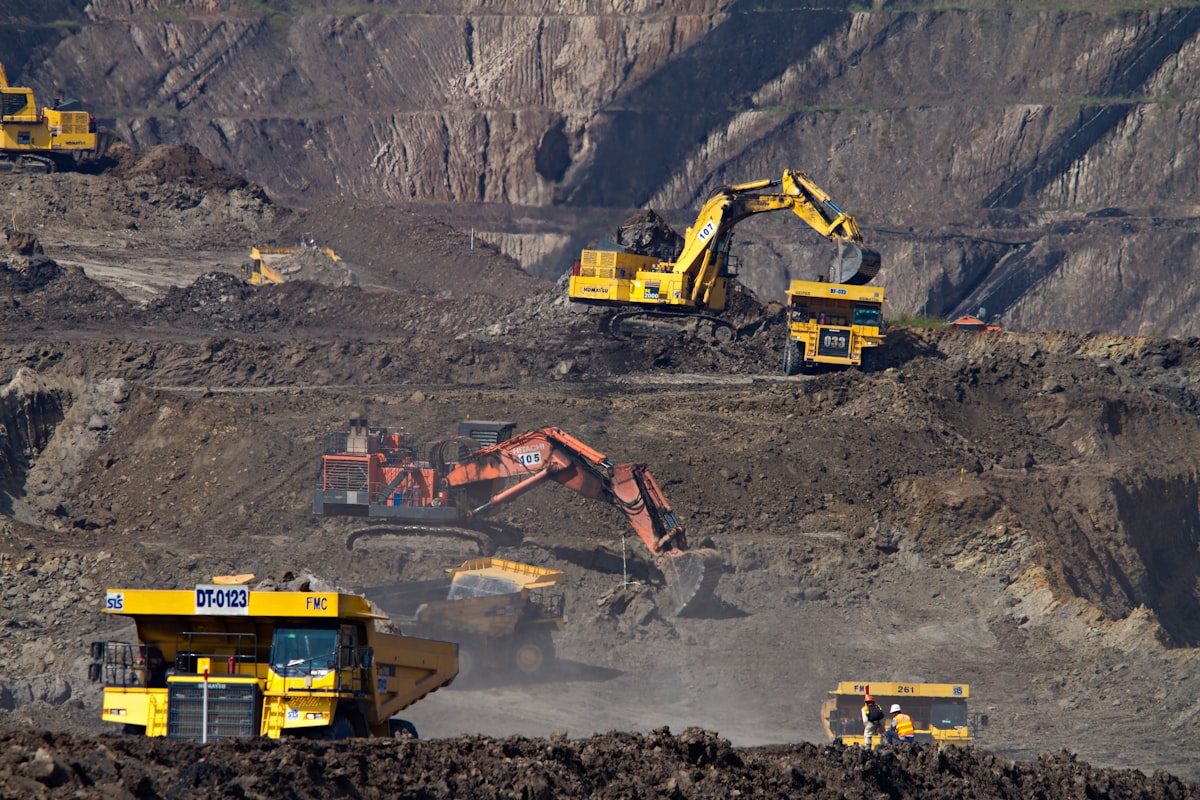
Industrial wastewater is bounded, a manufacturing plant produces a known volume per shift with a defined process chemistry. Mining wastewater is unbounded in three directions at once.
Volume is geology-driven, not process-driven. A 30,000 m3/day target at design becomes 70,000 m3/day during the spring freshet when contact-water collects from waste rock and pit walls. The treatment plant either has buffer storage and turn-down range, or it spills.
Composition shifts over the life of the mine. As the open pit deepens and exposes new lithology, sulphate, [iron](/elements/iron), manganese, and trace metal concentrations change. A treatment train spec'd in year 3 from year-1 water characterisation data is overpriced or undersized by year 8.
The liability outlasts the operation. When the mine closes, the water doesn't. Acid drainage from sulphide ore continues to oxidise for decades or centuries. The treatment decision made at FEED stage commits the parent company, or a public reclamation fund, to perpetual OPEX, often without a robust NPV in the closure cost estimate.
The [US EPA's Superfund cost recovery record](dofollow:https://www.epa.gov/enforcement/superfund-enforcement) for hard-rock mining sites shows perpetual-treatment cost as the largest single line item in legacy mine remediation budgets. The treatment design that minimises year-1 CAPEX is rarely the design that minimises 100-year liability, and the operator almost never sees that comparison until a closure consultant runs it post-fact.
## The Contaminants That Drive Treatment Selection
Mining wastewater is not one stream. It's a portfolio of streams with different chemistry, and the dominant contaminant, the one that drives technology selection, varies by ore type.
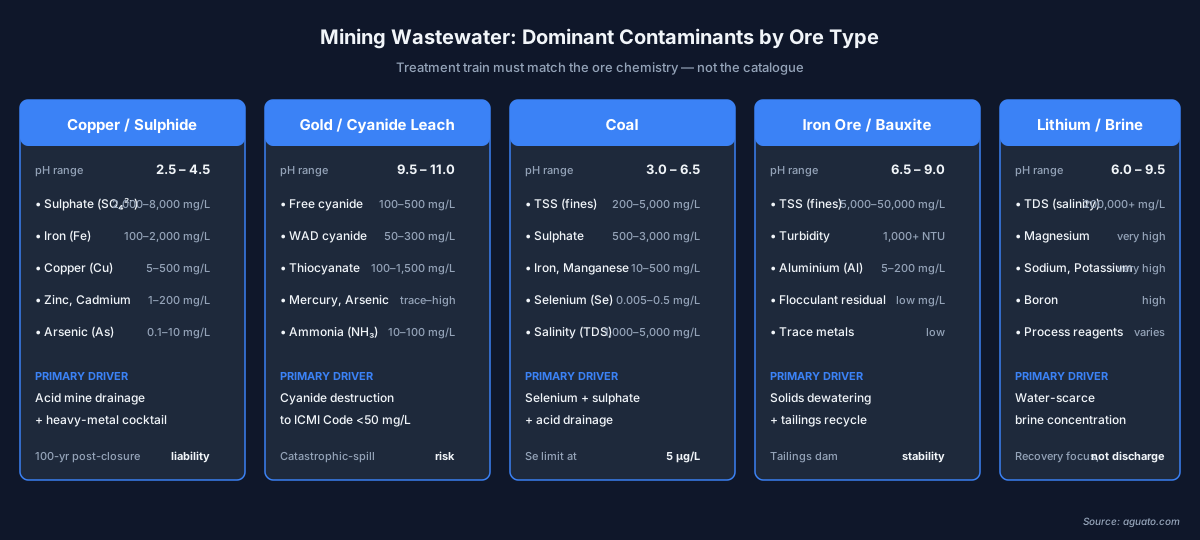
Copper, zinc, nickel, and other base-metal sulphide ores generate the textbook acid mine drainage problem: pH 2.5 to 4.5, sulphate at 2,000 to 8,000 mg/L, iron at 100 to 2,000 mg/L, and a heavy-metal cocktail of Cu, Zn, Cd, As, and others at 1 to 500 mg/L each. The treatment problem is acidity neutralisation, metal hydroxide precipitation, and sulphate management.
Gold operations using cyanide leach generate alkaline streams (pH 9.5 to 11) heavy in free cyanide (100 to 500 mg/L), weak-acid-dissociable cyanide (50 to 300 mg/L), thiocyanate, ammonia, and trace mercury and arsenic. The treatment problem is cyanide destruction first, then heavy-metal polish, and the order matters because oxidising thiocyanate releases cyanide that then needs second-stage destruction.
Coal mines produce a hybrid: acid drainage chemistry (pH 3.0 to 6.5, sulphate, iron, manganese) plus a high TSS load from coal fines, plus selenium. Selenium is the technology-defining contaminant in modern coal water, a coal plant with an originally-strict 5 µg/L Se limit needs biological reduction or zero-valent iron in addition to lime, and these are not interchangeable with metal hydroxide precipitation.
Iron ore and bauxite generate massive volumes of low-toxicity but high-TSS water (5,000 to 50,000 mg/L solids, 1,000+ NTU turbidity). The treatment problem is dewatering and recycle, not contaminant removal, and the economics are dominated by tailings dam stability and water-balance management.
Lithium brine operations are the inverse, TDS at 200,000+ mg/L, with magnesium, sodium, potassium, and boron the dominant ions. The objective is selective recovery of lithium, not "treatment" in the conventional sense. Conventional metal-precipitation chemistry is irrelevant; evaporative concentration, selective adsorption, and direct lithium extraction (DLE) define the toolkit.
## Acid Mine Drainage: The Long-Tail Liability
Acid mine drainage (AMD) is the dominant water-treatment problem at sulphide-ore mines and the single most expensive water liability in mining. The chemistry is simple: pyrite (FeS2) plus oxygen plus water generates sulphuric acid plus dissolved iron plus a cascade of dissolved heavy metals as host rock dissolves under low pH.
The reaction does not stop when mining stops. The [Acid Mine Drainage chemistry described by the US Geological Survey](dofollow:https://www.usgs.gov/centers/upper-midwest-water-science-center/science/acid-mine-drainage) shows that pyrite oxidation continues for decades after ore extraction ends, driven by atmospheric oxygen access through waste rock, exposed pit walls, and tailings facilities. AMD has been observed flowing from Roman-era and medieval mining sites in Europe, over 1,500 years post-closure.
The implication for the operator is severe: the treatment plant designed for the operating phase is the same plant that must run, in some form, for the post-closure life of the mine. Designing it cheap for a 25-year mine life is designing 50 to 100 years of expensive operating costs into the closure trust fund. Designing it for a 100-year life is also wrong, the load profile changes after closure, and a plant designed for active-mining flow rates is overbuilt for closure-phase flows.
The two strategies that actually reduce long-tail liability:
1. Source control, desulphurisation of tailings, dry-stack tailings, geomembrane covers, and sub-aqueous deposition that limit oxygen access to sulphides at all. These add CAPEX during operations but reduce post-closure water volume by 30 to 80%. 2. Passive treatment retrofit at closure, designing the active-treatment plant with a planned transition to lower-OPEX passive systems (constructed wetlands, sulphate-reducing bioreactors, anoxic limestone drains) once flow rates and acidity loads decline post-closure.
The decision to apply either is made at FEED, not at closure. Operators who don't make it at FEED inherit a 100-year reagent purchase order.
## Benchmarks from 14 published mining treatment cases
Most mining water guides quote reagent ranges. The numbers here come from a corpus of 14 published mining and mine-drainage treatment cases that Aguato has transcribed from peer-reviewed journals and delivered-project reports, each with paired influent and effluent measurements and the actual treatment train. The corpus spans 8 countries and runs from bench and pilot rigs to a 25,000 m3/day full-scale reclamation plant. Half the cases sit at documented tier, meaning the full influent-to-effluent vector was read from the source table rather than a summary.
Mining water is a metals-and-acidity problem, not a COD problem, so the parameters that carry enough data to report across the corpus are sulphate, iron, and manganese. On those three the picture is clear (concentrations in mg/L):
| Parameter | Influent median | Influent p90 | Effluent median | Median removal | |---|---|---|---|---| | Iron (Fe) | 44 | 228 | 0.2 | 97.4% | | Manganese (Mn) | 3.1 | 39 | 0.6 | 72.8% | | Sulphate (SO4) | 1,616 | 10,384 | 410 | 83.3% |
Iron is the parameter treatment removes most reliably: a median 97.4% removal, and the top decile reaches 99.9%. Manganese is the laggard, median 72.8% with a wide spread, because it precipitates only at a higher pH than iron and re-dissolves easily if the pH drifts. Sulphate is the honest limitation of conventional treatment: the median removal looks strong at 83%, but the bottom decile is only 13%, because lime neutralisation drives sulphate down to the gypsum solubility floor near 1,200 to 1,500 mg/L and no further. Getting below that floor needs a different chemistry, which the real plants below make concrete.
One structural fact from the corpus shapes the technology decision: a metals-precipitation step appears in 71% of the cases, while membranes appear in only 7%, and every membrane case is a reuse or zero-liquid-discharge project. Precipitation is the workhorse; membranes are the reuse decision. Providers that build these trains are listed under [heavy metals removal suppliers](/heavy-metals-removal) and, for the sector view, [mining water treatment suppliers](/industries/mining).
### Real installations, with the numbers and the train
Every row is a real, named facility with a published source in the Sources section. Concentrations in mg/L; the train reads in treatment order.
| Plant, country | Flow (m3/day) | Train | Headline result | |---|---|---|---| | Coal-AMD reclamation, eMalahleni, South Africa | 25,000 | Lime metals precipitation, ultrafiltration, three-stage reverse osmosis | SO4 2,481 to 55; TDS 3,727 to 145 (reuse grade) | | Copper-smelter acid wastewater, Glogow, Poland | full-scale | Coagulation, lime metals precipitation | As 310 to 0.035; Cu 16 to 0.05; SO4 10,086 to 740 | | Coal-AMD active lime plant, Charqueadas, Brazil | full-scale | Lime neutralisation and precipitation | Fe 178 to 0.1; Mn 3.1 to 0.6 (17-year average) | | Coal-mine AMD passive system, Clinton County, USA | field | Aerobic, then sulphate-reducing anaerobic, then metals precipitation | SO4 1,208 to 12.5; Fe 68.5 to 1.75; Mn 27.4 to 0.15 | | Iron-mine AMD constructed wetland, Ma'anshan, China | field | Multi-stage constructed wetland | Fe 8.3 to 0.03; SO4 4,890 to 1,992; Mn only 84 to 32 |
The eMalahleni plant is the reuse benchmark: a full lime-precipitation front end feeding ultrafiltration and three-pass reverse osmosis takes acidic coal drainage to drinking-quality reuse at 25,000 m3/day. Glogow shows what precipitation alone does to a smelter acid stream, taking arsenic from 310 down to 0.035 mg/L. But two cases show the honest limits. The Clinton County passive system reaches sulphate 12.5 mg/L only because a sulphate-reducing biological stage does what lime cannot, and the Ma'anshan wetland removes iron almost completely while leaving manganese barely touched (84 to 32 mg/L), the classic passive-treatment manganese gap. The sulphate floor is real: a pilot at Criciuma, Brazil that drove the chemistry to high-lime ettringite precipitation reached 83% sulphate removal (815 to 148 mg/L), while the same water under conventional lime moved sulphate only 2 to 18%. If a consent sets a sulphate limit below about 1,200 mg/L, conventional lime will not reach it, and that is a FEED-stage technology decision, not a dosing tweak.
Nepti benchmarks your own mine-water numbers against this corpus. [Model your stream and see where it sits against the real-plant distribution in Nepti](/nepti) before you accept an EPC contractor's reagent-dose guarantee.
## Treatment Technology Matrix
There is no single "best" mining water treatment. There is a matrix of technology options, each strong against a contaminant class and weak against another, and the right plant is a sequenced combination matched to the actual stream.
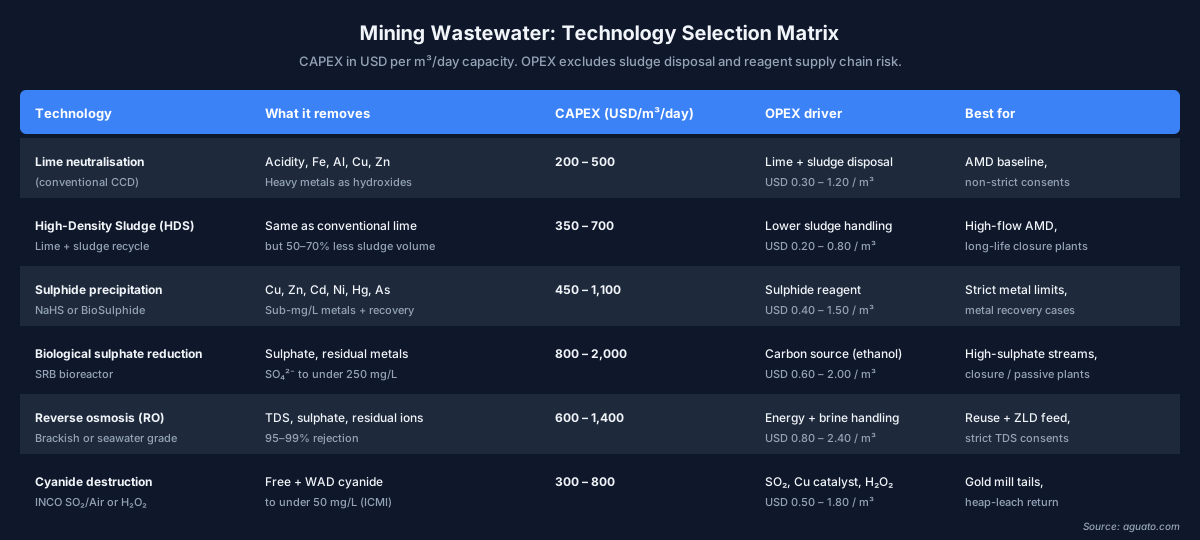
| Technology | Targets | CAPEX (USD per m³/day) | OPEX | Best for | Main risk | |---|---|---|---|---|---| | Conventional lime neutralisation | Acidity, Fe, Al, base metals as hydroxides | 200 to 500 | USD 0.30 to 1.20 / m³ (lime + sludge) | AMD baseline, non-strict consents | Sludge volume; metal re-dissolution at off-spec pH | | High-Density Sludge (HDS) | Same chemistry, 50 to 70% less sludge | 350 to 700 | USD 0.20 to 0.80 / m³ | High-flow AMD, long-life closure plants | Higher CAPEX; needs experienced operations | | Sulphide precipitation (NaHS or biogenic sulphide) | Cu, Zn, Cd, Ni, Hg, As to sub-mg/L | 450 to 1,100 | USD 0.40 to 1.50 / m³ | Strict metal limits, metal-recovery cases | Reagent supply chain; H2S handling | | Biological sulphate reduction (SRB) | Sulphate to under 250 mg/L, residual metals | 800 to 2,000 | USD 0.60 to 2.00 / m³ | High-sulphate streams, closure / passive plants | Carbon source supply; cold-climate kinetics | | Reverse osmosis | TDS, sulphate, residual ions | 600 to 1,400 | USD 0.80 to 2.40 / m³ | Reuse + ZLD feed, strict TDS consents | Brine handling; scaling on Ca/Mg streams | | Cyanide destruction (SO₂/air or H₂O₂) | Free + WAD cyanide to under 50 mg/L | 300 to 800 | USD 0.50 to 1.80 / m³ | Gold mill tails, heap-leach return | Underdosing on WAD CN; thiocyanate breakthrough |
The single most common mistake in technology selection is choosing the lowest-CAPEX option (conventional lime) for a mine that will eventually need strict-metal compliance, then bolting a sulphide-precipitation polishing step onto the back end at full CAPEX three years later. The retrofit costs more than the integrated design would have. The right choice depends on the actual stream chemistry and the consent trajectory, not the catalogue. [Browse verified mining water treatment providers](/providers) and request scoped proposals from 3 to 5 specialists with real reference plants in your ore class, rather than letting one vendor's preferred technology drive the selection.
[cta:nepti-dark]
## Tailings Water: Recycle, Reuse, ZLD
Tailings storage facility (TSF) water is the largest water inventory at most mines. How it's managed determines whether the operation runs in water surplus or water deficit, and that decision drives both CAPEX and ESG positioning.
The water balance question is whether tailings water is recycled to the mill (reducing fresh-water draw and discharge volume), partially recycled with discharge of surplus, or in a closed-loop ZLD configuration where the only "out" is solids and atmospheric evaporation.
The trade-offs:
- Recycle to mill is the cheapest option in CAPEX but accumulates dissolved species (sulphate, calcium, residual reagents) over cycles, eventually impairing process recovery in flotation or leach circuits. There is a chemistry ceiling, typically 5 to 8 cycles, beyond which a bleed stream is required. - Partial recycle with treated discharge balances the mill chemistry but commits the site to a permanent treatment plant for the surplus. The treatment cost is OPEX-heavy and tied to consent limits. - Zero liquid discharge (ZLD) eliminates the discharge consent risk entirely but at significant CAPEX (USD 3M, 15M+ for evaporator + crystalliser packages on industrial mining flows) and significant energy OPEX (30 to 80 kWh/m3 on thermal ZLD). [Zero liquid discharge in mining](/resources/zero-liquid-discharge) makes economic sense in water-scarce jurisdictions or where the receiving environment cannot accept any treated discharge, and rarely makes sense purely on water-cost arithmetic.
The decision depends on water scarcity, regulator posture, and the strategic ESG case. The ICMM Water Stewardship framework gives a structured methodology for evaluating which option fits a specific catchment, and sites pursuing ICMM alignment increasingly default to recycle-maximising designs even where treated discharge would technically be permitted, because the reputational and stakeholder risk of any discharge, even compliant, is rising.
## Cyanide and Process-Specific Streams
Cyanide is the highest-profile chemical risk in mining water. The treatment standard is set by the [International Cyanide Management Code (ICMI)](dofollow:https://www.cyanidecode.org/) at under 50 mg/L WAD cyanide in any solution discharged to a tailings facility, and operators signed up to the Code are independently audited every three years.
The two industrial-scale destruction technologies:
| Method | Dose / chemistry | CAPEX (USD per m³/day) | OPEX | Best for | Limitation | |---|---|---|---|---|---| | SO₂/air process | SO₂ + air with Cu²⁺ catalyst | 300 to 600 | USD 0.50 to 1.50 / m³ | High-flow tailings discharge, mill pulp | Underdosing on WAD CN; pH control critical | | Hydrogen peroxide (H₂O₂) | H₂O₂ with Cu catalyst | 300 to 800 | USD 0.80 to 1.80 / m³ | Polishing streams, low residual targets | Reagent cost; not economical at high CN |
Underdosing is the dominant failure mode. The SO₂/air process is calibrated to free cyanide; if WAD cyanide (the metallocyanide complexes) is not separately accounted for, the residual at the discharge point exceeds 50 mg/L even when the dose calculation looks right on paper. Specifying cyanide destruction without a real WAD-cyanide measurement on the actual mill discharge is one of the most common audit findings under the Code. [Post your project](/post-project) and qualified providers will spec the dose against your measured WAD CN profile, not generic catalogue values.
Beyond cyanide, mining sites generate process-specific streams that need their own treatment:
- Heap-leach pregnant solution and barren return, often re-injected to the heap but requires periodic bleed treatment for accumulating impurities - SX-EW raffinate in copper hydrometallurgy, acidic, organic-contaminated, requires neutralisation plus organic removal - Mine drainage from underground ventilation contact, diesel, oil, and detergent loads in addition to mineralised water
Each requires its own technology train. A general-purpose mining water plant that treats all these streams together will fail audits on the most-restricted parameter, typically a process reagent that gets diluted out of the others' detection limit.
## The Compliance Regimes That Actually Bite
Mining water consents are a layered compliance environment that often catches operators by surprise post-FEED.
Direct discharge consents at the surface-water outfall are set by the national or state environmental regulator. Typical parameters include pH (6.5 to 9.0), TSS (under 50 mg/L), specific metals (Cu, Zn under 0.1 to 0.5 mg/L; Pb, Cd, As, Hg under 0.005 to 0.05 mg/L), sulphate (250 to 1,500 mg/L depending on receiving water), and increasingly selenium (under 5 µg/L on coal and some hard-rock sites).
International codes such as the ICMI Cyanide Code and the IFC Performance Standards (especially PS6 on biodiversity and ecosystem services) effectively become consent conditions when financing is sought from any major lender, these are the "soft consents" that make or break project financing.
Closure consents are increasingly written before the mine is built, requiring the operator to fund a closure trust on a discounted-cash-flow basis covering perpetual treatment. The discount rate used (typically 3 to 6% real) makes a vast difference to the bond size, and operators who model closure on a 25-year horizon at a 6% discount understate the true NPV by 40 to 70% relative to the actual perpetual liability.
The pattern that protects the operator: model treatment OPEX over a 50 to 100 year horizon at a defensible discount rate, design the treatment plant around the curve (not the peak), and provision the closure bond at the larger of the two NPV scenarios. The pattern that destroys economics: budget on construction CAPEX plus 25-year OPEX, and discover at year 18 that the receiving environment has tightened consents and the closure bond is half what it needs to be.
## Where Mining Water Projects Fail
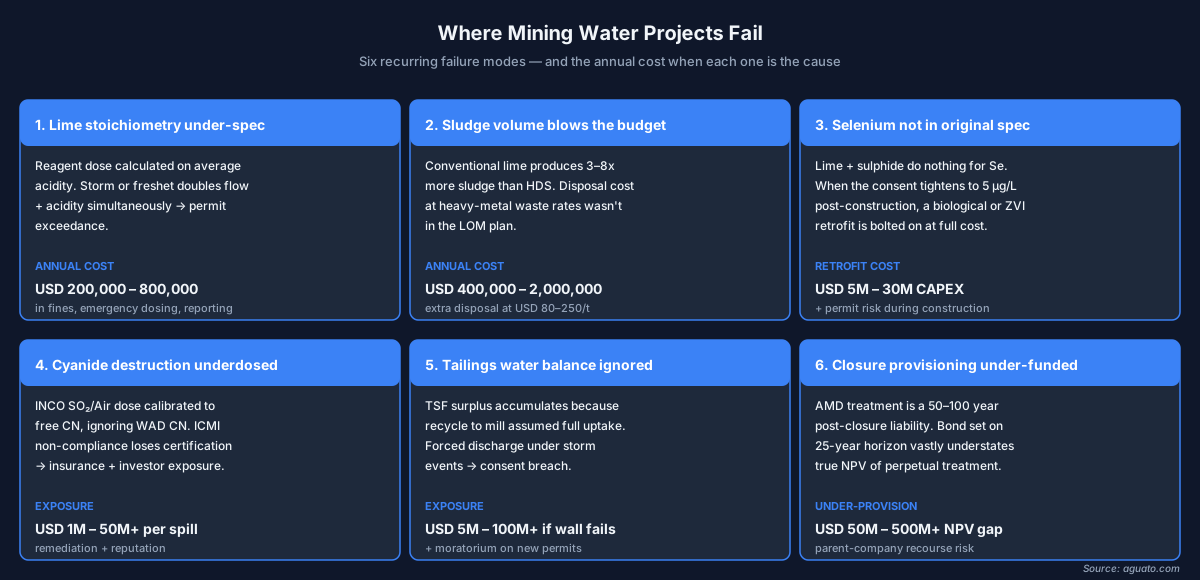
The six recurring failure modes:
Lime stoichiometry under-spec. Reagent dose calculated against average acidity; storm or freshet doubles flow and acidity simultaneously; permit exceedance follows. Cost: USD 200,000 to 800,000 per year in fines, emergency dosing, and reporting.
Sludge volume blows the budget. Conventional lime produces 3 to 8x more sludge than HDS. Disposal at heavy-metal waste rates wasn't priced into the LOM plan. Cost: USD 400,000 to 2,000,000 per year extra at USD 80 to 250/t disposal rates.
Selenium not in original spec. Lime + sulphide do nothing for Se. When the consent tightens to 5 µg/L mid-life, biological reduction or zero-valent iron is bolted on at full retrofit cost. Cost: USD 5M, 30M CAPEX retrofit plus permit risk during construction.
Cyanide destruction underdosed. SO₂/air dose calibrated to free CN, ignoring WAD CN; ICMI non-compliance loses certification, triggering insurance and investor exposure. Cost: USD 1M, 50M+ per spill in remediation and reputation.
Tailings water balance ignored. TSF surplus accumulates because recycle to mill assumed full uptake; forced discharge under storm events breaches consent. Cost: USD 5M, 100M+ if a wall fails plus permit moratorium on new operations.
Closure provisioning under-funded. AMD treatment is a 50 to 100 year post-closure liability. A bond set on a 25-year horizon vastly understates true NPV of perpetual treatment. Cost: USD 50M, 500M+ NPV gap, and parent-company recourse risk if the operating subsidiary cannot fund closure.
The pattern across all six is the same: each fails not because the engineering was wrong on day one, but because the design was matched to a snapshot scenario that wasn't representative of the actual operating envelope or the actual liability horizon. Real mining water engineering is probabilistic, model the distribution of flows, loads, and consent trajectories, and design to the curve, not the median.
If you replace one wrong-spec mining water plant with the right configuration matched to your actual ore chemistry, climate, and consent trajectory, you save USD 1.5M, 8M per year in OPEX over the life of the mine, and you avoid USD 50M, 500M+ in retrofit and closure-bond shortfall on the back end. The biggest cost-of-doing-nothing is letting the EPC contractor specify the same lime-neutralisation package that won the last bid, regardless of whether your stream needs sulphide polishing, biological sulphate reduction, or selenium-specific treatment, that single decision is where every nine-figure mining water mistake begins.
## Sources
The plant benchmarks and case studies in this guide are drawn from Aguato's mining-water reference corpus of published treatment studies. Featured facilities:
- Copper-smelter acid wastewater, Glogow, Poland: [E3S Web of Conferences (2017)](https://www.e3s-conferences.org/articles/e3sconf/pdf/2017/05/e3sconf_eko2017_00020.pdf) - Coal-mine AMD passive system, Clinton County, Pennsylvania, USA: [study (2019)](https://pmc.ncbi.nlm.nih.gov/articles/PMC6716070/) - Iron-mine AMD constructed wetland, Ma'anshan, China: [study (2025)](https://pmc.ncbi.nlm.nih.gov/articles/PMC12835047/) - Ettringite sulphate-removal work, Criciuma, Brazil: [UFRGS repository (2009)](http://hdl.handle.net/10183/25071) - Coal-AMD active lime plant, Charqueadas, Brazil: [Minerals 15(10):1068 (2025)](https://www.mdpi.com/2075-163X/15/10/1068)
The eMalahleni coal-AMD reclamation plant (South Africa) and a gold-cyanidation detoxification pilot (Ghana) are drawn from peer-reviewed conference proceedings and journals in the same corpus.
## FAQ
### What's the difference between AMD and ARD?
ARD (acid rock drainage) is the umbrella term for any acidic drainage from sulphide-bearing rock. AMD (acid mine drainage) is the subset specifically generated by mining activity, when waste rock dumps, tailings, and exposed pit walls accelerate the natural ARD process by 100 to 1,000x through increased oxygen access. The treatment chemistry is identical; the difference is volume and concentration.
### Why is selenium suddenly the dominant issue at coal sites?
Discharge limits for selenium have tightened from 50 µg/L to 5 µg/L (and lower in some jurisdictions) over the past decade, driven by aquatic toxicity research showing chronic effects at single-digit parts-per-billion. Conventional lime treatment removes essentially zero selenium because Se(VI) is anionic and doesn't precipitate as a hydroxide. Operators with mid-life consents now face USD 5M, 30M retrofits to add biological selenium reduction or zero-valent iron treatment.
### How long does AMD continue after a mine closes?
Decades to centuries. Pyrite oxidation is rate-limited by oxygen access; as long as exposed sulphide surfaces contact air and moisture, the reaction continues. AMD has been observed flowing from Roman and medieval European mining sites, over 1,500 years post-closure. For modern operators, the practical horizon is 50 to 100+ years of post-closure treatment OPEX, which is why the closure bond NPV is the largest single financial decision in the project's life.
### Is RO economic for mining water?
Sometimes. RO is the right answer when the consent requires TDS reduction below what precipitation chemistry can achieve, when reuse is the strategic objective, or when feeding a ZLD evaporator. RO is the wrong answer when the underlying problem is heavy metals, lime or sulphide precipitation removes them at a fraction of the energy cost. The CAPEX range (USD 600 to 1,400 per m3/day) and the energy OPEX (0.8 to 2.4 kWh/m3) are real, but so is the brine-disposal problem that follows. RO without a downstream concentrate strategy is half a solution.
### How do operators decide between active and passive treatment at closure?
Active treatment (lime + clarifier + chemical addition) gives high removal but requires perpetual labour and reagent supply. Passive treatment (constructed wetlands, anoxic limestone drains, sulphate-reducing bioreactors) has 70 to 90% lower OPEX but works only at lower flow rates and lower acidity loads. The decision typically goes: design active for operating phase + first 10 to 20 years post-closure, then transition to passive once acidity loads have declined. Operators that try to design passive from day one against active-mining flow rates fail both consent and economics.
### What's a defensible discount rate for closure-bond NPV?
The range used in industry practice is 3 to 6% real, with regulators in some jurisdictions (notably British Columbia, certain Australian states) imposing ceilings around 4%. Using 6%+ understates the perpetual-treatment NPV by 30 to 50% relative to a 3% case. Best practice is to model under multiple discount rates, present the range to the regulator, and provision the bond at the upper-bound case, not the company's preferred low-bond scenario.
### Can blockchain or sensor networks help with consent compliance?
Real-time online sensor networks (pH, conductivity, ORP, specific-ion electrodes for cyanide and metals where validated) are now standard at major mining operations and integrate into SCADA-driven dosing control. They detect excursions in seconds rather than days, which catches consent breaches before they reach the outfall. Blockchain-based reporting (immutable monitoring data hashed to a distributed ledger) is being trialled by ICMI Code participants for cyanide reporting, the use case is regulator and stakeholder trust in the data, not the data itself.