Bad water monitoring drives $50K-200K/yr in wasted chemistry plus compliance fines. Compare online sensors vs lab analysis, parameters, and total cost.
The most common and most avoidable failure in industrial water treatment is treating the wrong problem. A cooling tower scaled with calcium carbonate requires a completely different chemical programme from one contaminated with silica; an RO system failing from biological fouling needs a different response than one failing from scale. Without systematic water quality testing, treatment decisions are guesses, sometimes educated guesses, but guesses nonetheless.
Water testing is not a compliance exercise, it is the diagnostic foundation of every treatment decision. The [WHO drinking water quality guidelines, chemical parameters](dofollow:https://www.who.int/publications/i/item/9789241549950) establish parameter targets for drinking water; industrial systems have different targets, but the same principle applies: you cannot control what you do not measure.
Testing programmes fail in one of three ways: the wrong parameters are measured, the measurement frequency is too low to catch deterioration before it causes damage, or the results are collected but not acted on. This guide addresses all three.
## Why Water Testing Is the Foundation of Treatment Design
Every water treatment system, cooling tower, boiler, closed circuit, RO, filtration train, operates against a set of performance targets. Those targets are derived from the water chemistry of the feed, the metallurgy of the system, and the process requirements of the end use. Change the feed water chemistry (which happens seasonally, with source switching, with upstream process changes) and the treatment programme that was optimal last quarter may now be inadequate or excessive.
Across the industrial installations we monitor, the single most consistent predictor of treatment programme failure is the absence of routine chemical analysis. Plants that test feed water annually and adjust treatment quarterly perform significantly worse than those testing monthly and adjusting continuously. The correlation is not subtle, poor testing programmes are responsible for the majority of scaling, corrosion, and biological control failures in industrial water systems.
The economics are clear: a comprehensive water analysis costs $50 to 500 depending on the parameter panel and laboratory. A single episode of cooling tower Legionella contamination requiring remediation costs $50,000 to 500,000 including emergency treatment, regulatory notification, investigation, and reputational management. A membrane replacement event in an industrial RO system caused by [chlorine](/elements/chlorine) breakthrough that went undetected for 48 hours costs $25,000 to 80,000. Water testing is the cheapest insurance in industrial operations.
## The Core Parameters Every Industrial System Needs
The parameters that matter depend on the system type and application. This table covers the core parameters across industrial water systems:
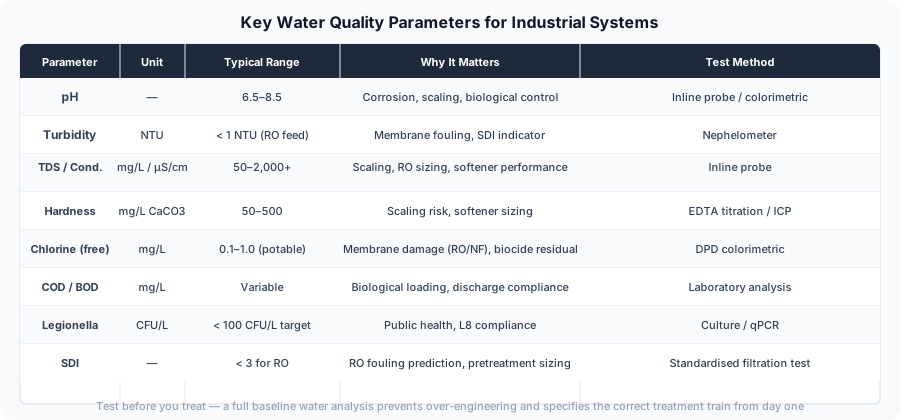
pH is the single most important parameter across all water-contacting systems. pH governs corrosion rate (low pH accelerates dissolution of metals; high pH promotes carbonate scaling), biological activity (most microorganisms are inhibited outside pH 6 to 9), and chemical treatment efficacy (many inhibitors and biocides have narrow pH operating windows). The target pH range varies by system: cooling towers typically 7.0 to 8.5; boilers 10.5 to 12.5 (feed water 8.5 to 9.5); closed circuits 7.5 to 9.5; RO feed 6.5 to 7.5.
Conductivity is a proxy measurement for total dissolved solids. In cooling tower management, the ratio of circulating water conductivity to makeup water conductivity gives the cycles of concentration (CoC), the primary control parameter for blowdown management. In RO permeate, conductivity indicates salt rejection performance; in closed circuits, rising conductivity indicates system corrosion or ingress.
Hardness (expressed as CaCO3 equivalent) determines scaling tendency and defines the softener or antiscalant programme requirement. Hard water (above 300 mg/L CaCO3) in cooling towers without adequate scale inhibitor creates calcium carbonate deposits that reduce heat transfer by 15 to 30% in a single season and eventually block heat exchanger tubes.
Free chlorine is both a treatment parameter (biocide residual verification) and a threat parameter (membrane-damaging oxidant). Maintaining 0.1 to 0.5 mg/L free chlorine in cooling tower circuits provides effective biocide residual while avoiding stress corrosion cracking on stainless steel. Upstream of polyamide RO membranes, the target is zero, even episodic exposure at 0.5 to 1.0 mg/L over 24 to 48 hours causes measurable membrane degradation. For a comparison of chlorination, UV, and ozone as disinfection technologies, including the residual monitoring implications of each, see the [industrial water disinfection guide](/resources/industrial-water-disinfection).
[Legionella monitoring](/resources/legionella-risk-assessment) is a legal requirement, not a discretionary parameter, for cooling towers and hot and cold water services in most jurisdictions. UK L8 duty holders must carry out routine monitoring; a single positive Legionella result at detectable levels triggers a formal risk response.
## Online Monitoring vs Laboratory Analysis
Industrial water quality testing spans three distinct methods, each with a specific role:
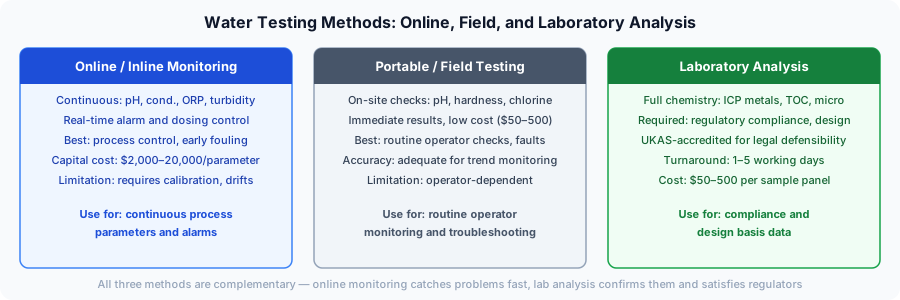
Online monitoring provides continuous data streams for parameters that change rapidly or where real-time control is required. pH, conductivity, ORP (oxidation-reduction potential), turbidity, and chlorine residual are all routinely monitored inline. An online ORP analyser on a cooling tower makeup line costs $2,000 to 5,000 to install and provides continuous oxidant residual data, worth every cent if it catches a dosing pump failure before Legionella proliferates.
Limitations of online monitoring: instruments drift. pH electrodes typically require calibration every 1 to 4 weeks; chlorine analysers can foul in turbid water. An online instrument reading an incorrect value is more dangerous than no instrument at all, because it creates false confidence. Calibration programmes are as important as installation.
Laboratory analysis provides the full picture that inline instruments cannot, complete ion analysis, metals speciation, organic loading, and microbiological counts. For regulatory compliance, UKAS-accredited (or equivalent) laboratory analysis is required, a field test kit result is not legally defensible in the event of a compliance dispute or enforcement action. Send samples to accredited laboratories for: Legionella culture, microbiological counts, full metals analysis, and any parameter that forms part of your discharge consent or operating permit.
The [ISO 5667, water quality sampling standards](dofollow:https://www.iso.org/standard/75359.html) specify sampling procedures, container selection, preservation, and chain-of-custody requirements that must be followed for laboratory results to be legally defensible. Samples collected incorrectly, wrong container, wrong preservation, delayed submission, incorrect labelling, will be rejected or may produce unreliable results.
[cta:nepti-dark]
## Testing Frequency: What to Measure and When
Testing frequency should be proportional to the consequence of missing a deterioration event. A cooling tower that is three days past a biocide dose with rising turbidity and temperature is a Legionella incubation environment. A boiler on the borderline of hardness specification is hours away from carbonate scaling in the steam drum. The testing schedule should be designed so that problems are detected before they cause damage, not after.
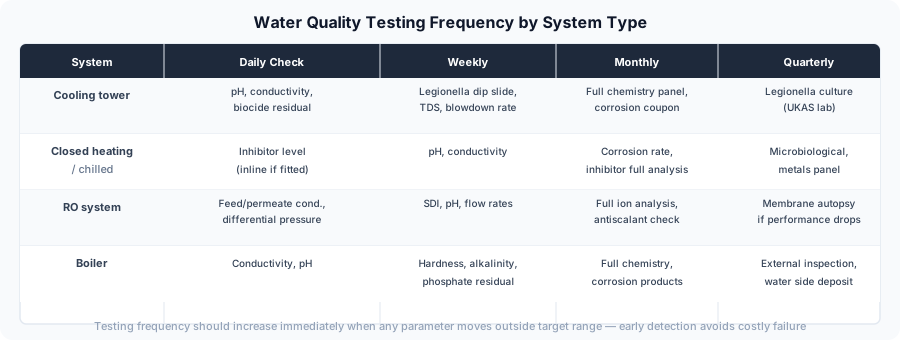
Cooling towers require daily monitoring of the core control parameters (pH, conductivity, biocide residual) because the consequences of exceedance are acute, Legionella can achieve dangerous proliferation concentrations within 48 to 72 hours under favourable conditions. Weekly microbiological dip slides provide an early warning of biological activity between quarterly UKAS Legionella cultures.
Closed heating and chilled water circuits are slower-moving systems, once properly commissioned with an adequate inhibitor programme, the main risk is inhibitor depletion through leaks and top-ups with untreated water. Monthly full analysis is adequate for stable systems; increase frequency when significant water losses are detected or when the inhibitor level shows unexpected decline.
RO systems require daily monitoring of the normalised performance data (feed/permeate conductivity, differential pressure, flow rates) to detect the early stages of fouling or scaling before they become irreversible. Monthly full ion analysis of feed, permeate, and concentrate provides the data needed to verify antiscalant programme adequacy and detect upstream feed water changes. Where the RO permeate feeds a purification or final polishing stage, the required permeate quality targets are covered in the [industrial water purification guide](/resources/industrial-water-purification).
Hardness testing for softener sizing, if you are assessing whether softener performance is meeting specification, verify hardness at the softener outlet, not just at the site feed. Post-softener hardness should be below 1 to 5 mg/L CaCO3; hardness breakthrough indicates resin exhaustion or regeneration failure.
## Interpreting Results and Adjusting Treatment
Raw test results are numbers. The value is in the trend and the response. A cooling tower conductivity reading of 2,200 µS/cm is meaningless without context, is this the normal operating value for the site's current CoC target, or has it risen from 1,800 µS/cm over two weeks indicating a blowdown failure?
Set control ranges, not just targets. Every parameter should have a target value and an action range, the band within which the parameter triggers a review and treatment adjustment. Parameters outside the action range should trigger an immediate response, not a note in the log book.
Response protocols should be pre-written. "pH is 9.2, what do we do?" should have a written answer in the operating procedures, not require a call to the chemical supplier. If the answer depends on other parameters (is ORP still in range? Is Legionella culture from last month negative?), the protocol should capture that decision tree explicitly.
For RO systems, normalised performance analysis is the standard interpretation method. Raw flux and rejection data varies with temperature, pressure, and recovery, normalisation removes these operating variable effects and makes the underlying fouling or scaling trend visible. Most RO control systems include normalisation software; if yours does not, the membrane manufacturer's ROSA or IMSDesign software provides this at no cost.
[Enter your test results into Nepti](/nepti) to model treatment programme adjustments against your specific water chemistry, the tool generates ranked recommendations based on parameter deviations from target, with quantified risk assessments for each.
## Where Water Testing Programmes Fail
1. Testing conducted but results not acted on Decision made: quarterly analysis sent to the chemical supplier; results filed without review; no action threshold defined. Outcome: inhibitor concentration in a closed chilled water system declined from 300 mg/L to 80 mg/L over 18 months (below the 150 mg/L minimum protective level). Corrosion progressed silently; failure discovered when a heat exchanger developed pinhole leaks. Repair cost: $45,000. Correct decision: set action thresholds; require written acknowledgement and response plan from the treatment supplier within 5 working days of any out-of-range result.
2. Sampling from the wrong location Decision made: boiler feed water sampled from the dosing chemical feed point rather than the deaerator outlet. Sample contained elevated phosphate from the dosing chemical, masking near-zero hardness that indicated the softener had failed. Outcome: hardness breakthrough to the boiler caused significant calcium carbonate deposit in the mud drum within 6 weeks. Correct decision: sample from the correct process point for each parameter. Feed water hardness must be measured downstream of all dosing and upstream of the boiler feed pump.
3. Field test kits used as the sole compliance measure Decision made: site operated Legionella risk assessment using weekly dip slides and monthly total viable count field tests, without UKAS Legionella culture. Outbreak occurred. Regulator found that the monitoring programme did not meet L8 Code of Practice requirements, the responsible person faced enforcement action regardless of whether the monitoring had shown negative results. Correct decision: UKAS-accredited Legionella culture at the required L8 frequency is a legal minimum, not an optional upgrade from field testing.
The [EPA water quality monitoring guidance](dofollow:https://www.epa.gov/water-research/water-quality-monitoring) provides a systematic framework for monitoring programme design that applies equally to industrial water systems as to environmental monitoring. [Post your water testing project](/post-project) to find accredited providers who can establish a compliant monitoring programme for your specific systems.
## FAQ
### How often should cooling tower water be tested for Legionella?
Under the UK L8 Code of Practice, the minimum requirement is UKAS-accredited Legionella culture monthly for cooling towers, with quarterly cultures for lower-risk systems (where agreed with a competent person). Routine dip slide monitoring weekly or fortnightly provides an interim indicator between cultures. Following any system shutdown and restart, or after any positive Legionella result, additional sampling and immediate remedial action is required. In other jurisdictions, the specific frequency requirements vary, always refer to the applicable national guidance.
### What does a complete water analysis for RO design include?
A complete design basis analysis for RO system design should include: major cations ([calcium](/elements/calcium), magnesium, sodium, potassium, barium, strontium, iron, manganese), major anions (bicarbonate, sulphate, chloride, nitrate, fluoride), silica (as SiO2 total and dissolved), pH and alkalinity, TOC, turbidity and SDI, free and total chlorine, temperature range, and microbiological indicators (total viable count, coliforms). A single sample at a single time is a starting point, not a basis for design. Collect samples over a minimum of 3 months to capture seasonal variation, especially important for surface water sources and industrial feeds.
### What is the difference between total hardness and calcium hardness?
Total hardness measures the combined concentration of divalent cations, primarily calcium (Ca2+) and magnesium (Mg2+), expressed as CaCO3 equivalent. Calcium hardness measures only the calcium fraction. The distinction matters because calcium and magnesium have different scaling tendencies: calcium forms harder, more adherent scale (calcium carbonate, calcium sulphate); magnesium forms softer hydroxide deposits primarily at higher pH. Softener sizing is based on total hardness; scale inhibitor selection may be based on the individual ion concentrations to address the dominant scaling risk.
### Can I use conductivity as a substitute for full ion analysis?
Conductivity is a useful proxy for total dissolved solids in systems where the ionic composition is relatively stable. In cooling tower management, conductivity controls blowdown well when makeup water composition is consistent. However, conductivity cannot distinguish between ions of different scaling tendency, a water with 500 µS/cm conductivity from sodium chloride is very different from one at the same conductivity from calcium bicarbonate. Full ion analysis is required for: initial system design, RO sizing, antiscalant selection, treatment programme changes, and whenever the water source or composition changes. Conductivity alone is only adequate for routine control of stable-composition systems.
### What laboratory accreditation should I require for water testing?
For regulatory compliance purposes, require UKAS accreditation (UK) or ISO 17025 accreditation (international) for any analysis that will be used to demonstrate compliance with an operating permit, discharge consent, or legal duty (including Legionella L8 monitoring). UKAS accreditation means the laboratory's specific methods have been independently validated for accuracy, precision, and traceability. Unaccredited laboratories may produce accurate results but their reports are not legally defensible, a distinction that matters when facing an enforcement investigation or civil claim.
### How do I know if my online instruments are reading correctly?
Calibrate regularly using certified reference standards, pH calibration requires two-point calibration (typically pH 4.00 and 7.00, or 7.00 and 10.00 buffers) at the operating temperature. Chlorine analysers should be verified against a DPD colorimetric spot check at least weekly. ORP probes can be checked against a quinhydrone reference solution. The most reliable check is concurrent laboratory analysis, send a sample to an accredited laboratory while recording the inline instrument reading at the same time. Any discrepancy of more than 10% indicates calibration drift or sensor fouling requiring maintenance.