Untreated boiler water causes scale, oxygen pitting, and steam contamination, all of them preventable. This guide covers the chemistry, the programme structure, and the failure scenarios that cost industrial plant operators $19,000 to 100,000 per incident.
A single industrial boiler tube rupture from preventable scale fouling costs $19,000 to 100,000 in repair plus 5 to 14 days of unplanned production downtime, typically another $50,000 to 500,000 in lost output depending on what the boiler feeds. An undetected [oxygen](/elements/oxygen)-pitting failure on a 4 t/hr steam generator can write off a tube sheet and demand a 6-week parts lead time and an 11-day shutdown. TDS carry-over into a steam-driven turbine deposits silica on blades that cuts output 5 to 15% and forces an unscheduled overhaul. All three failure modes are entirely preventable for $5,000 to 11,000/year in properly engineered industrial boiler water treatment. And yet a significant share of industrial boilers run without a structured programme, or with one that addresses only one failure mechanism instead of all three, usually because the original installer sold a chemical-supply contract instead of an engineered treatment design.
The chemistry that causes tube ruptures, emergency shutdowns, and five-figure repair bills is well understood. The decision logic for who-treats-what at which pressure class is well documented (IAPWS, BG04, HSE INDG436). What's missing on most sites is the discipline to actually run the programme to spec, and the procurement scrutiny to refuse the lowest-bidder contract that gets sold as "boiler chemistry" but covers only the easy 30% of the work.
This guide is for plant engineers and operations directors specifying or maintaining steam systems, procurement leads writing the next boiler treatment RFP, and sustainability heads building the energy and reliability business case for plant upgrades. It covers what boiler water treatment actually does, the three failure mechanisms (with cost-per-failure quantified), how to build a programme that addresses all three, what it costs vs what NOT treating costs, and the dollar number to take to your CFO.
## The decision in brief
- Replace the chemical-supply contract with an engineered boiler programme. On a single 4 to 10 t/hr industrial steam boiler, you avoid $80,000 to 300,000 over a 5-year contract term, with zero unplanned shutdowns from preventable causes. - Know what the number is made of. A single avoided tube rupture is $19K to 100K, one avoided turbine fouling event is $20K to 80K, and 2 to 4 years of preserved heat-transfer efficiency is $25K to 100K. - Cover all three failure mechanisms. The right programme, with the right pre-treatment, dosing chemistry, and conductivity-controlled blowdown, costs $5,000 to 11,000/year, a payback ratio of 5 to 15 times before insurance, compliance, and uptime variance are even priced in.
The biggest cost of doing nothing is buying chemistry from a supplier whose revenue scales with your problem, not from an engineer whose programme prevents it, until the boiler fails on a Friday afternoon.
## What Boiler Water Treatment Actually Does
A boiler converts liquid water into steam. In doing so, it concentrates every dissolved solid, gas, and mineral that enters with the feedwater. What starts as mains water at 300 to 400 mg/L TDS becomes boiler water at 1,500 to 3,500 mg/L TDS or higher, depending on the blowdown rate and operating pressure.
Three consequences follow from this concentration process if it goes unmanaged. First, minerals that exceed their solubility limits at boiler temperature precipitate onto heat transfer surfaces as scale. Second, dissolved gases, primarily oxygen, attack exposed metal surfaces through electrochemical corrosion. Third, if TDS rises too high, dissolved solids are entrained in the steam leaving the boiler, contaminating the steam supply and downstream equipment.
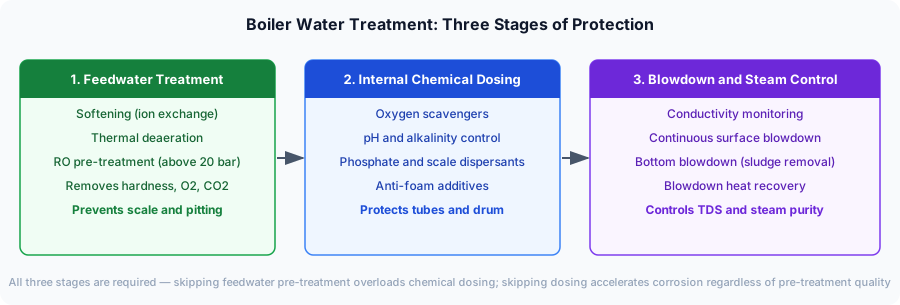
A boiler water treatment programme exists to prevent all three simultaneously. The programme has three components: feedwater pre-treatment (removing the problem before it enters the boiler), internal chemical dosing (neutralising what pre-treatment cannot remove), and blowdown management (controlling TDS concentration). Skipping any one of the three means overloading the other two.
## The Three Failure Mechanisms: Scale, Corrosion, and Carry-Over
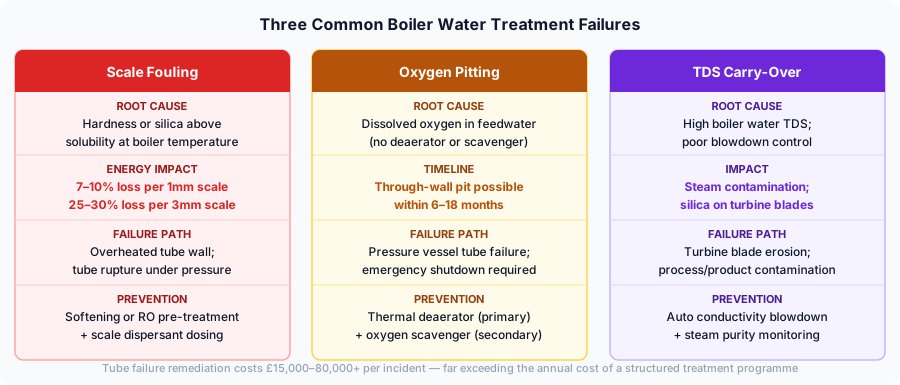
| Failure mode | Time to damage | Energy / production cost | Repair cost per incident | Prevention cost | |---|---|---|---|---| | Scale fouling (CaCO3 / silicate) | 6 to 18 months without softening | 7 to 10% efficiency loss per mm + $50K, 500K lost output if rupture | $19,000 to 50,000 (descale) to $100,000+ (tube replacement) | Softener + dispersant: $2,000 to 5,000/yr | | Oxygen pitting | Through-wall in 6 to 18 months without scavenger or deaerator | Pressure fluctuation + sudden failure risk | $30,000 to 80,000 (tube sheet repair) + 11+ days downtime | Deaerator + scavenger: $1,500 to 4,000/yr | | TDS carry-over | 3 to 12 months with inadequate blowdown | 5 to 15% turbine output drop + product contamination | $20,000 to 80,000 (turbine clean / batch reject) | Conductivity controller: $1,500 CAPEX + $500/yr |
### Scale Fouling
Scale is calcium carbonate (CaCO3), magnesium silicate, or calcium sulphate depositing on the inner surface of boiler tubes. The deposit acts as a thermal insulator between the combustion gases and the water. A 1 mm scale layer reduces heat transfer efficiency by 7 to 10%, forcing the burner to run hotter and longer to maintain steam output. At 3 mm, efficiency loss reaches 25 to 30%.
The operational consequence is not just fuel waste. As the tube wall temperature rises behind the insulating scale layer, the steel begins to overheat. At some point, depending on tube material, operating pressure, and the thickness and thermal conductivity of the deposit, the tube wall can no longer withstand operating pressure. The result is tube rupture: an unplanned shutdown, a pressure release, and a repair that typically costs $19,000 to 50,000 before return to service.
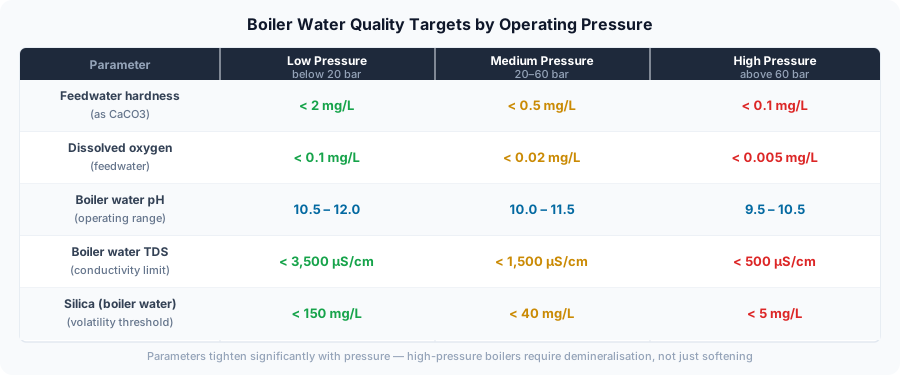
The root cause is simple: hardness or silica above solubility limits at boiler temperature. The prevention is equally simple: remove hardness and control silica before water enters the boiler. What makes this difficult in practice is that the required limits tighten significantly with operating pressure, and many sites apply a low-pressure softening standard to medium or high-pressure boilers.
The [IAPWS Technical Guidance on steam and water chemistry](dofollow:https://www.iapws.org/techguide/Boiler.html) provides internationally recognised targets for feedwater and boiler water quality across pressure ranges, the most comprehensive technical basis for treatment programme design available without commissioning a bespoke study.
### Oxygen Pitting
Dissolved oxygen in feedwater creates localised electrochemical attack on steel surfaces inside the boiler. Unlike general corrosion, which reduces wall thickness uniformly, oxygen pitting creates discrete craters, small in area, potentially deep. A through-wall pit can develop within 6 to 18 months on an untreated system.
The mechanism requires only three conditions: dissolved oxygen, a metal surface, and water. These conditions exist in every boiler that lacks either a thermal deaerator or a chemical oxygen scavenger, both of which are standard on any properly specified system. The failure is almost always one of programme design, not bad luck.
### TDS Carry-Over
As boiler water TDS rises, the probability of liquid droplets being mechanically entrained in the steam increases. These droplets carry dissolved solids, particularly silica, into the steam distribution system and any downstream turbines or process equipment.
On steam turbines, silica deposits on blades at a rate proportional to boiler water silica concentration and steam loading. The deposits build unevenly, causing vibration and reducing turbine output. On process equipment, TDS carry-over introduces contamination into product streams, a critical issue for food, pharmaceutical, and fine chemical applications where steam contacts product directly.
## Feedwater Treatment: The First Line of Defence
Feedwater treatment removes as much of the chemical load as possible before water enters the boiler. The approach depends on operating pressure and local water chemistry.
### Water Softening
Ion exchange softening replaces calcium (Ca2+) and magnesium (Mg2+) ions with [sodium](/elements/sodium) (Na+), eliminating the primary source of scale-forming hardness. A well-maintained softener should deliver hardness below 0.5 mg/L as CaCO3, effectively zero for low and medium-pressure boiler purposes.
Softening is the minimum feedwater treatment for any boiler above atmospheric pressure. For sites still operating without it, it is invariably the first action a treatment specialist will recommend. A simplex softener suitable for a 2 to 5 t/hr shell boiler typically costs $5,000 to 10,000 installed, with salt and regeneration costs of $1,500 to 3,200 per year.
### Thermal Deaeration
A thermal deaerator heats feedwater to near boiling point, driving dissolved oxygen and carbon dioxide out of solution before the water enters the boiler. Properly operated, a deaerator reduces dissolved oxygen to 0.02 to 0.05 mg/L, well below the threshold at which significant corrosion occurs.
Deaerators are standard on industrial shell boilers above around 5 t/hr steam output. Smaller packaged boilers and steam generators often omit them on grounds of cost or footprint, relying instead on chemical oxygen scavenging. The trade-off is higher chemical consumption and greater reliance on dosing consistency, if dosing lapses, there is no secondary protection.
### Reverse Osmosis for High-Pressure Applications
Above approximately 40 to 60 bar, softening and deaeration are insufficient. The silica and dissolved solids targets become tight enough that RO pre-treatment is required to achieve feedwater quality that internal chemical dosing can then manage.
RO removes 95 to 99% of dissolved solids, including silica, chlorides, and sulphates that contribute to stress corrosion in high-pressure drums. The trade-off is higher CAPEX, typically $37,500 to 150,000 for an industrial RO skid, and a 20 to 25% reject stream that requires disposal or recovery.
| Pre-treatment | What it removes | CAPEX | Annual OPEX | Required for boiler pressure | |---|---|---|---|---| | Softening (ion exchange) | Hardness (Ca, Mg) → < 0.5 mg/L | $5,000 to 15,000 | $1,500 to 3,200 (salt + regeneration) | Mandatory for any boiler > atmospheric | | Thermal deaeration | Dissolved O2 → 0.02 to 0.05 mg/L | $15,000 to 60,000 (integrated) | Steam consumption only | Standard above ~5 t/hr; otherwise rely on chemical scavenging | | Reverse osmosis | 95 to 99% TDS, silica, chlorides | $37,500 to 150,000 (industrial skid) | $0.40 to 1.20/m³ + 20 to 25% reject | Mandatory above 40 to 60 bar | | Mixed-bed polish | Final dissolved-ion removal | $10,000 to 40,000 | Resin replacement $2,000 to 6,000/yr | Power-gen high-pressure (> 100 bar) |
Similar pre-treatment logic applies to cooling tower systems, where concentrate control is equally fundamental, see our guide on [cooling tower water treatment](/resources/cooling-tower-water-treatment) for a detailed comparison of how concentration cycles are managed across both technologies.
Similar pre-treatment logic applies to cooling tower systems, where concentrate control is equally fundamental, see our guide on [cooling tower water treatment](/resources/cooling-tower-water-treatment) for a detailed comparison of how concentration cycles are managed across both technologies.
## Internal Chemical Treatment: What Softening Cannot Remove
Pre-treatment reduces chemical load. Internal chemical dosing handles the residuals and manages chemistry inside the boiler itself. Both are required; one cannot substitute for the other.
### Oxygen Scavengers
Even with a deaerator, residual dissolved oxygen remains in feedwater. Chemical oxygen scavengers react with this residual oxygen before it can attack metal surfaces.
Sodium metabisulphite (SMBS) is the most common scavenger for low and medium-pressure boilers. It reacts with dissolved oxygen to form sodium sulphate, an inert compound. Dosing rate is typically 7 to 10 mg SMBS per mg O2 removed, with a residual target of 5 to 20 mg/L SMBS in feedwater.
For higher-pressure boilers where sulphate accumulation becomes a concern, carbohydrazide or DEHA (diethylhydroxylamine) are used instead. Both are volatile, meaning they follow the steam into the condensate system and provide corrosion protection there as well.
The [HSE guidance on the safe use of steam boilers (INDG436)](dofollow:https://www.hse.gov.uk/pubns/indg436.pdf) sets out the statutory requirements for safe boiler operation, including the chemical treatment obligations that sit within a boiler's written scheme of examination under the Pressure Systems Safety Regulations 2000.
### pH and Alkalinity Control
Boiler water must be maintained alkaline to suppress corrosion. At low and medium pressures, the target is pH 10.5 to 12.0 in boiler water; at high pressures, the range tightens to pH 9.5 to 10.5.
Caustic soda (NaOH) raises pH directly. Trisodium phosphate provides pH buffering and also reacts with residual hardness to form hydroxyapatite, a non-adherent sludge that can be removed by blowdown rather than depositing as scale on tube surfaces.
The relationship between pH and corrosion is not linear. Too low and corrosion accelerates; too high and caustic attack on weld points and crevices begins. Maintaining alkalinity in the correct range requires regular testing, not just initial adjustment.
### Scale Dispersants and Anti-Foam
Polymer-based scale dispersants condition any remaining hardness or silica into non-adherent forms. Rather than allowing precipitated minerals to deposit and sinter onto tube surfaces, dispersants hold them in suspension for removal by blowdown.
Anti-foam additives prevent the surface turbulence that causes liquid water to be entrained in steam. They become critical on systems operating near the upper TDS limit for their pressure class.
Most operators underestimate how quickly the effectiveness of internal dosing degrades when feedwater quality deteriorates. A dosing regime calibrated for softened feedwater at 50 mg/L hardness will be overwhelmed if the softener runs to exhaustion and hardness leaks to 200 mg/L. Pre-treatment reliability and chemical dosing are not independent systems, they fail together.
[cta:nepti-dark]
## Blowdown Management: Controlling TDS Without Wasting Water
Blowdown is the deliberate removal of a fraction of boiler water to prevent TDS from building to the point of carry-over or increased scaling risk. It is the primary mechanism for controlling dissolved solids concentration in the boiler.
### Two Types of Blowdown
Surface blowdown removes water from just below the waterline, where dissolved solids concentrate. It is typically continuous, controlled by a conductivity set-point. Bottom blowdown removes settled sludge from the base of the shell, typically performed manually at intervals of 8 to 24 hours, depending on feedwater hardness and sludge generation rate. The cooling-tower analogue of this control problem, which uses the same conductivity-setpoint logic but with a different cycles-of-concentration target band and a different discharge-permit perimeter, is covered in our [cooling tower blowdown guide](/resources/cooling-tower-blowdown).
### Conductivity Control
Modern boilers use continuous conductivity monitoring to automate surface blowdown. When conductivity exceeds the upper set-point, a blowdown valve opens until the reading drops to the lower limit. This approach provides tighter TDS control than manual blowdown and reduces heat waste and make-up water consumption.
Conductivity is a proxy for TDS. The conversion factor varies by dissolved solids mix, but a common working figure is 1 µS/cm approximately 0.5 to 0.7 mg/L TDS. For a low-pressure boiler with a 3,500 µS/cm limit, the conductivity controller should trigger blowdown at around 2,800 to 3,000 µS/cm to maintain a safety margin below the carry-over threshold.
### Heat Recovery from Blowdown
Blowdown water leaves the boiler at near-saturation temperature, typically 150 to 180°C at low-to-medium pressures. Discharging it directly to drain represents a significant energy loss. A blowdown heat recovery system, flash vessel plus heat exchanger, can recover 60 to 80% of this heat, preheating incoming make-up water.
Payback periods of 12 to 24 months are common on boilers running above 2 t/hr steam output. On larger systems, blowdown heat recovery is rarely optional from an energy management standpoint.
A pharmaceutical manufacturer in the East Midlands reduced total fuel consumption by 8% after upgrading from manual, time-based blowdown to a conductivity-controlled automated system with a flash vessel. The project cost $22,500 and paid back in under two years. The secondary benefit, more consistent steam quality across their clean steam distribution, was a compliance requirement that manual blowdown had never reliably met.
## CAPEX and OPEX: What a Boiler Treatment Programme Actually Costs
Treatment programme costs divide into equipment, consumables, and service.
Equipment (CAPEX): A base-spec programme for a single medium-sized shell boiler typically includes a simplex or duplex softener ($5,000 to 15,000), dosing pumps and chemical day tanks ($3,100 to 7,500), and blowdown heat recovery if not already installed ($7,500 to 25,000). For high-pressure applications requiring RO, add $37,500 to 150,000. Total CAPEX range across configurations: $19,000 to 200,000.
Chemicals (OPEX): Annual chemical spend for a 2 t/hr boiler running 6,000 hours per year is typically $3,750 to 10,000, covering oxygen scavenger, pH treatment, scale dispersant, and anti-foam. Larger boilers running 10 to 20 t/hr will spend $15,000 to 37,500 per year in chemicals alone.
Service visits: Most treatment contracts include quarterly service visits, water testing, log review, dosing calibration, at $1,000 to 2,500 per visit, plus an annual inspection. Budget $5,000 to 11,300 per year for a fully managed programme on a single boiler installation. A three-boiler site at 20 t/hr total capacity typically runs $31,000 to 56,000 per year.
The comparison that matters: tube failure remediation costs $19,000 to 100,000 per incident, excluding lost production. A single unplanned shutdown often exceeds several years of structured treatment costs. The decision is not whether treatment is expensive, it is whether the cost of treatment is less than the cost of not treating.
## Where Boiler Treatment Fails and What It Costs
Most boiler treatment failures are not chemistry failures. They are process failures, situations where the right chemistry was specified but not consistently applied, or where the right treatment was applied to the wrong problem.
### Scale Failure: Running a Softener to Exhaustion
A food manufacturer in the North West operated a 4 t/hr shell boiler with a correctly specified simplex softener. Over 14 months, the site's maintenance team gradually extended the regeneration interval from 5 days to 7, then to 10. Each extension saved roughly 40 minutes of operator time per cycle.
At month 14, a hardness test on the boiler water returned 180 mg/L as CaCO3. The tubes had scale deposits 2.5 to 3 mm thick across approximately 30% of the heating surface. Boiler efficiency had dropped 20% over the preceding year, attributed to gas price increases rather than investigated operationally.
Descaling and reinstatement cost $27,500. The correct action: regenerate on a volume-based schedule tied to throughput, not elapsed time, or install a hardness alarm on the softener outlet.
### Oxygen Pitting: No Deaerator and Inconsistent Dosing
A process plant installed a new steam generator in 2022 without a deaerator, relying entirely on chemical oxygen scavenging. The dosing pump was maintained by general site maintenance rather than boiler chemistry specialists. By early 2024, dissolved oxygen readings in feedwater were consistently 0.3 to 0.5 mg/L, ten to twenty-five times the target residual.
An inspection triggered by unexplained pressure fluctuations found through-wall oxygen pitting on two tube sheets. The steam generator required specialist repair at $47,500, with a 6-week parts lead time and an 11-day full production shutdown.
The correct approach: thermal deaeration as the primary oxygen control, with chemical scavenging as secondary backup, verified by routine dissolved oxygen testing.
### TDS Carry-Over: Inadequate Blowdown Control
A textile dyehouse operating at 8 bar had no automated blowdown. Manual blowdown was performed once per shift regardless of conductivity. Over six months, TDS crept to 6,500 µS/cm, nearly double the low-pressure limit of 3,500 µS/cm.
Steam entering the dye process was visibly wet and carried dissolved solids causing batch inconsistency. Product rejection rates in one dyeing process increased approximately 15% before the root cause was identified. Remediation involved installing a conductivity controller, an automatic surface blowdown valve, and a 3-month pipework flush programme.
The financial cost of product rejections exceeded $56,000 before the problem was diagnosed. The conductivity controller that would have prevented it cost $1,500.
## Selecting a Boiler Water Treatment Provider
A good treatment provider is not simply a chemical supplier. The value lies in programme design, commissioning, operator training, and ongoing technical support, not product delivery alone.
What to look for: a provider who performs a feedwater analysis before recommending any programme; who specifies treatment targets against recognised standards (IAPWS, BG04); who includes chemical consumption logs and quarterly water test reports in the service agreement; and who can demonstrate experience with the relevant pressure class.
Warning signs: providers who recommend a standard programme without ever analysing the feedwater; providers who cannot explain the basis for their dosing rates; annual service visits rather than quarterly; no blowdown optimisation review.
Use [Nepti](/nepti) to characterise your boiler feedwater quality, operating pressure, and current treatment status before engaging providers. It models treatment options against your specific water matrix and generates a ranked comparison of programme approaches, meaning your first conversation with a treatment provider starts from a defined technical position rather than a blank page.
Once you have a clear technical specification, [post your boiler treatment requirement on Aguato](/post-project) to receive proposals from qualified specialists. Independent proposals on the same specification are the fastest way to establish whether a quote is competitive and whether the recommended approach is technically justified.
## Frequently Asked Questions
### What is the minimum water treatment required for a steam boiler?
At minimum, feedwater should pass through a water softener to remove hardness, and chemical oxygen scavengers should be dosed continuously into the feedwater line. For boilers above approximately 5 t/hr steam output, a thermal deaerator replaces much of the chemical oxygen scavenging burden and provides more reliable protection. This minimum applies to low-pressure boilers (below 20 bar); medium and high-pressure systems require progressively more rigorous treatment including reverse osmosis pre-treatment.
### How often should boiler water be tested?
Boiler water parameters, pH, TDS (conductivity), hardness, alkalinity, and chemical residuals, should be tested at minimum weekly on most industrial installations. Sites with variable feedwater quality, manual chemical dosing, or intermittent operation may require daily checks. Dissolved oxygen in feedwater should be measured at least monthly. Treatment providers typically perform a full quarterly analysis with a written report as part of a managed programme.
### What is blowdown and why does it matter?
Blowdown is the deliberate removal of a portion of boiler water to control TDS concentration. As water evaporates into steam, dissolved solids remain behind and concentrate. Without blowdown, TDS eventually exceeds the operating limit for the pressure class, causing carry-over and accelerating scale formation. Conductivity-controlled automatic blowdown is the most reliable approach; manual blowdown based on fixed schedules is common but frequently under-executed. The [US DOE Steam Systems guidance](dofollow:https://www.energy.gov/eere/amo/steam-systems) provides detailed methodology for blowdown rate optimisation and heat recovery calculations.
### Is a boiler water treatment programme a legal requirement in the UK?
In the UK, boilers over 0.5 bar are subject to the Pressure Systems Safety Regulations 2000 (PSSR 2000), which require a written scheme of examination and defined safe operating limits. While PSSR 2000 does not mandate a specific treatment programme by name, HSE guidance (INDG436) explicitly identifies inadequate water treatment as a contributing factor to boiler failure. Many insurers require evidence of an active treatment programme as a condition of cover for pressure systems. Operating a boiler above 10 bar without a documented treatment programme creates significant regulatory and liability exposure.
### What chemicals are used in boiler water treatment?
The most common chemicals are sodium metabisulphite (SMBS) or DEHA for oxygen scavenging, caustic soda (NaOH) or trisodium phosphate for pH and alkalinity control, and polyacrylate or polymaleic acid dispersants for scale conditioning. Anti-foam agents are added where TDS is managed close to the upper limit. All chemicals used in boilers supplying steam to food or pharmaceutical processes must be food-grade approved, specify this requirement to any treatment provider at the outset.
### How do I know if my boiler has scale build-up?
The most reliable indicator is a rising fuel-to-steam ratio over time, more fuel required to produce the same steam output. Boilers with scale deposits will also show higher stack temperatures, as heat is not being absorbed efficiently by the water. Tube scale is detectable by borescope inspection during annual shutdown, or by ultrasonic wall thickness testing without taking the boiler offline. If efficiency has declined noticeably over 12 to 18 months without a clear operational cause, scale should be investigated before the next thermal performance test.
### What does a boiler water treatment programme cost per year?
For a single shell boiler of 2 to 5 t/hr capacity, expect $10,000 to 25,000 per year for a fully managed programme including chemicals, service visits, water testing, and an annual inspection report. Larger multi-boiler installations benefit from economies of scale: a three-boiler site running 20 t/hr total capacity might run $31,000 to 56,000 per year. Compare this to the cost of a single tube failure ($19,000 to 100,000 plus lost production) and the economic case for treatment is unambiguous for any boiler running more than around 2,000 hours per year.