Industrial water filtration covers a broad range of technologies from multimedia sand filters to activated carbon and membrane systems. This guide explains which filtration technology fits which problem, with sizing benchmarks and failure modes to avoid.
Industrial water filtration is not a single technology. It is a family of processes spanning particle sizes from 200 micrometres down to 0.01 micrometres, covering suspended solids, dissolved organics, microorganisms, and residual disinfectants. The most common filtration error is not choosing the wrong technology, it is specifying a technology before measuring what needs to be removed. The result is systems that meet specification at commissioning and fail to perform within 6 months, because the feed water was different from the assumption.
The [WHO Guidelines on turbidity and particle removal](dofollow:https://www.who.int/publications/i/item/9789241549950) establish that turbidity below 0.3 NTU is required at the point of pathogen removal in drinking water systems. Industrial systems targeting [RO pretreatment](/resources/reverse-osmosis-systems) or sensitive process water applications require similar or tighter standards, but the path to achieving them varies significantly by feed water type.
Filtration selection is a data problem. The most expensive mistake in industrial water filtration is selecting a technology based on the target effluent quality without characterising the feed. Identify the dominant contaminant first, particle size, nature (biological, mineral, organic), concentration, and variability over time, then match the technology to it.
## Filtration Is Not One Technology, It's a Family
The filtration technologies used in industrial water treatment span six orders of magnitude in particle size removal:
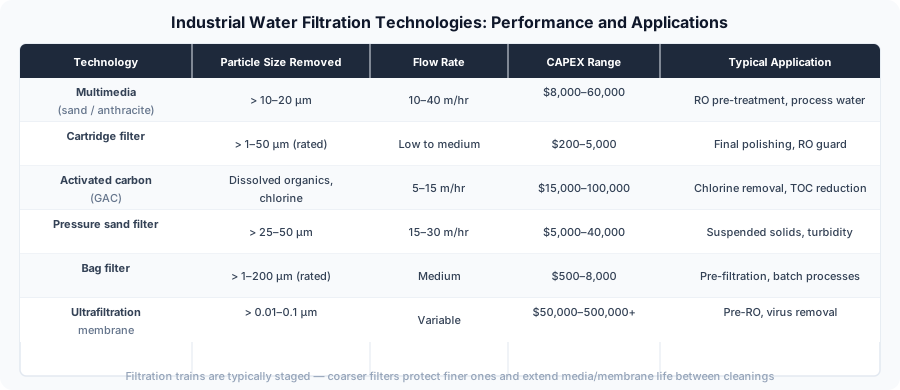
Each technology operates through a different removal mechanism:
- Depth filtration (multimedia, pressure sand): particles are physically trapped within the filter bed by collision and adhesion. The filter continues to work after initial loading because trapped particles act as additional collectors. This is why a partially loaded multimedia filter often performs better than a clean one.
- Surface filtration (cartridge, bag): particles larger than the nominal pore size are captured at the filter surface. Performance is predictable but the filter has finite capacity, differential pressure rises as the surface loads, and the filter must be replaced or backwashed.
- Adsorption (activated carbon): dissolved organics, [chlorine](/elements/chlorine), and some metals are removed by adsorption onto the carbon surface rather than physical straining. The mechanism is chemical, not mechanical, and is irreversible, once the carbon is exhausted, it must be regenerated or replaced.
- Membrane separation ([ultrafiltration systems](/resources/ultrafiltration)): absolute barrier removal based on pore size. Unlike depth filtration, properly integrity-tested membrane systems provide a guaranteed log removal for particles above the molecular weight cut-off.
The choice between these mechanisms determines the sizing parameters, maintenance regime, and total operating cost.
## Media Filtration: Sand, Multimedia, and Activated Carbon
Media filtration remains the workhorse of industrial water pretreatment. A dual-media filter (anthracite over silica sand) or triple-media filter (anthracite / sand / garnet) operates at hydraulic loading rates of 10 to 40 m/hr, handles feed turbidity up to several hundred NTU, and requires only backwash water and pump energy to operate. Capital cost is low relative to the volume of water treated.
The key design parameter for multimedia filtration is the empty bed contact time (EBCT) and hydraulic loading rate, not the media depth alone. Oversizing the surface area reduces capital cost (thinner vessels) but forces a higher loading rate that reduces particle capture efficiency. Undersizing causes rapid pressure buildup and increases backwash frequency. Design loading rates of 10 to 20 m/hr for turbid feeds and up to 30 m/hr for low-turbidity polishing applications are standard.
Activated carbon (GAC) filtration addresses the contaminants that sand filtration cannot touch, dissolved chlorine, trihalomethanes (THMs), volatile organic compounds (VOCs), taste and odour compounds, and general TOC reduction. GAC is mandatory upstream of polyamide RO membranes to remove chlorine, which oxidises the membrane active layer within hours at concentrations above 0.1 mg/L free chlorine.
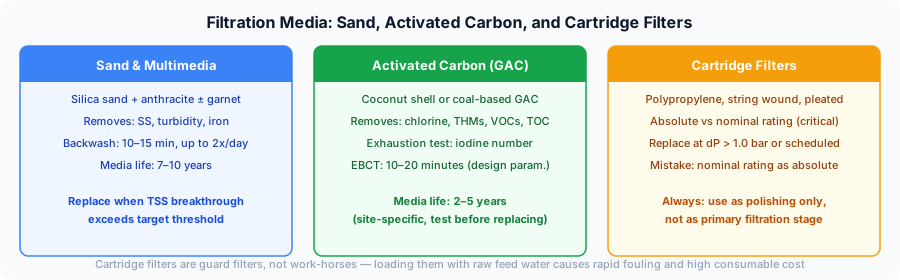
GAC sizing is governed by the empty bed contact time (EBCT), the time the water spends in contact with the carbon bed. EBCT of 10 to 20 minutes is standard for chlorine removal and TOC reduction; longer contact times (15 to 20 min) are required for micropollutant removal. A system treating 100 m³/hr at 15 minutes EBCT requires a carbon volume of 25 m³, at a bulk density of 0.45 to 0.55 kg/L, this is 11 to 14 tonnes of GAC, which at $2 to 4/kg represents $22,000 to 56,000 in media cost per fill.
GAC exhaustion is not visible. Chlorine breakthrough, the point where the carbon capacity is consumed and chlorine passes through to the RO feed, will destroy a membrane skid within hours of first occurrence. Exhaustion testing by [iodine](/elements/iodine) number measurement and online chlorine monitoring are not optional for RO-upstream carbon systems.
## Membrane Filtration in Industrial Contexts
Membrane filtration, specifically [microfiltration](/resources/microfiltration) (MF) and [ultrafiltration](/resources/ultrafiltration) (UF), provides absolute barrier removal in a compact footprint. It is the appropriate technology when:
- Feed SDI exceeds 3 and conventional multimedia cannot consistently achieve the RO pretreatment target - Feed water contains pathogens or microorganisms requiring log removal verification - Process space is constrained (membrane systems are compact relative to sand filters for equivalent throughput) - Feed quality is variable (surface water, secondary effluent) and multimedia alone provides insufficient protection
The capital cost premium of UF over multimedia is significant, $50,000 to 500,000 for a UF system versus $8,000 to 60,000 for multimedia at comparable flow rates. The OPEX premium (membrane chemicals, replacement membranes at 5 to 10 year intervals) adds further. But the economic case is compelling when considering the downstream value: UF pretreatment typically extends RO membrane life by 2 to 4x compared to multimedia-only, and the CIP frequency for the RO train falls from monthly to quarterly in most applications. For a full comparison of MF, UF, NF, and RO by removal capability, energy cost, and application fit, see the [RO vs NF vs UF membrane comparison](/resources/ro-vs-nf-vs-uf-comparison).
[cta:nepti-dark]
## Matching Filtration Technology to the Contaminant
The selection logic is straightforward once feed water data is in hand:
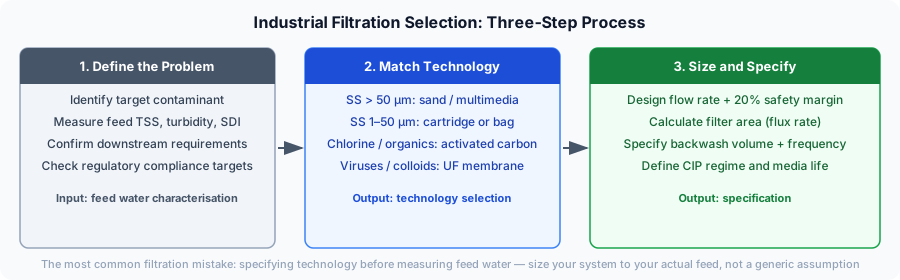
Suspended solids above 50 µm: multimedia or pressure sand filter. Simple, low-cost, high-throughput. Backwash-regenerable, long media life.
Suspended solids 1 to 50 µm: cartridge or bag filter for lower flow rates; multimedia with flocculant dosing for higher flow rates. Cartridge filters used at this size range as guard filters on RO, not as primary treatment.
Chlorine and dissolved organics: GAC. Size for EBCT based on target compound, 7 minutes for chlorine removal, 15 to 20 minutes for THM and VOC reduction.
Colloidal material, SDI reduction, pathogen removal: UF membrane. Design flux typically 30 to 80 LMH (litres per square metre per hour), higher flux shortens cleaning intervals, so design at 60 to 70% of the maximum flux for the feed water type to allow fouling tolerance.
Multiple contaminants: staged treatment train. The sequencing matters, larger particles first, then smaller, then dissolved contaminants. Reversing this order (carbon first, then multimedia) loads the expensive carbon bed with suspended solids that could have been cheaply removed upstream, dramatically shortening GAC life.
[Browse filtration system providers](/providers) who can validate this technology selection against your specific feed water data, general-purpose quotes are rarely the right answer for industrial filtration design.
## Sizing and Specifying Industrial Filtration Systems
Accurate sizing requires four inputs: design flow rate, feed water quality (TSS, turbidity, SDI, key contaminants), target effluent quality, and the downstream process requirements. Of these, feed water quality characterisation is consistently the weakest part of industrial filtration specifications, either missing entirely or based on a single sample rather than the range experienced over a season or production cycle.
Key sizing parameters:
- Hydraulic loading rate (m/hr or LMH): filter area = design flow / loading rate. Add 20% safety margin for peak flow events - EBCT (minutes): bed volume = design flow x EBCT - Backwash requirements: multimedia filters require 10 to 15 minutes backwash at 30 to 40 m/hr flow. Backwash water volume is typically 3 to 5% of production volume, relevant for sites with water scarcity or high effluent treatment cost - Differential pressure monitoring: all filter housings must be fitted with inlet/outlet pressure gauges. dP rise is the primary indicator of loading state and replacement requirement for cartridge filters
Specify actual feed water data, not typical values. A pressure sand filter sized for municipal feed water (SDI 1 to 2) will have a very different media selection and backwash requirement than one treating surface water after coagulation (SDI 3 to 5, with floc loading). The same nominal vessel size behaves completely differently.
## Where Filtration Projects Go Wrong
1. Cartridge filters used as primary filtration Decision made: to reduce CAPEX, multimedia filtration was omitted; cartridge filters specified as the sole pretreatment before RO. Feed water was river intake after coagulation with SDI 4 to 6 and residual turbidity 2 to 5 NTU. Outcome: cartridge filters blinded within 2 to 4 hours of operation, requiring replacement 3 to 4 times per day at $200 to 400 per housing per change. Annual consumable cost: $85,000 versus $15,000 for multimedia + cartridge polishing. Correct decision: cartridges are guard filters, not work-horses. Never use them as primary filtration against turbid feeds.
2. GAC media not replaced at exhaustion Decision made: GAC replacement deferred on cost grounds when iodine number testing indicated exhaustion; chlorine monitoring was visual (test kit) rather than continuous inline. Outcome: chlorine breakthrough to RO feed was not detected for 48 hours. Membrane rejection dropped from 98.7% to 89% within 36 hours, irreversible oxidative damage. Replacement cost: 3 pressure vessels, 18 membrane elements at $250 each = $34,500. Correct decision: continuous inline chlorine analyser on GAC outlet, hard interlock to RO shutdown on high chlorine alarm.
3. UF flux set too high to minimise footprint Decision made: UF system designed at 90% of maximum flux to minimise vessel count and reduce capital cost. Feed water was secondary effluent with high biopolymer content. Outcome: irreversible fouling within 4 months, CIP frequency escalated to twice-weekly; membrane integrity declining by month 6. Correct decision: design at 60 to 65% of maximum allowable flux for secondary effluent feeds. The 20% flux reduction reduces vessel count by only 25%, but extends CIP intervals by 3 to 5x and doubles membrane life.
4. Nominal cartridge rating treated as absolute Decision made: 5-micron nominal cartridge filters specified for final RO pretreatment, with the assumption that particles above 5 µm would be removed. A nominal-rated filter typically passes 40 to 60% of particles at the nominal size, absolute-rated filters remove 99.9%+ at the rated size. Outcome: membrane fouling rate significantly higher than design, requiring monthly CIP rather than quarterly. Correct decision: always specify absolute-rated cartridges for RO guard duty, and specify the rating explicitly in the purchase order. The cost difference between nominal and absolute cartridges is minimal; the performance difference is significant.
The [Water Research, granular activated carbon performance](dofollow:https://www.sciencedirect.com/journal/water-research) documents field performance of GAC in industrial pretreatment applications, including breakthrough curves and exhaustion rates under varying feed conditions.
[Post your filtration project](/post-project) with actual feed water data, and receive proposals from providers who will size the system to your operating reality rather than a catalogue assumption. [Use Nepti to model your filtration train](/nepti) before engaging vendors, understanding your contaminant profile makes the specification process significantly faster and more defensible.
## FAQ
### What is the difference between nominal and absolute filter ratings?
A nominal filter rating indicates the particle size at which the filter achieves approximately 60 to 85% removal efficiency, the exact definition varies between manufacturers, making nominal ratings non-comparable. An absolute filter rating indicates the particle size at which the filter achieves 99.9% or greater removal under specified test conditions (ISO 16889 Beta ratio test). For critical applications, RO guard duty, pharmaceutical-grade water, or any application where particle breakthrough has consequences, always specify absolute-rated filters. Nominal-rated filters are appropriate only for low-consequence applications where approximate particle removal is acceptable.
### How often should multimedia filters be backwashed?
Backwash frequency depends on feed water TSS and the filter's design pressure differential. Typical industrial practice is once or twice per day for filters treating moderately turbid feeds (5 to 50 NTU feed), increasing to 3 to 4 times per day for high-turbidity feeds. Some systems use timer-based backwash (fixed interval); better practice is dP-triggered backwash (initiate when pressure differential reaches 0.5 to 0.7 bar). dP-triggered backwash extends filter run times during periods of clean feed, and ensures prompt backwash when turbidity spikes occur.
### Can activated carbon remove all dissolved contaminants?
No. GAC removes contaminants by adsorption, the contaminant must have affinity for the carbon surface. GAC is highly effective for: chlorine, chloramines, THMs, VOCs, many pesticides, taste and odour compounds, and moderate TOC reduction. GAC is NOT effective for: dissolved inorganic ions (nitrates, fluoride, hardness, metals in ionic form), dissolved gases (CO2, radon), and low-molecular-weight polar organics (methanol, acetone, MTBE at low concentration). If your contaminant is not on the adsorption list, GAC will not remove it, regardless of contact time or carbon quality.
### What flow rate can a pressure sand filter handle?
A pressure sand filter operating at 15 to 25 m/hr hydraulic loading is standard for most industrial applications. At these rates, a 1-metre diameter vessel handles approximately 12 to 20 m³/hr; a 2-metre diameter vessel handles 47 to 80 m³/hr. For higher flow rates, multiple vessels in parallel are used. Surface area scales as the square of diameter, so doubling vessel diameter quadruples the flow capacity. Filters should not operate above 30 m/hr, above this, shear forces disrupt the filter bed and particles that were captured are re-suspended.
### When should UF replace multimedia filtration for RO pretreatment?
The decision threshold is SDI. If feed water SDI is consistently above 3 after multimedia filtration (measured at the multimedia outlet, before the cartridge filter), UF is justified for RO pretreatment. If SDI is consistently below 3 after multimedia, UF adds cost without proportionate benefit. Surface waters, secondary effluents, and industrial process waters with significant biological or colloidal loading typically require UF. Deep groundwater and good-quality municipal supplies typically do not. Measure SDI at multiple times of year, seasonal variation in surface water SDI can be significant and a system designed for average conditions will fail during high-turbidity events.
### How is activated carbon exhaustion detected?
The definitive test is the iodine number, a laboratory measurement of the carbon's remaining adsorption capacity. A fresh coconut-shell GAC typically has an iodine number of 900 to 1,100 mg/g; replacement is indicated when it falls below 600 to 700 mg/g. In-service testing frequency should be quarterly for chlorine removal applications and semi-annually for TOC/TOC applications. For RO-upstream carbon, supplement iodine number testing with continuous inline chlorine monitoring at the carbon outlet, this provides real-time warning of chlorine breakthrough regardless of average exhaustion state. Iodine numbers are averages across the bed; channelling can cause localised breakthrough before overall exhaustion.