Cooling towers concentrate dissolved solids with every cycle. Without scale inhibition, biocide rotation, and blowdown control, the result is fouled heat exchangers, corroded pipework, and Legionella liability. This guide covers the chemistry, the compliance requirements, and the treatment programme decisions that matter.
A poorly run cooling tower water treatment programme on a 5 MW industrial system bleeds $80,000 to 250,000/year in energy penalties from scaled heat exchangers, premature equipment replacement, and emergency Legionella response, and that is BEFORE counting the existential risk of a fatal Legionnaires' outbreak that has put facilities managers on criminal-prosecution lists across Europe. A proper programme costs $6,000 to 15,000/year. The economics are not subtle.
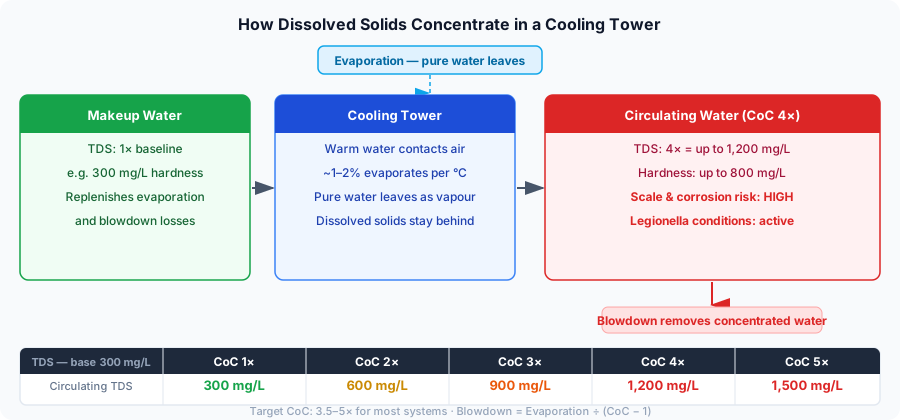
Cooling towers concentrate dissolved solids with every evaporation cycle: a system running at 4 cycles of concentration turns incoming water at 300 mg/L TDS into circulating water at 1,200 mg/L within days. Without active scale inhibition, biocide rotation, conductivity-based blowdown, and documented Legionella monitoring, the failure modes are not hypothetical, they are predictable, measured, and well-understood. The "treatment as chemical-supply contract" model that dominates the market is the single most expensive procurement decision a facilities team can make. The cheapest chemistry programme on paper is routinely the most expensive in operating reality.
This guide is for plant engineers and facility operators running cooling water systems day-to-day, procurement leads writing the next treatment RFP, and sustainability/ESG directors building the multi-site water and energy business case. It covers the chemistry that forces action, the three failure modes that destroy efficiency, the Legionella regime that sits on top of every cooling tower, the cost of a proper programme versus what shortcuts actually cost, and the dollar number that should drive the next procurement decision.
## The decision in brief
- Replace the chemical-supply contract with an engineered programme. On a single 5 MW industrial cooling system, you avoid $80,000 to 250,000/year in scale-driven energy waste, premature equipment replacement, and Legionella incident exposure. - Price the programme against what it avoids. The incremental annual cost is $8,000 to 15,000, and the payback ratio is 5 to 20 times before reputational and regulatory exposure are even priced in. - Scale it across the portfolio. Across a 3-site portfolio, the avoided cost compounds to a seven-figure number over a 5-year contract term, the number to weigh against what looks like a saving on the procurement line.
The biggest cost of doing nothing is staying with the lowest-bidder chemical supplier whose interests are aligned with selling more chemicals, not minimising your operating cost, which quietly burns six figures every year.
## What Cooling Tower Water Treatment Actually Does
A cooling tower rejects heat by evaporating a fraction of the circulating water. That evaporation removes pure water, the dissolved solids stay behind. With every cycle, the concentration of [calcium](/elements/calcium), magnesium, silica, chloride, and other ions increases in the basin.
Cycles of concentration (CoC) is the ratio of dissolved solids in the circulating water versus the makeup water. At CoC 4, feed water with 200 mg/L hardness produces circulating water at 800 mg/L hardness. At CoC 6, it reaches 1,200 mg/L. Both figures are achievable within a few days of operation without blowdown control.
Treatment has three objectives:
- Prevent scale, keep calcium carbonate and calcium sulphate in solution rather than depositing on heat transfer surfaces - Prevent corrosion, protect steel, copper, and galvanised metal in the system from electrochemical attack - Control biological growth, suppress bacteria, algae, and biofilm, with particular focus on *Legionella pneumophila*
None of these objectives can be achieved by a single chemical. A complete programme is always multi-component.
## The Chemistry That Forces Action
The Langelier Saturation Index (LSI) determines whether circulating water will deposit calcium carbonate or dissolve it. An LSI above +0.5 in a cooling circuit means scale is forming. An LSI below -0.5 means the water is corrosive to metal surfaces. Maintaining LSI between -0.2 and +0.5 is the target for most systems, slightly scale-tending to protect metal, but not aggressively depositing.
LSI is influenced by temperature, pH, hardness, alkalinity, and TDS. As cycles increase, LSI rises. As the tower cools water across a temperature differential of 5 to 10°C, saturation conditions change within minutes. This is dynamic chemistry, not a set-and-forget calculation.
Silica is a separate problem. Above 150 mg/L in the circulating water, silica scale begins forming, and silica scale is among the hardest deposits to remove chemically. Many sites with high-silica makeup water need CoC limited to 2 to 3 regardless of other chemistry.
## Scale, Corrosion, and Biofouling: Three Mechanisms That Kill Efficiency
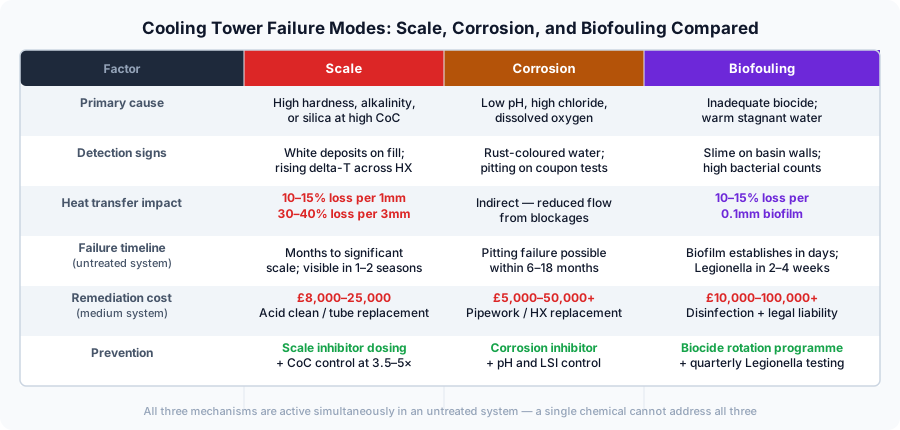
Each failure mechanism has a different timeline, detection signature, and cost profile. In an untreated system, all three operate simultaneously.
| Failure mode | Time to visible damage | Annual cost on a 500 kW chiller | Detection signature | Prevention cost | |---|---|---|---|---| | Scale (CaCO3) | 6 to 18 months without inhibitor | $10,000 to 25,000 in extra electricity per mm of scale | Rising condenser approach temp; visible white deposits on fill | Phosphonate inhibitor + CoC control: $2,000 to 4,000/yr | | Corrosion (uniform/pitting/galvanic) | 18 months to 5 years | $5,000 to 15,000/yr ongoing + $30,000 to 80,000 per tube failure | Rising iron/copper in basin; coupon weight loss; localised perforations | pH/inhibitor maintenance: $1,500 to 3,500/yr | | Biofouling (biofilm + algae) | 1 to 6 months without biocide | $8,000 to 20,000/yr + Legionella exposure ($45K, 180K per incident) | Slime on fill, dropping biocide residual, rising bacterial counts | Oxidising/non-oxidising biocide rotation: $2,500 to 5,000/yr |
### Scale
Calcium carbonate scale on heat exchanger tubes is the most common and most measured failure mode. The relationship between scale thickness and heat transfer loss is well established:
- 1 mm of calcium carbonate scale: 10 to 15% reduction in heat transfer efficiency - 3 mm: 30 to 40% reduction - 6 mm: the system may be incapable of meeting design heat rejection capacity
A 500 kW chiller condenser with 5 mm of scale may require 20 to 30% more energy to maintain setpoint, translating to $10,000 to 25,000 in additional electricity costs per year at typical commercial rates. Scale also creates differential pressure across heat exchangers, increases pump energy consumption, and can eventually block tubes entirely.
The frustration is that scale accumulates invisibly. Most facilities only discover it during reactive maintenance when performance has already degraded significantly.
### Corrosion
Three forms matter in cooling systems:
- Uniform corrosion, slow metal loss across a surface; detectable by coupon testing; predictable but cumulative - Pitting corrosion, localised attack creating deep holes in pipework or tubes; unpredictable; can cause through-wall failure within months - Galvanic corrosion, where dissimilar metals (copper and galvanised steel is a common pairing) are electrically connected in the circuit
Pitting is the most dangerous. Chloride ions, even at modest concentrations, accelerate pitting in carbon steel and stainless steel. A circuit running at CoC 5 with chloride-rich makeup water can generate circulating chloride levels that attack pipework even when other chemistry parameters look controlled.
### Biofouling
Biofilm, the matrix of bacteria and polysaccharides that attaches to surfaces, is both an efficiency problem and a biological risk. A 0.1 mm biofilm on a heat exchanger surface reduces heat transfer by approximately 10 to 15%, comparable in impact to a much thicker mineral scale deposit. It also provides shelter for *Legionella pneumophila*, protecting cells from both heat and disinfectants.
Algae growth in open towers, driven by sunlight exposure in the fill media, consumes dissolved oxygen and creates localised pH drops that accelerate corrosion underneath the biofilm layer.
## Legionella: Why Cooling Towers Carry the Highest Biological Risk
Cooling towers create warm aerosol at 20 to 45°C, the exact temperature range in which *Legionella pneumophila* multiplies fastest. The aerosol is fine enough to be inhaled deep into the lungs. The combination of droplet generation, biological growth conditions, and proximity to occupied buildings makes evaporative cooling the highest-risk water system category in the built environment.
This is not theoretical. Cooling tower-associated Legionnaires' disease outbreaks have resulted in multiple fatalities, enforcement action, and multi-million-pound liability claims in the UK and across Europe. The [WHO guidance on Legionella and the prevention of legionellosis](dofollow:https://apps.who.int/iris/handle/10665/44092) identifies cooling towers as the primary amplification risk requiring mandatory control programmes.
Temperature management alone is insufficient. Maintaining hot water above 60°C and cold water below 20°C, the standard domestic approach, does not apply to cooling towers, which operate in the Legionella growth range by design. Chemical control is the primary barrier.
Legionella risk in cooling towers is also seasonal. Growth accelerates in warmer months, and systems that sit idle over winter and are re-commissioned in spring without prior disinfection can release high bacterial loads into their first cycle of operation. This failure mode has caused documented outbreaks across Europe.
The legal framework is clear. In the UK, cooling towers must be registered with the local authority. Risk assessments, written schemes of control, and documented monitoring are legal requirements under HSE L8, not guidance. In most EU member states, equivalent national regulations based on the EU Biocidal Products Regulation and Workplace Health and Safety directives apply.
[cta:nepti-dark]
## Building an Effective Treatment Programme
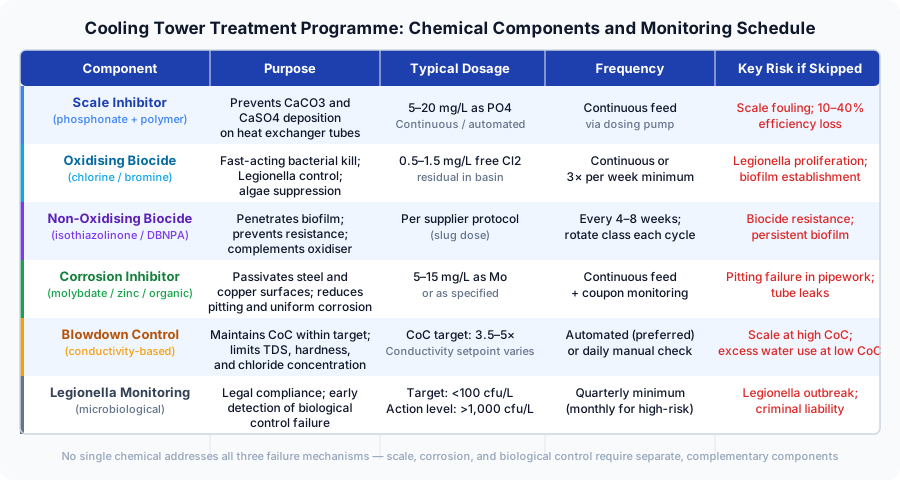
A complete cooling tower treatment programme has four elements, not one:
1. Scale and corrosion inhibitors
Phosphonate-based inhibitors are the workhorse of cooling water chemistry. They function by threshold inhibition, small concentrations (2 to 15 mg/L as PO4) prevent scale nucleation at bulk concentrations where calcium carbonate would otherwise precipitate. They also passivate steel surfaces, reducing corrosion rates.
Polymer dispersants (polyacrylate-based) work alongside phosphonates to keep any particles that do form suspended rather than depositing. Zinc-containing formulations are used where aggressive corrosion requires additional cathodic protection, though zinc is increasingly restricted in environmental discharge conditions.
2. Biocide programme
No single biocide is adequate for a professional cooling water programme. Rotation between oxidising and non-oxidising biocides is standard practice:
- Oxidising biocides ([chlorine](/elements/chlorine), bromine, chlorine dioxide): fast-acting, attack cell walls directly; depleted quickly by organic load and heat; require continuous or high-frequency dosing - Non-oxidising biocides (isothiazolinone, DBNPA, quaternary ammonium compounds): membrane-disrupting or enzyme-blocking; longer-lasting; selected to prevent resistance development
Target free chlorine or bromine residuals in the tower basin: 0.5 to 1.5 mg/L as Cl2. Residuals above 3 mg/L accelerate corrosion; below 0.2 mg/L, biological control is not achieved.
3. Blowdown control
Blowdown, the deliberate discharge of circulating water to dilute dissolved solids, is the primary lever for controlling CoC. Automated conductivity control (bleeding to drain when conductivity exceeds a setpoint) is strongly preferred over manual blowdown, which is inconsistent and commonly skipped under operational pressure. For the deeper engineering, control method comparison, discharge-permit perimeter, and the five recurring blowdown failure modes, see our [cooling tower blowdown guide](/resources/cooling-tower-blowdown).
Target CoC for most systems is 3.5 to 5x. Higher is better for water efficiency but increases scale and corrosion risk; lower wastes makeup water and chemicals. The optimum depends on makeup water quality, regulatory discharge limits, and heat rejection demand.
4. Monitoring
A documented monitoring schedule is both a compliance requirement and the only reliable early-warning system for treatment drift. At minimum:
- Weekly: pH, conductivity, free biocide residual, visual inspection - Monthly: hardness, alkalinity, inhibitor levels, corrosion coupon evaluation - Quarterly: full microbiological analysis including *Legionella* count (target: <100 cfu/L; action level: >1,000 cfu/L) - Annual: full system inspection, disinfection before seasonal recommissioning
[Nepti](/nepti) can model your makeup water chemistry, simulate CoC scenarios, and generate a ranked comparison of treatment programme options, useful for new installations or sites where the current programme is underperforming before you commission external providers.
[HSE L8 Approved Code of Practice for the Control of Legionella Bacteria in Water Systems](dofollow:https://www.hse.gov.uk/pubns/books/l8.htm) defines the legal standard for cooling water management in the UK and is the primary reference for written scheme preparation, competency requirements, and monitoring frequencies.
## CAPEX and OPEX: What a Cooling Tower Treatment Programme Actually Costs
Programme costs scale with system size, water volume, and automation level.
Manual dosing programme (small to mid-size systems)
- Chemical supply: $3,100 to 6,300/year - Monitoring and testing: $1,250 to 2,500/year - Specialist service visits: $1,900 to 3,800/year (quarterly typical) - Total OPEX: $6,300 to 12,500/year
Manual programmes are cheaper on paper but depend on consistent execution. Dosing is frequently inconsistent when maintenance workload is high, producing periods of over-treatment (accelerated corrosion) or under-treatment (scale or biological growth).
Automated dosing system
- CAPEX (dosing controllers, conductivity probes, biocide pump sets): $6,300 to 18,750 depending on system size - Ongoing chemical supply: $1,900 to 4,400/year - Service contract: $1,250 to 2,500/year - Total OPEX: $3,100 to 6,900/year after payback (typically 2 to 3 years)
Automation pays back in both cost reduction and risk reduction. Conductivity-based blowdown control typically reduces makeup water consumption by 15 to 25% versus manual blowdown, and consistent chemical dosing reduces both scale formation and corrosion.
| Aspect | Manual dosing | Automated dosing | Side-stream filtration (add-on) | |---|---|---|---| | CAPEX | $0 to 500 | $6,300 to 18,750 | $3,750 to 10,000 | | Annual chemical cost | $3,100 to 6,300 | $1,900 to 4,400 | n/a | | Annual service cost | $1,900 to 3,800 | $1,250 to 2,500 | $625 to 1,900 | | Total annual OPEX | $6,300 to 12,500 | $3,100 to 6,900 (after 2 to 3 yr payback) | $625 to 1,900 ongoing | | Makeup water consumption | Baseline | 15 to 25% lower | Same as base programme | | Failure-mode risk | High (operator-dependent) | Low (sensor-controlled) | n/a | | Best for | Small systems, tight budgets, high-discipline teams | Mid/large systems, sites with poor manual-dosing track record | High-dust/industrial sites, prolonging heat exchanger life |
Side-stream filtration (recommended for high-turbidity or industrial sites)
Cooling towers are open to atmosphere. Dust, pollen, microorganisms, and airborne particles enter the basin continuously. In industrial locations, near quarrying, construction, or high-dust manufacturing, particulate loading drives rapid filter fouling and biofilm formation.
Side-stream filtration (sand or disc filters processing 5 to 10% of circulating flow) removes suspended solids before they deposit on heat exchanger surfaces.
- CAPEX: $3,750 to 10,000 - OPEX: $625 to 1,900/year (backwash water, media replacement)
The payback is longer than dosing automation, but in high-contamination environments it is often the single most effective measure for extending heat exchanger service life.
## Where Cooling Tower Treatment Fails
The failure patterns across industrial and commercial cooling water sites are consistent enough to be predictable.
### Seasonal shutdown without prior disinfection
A cooling tower sits idle for 3 to 4 months over winter. Water in the basin stagnates. Temperatures in spring return to the 25 to 40°C growth range. Biofilm that formed during autumn is not cleared. The system re-starts and distributes Legionella-laden aerosol across the building or surrounding area.
Proper protocol: full disinfection before re-commissioning (typically hyperchlorination to 50 mg/L free chlorine for 6 hours, followed by flushing, testing, and staged return to operation). This is a legal requirement in most jurisdictions. Multiple documented outbreaks across Europe trace directly to this omission, and several have resulted in criminal prosecution of facilities managers.
### Manual dosing with no feedback monitoring
A site uses a chemical supplier who delivers biocide and scale inhibitor quarterly. The engineer doses to a schedule. No conductivity monitoring, no residual testing between visits. In practice:
- Blowdown is skipped during peak summer operation when plant workload is highest - CoC rises to 8 to 10x during hot weeks - Scale deposits accumulate undetected through the summer - The following January, an inspection reveals 8 mm of scale on condenser tubes
Remediation cost: $19,000 to 44,000 for tube cleaning, replacement of badly fouled sections, and a 3 to 5 day production interruption.
The chemical supplier's contract was profitable. The site's outcome was not.
### Biocide resistance from single-product programmes
Sites that use a single biocide continuously, often because it is cheapest, create selection pressure for resistant strains. Quaternary ammonium compound resistance in Legionella-associated biofilms is documented in the literature. [ASHRAE Standard 188](dofollow:https://www.ashrae.org/technical-resources/bookstore/ansi-ashrae-standard-188-2021-legionellosis-risk-management-for-building-water-systems) requires a water management programme that includes multiple control measures, not reliance on a single biocide. Rotating biocide classes every 4 to 8 weeks, combined with periodic shock dosing, is the minimum professional standard.
## Selecting a Water Treatment Provider for Cooling Systems
A cooling water treatment provider should be doing more than delivering chemicals. The distinction between a chemical supply contract and a managed water treatment programme is significant, and it is the difference that determines whether your system runs reliably or generates liability.
What a good programme looks like:
- Initial site survey and risk assessment covering system configuration, makeup water quality, and existing condition - Written water treatment scheme with dosing targets, monitoring frequencies, and corrective action thresholds - Regular service visits with documented test results - 24/7 emergency response capability for Legionella exceedances - Annual system inspection and pre-commissioning disinfection
Red flags:
- Proposal delivered without a site visit - Programme based on a standard package without makeup water analysis - No documented monitoring schedule included in the contract - Chemical costs are the only variable discussed (the cheapest chemical programme is often the most expensive when remediation costs are factored in) - Inability to provide certified Legionella testing through an accredited laboratory (UKAS in the UK; EN ISO 11731 test standard)
[Post your cooling tower water treatment challenge on Aguato](/post-project) and receive independent proposals from qualified providers, compare monitoring programmes, service models, and costs without committing to a single supplier upfront.
If you want to characterise your makeup water chemistry and simulate which treatment programme is most cost-effective for your system configuration before engaging providers, [Nepti](/nepti) can run that analysis for you.
For water-cooled systems, the chiller loop and condenser loop require separate treatment programmes. See our guide to [industrial water chillers](/resources/industrial-water-chiller) for detail on closed-loop chemistry requirements and water quality thresholds for chiller warranty compliance. Where cooling towers serve HVAC plant rooms alongside hot water circuits and air handling units, the [HVAC water treatment guide](/resources/hvac-water-treatment) covers the full building water system context. For high-density compute sites, the [data center water treatment](/resources/data-center-water-treatment) guide covers the cooling-water programme, reuse strategy, and Legionella compliance specific to hyperscale and colocation facilities. If your site also operates steam or hot water boilers alongside the cooling tower, [boiler water treatment](/resources/industrial-boiler-water-treatment) runs on different chemistry, the two programmes interact at the softener and makeup water stage.
## Frequently Asked Questions
### How often should cooling tower water be tested?
At minimum: pH, conductivity, and free biocide residual weekly; hardness, alkalinity, and inhibitor levels monthly; full microbiological analysis including Legionella quarterly. High-risk systems (large towers, hospital sites, public-facing buildings) require monthly Legionella testing. Any system returning a Legionella count above 1,000 cfu/L requires immediate remedial action regardless of the scheduled testing frequency.
### What is the correct cycles of concentration for a cooling tower?
For most industrial systems with normal makeup water quality (hardness under 300 mg/L as CaCO3, silica under 30 mg/L), CoC 3.5 to 5x is the operational target. Higher cycles reduce makeup water and chemical consumption but increase scale and corrosion risk. Hard or silica-rich supply water may require limiting CoC to 2 to 3x. The optimum is calculated from your specific makeup water analysis, not a generic recommendation.
### Is chlorine or bromine better for cooling tower disinfection?
Both are oxidising biocides and both work, but they have different profiles. Bromine is more stable at higher pH (8.0 to 8.5, typical in carbonate-buffered cooling water) and more effective per unit weight in that range. Chlorine is cheaper and more universally available. Neither should be used as the sole biocide, both require supplementation with a non-oxidising biocide on a rotation schedule to prevent biofilm establishment and resistance development. For a full comparison of chlorination, UV, and ozone across industrial applications, see our guide to [industrial water disinfection](/resources/industrial-water-disinfection). For the full statutory framework governing Legionella control in cooling systems and HVAC, see our [Legionella risk assessment guide](/resources/legionella-risk-assessment).
### What causes white deposits on cooling tower fill media?
White deposits are almost always calcium carbonate scale, formed when the circulating water exceeds its calcium carbonate saturation point. The fill media, with its large surface area and active evaporation, is the first place scale appears. Significant fill fouling reduces airflow, increases fan energy consumption, and reduces cooling capacity. It also provides a substrate for biofilm. Prevention requires scale inhibitor dosing and CoC control; removal requires acid cleaning (citric or hydrochloric) or fill replacement in severe cases.
### Do I need a Legionella risk assessment for a cooling tower?
Yes, this is a legal requirement in the UK (HSE L8), across EU member states, and in most other jurisdictions. The risk assessment must be carried out by a competent person, documented, reviewed at least every two years (or after any significant system change), and acted upon. Registration with the local authority is also required in England and Wales for any notifiable cooling system. Failure to comply is a criminal offence.
### Can I manage cooling tower water treatment in-house?
For chemical dosing and routine monitoring, yes, if the in-house team has the training and time. For Legionella risk assessment, written scheme preparation, and microbiological testing, a competent external specialist is required. The distinction matters: site staff can be trained to test conductivity and dose chemicals; they cannot self-certify a Legionella risk assessment unless they hold relevant competency qualifications (City & Guilds 6084, or equivalent). Most medium-to-large sites use a hybrid model, in-house routine monitoring with quarterly specialist service visits and annual inspection.
### How do I calculate blowdown rate?
The standard formula is: Blowdown (L/hr) = Evaporation rate (L/hr) divided by (Cycles of concentration minus 1). Evaporation rate is approximately 0.1 to 0.2% of circulating flow per degree Celsius of cooling range. For a system circulating 100 m3/hr across a 6°C cooling range, evaporation is approximately 600 to 1,200 L/hr. At CoC 4, blowdown should be 200 to 400 L/hr. Automated conductivity control maintains this ratio continuously; manual blowdown requires consistent operator action and is frequently under-executed in practice.