Reverse osmosis is the dominant technology for dissolved solids removal in industrial water treatment. This guide covers system design, sizing, CAPEX/OPEX benchmarks, pretreatment requirements, and the failure modes that cut membrane life in half.
Reverse osmosis (RO) is the most widely deployed technology for removing dissolved solids from water at industrial scale. A correctly designed and operated RO system achieves 96 to 99.7% salt rejection, producing permeate with TDS below 50 mg/L from most feed waters, a performance level no other single-pass technology matches at comparable cost. The [WHO TDS guidelines for drinking water](dofollow:https://www.who.int/publications/i/item/9789241549950) establish that drinking water TDS below 600 mg/L is generally acceptable; RO delivers this consistently from municipal, brackish, and even seawater feeds.
Where RO fails, the cause is almost always pretreatment, not the membranes themselves. Understanding that distinction is the central skill in RO system management.
## What Reverse Osmosis Actually Does (and Its Limits)
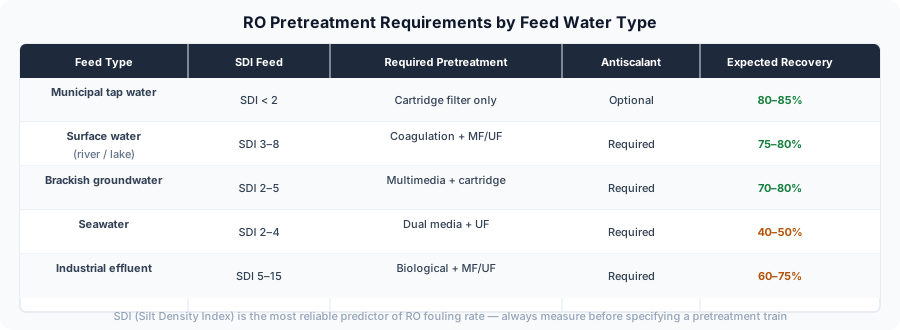
RO uses hydraulic pressure to force water through a semi-permeable membrane against the osmotic pressure gradient. The membrane rejects dissolved ions, organics, and microorganisms, allowing only water molecules and very small uncharged molecules to pass. Operating pressure ranges from 10 to 20 bar for brackish water to 55 to 80 bar for seawater, this energy cost is the dominant OPEX driver.
What RO does not remove well: dissolved gases (CO2, H2S pass freely), uncharged low-molecular-weight organics (some solvents, NDMA), and boron (rejection 60 to 80% at standard pH, requiring two-pass or elevated pH operation to achieve pharmaceutical-grade specifications). For feed waters with these contaminants, additional post-treatment is required.
RO is also not the right technology for every dissolved-solids problem. If TDS is below 500 mg/L and the target is softening or specific ion removal rather than near-zero TDS, [nanofiltration](/resources/nanofiltration) or ion exchange typically delivers better economics. Read the [RO vs nanofiltration vs ultrafiltration comparison](/resources/ro-vs-nf-vs-uf-comparison) to understand where each membrane type has an edge.
The recovery rate, what fraction of feed water becomes permeate, is constrained by scaling and concentration polarisation. Brackish water systems typically achieve 70 to 85% recovery; seawater RO is limited to 40 to 50% because osmotic pressure at the membrane surface increases with concentration, requiring more energy and eventually causing precipitation.
## Pretreatment: The Part That Determines Whether Your Membranes Last
Every RO specification starts with feed water characterisation. The most important single measurement is the Silt Density Index (SDI), a standardised 15-minute filtration test that predicts fouling tendency. RO membranes require SDI below 3; SDI above 5 causes rapid irreversible fouling regardless of how good the membranes are.
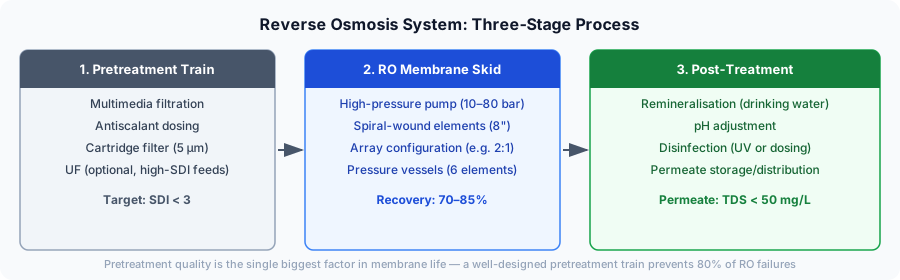
The pretreatment train must be designed for the specific feed water, not a generic template. Across the industrial installations we track, the single most common cause of premature membrane replacement is inadequate pretreatment specified from a catalogue rather than from actual feed water data.
Key pretreatment components and their function:
- Multimedia filtration (dual or triple layer): removes suspended solids above 10 to 25 µm, protecting downstream cartridge filters and membranes from bulk particle loading - Antiscalant dosing: threshold inhibitors that delay precipitation of sparingly soluble salts (calcium carbonate, calcium sulphate, silica, barium sulphate) within the concentrate stream, critical for any system with Langelier Saturation Index above zero - Cartridge filtration (5 µm): final particle barrier before the high-pressure pump; protects pump impellers and feed spacers from physical damage - [UF pretreatment](/resources/ultrafiltration): justified when feed SDI exceeds 3 consistently (surface water, industrial effluent), extends RO CIP intervals by 2 to 4x compared to multimedia-only pretreatment
[Chlorine](/elements/chlorine) is the most destructive chemical for polyamide RO membranes. Free chlorine above 0.1 mg/L causes irreversible oxidative degradation of the membrane active layer, visible as loss of salt rejection before mechanical failure. Sodium bisulphite (SBS) dosing or activated carbon filtration must completely remove chlorine before the RO feed, and residual must be verified by continuous inline measurement.
## System Design and Array Configuration
An industrial RO system is not a single membrane, it is an array of pressure vessels, each containing 6 to 7 spiral-wound elements in series. The array configuration (expressed as vessels in the first stage : vessels in the second stage, e.g. 2:1 or 4:2:1) manages the hydraulic profile across the system, maintaining adequate crossflow velocity in all elements to control concentration polarisation.
Rule of thumb for array design: maintain element recovery below 15% per element and system recovery within 10% of the design maximum to avoid localised scaling in the tail elements. A 2:1 array at 75% system recovery distributes the concentration gradient across two stages rather than loading all of it onto the final elements.
Sizing the high-pressure pump correctly is critical. Undersizing by even 10 to 15% reduces recovery and wastes energy; oversizing causes excessive throttling and cavitation risk. Pump duty must match the design recovery at the maximum specified feed TDS, not the clean membrane TDP, which will be lower at commissioning and rise as fouling develops.
For systems above 500 m³/day, energy recovery devices (pressure exchangers or turbochargers) on the concentrate stream recover 90 to 95% of the hydraulic energy, reducing SWRO power consumption from 5 to 8 kWh/m³ to 2.5 to 4 kWh/m³. The full breakdown of where the kilowatt-hours go, and the levers that cut them, is in our guide to [desalination energy consumption benchmarks](/resources/desalination-energy-consumption).
[cta:nepti-dark]
## CAPEX, OPEX, and Total Cost of Ownership
RO system economics vary significantly by scale, feed water salinity, and pretreatment requirements. The benchmarks below are for brackish water / industrial feed; seawater RO carries a significant premium due to higher operating pressure and corrosion-resistant metallurgy.
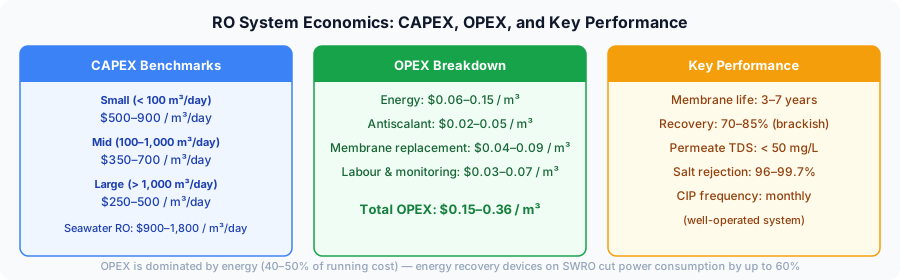
Energy dominates OPEX at 40 to 50% of operating cost. For systems consuming 0.5 to 2 kWh/m³ (brackish water), energy cost at $0.10/kWh contributes $0.05 to 0.20/m³ treated. At seawater pressures (5 to 8 kWh/m³ without energy recovery), this rises to $0.50 to 0.80/m³, which is why energy recovery devices have a compelling payback even at modest scale.
Membrane replacement is the second-largest cost driver. Well-operated brackish water systems achieve 5 to 7 year membrane life; poorly operated systems (inadequate pretreatment, aggressive CIP, chlorine episodes) replace membranes every 2 to 3 years at a cost of $150 to 300 per 8-inch element.
The total cost of ownership is dominated by decisions made at design stage, feed water characterisation, pretreatment sizing, array configuration, and materials selection. Cutting pretreatment CAPEX by $50,000 on a 500 m³/day system will typically cost $150,000 to 300,000 in membrane replacements over the system lifetime. [Post your RO project](/post-project) for independent proposals that include full lifecycle costing, not just installation price.
## Where RO Systems Fail
The failure modes in industrial RO are well-documented and almost entirely preventable. Here are the four most costly patterns:
1. Scaling failure, calcium carbonate or sulphate precipitation Decision made: antiscalant programme specified on design data, not updated when feed water chemistry changed seasonally. Outcome: scale deposition on tail-end elements, 30 to 40% flux decline within 6 months, recovery impossible without aggressive acid CIP. Correct decision: continuous online conductivity monitoring of permeate and concentrate, with antiscalant dose adjustment responsive to actual Langelier SI, not a fixed pump setting.
2. Biological fouling, biofilm development on feed spacers Decision made: biocide programme omitted from OPEX budget; sanitisation performed only when performance deteriorated. Outcome: irreversible biofouling within 12 months on a system treating surface water. Quantified cost: emergency CIP chemicals $8,000 to 15,000, extended downtime, partial membrane replacement $60,000. Correct decision: non-oxidising biocide shock dose every 2 to 4 weeks; hypochlorite flushing for CTA membranes where tolerated.
3. Chlorine damage from SBS failure Decision made: sodium bisulphite dosing pump not fitted with offline alarm; chlorine breakthrough not detected. Outcome: within 72 hours of a pump failure, 40% of membrane active layer oxidised. Salt rejection dropped from 98.5% to 92%, the system ceased to meet process specification. Correct decision: continuous inline ORP monitor on the RO feed with high-alarm shutdown, not a periodic manual check.
4. Over-recovery pushing the system beyond design limits Decision made: operator increased recovery from 75% to 85% to reduce waste water volume without reassessing antiscalant dose or concentrate chemistry. Outcome: precipitation in tail elements within 3 weeks. Correct decision: [model your feed water with Nepti](/nepti) before adjusting operating parameters, recovery changes affect Langelier SI non-linearly and require antiscalant reformulation, not just dose increase.
The [Water Research, RO membrane fouling mechanisms](dofollow:https://www.sciencedirect.com/journal/water-research) literature identifies biological fouling and scaling as responsible for over 70% of unplanned RO downtime across industrial applications.
## Selecting and Specifying an RO System
A credible RO specification requires feed water data, not assumptions. Before approaching [qualified RO system providers](/providers), collect:
- Full ion analysis (Ca, Mg, Na, K, SO4, Cl, HCO3, silica, [barium](/elements/barium), strontium) - SDI at multiple times of year (seasonal variation matters) - Turbidity, pH, temperature range - TOC and biological oxygen demand (for biological fouling risk assessment) - Chlorine and other oxidant residuals
With this data, a competent designer will run an ROSA or IMSDesign projection to verify recovery at the tail element without scaling, validate antiscalant selection, and size the pretreatment train. Any RO quotation that does not reference specific feed water data is a generic product sale, not an engineered solution.
Vendors have a commercial incentive to simplify pretreatment. The cheapest system to install is rarely the cheapest system to operate. Insist on documented element-level flux projections, projected CIP frequency, and membrane replacement frequency as part of the specification, and compare them across bidders.
## FAQ
### What is the typical lifespan of RO membranes?
In a well-operated system with adequate pretreatment, brackish water RO membranes last 5 to 7 years. Seawater RO membranes typically last 3 to 5 years due to higher operating pressures and more aggressive feed conditions. The primary drivers of premature failure are: chlorine exposure (hours-to-days for irreversible damage), severe biological fouling (months), and scaling from inadequate antiscalant dosing (weeks-to-months in hard water). Membrane life is almost entirely a function of operating discipline, the same element chemistry operated correctly lasts 2 to 3x longer than the same element under poor operating conditions.
### How do I know if my RO system needs a CIP clean?
The standard triggers for CIP (Clean-in-Place) are: normalised permeate flow drops more than 10 to 15% from baseline, salt rejection drops more than 1%, or pressure differential across a stage increases more than 15%. These are calculated as normalised values (corrected for temperature and pressure) not raw instrument readings. Monthly CIP is typical for well-operated industrial systems; more frequent cleaning indicates a pretreatment problem that should be resolved upstream, not accepted as normal.
### What is the difference between 1-pass and 2-pass RO?
A single-pass RO system passes feed water through one set of membranes, producing permeate at typically 95 to 99% salt rejection. A 2-pass system feeds the first-pass permeate through a second RO stage, achieving 99.5 to 99.9% rejection and permeate TDS below 5 mg/L. 2-pass is required for pharmaceutical water (Purified Water or WFI specifications), high-pressure boiler feedwater, semiconductor applications, and medical uses such as [dialysis water treatment](/resources/dialysis-water-treatment), where RO sits at the core of an AAMI/ISO-governed train. It roughly doubles the membrane CAPEX and increases energy consumption by 30 to 50%, use it only where the purity specification demands it.
### How is RO recovery calculated and what limits it?
Recovery (%) = (permeate flow / feed flow) x 100. Recovery is limited by scaling risk in the concentrate stream, as recovery increases, the concentration factor (CF = 1/(1-R)) rises sharply. At 75% recovery, CF = 4x; at 85%, CF = 6.7x; at 90%, CF = 10x. For most feed waters, calcium carbonate or sulphate scaling becomes the constraint at 75 to 85% recovery without antiscalant. Silica scaling limits recovery on some groundwater feeds regardless of antiscalant, because silica polymerisation above saturation is not well inhibited by threshold chemicals.
### What is SDI and how is it measured?
SDI (Silt Density Index) is a standardised test (ASTM D4189) measuring the rate at which a 0.45 µm membrane filter is blocked by a water sample over 15 minutes at 207 kPa. SDI below 3 is acceptable for RO; SDI above 5 causes rapid irreversible fouling. It is not directly proportional to turbidity, a water can have low turbidity but high SDI if it contains colloidal material that passes turbidity measurement but blocks the membrane. Always measure SDI, not just turbidity, when designing RO pretreatment.
### Can RO remove bacteria and viruses?
Yes. RO membranes provide an absolute barrier to bacteria (log 6+ removal) and viruses (log 4+ removal) due to their pore size exclusion mechanism. However, RO is not a disinfection technology, post-RO piping and storage must be managed to prevent recontamination. In pharmaceutical and food-grade applications, UV disinfection and periodic hot-water or steam sanitisation of the distribution loop is required to maintain microbiological quality at the point of use.
### What causes salt rejection to drop over time?
Progressive salt rejection decline can result from: membrane oxidation (chlorine damage), physical compaction at elevated pressure, scaling that creates localised concentration cells, O-ring failure in pressure vessel end-caps (causing bypass rather than permeation), or biological fouling creating concentration gradients across the membrane. A sudden drop in rejection (over hours or days) usually indicates a physical breach, O-ring failure or membrane damage. A gradual decline over months points to fouling or compaction. Conduct a salt rejection test at standardised conditions (temperature, pressure, recovery) before drawing conclusions from in-situ instrument readings.
### What is the [EPA Drinking Water Treatment Technologies](dofollow:https://www.epa.gov/water-research/drinking-water-treatment-technologies) guidance on RO for drinking water?
The EPA classifies RO as a Best Available Technology (BAT) for reducing TDS, nitrates, radionuclides, arsenic, fluoride, and several organic contaminants in drinking water systems. For public water systems, the EPA requires post-RO remineralisation or blending to maintain water stability and prevent corrosive attack on distribution infrastructure. The same principle applies to industrial systems supplying water for human consumption, permeate with TDS below 50 mg/L is aggressive towards carbon steel and copper pipework and requires pH adjustment (typically to pH 7.5 to 8.5) and alkalinity restoration before distribution.