A senior engineer's guide to ultrafiltration, what UF membranes actually do, how to size and specify a system, and the failure modes that kill projects before they deliver value.
Ultrafiltration sits at the intersection of cost and performance in membrane water treatment. It is pressure-driven, operates at 0.5 to 3 bar, a fraction of the energy demand of nanofiltration or reverse osmosis, and provides an absolute barrier against bacteria, viruses, and colloidal material down to 0.01 micrometres. No probabilistic removal, no turbidity spikes during backwash, no breakthrough events of the kind that plague conventional sand filtration during high-loading episodes. In RO pretreatment alone, UF has become the standard specification for new industrial plants precisely because it delivers consistent SDI values below 2 regardless of feed water variation.
The technology is mature and the membranes are not the problem. Most UF projects fail from poor feed water characterisation and incorrect flux selection, the feed was assumed, not measured, and the system was designed around an assumption that lasted until commissioning. This guide is a design and decision reference for engineers who need to specify UF correctly: what it removes, what it cannot, how to size and configure a system, and where the common failure modes are.
## What Ultrafiltration Actually Does (and What It Cannot)
Ultrafiltration is a pressure-driven membrane process that removes particles in the 0.01 to 0.1 micron range, bacteria, viruses, colloids, suspended solids, and high-molecular-weight organics, while allowing dissolved salts and small organic molecules to pass through with the permeate.
The driving pressure is typically 0.5 to 3 bar, far lower than nanofiltration or reverse osmosis. That translates directly to lower energy consumption and simpler infrastructure. Most industrial UF systems operate at flux rates of 40 to 120 litres per square metre per hour (LMH) depending on feed water quality and membrane type.
What UF cannot do is equally important to understand. It will not remove dissolved salts, hardness, nitrates, or low-molecular-weight organic compounds. If your process target is TDS reduction or heavy metal removal, you need NF or RO downstream. Conflating UF with full demineralisation is one of the most common scoping errors in industrial water projects.
The [WHO Guidelines for Drinking-water Quality](dofollow:https://www.who.int/publications/i/item/9789241549950) classify UF as a validated barrier against Cryptosporidium and Giardia, organisms that chlorination alone does not reliably inactivate. This positions UF as a critical safety layer in drinking water and food-grade process water applications, not merely a clarification step.
Most UF projects fail not because the membrane is wrong, but because the feed water characterisation was inadequate and fouling was never properly modelled.
## UF vs MF, NF, and RO: Choosing the Right Membrane
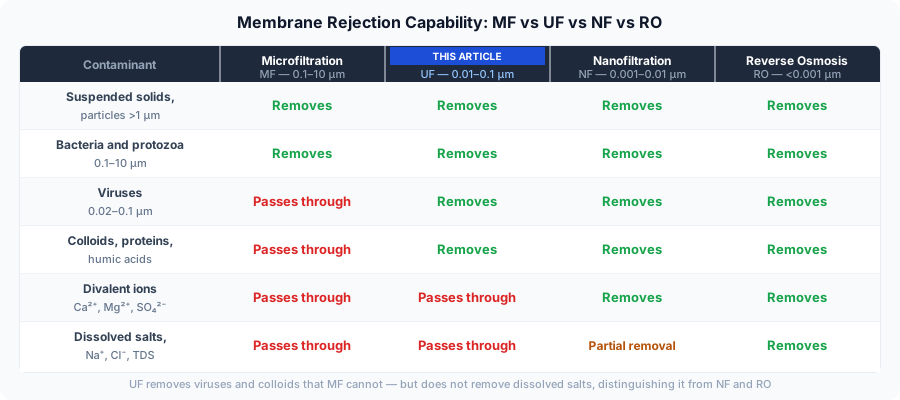
Choosing between membrane technologies is a question of what you need to remove and what you are willing to pay to run the system:
Microfiltration (MF, 0.1 to 10 micron): Removes suspended solids and some bacteria. Does not reliably remove viruses. Used for pre-treatment ahead of UF or RO, or for simple clarification duties. Lowest energy and lowest selectivity.
Ultrafiltration (UF, 0.01 to 0.1 micron): Removes all suspended solids, all bacteria, most viruses, and colloids. The workhorse for municipal drinking water, RO pre-treatment, and food/beverage processing. Molecular weight cut-off (MWCO) ranges from 10,000 to 300,000 Daltons depending on application.
Nanofiltration (NF, 0.001 to 0.01 micron): Removes divalent ions (calcium, magnesium, sulphate), natural organic matter, and micropollutants. Softening without full salt rejection. Operates at 5 to 15 bar and produces a concentrate stream requiring disposal.
Reverse Osmosis (RO, <0.001 micron): Removes essentially everything including monovalent salts. Required when TDS, nitrate, or trace organics are the target. Operates at 10 to 80 bar, highest energy cost, and requires the most rigorous pre-treatment to protect membranes.
The decision is rarely binary. In most industrial plants, UF functions as the pre-treatment stage ahead of RO, removing the colloidal and biological load that would otherwise foul the RO membranes within weeks. A well-designed UF-RO train will extend RO membrane life by 2 to 3x compared to conventional media filtration pre-treatment. For a full side-by-side cost and performance comparison across all four membrane types, see the [RO vs NF vs UF membrane comparison](/resources/ro-vs-nf-vs-uf-comparison).
For [industrial wastewater treatment](/resources/industrial-wastewater-treatment) duties where suspended solids are high and variability is significant, UF outperforms sand filtration because it provides a consistent, absolute barrier rather than a probabilistic one. Where UF sits in the operational sequence, and what upstream stages must deliver to it, is covered in the [step-by-step industrial wastewater treatment process walkthrough](/resources/industrial-wastewater-treatment-process).
## How an Ultrafiltration System Works
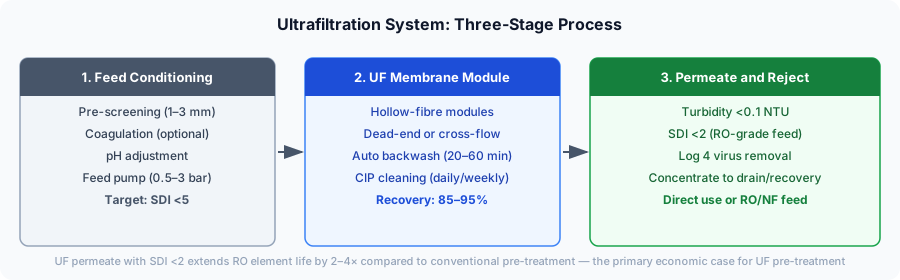
A complete UF system has three functional zones: feed conditioning, membrane filtration, and permeate/reject management. UF sits within the broader [membrane filtration system selection framework](/resources/membrane-filtration-system), choosing UF over NF or RO is a class decision; choosing hollow fibre over tubular is a module decision; both must align for the system to deliver on cost.
Feed conditioning typically involves coarse screening (1 to 3 mm) to protect membrane modules from fibrous material, followed by pH adjustment if needed and sometimes a low-dose coagulant or acid addition to control fouling propensity. Skipping this step is a project-killing mistake, membrane modules exposed to unscreened fibrous feed block within hours.
Membrane filtration in modern systems uses hollow-fibre modules operating in either outside-in or inside-out flow configuration. Outside-in (shell-side feed) allows higher suspended solids loading and is standard for surface water and wastewater applications. Inside-in (lumen-side feed) provides better flow distribution and is preferred for pre-treated or lower-turbidity feeds.
Backwash cycles run automatically every 15 to 45 minutes, reversing permeate flow through the fibres to dislodge accumulated fouling layer. A typical backwash lasts 30 to 60 seconds and uses 3 to 5% of the net permeate output. Enhanced backwashes with air scouring or chemical-enhanced backwash (CEB) using chlorine, caustic, or acid are scheduled weekly to monthly depending on feed water characteristics.
Chemically enhanced cleaning (CIP) is required every 1 to 12 months depending on fouling severity. A standard CIP sequence involves alkaline clean (NaOH + NaOCl) to remove organics and biological fouling, followed by acid clean (citric acid or HCl) to dissolve inorganic scale. CIP downtime is typically 4 to 8 hours per train.
Recovery rates of 85 to 95% are standard for surface water and municipal pre-treatment applications. For [industrial wastewater treatment](/resources/industrial-wastewater-treatment) with high solids loading, recovery may be designed at 75 to 85% to maintain manageable flux and fouling rates.
[cta:nepti-dark]
## Industrial Applications Where UF Delivers Real Value
UF is not a one-size-fits-all technology, but there are specific industrial contexts where it is genuinely the best option:
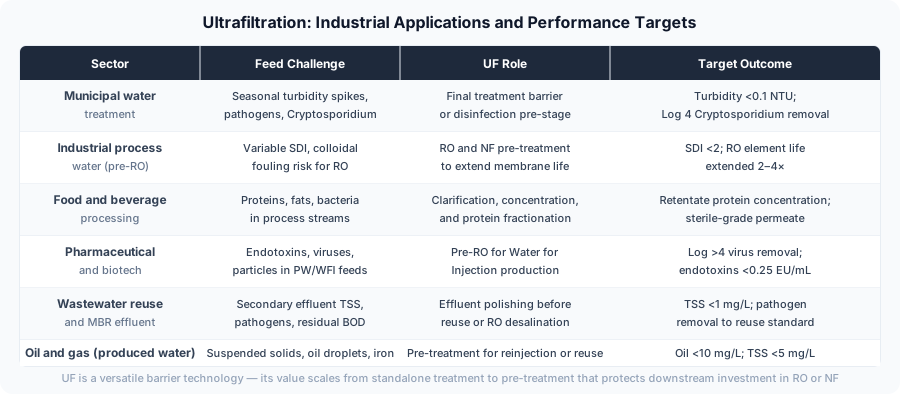
RO pre-treatment (largest market segment): UF as RO pre-treatment has largely displaced dual-media filtration in new-build industrial plants because it delivers consistent SDI (Silt Density Index) values below 2, regardless of feed water variation. Media filters can spike to SDI 5 to 8 during turbidity events. UF holds SDI stable and protects a far more expensive downstream asset.
Food and beverage processing: Dairy (whey concentration, milk standardisation), juice clarification, brewing (beer clarification and sterile filtration), and edible oil processing all rely on UF for product quality and microbiological safety. Here UF serves a dual role, process separation and pathogen barrier. The material specification on these duties has shifted toward inorganic options, see [ceramic membranes](/resources/ceramic-membranes) for the 15-year TCO case on hot-CIP duty, where ceramic UF lasts 15 to 20 years against polymeric's 3 to 5.
Pharmaceutical and biotech: Ultrafiltration in pharmaceutical manufacturing is used for protein concentration, buffer exchange, and sterile filtration. Regulatory acceptance under FDA 21 CFR and EU GMP requires documented integrity testing (pressure decay or diffusion tests) on every production batch. The same endotoxin-barrier role makes UF the final polish in [dialysis water treatment](/resources/dialysis-water-treatment), where a point-of-use ultrafilter is what separates standard dialysis water from the ultrapure grade required for online haemodiafiltration.
Municipal drinking water: Over 5,000 UF drinking water plants operate globally at scales from 500 m3/day community systems to 500,000 m3/day metropolitan plants. The [Water Research, UF membrane fouling mechanisms](dofollow:https://www.sciencedirect.com/journal/water-research) literature consistently shows UF achieving 4-log virus removal and >6-log Cryptosporidium removal under verified integrity conditions.
Industrial wastewater recycle: Process water recycle schemes in automotive manufacturing, electronics fabs, and textile dyehouses use UF to recover process water at 80 to 90% recovery, reducing fresh water intake by the same fraction. In water-stressed regions, this is now an economic imperative, not just environmental good practice.
If you need to evaluate whether UF fits your specific feed water, [use Nepti to model your water profile](/nepti) before committing to a vendor specification.
## Sizing and Specifying a UF System
Flux rate selection is the central sizing parameter. Design flux is selected based on the recoverable flux in fouling conditions, not clean water flux, a distinction many inexperienced specifiers miss. Typical design fluxes are:
- Surface water (low turbidity, SDI 3 to 6): 40 to 60 LMH - Wastewater secondary effluent: 20 to 40 LMH - Seawater pre-treatment: 30 to 50 LMH - Well water or reservoir water (clean): 60 to 90 LMH
Running above the design flux to reduce capital cost always backfires. Fouling rates increase non-linearly above the critical flux threshold, CIP frequency doubles, and membrane life drops from 7 to 10 years to 3 to 5 years. The capital saving is consumed within 18 months by increased chemical and replacement costs.
Membrane area is calculated from design flow rate divided by design flux, with a 15 to 20% redundancy allowance for one module offline during CIP or integrity testing.
MWCO selection should match the target rejection. For virus removal in drinking water, select MWCO below 100,000 Daltons. For protein retention in food processing, MWCO selection depends on the specific protein molecular weight plus a safety factor. For pre-treatment purposes where only suspended solids and bacteria matter, MWCO up to 300,000 Daltons is acceptable and gives better permeability (lower energy).
Integrity testing must be specified into the design from day one. Pressure decay tests (PDT) or diffusion tests run automatically in modern systems and should be scheduled at least weekly. Regulatory requirements for drinking water applications in many jurisdictions require daily integrity tests with documented pass/fail records.
To find [qualified UF system providers](/providers) with experience in your sector, post your specification on the Aguato platform and compare proposals from multiple vendors with verified track records.
## When UF Fails, and Why
UF systems fail in predictable ways. Understanding these failure modes during design prevents expensive surprises during operation.
Wrong MWCO selection: Specifying a MWCO that is too tight increases operating pressure beyond membrane rating, shortens membrane life, and increases energy costs without improving rejection for the target application. Specifying MWCO that is too open fails to achieve the target removal, most commonly seen in virus removal applications where the specifier selects a 200,000 Dalton membrane when the target requires sub-100,000 Dalton.
Inadequate backwash frequency: Reducing backwash frequency to increase net production is a false economy. The fouling layer becomes irreversible above a certain thickness. Once a UF membrane has suffered irreversible fouling, identifiable by transmembrane pressure (TMP) increasing despite CIP, the only remedy is membrane replacement at $19, $75 per module depending on size.
Poor pre-screening: The single most common mechanical failure in UF systems is fibre breakage caused by fibrous material (hair, fibres, algae strands) entering the modules. A 1 mm coarse screen and a 300 to 500 micron fine screen before the UF train is non-negotiable, and specifying the duty correctly with proven [screening equipment suppliers](/screen-equipment-companies) is what keeps the membranes intact. This adds less than $6,300 to a system cost but prevents module replacement campaigns costing 10 to 50x that amount.
Operating above rated flux: Commissioning engineers under production pressure push flux above the design point to reduce the number of modules and meet immediate throughput targets. Within 3 to 6 months, the system is operating at twice the design TMP, CIP frequency has doubled, and the operator is managing a deteriorating asset rather than a reliable process.
Inadequate CIP: The [EPA Membrane Filtration Guidance Manual](dofollow:https://www.epa.gov/dwsixyearreview/membrane-filtration-guidance-manual) emphasises that chemical cleaning protocols must be validated for specific membrane materials and foulants. Using a generic CIP chemical at the wrong concentration or pH destroys membrane integrity, caustic NaOH above pH 13 or acid below pH 2 can cause irreversible membrane damage in less than 30 minutes.
Missing integrity testing: A failed UF membrane that is not detected by integrity testing provides zero barrier credit. In drinking water and pharmaceutical applications, operating with undetected membrane integrity failures is both a regulatory violation and a public health risk.
If your UF project is in early scoping, [post your project](/post-project) to get detailed technical proposals from providers who have solved similar feed water challenges. The [Aguato Insider](/resources) publishes regular technical deep-dives on membrane system design and operation.
## FAQ
### What is the difference between ultrafiltration and microfiltration?
Ultrafiltration removes particles down to 0.01 microns, including viruses, all bacteria, and colloids. Microfiltration operates at 0.1 to 10 microns and removes suspended solids and most bacteria but does not provide reliable virus removal. For applications requiring a virus barrier, drinking water, pharmaceutical manufacturing, food processing, UF is required. MF is appropriate for pre-clarification duties or as pre-treatment ahead of UF.
### How long do UF membranes last?
Well-maintained UF membranes in clean water applications typically last 7 to 10 years. In wastewater or high-fouling applications, expected life is 4 to 7 years. Membrane life is strongly influenced by operating flux (stay below design flux), CIP quality (correct chemicals, correct pH, correct temperature), and integrity testing frequency (catch failures early before they propagate). Membranes that are chemically attacked by incorrect CIP or exposure to oxidants above recommended concentrations can fail within months.
### What is a reasonable recovery rate for a UF system?
Recovery of 88 to 95% is standard for municipal drinking water and RO pre-treatment applications. For surface water with high turbidity or seasonal algae loading, design recovery may be reduced to 80 to 88% to keep backwash waste manageable. For secondary wastewater effluent polishing, recovery of 75 to 85% is typical. The reject stream must be disposed of, usually returned to drain or a sludge handling system, and the volume must be factored into hydraulic balance calculations from the start.
### Does UF remove colour from water?
UF removes colloidal colour, colour caused by suspended colloids and large humic aggregates, but does not reliably remove true dissolved colour from low-molecular-weight humic substances. For full colour removal in surface water treatment, coagulation ahead of UF is standard practice. The coagulant destabilises dissolved colour to form colloidal aggregates that UF can then reject. Without coagulation, colour breakthrough will occur, and the permeate will fail drinking water colour standards.
### Can UF be used for seawater pre-treatment?
Yes, and this is now the dominant pre-treatment technology for seawater reverse osmosis (SWRO) desalination plants. UF delivers consistent SDI values below 2 regardless of seawater turbidity events, a critical requirement for protecting SWRO membranes. Design flux for seawater UF is typically 30 to 50 LMH with enhanced backwash protocols to manage algal blooms. Several large SWRO plants in the Middle East and Asia operate UF trains at over 100,000 m3/day capacity per installation.
### What does a UF system cost?
Indicative CAPEX for packaged UF systems ranges from $100, $250 per m3/day of capacity for pre-engineered systems at scales of 500 to 5,000 m3/day. Custom-engineered plants at larger scale often achieve $50, $100 per m3/day due to economies of scale. OPEX is primarily energy (typically 0.05 to 0.15 kWh/m3 permeate), chemicals for CIP and CEB ($0.01, $0.06/m3), and membrane replacement amortised over membrane life. Get competitive quotes by posting your specification through the Aguato platform.
### How do I know if my feed water needs UF or just media filtration?
Run a Silt Density Index (SDI) test on your feed water. If SDI is consistently below 3, well-designed dual-media filtration may be adequate for RO pre-treatment. If SDI exceeds 3, or if you experience variability above 5 during storm events, UF is the appropriate choice for reliable RO pre-treatment. For drinking water or food-grade applications requiring virus removal, UF is required regardless of SDI value, media filtration does not provide a validated pathogen barrier.