Industrial water chillers are precision cooling systems found in food processing, pharma, data centres, and plastics. This guide covers compressor types, air-cooled vs water-cooled selection, water quality requirements, and where treatment programmes fail.
An over-specified or under-treated industrial water chiller quietly burns $80,000 to 250,000 in avoidable energy and corrective spend over a 20-year service life. A scale-fouled condenser drops chiller COP by 20 to 25% within 18 months of dosing failure, that is a 5- to 6-figure annual electricity penalty on a single 1 MW machine, before tube replacement and downtime are added. A neglected closed-loop circuit silently corrodes the evaporator; the first sign is a tube failure that costs $70,000 to 120,000 and six weeks of production downtime to fix. Both failure modes are preventable for under $5,000/year in properly specified water treatment.
The fundamental physics of a chiller are the same across all types, refrigerant cycle takes heat off the process, rejects it to air or to a cooling tower. The engineering decisions are where money gets made or lost: compressor technology (which sets the efficiency ceiling), heat rejection method, open-circuit, [closed-circuit cooling tower](/resources/closed-circuit-cooling-tower), or dry, which decides whether you carry a Legionella programme on top of the chiller plant; refrigerant selection (which determines your F-Gas exposure for the next 20 years), and water quality programme (which determines whether the machine runs to design life or fails at year 10). Vendors will quote whatever they sell. The buyer's job is to model the lifecycle cost of the alternatives.
This guide is for plant engineers and operations directors specifying or replacing a chiller, procurement leads running a chiller RFP, and sustainability heads building the energy and water business case for a multi-site retrofit. It covers the four engineering decisions in order, quantifies what each gets wrong, and ends with the dollar number that should be in your CFO conversation. The output for the chiller itself, chilled water at 6 to 12°C, circulates through a closed loop to heat exchangers, process reactors, injection moulding tooling, server racks, or [HVAC air handling units](/resources/hvac-water-treatment).
## The decision in brief
- Specify the chiller and the water treatment together. On a single 1 MW industrial chiller, the right configuration plus the right water treatment programme saves $150,000 to 400,000 over the 20-year asset life. - Know where the saving sits. Energy from the right compressor type and heat-rejection method saves $40,000 to 120,000, a maintained closed loop avoids $60,000 to 180,000 in premature evaporator and condenser replacement, and sustained scale control avoids $50,000 to 100,000 in efficiency degradation. - Run both circuits, both chemistries. The incremental cost of the right water treatment programme is $5,000 to 8,000/year, which means the programme pays for itself 3 to 5 times over before the asset reaches mid-life.
The biggest cost of doing nothing is a lowest-bidder chiller with water treatment as an afterthought line item, a decision that quietly compounds for two decades and turns a 25-year machine into a 12-year liability.
## Air-Cooled vs Water-Cooled: The First and Most Consequential Decision
Every chiller project starts with the same fork: reject heat to air or reject it to water.
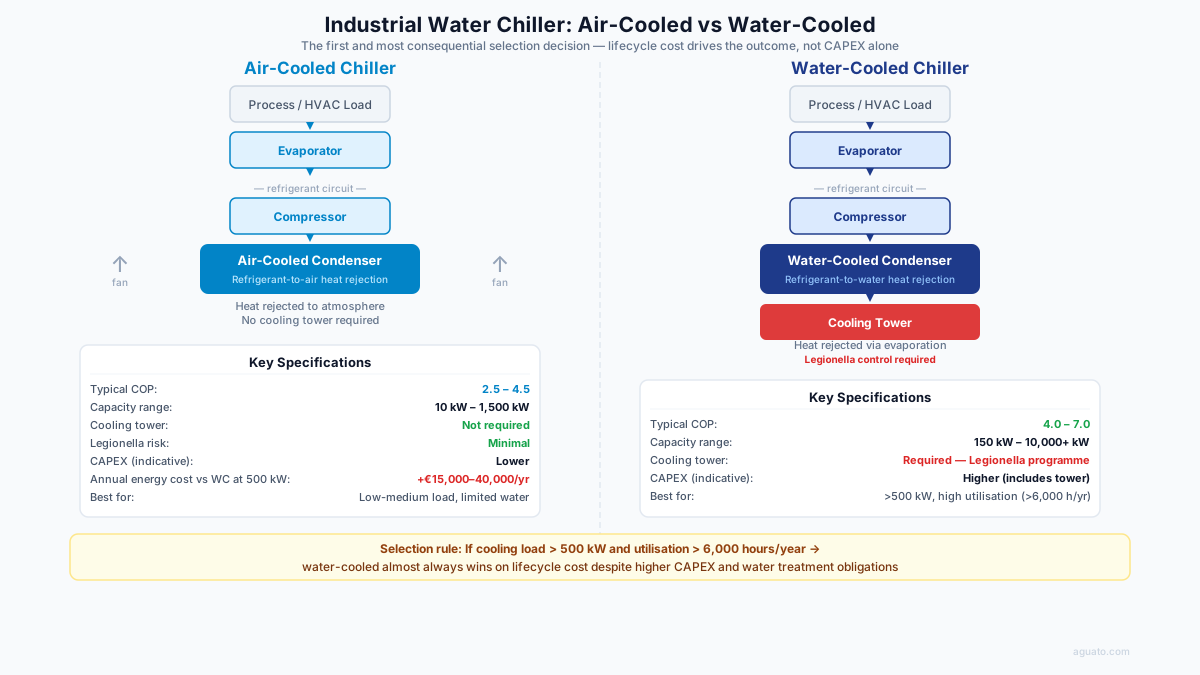
Air-cooled chillers use refrigerant-to-air condensers with fans to reject heat directly to atmosphere. No cooling tower. No condenser water circuit. Simpler infrastructure, lower CAPEX, easier site requirements. The penalty is efficiency: COP of 2.5 to 4.5 versus 4.0 to 7.0 for water-cooled equivalents, because air is a far less efficient heat rejection medium than water, especially in summer when you need the chiller most.
Water-cooled chillers reject heat from the refrigerant to a condenser water circuit, which then carries it to a cooling tower where evaporation does the real work. The efficiency advantage is significant. At 500 kW, the annual energy cost difference is typically $16,500, $44,000 in favour of the water-cooled configuration. Over a 20-year asset life, that difference dwarfs the additional CAPEX of the cooling tower and water treatment system.
The decision rule is not complicated. If your cooling load exceeds 500 kW and the chiller will run more than 6,000 hours per year, water-cooled almost always wins on lifecycle cost. Below those thresholds, or where water supply is constrained, or Legionella obligations are being actively avoided, air-cooled is the rational choice.
What makes this decision consequential is that it determines the entire ancillary infrastructure: whether you need a [cooling tower treatment programme](/resources/cooling-tower-water-treatment), a condenser water pump set, a [Legionella risk assessment](/resources/legionella-risk-assessment), a water management programme, and an ongoing relationship with a water treatment specialist. Operators frequently underestimate the total cost of the water-cooled path. They also frequently underestimate the total energy cost of the air-cooled path. Run the 10-year numbers before you decide.
Water hardness compounds this. If your mains supply exceeds 300 mg/L total hardness as CaCO3, the scale fouling rate on condenser tubes will erode the water-cooled COP advantage unless water treatment is maintained rigorously. An air-cooled chiller with no condenser water circuit avoids this problem entirely, at the cost of permanently higher energy bills.
| Aspect | Air-cooled | Water-cooled | |---|---|---| | Full-load COP | 2.5 to 4.5 | 4.0 to 7.0 | | CAPEX (per kW) | $130 to 280 | $200 to 450 + cooling tower + treatment | | Annual energy cost (500 kW, 6,000 hrs) | Baseline | $16,500 to 44,000 LOWER | | Cooling tower required | No | Yes | | Legionella programme required | No | Yes (HSE L8 / ASHRAE 188) | | Water consumption | Zero | 3 to 6 m³ per MWh of rejected heat | | Best for | < 300 kW, low operating hours, water-stressed sites | > 500 kW, > 6,000 hrs/year, abundant water | | Lifecycle winner above 500 kW + 6,000 hrs | No | Yes (energy savings dwarf added CAPEX over 10 years) |
## Compressor Types: Centrifugal, Screw, and Scroll
The compressor is the heart of the chiller. It sets the capacity ceiling, the efficiency profile, and the maintenance complexity. Three technologies dominate industrial applications:
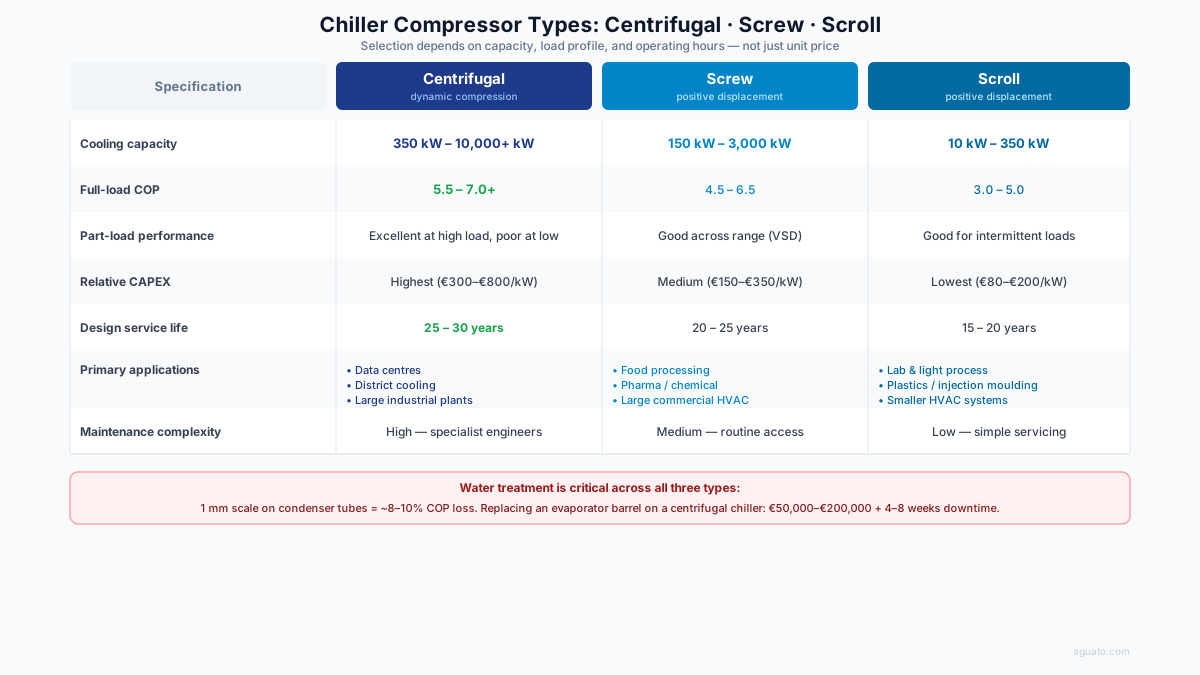
Centrifugal compressors use dynamic compression, a high-speed impeller accelerates refrigerant vapour, converting kinetic energy to pressure. They dominate large-capacity applications (350 kW to 10,000+ kW), achieve the highest full-load COPs (5.5 to 7.0+ in modern magnetic-bearing designs), and carry the longest service lives (25 to 30 years with proper maintenance). The limitation is part-load performance: centrifugal compressors exhibit surge behaviour at low loads, making them poorly suited to sites where the chiller runs below 30 to 40% of capacity for extended periods. They require specialist engineers for maintenance and carry the highest CAPEX ($330, $880/kW).
Screw compressors are positive displacement, two counter-rotating helical rotors trap and compress refrigerant. The operating range (150 kW to 3,000 kW) covers most industrial mid-range applications. With variable speed drives, screw chillers deliver good part-load efficiency across the load range, making them the default choice for pharmaceutical manufacturing, food processing, and large commercial HVAC. Full-load COP runs 4.5 to 6.5. CAPEX is moderate ($165, $385/kW). Routine maintenance access is straightforward compared to centrifugal.
Scroll compressors use two interleaving spiral elements. They are compact, mechanically simple, and well-suited to smaller capacity ranges (10 kW to 350 kW). Full-load COP is lower (3.0 to 5.0) and service life shorter (15 to 20 years), but CAPEX is lowest ($88, $220/kW) and servicing is minimal. They are the standard for laboratory cooling, plastics injection moulding, and smaller commercial HVAC systems where simplicity and low maintenance overhead matter more than peak efficiency.
| Aspect | Centrifugal | Screw | Scroll | |---|---|---|---| | Capacity range | 350 to 10,000+ kW | 150 to 3,000 kW | 10 to 350 kW | | Full-load COP | 5.5 to 7.0+ | 4.5 to 6.5 | 3.0 to 5.0 | | Part-load efficiency | Poor (surge below 30 to 40%) | Excellent with VSD | Moderate | | Service life | 25 to 30 years | 20 to 25 years | 15 to 20 years | | CAPEX (per kW) | $330 to 880 | $165 to 385 | $88 to 220 | | Maintenance complexity | Specialist required | Standard | Minimal | | Best for | Data centres, large process, continuous full load | Pharma, food, mid-range HVAC, variable load | Labs, plastics, small commercial |
One point that vendors understate: refrigerant matters as much as compressor type. R134a, R1234ze, and R513A serve different capacity ranges and ambient temperature limits. The transition away from high-GWP refrigerants is reshaping chiller specifications, any machine procured today should be evaluated for its refrigerant roadmap across its 20 to 25 year service life. Use the [AHRI Certified Directory](dofollow:https://www.ahridirectory.org/) to verify published COP and capacity ratings against actual certified performance data, manufacturer datasheets and certified test results frequently differ by 5 to 12%.
## Industrial Applications by Sector
The chiller is one of the few pieces of process equipment that appears across nearly every industrial sector. The selection criteria shift based on what the chilling is actually doing:
Food and beverage processing relies on chillers for both product temperature control and CIP (clean-in-place) water cooling. Here, glycol chillers are common, propylene glycol added to the chilled water circuit prevents freeze damage and extends operating range to below 0°C for blast cooling and freeze tunnels. FDA and EU food-contact material compliance affects allowable inhibitor chemistry in the glycol loop.
Pharmaceutical manufacturing demands chilled water circuits with tight temperature control (±0.5°C or better), low particulate contamination, and often WFI (water for injection) compatibility in secondary circuits. GMP environments require full documentation of water treatment chemicals, validated cleaning protocols, and change control for any chemistry modification.
Data centre cooling accounts for a fast-growing share of large centrifugal chiller installations. A hyperscale data hall might operate 4 to 6 large centrifugal chillers continuously at or near full load, exactly the operating profile where centrifugal efficiency shines. Water treatment is mission-critical: a chiller trip at an unplanned moment costs more than the annual water treatment budget in a matter of hours.
Plastics and rubber processing uses chillers to control tool temperature during injection moulding, extrusion, and blow moulding. Cycle time, dimensional consistency, and surface finish are all sensitive to supply water temperature. Scroll and screw chillers at 30 to 500 kW are typical. The water circuit sees frequent contaminants from mould leaks, treatment programme discipline is lower in this sector than it should be.
Chemical and petrochemical applications use chillers for reactor temperature control, reflux condensing, and product stabilisation. Process side water is often contaminated with dissolved organics or process chemicals that can cross into the chilled water side through heat exchanger leaks, leak detection and chemistry monitoring matter more here than in HVAC applications.
[cta:nepti-dark]
## Water Quality Requirements: Two Circuits, Two Programmes
Every water-cooled chiller has two distinct water circuits, each requiring a separate treatment approach. Getting one right and ignoring the other is how expensive failures happen.
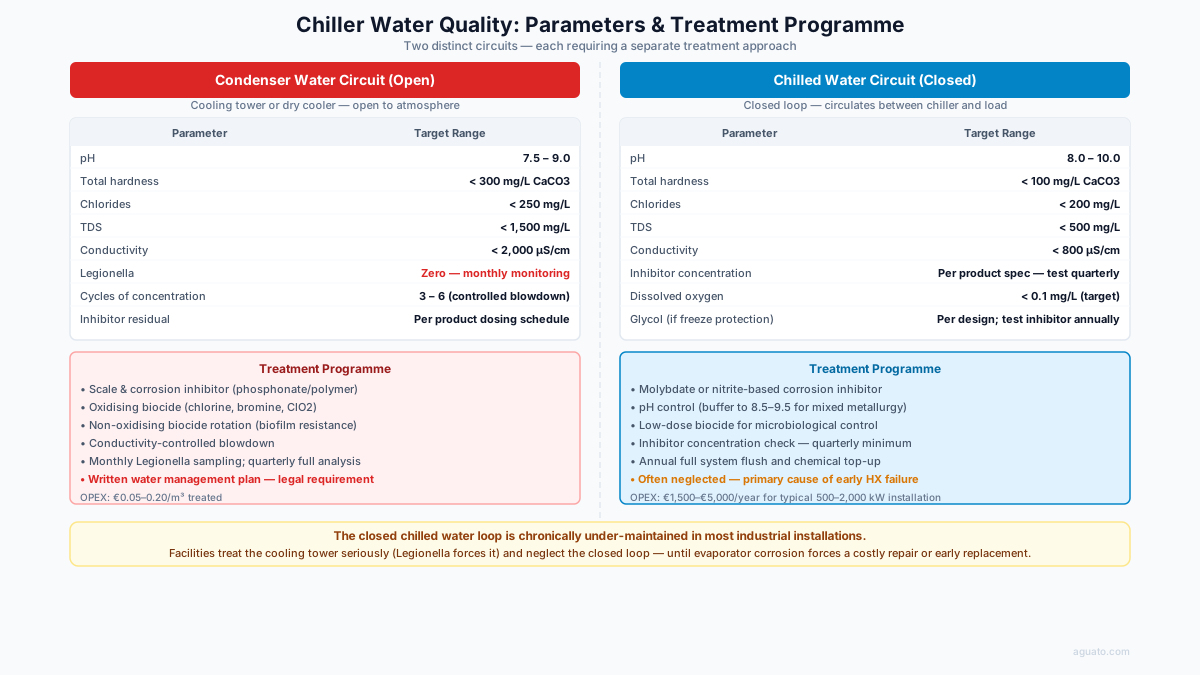
The condenser water circuit (cooling tower loop) is open to atmosphere. Evaporation concentrates dissolved solids. Biological contamination, including Legionella pneumophila, is an active risk because the conditions (warm water, aerosols, nutrient availability) are ideal for proliferation. This circuit receives serious attention because Legionella forces it: regulatory obligations, insurance requirements, and the risk of a fatality or public health incident ensure that most operators maintain a proper water management programme here.
Target parameters for condenser water: - pH: 7.5 to 9.0 - Total hardness: < 300 mg/L as CaCO3 - Chlorides: < 250 mg/L - TDS: < 1,500 mg/L - Conductivity: < 2,000 µS/cm - Legionella: zero, monthly monitoring minimum - Cycles of concentration: 3 to 6, controlled via automated blowdown
The closed chilled water circuit receives far less attention. Because it is closed and recirculating, operators assume it takes care of itself. It does not. Dissolved [oxygen](/elements/oxygen), pH drift, and the absence of inhibitor replenishment create steady corrosion, particularly at aluminium heat exchangers and [copper](/elements/copper) tube bundles. The corroded material deposits on heat exchanger surfaces, reducing efficiency and eventually causing tube failure.
Target parameters for closed chilled water: - pH: 8.0 to 10.0 - Total hardness: < 100 mg/L as CaCO3 - Chlorides: < 200 mg/L - TDS: < 500 mg/L - Conductivity: < 800 µS/cm - Dissolved oxygen: < 0.1 mg/L - Inhibitor concentration: per product specification, checked quarterly
The closed loop is the circuit most likely to be found in neglected condition during a system audit. Engineers who maintain the cooling tower rigorously often have no record of the last time the chilled water circuit was tested or topped up with inhibitor.
[Use Nepti to model your chiller water profile and identify which treatment programme applies to your specific installation](/nepti), particularly useful when you are inheriting a system with unknown treatment history.
## Water Treatment Programme: What the Schedule Looks Like
For water-cooled installations, two concurrent treatment programmes run in parallel:
Condenser water (cooling tower) programme: - Scale and corrosion inhibitor, phosphonate/polymer blend dosed continuously or on a timer via automated chemical dosing system - Oxidising biocide, chlorine (hypochlorite), bromine (BCDMH), or chlorine dioxide. Applied continuously or as slug doses on a timed schedule - Non-oxidising biocide rotation, isothiazolinone, DBNPA, or glutaraldehyde rotated to prevent biofilm resistance - Conductivity-controlled blowdown, automated valve controlled by conductivity sensor, maintaining cycles of concentration in target range; for setpoint engineering and discharge-permit context see the [cooling tower blowdown guide](/resources/cooling-tower-blowdown) - Monthly Legionella sampling, cultured and tested to [HSE L8 / CIBSE TM13](dofollow:https://www.hse.gov.uk/legionnaires/) standards. Positive results trigger immediate corrective action protocol - Quarterly full water analysis, hardness, alkalinity, chlorides, inhibitor residual, bacteriology - Written Legionella water management plan, legal requirement in most jurisdictions. Not a recommendation. A legal requirement.
OPEX for the condenser water programme: $0.06 to 0.22/m³ treated, depending on water quality and biocide regime.
Closed chilled water programme: - Molybdate or nitrite-based corrosion inhibitor, maintained at manufacturer-specified concentration; depleted over time through oxygen consumption and minor losses. Without top-up, protection fails silently - pH buffer, maintained at 8.5 to 9.5 for mixed metallurgy systems (copper, aluminium, carbon steel). Below pH 8.0, aluminium corrosion accelerates markedly - Low-dose biocide, isothiazolinone or similar for microbiological control in the closed loop - Inhibitor concentration check quarterly, the check most frequently skipped in practice - Annual full system flush and chemical recharge, particularly after any significant make-up water addition
OPEX for the closed loop programme: $1,650, $5,500 per year for a typical 500 to 2,000 kW installation. The number that prompts skipping it.
[Browse qualified water treatment specialists who serve industrial chiller installations](/providers), filter by cooling tower, Legionella, or industrial HVAC treatment specialisms.
## Where Chiller Projects Fail: Three Scenarios
Failure scenario 1: Scale fouling destroys condenser efficiency. A food manufacturing plant in the Netherlands operated a 1,200 kW water-cooled screw chiller on mains water with 340 mg/L total hardness. The scale inhibitor dosing pump failed intermittently and was not alarmed. Within 18 months, 1.2 mm of calcium carbonate scale had deposited on condenser tube surfaces. Measured COP dropped from 5.8 to 4.4, a 24% efficiency loss. Annual energy penalty: approximately $31,000. Descaling campaign: $10,000 plus four days downtime. Root cause: no conductivity monitoring, no alarm on dosing pump, no monthly water test. A properly designed dosing and monitoring system costs under $3,300 to install.
Failure scenario 2: Closed loop corrosion destroys the evaporator. A pharmaceutical site in Ireland inherited a 10-year-old centrifugal chiller when they acquired a production facility. No treatment records were transferred with the asset. The closed chilled water circuit had been running without inhibitor for at least three years, pH had drifted to 6.9 and dissolved copper was 4.2 mg/L (indicating active corrosion). Eighteen months after acquisition, an evaporator tube bundle failed, copper tube wall thinning to the point of perforation. Retubing cost: $94,000 plus six weeks downtime. The original closed loop treatment programme would have cost under $4,400 per year to maintain.
Failure scenario 3: Undersized cooling tower collapses water-cooled COP advantage. A data centre operator in Germany specified a water-cooled centrifugal chiller to achieve a design COP of 6.2. The cooling tower was sized for design ambient temperature of 28°C wet bulb. During an extended heat event (five days above 34°C dry bulb, 22°C wet bulb), the cooling tower approached its thermal limit. Condenser entering water temperature rose from 28°C to 36°C. Chiller COP dropped to 4.1, comparable to a high-end air-cooled machine. The operator had not modelled the 99th-percentile ambient scenario during design. The fix: a supplemental dry cooler added to the condenser water circuit, costing $72,000 installed. This is a selection and modelling problem, not a maintenance problem.
## Sizing and Selection Framework
Use this threshold logic before engaging vendors:
Step 1, Establish cooling load and operating hours. If peak load < 150 kW → scroll chiller is the default. If load is 150 to 500 kW → screw chiller is the default. If load > 500 kW → centrifugal or screw depending on load profile.
Step 2, Assess load profile. If the chiller will operate below 40% load for more than 30% of annual hours → avoid centrifugal (surge risk); prefer screw with VSD. If load factor is consistently high (> 80%) → centrifugal delivers best full-load COP.
Step 3, Choose heat rejection method. If load > 500 kW AND annual hours > 6,000 → water-cooled. If water supply is constrained, or Legionella management is being explicitly avoided, or load < 300 kW → air-cooled. If intermediate → run a 10-year lifecycle cost comparison with your actual electricity tariff and local water quality.
Step 4, Assess incoming water quality. Get a water analysis before specifying anything. If total hardness > 300 mg/L → softening or antiscalant dosing is non-negotiable for condenser water. If TDS > 1,200 mg/L → blowdown volume will be high; consider partial softening or RO make-up.
Step 5, Specify the treatment programme before the chiller arrives. The chemical dosing system, conductivity controller, and monitoring protocol should be in the scope document before procurement, not added as an afterthought after installation. A chiller vendor who does not mention water treatment in their proposal is selling a machine, not a solution.
[Post your chiller requirement and receive independent proposals from qualified providers](/post-project) who specify water treatment as part of the system package, not an optional extra.
For complex installations, multiple chillers, variable load profiles, unusual water chemistry, [use Nepti to model your system before you talk to vendors](/nepti). Before specifying any chiller, review the [industrial water treatment selection guide](/resources/how-to-choose-industrial-water-treatment) for a structured framework on feed water characterisation and technology matching. Nepti analyses your water matrix and load profile to rank chiller configurations and treatment programmes by lifecycle cost.
## Frequently Asked Questions
### What is the difference between an industrial water chiller and a commercial HVAC chiller?
The engineering is similar, but the operating context differs. Industrial chillers serve process applications, they may need to deliver water at below 0°C (with glycol), maintain tighter temperature tolerances (±0.5°C), operate continuously at full load, or integrate with process control systems. Commercial HVAC chillers serve building conditioning loads with more variable demand and less stringent temperature precision. The water quality and treatment obligations also differ: industrial applications in food, pharma, or chemical sectors carry food-contact or GMP requirements that standard HVAC chemistry does not meet.
### How do I choose between an air-cooled and water-cooled chiller?
The primary driver is lifecycle cost, not CAPEX. If your cooling load exceeds 500 kW and the chiller runs more than 6,000 hours per year, water-cooled almost always wins on energy cost, typically $16,500, $44,000 per year cheaper at 500 kW, despite higher installation cost. Below those thresholds, or where water supply is limited or Legionella management is actively avoided, air-cooled is the rational choice.
### What water treatment does an industrial water chiller need?
Two circuits require separate treatment. The condenser water circuit (cooling tower loop) needs scale inhibitor, oxidising and non-oxidising biocides, conductivity-controlled blowdown, and monthly Legionella sampling, typically $0.06 to 0.22/m³ treated. The closed chilled water circuit needs molybdate or nitrite-based corrosion inhibitor, pH buffering to 8.5 to 9.5, and quarterly inhibitor checks, typically $1,650, $5,500/year for a 500 to 2,000 kW installation.
### What causes industrial chiller efficiency loss over time?
The two primary causes are scale fouling on condenser tubes (1 mm of calcium carbonate causes approximately 8 to 10% COP loss) and evaporator fouling or corrosion from neglected closed loop chemistry. Both are prevented by a properly maintained water treatment programme. Secondary causes include refrigerant loss, compressor wear, and heat exchanger fouling from process contamination. Scale fouling is by far the most common and most preventable.
### How long does an industrial water chiller last?
Design service life varies by compressor type: centrifugal 25 to 30 years, screw 20 to 25 years, scroll 15 to 20 years. Actual service life is heavily influenced by water quality management. Evaporator or condenser tube failures caused by corrosion or scale can force major repairs or early replacement at 10 to 12 years in poorly maintained systems. The machines that reach or exceed design life are universally associated with consistent water treatment programmes and documented maintenance records.
### Is a Legionella risk assessment required for a water-cooled chiller installation?
Yes, in most jurisdictions. Any evaporative cooling system, including cooling towers used with water-cooled chillers, is a notifiable cooling system under UK HSE L8, equivalent EU national regulations, and [ASHRAE Standard 188](dofollow:https://www.ashrae.org/technical-resources/bookstore/ansi-ashrae-standard-188-2021-legionellosis-risk-management-for-building-water-systems) in the US. A written Legionella risk assessment, written scheme of control, and documented monitoring programme are legal requirements, not recommendations. Many chiller manufacturers require evidence of a water management programme as a condition of warranty.
### What refrigerants are used in industrial water chillers?
The most common refrigerants for large industrial applications are R134a (HFC, medium GWP), R1234ze and R513A (lower GWP alternatives increasingly mandated under F-Gas regulations), and R410A in smaller scroll applications. Ammonia (R717) remains dominant in refrigeration-grade applications below 0°C and in large industrial cooling. Verify certified efficiency ratings using the AHRI directory referenced in the Compressor Types section above before making any procurement decision.