Microfiltration removes suspended solids, bacteria, and turbidity at a fraction of the energy cost of tighter membranes. This guide covers how it works, what it costs, when to specify it, and the decision points that determine whether MF or a tighter membrane is right for your project.
Defaulting to ultrafiltration when microfiltration would do the same job costs $200,000 in excess CAPEX plus $28,000/year in excess energy on a typical 500 m³/day municipal or industrial system, over a 15-year asset life that's roughly $620,000 you didn't have to spend. Going the other way, specifying MF where the application actually needs UF for virus removal, costs $310,000 in retrofit plus a 4-month project delay when the regulator catches it. Both are common procurement errors. Both are entirely preventable with feed-water characterisation that takes less than a week and costs under $5,000.
Microfiltration removes suspended solids, bacteria, protozoa, and colloidal matter at pore sizes of 0.1 to 10 µm, operating pressure of 0.1 to 2 bar, and energy use of 0.1 to 0.3 kWh/m³, roughly 5 to 10× lower than RO. It does not remove dissolved salts, viruses, or organic molecules below its pore size cutoff. The decision to specify MF instead of UF, NF, or RO is straightforward when the feed-water analysis is in front of you. The decision is consistently wrong when it isn't. Vendors will quote what they sell.
This guide is for plant engineers and process designers specifying membrane treatment, procurement leads writing the next RFP, and sustainability heads building the lifecycle business case. It covers how MF works at the pore-size and flux level, where it consistently delivers the lowest lifecycle cost (with industry-specific examples and concrete CAPEX/OPEX), where projects fail (with the cost of each failure), the decision logic for choosing MF vs UF vs NF vs RO, and the dollar number to take to your CFO.
Contents: [What Is Microfiltration?](#what-is-microfiltration) [How It Works: Pore Size, Pressure, and Flux](#how-microfiltration-works-pore-size-pressure-and-flux) [MF vs UF vs NF vs RO](#microfiltration-vs-ultrafiltration-nanofiltration-and-reverse-osmosis) [Industrial Applications](#industrial-applications-of-microfiltration) [Decision Framework: When to Choose MF](#when-microfiltration-is-the-right-choice) [CAPEX and OPEX](#capex-and-opex-what-microfiltration-systems-actually-cost) [Where Projects Go Wrong](#where-microfiltration-projects-go-wrong) [Selecting a System and Provider](#selecting-a-microfiltration-system-and-provider) [Frequently Asked Questions](#frequently-asked-questions)
## The decision in brief
- Specify MF for low-turbidity, no-virus-removal duty. MF specified correctly for a low-turbidity, no-virus-removal application at 500 m³/day, instead of defaulting to UF, saves $420,000 to 620,000 over the 15-year asset life. - Know the split. The saving splits between CAPEX at $150,000 to 250,000 from smaller-pump, lower-pressure-rated equipment, energy at $120,000 to 250,000 from the lower operating pressure, and chemistry at $30,000 to 80,000 from a less aggressive cleaning regime. - Do not specify MF where the water needs UF. If you specify MF where the application actually needs UF for virus or SDI < 3 compliance and discover it during regulatory audit, the corrective retrofit costs $310,000+ plus a 4-month project delay and any fines for the compliance gap.
The biggest cost of doing nothing is letting a vendor over-specify to be safe. You pay for that safety for 15 years in CAPEX you never needed and energy you keep paying for.
## What Is Microfiltration?
Microfiltration (MF) is a pressure-driven membrane separation process that removes particles in the 0.1 to 10 micrometre range from a liquid stream. It operates at low transmembrane pressure, typically 0.1 to 2 bar, and removes suspended solids, bacteria (including E. coli and Pseudomonas), protozoa (Cryptosporidium, Giardia), turbidity, and colloidal matter. It does not remove dissolved salts, viruses, or organic molecules below its pore size cutoff.
Microfiltration systems are available in hollow fibre, tubular, flat sheet, and spiral wound configurations, see the [membrane filtration system selection guide](/resources/membrane-filtration-system) for how module choice interacts with feed quality across all four membrane classes. Hollow fibre is the dominant format for high-throughput industrial applications due to its high surface area per unit volume and ease of backwashing. According to the [WHO Guidelines for Drinking-water Quality](dofollow:https://www.who.int/publications/i/item/9789241549950), membrane filtration including MF provides effective barrier protection against protozoan pathogens when correctly designed and operated.
## How Microfiltration Works: Pore Size, Pressure, and Flux
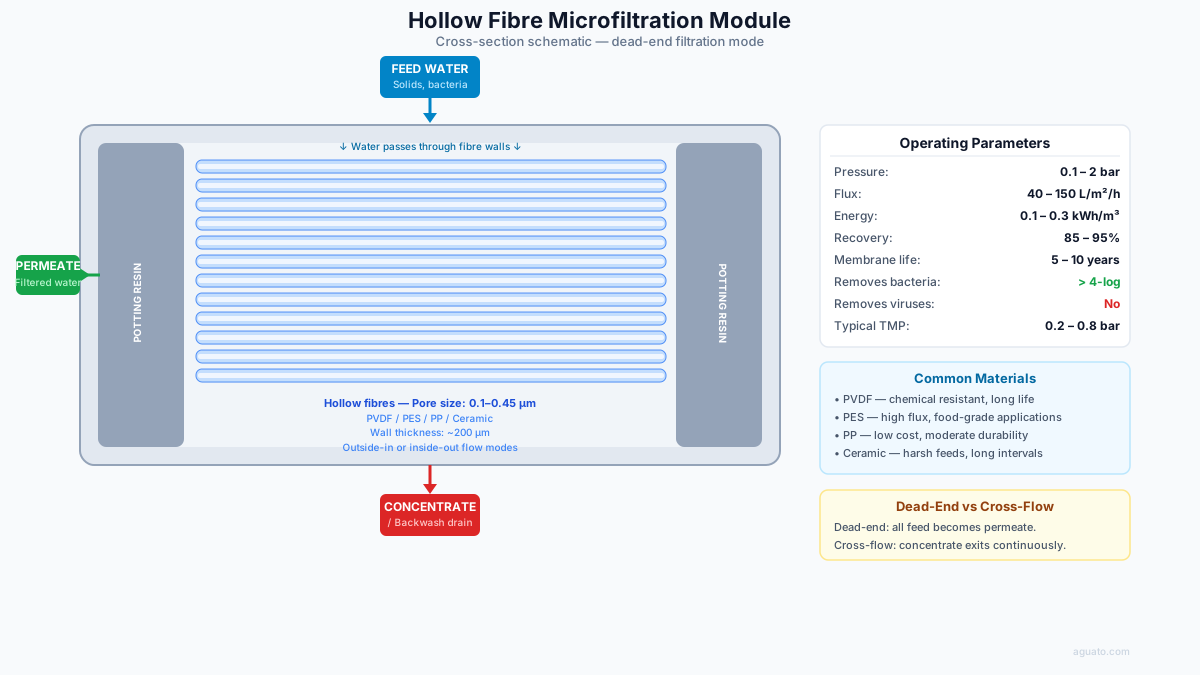
Feed water is pumped across the membrane surface under pressure. Water and particles smaller than the pore size pass through as permeate; larger particles are retained and either flushed to drain in crossflow mode or cleared during backwash cycles in dead-end mode.
### Key operating parameters
Pore size: 0.1 to 10 µm (most industrial MF runs at 0.1 to 0.45 µm) Transmembrane pressure (TMP): 0.1 to 2 bar Flux: 40 to 150 L/m²/h depending on feed quality and fouling rate Energy consumption: 0.1 to 0.3 kWh/m³, roughly 5 to 10x lower than RO Recovery rate: 85 to 95% in well-designed systems
Fouling is the dominant operating variable. Organic matter, [oils](/resources/oily-wastewater-treatment), and biologically active feed water accelerate fouling and reduce flux over time. A well-matched coagulation or pre-screening step upstream can extend membrane life from 3 to 4 years to 7 to 10 years and reduce chemical cleaning frequency significantly.
Microfiltration is not a standalone technology for most industrial applications. It is typically positioned as pretreatment before downstream RO or NF, or as a primary treatment step where dissolved solids removal is not required.
## Microfiltration vs Ultrafiltration, Nanofiltration, and Reverse Osmosis
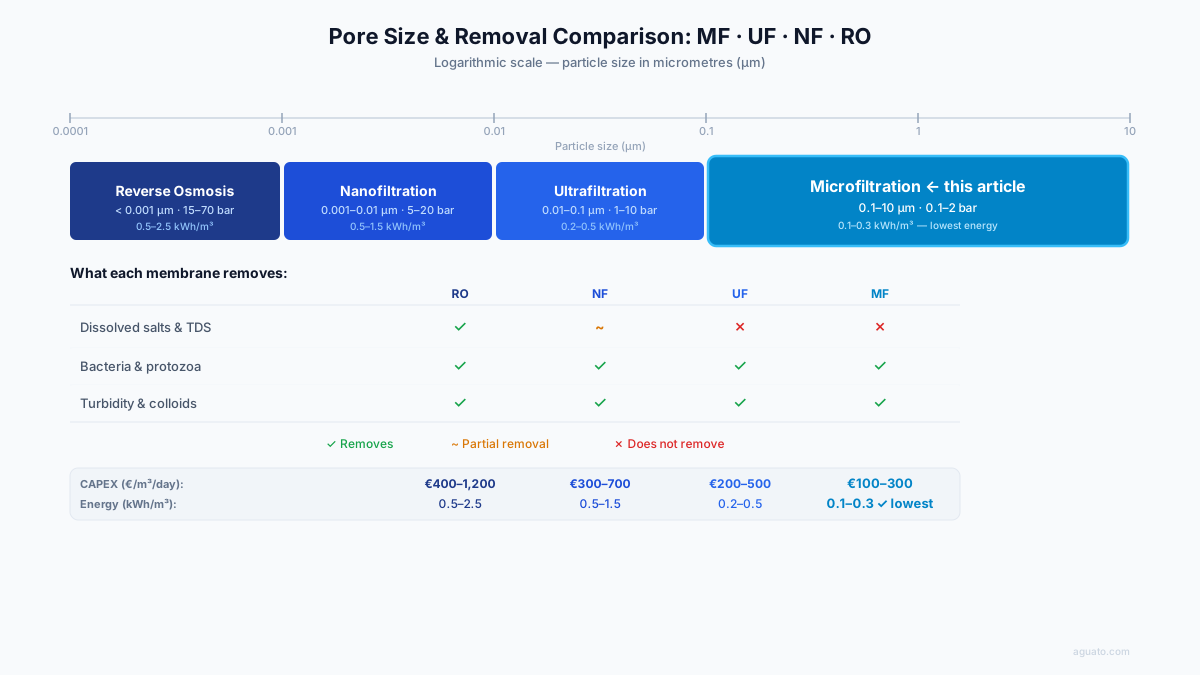
Membrane selection is not a technology problem, it is a data problem. The correct membrane is the one that removes what needs to be removed at the lowest lifecycle cost. The table below maps pore size, removal capability, and indicative operating costs across the four main pressure-driven membrane technologies.
| Parameter | MF | UF | NF | RO | |---|---|---|---|---| | Pore size | 0.1 to 10 µm | 0.01 to 0.1 µm | 1 to 10 nm | < 1 nm | | Operating pressure | 0.1 to 2 bar | 1 to 10 bar | 5 to 20 bar | 15 to 70 bar | | Energy (kWh/m³) | 0.1 to 0.3 | 0.2 to 0.5 | 0.5 to 1.5 | 0.5 to 2.5 | | Removes bacteria | Yes | Yes | Yes | Yes | | Removes viruses | No | Yes | Yes | Yes | | Removes dissolved salts | No | No | Partial | Yes | | Typical CAPEX ($/m³/day) | 110 to 330 | 220 to 550 | 330 to 770 | 440 to 1,320 |
Most projects that end up with UF should have started with a microfiltration analysis first. The default to UF is a conservative choice, not always a cost-effective one. For a full cost comparison across all four membrane types, see the [RO vs NF vs UF comparison](/resources/ro-vs-nf-vs-uf-comparison). When virus removal or SDI below 3 is a requirement and MF is not sufficient, the [ultrafiltration systems guide](/resources/ultrafiltration) covers the step up in detail.
## Industrial Applications of Microfiltration
### Food and Beverage
Microfiltration is used extensively in dairy processing, specifically for cold pasteurisation of milk and whey protein fractionation, where it achieves > 4-log bacterial reduction without heat damage to proteins. Breweries use MF for beer clarification and sterile filtration, replacing diatomaceous earth (DE) filtration with a continuous, waste-free process that reduces OPEX by 20 to 35% in typical installations.
Typical pattern in food processing: plants specify UF for bacterial control when MF at 0.2 µm achieves the same log reduction at lower TMP and energy cost. The driver is usually over-specification from a cautious vendor proposal, not process requirements.
### Municipal and Drinking Water
Microfiltration has largely replaced conventional coagulation-sedimentation-sand filtration sequences in small-to-medium surface water treatment plants. A 500 m³/day MF system can be designed and commissioned for $165,000, $385,000 CAPEX, compared to $440,000+ for an equivalent UF system. For plants treating low-turbidity groundwater, MF offers a compliant, low-cost alternative to chemical treatment.
### Industrial Wastewater and Process Water
In textile manufacturing, MF is used for dye bath recovery and suspended solids removal ahead of NF or RO polishing steps. In pharmaceutical manufacturing, MF is the standard technology for bioburden reduction in purified water systems. In oil and gas, MF handles [produced water and other oily wastewater](/resources/oily-wastewater-treatment) ahead of injection or discharge, removing suspended solids to < 2 mg/L and extending downstream media filter life significantly. For the offshore-specific architecture, hydrocyclones, IGF, nutshell, MPPE, and where ceramic UF replaces MF on weight-constrained decks, see the [offshore produced water treatment guide](/resources/offshore-produced-water-treatment). For the broader case on when [ceramic membranes](/resources/ceramic-membranes) beat polymeric MF on tough-feed duty, dairy, brewing, refinery effluent, pharma SIP, see our dedicated decision guide.
### Mining and Metal Processing
[Mining water treatment](/resources/mining-wastewater-treatment) relies on MF to remove fine suspended solids from process water before recycling. At a typical mid-size mining site processing 2,000 m³/day, switching from conventional clarification to MF has reduced chemical dosing costs by 40 to 60% and eliminated sludge handling from the process water circuit.
If you are evaluating microfiltration for any of these sectors, [browse qualified MF system providers on Aguato](/providers) to compare experience, project references, and technology offerings across multiple vendors.
[cta:nepti-dark]
## When Microfiltration Is the Right Choice
Apply this decision logic before committing to a membrane technology:
If the target is suspended solids, turbidity, or bacteria removal only (no dissolved contaminants) → MF is the primary candidate
If bacteria removal to 4-log is required and viruses are not a regulated concern → MF at 0.2 µm qualifies
If viruses must be removed → minimum UF (0.01 to 0.02 µm); microfiltration is not sufficient
If SDI < 3 is required for downstream RO → specify UF; MF typically achieves SDI 3 to 5
If SDI 3 to 5 is acceptable for downstream RO → MF is a valid and lower-cost pretreatment option
If TDS reduction is required → MF removes nothing dissolved; NF or RO is required downstream
If OPEX minimisation is the primary driver and feed water is clean (< 5 NTU, low organics) → MF
If turbidity > 50 NTU on a seasonal basis → pilot test is mandatory before committing to MF
One test worth running before selection: measure the Modified Fouling Index (MFI) of your feed water. MFI > 10 s/L² suggests MF will foul rapidly without upstream pretreatment, and UF may deliver better total cost of ownership despite higher capital cost.
[Use Nepti to model your water profile and get a ranked comparison of membrane technology options with cost projections](/nepti) before issuing an RFQ. It is the fastest way to enter vendor conversations with a defensible baseline.
## CAPEX and OPEX: What Microfiltration Systems Actually Cost
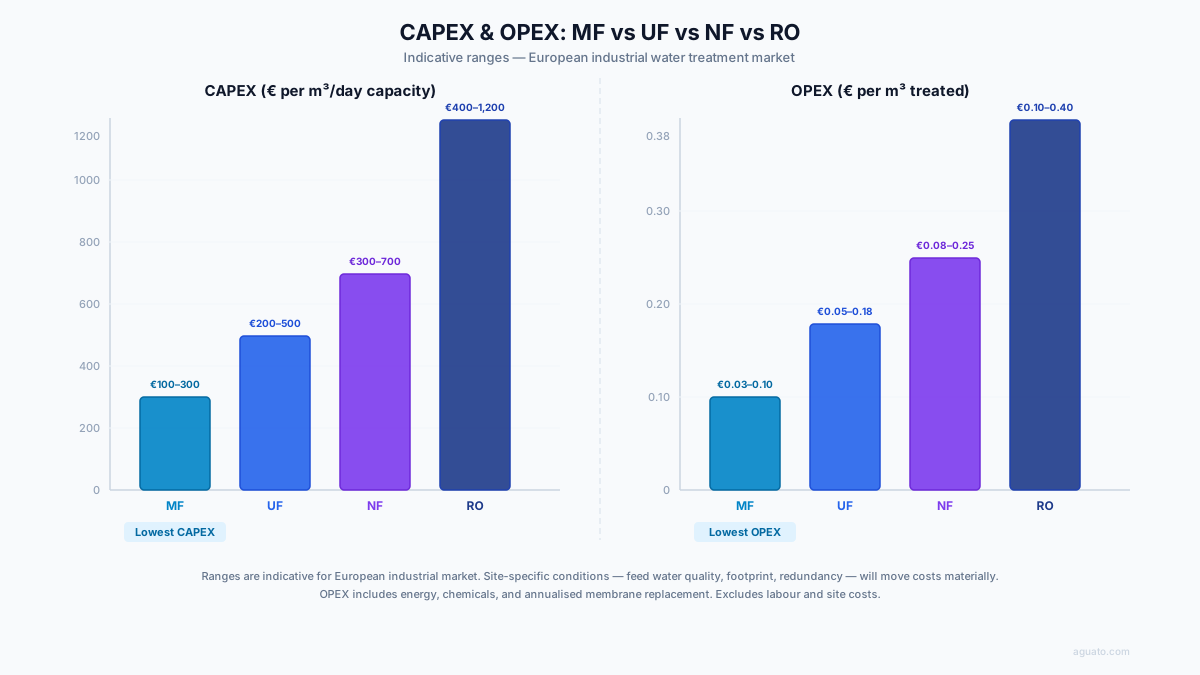
The figures below are indicative ranges drawn from European and Middle Eastern industrial projects. Feed water quality, footprint constraints, and redundancy requirements will move costs materially on any specific project.
### CAPEX by system size
| System size | Throughput | CAPEX range | $/m³/day | |---|---|---|---| | Small | < 100 m³/day | $55,000 to 165,000 | $550 to 1,650 | | Mid-size | 100 to 1,000 m³/day | $165,000 to 660,000 | $165 to 660 | | Large | > 1,000 m³/day | $550,000 to 2,200,000+ | $110 to 550 | | MF benchmark | per m³/day |, | $110 to 330 | | UF equivalent | per m³/day |, | $220 to 550 | | RO equivalent | per m³/day |, | $440 to 1,320 |
### OPEX breakdown (per m³ permeate)
| Cost line | $/m³ | Annual cost (500 m³/day) | Notes | |---|---|---|---| | Energy | $0.01 to 0.03 | $1,800 to 5,500 | At $0.11/kWh; tracks tariff | | Chemical cleaning (CIP) | $0.01 to 0.02 | $1,800 to 3,600 | Frequency depends on fouling rate | | Membrane replacement (annualised over 7-yr life) | $0.01 to 0.06 | $1,800 to 11,000 | Doubles to triple if pretreatment is inadequate | | Labour + monitoring | $0.005 to 0.02 | $900 to 3,600 | Highly automated systems sit at low end | | Total OPEX | $0.03 to 0.11 | $5,500 to 24,000 | UF equivalent: $11K, 46K (2× higher) |
The most common OPEX error is underestimating membrane replacement frequency when feed water quality is variable. Ask vendors for their P90 flux data, what the system delivers when feed water has a bad day, not just average or design-point performance. A vendor who cannot provide P90 data from a comparable installation is selling a system, not a performance guarantee.
## Where Microfiltration Projects Go Wrong
### Under-specifying pore size for virus control
Decision made: Specified MF at 0.2 µm for a drinking water plant with a regulatory requirement for virus removal to 4-log. What happened: Regulatory audit found that 0.2 µm MF does not achieve the required virus log reduction under the applicable standard. The membrane train required replacement with UF. Cost: $310,000 in additional capital plus a 4-month project delay. Correct decision: Map regulatory requirements before technology selection. Virus removal mandates UF or UV disinfection as a minimum, not MF. The [US EPA Membrane Filtration Guidance Manual](dofollow:https://www.epa.gov/sites/default/files/2015-09/documents/membrane_filtration_guidance_manual.pdf) defines log removal credit limits for MF and UF and is the reference document for this specification decision in drinking water applications.
### Skipping the pilot test on variable feed water
Decision made: Specified a 500 m³/day hollow fibre MF system based on average feed water quality data from 6 months of river intake sampling. What happened: Seasonal variation elevated turbidity to 200+ NTU for 6 to 8 weeks per year. Fouling rate increased 4-fold during these periods. Chemical cleaning frequency jumped from monthly to weekly. Membrane life dropped from an expected 7 years to under 3. Cost: $99,000 in unplanned membrane replacements plus $44,000 in additional chemical costs over 5 years. Correct decision: Pilot test over at least one seasonal cycle, or design for worst-case feed water quality with an upstream coagulation or sedimentation step.
### Over-specifying to UF when MF was sufficient
Decision made: Specified UF at 0.02 µm for a municipal plant treating groundwater with turbidity consistently below 2 NTU and no virus removal requirement. What happened: The system ran reliably, but CAPEX was $200,000 higher than an equivalent MF system, and energy consumption ran at 0.4 kWh/m³ vs an estimated 0.15 kWh/m³ for MF. Cost: $200,000 excess CAPEX plus approximately $28,000/year in excess energy at 500 m³/day throughput. Correct decision: Match the membrane to the actual treatment objective. Low-turbidity groundwater with no dissolved contaminant targets is a textbook microfiltration application.
## Selecting a Microfiltration System and Provider
The technology decision and the supplier selection are separate steps, and conflating them is where projects lose money. Getting both right requires an independent baseline before vendor conversations start.
[Post your water challenge on Aguato to receive structured proposals from 3 to 5 qualified microfiltration providers](/post-project), with direct cost and performance breakdowns that make comparison straightforward.
When evaluating providers, ask specifically:
What is the P90 flux guarantee under your feed water conditions, not just average flux? What pretreatment do they recommend, and what is the basis for that recommendation? What is the expected membrane replacement interval at your feed water composition? Can they provide operating data, flux, TMP trend, CIP frequency, from a comparable installation? What does the CIP protocol involve, and what chemicals and downtime are required?
A structured comparison across 3 to 5 independent proposals on equivalent specifications typically surfaces a 15 to 25% cost difference between the highest and lowest-cost qualified options. According to research published in [Water Science and Technology](dofollow:https://iwaponline.com/wst), competitive tendering with pre-qualified vendors consistently outperforms single-vendor negotiations on both CAPEX and long-term service cost for membrane systems.
## Frequently Asked Questions
### What does microfiltration remove?
Microfiltration removes suspended solids, turbidity, bacteria (including E. coli), protozoa (Cryptosporidium and Giardia), colloidal matter, and particles in the 0.1 to 10 micrometre range. It does not remove dissolved salts, heavy metals, viruses, or organic molecules smaller than its pore size cutoff. For dissolved contaminant removal, nanofiltration or reverse osmosis is required downstream.
### Is microfiltration cheaper than ultrafiltration?
Yes, in most applications. Microfiltration CAPEX typically runs $110, $330 per m³/day capacity, compared to $220, $550 for UF. Energy is also lower: 0.1 to 0.3 kWh/m³ for MF vs 0.2 to 0.5 kWh/m³ for UF. The caveat is that MF cannot achieve virus log reduction, where viruses are a regulated target, UF is the minimum requirement regardless of cost.
### What is the difference between microfiltration and ultrafiltration?
The main difference is pore size and what is retained. Microfiltration operates at 0.1 to 10 µm and removes bacteria and suspended solids. Ultrafiltration operates at 0.01 to 0.1 µm and additionally removes viruses and high-molecular-weight organics. UF also produces a lower SDI effluent, making it a better pretreatment step for RO systems where SDI < 3 is required.
### How long do microfiltration membranes last?
Properly maintained microfiltration membranes last 5 to 10 years in most industrial applications. Feed water quality is the primary variable, high fouling loads from oils, high organics, or variable turbidity reduce membrane life significantly without adequate pretreatment. Systems on clean, stable groundwater routinely achieve 10+ year membrane life.
### When should I use microfiltration as pretreatment for RO?
Use MF as RO pretreatment when feed water turbidity is consistently below 5 NTU, virus removal is not a requirement, and SDI 3 to 5 is acceptable for your RO system. If your RO system requires SDI < 3, specify UF instead. MF typically achieves SDI 3 to 5 and may not provide sufficient protection for tight RO membranes at high recovery.
### What industries use microfiltration most?
Food and beverage, municipal water treatment, pharmaceutical manufacturing, and industrial process water are the largest application areas. Dairy and brewing industries use MF for cold sterilisation and product clarification. Municipal plants use it as a lower-cost alternative to conventional clarification. Pharmaceutical plants rely on MF for bioburden reduction in purified water systems.
### How do I know if microfiltration is right for my project?
Characterise your feed water first. Measure turbidity, SDI, bacterial load, organic content (TOC/COD), and any dissolved contaminants relevant to your discharge or reuse target. Apply the decision framework in this guide. If you need independent analysis before engaging vendors, [use Nepti to model your water profile and get a ranked technology comparison](/nepti).