Water treatment chemicals are not commodities, wrong product selection or poor dosing control wastes money and causes compliance failures. This guide covers every major chemical category with hard numbers on dosing, selection logic, and common mistakes.
Water treatment chemicals are not a commodity. The wrong biocide selection allows tolerant bacterial strains to proliferate within months. An overdosed scale inhibitor at incorrect pH deposits rather than prevents scale. The cheapest coagulant applied without jar testing and feed data analysis produces worse treated water than no coagulant at all. The financial damage from chemical programme failures, Legionella incidents, membrane replacements, heat exchanger descaling, boiler tube failures, consistently exceeds the savings from cutting chemical spend.
A chemical programme must be designed from feed water data and the specific metallurgy, temperature, and operational profile of the system it serves. It must then be monitored at sufficient frequency to detect drift before it becomes damage, not reviewed quarterly when the damage is already done. Most water treatment chemical failures are not product failures, they are dosing control failures. The correct product at the wrong dose or without adequate monitoring delivers the same outcome as the wrong product.
This article covers the five chemical categories used across industrial water treatment programmes, coagulants and flocculants, biocides, scale and corrosion inhibitors, pH adjusters, and oxygen scavengers, how they interact, and the failure modes that generate the most costly consequences in industrial operations.
## The Five Chemical Categories Every Water Treatment Programme Uses
Water treatment chemicals are not a single product category, they are five distinct families with different modes of action, application windows, and failure modes. Most industrial water treatment programmes use chemicals from multiple categories simultaneously, and the interactions between them must be understood at the design stage.
The [WHO, chemical aspects of drinking water quality](dofollow:https://www.who.int/publications/i/item/9789241549950) establishes that even in drinking water treatment, the most regulated application, multiple chemical classes are used in combination. The same principle applies throughout industrial water treatment: no single chemical addresses all water quality challenges, and optimising a chemical programme requires understanding how each category contributes to overall system performance.
Most water treatment chemical failures are not product failures, they are dosing control failures. The correct product at the wrong dose, the wrong timing, or without adequate monitoring delivers the same outcome as the wrong product. This is the central management challenge of industrial water chemistry, and the [chemical dosing control systems](/resources/chemical-dosing-control-systems) guide covers how automated closed-loop control eliminates the overdose and underdose failures that drive most of the avoidable cost.
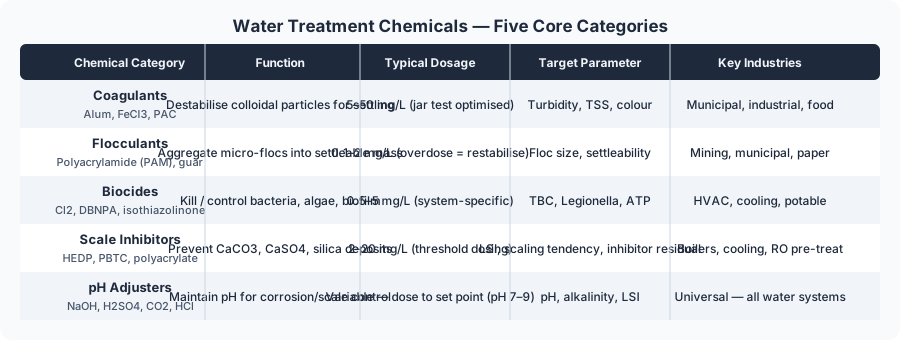
| Chemical category | Primary purpose | Typical dose | Dominant failure mode | Cost-of-failure exposure | |---|---|---|---|---| | Coagulants / flocculants | Solid removal, turbidity reduction | 5 to 80 mg/L (varies by species) | Overdose restabilises colloids | USD 50K, 500K/yr in chemicals + sludge | | Biocides (oxidising + non-oxidising) | Microbiological control, Legionella prevention | 0.5 to 3 mg/L residual + shock dose | Tolerant strains develop without rotation | USD 100K, 10M+ per Legionella incident | | Scale and corrosion inhibitors | Heat-transfer protection, asset preservation | 2 to 20 mg/L active | Programme drift on water-chemistry change | USD 50K, 500K/yr in fuel + descaling | | pH adjusters | Process compatibility, downstream chemistry | dose-to-setpoint | Operator-controlled excursions | USD 10K, 200K/yr in compliance margin | | Oxygen scavengers | Boiler / closed-loop corrosion control | 0.5 to 10 mg/L (sodium sulphite, DEHA) | Wrong scavenger for system temperature | USD 25K, 1M+ per boiler tube failure |
## Coagulants and Flocculants: Solid Removal at Scale
Coagulation and flocculation are the primary mechanisms for removing suspended and colloidal solids from water, particles too small to settle under gravity alone and not filterable by conventional media. Understanding the distinction between coagulation and flocculation is essential for correct chemical selection and dosing sequence.
Coagulation is a charge neutralisation process. Colloidal particles in water carry a negative surface charge that keeps them suspended through electrostatic repulsion. Coagulant chemicals, inorganic metal salts or cationic polymers, destabilise this charge, allowing particles to collide and aggregate. The most common coagulants are:
- Aluminium sulphate (alum, Al2(SO4)3): Widely used in drinking water and industrial applications. Effective at pH 6.5 to 8.0. Produces aluminium hydroxide floc with good settleability. Residual aluminium in treated water must be monitored (drinking water limit 0.2 mg/L).
- Ferric chloride (FeCl3): Effective across a wider pH range than alum (4.0 to 9.0), produces denser floc, and is particularly effective for phosphorus removal and coloured water treatment. Corrosive in handling and generates ferric hydroxide sludge.
- Polyaluminium chloride (PAC): Pre-hydrolysed aluminium coagulant with better low-temperature performance than alum and lower sludge volume. Preferred for drinking water applications in colder climates and for higher-turbidity feeds.
Flocculation follows coagulation and provides gentle agitation that promotes collision and growth of destabilised particles into settleable flocs. Flocculants (polyelectrolytes) are long-chain polymers that bridge between particles, creating large, robust floc aggregates that settle rapidly. Anionic polyacrylamide is standard for most applications; cationic variants are used where coagulant demand is high; nonionic grades are used in specific pH ranges.
Flocculant overdose is a critical failure mode: excess polymer restabilises the colloid, reversing coagulation and causing the treated water to worsen rather than improve. Jar testing, laboratory simulation of the coagulation-flocculation process at different doses, is mandatory before scaling up any coagulant programme to an operating plant.
Design targets: coagulation-flocculation achieving >90% TSS removal, 40 to 70% COD removal from colloidal organics, and turbidity reduction from 50 to 500 NTU to below 5 NTU in a single pass through a clarifier or DAF unit.
The [Water Research, coagulation and flocculation in water treatment](dofollow:https://www.sciencedirect.com/journal/water-research) literature documents that coagulant dose optimisation alone typically reduces chemical consumption by 20 to 40% compared to fixed-dose programmes, with equivalent or better treated water quality.
## Biocides: Controlling Microbiological Risk
Biocides are the most regulation-sensitive category of water treatment chemicals. In the UK and EU, biocidal products used in water treatment are regulated under the Biocidal Products Regulation (BPR, EU 528/2012) and must be authorised for their specific use type. Using a biocide without the correct BPR authorisation is a regulatory offence regardless of technical efficacy.
The biological targets in industrial water treatment are three distinct populations requiring different chemical strategies:
Planktonic bacteria (free-swimming, measured by total viable count, TVC) are the most accessible target. All approved biocides kill planktonic organisms at their label dosage. TVC results are used to verify overall microbiological control but do not reflect the true population if significant biofilm is present.
Biofilm (sessile bacteria attached to surfaces, typically 1,000 to 10,000 times more biocide-resistant than planktonic equivalents) is the primary public health risk in water systems (Legionella, Pseudomonas) and the primary cause of accelerated under-deposit corrosion. Biofilm penetration requires non-oxidising biocides with good surface activity (isothiazolinones, DBNPA) at higher doses than steady-state maintenance dosing.
Algae (in open cooling systems and water storage with light exposure) require algaecidal biocides or, more effectively, physical measures (covers, UV, shading) combined with oxidant dosing.
The biocide programme design principles are:
Oxidising biocides (chlorine, bromine-based products, ClO2): Fast-acting, broad-spectrum, measurable residual (allowing real-time control), but consumed by organic load and reduced in effectiveness above pH 8.0 for free chlorine. Best for continuous low-level disinfection with measurable residual control. Target residual: 0.5 to 3 mg/L depending on system type. For a comparison of chlorination versus UV and ozone as primary disinfection technologies, including capital cost, DBP formation, and membrane compatibility, see the guide to [industrial water disinfection](/resources/industrial-water-disinfection).
Non-oxidising biocides (isothiazolinones, DBNPA, glutaraldehyde, QACs): Not consumed by organic load, more effective against established biofilm, and not pH-sensitive in the same way. Used for periodic shock dosing (2 to 4 times per year) or as part of a rotation programme. Higher acute toxicity, storage, handling, and disposal require COSHH assessment.
Biocide rotation is not optional in systems with continuous treatment needs. The same biocide active applied continuously selects for tolerant strains within 6 to 12 months of continuous use. Documented rotation between at least two biocide types with different modes of action is the industry standard.
For [HVAC water treatment](/resources/hvac-water-treatment) applications, biocide selection must be compatible with corrosion inhibitor products, some combinations reduce inhibitor effectiveness or cause product incompatibility (precipitation, emulsion breaking).
[cta:nepti-dark]
## Scale and Corrosion Inhibitors
Scale and corrosion inhibitors are the most chemically specific category, their selection must be validated against the exact water chemistry and metallurgy of the target system. Generic inhibitor products work adequately in the water chemistry and temperature range they were formulated for; outside that range, they underperform or fail.
Scale inhibitors prevent the deposition of sparingly soluble inorganic compounds, primarily calcium carbonate (CaCO3), calcium sulphate (CaSO4), silica (SiO2), and barium sulphate (BaSO4), on heat transfer surfaces and in distribution pipework. The primary mechanisms are threshold inhibition (retarding nucleation at sub-stoichiometric doses of 2 to 10 mg/L) and crystal modification (changing crystal morphology to produce less adherent deposits).
Key scale inhibitor types and their applications:
- Phosphonates (HEDP, PBTC, ATMP): Most widely used for calcium carbonate and sulphate scale control. Effective at 2 to 8 mg/L active. Stable at temperatures up to 80 to 120°C depending on specific molecule. HEDP is the most temperature-stable and is preferred for boiler applications, for the full chemistry programme context, see the [boiler water treatment guide](/resources/industrial-boiler-water-treatment). Phosphonate residual monitoring confirms programme delivery.
- Polyacrylates: Dispersant action prevents existing deposits from adhering. Used in combination with phosphonates for comprehensive scale management. Less effective as threshold inhibitors but excellent for keeping loosened scale in suspension for removal by blowdown.
- Silica dispersants (polysilicates, specific polymers): Required where silica scaling is a risk, high-silica makeup water, high concentration factors, or high-temperature heat exchangers. Standard phosphonate-polyacrylate blends do not control silica effectively.
Corrosion inhibitors form a protective film on metal surfaces. Selection depends entirely on the metallurgy:
- Steel systems: Oxygen scavengers (DEHA, hydrazine-free products) for boiler feedwater; molybdate or nitrite-free phosphonate blends for closed cooling circuits.
- [Copper](/elements/copper) and copper alloys: Azole compounds (benzotriazole, tolyltriazole) at 1 to 5 mg/L, specific to copper metallurgy and not effective on steel.
- Galvanised (zinc) surfaces: Mild alkaline pH (7.5 to 8.5) and low-phosphate chemistry, high phosphate accelerates dezincification.
Mixed metallurgy systems require a blended inhibitor formulated for all metals present. Single-component inhibitor products optimised for one metal type will underprotect or aggressively attack other metals in the same circuit.
## Dosing Systems: Getting Chemical Addition Right
A technically correct chemical specification is worthless without a dosing system that delivers the right product at the right rate to the right point. Dosing system design failures are responsible for a significant proportion of water treatment programme failures in industrial plants.
Dosing point location must be carefully engineered. Coagulants should be dosed to a turbulent zone before the flash mixer to ensure rapid dispersion. Biocides in cooling tower circuits should be dosed to a point of high flow to maximise dispersal before the water reaches the tower fill. Scale inhibitors for RO pre-treatment must be dosed upstream of any pH adjustment chemical to prevent precipitation at the point of addition.
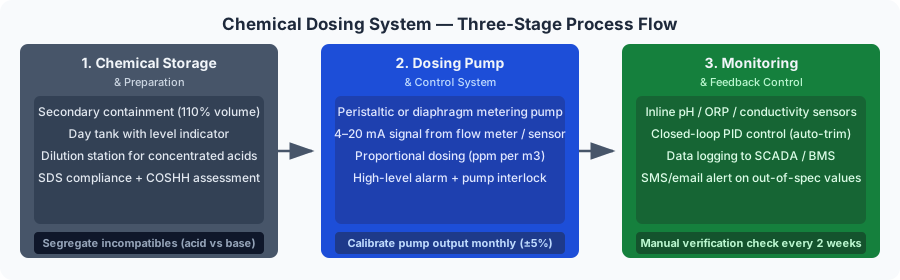
Pump selection depends on chemical compatibility, dose volume, and required turndown range. Peristaltic pumps are ideal for viscous or abrasive chemicals and provide inherent leak containment (no seals in contact with fluid). Diaphragm pumps offer higher precision at low flow rates and are preferred for pharmaceutical or food-grade applications. Both types require regular calibration verification, pump output can drift by 10 to 20% over months of operation due to tubing wear (peristaltic) or valve wear (diaphragm).
Control strategy determines whether the dosing system responds to actual water quality or simply runs on a timer. Flow-proportional dosing (dose volume proportional to treated water flow) is the minimum standard. Feedback control based on online measurement, pH, ORP (oxidation-reduction potential for oxidant biocides), conductivity, or specific ion measurement, provides the most accurate dosing and the lowest chemical consumption. For scale inhibitor programmes, phosphonate residual monitoring (colorimetric test or online probe) verifies that the inhibitor is present at the required level in the system, not just that the correct volume was dosed from the tank.
Secondary containment of all chemical storage is a legal requirement under COSHH and environmental regulations. All dosing skids must have a drip tray or bunded area capable of containing 110% of the largest container on the skid. Incompatible chemicals (acids and alkalis, oxidising and reducing biocides) must be stored in separate bunded areas with physical segregation.
The [EPA, water treatment chemical safety](dofollow:https://www.epa.gov/sdwa/chemical-contaminants-rules) guidance and equivalent UK COSHH regulations require a documented COSHH assessment for every chemical in use, covering hazards, exposure controls, emergency procedures, and disposal routes.
To find [qualified chemical suppliers](/providers) who can supply fully validated chemical programmes with dosing system design, use the Aguato platform. For complex dosing requirements across multiple water systems, [use Nepti to optimise your dosing strategy](/nepti) before committing to a supplier.
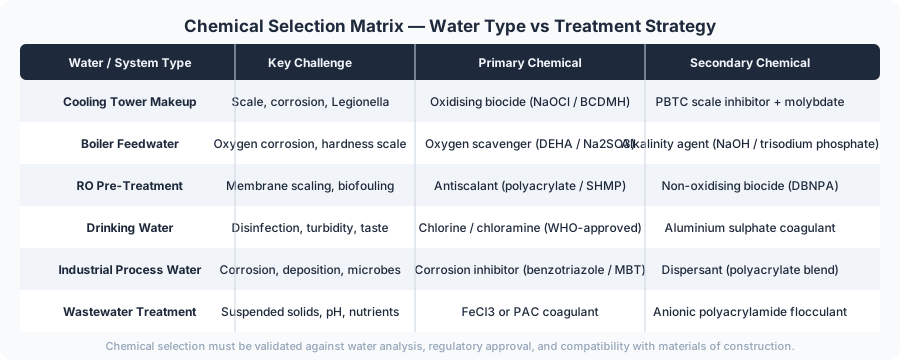
## Where Chemical Programmes Fail
Overdependence on reactive monitoring. Many industrial water treatment programmes monitor monthly and react to results that are already 4 weeks old. By the time a Legionella count at 5,000 CFU/L is reported, the system has been at elevated risk for weeks. Online ORP monitoring for oxidant level and weekly on-site checks provide the early warning that makes monthly laboratory analysis actionable rather than retrospective.
Incorrect pH assumptions. Chemical efficacy is strongly pH-dependent. Free [chlorine](/elements/chlorine) efficacy drops from 94% HOCl at pH 6 to 21% HOCl at pH 8.5, a fourfold reduction in effective disinfectant at the same measured residual. Scale inhibitor performance varies with pH and temperature. Running a cooling tower at pH 8.5 to reduce corrosion risk while relying on free chlorine biocide is contradictory chemistry, you are suppressing the mechanism you depend on.
Ignoring seasonal variation. [Cooling tower water treatment](/resources/cooling-tower-water-treatment) chemistry must account for significant seasonal variation, algal bloom events in summer increase organic load and deplete oxidant, winter temperatures reduce biological activity but increase scale risk as concentration factor increases during low evaporation periods. A chemical programme that is not reviewed and adjusted seasonally is suboptimal for significant periods of the year.
Poor sludge and deposit management. Chemical treatment programmes prevent new deposit formation but do not remove existing scale, corrosion products, or biofilm. A system with significant existing fouling requires a physical clean and system flush before a new chemical programme can be effective. Applying a scale inhibitor to a system with 3 mm of existing CaCO3 scale does not remove the scale, it prevents further deposition while the underlying efficiency loss and corrosion risk from the existing deposit persists.
Underspecifying [industrial wastewater treatment](/resources/industrial-wastewater-treatment) for chemical discharge. Biocide and inhibitor chemicals discharged in blowdown, backwash, or regeneration streams add to the trade effluent load. Phosphonate inhibitors contribute phosphorus; biocides may be regulated under trade effluent consent. Changes to chemical programme composition must be communicated to the effluent treatment system operator and verified against consent conditions, see the [step-by-step industrial wastewater treatment process](/resources/industrial-wastewater-treatment-process) for where chemical-laden side streams hit the treatment train.
No supplier independence. Receiving chemical supply and programme monitoring from the same supplier creates a conflict of interest, the supplier benefits from higher chemical consumption, not from optimised dosing. Separating supply from monitoring, or using an independent water management consultant to audit the programme annually, provides objective verification that the programme is performing as specified.
To [post your chemical treatment project](/post-project) and receive competitive proposals from multiple independent suppliers, use the Aguato platform. The [Aguato Insider](/resources) regularly publishes technical guidance on water chemistry optimisation for industrial applications.
## FAQ
### What is the difference between a coagulant and a flocculant?
A coagulant destabilises colloidal particles by neutralising their surface charge, allowing them to collide and aggregate. A flocculant is a long-chain polymer that bridges between destabilised particles, growing them into larger, more rapidly settleable floc. Coagulation happens first (typically in a rapid-mix stage with G values of 200 to 1,000 s-1), followed by flocculation (gentle agitation, G values of 10 to 50 s-1). Using a flocculant without prior coagulation typically fails, the polymer cannot bridge particles that are still charge-stabilised. The two processes work in sequence, not in substitution for each other.
### How do I choose between ferric chloride and alum as a coagulant?
Ferric chloride works across a wider pH range (4 to 9 versus 6 to 8 for alum), produces denser and more rapidly settling floc, and is more effective for coloured water and phosphorus removal. Alum is less corrosive, lower cost in many markets, and produces lower sludge volumes per unit of COD removed. Where both work, the choice comes down to: local price, sludge dewatering characteristics (ferric sludge dewaters better on filter presses), downstream impacts (aluminium residual versus iron residual in treated water), and pH management requirements. In cold water (below 5°C), ferric coagulants generally outperform alum.
### Can biocides cause corrosion in water treatment systems?
Yes, if incorrectly selected or overdosed. Oxidising biocides (particularly chlorine-based) at high concentrations are aggressive corrosives on stainless steel (crevice corrosion), copper (dezincification in brass), and carbon steel (general corrosion). The recommended operating range for free chlorine in cooling systems (1 to 3 mg/L) is set to balance biocidal efficacy against corrosion risk. Chlorine dioxide (ClO2) at low doses (0.1 to 0.5 mg/L) provides effective disinfection with significantly lower corrosion impact than equivalent chlorine doses, relevant for systems with sensitive metallurgy.
### What is the shelf life of water treatment chemicals?
Most liquid water treatment chemicals have shelf lives of 12 to 24 months when stored correctly (cool, dry, away from freezing and direct sunlight). Sodium hypochlorite degrades faster, at 10 to 15% strength, it loses approximately 5 to 10% active chlorine per month at ambient temperature. Solid chemicals (calcium hypochlorite, alum) have longer shelf lives (2 to 5 years) if kept dry and sealed. Always check the manufacturer's certificate of analysis for original concentration, calculate expected degradation based on storage time and conditions, and verify actual concentration by titration before use in critical applications.
### How do I calculate chemical dosing rates?
The fundamental calculation is: dose rate (L/hr) = [target concentration (mg/L) x flow rate (m3/hr) x 1,000] / [product concentration (mg/L active)]. Example: to maintain 5 mg/L HEDP inhibitor in a cooling tower circuit at 100 m3/hr circulation, using a product at 35% active (350,000 mg/L): dose rate = (5 x 100,000) / 350,000 = 1.43 L/hr. This is the continuous make-up dose. Additional calculations for blowdown losses, evaporation losses, and batch shock doses complete the total chemical consumption model. Proportional control based on makeup water flow meter is more accurate than time-clock dosing in variable-flow systems.
### When should I use a water treatment chemical consultant versus a chemical supplier?
A chemical supplier provides products and a basic application service. An independent consultant provides objective programme design, supplier selection, performance auditing, and regulatory compliance advice without a product sales incentive. Use an independent consultant when: your water treatment programme has failed and you need an unbiased diagnosis; you are commissioning a new system and want a defensible specification before approaching suppliers; you have a regulatory compliance issue requiring expert evidence; or your existing supplier relationship has become complacent and you need an objective performance review. The cost of an independent consultant ($625, $2,500/day for experienced water chemistry specialists) is typically recovered within weeks through improved programme efficiency and reduced chemical consumption.