A water marketplace connects buyers with water treatment services, technology, rights, or resources. Most industrial buyers need one specific type, here is how to tell them apart and choose the right one.
A water marketplace is a platform or system where water-related services, technology, rights, or resources are matched between buyers and providers. The term covers three fundamentally different categories of platform, industrial procurement portals connecting factories with water treatment specialists, innovation hubs trading circular economy technologies, and regulated markets where water abstraction rights are bought and sold. They share a subject but serve entirely different users.
The confusion between these three categories is common and consequential. An industrial plant manager searching for a water treatment partner and a farmer in California trading irrigation entitlements are both operating in "water marketplaces", but the platforms, processes, and decision criteria involved have nothing in common. Getting this wrong at the start of a procurement search wastes weeks.
For industrial and commercial buyers, food processors, pharmaceutical manufacturers, chemical plants, mining operations, real estate developers, the relevant marketplace is the industrial water treatment provider marketplace: a platform that matches project owners with verified specialists and enables structured comparison of independent proposals. That is the primary focus of this guide, alongside a complete map of all three types.
## What Is a Water Marketplace?
A water marketplace is any structured platform or mechanism that facilitates the exchange of water-related value, whether that value is a treatment service, a technology solution, a circular economy innovation, or a legal right to abstract water from a source.
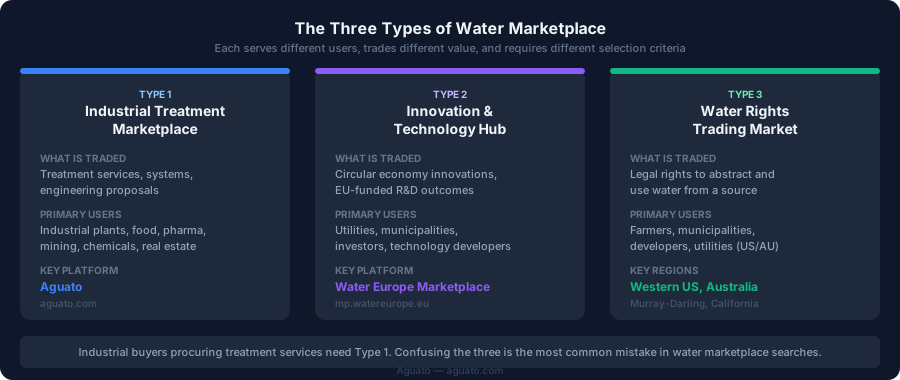
Three distinct types exist, each with a different definition of what is traded, who the buyers and sellers are, and what decision framework applies:
| Type | What Is Traded | Primary Buyers | Decision Driver | |---|---|---|---| | Industrial treatment marketplace | Provider services, treatment systems, engineering proposals | Industrial plants, food/pharma/mining/chemicals | Technology fit, OPEX, compliance | | Innovation and technology hub | EU-funded solutions, circular economy innovations, R&D outcomes | Utilities, municipalities, investors | Commercialisation potential | | Water rights market | Legal entitlements to abstract and use water | Farmers, municipalities, developers | Regulatory allocation, scarcity pricing |
The [WHO's guidelines on water quality management](dofollow:https://www.who.int/publications/i/item/9789240045064) establish the framework against which most industrial discharge and process water standards are set, but neither rights markets nor innovation hubs address the operational question of how to meet those standards in practice. That is what the industrial treatment marketplace exists to answer.
## Key Water Marketplaces: A Comparison
The platforms most commonly referenced when buyers search for a water marketplace:
[1. Aguato, Industrial Water Treatment Marketplace](https://aguato.com) 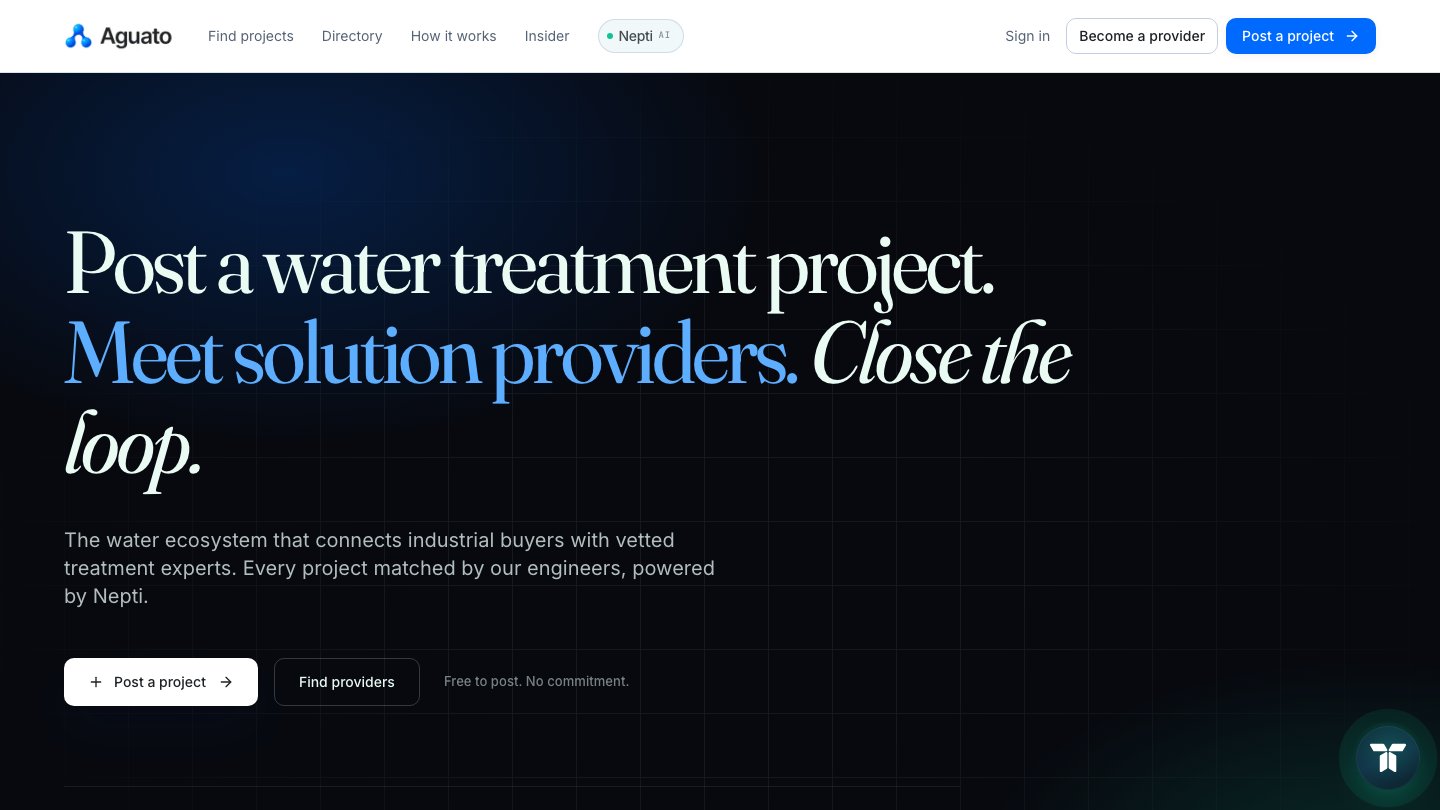 The operational platform connecting industrial project owners with 1,000+ verified water treatment specialists. Buyers post a project brief, built from feed water data using Nepti AI, and receive 3 to 5 independent proposals from matched providers, comparable on a consistent specification. Active projects span food and beverage, pharmaceuticals, chemicals, mining, and commercial real estate across Europe, the Gulf, and beyond. [Browse providers](/providers) or [post a project](/post-project).
2. Water Europe Marketplace 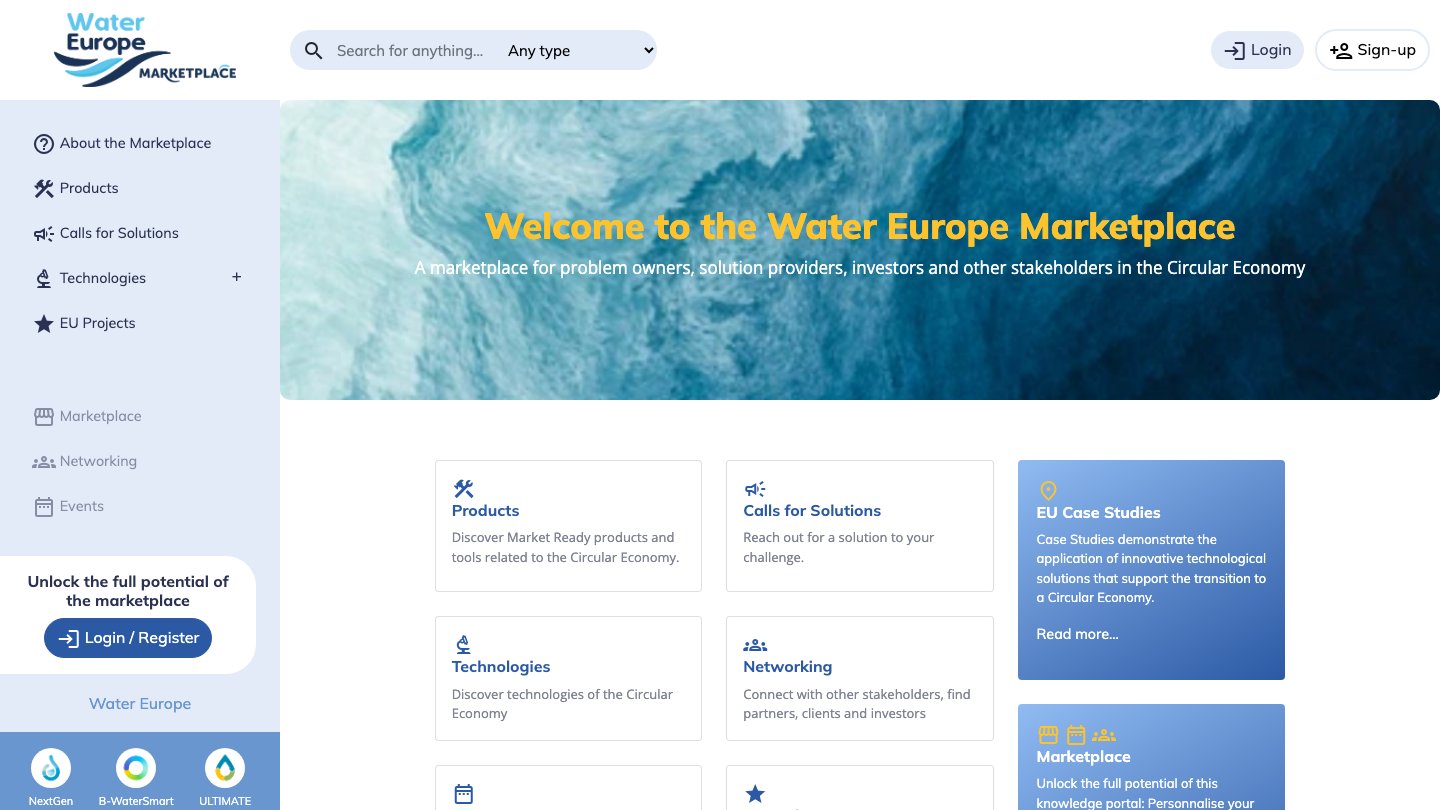 An EU Horizon-funded innovation hub (mp.watereurope.eu) connecting technology developers, utilities, and investors around circular economy water solutions. Oriented toward piloting and commercialising EU-funded R&D outcomes. Not a procurement tool for industrial treatment needs, but the primary discovery platform for circular economy innovation in the European water sector.
3. WaterSurplus  A secondary-market platform for buying and selling surplus industrial water treatment equipment. Useful for capital cost reduction when proven pre-owned systems are appropriate, but does not provide matched provider proposals or technology selection support.
4. Water Rights Marketplace (US) 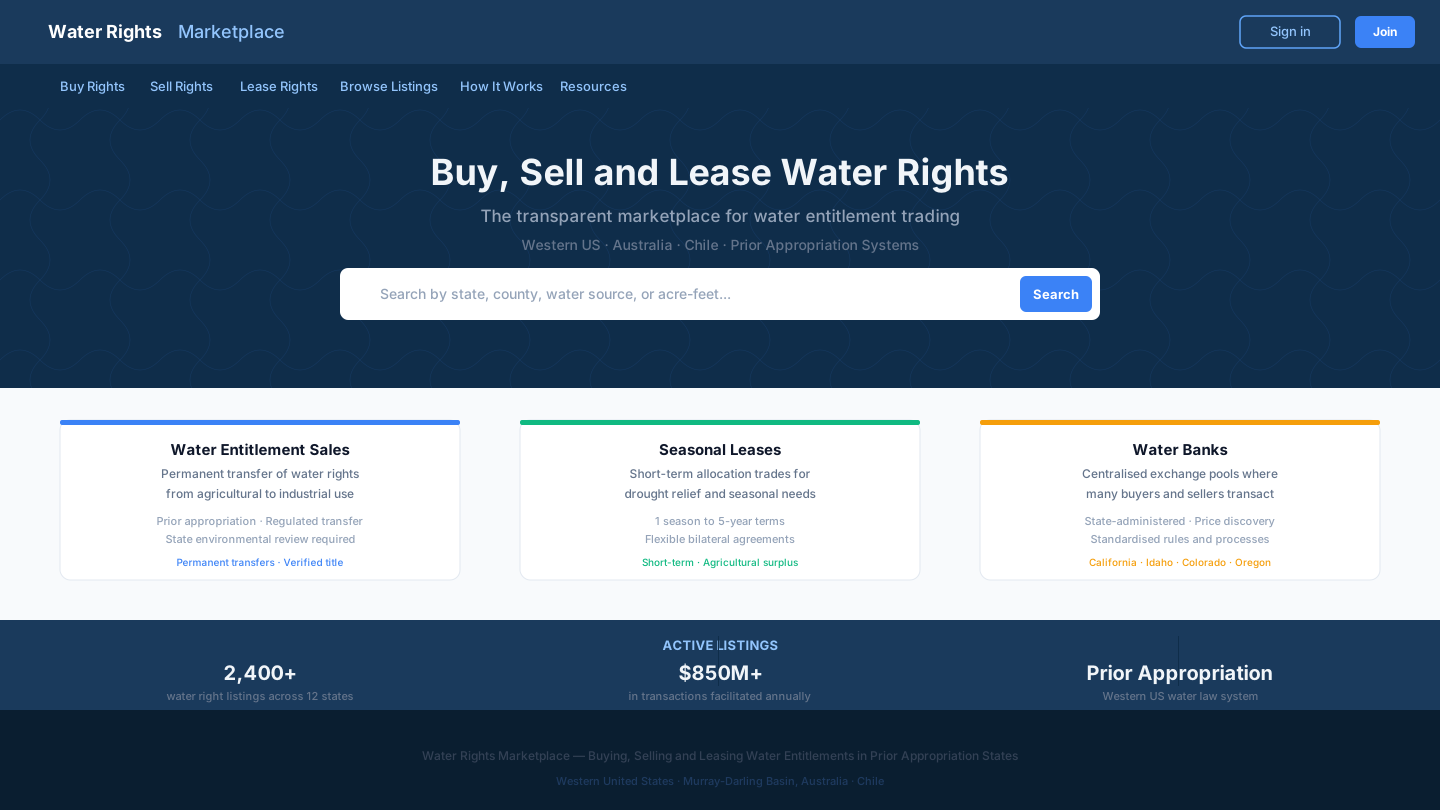 Regional platforms and state-administered systems for trading water abstraction rights under prior appropriation law. Dominant in the western United States, Australia's Murray-Darling Basin, and parts of Chile. Entirely separate from treatment procurement, relevant only when the challenge is securing the legal right to use a water source, not treating it.
5. WATER-MINING Marketplace 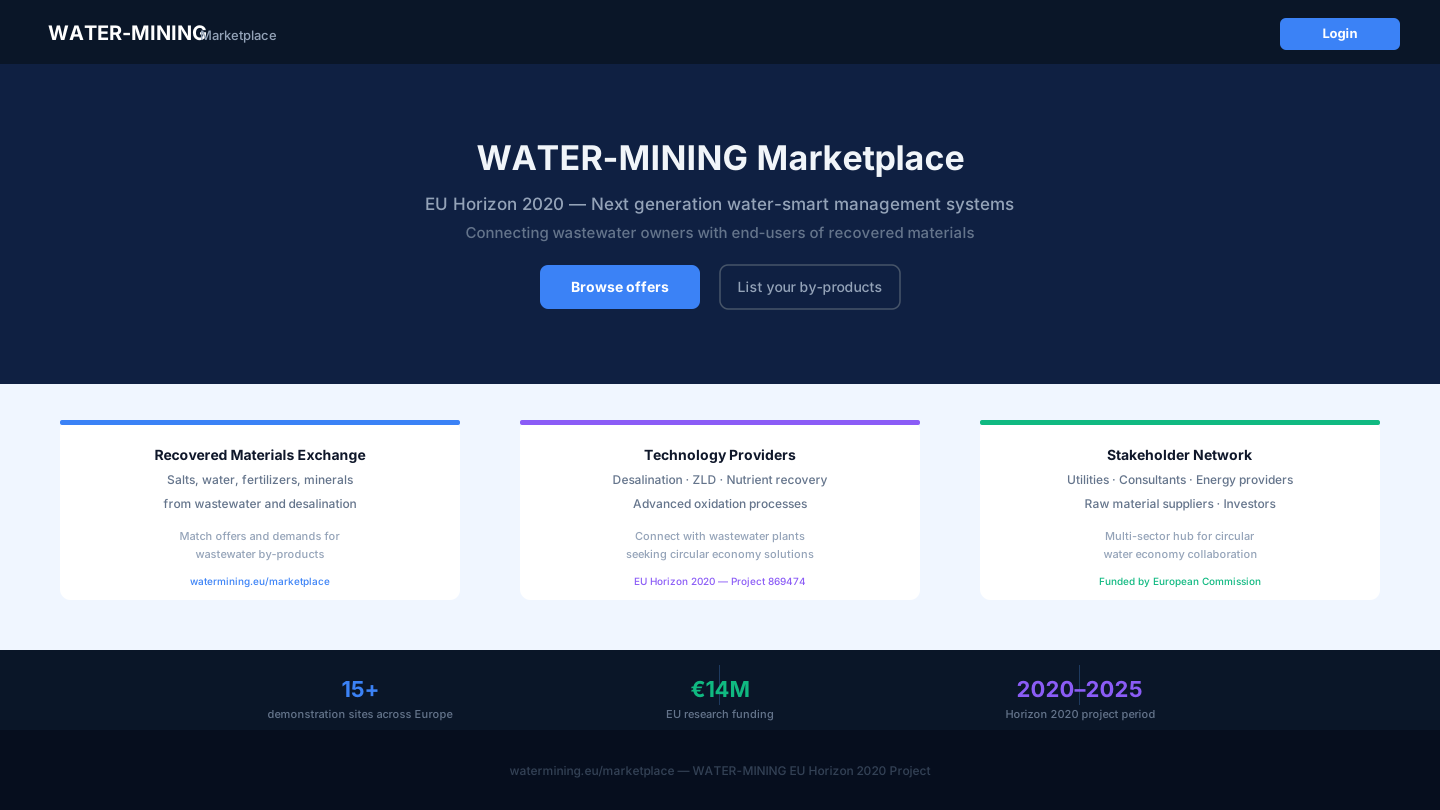 An EU-funded platform for water mining and resource recovery technologies, advanced wastewater-to-resource innovations including nutrient recovery, brackish water desalination, and zero-liquid discharge. Early-stage technology focus with a primarily European utility and research audience.
## How an Industrial Water Marketplace Works
The core value proposition of an industrial water marketplace is eliminating the information asymmetry that drives poor procurement decisions. Traditional selection relies on whoever answers the phone first. A marketplace replaces that with a structured, competitive, data-driven process.
On [Aguato](/how-it-works), the process follows four steps:
Step 1, Characterise with Nepti. Input feed water data: TDS, hardness, alkalinity, TOC, flow rate, industry type, quality target, and regulatory context. [Nepti](/nepti) processes this against 1,000+ provider capability profiles and returns a ranked set of compatible technology options with CAPEX and OPEX projections, in under one hour. No vendor sees this analysis. The buyer owns it.
Step 2, Define the brief. The Nepti output becomes the project specification: technically grounded, built on your water data, not on what a vendor proposed. This is the document that goes to the market.
Step 3, Post on Aguato. The brief is distributed to providers matched by technology, industry, geographic capacity, and track record. The network spans reverse osmosis, membrane bioreactors, nanofiltration, electrocoagulation, advanced oxidation, ion exchange, zero liquid discharge, and 25+ other technology categories.
Step 4, Compare independent proposals. Receive 3 to 5 proposals responding to the same specification. Evaluate on CAPEX, OPEX, technology approach, commissioning timeline, and references, all on a consistent basis, without the noise of competing vendor formats.
[cta:nepti-dark]
The differentiator is Step 1. Most platforms are directories. Aguato's intelligence layer means proposals arrive calibrated to the technical reality of the water challenge, reducing back-and-forth negotiation and shortening the path to shortlist from months to weeks.
## Why Industrial Buyers Are Switching to Marketplaces
Three converging pressures have made the case for marketplace-based procurement compelling across the industrial sector.
Regulatory tightening on accelerated timescales. The EU Water Framework Directive review cycle, US EPA effluent guideline updates, and emerging discharge standards in the Gulf and Southeast Asia are reducing compliance windows. A food processor facing a new COD limit in 90 days cannot afford a 4-month procurement cycle. Marketplaces compress selection time without sacrificing proposal quality.
Technology proliferation without independent guidance. The range of viable industrial water treatment technologies has expanded significantly: nanofiltration, membrane bioreactors, electrocoagulation, advanced oxidation, ZLD. Each has legitimate use cases, but no single vendor covers all of them objectively, and most proposals are shaped by product portfolio rather than optimal fit. A marketplace enforces competitive, specification-based comparison across technology categories.
Quantified cost of wrong decisions. Failed pilots cost $275k, $2.2M per site. System retrofits after incorrect technology selection run $1.1M, $5.5M. Production downtime during remediation averages $110k, $550k per week. Most of these failures trace back to one cause: technology selected without adequate independent data. The global aggregate of these losses exceeds $22 billion annually, a figure that makes the case for structured procurement more clearly than any case study. As explored in [How to Choose Industrial Water Treatment Technology](/resources/how-to-choose-industrial-water-treatment), the decision framework matters more than the technology itself.
Access to specialists beyond the Tier 1 vendors. The global market is dominated by Veolia, Ecolab, Evoqua, and SUEZ. Large vendors are effective at scale, but often propose standardised solutions rather than optimised ones. A marketplace gives mid-size industrial buyers access to the 1,000+ specialist providers that large vendor relationships don't reach.
## What to Look For When Choosing a Water Marketplace
Not all industrial water marketplaces deliver equivalent results. The criteria that determine whether a marketplace produces better procurement decisions than traditional RFP cycles:
Provider verification depth. A marketplace is only as good as its network. Verified credentials, technology-specific track records, past project references, and geographic capacity matter more than raw provider count. Five well-matched, verified specialists consistently outperform fifty unfiltered directory listings.
Matching logic. Keyword search produces generic results. Technology fit matching, based on water composition, required output quality, flow rate, industry, and capacity range, produces actionable results. Ask specifically how the platform matches projects to providers, and whether that matching is driven by data or by provider subscriptions.
Specification support. Vague briefs produce vague proposals. A well-designed marketplace provides tools to build technically defined specifications, or, in Aguato's case, generates them from water chemistry data via AI. The quality of the incoming spec is the single biggest driver of proposal quality.
Commercial neutrality. Fee structures that charge providers per lead create incentives to surface high-paying providers rather than best-fit providers. A neutral marketplace charges for platform access, not for preferential placement.
Proposal comparison framework. Receiving multiple proposals is valuable only if they can be evaluated on a consistent basis. Look for platforms that structure proposals around standardised fields: technology approach, CAPEX range, OPEX projection per m³, installation and commissioning timeline, and client references.
## AI and the Modern Water Marketplace
Artificial intelligence has changed the most important step in industrial water procurement: the pre-specification phase.
Traditionally, a buyer seeking proposals described their problem in natural language, often without access to independent technical guidance. Vendors responded based on their product portfolio. The buyer had no independent reference point to evaluate whether the proposed technology was the best fit or simply the one the vendor was most confident selling.
The [Water Research Foundation](dofollow:https://www.waterrf.org/) has published extensively on the gap between technology-optimal and procurement-optimal decisions in industrial water treatment, a gap driven almost entirely by information asymmetry at the selection stage.
AI closes this gap by processing feed water chemistry data and modelling which technology combinations minimise total cost and risk for that specific water profile. The output is vendor-independent, it is a ranked set of technology options with cost projections, owned by the buyer. As detailed in [Nepti: The Intelligence Layer Industrial Water Has Been Missing](/resources/nepti-decision-intelligence-water-treatment), this shifts the information asymmetry that has historically favoured vendors.
The regulatory clock reinforces the case. The [EU Water Framework Directive](dofollow:https://environment.ec.europa.eu/topics/water/water-framework-directive_en) mandates progressively tighter discharge standards through 2027 and beyond. Industrial operators facing new compliance requirements on short timescales need technology evaluation faster than consultant-led processes allow, and at a cost that reflects a mid-cycle operational decision, not a capital planning exercise.
The quantified impact: AI-assisted selection reduces decision time from 4 to 6 months to 2 to 6 weeks and cuts selection cost by 70 to 90% compared to traditional consultancy-led approaches, saving $19k, $47k per project selection while improving technical quality.
## Water Marketplace vs. Traditional Procurement
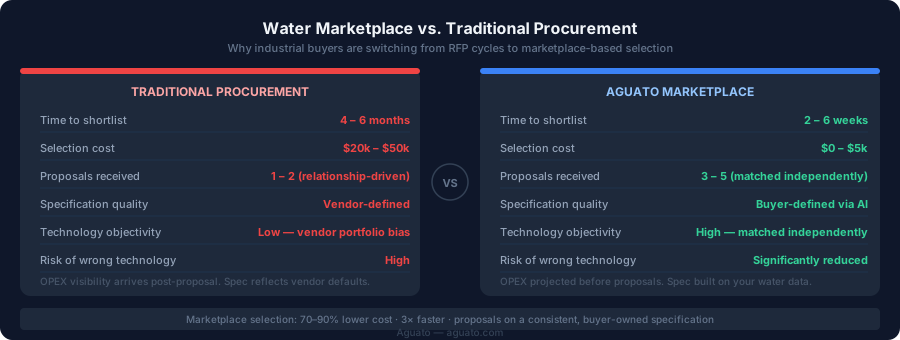
The comparison makes the structural case. Marketplaces do not merely accelerate procurement, they change its architecture. Vendor-defined specifications systematically favour vendor product ranges. Buyer-defined specifications, built on independent water data analysis, produce proposals that compete on technical fit rather than on relationship and familiarity.
The practical result: industrial buyers who post projects through the Aguato marketplace consistently receive 3 to 5 proposals within 2 to 3 weeks, at a fraction of the cost of traditional selection, against a specification that reflects their water, not a vendor's defaults.
---
## FAQ
### What is a water marketplace?
A water marketplace is a platform or system where water-related services, technology, rights, or resources are matched between buyers and providers. Three distinct types exist: industrial water treatment procurement platforms (like Aguato), innovation and technology hubs connecting circular economy solution developers with utilities and investors (like Water Europe Marketplace), and regulated markets where water abstraction rights are bought and sold (like California's water trading system). The type relevant to any given buyer depends entirely on the problem being solved.
### What is the difference between a water marketplace and a water rights market?
A water rights market facilitates the buying, selling, and leasing of legal entitlements to abstract water from a river, aquifer, or reservoir, a regulatory mechanism for water allocation in scarcity-affected regions like the western United States and Australia. A water treatment marketplace connects buyers who already have access to water with providers of treatment services to improve that water's quality or enable its reuse. The two have completely different users, transaction types, and regulatory frameworks.
### How does Aguato work as a water marketplace?
Aguato is an industrial water treatment marketplace connecting project owners with 700+ verified specialists. Buyers characterise their water challenge using Nepti AI, entering feed water data to receive ranked technology options with cost projections within one hour. That analysis becomes a project brief, posted to the marketplace and distributed to matched providers. Buyers receive 3 to 5 independent proposals, all responding to the same specification. The full process takes 2 to 6 weeks vs. 4 to 6 months for traditional procurement. Details at [aguato.com/how-it-works](/how-it-works).
### How long does it take to find a water treatment provider on a marketplace?
On Aguato, most projects receive 3 to 5 proposals within 2 to 3 weeks of posting. Total time from initial characterisation to shortlist is typically 2 to 6 weeks, compared to 4 to 6 months for traditional consultant-led or RFP-based selection. The time reduction comes from pre-qualified provider matching, AI-generated specifications, and structured proposal comparison, not from cutting corners on technical quality.
### Is a water marketplace only for large projects?
No. Industrial water marketplaces serve projects across a wide CAPEX range, from small treatment systems at $50k, $200k to multi-million dollar installations. For smaller projects, the primary benefit is access to specialist providers that are hard to identify through personal networks. For larger projects, the primary benefit is competitive, specification-based comparison that drives both technical quality and cost discipline.
### Which industries use water marketplaces most?
The highest adoption is in food and beverage processing, pharmaceuticals, chemicals and petrochemicals, mining, and textile manufacturing, all industries with high water consumption and strict discharge requirements. Commercial real estate and municipalities are growing segments as discharge regulations tighten. [Browse verified providers by technology and industry](/providers) on the Aguato marketplace.
### Can a water marketplace help with regulatory compliance?
Yes. A well-designed marketplace matches project briefs to providers with documented experience in the relevant regulatory environment, EU IED discharge standards, US EPA effluent guidelines, Gulf municipal discharge codes, and ISO water quality frameworks. The Nepti AI pre-screening also factors compliance requirements into technology rankings, ensuring proposals respond to the legal context, not just the water chemistry.