Nepti is Aguato's AI decision engine for industrial water. It ranks treatment options, models costs, and characterises water in under an hour.
Water treatment is a $48 billion market where most technology decisions are still made by calling a vendor and asking what they think. No independent analysis. No ranked comparison of alternatives. No cost modelling before the first proposal lands. Just whoever answers the phone fastest, and a specification that reflects their product line, not your water chemistry.
This is not one company's failure. It is the industry standard, globally. And it costs an estimated $22 billion every year in failed pilots, system retrofits, production downtime, and compliance penalties, losses driven almost entirely by poor technology selection, not poor technology.
[Nepti](/nepti) is Aguato's answer to this. A decision intelligence engine built specifically for water technology selection, the step that happens before any vendor is contacted. Input your feed water data. Receive ranked technology recommendations with cost projections in under one hour. Own the analysis, independent of any provider's commercial interest. This article explains what Nepti is, why it works, and why the timing is significant. For the broader decision framework Nepti feeds into, see [how to choose industrial water treatment](/resources/how-to-choose-industrial-water-treatment) and [how the Aguato water marketplace works](/resources/water-marketplace).
## The $22 Billion Decision Problem
The standard process for choosing an industrial water treatment technology: describe the problem to a vendor, receive a proposal, compare it against one or two others, award to the lowest price or most familiar name.
What does not happen: independent feed water characterisation, systematic comparison of all compatible technologies, CAPEX and OPEX modelling before any vendor sees the project, or risk quantification across alternatives.
The global aggregate of these failures adds up to more than $22 billion annually: failed pilots costing $275k, $2.2M per site, system retrofits running $1.1M, $5.5M, downtime at $110k, $550k per week during remediation. Losses that are, in almost every case, driven by one cause, technology selected without adequate independent data.
The [IEA's analysis of the water-energy nexus](dofollow:https://www.iea.org/reports/water-energy-nexus) places industrial water decisions at the intersection of energy efficiency, operational cost, and regulatory compliance, three dimensions that vendor-led selection fails to optimise simultaneously.
## What Nepti Actually Does
Nepti is not a chatbot. It is a structured decision intelligence engine trained on water treatment outcomes.
The input is specific: feed water composition (TDS, hardness, alkalinity, silica, TOC, microbiology), flow rate, quality target, operational constraints, industry type, and regulatory context. The same parameters a consultant would need, entered directly, without the intermediary, without the weeks of scoping calls.
The output is decision-ready: - Ranked technology options matched to your specific water matrix - CAPEX and OPEX projections per option - Pre-treatment requirements surfaced before they become expensive surprises - Risk and confidence score per technology path - Matched provider criteria, what a qualified vendor needs to demonstrate
Nepti offers two modes. Diagnose handles existing systems with performance issues or compliance gaps, it identifies what is failing and which technology options would correct it. Design handles new installations and major upgrades, it produces a process flow recommendation with sizing parameters and technology combinations optimised for cost and reliability.
The output is a brief. Not a construction drawing. Not a final specification. A structured starting point that gives engineering teams, procurement leads, and plant managers the same analytical depth that previously required a $30,000 consultancy engagement, available in under an hour, at a fraction of the cost.
## The ROI Is Already Quantified
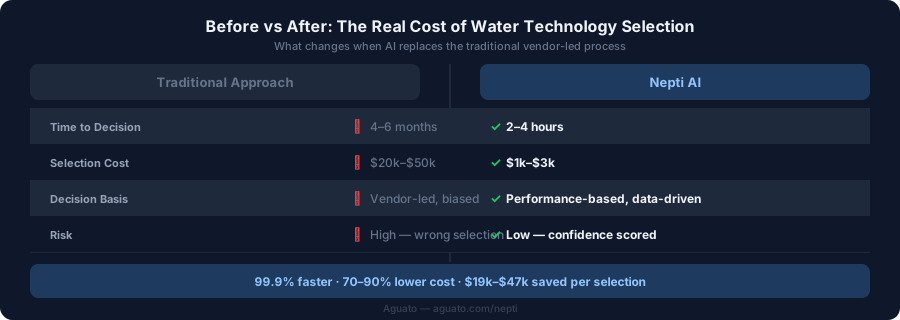
The performance gap between traditional technology selection and Nepti is not a projection, it is a direct comparison of documented processes:
| Metric | Traditional | With Nepti | |---|---|---| | Time to decision | 4 to 6 months | 2 to 4 hours | | Selection cost | $20k, $50k | $1k, $3k | | Decision basis | Vendor-led, biased | Performance-based | | Risk of wrong selection | High | Low, confidence-scored |
99.9% faster. 70 to 90% lower cost per selection cycle. Savings of $19k, $47k before accounting for the reduced probability of selecting the wrong technology entirely.
For a manufacturing facility conducting two to three water treatment reviews annually, the annual saving exceeds $100k. For a multi-site enterprise operating under tightening compliance requirements, the compounding value is substantial. And for the first time, a plant manager without a dedicated water chemistry team can walk into a vendor conversation with an independent, data-backed specification, and evaluate every proposal on equal terms.
## One Root Cause Across Five Sectors
Water treatment challenges look entirely different across industries. A pharmaceutical purified water loop and a textile dyeing effluent plant have almost nothing in common technically. But the decision failure mode is identical in every sector: technology chosen without adequate independent data analysis.
Textile and apparel face mandatory effluent treatment requirements and tightening discharge limits. Bangladesh's Environmental Conservation Rules 2023 cut the BOD limit from 100 to 30 mg/L. EU buyer compliance requirements, ZDHC, CSDDD, are accelerating further. Thousands of water-intensive facilities will need to make new technology decisions before 2027.
Pharmaceutical and life sciences operate under pharmacopoeia specification with zero tolerance for exceedance. USP Purified Water requires conductivity below 1.3 µS/cm and TOC below 500 µg/L. A loop that fails specification triggers a CAPA, a production hold, and potential re-validation costing months of lost output. Technology selection errors here are regulatory events, not operational costs.
Food and beverage process water must meet potable standards with constraints on taste, odour, and microbial consistency. Water costs have risen 15 to 30% in three years across water-stressed regions. Reducing consumption and enabling reuse requires correctly specified treatment technology from the outset.
Cooling and HVAC carry statutory Legionella compliance obligations. A poorly specified [cooling tower](/resources/cooling-tower-water-treatment) treatment programme consumes 8 to 15% more energy than an optimised one, and carries the legal exposure that a correct technology specification prevents entirely.
High-purity manufacturing, semiconductors, advanced electronics, requires water at conductivity below 0.056 µS/cm. A UPW system for a semiconductor fab costs $15 to 60M. The specification must be right before a single unit is ordered.
In every case, Nepti's value is the same: independent data-driven analysis before any vendor is contacted. [Browse providers](/providers) by technology and industry specialisation once your analysis is complete.
## Why the Regulatory Window Is Wide Open
Three forces are converging to make AI-assisted water technology selection not just useful, but urgent.
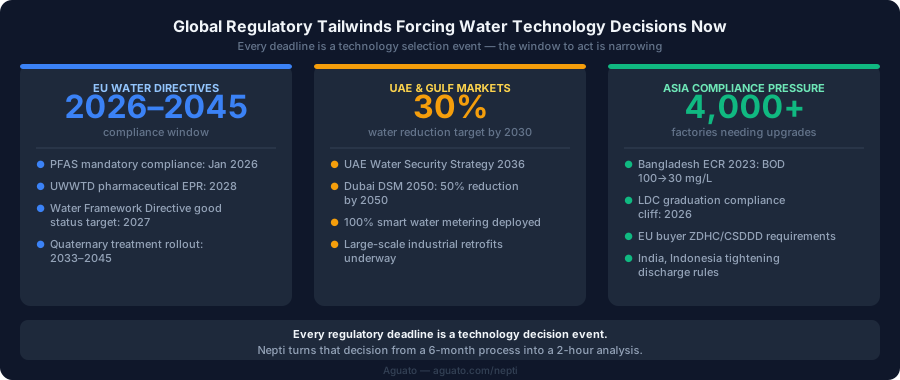
European regulatory acceleration. EU water directives have staggered compliance deadlines running from 2026 to 2045. PFAS mandatory compliance under the recast [EU Drinking Water Directive](dofollow:https://eur-lex.europa.eu/legal-content/EN/TXT/?uri=CELEX%3A32020L2184) takes effect January 2026. The Urban Wastewater Treatment Directive requires pharmaceutical and cosmetics industries to fund pollutant removal through Extended Producer Responsibility by 2028. The Water Framework Directive's "good status" deadline is 2027. Each deadline represents a mandatory technology decision event for thousands of facilities across the EU.
UAE and Gulf markets committed at scale. The UAE Water Security Strategy 2036 and Dubai Sustainability Master Plan 2050 mandate 30% water demand reduction by 2030 and 50% by 2050. 100% smart water metering and full treated wastewater reuse for irrigation are already operational targets. Large-scale technology retrofits across buildings, industry, and cooling systems are accelerating.
Developing market compliance pressure. Bangladesh's LDC graduation in 2026 creates a compliance cliff, factories must match international standards to maintain EU and US market access. The Alliance for Water Reuse targets 50%+ water recovery in large plants by 2030. Thousands of facilities face technology decisions, most without formal feed water analysis on record.
[cta:nepti-dark]
## Traction: What Is Live Today
Nepti is not a roadmap. The platform is operational.
1,000+ vetted solution provider profiles, categorised by technology, services, use cases, and location. $3M+ in live industrial water projects currently on the platform, including cosmetic-grade RO upgrades in France, high-salinity algal bloom treatment in Saudi Arabia, radionuclide removal from well water, and greenhouse irrigation quality optimisation in Spain. Nepti AI v1.0 live, combining NLP and LLM with a structured analysis interface.
The Aguato marketplace connects characterised project briefs with matched providers. Every project posted generates the structured outcome data that makes future recommendations more precise. The platform is live, the providers are vetted, and the projects are real.
## The Intelligence Layer That Gets Smarter
What distinguishes Nepti from a standalone tool is the data flywheel embedded in the Aguato platform.
Every project executed on Aguato generates structured outcome data: feed chemistry, technology selected, provider performance, actual results against specification. This data feeds back into Nepti's training, making recommendations progressively more accurate for similar water matrices, industries, and regulatory contexts. The platform improves with every project executed.
No water treatment consultancy, vendor, or point-solution AI has this. A consultancy's project database is proprietary and siloed. A vendor's outcome data is self-selected and commercially filtered. Nepti's training data grows with the marketplace, and because providers submit verified references to join the network, the quality of that data is structurally higher than anything assembled by a single firm.
The [World Bank's water and development overview](dofollow:https://www.worldbank.org/en/topic/water/overview) identifies decision quality in industrial water management as one of the highest-leverage interventions for reducing water waste and energy consumption at scale. Nepti is precisely that, a decision quality upgrade available to any plant manager with a water challenge to solve, regardless of whether they have a dedicated water chemistry team or a consultancy budget.
This is what makes Nepti a platform asset rather than a feature. It is the intelligence layer industrial water has been missing, and that every regulatory deadline, every failed pilot, and every $300k technology selection process makes more necessary.
## FAQ
### What is Nepti and who is it for?
Nepti is Aguato's AI decision intelligence engine for industrial water technology selection. It is built for plant managers, operations engineers, sustainability directors, and procurement leads responsible for water treatment in manufacturing, pharmaceuticals, food processing, textiles, cooling systems, and any water-intensive industry. It is also used by engineering firms conducting pre-specification analysis on behalf of clients.
### How does Nepti differ from asking a water treatment consultant?
A consultant brings on-site capability and project experience. Nepti brings data-driven analysis across 1,000+ provider capabilities in under one hour, at no upfront cost, with no commercial interest in which technology you choose. The two are complementary: Nepti for technology shortlisting and pre-specification analysis, a qualified engineer for site survey, hydraulic design, and compliance review. For most projects, the right sequence is Nepti first, then the engineer.
### Does Nepti work for existing systems as well as new installations?
Yes. Nepti's Diagnose mode handles existing systems with performance issues, compliance gaps, or upgrade requirements, it identifies what is failing and which technology options correct it. Design mode handles new installations and major capacity changes. Both return ranked options with cost projections and pre-treatment requirements.
### How accurate are the recommendations?
Recommendations are matched against structured provider capability profiles and validated against outcome data from projects executed on Aguato. A confidence score is returned with each recommendation. Accuracy improves continuously as more projects complete through the platform, the more water challenges processed, the more precise the recommendations for similar matrices and industries.
### How does the Aguato marketplace work after a Nepti analysis?
Once your Nepti analysis produces a ranked technology brief, you can post your project to the Aguato marketplace. Matched providers receive your specification, not a description of your problem, but a structured brief built on your water data. You receive 3 to 5 independent proposals, comparable on a consistent spec. Providers only see your project after it is posted; the analysis phase is completely private.