Most water treatment projects stall not from bad engineering but from weak financial cases. Learn how to frame roi water treatment investment to win CFO approval.
Water treatment capital requests fail in the CFO's office more often than they fail in the engineering review. The technology is rarely wrong. The financial case usually is. A poorly scoped pre-treatment upgrade that costs $280,000 to install can prevent a single boiler scale event worth $600,000 in lost production, emergency maintenance, and regulatory notice costs, yet it gets deferred for two budget cycles because no one quantified the avoided cost in language finance will accept. That pattern repeats across sectors, and it is expensive.
The contrarian reality is that most water treatment ROI cases are too conservative. Engineers document the cost of the new system and stop there. They omit avoided regulatory penalties, the cost of premature asset replacement caused by poor water quality, the insurance and liability tail on a Legionella outbreak, and the ESG reporting value of documented water reduction metrics. A complete financial model routinely doubles the apparent return compared to a "chemicals + energy + CAPEX" only analysis. The projects that win budget are the ones that make the full case.
This article covers how to structure a defensible roi water treatment investment case, which cost categories most teams miss, how to choose the right technology based on quantified thresholds rather than spec sheets, the failure scenarios that turn deferred upgrades into emergency CAPEX, and the financial language that moves a project from engineering recommendation to board approval. It is written for operations leads building the internal case, procurement managers preparing RFP evaluation criteria, and sustainability directors who need to anchor ESG water targets to financial outcomes.
## The decision in brief
- Correct the approach today. If you correct your water treatment approach today, a mid-size industrial site typically recovers $200,000 to $900,000 over five years. - Count four sources of recovery. The recovery comes through a combination of reduced chemical spend, lower energy consumption, extended membrane and boiler life, and avoided regulatory events. - Build the case on single-event exposure, not OPEX creep. The biggest cost of doing nothing is not gradual OPEX creep but the single-event exposure: a cooling tower Legionella incident, an RO membrane replacement cycle triggered by poor pre-treatment, or a regulatory notice that triggers a mandatory upgrade on a timeline you do not control.
The cost of doing nothing is that forced upgrade, typically at 2 to 4 times the cost of a planned project.
## Why water treatment ROI cases fail at the CFO level
A water treatment investment proposal fails when the financial team cannot verify the numbers independently. Most engineering submissions are written for other engineers, not for a capital allocation committee that is simultaneously reviewing a warehouse automation project, a fleet renewal, and a lighting retrofit. The water treatment case needs to speak the same language as those competing bids.
The most common structural failure is presenting a point estimate rather than a range. Stating that a new RO system will "save approximately $180,000 per year" without sourcing the number or showing sensitivity analysis looks like a guess, because it is. Capital reviewers have seen optimistic project estimates before. The ones that survive scrutiny show: current verified spend, the avoided cost under two or three scenarios, the downside if the project is deferred, and a payback period calculated at the firm's actual hurdle rate, not a convenient one.
A pattern that recurs in industrial installations is that the person closest to the water system, often the utilities manager or plant engineer, has excellent intuition about risk but has never been asked to translate it into financial exposure. The gap is not knowledge, it is formatting. The ROI case is the translation layer, and it is worth spending as much time on that document as on the technical specification.
## The four cost categories most teams leave out
The standard water treatment budget exercise captures chemical spend, energy cost, and the capital cost of new equipment. Those three categories are necessary but not sufficient. A complete roi water treatment investment analysis adds four more.
Downtime and production loss is the largest omitted number in most cases. A single cooling tower failure from scale or biological fouling at a 24/7 process plant costs $50,000 to $2,000,000 per event depending on the sector. Pharmaceutical batch loss, automotive paint line shutdown, food and beverage product recall risk, and data centre cooling failure each carry different cost profiles, but all of them dwarf the cost of the water treatment upgrade that would have prevented the event. The correct way to model this is: (probability of failure per year) x (average event cost) = expected annual loss. If your current water treatment regime has a 15% probability of a scale-related failure and each failure costs $400,000, that is $60,000 of expected annual loss that disappears when the treatment is corrected.
Accelerated asset degradation is the cost of running on poor water quality rather than having a discrete failure. Scale on heat exchangers reduces thermal efficiency by 10 to 25%, increasing energy consumption and shortening equipment life. Specifying the right alloy and plate geometry from established [heat exchanger suppliers for water systems](/heat-exchanger-water-companies) is a direct lever on this loss. A boiler operating on water with hardness above 50 mg/L as CaCO3 typically needs descaling at 12 to 18 month intervals instead of 4 to 6 years, adding $15,000 to $80,000 per boiler per cycle in maintenance labour and chemical costs. Membrane fouling on RO systems from inadequately pre-treated feed shortens membrane life from 5 to 7 years down to 18 to 30 months, adding $40,000 to $120,000 in replacement costs per system.
Regulatory and compliance exposure is increasingly material. [US EPA enforcement actions](dofollow:https://www.epa.gov/enforcement/water-enforcement) under the Clean Water Act carried average civil penalties of $37,000 per violation in 2023, with severe cases reaching $1,000,000 or more. Legionella-related regulatory investigations carry audit costs, mandatory remediation spend of $30,000 to $250,000, and potential third-party liability that makes the number uncapped. The compliance line item in a water treatment ROI case should be: (probability of enforcement event) x (expected penalty + remediation + legal cost), discounted for any risk mitigation the project provides.
Water tariff inflation is a structural cost driver that rarely appears in a five-year budget model. Municipal industrial water rates in the US rose at an average 4.8% compound annual rate over the 2015 to 2023 period according to industry surveys. A plant consuming 5,000 m3 per day at $3.50/m3 carries a $6.4 million annual water bill today and, at that growth rate, a $9.3 million bill in 2030. A reuse or recycling upgrade that reduces consumption by 20% is worth $1.3 million of avoided cost over that period on water tariff alone, before any treatment chemistry savings.
## Building the baseline: what you are actually spending today
You cannot demonstrate savings without a verified baseline. A credible baseline covers five line items: chemical spend (by product, volume, and unit cost), energy consumption (pump kWh, heating kWh, cooling kWh attributable to water management), maintenance labour and contractor spend on water-related equipment, water purchase and discharge costs, and unplanned downtime events attributable to water quality failures in the prior 24 months.
Most plants have this data in maintenance management systems, utility invoices, and purchasing records. The challenge is attribution: energy and labour are often shared across systems. A reasonable method is to allocate water-related energy at 15 to 25% of total plant energy for process-intensive sites (refinery, power, food and beverage), and 5 to 12% for lighter manufacturing. Labour is allocated by maintenance order codes where available, or estimated at 1.5 to 3.0 FTE equivalents for sites with active cooling towers, boilers, and pre-treatment trains.
A key discipline is separating cash costs from accounting allocations. The CFO cares about the incremental cash impact of the investment decision. If the maintenance team already exists and will not be reduced if the project does not proceed, their time is not a cash saving from the project. Frame labour savings as redeployment or capacity gain, not headcount reduction, unless headcount is genuinely at risk. Cash avoidance (regulatory penalty, emergency repair) is always credible because the counterfactual is clear.
Once the baseline is established, review it against the [water operational risk framework](/resources/water-operational-risk-fluid-management) to identify which line items carry the highest risk-adjusted cost. This step frequently surfaces the 20% of cost drivers that account for 80% of total exposure.
## Technology selection by financial threshold
Technology selection should be driven by economics at defined thresholds, not by engineering preference. The most defensible specification is one where you can show the capital review committee that the chosen technology is the least-cost option that meets the performance requirement at the given feed water quality.
The threshold logic works as follows. If your feed TDS is below 500 mg/L and hardness is the primary concern, an ion exchange softener at $80,000 to $350,000 installed cost with $12 to $20/m3 per year in chemical OPEX is almost always the correct answer. If TDS is 500 to 2,000 mg/L and you need consistent low-conductivity output for a boiler or clean process, a single-pass reverse osmosis system at $150,000 to $600,000 installed and $18 to $40/m3 per year becomes the minimum viable solution. If TDS exceeds 2,000 mg/L or you are treating a mixed industrial wastewater, two-pass RO or a combination of RO with ion exchange polishing is the threshold where treatment economics shift again.
For zero liquid discharge requirements, the cost floor jumps to $800 to $3,000 per m3/day of capacity installed, with annual OPEX of $1.50 to $4.00 per m3 treated, which means ZLD is only financially defensible where the avoided discharge cost, regulatory penalty avoidance, or water reuse value exceeds approximately $800,000 to $2,000,000 per year at medium industrial scale. Anyone pitching ZLD below that revenue or avoided-cost threshold needs to revisit the business case. [Learn how the most efficient water solutions compare at scale](/resources/most-efficient-water-solution) to validate whether a less intensive technology meets the specification.
The right answer depends on your feed water, seasonal variation, and duty profile. [Post your project](/post-project) and qualified providers will scope the technology trade-off against your actual numbers rather than generic benchmarks.
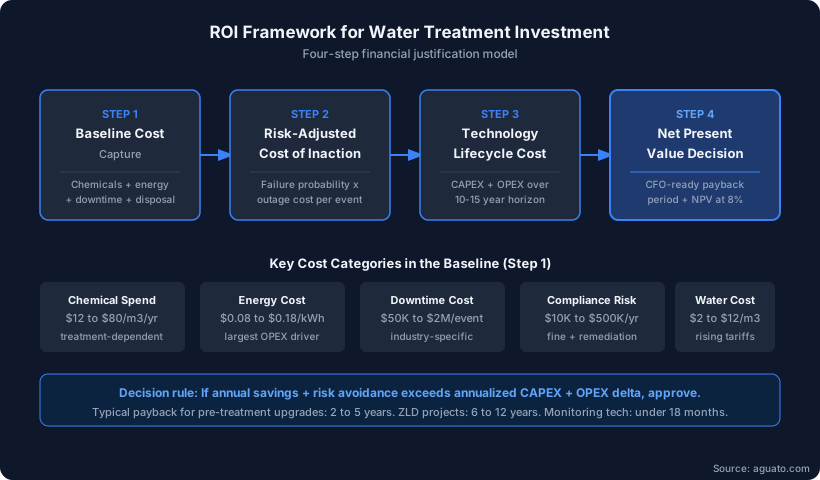
The framework above condenses the four steps every capital request needs. Step 1 is the baseline capture described above. Step 2 is the risk-adjusted cost of inaction, which is the expected value of failure scenarios discounted at the firm's cost of capital. Step 3 is the technology lifecycle cost over 10 to 15 years, which is the comparison surface where technology options compete. Step 4 is the net present value decision at the firm's hurdle rate, typically 8 to 12% for infrastructure investments at industrial sites.
## The technology lifecycle cost comparison
The comparison table below is the procurement-level artefact that should accompany every water treatment capital request. It shows total cost of ownership over a 10-year horizon, the primary failure risk, and the application context where each technology is the economically correct choice.
| Technology | CAPEX (installed) | 10-yr OPEX | Total 10-yr cost per m3/day capacity | Primary risk | Best for | |---|---|---|---|---|---| | Ion exchange softening | $80K to $350K | $12 to $20/m3/yr | $380 to $540 | Resin fouling, salt overdose | TDS <500 mg/L, hardness target <50 mg/L | | Multimedia filtration | $60K to $280K | $8 to $15/m3/yr | $320 to $430 | Channelling, breakthrough at peak turbidity | TSS >20 NTU pre-treatment for downstream membrane | | Ultrafiltration | $120K to $550K | $15 to $25/m3/yr | $600 to $870 | Membrane fouling, CIP chemical cost | RO pre-treatment, SDI <3 requirement | | Single-pass RO | $150K to $600K | $18 to $40/m3/yr | $890 to $1,280 | Scaling, fouling, concentrate disposal | TDS 500 to 5,000 mg/L, process / boiler feed | | RO + EDI polishing | $200K to $800K | $25 to $55/m3/yr | $1,250 to $1,870 | EDI module fouling, hardness leakage upstream | Conductivity <0.1 µS/cm requirement, pharma, power | | Zero liquid discharge | $1.2M to $8M | $150K to $600K/yr | $2,200 to $3,400+ | Crystalliser scaling, high energy intensity | Regulated zero-discharge permit, water scarcity sites |
[cta:nepti-dark]
The OPEX dominance in the table is intentional and often misread. For RO and above, OPEX over 10 years is 60 to 75% of total cost. A CAPEX-only comparison between two RO vendors that differ by $80,000 on installation price is essentially meaningless if their membrane replacement intervals differ by 18 months. The procurement team needs the lifecycle cost figure, not the purchase order value.
## Failure scenarios and their dollar cost
The most powerful section of any water treatment ROI case is the failure scenario analysis. Finance teams respond to downside scenarios because they are in the business of risk management. Three examples from common industrial contexts demonstrate the pattern.
Cooling tower scale and Legionella co-risk, food manufacturing. A mid-size food processing plant with 2 cooling towers and no automated blowdown control. Chemical dosing is manual, water quality monitoring monthly. Over 18 months, scale builds on the condenser tubes, reducing thermal efficiency by 18% and increasing chiller energy consumption by approximately $42,000 per year. In month 19, a Legionella risk assessment triggered by a staff illness event reveals risk category 4 conditions. Mandatory shutdown, emergency remediation, third-party CRO audit, and legal review: $210,000 direct cost, 11 days of production loss at $65,000/day = $715,000 plus $210,000 = $925,000 total event cost. The automated dosing and monitoring upgrade that would have prevented the event: $85,000 installed. The correct decision was a 10:1 return on avoided risk.
Boiler feedwater hardness exceedance, light manufacturing. A 10 bar steam boiler running on municipal supply without softening pre-treatment in a region where hardness runs 280 mg/L. Scale deposition builds at approximately 1mm per year on heat transfer surfaces. After 3 years, a scheduled inspection reveals 3.5mm of scale on the fireside tubes, reducing efficiency by 22% and requiring a tube bundle replacement at $95,000. Soft water installation cost: $28,000. Annual salt and maintenance OPEX: $4,200. Three-year ROI on the softener: $95,000 avoided repair minus $12,600 OPEX = $82,400 net saving, a payback under 5 months from the incident.
RO membrane fouling from inadequate pre-treatment, pharmaceutical site. An API manufacturing site installs a two-pass RO to supply purified water for cleaning validation. Feed water pre-treatment is limited to a single 5-micron cartridge filter. Membrane SDI at the RO inlet averages 5.5 instead of the specified maximum 3. First membrane set fails at 22 months, 18 months early. Replacement cost: $68,000. Second set fails at 19 months. Total premature replacement cost over 5 years: $136,000. Installing a UF pre-treatment train at $145,000 would have extended membrane life to its rated 5 to 7 years. Break-even on the UF investment occurs within the first membrane replacement cycle avoided.
## Structuring the payback model for board approval
A payback model that wins board approval has five elements presented in this sequence: the problem statement in one sentence with a dollar figure, the current verified baseline spend, the project cost and implementation timeline, the annual benefit (savings + risk avoidance) and the method used to calculate it, and the sensitivity table showing how payback changes under optimistic, base, and conservative assumptions.
The sensitivity table is the element most teams skip and the one that most builds credibility. If your base case shows a 2.8-year payback, show that under conservative assumptions (benefit 30% lower than estimated, project 20% over budget) the payback extends to 4.1 years, still well within a typical 5-year approval threshold for infrastructure. If the downside scenario still passes the hurdle rate, the capital committee can approve with confidence.
Avoid the IRR trap. IRR is mathematically clean but sensitive to assumptions about the terminal value and reinvestment rate. For water treatment infrastructure, where benefits are mostly cost avoidance rather than revenue, a simple net present value at the firm's discount rate paired with a discounted payback period is more defensible. Use IRR as a secondary metric if the capital review process requires it, not as the lead headline.
Engage [engineering consultants](/consulting-services) early in the model-building stage. A qualified water treatment engineer can validate the benefit assumptions, provide comparable project cost data from similar installations, and sign off on the performance projection. That sign-off converts an internal estimate into a third-party-verified number, which materially increases approval probability.
According to [US DOE guidance on industrial water management](dofollow:https://www.energy.gov/eere/amo/water-efficiency-in-industrial-facilities), water-related energy savings of 10 to 30% are achievable in most industrial sites through technology upgrades, providing a benchmark for the energy savings line in the payback model. Use published benchmarks where available; invented numbers are the fastest way to lose credibility in a capital review.
## ESG and regulatory value as a monetisable line item
Water reduction targets are now a standard ESG disclosure for listed companies and are increasingly a procurement requirement in B2B supply chains. If your organisation reports under GRI 303 or has committed to a science-based target on water, every cubic metre saved has an internal shadow price that should appear in the water treatment investment case.
The shadow price methodology is straightforward. If your company has committed to a 25% water intensity reduction by 2030 and is currently off track, the cost of not achieving the target includes: executive time, external sustainability consultant spend, potential loss of contracts from customers with supply chain water requirements, and reputational cost. A conservative internal shadow price of $1 to $3 per m3 for non-scarce-region water and $5 to $15 per m3 for water-stressed regions is supported by corporate water accounting frameworks. At 5,000 m3/day consumption, a 20% reduction project delivering 1,000 m3/day saves 365,000 m3 per year, worth $365,000 to $5.5 million per year in shadow-price terms depending on scarcity.
A pattern that recurs in industrial installations is that the sustainability team has already committed to a water reduction number in the annual report, but no one has told the capital committee that there is a specific technology project that delivers it. Connecting the ESG commitment to the specific investment creates a second approval pathway through the sustainability budget, not just the CAPEX budget. This is a structural funding opportunity that most water treatment ROI cases leave on the table.
[ISO 14001 environmental management systems](dofollow:https://www.iso.org/standard/60857.html) provide the audit framework that makes water reduction claims auditable, which converts the ESG benefit from a soft narrative to a verifiable performance metric. Auditable metrics carry more weight with finance than qualitative claims.
For multi-site operators, the ESG case is even stronger. A water treatment technology standardised across 10 sites with a 15% average consumption reduction at 2,000 m3/day each saves 3,000 m3/day across the portfolio, enough to materially move a sector-level water intensity KPI. The per-site investment case does not need to clear the hurdle alone if the portfolio case does.
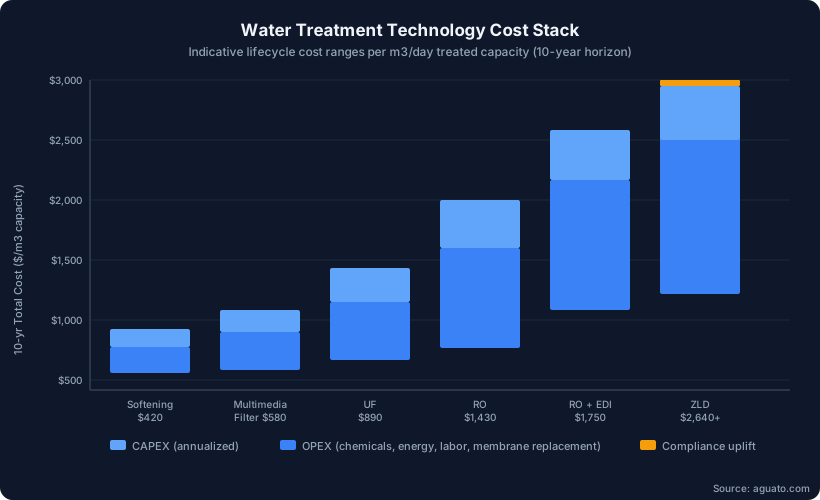
The cost stack above reinforces the lifecycle dominance of OPEX for mid-to-high-complexity systems. For RO and above, the 10-year OPEX component is 60 to 75% of total cost. This means procurement decisions made purely on installed capital cost are selecting the wrong optimisation variable in most cases.
## How to use technology modelling to de-risk the specification
The specification stage is where most water treatment ROI cases introduce avoidable risk. A technology is selected from a catalogue, a consultant applies a standard design, and the cost estimate is built around that design. If the feed water quality is different from the design assumption, or if the duty profile varies seasonally, the performance projection is wrong before the ink dries.
Decision-intelligence tools like [Nepti](/nepti) address this by modelling your actual water matrix against the performance characteristics of each technology option, then producing a ranked comparison of treatment trains with cost projections anchored to your site parameters. That output is substantially more credible in a capital review than a static vendor quotation, because it shows the selection logic and the sensitivity of the recommendation to key variables.
The practical benefit for the ROI case is that a modelled specification reduces the contingency requirement. Capital reviewers typically add 20 to 30% contingency to water treatment estimates when they are vendor-derived and less when they are independently validated. At a $500,000 project, that 10-point contingency difference is $50,000, which can make the difference between approval and deferral.
A second benefit is vendor independence. A technology model that shows three competitive options with lifecycle cost projections for each gives the procurement team a negotiation anchor. It converts the vendor conversation from "this is what we quote" to "this is the performance we need to match and here is the cost ceiling that makes the project viable." The result is better commercial outcomes and a more defensible audit trail for procurement governance. [Explore how to choose industrial water treatment providers](/resources/how-to-choose-industrial-water-treatment) for the evaluation criteria that complement the financial model.
The right answer on technology choice depends on your specific feed water chemistry, flow rates, and performance targets. [Browse qualified water treatment providers](/providers) to validate your technology assumptions against current market pricing.
## FAQ
### What is a typical payback period for a water treatment investment?
Payback periods for water treatment projects range from under 12 months to over 8 years depending on the technology, site water consumption, and the cost categories included in the model. Softening and basic pre-treatment upgrades typically pay back in 6 to 24 months when the baseline includes scale-related maintenance and energy losses. Full RO installations at medium industrial scale typically pay back in 2 to 5 years. Zero liquid discharge systems require 6 to 12 years and only clear the hurdle where avoided discharge costs or water scarcity premiums are material. The most important variable is whether the model includes risk-adjusted downtime avoidance; omitting it understates the return by 30 to 60% in most industrial contexts.
### How do I calculate the cost of water treatment inaction?
The cost of inaction is calculated as the probability-weighted expected value of adverse outcomes over a defined horizon, discounted at the firm's cost of capital. Identify the two or three most likely failure scenarios for your current water system, estimate their probability per year based on maintenance history and water quality trends, assign a cost to each scenario using actual event costs from comparable sites, and multiply probability by cost to get expected annual loss. Sum those across the horizon and discount. Common failure scenarios include scale-related heat exchanger maintenance, Legionella risk events, regulatory enforcement actions, and premature membrane replacement. A pattern that recurs in industrial installations is that even a conservative estimate of this figure exceeds the annualized cost of the treatment upgrade that would have prevented the events.
### What financial model format does a CFO want for a water treatment CAPEX request?
Most capital allocation processes want a net present value calculation at the firm's discount rate, a discounted payback period, and a sensitivity table showing payback under conservative, base, and optimistic assumptions. IRR is useful as a secondary metric but should not lead the submission because it is sensitive to terminal value assumptions. The most credible submissions include a verified baseline from accounting records, a source for every benefit assumption (vendor validation, third-party benchmark, or engineering calculation), and a contingency analysis that shows the project still clears the hurdle rate under a downside scenario. Avoid point estimates presented without methodology, as these are the most common reason water treatment requests are sent back for rework.
### How do I include ESG value in a water treatment ROI case?
ESG value is monetised by applying a shadow price to the water volume reduced or the emissions avoided, then discounting it over the target period. A shadow price of $1 to $3 per m3 is appropriate for non-water-stressed regions, and $5 to $15 per m3 for high-stress regions. For carbon, apply the firm's internal carbon price (typically $20 to $80 per tonne) to the CO2 equivalent reduction from lower energy consumption. Frame these as risk avoidance items: the cost of not achieving a committed ESG target includes contract loss risk, sustainability reporting remediation, and executive reputational exposure. List companies with water intensity targets in annual ESG disclosures face analyst scrutiny when targets are missed, which is a quantifiable governance risk that belongs in the capital submission.
### Which water treatment technology has the best ROI for industrial applications?
Pre-treatment and softening consistently deliver the fastest payback because the baseline cost of scale and fouling is high and the treatment cost is low. A softener or UF pre-treatment train that extends downstream membrane or boiler life by 2 to 3 years typically returns 3 to 8 times its installed cost over the first membrane replacement cycle. For higher-complexity requirements, the best ROI technology is the one sized correctly for the feed water quality, because oversizing or undersizing any system from RO to ZLD inflates OPEX without proportionate performance benefit. [US EPA technical guidance on water treatment technologies](dofollow:https://www.epa.gov/ground-water-and-drinking-water/national-primary-drinking-water-regulations) provides reference performance data that can anchor technology comparisons in a capital submission.
### How does water treatment investment compare to other utility capital projects?
Water treatment projects typically rank in the top quartile of utility CAPEX returns when the ROI case is built correctly, because the baseline spend is large and poorly tracked. Lighting retrofits, compressed air upgrades, and steam insulation projects are better understood by finance teams because their ROI methodology is standardised. Water treatment ROI methodology is less standardised, which means well-constructed cases stand out. The risk-adjusted return is often superior to lighting or motor replacement projects because the downside scenarios (regulatory event, major downtime) are larger. The challenge is not return quality but case construction quality, which is why most teams underinvest in the financial model relative to the engineering design.
### What are the most common mistakes in water treatment ROI cases?
The four most common mistakes are: omitting risk-adjusted downtime avoidance, using vendor-only cost data without independent validation, presenting a single-point estimate rather than a sensitivity range, and failing to connect the project to an existing ESG or regulatory compliance commitment. A fifth mistake, specific to procurement-led cases, is comparing technologies on installed CAPEX rather than 10-year lifecycle cost, which systematically selects the wrong technology for membrane-based applications where OPEX dominates. The fix for all five is to build the financial model before selecting the technology specification, so that the technology choice is demonstrably the least-cost path to the required outcome rather than a specification that was later justified financially.