Cooling towers are the highest-risk legionella source in industrial settings. A single outbreak triggers regulatory investigation, reputational damage, and potential criminal liability. Here is the water treatment programme, testing protocol, and regulatory framework that keeps industrial facilities compliant.
In August 2015, a Legionella outbreak at a hotel complex in Edinburgh infected 14 people and killed three. The source was the cooling tower on the roof of the building. The response cost exceeded 2 million pounds in treatment, clean-up, and compensation before legal costs were included. The Hilton Hotels & Resorts outbreak in 2019 in Auckland, New Zealand, resulted in regulatory action, reputational damage, and civil litigation that ran for over four years after the event. In both cases, the water treatment programme in place had been documented, but the documentation bore insufficient relation to what was actually being done in practice.
Legionella is not a water treatment problem that requires exotic technology. It is a process discipline problem that requires reliable, documented, and audited execution of a well-understood set of control measures. The technology is mature. The chemistry is understood. The regulations are explicit. The failures are almost always attributable to gaps between what the written programme prescribes and what operations actually delivers.
This guide covers the biology of Legionella in cooling towers, the regulatory framework across major jurisdictions, the water treatment programme design, biocide selection and rotation, physical control measures, monitoring frequency and action levels, and the failure modes that turn a compliant programme on paper into an outbreak in practice.
## The decision in brief
- Budget the programme, not the outbreak. For a UK industrial facility with a cooling tower, a compliant water treatment programme covering chemical treatment, monitoring and specialist support typically costs 15,000 to 60,000 pounds per year depending on tower size and system complexity. - Weigh that against a single outbreak. The probability-weighted cost of a Legionella outbreak, even a minor one without fatalities, including investigation, remediation, legal support and regulatory engagement, typically exceeds 500,000 pounds. Public accounts put the Edinburgh 2015 outbreak above 2 million pounds before legal costs. - Treat the programme as the operating licence. A UK facility where HSE determines the water treatment programme is inadequate can be directed to shut the cooling system down until compliance is demonstrated, and for most processes that depend on process cooling a cooling tower shutdown is a production shutdown.
The business case for a compliant programme closes without sophisticated analysis: a known, budgeted 15,000 to 60,000 pounds per year against an outbreak cost that typically exceeds 500,000 pounds.
[Use Aguato's Nepti tool](/nepti) to assess the water quality risks at your facility. [Browse specialist consultants](/consulting-services) who can review your existing Legionella risk assessment and programme against current HSG274 or equivalent requirements.
## Why cooling towers are the highest-risk Legionella source
Legionella pneumophila, the species responsible for Legionnaires' disease, is a gram-negative bacterium that is ubiquitous in natural water environments at low, non-pathogenic concentrations. It becomes dangerous when it proliferates to high concentrations in man-made water systems that create conditions for amplification and then aerosolise the water in a way that allows respiratory exposure.
Cooling towers create all three conditions simultaneously. The recirculating water is maintained at temperatures of 25 to 35 degrees Celsius, exactly the range in which Legionella grows fastest. The fill packs and sumps in cooling towers provide high surface area for biofilm development, and biofilm is the protective matrix in which Legionella achieves its highest concentrations and best resistance to biocides. The natural function of a cooling tower is to produce fine water droplets through the fill and drift eliminators, and while good drift eliminators capture most large droplets, they cannot capture all. The drift that escapes carries Legionella-contaminated water into the air downwind of the tower.
The combination of amplification temperature, biofilm substrate, and aerosol generation is unique to evaporative cooling systems. Hot water systems, swimming pools, and spa pools are also associated with Legionella risk, but their aerosol generation is different in character and typically less directional than a cooling tower plume. Industrial and commercial cooling towers are the primary source in the vast majority of documented community-acquired Legionnaires' disease outbreaks.
The [cooling tower water treatment guide](/resources/cooling-tower-water-treatment) covers the broader water chemistry programme for cooling systems. This article focuses specifically on the Legionella control elements that are distinct from general scale, corrosion, and fouling control.
## How Legionella grows and spreads from cooling towers
Legionella proliferates within biofilm communities rather than as free-swimming cells in the bulk water. The biofilm provides protection from biocide contact, elevated local nutrient concentrations, and a stable thermal environment. Concentrations of Legionella within biofilm can be 1,000 to 10,000 times higher than in the adjacent bulk water. This is why bulk water sampling alone systematically underestimates the Legionella burden in a cooling tower system.
Legionella also exploits an intracellular growth strategy: it invades and replicates within protozoa, particularly Acanthamoeba species, which are common in cooling tower biofilms. Growth within amoebae provides protection from biocides that would kill free Legionella cells in suspension. When the host amoeba is lysed by environmental stress or biocide action, a bolus of Legionella, some of it newly released and virulent, enters the bulk water. This explains the paradoxical observation that biocide shock-dosing events are sometimes followed by a temporary spike in bulk water Legionella counts before the count falls.
The aerosol generation from a cooling tower carries droplets ranging from 1 to 100 micrometres in diameter. The respirable size fraction for deep lung deposition is approximately 1 to 5 micrometres. While most water droplets leaving a tower are larger than 5 micrometres, evaporation of the droplet during flight through the air reduces its size, and what was a 10-micrometre droplet at the tower face may reach a 2-micrometre droplet nucleus by the time it reaches a susceptible person 50 to 200 metres downwind. The Legionella cells survive this transit if the relative humidity is high enough to prevent complete desiccation.
Risk is highest for people with respiratory compromise, immunosuppression, age above 60, or smoking history. Healthy adults exposed to moderate concentrations of Legionella-containing aerosol generally have low risk of clinical disease, but the pathogen concentration and infective dose for vulnerable individuals is lower than for the general population.
## The regulatory framework
The regulatory frameworks for Legionella control in cooling towers vary by jurisdiction but share common elements: duty of care on the owner/operator, requirement for a written risk assessment, a documented water treatment programme, regular testing, and record-keeping that can demonstrate compliance to an inspector.
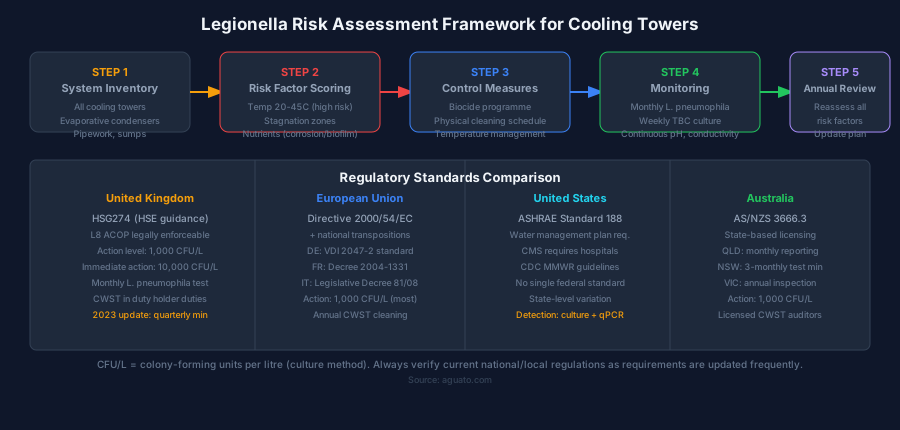
United Kingdom: The Health and Safety Executive's L8 Approved Code of Practice and HSG274 (Technical Guidance for Water Systems) are the primary documents. L8 is legally enforceable under the Health and Safety at Work Act. HSG274 Part I covers cooling towers in detail. Key requirements include: a competent person responsible for the water treatment programme, a site-specific written scheme for controlling Legionella risk, monthly microbiological monitoring of Legionella pneumophila, an action level of 1,000 CFU/L triggering investigation, and immediate corrective action if counts exceed 10,000 CFU/L. The 2023 update to HSG274 strengthened requirements for regular physical cleaning and inspection.
European Union: Regulation at the EU level falls under the Health and Safety at Work Framework Directive (89/391/EEC) and the Biocidal Products Regulation (BPR) for the biocides used in treatment programmes. National transpositions vary: Germany's VDI 2047-2 technical standard is widely referenced; France's Decree 2004-1331 requires mandatory registration and inspection of cooling towers. The common thread across EU jurisdictions is that operators must assess, document, and demonstrate control.
United States: ASHRAE Standard 188-2021 (Legionellosis: Risk Management for Building Water Systems) is the primary industry standard and is referenced by the Centers for Medicare & Medicaid Services (CMS) as mandatory for healthcare facilities. It requires a water management plan (WMP) with control limits, monitoring frequencies, and corrective action protocols. There is no single federal standard applicable to all industrial cooling towers, creating variation between state OSHA requirements and industry best practice guidance.
Australia and New Zealand: AS/NZS 3666.3 covers cooling water systems. State-based licensing applies in Queensland (monthly reporting mandatory), New South Wales (quarterly minimum testing), and Victoria (annual inspections). Action levels are typically 1,000 CFU/L consistent with UK/EU practice.
## Risk assessment: your legal obligation
A Legionella risk assessment is not optional documentation. In the UK, EU, and most other developed jurisdictions, it is a legal requirement for any operator of a cooling tower system. The risk assessment must be:
- Site-specific: a generic risk assessment that was not written for your system does not satisfy the legal requirement - Carried out by a competent person: meaning someone with specific Legionella risk assessment training and experience, not just a general health and safety officer - Reviewed when significant changes occur: new or replaced towers, changes to water chemistry, changes to operating temperatures, or following any microbiological exceedance - Reviewed periodically: at least every two years in UK and most EU jurisdictions
The risk assessment identifies all systems with Legionella risk (cooling towers, evaporative condensers, spa pools, decorative water features, and in some contexts hot water systems), assesses the risk factors for each, and specifies the control measures in a written scheme of work.
A common legal pitfall: the duty holder under UK L8 and equivalent regulations is the organisation that has control over the premises, not the water treatment contractor. If the water treatment contractor's programme is inadequate and an outbreak occurs, the contractor is liable for the programme they provided, but the duty holder is liable for appointing an incompetent contractor and for failing to monitor that the programme was being executed. Shared liability does not mean reduced liability for the duty holder. [Browse specialist water treatment and compliance consultants on Aguato](/consulting-services) who can carry out independent risk assessments and programme audits.
## Water treatment programme design
A Legionella control water treatment programme for cooling towers has three components that operate simultaneously: chemical treatment (biocide and scale/corrosion inhibitor programme), physical treatment (cleaning, blow-down, drift eliminator maintenance), and operational controls (temperature management, water make-up control, system hygiene).
Cycles of concentration control: The [cooling tower cycles of concentration guide](/resources/cooling-tower-cycles-of-concentration) covers the chemistry of concentration ratio management. From a Legionella perspective, the critical point is that excessively high cycles of concentration concentrate the nutrients (phosphate, nitrogen, organic carbon) that support microbial growth, including Legionella. Target cycles of concentration in the range of 3 to 6 for most cooling tower applications, maintained by controlled blow-down, provides an acceptable balance between water efficiency and microbiological risk.
Scale and corrosion inhibition: Scale deposits on fill packs and heat exchangers provide a protected surface for biofilm formation. Corrosion products (iron, copper) from system pipework are both nutrients for bacteria and physical surfaces for attachment. The scale and corrosion inhibitor programme must be designed and maintained to prevent these deposits, not just to protect heat transfer efficiency. A scale-covered fill pack is a Legionella-risk structure as well as an energy-efficiency problem.
## Biocide selection and rotation strategy
The biocide programme is the primary chemical defence against Legionella in cooling tower water. The biocide strategy must address both free-swimming Legionella in the bulk water and Legionella within biofilm and protozoan hosts.
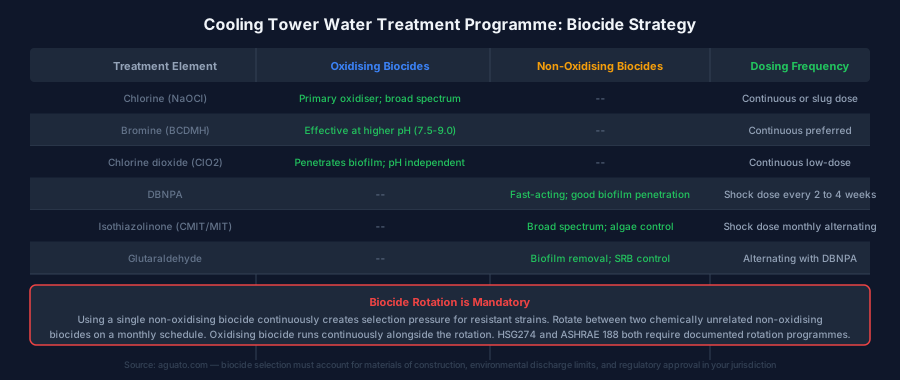
Oxidising biocides ([chlorine](/elements/chlorine) as sodium hypochlorite, [bromine](/elements/bromine) as BCDMH, chlorine dioxide) are continuous-dosing biocides that control bulk water Legionella and suppress free-swimming cell counts. Chlorine is effective at pH 7.0 to 7.5 but loses activity rapidly above pH 8.0, where the hypochlorous acid (active form) equilibrium shifts to hypochlorite ion (less active). Bromine as BCDMH maintains activity to pH 8.5, making it preferable for systems running at higher pH for corrosion protection. Chlorine dioxide is effective across a wide pH range and penetrates biofilm more effectively than hypochlorous acid, making it particularly valuable in systems with known biofilm issues.
Non-oxidising biocides (DBNPA, isothiazolinone blends, glutaraldehyde) are shock-dosed on a scheduled basis (typically every 2 to 4 weeks) as the second line of defence against biofilm. They work through different mechanisms than oxidising biocides and target organisms that have developed tolerance to oxidising biocide residuals. Rotation between two chemically unrelated non-oxidising biocides on a monthly or quarterly schedule is essential to prevent the development of tolerant microbial communities. Using a single non-oxidising biocide continuously for months or years selects for tolerant strains that will eventually fail to respond even at increased doses.
The biocide programme should be designed by a qualified water treatment chemist based on the specific water chemistry, tower materials, system volume, and local regulatory requirements for biocide selection (some biocides require specific approval under the EU Biocidal Products Regulation or US EPA registration for cooling tower use).
## Physical controls: temperature, cleaning, and drift eliminators
Physical controls are distinct from chemical treatment and address the conditions that allow Legionella to persist even in the presence of an adequate biocide programme.
Temperature management: Legionella grows fastest between 25 and 45 degrees Celsius. Above 60 degrees Celsius, it is killed within minutes. Below 20 degrees Celsius, it does not multiply (though it can survive). Cooling tower recirculating water by design operates in the growth range. The control levers are: ensuring the system is fully turned off (water drained or heated) during periods of non-use, and ensuring system start-up after a period of shutdown includes a thermal or biocide shock before aerosol generation begins.
Physical cleaning: Biofilm and scale accumulation in fill packs, sumps, and pipework is not controlled by chemical treatment alone. Annual cleaning of fill packs (and more frequently if sampling or inspection indicates heavy biofilm), cleaning and inspection of the sump and distribution system, and cleaning of drift eliminators are minimum requirements under HSG274 and equivalent standards. Cleaning should be undertaken by personnel with appropriate respiratory protection (FFP3 masks or powered respirator), and the cleaning process itself generates aerosol, which must be controlled to protect personnel and downwind areas.
Drift eliminators: Modern high-efficiency drift eliminators achieve drift rates below 0.001% of circulating water flow, compared to 0.1 to 0.2% for older designs. Retro-fitting high-efficiency drift eliminators to older towers is one of the most cost-effective risk reduction measures available on legacy systems. Drift eliminators must be inspected for damage and blockage regularly: a damaged drift eliminator that allows bulk water carry-over negates the protection of the chemical treatment programme.
## Monitoring and testing: frequency, method, and action levels
Monitoring serves two purposes: demonstrating compliance to regulators and providing early warning of programme failure before Legionella counts reach dangerous levels.
Legionella culture (ISO 11731): The standard method for Legionella quantification. Samples are cultured on BCYE agar plates and colonies counted after 10 to 14 days. The delay between sampling and result (2 weeks) means culture results confirm that conditions were controlled, but do not provide real-time protection. UK HSG274 requires monthly sampling as a minimum, more frequently for high-risk systems or following any exceedance.
Quantitative PCR (qPCR): PCR methods detect Legionella DNA in 24 to 48 hours and can detect viable but non-culturable (VBNC) organisms that culture methods miss. qPCR is increasingly used as a rapid screening method to identify problem periods between monthly culture tests. Some UK and Australian jurisdictions now accept qPCR as a supplementary method. The key limitation is that qPCR detects dead cell fragments as well as live cells, so high qPCR results require culture confirmation to quantify viable Legionella.
Action levels: The UK and European standard action levels are: - Below 100 CFU/L: satisfactory, continue routine monitoring - 100 to 1,000 CFU/L: review programme, investigate cause, increase monitoring frequency - 1,000 to 10,000 CFU/L: implement corrective action, review biocide programme, consider shock disinfection, notify duty holder - Above 10,000 CFU/L: shut down if safe to do so, shock disinfect, do not restart without review by competent person, notify HSE (UK) or equivalent regulator
Surrogate parameters: Legionella counts are the direct monitoring target, but they are tested monthly. Daily or continuous monitoring of pH, conductivity, biocide residual (free chlorine or bromine), and flow rates provides a continuous check that the conditions for Legionella control are being maintained. A sudden drop in biocide residual, a shift in pH outside the control range, or a disruption to the blow-down programme are early indicators of programme failure that should trigger investigation before the next scheduled Legionella test.
According to [guidance published by the European Centre for Disease Prevention and Control](dofollow:https://www.ecdc.europa.eu/en/legionnaires-disease), approximately 30% of community-acquired Legionnaires' disease outbreaks with identified sources in Europe are attributed to cooling towers, making them the leading identified outbreak source category.
## Outbreak response protocol
When a case of Legionnaires' disease is notified by a local health authority as potentially linked to your facility, the response must be immediate and structured. This is not a situation where the water treatment contractor handles it; it is a situation where the duty holder, supported by specialists, takes direct command.
Immediate actions (within hours): - Notify the duty holder and activate the response team - Contact the local health authority to understand the scope of the investigation - Commission emergency Legionella sampling of all cooling towers and related systems - Do not shut down systems without consulting the investigating authority (in some cases, continued operation with hyperchlorination is preferred to shutdown to preserve the outbreak source for investigation)
Within 24 to 48 hours: - Emergency shock-dose biocide treatment if directed by the response team - Physical inspection of all fill packs, sumps, drift eliminators - Review the previous 12 months of monitoring records for anomalies - Commission a specialist Legionella investigation if not already engaged
Documentation: Every action, decision, and communication must be documented in writing from the moment the outbreak link is suggested. This documentation is the legal record of the duty holder's response. Inadequate documentation of a competent response is nearly as damaging legally as an inadequate response itself.
[Post your cooling tower treatment programme review on Aguato](/post-project) to engage Legionella-specialist water treatment consultants who can audit your programme against current regulatory requirements before an outbreak event.
## Where legionella programmes fail in industrial facilities
Paper programme, real-world deviation: The most common failure mode is a water treatment programme that is well-designed on paper but inconsistently executed in practice. Biocide dose timing slips, blow-down rates are reduced to save water costs, monitoring samples are not taken at the specified frequency, or the responsible operator changes without a handover of competency. The programme appears compliant in the records until a test reveals an exceedance, and then the investigation reveals months of deviation.
Microbiological test used as the only monitoring: Monthly Legionella culture is a lagging indicator. By the time a high-count result is returned, the system may have been non-compliant for weeks. Facilities that monitor pH, conductivity, and biocide residual daily catch programme failures in real time and can correct them before they progress to high Legionella counts.
Biocide resistance development: A system running on the same non-oxidising biocide for more than 6 months without rotation is at increased risk of biocide-tolerant microbial communities developing. This does not mean Legionella has become resistant in the same sense as antibiotic resistance, but it means the community of organisms that competes with Legionella has been selected for tolerance, and the protective microbial ecology that keeps Legionella at low counts is altered.
Post-commissioning drift from design: Industrial cooling towers change over time. Changes to the condenser water temperature set point, additions to the load, changes in make-up water quality, and maintenance work that introduces new biofilm sources all shift the system from the conditions under which the water treatment programme was designed. Annual programme review that includes a new water analysis and a reassessment of risk factors is not bureaucratic compliance; it is the mechanism that catches these drift events.
Not using Aguato to compare specialist proposals: For any industrial facility operating cooling towers, engaging a qualified Legionella water treatment specialist through a competitive process ensures the programme is technically current. [Browse cooling tower water treatment specialists on Aguato](/cooling-tower-water-treatment-companies) to compare provider capabilities and [post your Legionella management programme brief](/post-project) to receive structured proposals.
## FAQ
### What temperature kills Legionella in cooling tower water?
Legionella pneumophila is killed within minutes at temperatures above 60 degrees Celsius. It stops multiplying below 20 degrees Celsius but can survive for extended periods at low temperatures. Cooling tower recirculating water typically operates between 25 and 35 degrees Celsius, which is the optimal growth range. The temperature cannot be reduced in a cooling tower without defeating its function, which is why chemical biocide treatment is the primary control rather than thermal management.
### How often should Legionella testing be carried out on cooling towers?
UK HSG274 and most European guidance requires monthly sampling as a minimum, using the ISO 11731 culture method. Higher-risk systems, systems following an exceedance, or systems that have recently been recommissioned after shutdown should be tested more frequently. Rapid qPCR testing can be used between monthly culture tests to provide faster turnaround during investigations. Surrogate parameters (pH, biocide residual, conductivity) should be monitored at least weekly and ideally daily or continuously.
### What is the regulatory action level for Legionella in cooling tower water?
The UK and most European regulatory action levels are: below 100 CFU/L (colony-forming units per litre) is satisfactory; 100 to 1,000 CFU/L requires investigation and programme review; 1,000 to 10,000 CFU/L requires corrective action and possible shock disinfection; above 10,000 CFU/L requires immediate corrective action and, in the UK, notification to HSE. US guidance under ASHRAE 188 does not specify numerical action levels in the same way, requiring instead that the water management plan defines the facility's own action levels based on a risk assessment.
### Why do biocide shock doses sometimes cause a temporary spike in Legionella counts?
When a shock dose of biocide is applied to a cooling tower, it kills a large proportion of the biofilm organisms, including amoebae that harbour intracellular Legionella. Lysed amoebae release Legionella cells into the bulk water, causing a temporary spike in planktonic count before the biocide kills the released organisms. This is a known and expected phenomenon. The count typically returns to lower levels within 24 to 48 hours as the biocide level is maintained. A spike following a shock dose is not evidence of treatment failure, but monitoring should continue through the post-dose period to confirm the count returns to baseline.
### Who is responsible for Legionella control in industrial cooling towers?
In most jurisdictions, the duty holder is the organisation that has control of the premises and the water-using systems within it, typically the building or process owner or the organisation that occupies and operates the facility. This duty cannot be fully transferred to a water treatment contractor: engaging a contractor discharges the practical execution of the programme, but the duty holder remains responsible for ensuring the contractor is competent, monitoring that the programme is being executed, and responding appropriately to any exceedances or incidents. The contractor is liable for the quality of the programme they deliver; the duty holder is liable for the decision to appoint them and for overall programme oversight.
### What is the difference between Legionella culture and PCR testing?
Legionella culture (ISO 11731) grows Legionella colonies on selective agar plates over 10 to 14 days and counts viable, cultivable cells. It is the standard regulatory method. PCR (polymerase chain reaction) detects Legionella DNA within 24 to 48 hours and can detect viable but non-culturable (VBNC) organisms. PCR can overestimate live Legionella because it also detects DNA from dead cells. The regulatory consensus is that culture remains the reference method for compliance reporting, with PCR used for rapid screening and investigation purposes.