Chlorination, UV, and ozone each solve a different disinfection problem in industrial water systems. This guide covers mechanism, dose, cost, and DBP risk, with a decision framework for operators and engineers selecting the right technology.
Industrial disinfection exists to solve a different problem from municipal water treatment. The goal is not potability, it is biological stability under continuous process conditions. A cooling tower operating at 40°C with dead legs and residual nutrient load is a bioreactor, not a vessel of treated water. A food processing rinse line that runs chlorinated supply water at the tap but accumulates biofilm in the distribution pipework is a liability, not a controlled environment.
The cost of biological failure in industrial water systems falls into three categories: product contamination (food, pharma, semiconductor), regulatory and legal exposure (Legionella, environmental discharge), and asset degradation (biofilm on membranes, corrosion under biofilm, scale-associated fouling). Each category has quantifiable costs that dwarf the investment in a properly designed disinfection programme.
Three disinfection technologies dominate industrial water practice: chlorination (free [chlorine](/elements/chlorine) and chloramines), UV irradiation, and ozone. Each has a distinct mechanism, performance envelope, cost structure, and set of failure conditions. Most industrial systems default to chlorination without evaluating the alternatives. In many applications that default is defensible, but in others, it produces disinfection byproduct (DBP) liabilities, membrane compatibility problems, or incomplete inactivation of resistant organisms that a different technology would have avoided.
## Why Industrial Disinfection Differs from Municipal Treatment
Municipal water treatment is designed for a static distribution system delivering water to passive end users. Industrial water systems present a fundamentally different challenge: the water is used, recirculated, heated, cooled, concentrated, and brought into contact with process materials under conditions that actively promote biological growth.
Three factors drive this difference:
Temperature. Industrial cooling towers and HVAC systems operate at water temperatures that straddle the ideal growth range for *Legionella pneumophila* (25 to 45°C). Unlike domestic hot water systems where temperature above 60°C is maintained as a kill barrier, many industrial systems cannot run at temperatures that prevent biological growth. Disinfection must compensate.
Concentration cycles. Evaporative cooling systems concentrate dissolved solids, organic load, and microorganisms with each cycle. A cooling tower operating at 4 to 5 cycles of concentration delivers 4 to 5x the biofilm nutrient load to every wetted surface compared to once-through use. This dramatically increases the disinfection demand.
Process integration. Industrial water contacts membranes, heat exchanger surfaces, food-contact equipment, and clean steam generators. The [WHO Guidelines for Drinking-water Quality](dofollow:https://www.who.int/publications/i/item/9789241549950) establish the microbiological baseline that industrial systems supplying potable water must meet, but most industrial process water specifications go further, RO membranes, for instance, are incompatible with sustained free chlorine above 0.1 mg/L.
These three factors mean that industrial disinfection design cannot rely on municipal protocols. The required disinfection dose is typically higher, the constraints on residuals are often stricter, and the consequences of a programme failure are faster and more costly.
## Chlorination: Free Chlorine, Chloramines, and Residual Control
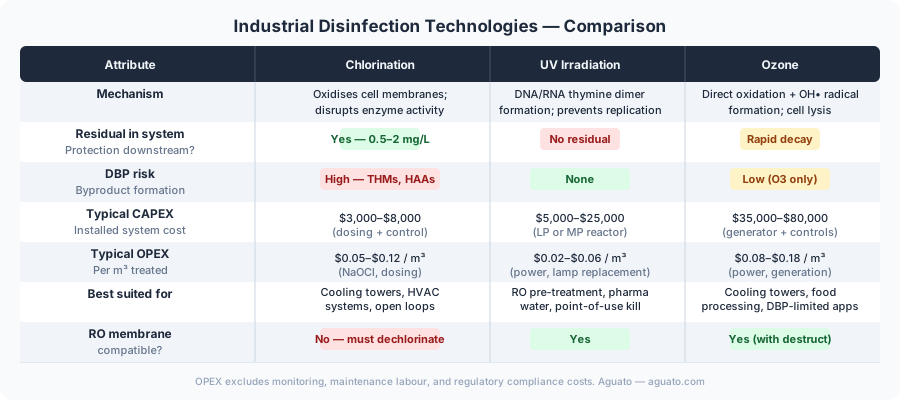
Chlorination remains the dominant disinfection method in industrial water for a simple reason: it provides a measurable, persistent residual that continues to act as biocide throughout the distribution system and recirculation loop. A free chlorine residual of 0.5 to 1.0 mg/L suppresses most planktonic bacterial growth in clean water; 1 to 2 mg/L is required for systems with higher organic loads.
Free chlorine (hypochlorous acid and hypochlorite) is the most reactive form. At pH 6.5 to 7.5, 70 to 80% is present as hypochlorous acid (HOCl), the more biocidal undissociated form. Above pH 8.0, the equilibrium shifts toward hypochlorite ion (OCl-), which is 80x less effective, a critical factor in cooling tower systems where pH is often maintained at 8.0 to 9.0 to control corrosion. Running a cooling tower at pH 8.5 while expecting pH-neutral chlorine dosing performance is a design error that routinely results in under-disinfection.
Chloramines (formed by reacting chlorine with ammonia) are less reactive than free chlorine but provide longer-lasting residuals in systems with high organic loads. They are useful where DBP formation from free chlorine is a regulatory concern and where the system requires persistent residual through long distribution runs. The trade-off is lower inactivation efficacy, chloramines require approximately 25 to 50x the contact time to achieve equivalent log reductions for *Legionella* compared to free chlorine.
Dosing and control: chlorine demand must be measured, not assumed. In a recirculating system with biological activity, organic load, and temperature variation, a fixed dosing rate is not a disinfection programme, it is a starting point. Continuous residual monitoring with feedback control is the minimum standard for cooling tower and HVAC systems. Grab-sample testing once per shift is not adequate for systems where biological events can progress within hours. For the full monitoring framework, parameters, frequencies, and the interpretation methods required to turn test results into treatment decisions, see the [industrial water quality testing guide](/resources/industrial-water-quality-testing).
Material compatibility: free chlorine above 0.5 mg/L will oxidise polyamide RO membranes within hours of sustained exposure. Where RO is downstream of chlorinated supply water, dechlorination with sodium bisulphite or granular activated carbon is required before the membrane feed. See our [water treatment chemicals guide](/resources/water-treatment-chemicals) for dosing guidance on dechlorination agents.
Typical OPEX for sodium hypochlorite dosing in a cooling tower system: $0.05, $0.12/m3 of make-up water, excluding monitoring equipment and labour.
## UV Disinfection: Mechanism, Design, and Limitations
UV disinfection at 254 nm disrupts DNA and RNA by inducing thymine dimer formation, preventing cellular replication. Unlike chemical disinfectants, UV leaves no residual in the water, its effect ends when the water leaves the irradiated zone. For the full decision logic on when UV beats chlorination and when a combined approach is required, see the [UV vs chlorination decision framework](/resources/uv-vs-chlorination-disinfection). This makes UV unsuitable as the sole disinfection method for any system where biological re-growth downstream of the UV unit is a risk. It is ideally suited as a polishing step immediately upstream of a critical point-of-use, or as a pre-treatment stage before a system where chemical residuals are unwanted.
UV dose is measured in mJ/cm2 (millijoules per square centimetre) and determines the log reduction achieved. Regulatory minimum doses vary by target organism and jurisdiction, but 40 mJ/cm2 is the generally accepted minimum for 4-log inactivation of *Cryptosporidium* and 3-log inactivation of most bacteria. For *Legionella*, the [EPA UV Disinfection Guidance Manual](dofollow:https://www.epa.gov/sites/default/files/2019-08/documents/uvdisinfection_guidancemanual.pdf) targets validated doses above 40 mJ/cm2 for surface water systems; industrial hot water systems typically design for higher doses (100 to 186 mJ/cm2) to account for UV absorbance at elevated temperatures.
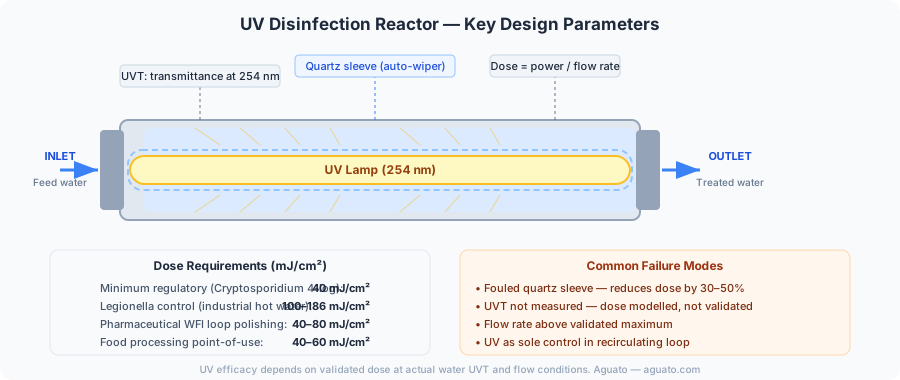
Design parameters that determine UV performance:
Transmittance (UVT): the fraction of UV light that passes through 1 cm of the water to be treated. Water at UVT 75% transmits 56% less UV energy than water at UVT 95%, the dose delivered at the reactor wall can be a fraction of the dose at the lamp surface. UV systems must be validated at the actual UVT of the feed water, not at laboratory conditions.
Flow rate: UV dose is inversely proportional to flow velocity through the reactor. A system validated at 10 m3/h will not deliver the same dose at 15 m3/h without a larger or additional reactor. Flow variation, common in recirculating systems, must be designed for.
Lamp fouling: quartz sleeves accumulate scale and biofilm in service, reducing UV transmittance. Automatic sleeve wipers are not optional in hard or organic-loaded water, they are a maintenance function that determines whether the system delivers design dose. A UV system with a fouled sleeve may appear operational while delivering 30 to 50% of design dose.
Applications suited to UV: reverse osmosis pre-treatment (where chlorine cannot be used), [pharmaceutical purified water and WFI loops](/resources/industrial-water-purification), food rinse water, and point-of-use disinfection in high-purity water systems. Use [Nepti](/nepti) to model your water quality parameters against UV dose requirements before specifying reactor sizing.
Typical OPEX for medium-pressure UV systems: $0.02, $0.06/m3, depending on lamp replacement frequency and power consumption. Low-pressure high-output lamps offer better energy efficiency for continuous, high-flow applications.
[cta:nepti-dark]
## Ozone Treatment: Performance, Cost, and Application Windows
Ozone (O3) is the strongest industrial water disinfectant in common use, with a redox potential of 2.07V, significantly higher than chlorine (1.36V) or chlorine dioxide (0.95V). It achieves log reductions across the full spectrum of waterborne pathogens, including protozoa and spore-forming bacteria that resist chlorination, at contact times of 0.5 to 10 minutes depending on dose and organism.
Mechanism: ozone disinfects by direct oxidation of cell membranes and indirect reaction through hydroxyl radical (OH•) formation. Unlike chlorine, ozone decomposes to oxygen within minutes at ambient temperatures, leaving no chemical residual. In cooling tower applications, this means ozone must be continuously generated and dosed; residual monitoring reflects real-time generation, not stored biocide.
Ozone in cooling towers: the most commercially established industrial ozone application. Ozone at 0.05 to 0.2 mg/L in cooling tower basin water achieves equivalent or superior biofilm control to biocide programmes, with the additional benefit of oxidising scale precursors and reducing total organic carbon (TOC) load. Several operators have reported 40 to 60% reduction in blowdown frequency after switching to ozone-based programmes, reducing water consumption and chemical discharge costs.
The capital cost barrier is real: a medium-duty ozone system for a 500 m3/h cooling tower costs $35,000, $80,000 installed, compared to $3,000, $8,000 for a chemical dosing system. The payback case depends on water cost, chemical cost, blowdown volume, and whether the system currently experiences significant biofouling-driven maintenance costs.
Ozone in food and beverage: ozone is FDA GRAS-listed for direct food contact applications. Concentrations of 0.5 to 2 mg/L are used for produce washing, carcass rinse, and equipment sanitisation, eliminating the chlorinated rinse water DBP concerns that affect some food processing discharge permits.
Limitations: ozone at concentrations above 0.1 mg/L aggressively attacks many elastomers (EPDM, NBR, natural rubber) and some plastics (PVC at sustained contact). System materials, gaskets, seals, pipe liners, must be specified for ozone service. Ozone generation also produces off-gases that require catalytic destruction before discharge; most modern systems include ozone destruct units, but these represent additional capital and maintenance cost.
## Disinfection Byproducts and Regulatory Exposure
The regulatory risk of getting disinfection chemistry wrong is asymmetric. An over-disinfected system produces DBPs that may exceed discharge consent. An under-disinfected system risks Legionella fatalities, food contamination incidents, or biofilm-driven membrane failures, each with costs orders of magnitude larger than the treatment programme investment.
Chlorination of water containing natural organic matter (NOM) produces trihalomethanes (THMs) and haloacetic acids (HAAs), regulated classes of DBPs in both drinking water supply and process water discharge. The [EPA Disinfectants and Disinfection Byproducts Rule](dofollow:https://www.epa.gov/dwreginfo/disinfectants-and-disinfection-byproducts-rule) sets Maximum Contaminant Levels of 80 µg/L for total THMs and 60 µg/L for HAAs in public water systems. Industrial facilities that supply process water from their own treatment systems, or that discharge DBP-containing blowdown, face equivalent regulatory exposure under their permit conditions.
Chlorine dioxide (ClO2) offers a DBP profile intermediate between free chlorine and ozone, it does not produce THMs or HAAs but generates chlorite and chlorate as degradation byproducts. ClO2 is increasingly used in [cooling tower water treatment](/resources/cooling-tower-water-treatment) and food processing applications where THM formation is a concern but ozone capital costs are prohibitive.
Monitoring obligations: UK HSE ACoP L8 and COSHH regulations impose specific monitoring and record-keeping requirements for [HVAC water treatment](/resources/hvac-water-treatment) systems. Failure to demonstrate a documented, monitored Legionella risk management programme, including validated biocide dosing and microbiological testing, represents a direct regulatory liability for site operators.
## Decision Framework: Matching Technology to Application
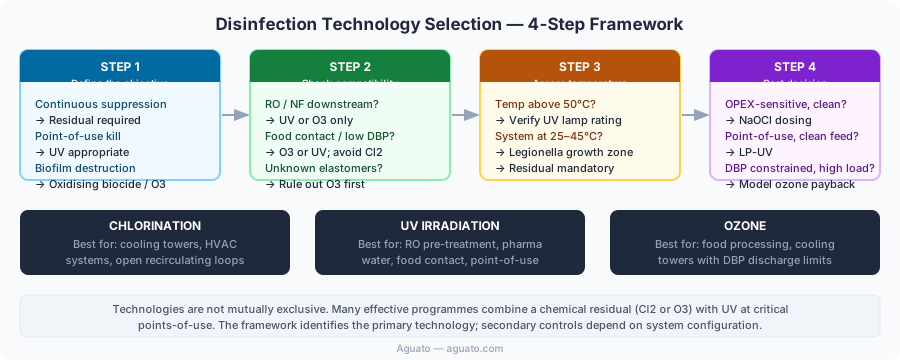
Step 1, Define the disinfection objective: - Continuous microbiological suppression in a recirculating system → requires a chemical residual (chlorination, or ozone with continuous generation) - Point-of-use inactivation before critical contact → UV is appropriate; no residual needed downstream - Biofilm destruction in established-fouling situations → ozone or oxidising biocide shock treatment
Step 2, Assess compatibility constraints: - RO or NF membranes downstream → UV or ozone only; dechlorination required if chlorine used upstream - Food contact or low DBP tolerance → ozone or UV; avoid free chlorine if NOM load is high - Elastomer compatibility unknown → rule out ozone until materials survey is complete
Step 3, Set the operating temperature range: - Water temperature above 50°C continuously → verify UV lamp temperature rating; ozone degrades faster but may still be viable - System straddles 25 to 45°C → Legionella growth range; chemical residual or continuous UV through high-risk points is mandatory
Step 4, Cost decision: - OPEX-sensitive, low organic load, moderate risk → sodium hypochlorite with automated dosing - OPEX-sensitive, clean feed water, point-of-use kill needed → low-pressure UV - High organic load, DBP constraints, water cost above $3/m3 → ozone; model the payback against chemical programme costs
[Post your water treatment challenge on Aguato](/post-project) to receive structured proposals from providers who specialise in industrial disinfection. Framing the application correctly before engaging vendors reduces the risk of being sold the wrong technology for your system.
## Where Disinfection Programmes Fail
Dead legs. Any section of pipework or equipment that does not experience regular through-flow is a biological reservoir that biocide residuals cannot reach effectively. A cooling tower that passes weekly biocide doses through the main circuit while running dead water in bypassed heat exchanger circuits will grow *Legionella* in those circuits regardless of basin residuals. The solution is engineering, not chemistry.
Organic load not managed upstream. Free chlorine in water with high BOD or TOC is consumed by organic oxidation before it inactivates microorganisms. A heavily loaded cooling tower system with 10 mg/L TOC and 1.0 mg/L chlorine dose is not a disinfected system, the chlorine is being consumed before it reaches the organisms. Biofilm management (dispersants, physical cleaning) must precede disinfection programme optimisation.
pH not controlled alongside biocide. The biocidal efficacy of free chlorine is strongly pH-dependent. A facility that doses sodium hypochlorite while controlling cooling tower pH at 8.5 for corrosion inhibition is effectively neutralising its biocide programme. Operators who run this configuration and then experience Legionella incidents typically find the cause in the logbooks, pH and chlorine residuals were both in specification individually, but the combination produced systematic under-disinfection.
Over-reliance on biocide alone. The Legionella risk management frameworks required by HSE ACoP L8 are explicit: chemical disinfection is one control measure among several, not a substitute for temperature management, physical cleaning, risk assessment, and microbiological monitoring. A programme that doses biocide but never physically cleans cooling fill, never validates residual at distal points, and never tests for *Legionella* spp. quarterly is not an L8-compliant programme.
Wrong technology for the application. UV installed on a recirculating system without a chemical residual inactivates organisms passing through the reactor. It does not prevent regrowth downstream of the reactor in the recirculating loop, in storage, or in dead legs. This is not a failure of UV technology, it is a misapplication. The correct configuration for a recirculating system is UV at the make-up water inlet combined with a low residual in the loop, not UV as the sole disinfection control.
[Browse verified disinfection and water treatment providers on Aguato](/providers) to find specialists with documented experience in your specific application, cooling towers, food processing, pharmaceutical water, or HVAC systems.
## FAQ
### What is the most effective industrial water disinfectant?
There is no single most effective disinfectant, performance depends on the target organism, water quality, system configuration, and the role of the disinfectant in the programme. Ozone achieves the highest inactivation rates across the widest range of organisms. Chlorination is most practical for residual maintenance in recirculating systems. UV is most appropriate for point-of-use applications where chemical residuals are unwanted or harmful to downstream equipment.
### Can UV disinfection be used for cooling tower treatment?
UV can be incorporated into cooling tower programmes but cannot function as the sole disinfection control. UV inactivates organisms passing through the reactor but does not provide a residual in the basin or pipework. Effective cooling tower disinfection requires a persistent biocide in the recirculating water. UV can be used to reduce biocide demand by treating make-up water before it enters the system.
### What chlorine residual is required for Legionella control in cooling towers?
UK Health and Safety Executive guidance (ACoP L8) recommends a free chlorine residual of 0.5 to 1.0 mg/L at all points in the system during normal operation. The residual must be verified at distal points, the basin concentration alone is not sufficient evidence of system-wide control. Where pH is maintained above 8.0, the effective biocidal concentration of free chlorine is significantly lower than the measured total residual, and dosing must be adjusted accordingly.
### Is ozone safe for use in food processing water?
Yes, ozone is FDA GRAS-listed for direct food contact applications. Aqueous ozone at 0.5 to 2 mg/L is used for produce washing, equipment sanitisation, and carcass rinse in meat processing. The key constraints are material compatibility (avoid rubber gaskets and PVC surfaces with sustained ozone contact) and off-gas management in enclosed spaces.
### Why does my chlorine residual disappear quickly?
Rapid chlorine consumption typically indicates one of three issues: high organic or ammonia load consuming chlorine through chemical oxidation, active biological growth consuming chlorine faster than dosing can supply it, or pH outside the 6.5 to 7.5 range reducing the proportion of the more biocidal HOCl form. Increasing dose without addressing the underlying cause produces more DBPs, not better disinfection.
### Do I need to comply with Legionella regulations if my site has no cooling towers?
In the UK, the duty to conduct a Legionella risk assessment applies to all work premises with water systems that could create a risk of exposure, including HVAC hot and cold water systems, spa pools, humidifiers, and process water systems that create mists or aerosols. The absence of cooling towers does not exempt a site from L8 obligations if other at-risk systems are present.
### What should I look for when evaluating a disinfection provider?
Verify documented experience with your specific system type, confirmation of the treatment validation method used (biological ATP monitoring, microbiological plating, *Legionella* spp. testing), and a clear description of the monitoring and reporting programme they will provide. A provider who can only describe what chemicals they dose, not how they verify efficacy, is not providing a disinfection programme. [Post a project brief on Aguato](/post-project) to benchmark independent proposals against each other before committing to a long-term service contract.