An rfp water treatment project issued without complete feed-water data costs 15 to 25% more at award. Learn how to write one that gets defensible bids.
A water treatment RFP issued without a complete feed-water analysis and quantified output specification will cost you 15 to 25% more at contract award. That premium does not come from vendor greed. It comes from vendors pricing risk into contingencies when they cannot see your actual water matrix, your regulatory discharge limits, or your uptime requirements. On a 500 m3/day municipal-grade industrial plant, that uncertainty premium is $80,000 to $220,000 on a $650,000 to $900,000 project. A tighter RFP does not just defend your budget, it attracts better vendors, shortens the evaluation cycle, and produces a contract you can defend at audit.
The uncomfortable truth is that most procurement teams write technology RFPs, not problem RFPs. They specify "an RO system" when they should specify "permeate at less than 50 mg/L TDS, 98% recovery, operating cost ceiling $0.35 per m3, with remote monitoring and a 24-hour response SLA." The first approach hands the vendor the design decision. The second approach creates a competitive performance contract and shifts the delivery risk where it belongs. That single reframe changes who responds, how they respond, and what you pay.
This guide is written for capital projects leads, plant operations managers, and sustainability directors who need to structure an rfp water treatment project that attracts qualified vendors, produces comparable bids, and holds up under internal and external scrutiny. It covers every section of a compliant RFP document, the feed-water data you must gather first, the evaluation matrix that produces a defensible award decision, and the failure modes that generate change orders later.
## The decision in brief
- Invest two weeks in the RFP document. A properly structured RFP document for a water treatment project, with complete feed-water data and a lifecycle cost evaluation matrix, will typically save $120,000 to $320,000 on a mid-scale industrial project. - Count the saving over the system's 15-year life. The $120,000 to $320,000 saving on a mid-scale industrial project comes through competitive pricing, eliminated change orders, and avoided OPEX premiums over the system's 15-year life. - Never award on lowest CAPEX without OPEX visibility. The underspecified RFP that awards to the lowest CAPEX bid without OPEX visibility accumulates excess operating cost across energy, chemicals, and membrane replacement that was always in the lifecycle model but never surfaced in the evaluation.
The biggest cost of doing nothing is that underspecified RFP, which accumulates $80,000 to $150,000 per year in excess operating cost.
## Why Most Water Treatment RFPs Fail Before They Are Issued
A water treatment RFP fails before it is issued when the team writing it has not completed a water audit. Without documented feed-water chemistry, flow rates at peak and minimum duty, seasonal variation, and discharge consent conditions, every vendor must build a contingency into their pricing. That contingency is not visible as a line item. It shows up as a suspiciously high total, or worse, as change orders twelve months into construction.
The most expensive mistake in water treatment procurement is specifying the technology rather than the problem. A team that issues an RFP for "a reverse osmosis unit" has already constrained the solution space, eliminated vendors who might offer a more cost-effective ion exchange or nanofiltration alternative, and accepted full responsibility for the design choice. If the RO underperforms, the vendor has delivered what was asked. A pattern that recurs in industrial installations is that the technology pre-selection in the original RFP locked in a capital cost 30 to 45% above what a performance-based specification would have attracted, because the winning vendor quoted to the spec rather than to the problem.
Three structural failures account for most bad water treatment RFPs. First, scope creep written into the RFP itself, where the team adds ancillary requirements (chemical storage, SCADA integration, civils) without attributing cost responsibility. Second, ambiguous output quality metrics, where the RFP says "potable quality" or "suitable for boiler feed" without specifying TDS, pH, hardness, or TOC limits with test method and frequency. Third, a procurement timeline that gives vendors fewer than four weeks to respond, which structurally advantages large incumbents with templated proposal libraries and disadvantages specialist providers who need to actually model your water chemistry.
## Feed-Water Analysis: The Non-Negotiable Foundation
Feed-water analysis is the foundation of any defensible water treatment RFP. Without it, you are buying a design contingency, not a water treatment system. Every technical specification in the RFP flows from what is actually in the water you need to treat.
The minimum dataset for a credible rfp water treatment project includes at minimum twelve parameters: TDS (total dissolved solids, mg/L), TSS (total suspended solids, mg/L), turbidity (NTU), pH, alkalinity (mg/L as CaCO3), total hardness (mg/L as CaCO3), calcium hardness, silica (reactive and total, mg/L), chloride (mg/L), sulphate (mg/L), [iron](/elements/iron) (dissolved and total, mg/L), and SDI (silt density index, unitless). For industrial sources, add ammonia, biological oxygen demand (BOD), chemical oxygen demand (COD), and any process-specific contaminants: heavy metals, hydrocarbons, PFAS, pharmaceutical residues. For discharge consent compliance, add the full list of parameters in your environmental permit.
Sampling frequency matters as much as the parameter list. A single sample taken on a dry July day will not reflect February flood-season turbidity spikes that can jump from 5 NTU to 400 NTU in surface water sources. The [EPA guidance on source water assessment](dofollow:https://www.epa.gov/sourcewaterprotection) recommends sampling across at least four seasonal points for surface sources and two dry/wet points for groundwater. Seasonal variation affects not just pre-treatment sizing but membrane element selection and chemical dosing strategy. A vendor designing to a dry-season sample and encountering wet-season feed quality will raise a change order, or more likely will allow the system to underperform quietly.
For large projects (above $500,000 CAPEX), commission an independent laboratory to run the feed analysis rather than relying on the facility's own samples. The cost is $2,000 to $8,000 depending on the parameter list. The insurance value against a vendor claiming feed quality deviation is orders of magnitude larger.
## Defining Output Requirements and Performance Guarantees
Output specification is where most RFPs lose competitive tension. Vendors cannot price meaningfully against vague output requirements, so they price conservatively, and the buyer pays for that conservatism.
Specify output by what the downstream process actually needs, not by a technology surrogate. If the output feeds a high-pressure boiler, specify: permeate TDS less than 0.1 mg/L (0.1 microsiemens/cm conductivity), silica less than 0.02 mg/L, pH 7.0 to 8.5, no free chlorine. If it feeds a cooling tower, specify: Langelier Saturation Index in the range 0.0 to 0.5, iron less than 0.3 mg/L, microbiological count less than 100 CFU/mL. If it feeds a food-grade rinse step, specify to the relevant food safety standard (BRC, SQF, or FSMA) and the applicable water quality regulation for your country. Numbers-based output specs replace interpretation with accountability.
Performance guarantees must be written into the RFP as contractual requirements, not aspirations. The guarantee set for a well-specified water treatment project typically includes: minimum permeate flow at reference conditions (m3/h at stated feed TDS and temperature), maximum energy consumption (kWh/m3 permeate), maximum chemical consumption (kg/m3 permeate per chemical), minimum system availability (95% to 98% uptime over rolling 12-month period), and response time for service call-out (4 hours to 24 hours depending on criticality).
Recovery rate is the performance parameter most frequently gamed in proposals. A vendor offering 85% recovery on a brackish water RO looks better than one offering 75% on the CAPEX page. But 85% recovery typically requires more aggressive antiscalant dosing, a higher-pressure pump, and more frequent CIP cycles. Independent procurement benchmarks consistently show that overstated recovery claims are one of the top three sources of design change orders in membrane-based projects. Specify recovery as a minimum at reference conditions and a maximum at peak conditions, not as a single design-point figure, and require vendors to provide a scaling sensitivity analysis at 110% and 120% of the design recovery rate. This single requirement separates vendors who have modelled your specific water chemistry from those who have quoted from a product brochure.
If you are not sure what recovery rate is appropriate for your feed water and duty, that is not a question for the RFP. [Post your project on Aguato](/post-project) and specialist vendors will model the trade-off against your actual feed-water analysis before you issue the document.
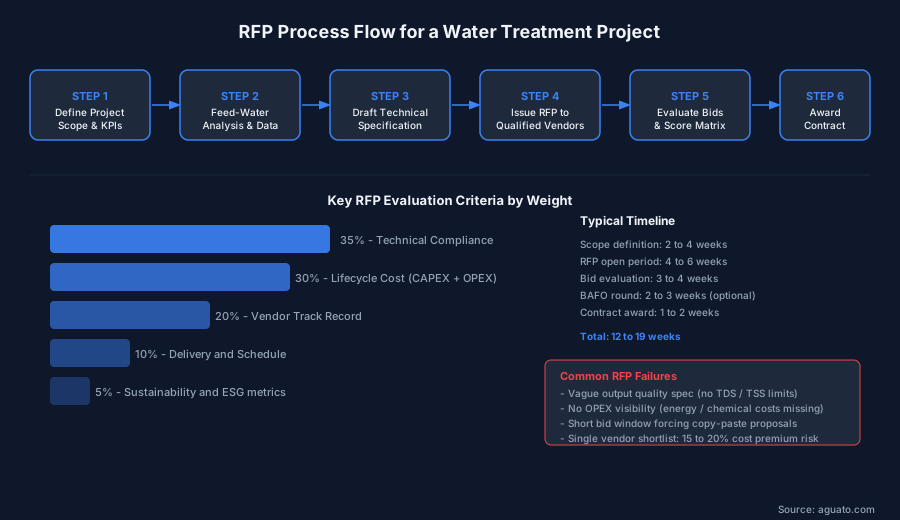
The six-step process above applies regardless of project size. The sequence is fixed because each step gates the next: you cannot write a credible technical specification without feed-water data, and you cannot evaluate bids without a published scoring matrix. Compressing or skipping any step shifts cost and risk back to the buyer.
## RFP Document Structure: What Every Section Must Include
A structured rfp water treatment project document eliminates the vendor interpretation that drives cost divergence. Comparable bids require a comparable question set.
The seven mandatory sections are: (1) Project Background and Objectives; (2) Site and Infrastructure Constraints; (3) Feed-Water Data Package; (4) Technical Specification and Performance Requirements; (5) Commercial Requirements; (6) Vendor Qualification Requirements; and (7) Submission Format and Evaluation Criteria.
The project background section is routinely written in two paragraphs when it needs to be two pages. Vendors need to understand your operational context, your regulatory environment, the reason you are replacing or adding a treatment step, and the strategic direction. A pharmaceutical manufacturer explaining that the project is driven by a USP 1231 compliance gap writes a very different RFP than one describing a general demineralization upgrade. The former attracts vendors with validated system experience and GMP documentation capability. The latter attracts general industrial suppliers.
Site and infrastructure constraints must include: available footprint (m2 or m3 for indoor installations), ceiling height, floor loading (kN/m2), available utilities (power: kVA available, voltage, frequency; compressed air: bar and l/min; drain capacity: m3/h; chemical storage: m3), access for equipment delivery (doorway dimensions, crane access), and any hazardous area classifications (ATEX zones). Missing any of these means vendors must assume, which means vendors must price conservatively.
Commercial requirements include payment milestones (typically 30% deposit, 30% on factory acceptance test, 30% on site acceptance test, 10% on end of warranty), liquidated damages for delivery delay and performance shortfall, warranty terms (minimum 12 months, typically 24 months for mechanical components), and spares provision. The commercial section is where most buyers leave the most money on the table. A clear liquidated damages clause of $2,000 to $5,000 per day for schedule overrun is far more powerful than a vague "time is of the essence" statement.
[cta:nepti-dark]
## Technology Selection Framework: When to Specify vs. Performance-Specify
Whether to specify a technology or specify performance is the single most consequential structural decision in writing an rfp water treatment project. Getting this wrong either constrains competition or exposes you to design liability you did not intend to accept.
Performance-specify when: the output quality is known, the feed water is characterised, and the technology landscape is genuinely competitive. This is the right approach for demineralization, cooling water treatment, general industrial filtration, and most municipal treatment upgrades. You get competitive design innovation, comparable lifecycle costs, and clear vendor ownership of performance.
Technology-specify when: regulatory or safety constraints mandate a specific technology, the system must integrate with existing proprietary equipment, or standardisation across multiple sites is an explicit requirement. A pharmaceutical water-for-injection system must meet Ph.Eur. / USP requirements, which effectively mandates distillation or membrane-based ultrapure water production. A food plant extending an existing carbon filtration train should technology-specify to maintain chemical and maintenance standardisation.
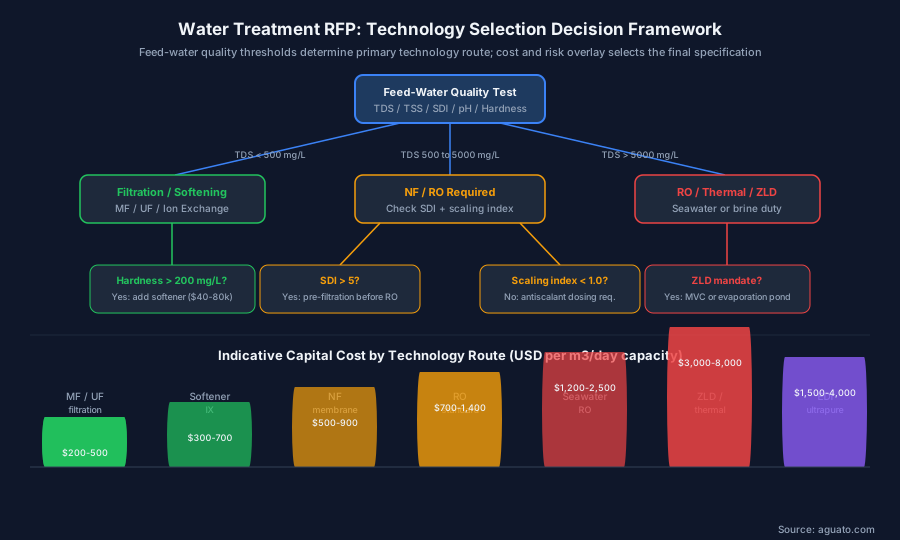
The table below summarises the primary technology routes, their cost ranges, risk profiles, and best-fit applications for a standard industrial procurement decision. Use it to set your internal expectation before reading proposals.
| Technology Route | CAPEX Range (USD/m3/day) | OPEX (USD/m3) | Key Risk | Best For | |---|---|---|---|---| | Multimedia filtration + softener | $300 to $700 | $0.05 to $0.15 | Channelling, resin fouling | Municipal water, light pre-treatment | | UF membrane pre-treatment | $400 to $900 | $0.08 to $0.20 | Membrane fouling, CIP frequency | Turbid surface water, SDI reduction | | NF membrane | $600 to $1,100 | $0.15 to $0.30 | Scaling at high recovery | Hardness removal, colour, partial desalt | | Brackish RO | $700 to $1,400 | $0.20 to $0.45 | Scaling, biofouling at >75% recovery | Industrial demineralisation, TDS 500 to 5,000 mg/L | | Seawater RO | $1,200 to $2,500 | $0.50 to $1.20 | Energy (3.5 to 5 kWh/m3), corrosion | Coastal industrial, TDS > 35,000 mg/L | | EDI / mixed-bed polishing | $1,500 to $4,000 | $0.30 to $0.80 | Resin fouling if RO permeate quality poor | Ultrapure water, boiler make-up, pharma | | ZLD (thermal/MVC) | $3,000 to $8,000 | $2.00 to $6.00 | Energy intensity, scale, corrosion | Zero-discharge mandate, high-TDS brine |
The cost column is the number to take to your CFO pre-RFP. Seeing that ZLD carries 4 to 10x the lifecycle cost of a standard RO system reframes whether the discharge constraint driving that requirement is worth challenging with the regulator before you issue the document. The [International Desalination Association's technical reference library](dofollow:https://www.idadesal.org) provides independent benchmarks for recovery rates, energy consumption, and OPEX ranges by technology type that align with the cost bands in the table above.
The right answer for your site depends on your actual feed water, duty cycle, and discharge constraints. If those variables are still open, [explore the technology options with qualified consultants](/consulting-services) before the RFP goes out.
## Vendor Qualification and Shortlisting
Vendor qualification for a water treatment project is not a formality. The engineering, procurement, and construction (EPC) capability of your vendor directly determines whether your plant is commissioned on time, whether it performs to spec in year three, and whether you have parts and service support in year seven.
The minimum qualification threshold for a water treatment project above $200,000 is: at minimum three references for comparable projects (similar technology, similar scale, similar application) in the past five years, with contact details for the operator rather than the vendor. "Similar scale" means within 2x of your flow rate and TDS range. A vendor with excellent references at 10 m3/h should not be pre-qualified for a 500 m3/h plant without explanation.
For projects above $1 million, add: ISO 9001 quality certification, ASME or relevant pressure vessel certification, factory acceptance test capability (a functioning test rig, not just a PowerPoint), and financial accounts demonstrating capacity to complete the contract. A $2 million water treatment contract awarded to a $1.5 million annual revenue vendor creates project delivery risk that no warranty clause can fully address.
Pre-qualification questionnaires (PQQs) should go out four to six weeks before the RFP. Target a shortlist of three to five qualified vendors. Fewer than three creates anti-competitive tension in the final negotiation. More than five dilutes the value of the exercise and signals to quality vendors that the evaluation may not be serious.
## Bid Evaluation Matrix and Scoring
A bid evaluation matrix is the document that transforms proposal comparison from a subjective discussion into a defensible procurement record. It must be designed before the RFP is issued and shared with bidders so they know how they will be evaluated.
The standard weighting for a water treatment project is: technical compliance 35%, lifecycle cost 30%, vendor track record 20%, delivery and schedule 10%, sustainability and ESG metrics 5%. These weights may shift: a utility-scale project with a tight regulatory deadline weights delivery higher; a pharmaceutical project weights technical compliance above 40%; a facility with an active science-based target weights sustainability above 5%. Whatever you choose, document it, share it in the RFP, and apply it consistently.
Technical compliance scoring works best with a binary-plus-quality approach. A vendor either meets a specification or does not (binary). If they meet it, score the quality of their approach on a 1 to 5 scale. The binary gate prevents a vendor with a beautifully presented non-compliant proposal from scoring ahead of a technically sound competitor. A pattern that recurs in industrial procurement is that the most professionally presented proposal does not correlate with the best technical execution. The written proposal reflects the quality of the sales team. The references reflect the quality of the engineering team. Weight accordingly.
For lifecycle cost, normalise all bids to a net present value over 15 years at a 7% discount rate. Request that vendors populate a standard spreadsheet with: CAPEX, annual energy cost (kWh/year at reference conditions), annual chemical cost (type, quantity, unit price), annual membrane or media replacement (unit cost, replacement interval), annual planned maintenance labour, and annual parts budget. This gives you a single comparable NPV number across all bids and exposes the proposals where low CAPEX is underwritten by high OPEX. For context, a water treatment plant with a $700,000 CAPEX and $0.45/m3 OPEX at 200,000 m3/year throughput accumulates $1.35 million in OPEX over 15 years before NPV discounting. The CAPEX is not the number that matters most.
## Lifecycle Cost Modelling: The Number That Changes the Award Decision
Lifecycle cost is the evaluation dimension most consistently underweighted in water treatment procurement. The bid with the lowest upfront capital cost wins selection committees more often than the bid with the lowest 15-year NPV, even when the difference is $300,000 to $600,000.
Membrane replacement cost is the variable that most often reverses an apparent CAPEX win. Brackish water RO membranes typically last three to five years before flux decline and salt passage increase beyond specification, with replacement costs of $30,000 to $180,000 per replacement event depending on the number and type of elements. A vendor quoting 5-year membrane life on a system that routinely runs above 80% recovery is likely to be generous. A competing vendor quoting 3-year life with a guaranteed supply contract may be more honest and more expensive per year but ultimately more accurate.
Energy cost is the largest single OPEX driver for RO and ZLD systems. For a 500 m3/day brackish RO, a pump efficiency difference of 15% between two proposals translates to $18,000 to $28,000 per year in electricity at $0.10/kWh. Over 15 years, at 7% NPV, that is $165,000 to $255,000. An energy recovery device on a seawater RO system costing $45,000 extra in CAPEX that reduces specific energy consumption from 4.5 kWh/m3 to 3.0 kWh/m3 recovers its premium in under two years of operation at typical industrial electricity prices.
Independent benchmarks for water treatment CAPEX and OPEX should be used to pressure-test vendor proposals before award. Ranges that deviate more than 30% from sector references warrant clarification before evaluation scoring closes.
Chemical costs are frequently understated in proposals because vendors base estimates on reference conditions (clean membrane, fresh media, compliant feed water). Build a 20% contingency into all vendor-provided chemical cost estimates and require vendors to provide a sensitivity analysis showing chemical cost at 1.25x and 1.5x the reference feed-water TDS. This single request surfaces design margin and vendor honesty simultaneously.
When comparing bids against your [water treatment plant design](/resources/water-treatment-plant-design) requirements, insist that the lifecycle cost model is locked into the contract as Appendix A. Any deviation from modelled operating parameters during commissioning and operation then triggers a transparent calculation of actual vs. projected cost, which becomes the basis of performance claims and warranty discussions.
## Common Failure Scenarios and Their Dollar Cost
The failure scenarios below are not theoretical. They recur systematically in water treatment projects where the RFP was underspecified or the evaluation was dominated by CAPEX.
Failure 1: Wrong technology selected because feed water was not fully characterised. Decision: Issued RFP with dry-season feed-water sample, selected UF + RO without accounting for seasonal silica spike. Operational outcome: Silica scaling on RO membranes during wet season, membrane flux decline to 60% of design within 18 months. Cost: $95,000 to $140,000 emergency membrane replacement and acid cleaning programme. Additional antiscalant system retrofit: $22,000. Correct decision: Wet-season sampling showing silica > 40 mg/L would have triggered antiscalant pre-dosing design and higher-rejection membrane selection from the outset.
Failure 2: No OPEX benchmark in the RFP, lowest CAPEX wins. Decision: Award to lowest capital bidder, 12% below the field. Evaluation matrix had no lifecycle cost dimension. Operational outcome: Energy consumption 40% above the next-lowest bid's projection. Chemical dosing controller not included, manual batch dosing produces 25% overdose and $35,000/year excess chemical spend. Cost: $85,000 to $110,000 per year in excess OPEX above the runner-up bid's projected costs. Retrofit of automated dosing: $48,000. Correct decision: A 15-year NPV evaluation would have shown the winning bid was $280,000 more expensive over its operating life than the apparent second-place bid.
Failure 3: Vendor qualification skipped, subcontractor delivers. Decision: Pre-qualification waived for an expedited procurement. Primary vendor subcontracted the design and manufacture to an unfamiliar supplier. Operational outcome: Commissioning delayed 14 weeks. Production line requiring demineralised water idled at $22,000 per day. Cost: $308,000 in production loss from delay alone. Two warranty claims in year one for pump seal failures totalling $38,000. Correct decision: A basic pre-qualification check against comparable references and financial accounts would have flagged the vendor's reliance on subcontracting for this scale.
A structured RFP for your specific site conditions is the most direct risk mitigation against all three scenarios. [Explore pre-vetted water treatment consultants and system suppliers](/consulting-services) who can both validate your specification and respond to the RFP as a qualified bidder.
## Using Decision Intelligence Tools for RFP Preparation
Decision intelligence tools have changed the economics of RFP preparation for water treatment projects, particularly for procurement teams without in-house process engineering capability.
Nepti models your water matrix and produces a ranked comparison of technology options with cost projections, designed to give a procurement team the same output quality they would get from a three-week independent engineering study at a fraction of the time and cost. Where previously a team would commission a $25,000 to $60,000 feasibility study before writing the RFP, Nepti can model the technology trade-off against your actual feed-water data, duty cycle, and output specification in hours. The output is a ranked technology comparison with CAPEX ranges, OPEX benchmarks, energy per m3, and a commentary on risk factors for each route, which becomes the technical foundation of your RFP specification.
This matters most when you are deciding whether to performance-specify or technology-specify. If Nepti's modelling shows that three technology routes all satisfy your output requirement within a 20% CAPEX band, you have strong grounds to performance-specify and let vendors compete. If the modelling shows one route dominates on lifecycle cost by more than 35%, you have grounds to technology-specify that route and focus the RFP on vendor qualification and commercial terms rather than design alternatives.
For multi-site procurement, decision intelligence becomes a portfolio tool. A facility group with twelve industrial sites each requiring a demineralisation upgrade can use Nepti to identify which sites share the same feed-water profile and output requirement, create a consolidated lot-based RFP, and negotiate volume pricing across the portfolio. A pattern that recurs in multi-site programmes is that the volume premium unlocked by lot consolidation covers the cost of the entire RFP preparation process, including the feed-water analysis programme. The [World Bank's water and sanitation infrastructure cost guidance](dofollow:https://www.worldbank.org/en/topic/water) provides sector-level benchmarks that decision intelligence platforms calibrate against when generating technology cost projections.
[Learn how Nepti supports water treatment technology selection](/nepti) across the full project lifecycle, from feed-water characterisation through RFP preparation to vendor comparison.
For context on [how to choose industrial water treatment](/resources/how-to-choose-industrial-water-treatment) technology for your application, the linked guide covers the full decision arc from needs assessment through system selection with quantified thresholds.
## FAQ
### What should be included in a water treatment RFP?
A water treatment RFP must include seven sections: project background, site and infrastructure constraints, feed-water data package, technical specification with quantified performance guarantees, commercial requirements including liquidated damages and warranty terms, vendor qualification requirements with minimum reference thresholds, and submission format with a published scoring matrix. The most commonly missing sections are the feed-water data package (often replaced by a verbal description) and a lifecycle cost template that forces vendors to disclose OPEX projections in a comparable format.
### How long should an RFP process take for a water treatment project?
A well-structured water treatment RFP process from scope definition to contract award takes 12 to 19 weeks for a project in the $300,000 to $2 million range. This includes two to four weeks for scope definition and feed-water sampling, four to six weeks of open bid period for vendors, three to four weeks for bid evaluation and scoring, an optional two to three weeks for a best-and-final-offer round with two finalists, and one to two weeks for contract negotiation and award. Shorter timelines structurally advantage large vendors with templated proposals and disadvantage specialist suppliers who do genuine site-specific design work.
### How do I compare water treatment bids when technologies differ?
Normalise all bids to a 15-year net present value at a 7% discount rate using a standard OPEX input template issued with the RFP. The NPV calculation captures CAPEX, annual energy cost, chemical cost, membrane or media replacement, labour, and parts. Divide by total treated volume over the period to arrive at a cost per m3 treated. This single number makes a $900,000 CAPEX low-energy-RO proposal directly comparable to a $650,000 CAPEX high-OPEX proposal and typically reverses the apparent winner from the capital cost page alone.
### What performance guarantees should I require in a water treatment contract?
The minimum performance guarantee set for an industrial water treatment contract includes: minimum permeate flow at reference feed conditions, maximum specific energy consumption (kWh per m3 permeate), maximum chemical consumption per m3, minimum system availability over a rolling 12-month period (typically 95% to 98%), and a maximum response time for emergency service call-out. Each guarantee should carry a corresponding remedy: for performance shortfall, typically a cost abatement tied to the verified underperformance; for availability shortfall, typically a credit calculated as the cost of supplemental supply. For ultrapure and pharmaceutical water systems, add a conductivity and TOC guarantee aligned to the applicable pharmacopoeial standard.
### When should I performance-specify versus technology-specify in a water treatment RFP?
Performance-specify when the output quality requirement is clear and the technology landscape is genuinely competitive. This applies to most industrial demineralisation, cooling water treatment, filtration, and general purification projects. Technology-specify only when regulatory requirements mandate a specific process (pharmaceutical water-for-injection, ATEX-zone chemical handling), when the system must integrate with proprietary existing equipment, or when standardisation across multiple sites outweighs the benefit of competitive design innovation. The default should be performance specification: it creates more competition, transfers design risk to the vendor, and typically produces 15 to 25% lower lifecycle cost than a prescriptive technology RFP. The [most efficient water solution](/resources/most-efficient-water-solution) guide explores this trade-off in detail for common industrial applications.
### How many vendors should I invite to bid on a water treatment RFP?
Invite three to five pre-qualified vendors. Fewer than three eliminates competitive pricing tension and typically adds 10 to 20% to the award price compared to a properly competitive field. More than five dilutes the process: vendors infer that the evaluation is not selective and invest less in proposal quality. The shortlist should be assembled through a pre-qualification questionnaire issued four to six weeks before the RFP. The PQQ should require at least three comparable references with operator contact details, financial accounts for the past two years, and certification evidence. [View qualified water treatment providers on Aguato](/providers) to build your initial longlist.
### What are the most common mistakes in water treatment RFP evaluation?
The three most expensive mistakes are: evaluating on CAPEX alone without a lifecycle cost model, failing to verify vendor references before award, and issuing the RFP before feed-water characterisation is complete. The CAPEX-only evaluation error is the most costly: a project that saves $80,000 at award through low-CAPEX selection and then spends $85,000 to $120,000 per year in excess OPEX has destroyed value in the first twelve months of operation. Reference verification catches the proposal-quality-versus-execution-quality gap: the best-written proposal is not always the best-delivered project. And incomplete feed-water data drives a 15 to 25% contingency premium across the entire bid field. The [consulting services](/consulting-services) available on Aguato include independent technical review of RFP documents before they are issued, which is the most cost-effective point to catch specification gaps.