Unmanaged water risk costs industrial sites $40,000 to $2M per event. A structured industrial water risk assessment cuts that exposure by 60 to 80%. Full framework inside.
Water is the single largest uninsured liability in most industrial operations, yet fewer than 30% of sites have a formal, documented industrial water risk assessment on file. When the consequences land, they land hard: a Legionella outbreak triggers liability exposure of $500,000 to $2,000,000 before legal costs; a permit exceedance on a discharge consent can generate $10,000 to $100,000 per day in regulatory fines; a scaling event left unmanaged for two quarters cuts heat exchanger efficiency by 15 to 20% and raises energy costs by a compounding $80,000 to $250,000 annually on a mid-size cooling circuit alone.
The uncomfortable reality is that most water incidents are not unpredictable. They follow predictable failure chains that a structured risk framework would have flagged three to six months in advance. The problem is that water risk assessment is still treated as a compliance checkbox rather than an operational and financial discipline. Sites that treat it as the latter typically spend $15,000 to $40,000 on the assessment and the remediation plan, and avoid events that cost ten to fifty times that figure.
This guide covers the five-stage industrial water risk assessment framework, the scoring methodology, the specific failure scenarios that generate the biggest financial exposures, how to build a defensible audit trail for regulators and insurers, and the decision thresholds that determine when you need outside expertise. It is written for operations, procurement, and sustainability leads who own both the OPEX budget and the regulatory clock.
## The decision in brief
- Act on the top five findings. If your site implements a structured industrial water risk assessment and acts on the top five findings, the avoided-event cost over a five-year window is typically $180,000 to $600,000 for a mid-size industrial facility. - Budget $25,000 to $70,000 for assessment and mitigation combined. That combined assessment and mitigation investment is what the $180,000 to $600,000 of avoided-event cost is set against over the five-year window. - Watch for the event that fines and interrupts at once. The biggest cost-of-doing-nothing is a Legionella liability event or a permit exceedance that generates both regulatory fines and business interruption simultaneously.
On a continuous-process site, that single incident can exceed $1,000,000.
## What a water risk assessment actually covers
An industrial water risk assessment is a systematic process for identifying every way water can cause financial, operational, environmental, or regulatory harm to a facility, scoring those risks by likelihood and severity, and building a prioritised mitigation plan with a cost model attached. It is not a water quality test report, and it is not a treatment audit. Both of those are inputs to the assessment, not the assessment itself.
The scope of a complete assessment spans five domains: source water variability (ground, municipal, or process-return), process water chemistry (cooling, boiler, rinse, product-contact), wastewater and discharge compliance, infrastructure integrity (tanks, pipework, heat exchangers), and biological risk (Legionella, biofilm, microbial contamination). Most sites that suffer large water-related losses had an assessment that addressed only one or two of these domains, usually the most visible one.
The output of the assessment is a ranked risk register, a treatment and control roadmap, a monitoring plan with defined alert thresholds, and a cost model showing avoided-loss versus investment. That package is also the evidence base that satisfies insurers, regulators, and ESG auditors, which is a separate line of value from the operational protection itself.
A pattern that recurs in industrial installations is that the biggest risks are not the ones that trigger monthly maintenance callouts. They are the slow-building ones: hardness creep in a cooling loop that nobody tests because the system has been running fine for three years, or a biofilm colony growing in a low-flow dead-leg that only becomes visible when it breaks off and contaminates a product batch. The framework below is specifically designed to surface these latent risks before they become incidents.
## The five-stage assessment framework
The five-stage model provides a repeatable, auditable structure that works across sectors from food and beverage to pharmaceuticals, power generation, and heavy industry. Each stage produces a defined output that feeds the next.
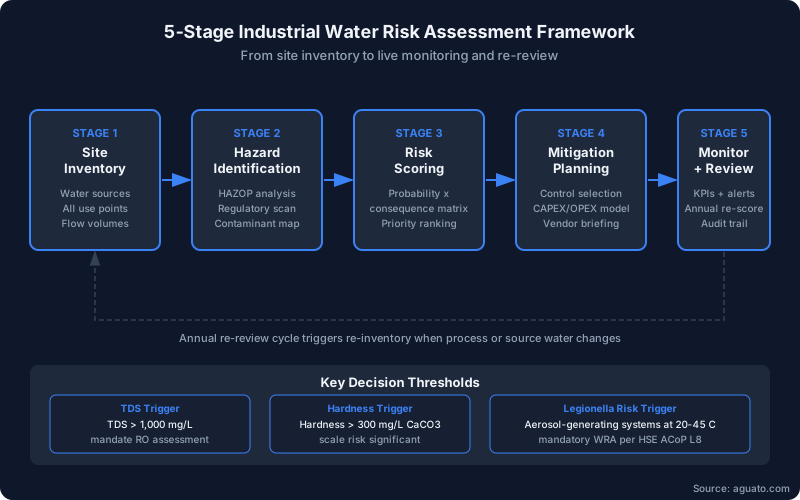
Stage 1: Site inventory. Map every water source, every use point, every storage vessel, every discharge path, and the volume flows linking them. Many sites undercount water use points by 20 to 40% in the first pass because temporary process water connections, occasional wash-down supplies, and emergency cooling headers are not on the P&IDs. If it is not on the map, it cannot be in the risk register.
Stage 2: Hazard identification. For each node in the water map, identify the failure modes. Use a structured HAZOP-style approach: what happens if flow stops, if quality degrades, if the system is contaminated from upstream, if temperature rises into the Legionella growth window (20 to 45 degrees Celsius)? Cross-reference against the site's regulatory permit conditions to flag any point where a failure would immediately breach a consent.
Stage 3: Risk scoring. Apply a probability-by-consequence matrix to produce a numerical risk score for each hazard. The scoring calibration matters more than the matrix format itself. Consequence scores should reference actual financial exposure (equipment damage, downtime, fines, liability) rather than abstract severity bands. A consequence score of "4" means nothing unless the scoring guide states that 4 = $50,000 to $200,000 direct cost.
Stage 4: Mitigation planning. For each risk above the defined threshold, identify the control measure, its capital cost, its annual OPEX, and the residual risk score after the control is in place. This is where treatment technology selection happens, and it is where a rigorous [industrial water treatment selection process](/resources/how-to-choose-industrial-water-treatment) connects directly to the risk framework. The mitigation plan is not a shopping list; it is an investment case with a defined return.
Stage 5: Monitor and review. Define the key performance indicators, the alert thresholds, the monitoring frequency, and the review cycle. The assessment is not a static document. Any significant change in source water quality, production volumes, or regulatory requirements triggers a partial re-assessment. Most sites set a formal full re-assessment cycle of 12 to 24 months.
## Risk scoring and the probability-consequence matrix
The probability-consequence matrix is the analytical core of any industrial water risk assessment. The matrix plots each identified hazard on two axes: how likely it is to occur in a given 12-month window, and how severe the operational and financial consequences would be if it did occur.
Calibrate the matrix to financial reality. Consequence bands should be anchored to real numbers: Minor = under $20,000 direct cost. Moderate = $20,000 to $100,000. Significant = $100,000 to $500,000. Catastrophic = over $500,000. These figures need to include production downtime at a realistic unplanned cost rate (typically $5,000 to $50,000 per hour depending on sector), not just equipment repair.
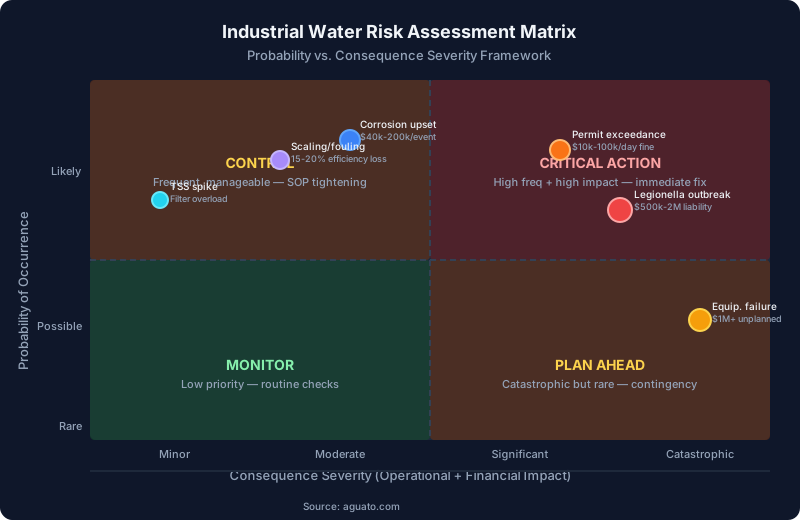
Probability bands should reflect site-specific history where it exists and sector benchmarks where it does not. A corrosion-related heat exchanger bypass event in a cooling circuit without inhibitor monitoring has a 30 to 50% annual probability at many industrial sites. That is not a "rare" event. Scoring it as rare because it has not happened at this specific site in the last two years is a common assessment error that produces a dangerously optimistic risk register.
The four-quadrant output defines the action priority: high-probability, high-consequence events (upper right) require immediate engineering controls. High-consequence, low-probability events require contingency planning and insurance review. High-probability, low-consequence events require SOP tightening and operational controls. Low-probability, low-consequence events require periodic monitoring only.
[cta:nepti-dark]
A risk score above 12 (on a typical 5x5 matrix with a maximum of 25) should trigger a formal mitigation project with a named owner, a budget line, and a completion deadline. The [EPA's industrial water management guidance](dofollow:https://www.epa.gov/waterreuse/guidelines-water-reuse) provides a supplementary framework for weighting risks that cross environmental discharge boundaries.
## The highest-cost failure scenarios and how to price them
Understanding where the money actually goes in a water-related incident changes how you prioritise the risk register. The following four scenarios account for over 70% of the total financial losses across industrial water incidents.
Legionella outbreak. A confirmed case traced to a site's cooling tower triggers an immediate shutdown order, a public health investigation, deep-clean and disinfection (cost: $30,000 to $80,000), extended monitoring obligations, and civil liability for any affected parties. Total cost for a mid-size food manufacturing site in one documented case: $1.4M including legal fees and reputational impact. The control cost to prevent it: $8,000 to $25,000 annually in enhanced monitoring and biocide dosing. This is the most asymmetric risk in industrial water management.
Permit exceedance on discharge consent. Breaching a site's effluent permit on a parameter like chemical oxygen demand (COD), suspended solids, or a specific heavy metal triggers escalating regulatory response. First breach: formal warning and an improvement notice. Repeated breach: fines up to $100,000 per day in most European jurisdictions and equivalent US EPA civil penalty ranges. The operational cause is almost always a process upset that the site's water quality monitoring programme was not calibrated to detect fast enough. [Proper water quality testing protocols](/resources/industrial-water-quality-testing) with defined response thresholds are the primary control.
Scaling and fouling-driven efficiency loss. Calcium carbonate scale at 1mm thickness reduces heat transfer efficiency by 7 to 10%. At 3mm, efficiency loss reaches 25 to 30%, and the energy cost penalty on a 500-ton cooling circuit running at $0.08/kWh is approximately $60,000 to $120,000 per year beyond the baseline. The typical treatment intervention costs $5,000 to $20,000 in chemicals and engineering time. The pattern that triggers real losses is not the presence of scale; it is the absence of a threshold at which intervention is automatically triggered.
Corrosion-driven equipment failure. Unmanaged corrosion in boiler systems, heat exchangers, or process piping progresses from a detected 2 to 3 mm/year corrosion rate to tube perforation in 18 to 36 months. A single boiler tube failure requires a planned shutdown of 3 to 5 days minimum, with repair costs of $15,000 to $60,000. An unplanned failure in continuous process production extends that to a $200,000 to $800,000 event when lost production is included. The threshold for intervention in a boiler water circuit is a corrosion rate above 2 mils per year (0.05 mm/yr) measured by corrosion coupon monitoring.
## Threshold-based decision framework: when to act and how
The value of a water risk assessment is only realised if the monitoring programme it produces contains specific, numeric decision thresholds. Qualitative thresholds ("if quality deteriorates") are unactionable. The following threshold structure is the minimum viable set for most industrial sites.
If TDS exceeds 1,000 mg/L in source or make-up water: trigger an RO feasibility assessment. Above this level, the scaling index in cooling circuits rises steeply and softening alone becomes insufficient for high-cycle applications. The right treatment pathway depends on your specific duty, but the trigger for investigation is fixed.
If hardness exceeds 300 mg/L as CaCO3 in make-up to cooling circuits: scale risk is significant and a treatment programme (inhibitor dosing or softening) must be active and verifiable before cooling cycle ratios can be increased. A site running a 4.0 cycles-of-concentration target with 350 mg/L make-up hardness and no inhibitor programme will reach saturation index conditions that produce visible scale within 90 days.
If Legionella count exceeds 100 CFU/L in a cooling tower sample (the HSE ACoP L8 action level): immediate notification to the responsible person, biocide shock dose, enhanced sampling at 48-hour intervals, and engineering review of the system design for dead-legs or low-flow zones that are incubating the colonisation. Do not wait for the 1,000 CFU/L level that triggers a regulatory notification. The cost of remediation at 1,000 CFU/L is 3 to 5 times higher than at 100 CFU/L.
If corrosion coupon reading exceeds 5 mpy (mils per year) in a cooling circuit: the inhibitor programme is failing, and the root cause (under-dosing, high chloride ingress, pH drift below 7.0) must be identified and corrected within 30 days. Continued operation above this threshold accelerates tube life loss at a predictable rate that a maintenance cost model can quantify in dollars per month.
If discharge COD exceeds 80% of consent limit on two consecutive monitoring events: trigger a process audit to identify the upset source before the limit is breached. Regulatory response at 100% of limit is immediate; internal response at 80% preserves the corrective action window.
The right monitoring programme to track these thresholds depends on your specific water chemistry and production profile. [Post your project](/post-project) and qualified water treatment providers will scope a monitoring plan against your actual parameters and permit conditions.
## Water risk assessment comparison: approaches and tools
Not all assessment approaches carry equal rigour or equal utility. The table below compares the main options by cost, audit defensibility, technical depth, and best fit.
| Approach | Typical cost | Risk column | Audit defensibility | Best for | |---|---|---|---|---| | In-house spreadsheet review | $0 to $5,000 internal time | Misses latent risks; no external benchmark | Low -- rejected by most insurers | Initial scoping, internal awareness | | Generic consultant template | $5,000 to $15,000 | Covers standard parameters; weak on site-specific hazards | Medium -- acceptable for basic compliance | Small sites, low-hazard processes | | Full specialist assessment (sector-specific) | $15,000 to $50,000 | Covers all five domains, site-calibrated scoring | High -- accepted by insurers, regulators, and ESG auditors | Mid-size to large industrial sites, food/pharma/power | | Continuous digital monitoring platform | $20,000 to $80,000 CAPEX + $10,000 to $25,000 annual | Real-time risk scoring; catches transient events | Very high -- timestamped data log accepted as evidence | High-value or high-hazard systems, multi-site programmes | | Decision-intelligence modelling (e.g. Nepti) | Variable; typically $8,000 to $30,000 | Models full water matrix, flags risk scenarios with cost projections | High -- structured output with traceable logic | Sites evaluating multiple treatment options against risk and cost |
The most common mistake is treating a generic template report as a complete assessment. A template may satisfy the minimum required by an insurer's questionnaire but will not surface the site-specific hazards that generate real losses. A pattern that recurs in industrial installations is that the two most expensive incidents in a five-year window were both present in the pre-incident water system as latent risks that a site-specific HAZOP review would have identified.
The [WHO's Water Safety Plan framework](dofollow:https://www.who.int/publications/i/item/9789241562430) provides the internationally recognised methodology for risk-based water management, and while it was developed for drinking water systems, the five-step risk scoring approach is directly applicable to industrial process water circuits.
## Building the audit trail regulators and insurers actually want
A documented industrial water risk assessment creates a defensible position in three contexts: regulatory inspection, insurance claim, and ESG audit. Each context has slightly different requirements, and a well-structured assessment satisfies all three.
Regulatory inspection. The Environment Agency (UK), EPA (US), and equivalent bodies in other jurisdictions want to see that a site has identified every discharge pathway and every source of potential permit breach, assigned a risk score, and documented the control measures in place. They also want to see that monitoring data is being reviewed against defined thresholds, not just archived. A site with a complete risk register and a documented SOP for threshold-triggered responses is in a structurally different position than one with an ad-hoc monitoring programme and no documented review process.
Insurance claim. Industrial property insurers increasingly require a current water risk assessment (typically less than 24 months old) as a condition of cover for water-related events including equipment damage, business interruption, and environmental liability. Sites without a current assessment that suffer a water-related loss may face policy exclusion or significant claim reduction. The ROI on a $20,000 assessment against a $500,000 potential claim exclusion is not a complex calculation.
ESG audit. Corporate water stewardship targets under frameworks like CDP Water Security and GRI 303 require quantified disclosure of water risk exposure and documented mitigation measures. Sites with a complete risk assessment translate that directly into the disclosure metrics -- water-related risk score, percentage of water volumes at high risk, and the mitigation investment deployed. Sites without it are forced into generic "no significant risks identified" responses that score poorly in investor-grade ESG ratings. Explore the [consulting services](/consulting-services) category to find specialists who structure assessments to these reporting frameworks.
The audit trail must include: the original assessment document with scoring methodology, dated monitoring records, records of threshold-triggered responses and outcomes, and the date of the last formal re-assessment. Missing any one of these elements can undermine the entire evidential position.
## Integration with operational risk fluid management
Water risk does not sit in isolation within a plant's overall risk picture. In most industrial facilities, water-related risk intersects with at least three other operational risk domains: energy efficiency, product quality, and environmental compliance. The most sophisticated plants manage these as a single integrated [operational risk and fluid management programme](/resources/water-operational-risk-fluid-management) rather than as parallel workstreams.
The practical integration point is the risk register itself. A water risk register that only tracks water-specific KPIs misses the signals that water chemistry is feeding into energy cost, product yield, or environmental liability. A corrosion rate reading in a cooling circuit, for instance, is simultaneously a water chemistry risk indicator, a maintenance cost signal, and an energy efficiency warning (because a corroded heat exchanger is also a scaling heat exchanger). A programme that manages these signals together responds faster and avoids the organisational blind spot where the water treatment team is reporting green on chemistry while the energy team is reporting a 15% efficiency degradation they attribute to plant age.
For multi-site operations, the integration challenge multiplies. Sites with more than three facilities typically need a standardised risk register format and a centralised reporting dashboard to make cross-site comparisons meaningful. The value of cross-site data is not just identifying the worst performer; it is identifying that the highest-risk site has a control that the second-highest-risk site lacks, and transferring that control at marginal cost. This is the logic that makes water risk assessment a positive ROI exercise at portfolio scale, not just a compliance cost at individual site level.
Nepti models your water matrix across process streams and produces a ranked comparison of risk scenarios with cost projections, which makes it directly useful for the Stage 3 scoring step in multi-system or multi-site contexts. [Explore Nepti's decision-intelligence platform](/nepti) to see how it maps onto an existing risk framework.
## Common mistakes that invalidate an assessment
An industrial water risk assessment that contains structural errors does not just fail to protect the site; it actively creates a false sense of security that delays the corrective actions a clear-eyed assessment would have prompted. The following mistakes are the most common ones seen in practice.
Scope creep excluded instead of managed. Assessments that only cover the "main" water systems consistently miss the highest-risk nodes, which are often the peripheral systems: emergency quench lines, temporary process connections, seasonal cooling circuits, and legacy pipework runs that have been isolated but not physically removed. Every water-containing component on site must be in the assessment scope.
Consequence scoring without financial calibration. A consequence matrix that uses abstract severity bands (low, medium, high, critical) without anchoring them to specific financial exposure produces a risk register that cannot support a business case for mitigation investment. If the board asks "how much does this risk cost us if it materialises?", the answer must be a number, not a band.
Static monitoring versus threshold-triggered monitoring. A monitoring programme that generates data but has no defined thresholds for what constitutes a result requiring action is not a risk control. It is data collection. The risk is still there; the site just has better documentation of the event that eventually happens. Every monitored parameter must have a defined alert threshold and a defined response SOP.
Annual review treated as a re-stamp, not a re-score. The annual review of a water risk assessment should re-score every risk based on current data, not simply confirm that the previous year's assessment is still valid. Process changes, source water shifts, regulatory changes, and equipment age all alter the probability and consequence scores. A three-year-old assessment re-stamped annually is not worth the paper it was originally written on.
Exclusion of [industrial water pollution risks](/resources/industrial-water-pollution) from the register. Sites that treat pollution risk as an environmental compliance issue separate from the water risk assessment end up with two documents that contradict each other. The risk of pollution to the receiving environment is part of the water risk picture, and the fines and remediation costs associated with a significant discharge event are among the largest financial exposures a site can face.
The detailed [ISO 14001:2015 environmental management standard](dofollow:https://www.iso.org/standard/60857.html) requires documented assessment of environmental risks including water-related impacts, and auditors cross-reference this against the site's operational risk documentation. A gap between the two is an immediate major non-conformance.
## FAQ
### What is an industrial water risk assessment and why is it required?
An industrial water risk assessment is a structured process that identifies, scores, and prioritises every way water can cause operational, financial, or regulatory harm to a facility. It is required under several regulatory frameworks including HSE ACoP L8 (Legionella control), ISO 14001 (environmental management), and increasingly as a condition of industrial property insurance. The output is a risk register with scored hazards, a mitigation roadmap, and a monitoring plan. Most jurisdictions do not mandate a single unified water risk assessment format, but the underlying risk identification and control obligations are embedded across sector-specific regulations.
### How much does an industrial water risk assessment cost?
A full specialist assessment for a mid-size industrial site typically costs $15,000 to $50,000 depending on site complexity, the number of water systems in scope, and the level of reporting detail required. In-house assessments using a structured framework can reduce this to $3,000 to $10,000 in internal time, but typically lack the external benchmark data and audit defensibility of a specialist-led exercise. The cost should be evaluated against the financial exposure of the top-ranked risks identified, not as a standalone compliance expense.
### How often should a water risk assessment be reviewed?
A formal full re-assessment should occur every 12 to 24 months, with interim reviews triggered by any significant change in source water quality, process volumes, new equipment installations, or updated regulatory requirements. Many sites set a fixed 12-month cycle and supplement it with a quarterly review of the monitoring data against the thresholds defined in the assessment. The review must produce a re-scored risk register, not just a confirmation that the previous document remains valid.
### What is the difference between a water risk assessment and a Legionella risk assessment?
A Legionella risk assessment is a subset of a full industrial water risk assessment, focused specifically on identifying water systems at risk of Legionella colonisation and the controls required to prevent it. A complete industrial water risk assessment covers all five domains: source water variability, process water chemistry, discharge compliance, infrastructure integrity, and biological risk (of which Legionella is one component). Sites that commission only a Legionella risk assessment have addressed one regulated risk but left the others unscored. Most [Legionella risk assessment specialists](/legionella-risk-assessment) can extend their scope to cover the full water risk picture.
### What parameters should be included in a water risk monitoring programme?
A minimum monitoring programme for a cooling and boiler circuit should track pH, conductivity (as a TDS proxy), hardness, inhibitor residual, biological activity (dip-slide or ATP count), and corrosion rate via corrosion coupons. Discharge monitoring requirements are set by the site's environmental permit and vary by sector, but typically include COD, BOD, suspended solids, pH, and any sector-specific parameters such as heavy metals or specific organic compounds. Each parameter must have a defined action threshold and a documented response SOP. Monitoring without defined thresholds produces data but not risk control.
### How do you build a business case for water risk assessment investment?
The business case is built on avoided-event cost, not on direct savings from treatment optimisation. Calculate the probability-weighted expected annual loss (EAL) for the top five risks in the register: EAL = probability x consequence cost. Sum the EALs to get the annual risk exposure in dollars. The assessment and mitigation programme cost, amortised over five years, should be a small fraction of the EAL it reduces. A typical mid-size site has an annual risk exposure of $100,000 to $400,000 from unmanaged water risks; an assessment programme that reduces this by 60% generates $60,000 to $240,000 in annualised avoided cost against a programme cost of $10,000 to $20,000 per year.
### What should be included in a water risk assessment audit trail?
A complete audit trail must include the original assessment document with the scoring methodology, dated monitoring records with each parameter's measured values and the threshold it was checked against, records of every threshold-triggered response with the action taken and the outcome, the credentials of the person who conducted the assessment, and the date of the most recent formal re-assessment. Missing any one element weakens the evidential position in a regulatory inspection, an insurance claim, or an ESG audit. The audit trail should be stored in a system that timestamps records and prevents retrospective editing, which is a requirement under several environmental management standards.