The wrong CAPEX vs OPEX water treatment decision costs $500K or more over 15 years. Here is the threshold-based framework procurement teams use to get it right.
The capital vs operating expenditure decision in water treatment is where projects go wrong before a single pipe is laid. A plant that finances a $1.2 million reverse osmosis system on a 20-year site lease will overpay by $400,000 to $700,000 versus a managed-service contract. Conversely, a food processor that signs a 10-year managed-service deal for a 2,000 m3/day demineralisation plant will pay a 35 to 50% premium on the same lifecycle cost compared with owning the asset outright. The capex vs opex water treatment decision is not a finance abstraction: it determines who carries the technology risk, who absorbs the regulatory upgrade cost, and whether the water utility line on your P&L is fixed or variable.
The industry's default instinct is to treat this as a straightforward build-or-buy question. It is not. The right answer depends on four interlocking variables: the plant's remaining economic life, your organisation's weighted average cost of capital, the in-house capability to operate the system, and the probability that the feed water specification or discharge consent will change within the asset's amortisation horizon. Get any one of those wrong and the entire lifecycle cost model collapses.
This article gives procurement leads, capital projects teams, and operations directors a threshold-based decision framework, a worked cost comparison for three common water treatment duties, the failure modes that turn each path into a CFO conversation, and a structured way to compare vendor proposals on a like-for-like basis.
## The decision in brief
- Count the operator before you count the financing spread. If your organisation owns a water treatment asset sized above 500 m3/day that is operated without a dedicated water treatment operator, the statistical likelihood of a membrane failure event within 3 years is above 60%. - Price the failure event at $200,000 to $500,000. That is what one event typically runs once you include emergency replacement, chemical cleaning, and 3 to 5 days of production disruption. - The financing spread is not the biggest cost. In the capex vs opex water treatment decision, the biggest cost-of-doing-nothing is not the financing spread between the two models but the unplanned spend of owning an asset without the operational infrastructure to run it correctly.
The cost of doing nothing is the $300,000 to $800,000 of unplanned spend, not the financing spread between the two models.
## What CAPEX and OPEX actually mean in water treatment
In water treatment, CAPEX covers the design, supply, civil works, installation, and commissioning of a treatment system that the purchasing organisation owns and depreciates. OPEX covers everything that runs the plant once it is live: energy, chemicals, consumables (membranes, resin, media), labour, maintenance, and compliance monitoring. The procurement decision is rarely pure CAPEX or pure OPEX. Most industrial water treatment projects sit on a spectrum, from full asset ownership with in-house operations at one end, to fully managed water-as-a-service contracts where the provider owns the kit and sells treated water at a per-m3 rate at the other.
What makes water treatment unusual versus other capital equipment categories is the high ratio of lifetime OPEX to initial CAPEX. A well-designed reverse osmosis plant typically carries a capital cost of $400 to $800 per m3/day of capacity. The OPEX to run that plant, including energy at $0.08 to $0.12/kWh, membrane replacement every 5 to 7 years, and chemicals, will add another $0.15 to $0.40 per m3 treated over the asset's life. Over 15 years, the cumulative OPEX on a 1,000 m3/day plant commonly exceeds the original capital cost by a factor of 2 to 3. That ratio means the ownership question is really an operations question in disguise.
Understanding [how to choose industrial water treatment](/resources/how-to-choose-industrial-water-treatment) technology is the prerequisite step. Once the technology is selected, the CAPEX vs OPEX question determines how you pay for it and who carries the risk of it performing as specified.
## The four variables that govern the decision
A pattern that recurs in industrial installations is that procurement teams anchor on the sticker price of the capital plant and treat OPEX as an afterthought. The four variables below are the ones that actually move the lifecycle cost needle, and they interact in non-obvious ways.
1. Remaining economic life of the site or process. If the facility has a credible 20-year runway, owning the water treatment asset is almost always cheaper on a net-present-value basis for systems above 500 m3/day. If the site lease has 7 years left, or the product line is under strategic review, locking into a CAPEX asset that cannot be redeployed is a balance-sheet trap. The crossover point for most membrane and ion exchange systems is between 9 and 11 years: before that point, a managed-service contract that bundles technology risk tends to be cheaper on a cash basis even if it costs more in total.
2. Weighted average cost of capital (WACC). At a WACC below 6%, owned assets generate significant NPV advantages over managed services for systems that perform within specification. At a WACC above 9%, the picture reverses and the capital deployed in a water treatment system represents a meaningful opportunity cost. Most industrial borrowers sit in the 6 to 8% range, which is exactly the zone where the decision is genuinely close and the choice should be driven by operational capability and risk appetite rather than finance alone.
3. In-house operational capability. A dedicated water treatment operator costs $55,000 to $90,000 per year in fully loaded employment cost in North America or Northern Europe. For a small system that needs 4 hours of operator time per day, that translates to $30,000 to $45,000 per year in allocated labour cost. The break-even calculation changes entirely when you include the cost of *not* having that capability, which shows up as unplanned downtime, chemical overdosing, premature membrane replacement, and compliance exceedances that attract regulatory fines.
4. Feed water variability and regulatory trajectory. Water treatment systems sized and configured for a specific feed water matrix can underperform severely if that feed changes. If your intake is surface water with seasonal turbidity swings, or if your discharge consent is under review for tighter nutrient or trace-contaminant limits, the cost of retrofitting or replacing a CAPEX-owned system falls entirely on your balance sheet. A managed-service provider contractually carries that risk if the performance specification is written correctly.
According to the [US EPA's guidelines on industrial water reuse and treatment economics](dofollow:https://www.epa.gov/waterreuse), lifecycle cost analysis for industrial water systems should include regulatory compliance upgrade costs projected over at least 10 years, which most CAPEX-only models omit entirely.
## Threshold-based decision framework
The framework below gives capital projects and procurement teams a structured set of go/no-go thresholds. These are not absolute rules; they are pressure-tested decision points drawn from the cost structures of hundreds of industrial water treatment installations.
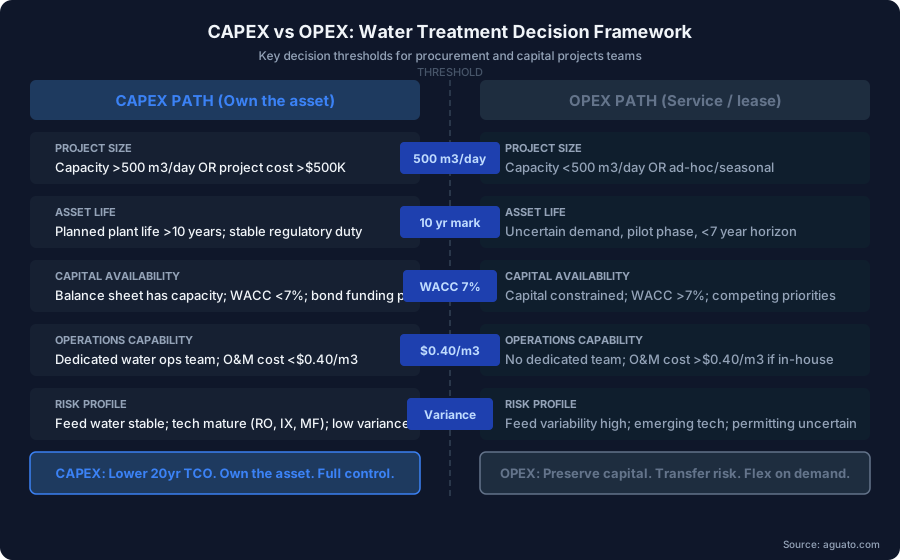
Use this framework as follows: if your project scores CAPEX on four or five dimensions, own the asset. Three CAPEX and two OPEX: the hybrid model (see below) warrants serious evaluation. Two or fewer CAPEX scores: managed service is likely the lower-risk path even if the nominal cost is higher, because the risks you are transferring are real and quantifiable.
Capacity threshold: 500 m3/day. Below this, the economics of scale that make owned systems competitive disappear. A 200 m3/day RO skid costs $180,000 to $280,000 to supply and install. A managed-service provider handling multiple small sites can spread their engineering and compliance overhead across a portfolio, delivering that same 200 m3/day at $0.35 to $0.55/m3 with full performance guarantee, which often beats the all-in owned cost including financing.
Asset life threshold: 10 years. Below 10 years, the net-present-value advantage of ownership rarely exceeds the technology risk premium built into a managed-service contract. Above 10 years, the NPV advantage of ownership for mid-to-large systems is typically $300,000 to $700,000 per $1 million of initial CAPEX on a 20-year horizon.
WACC threshold: 7%. At 7% WACC, a $1 million water treatment asset breaks even with an equivalent managed-service contract at approximately year 11. At 5% WACC, the break-even moves to year 8 and ownership wins decisively for any site with a 15-year-plus horizon.
O&M cost threshold: $0.40/m3. If your organisation can operate the system for less than $0.40/m3 treated (including all chemicals, energy, labour, and a 5% annual maintenance reserve), owning the asset is almost always cheaper than any managed-service rate for systems above 300 m3/day. If your in-house O&M cost exceeds $0.40/m3, you should be running a competitive tender against managed-service operators before committing to CAPEX.
## Cost comparison: three common water treatment duties
The table below compares CAPEX and OPEX economics across three common industrial water treatment duties. Figures are in USD, 2025 basis, and assume a 1,000 m3/day facility in North America or Western Europe. The managed-service column represents a water-as-a-service rate inclusive of capex recovery, O&M, chemicals, energy, and performance guarantee.
| Duty | CAPEX (supply + install) | OPEX (own, $/m3) | Managed service ($/m3) | 20-yr TCO owned ($) | 20-yr TCO managed ($) | Risk owner (managed) | Best for | |---|---|---|---|---|---|---|---| | Municipal RO (TDS 500 to 1,500 mg/L) | $450K to $650K | $0.18 to $0.28 | $0.35 to $0.48 | $1.9M to $2.7M | $2.6M to $3.5M | Provider | Stable feed, long tenure, in-house ops team | | Industrial demineralisation (IX or EDI) | $600K to $950K | $0.22 to $0.38 | $0.42 to $0.62 | $2.2M to $3.5M | $3.1M to $4.5M | Provider | Pharmaceutical, power, complex chemistry | | Wastewater to reuse (MBR + RO) | $1.1M to $2.2M | $0.35 to $0.65 | $0.60 to $0.95 | $3.6M to $6.9M | $4.4M to $6.9M | Provider | High discharge compliance risk, ESG drivers | | Cooling tower makeup (softening + biocide) | $80K to $180K | $0.08 to $0.14 | $0.20 to $0.32 | $0.7M to $1.2M | $1.5M to $2.3M | Provider | Low complexity; chemicals-only contract often better | | Ultrapure water (EDI + polishing) | $900K to $1.8M | $0.45 to $0.90 | $0.75 to $1.40 | $4.2M to $8.3M | $5.5M to $10.2M | Provider | Semiconductor, pharma; managed service strong option |
The most important column is not the CAPEX figure. The 20-year TCO owned versus managed comparison tells you the premium you are paying for risk transfer. For cooling tower makeup, that premium is 80 to 90%. For wastewater-to-reuse with high compliance exposure, the managed-service and owned costs converge, meaning you can get full risk transfer at near-zero premium if you write the contract well.
The right answer depends on your feed water chemistry, site tenure, and operational capability profile. [Post your project on Aguato](/post-project) and qualified providers will model the TCO trade-off against your specific numbers and duty cycle before you commit.
## CAPEX model: when owning the asset wins
Owning the water treatment asset makes unambiguous financial sense when four conditions align: the site has a credible 20-year operating life, the treatment technology is mature and the feed water specification is stable, your organisation has or can cost-effectively build in-house operating capability, and your WACC is below 7%.
The financial argument for ownership is strongest for large, continuous-duty systems with predictable chemistry. A power plant operating a 3,000 m3/day boiler feed water demineralisation system on stable river water will typically save $800,000 to $1.5 million over 20 years by owning versus contracting, even after accounting for membrane replacement cycles and a full-time water treatment operator. At that scale, the managed-service rate includes a margin that compounds to a significant sum.
Ownership also creates optionality that managed service does not. An owned system can be reconfigured, expanded, or redeployed as the process changes. [Water treatment plant design](/resources/water-treatment-plant-design) choices made at the FEED stage, particularly modular skid configuration and the selection of standardised pressure vessel sizes, directly affect how adaptable the asset is over its life. Sourcing code-stamped units from certified [pressure vessel suppliers](/pressure-vessel-companies) protects both the warranty and the resale value. A managed-service contract, by contrast, locks you into the provider's technology choices and their upgrade schedule.
The sustainability argument for ownership is underappreciated. When your organisation owns the system, energy efficiency investments (variable-frequency drives, high-rejection membranes, energy recovery devices) reduce your OPEX directly and improve your ESG water efficiency metrics. Under a managed-service contract, the energy saving accrues primarily to the provider unless the contract specifically shares efficiency gains.
[cta:nepti-dark]
## OPEX model: when managed service wins
Managed service, water-as-a-service, and service-contract models win decisively when technology risk is high, capital is constrained, or the organisation lacks the operational depth to run a complex system reliably. These are not edge cases: they describe a large share of mid-market industrial water users.
Technology risk is the most underweighted factor in CAPEX-versus-OPEX analyses. Emerging treatment duties, particularly PFAS removal, pharmaceutical trace contaminants, and zero-liquid-discharge systems, are evolving fast enough that a system specified today may need significant upgrading within 7 to 10 years to maintain compliance. When you own the asset, that upgrade cost is yours. When a specialist provider owns it under a performance contract, they carry the compliance risk in exchange for their margin. For a $1.5 million ZLD system, the cost of a mid-life compliance upgrade can run $400,000 to $800,000 and shows up nowhere in a standard CAPEX financial model.
Capital constraint is a harder argument to make to a CFO, but it is often the right one. Deploying $1.2 million of balance sheet into a water treatment system that returns the cost of capital at a 12 to 15-year payback is a defensible use of capital only if no better investment is available. For many manufacturers, consumer goods companies, and food processors, the return on that same capital deployed in production capacity, automation, or market expansion is substantially higher. The CAPEX case for water treatment is not "this is cheap"; it is "this is cheaper than the alternative." If the alternative is a 10% IRR production investment, the water treatment CAPEX case rarely wins on finance alone.
For organisations targeting net-zero or aggressive water stewardship targets, managed-service contracts with ESG-aligned providers can also accelerate compliance reporting. A provider who monitors and reports treatment performance in real time, against agreed KPIs, generates the audit trail that sustainability teams need for CDP, GRI, and internal ESG reporting without building that monitoring infrastructure in-house.
The most [efficient water solution](/resources/most-efficient-water-solution) for your site may not be the one with the lowest sticker price: it is the one that delivers the required water quality at the lowest verified lifecycle cost, with the performance risk allocated to the party best placed to manage it.
## Hybrid models and water-as-a-service contracts
The binary CAPEX-or-OPEX framing misses the most commercially interesting part of the market. Hybrid models, where the organisation owns the civil infrastructure and long-life assets (tanks, pipework, buildings) but contracts out the membrane trains, chemical dosing, and process control under a performance guarantee, are increasingly common for systems in the $500,000 to $3 million range.
Water-as-a-service (WaaS) contracts have proliferated in the last decade, particularly in food and beverage, pharmaceuticals, and data centres. The provider installs and retains ownership of the treatment equipment, the buyer pays a per-m3 or per-day service fee, and performance is guaranteed to a defined effluent quality specification. Contract durations typically run 7 to 12 years, with break clauses at years 3 to 5 that give the buyer optionality if the site or process changes.
The WaaS structure transfers technology risk, compliance upgrade risk, and operational risk to the provider, which is why the per-m3 rate carries a premium of 25 to 50% over an owned-and-operated system's all-in cost. Whether that premium is worth paying is a function of those four governing variables: site life, WACC, in-house capability, and regulatory trajectory.
A critical negotiating point in WaaS contracts is the definition of performance failure. Contracts that specify effluent quality in terms of specific parameters (conductivity, TDS, SDI, TOC) are more auditable and more defensible in dispute resolution than contracts that reference "treated water suitable for [process]." Procurement teams should insist on quantified performance KPIs with liquidated damages clauses that are proportionate to the cost of a process interruption.
According to the [International Water Association's benchmarking framework for industrial water contracts](dofollow:https://iwa-network.org), well-structured performance contracts in the industrial sector reduce unplanned downtime events by 30 to 60% compared with owner-operated systems at similar scale, because the provider's incentive structure aligns with uptime rather than minimising maintenance spend.
## Failure scenarios and what they cost
Understanding failure modes is as important as the baseline cost model. Each path has characteristic failure patterns, and the financial consequences are asymmetric enough to shift the decision.
CAPEX failure 1: Underspecified system, compliance exceedance. A pharmaceutical manufacturer specifies a $750,000 purified water system to current GMP standards. Three years later, the regulatory requirement is tightened for endotoxin limits. The retrofit to add ultrafiltration and upgraded monitoring costs $280,000, which was not in the asset plan. Total cost: $1,030,000 versus the $750,000 budgeted. Had the specification included a "future-proof" provision or had the asset been under a managed-service contract with a compliance upgrade clause, the incremental cost would have been $0 to the buyer. This scenario is not hypothetical. It is a pattern in pharmaceutical and semiconductor water systems where regulatory evolution is faster than typical asset amortisation periods.
CAPEX failure 2: Operator capability gap, early membrane failure. A food processing plant owns a $420,000 RO system for process water. The plant assigns membrane management to a general maintenance technician rather than a specialist operator. SDI is not monitored consistently, and biofouling develops across 30% of the membrane array within 18 months. Emergency membrane replacement costs $65,000, chemical cleaning costs $12,000, and 4 days of reduced production at $80,000/day represents $320,000 in lost output. Total unplanned cost: $397,000, or approximately the full replacement value of the system. This is the single most common CAPEX failure mode in mid-market industrial water treatment and it is entirely avoidable.
OPEX failure 1: Poorly written contract, performance ambiguity. A mining operation signs a WaaS contract for $0.65/m3 treated for process water. The contract specifies "water suitable for mineral processing" without defining specific conductivity, TDS, or hardness parameters. Feed water TDS rises seasonally from 800 to 1,800 mg/L. The provider argues the system is performing to contract; the operator argues the water quality is inadequate for the process. Dispute resolution costs $120,000 in legal fees and takes 8 months. During that period, the plant blends in additional softened water at an additional cost of $180,000. Total cost of the contract ambiguity: $300,000. Quantified performance specifications would have cost $15,000 to $25,000 in upfront contract engineering.
OPEX failure 2: Provider financial failure, stranded operations. A mid-size beverage manufacturer contracts a WaaS provider for a 10-year term. In year 4, the provider enters administration. The buyer has no ownership of the equipment and no operational knowledge of the system. Emergency procurement of replacement equipment takes 14 weeks; temporary trucked water supply costs $85,000; production losses are $240,000. The contractual protection a step-in rights clause and equipment vesting provision would have provided was not included in the original contract.
These failure scenarios share a common thread: the financial exposure from the wrong decision, or from the right decision executed poorly, consistently exceeds the original capital cost of the system. Managing [water operational risk](/resources/water-operational-risk-fluid-management) is inseparable from the CAPEX vs OPEX decision: you are not just choosing how to finance the asset, you are choosing how to allocate and manage the operational risk that comes with it.
## How to structure the RFP for a fair comparison
Most water treatment RFPs invite proposals on a CAPEX-supply basis and then compare them against a separate managed-service enquiry on a different specification. The result is that the procurement team ends up comparing incompatible cost models and cannot make a like-for-like decision.
A well-structured RFP asks all bidders to respond to the same performance specification and to price it in three ways: full CAPEX supply-only, CAPEX supply plus 5-year O&M contract, and WaaS per-m3 rate over 10 and 15 years. That structure forces all vendors to disclose the same underlying cost components and makes it possible to compute a consistent NPV comparison.
The specification itself should define effluent quality parameters (TDS, hardness, SDI, pH range, microbiological limits as applicable), peak and average flow requirements, availability requirement (typically 95 to 99%), and the cost of downtime to the process in $/hour. That last figure anchors the reliability and performance guarantee clauses in commercial terms both sides can audit.
[Nepti's decision-intelligence platform](/nepti) models your water matrix and site parameters against a structured database of technology configurations, producing a ranked comparison of CAPEX and OPEX cost projections across multiple technology paths with scenario analysis for feed variability and regulatory change. It is not a generic cost calculator: it uses your specific chemistry, duty cycle, and site constraints to generate a CFO-ready cost model.
Working with [industrial water treatment companies](/industrial-water-treatment-companies) that can price all three models in a single response gives procurement teams the most competitive tension in the RFP and the clearest basis for a defensible capital approval or managed-service contract award.
The procurement process should also include a total-cost-of-ownership audit of any existing system being replaced or supplemented. A pattern that recurs in capital projects is that organisations underestimate the O&M cost of the incumbent system because those costs are distributed across multiple cost centres (maintenance, chemicals, energy, compliance monitoring) and never aggregated into a single water treatment cost line. Before approving new CAPEX, build the current-state cost model first.
According to the [ISO 55001 standard for asset management](dofollow:https://www.iso.org/standard/55089.html), lifecycle cost analysis for industrial assets should include acquisition, operation, maintenance, renewal, and disposal costs as a minimum. Water treatment assets routinely omit disposal and decommissioning costs, which run $40,000 to $150,000 for a mid-size system and are sometimes excluded from both the CAPEX model and the managed-service contract.
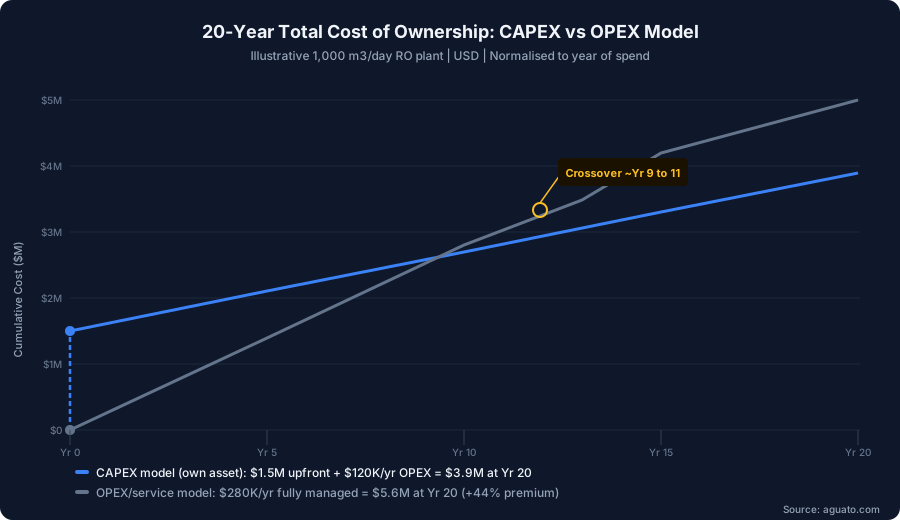
The crossover point in the chart above is the most important number in any CAPEX vs OPEX decision. If your credible site tenure does not extend past the crossover, the managed-service model is almost always the lower-risk choice even if its cumulative cost is higher, because you avoid stranding a depreciated asset and you preserve capital for higher-return uses.
The decision does not need to be made on intuition. [Post your project on Aguato](/post-project) with your water quality requirements, site tenure estimate, and capacity profile, and qualified providers will return CAPEX and WaaS pricing on the same specification, giving you the raw material for a defensible NPV comparison.
To assemble the raw material for that NPV comparison, compare vetted [industrial water treatment companies](/providers) on Aguato, filter by your duty and capacity profile, and request CAPEX and managed-service pricing on the same specification so the build-versus-buy threshold above is tested against real quotes.
## FAQ
### What is the typical payback period for a CAPEX water treatment investment?
For systems above 500 m3/day, the payback period versus a managed-service alternative is typically 9 to 13 years depending on WACC, in-house operational cost, and feed water complexity. Below 500 m3/day, the payback period often extends beyond 15 years because economies of scale favour service providers. The payback calculation should include capital financing cost, all-in OPEX (energy, chemicals, labour, maintenance, membrane replacement), and the cost of any compliance upgrades expected over the asset life.
### When does a water-as-a-service contract make more financial sense than CAPEX?
WaaS wins on a total-cost basis when site tenure is below 10 years, WACC is above 8%, or in-house O&M costs exceed $0.40 per m3 treated. It also wins in risk-adjusted terms when the treatment duty involves emerging contaminants, complex discharge consents, or pharmaceutical/semiconductor quality requirements where regulatory evolution is rapid. The 25 to 50% nominal premium over an owned system is the price of transferring those risks, and for many organisations that premium is justified.
### How do you compare CAPEX and OPEX bids on a like-for-like basis?
The most reliable method is net present value analysis using a consistent discount rate applied to all cost streams over a 15 to 20-year horizon. Include initial capital and financing, annual OPEX (energy, chemicals, labour, maintenance), periodic capital renewals (membrane replacement every 5 to 7 years, media replacement, instrument recalibration), regulatory compliance upgrade provisions, and decommissioning. Request all vendors to price the same specification in supply-only, supply-plus-O&M, and WaaS formats. That forces comparable cost disclosure and enables a genuine NPV comparison rather than a sticker-price comparison.
### What should a water treatment managed-service contract include?
At minimum: quantified effluent quality KPIs (conductivity, TDS, SDI, TOC, microbiological limits as applicable), guaranteed availability (typically 95 to 99%), liquidated damages for availability and quality failures, a compliance upgrade clause that assigns responsibility for regulatory changes, step-in rights for the buyer if the provider fails, and equipment vesting provisions. Performance-based contracts without defined KPIs and consequences routinely generate disputes in years 3 to 5. Contract engineering upfront costs $15,000 to $30,000; dispute resolution after a performance failure costs $100,000 to $300,000.
### How does in-house operational capability affect the CAPEX vs OPEX decision?
In-house capability is the single most underweighted variable in water treatment CAPEX decisions. A system that is technically and financially justified on a lifecycle cost basis will destroy value if it is not operated correctly. The cost of a membrane failure event caused by operator error (inadequate SDI monitoring, incorrect chemical dosing, failure to respond to fouling indicators) typically runs $200,000 to $500,000 when production disruption is included. Before committing to a CAPEX path, assess whether your organisation has, or can cost-effectively build, the specific competencies required: membrane management, chemical dosing control, compliance monitoring, and water quality data interpretation.
### What is the impact of feed water variability on the CAPEX vs OPEX decision?
High feed water variability is a strong argument for managed service or a hybrid model with performance guarantees. A CAPEX system sized for average feed conditions will underperform when the feed shifts seasonally or in response to catchment events. If feed TDS doubles seasonally (a common scenario on surface water intakes), a system sized for 800 mg/L feed will see recovery rates fall and specific energy consumption rise by 20 to 40% during high-TDS periods. Under a CAPEX-owned model, that cost is yours. Under a performance contract, the provider either manages the variability within the contracted rate or applies a pre-agreed variable-feed surcharge. [The most efficient water solution](/resources/most-efficient-water-solution) for variable-feed duties almost always involves a more sophisticated treatment train than the baseline case.
### How does the CAPEX vs OPEX decision affect ESG and sustainability reporting?
Ownership gives you direct control over energy efficiency investments and water efficiency metrics, which can improve ESG reporting. Under an owned model, installing energy recovery devices or high-rejection membranes reduces your reported energy per m3 and your water consumption ratio immediately and permanently. Under a managed-service contract, those gains accrue primarily to the provider unless the contract includes explicit efficiency sharing clauses. For organisations with public ESG commitments (CDP, GRI, Science-Based Targets), the ability to report granular, auditable water and energy performance data is a material consideration, and owned systems with real-time monitoring provide a cleaner audit trail than service contracts where the provider holds the primary data.