Choosing the wrong water treatment provider costs $150K to $500K per compliance failure. This checklist covers the five criteria that separate a reliable vendor from a costly one.
A single misjudged vendor selection in industrial water treatment can cost between $150,000 and $500,000 in compliance penalties, unplanned downtime, and rework once the system underperforms against its design specification. Water treatment provider evaluation is not a procurement formality; it is a risk-transfer exercise, and the organisations that treat it as a tick-box process end up absorbing the technical and financial risk themselves. The primary keyword here is literal: water treatment provider evaluation determines whether your capital spend lands in an asset or a liability.
The market compounds this challenge. There are hundreds of vendors globally capable of producing a technically plausible proposal, and the gap between a credible-looking document and a credible installation track record is not visible in the average RFP response. Procurement teams often default to lowest-unit-cost selection, miss the lifecycle cost arithmetic entirely, and discover the problem during commissioning or the first system failure event, not before it.
This guide gives operations directors, procurement leads, and sustainability managers a structured five-domain evaluation framework, decision thresholds, a comparison of engagement models with cost ranges, and the specific red flags that experienced project teams learn to filter for. It covers everything from feed water analysis to ESG disclosure, so you can build an audit-defensible shortlist and award with confidence.
## The decision in brief
- Apply the five-domain evaluation. If you apply a rigorous five-domain provider evaluation and select a vendor with a documented lifecycle cost model, live references, and a performance-guaranteed contract, the expected saving over ten years for a 2,000 m3/day industrial plant is $180,000 to $420,000 compared with a lowest-CAPEX award. - Get the feed water specification right. The biggest cost-of-doing-nothing is a mismatched feed water specification leading to a membrane or process failure event in year two, which carries a $150,000 to $500,000 fully loaded cost. - Spend $15,000 to $30,000 upfront. That membrane or process failure event, and the downtime, emergency engineering, and potential regulatory breach that come with it, is all preventable with a $15,000 to $30,000 upfront evaluation investment.
The cost of doing nothing is the year-two failure event at $150,000 to $500,000 fully loaded, against a $15,000 to $30,000 evaluation.
## Why provider selection fails: the hidden cost equation
The majority of water treatment provider evaluation failures happen not because the technology was wrong, but because the evaluation process never tested whether the vendor understood the site. A proposal that mirrors the RFP specification back to you is not evidence of capability; it is evidence of sales competence. The two are not the same thing.
Consider what a failed selection actually costs. A mid-scale industrial plant running at 2,000 m3 per day treated flow and losing 48 hours of production output to a water system failure loses between $80,000 and $400,000 in production value, depending on sector. Add $30,000 to $80,000 for emergency engineering and re-commissioning, plus potential regulatory breach fines of $10,000 to $50,000 per day under EPA Clean Water Act limits or equivalent regional discharge permit conditions. A single unplanned event can dwarf the cost savings a procurement team extracted during price negotiation.
The pressure to compress evaluation timelines is the second systemic failure driver. Engineering and procurement leaders routinely report being asked to compress a 12-week provider evaluation into 6 weeks to meet project schedule milestones. The shortcut that gets cut first is reference verification; the shortcut that gets cut second is a proper feed water matrix analysis. Both are the two domains most predictive of post-commissioning problems. This guide is calibrated for the team that wants to run a robust evaluation without extending the project timeline unnecessarily.
[cta:nepti]
## Domain 1: Technical fit and process design capability
Technical fit means the provider's proposed solution is demonstrably matched to your feed water chemistry, duty cycle, and effluent specification, not matched to a generic industrial profile. This is the domain where the most expensive errors originate, and it is also the domain most vulnerable to a confident-sounding proposal that lacks behind it any real analytical depth.
The baseline requirement is a full feed water analysis. Any provider that submits a proposal without requesting your actual feed water data, or that works from generic regional water quality assumptions, is designing for a hypothetical site, not yours. Feed water TDS, hardness, silica, iron, manganese, microbiological load, and the presence of any industrial contaminants all determine which treatment train is appropriate and at what capital and operating cost.
Threshold decision framework for technology selection based on feed water:
- TDS below 500 mg/L: softening, multimedia filtration, or UV disinfection may be sufficient depending on end-use quality requirements. - TDS 500 to 2,000 mg/L: reverse osmosis is typically warranted for high-purity applications; nanofiltration for hardness and organics reduction. See [reverse osmosis vs nanofiltration vs ultrafiltration comparison](/resources/ro-vs-nf-vs-uf-comparison) for a detailed technology selection breakdown. - TDS above 2,000 mg/L: RO with brine management or evaporative concentration becomes necessary. Discharge compliance for high-TDS reject streams is a significant secondary cost driver. - Silica above 20 mg/L: anti-scalant dosing and careful RO recovery rate control are essential; failure to account for silica scaling leads to membrane fouling events within 6 to 18 months. - Microbiological load above 1,000 CFU/mL: UV or chlorination at the head of the train plus periodic CIP protocol. Providers that omit biological risk assessment from proposals involving cooling systems or process water are a red flag, given [Legionella risk assessment](/resources/legionella-risk-assessment) requirements under HSE and ASHRAE guidelines.
The provider should be able to run a pilot test or desktop mass balance for your specific matrix and present the results with a defined performance guarantee tied to the actual feed water. Anything less is estimation, and estimation is risk you absorb.
## Domain 2: Commercial terms and lifecycle cost modelling
The single most common procurement mistake in water treatment is comparing vendor proposals on CAPEX alone. OPEX over a 10-year horizon routinely runs 3 to 5 times the initial capital cost on a present-value basis, and the variance between a well-engineered system and a cheaply specified one accumulates almost entirely in operating cost, not in purchase price.
A credible provider will present a 10-year total cost of ownership model broken down into: capital equipment, civil and structural works, commissioning, chemicals, energy, membrane replacement cycles, labour, and scheduled maintenance. Any provider that cannot or will not produce this model is either unable to do it (a capability gap) or unwilling to do it (a commercial tactic to obscure a high OPEX profile).
Vendor lock-in clauses deserve specific scrutiny. Some providers, particularly in the chemical dosing and DBO space, build contracts that require the use of proprietary chemical formulations, which can cost 30 to 60% more per m3 treated than open-market equivalents once the initial contract period ends. Identify these clauses during evaluation and model their 5-year cost impact before awarding. The right answer depends on your feed water and duty profile. [Post your project](/post-project) and qualified providers will scope the trade-off against your actual numbers.
Payment milestone structures also signal provider maturity. Credible EPC contractors tie payment milestones to verified performance outputs: successful commissioning test, 30-day performance demonstration at design throughput and effluent quality, and final acceptance sign-off. Providers that front-load payments toward delivery of equipment rather than toward demonstrated performance are transferring commissioning risk onto the buyer.
According to [US EPA industrial water management guidance](dofollow:https://www.epa.gov/watersense/industrial-water-use), lifecycle cost analysis is a core requirement of defensible procurement for any public or federally regulated industrial water system, and a useful standard for private-sector buyers as well.
## Domain 3: Track record and reference verification
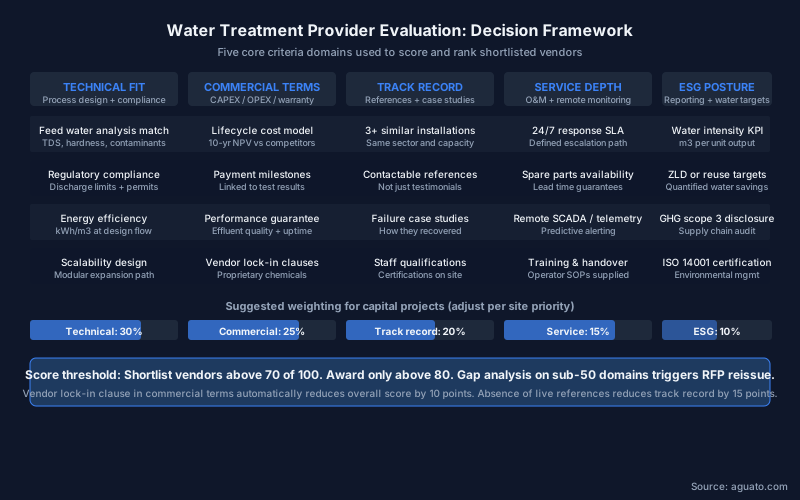
Track record is the single domain most systematically underweighted in provider evaluation, and the one that most reliably predicts post-commissioning performance. A provider with 3 documented installations in your sector, where you have spoken to the plant manager at each site, is worth more than a provider with 50 undifferentiated case studies on a website.
The minimum acceptable standard is three references from installations of comparable scale, process type, and feed water profile, all within the past five years, and all contactable by phone, not email. Testimonials provided in writing by the vendor's marketing team are not references. References exist so you can ask a specific question: "What went wrong during commissioning and how did the provider respond?"
A pattern that recurs in industrial installations is the gap between what a vendor's sales team promises and what their installation team actually delivers. That gap is most visible in references, not in proposals. Ask specifically: "Was the commissioning timeline met? Were performance guarantees achieved on first test? Were there any design modifications required post-installation?" A good provider's references answer these questions without hesitation. A weak provider's references are vague or refer you back to the vendor.
Staff qualification verification is part of this domain. Ask for CVs of the lead engineer and commissioning manager assigned to your project, not generic capability statements. Confirm that the lead engineer has direct experience with your specific technology type and feed water profile. This is not common practice in many procurement processes, but it is a legitimate and legally defensible requirement in any performance-guaranteed contract.
## Domain 4: Service depth and operational continuity
Post-commissioning service quality determines whether a well-designed system actually delivers its design performance over its operational life. A provider that disappears after the final acceptance certificate is signed is not a partner; it is a transaction counterparty, and the difference manifests in system uptime, consumable costs, and the speed of response when something fails.
The minimum service baseline for any system above $200,000 capital value is: a documented 24-hour emergency response protocol with a named on-call contact, a spare parts inventory commitment for critical consumables with a stated maximum lead time (ideally under 48 hours for membranes, filter media, and pump internals), and a remote monitoring capability with proactive alerting rather than reactive reporting.
Remote SCADA and telemetry integration is increasingly differentiating between tier-1 and tier-2 providers. A provider with a remote monitoring platform can identify membrane flux decline, chemical dosing drift, or feed pump performance degradation before it causes a water quality exceedance or unplanned shutdown. The cost of a predictive alert is essentially zero; the cost of a missed alert that results in a discharge compliance event is $10,000 to $50,000 plus regulatory scrutiny. Explore the [water marketplace](/water-marketplace) to compare providers with remote monitoring capability in your region.
Operator training and handover quality also belong in this domain. Ask what training programme is included in the contract scope, what documentation is produced (site-specific operating SOPs, not manufacturer manuals), and whether the vendor offers refresher training in year two. Sites that have invested in training see 30 to 50% fewer avoidable operating incidents in the first 24 months after commissioning compared with sites that rely solely on a manual handover.
## Domain 5: ESG posture and water stewardship reporting
ESG compliance in water management is moving from voluntary to mandatory faster than most industrial procurement processes have adapted. By 2027, the European Corporate Sustainability Reporting Directive (CSRD) requires over 50,000 companies to disclose quantitative water withdrawal and recycling metrics, and equivalent SEC climate-disclosure rules are driving similar transparency requirements in the US market.
This makes your provider's ESG posture commercially relevant, not just ethically desirable. A provider that cannot supply auditable water intensity data (m3 of water consumed per unit of product or output), chemical discharge documentation, and wastewater recycling rates creates a reporting gap that falls on you to fill at audit time.
The specific questions to ask during evaluation: Does the provider hold ISO 14001 environmental management certification? Can they provide a quantified water savings projection alongside their technical proposal, including baseline versus post-installation consumption? Do they have a defined policy on zero liquid discharge or water reuse for applicable installations? The answers to these questions are increasingly part of the ESG appendix of capital project approvals.
According to [WHO guidelines on safe use of wastewater, excreta and greywater](dofollow:https://www.who.int/publications/i/item/9241546832), water reuse programmes require provider-level documentation of treatment performance and health risk assessment, reinforcing the case for demanding quantitative ESG data during the procurement stage.
Sustainability directors negotiating multi-site contracts have additional leverage here. Providers that can demonstrate aggregate water savings across a portfolio of sites, with supporting data for annual ESG reports, command a premium in the market, but they also deliver measurable value against corporate water intensity targets that pure-CAPEX comparisons miss entirely.
## Engagement model comparison: EPC, DBO, WaaS, and chemical services
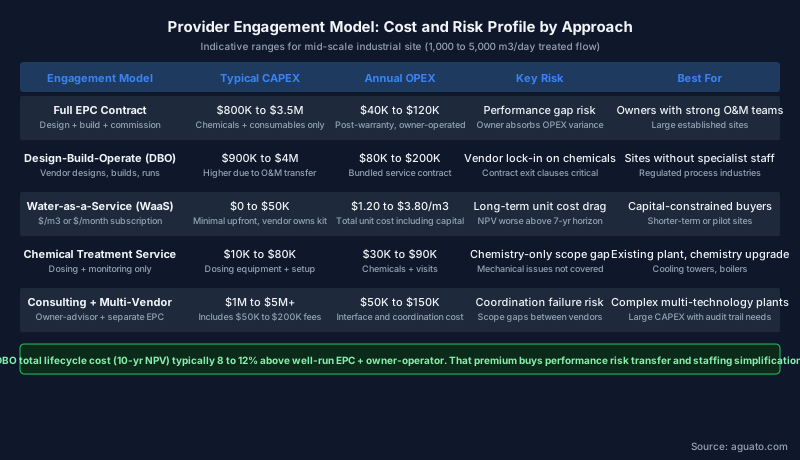
Choosing the right engagement model is as important as choosing the right technology, and the two decisions are related. The engagement model determines who absorbs operational risk, who owns the capital asset, and what your OPEX profile looks like for the next 10 years. Most organisations default to a full EPC contract without properly evaluating whether a DBO or Water-as-a-Service model would produce a better risk-adjusted outcome.
| Engagement Model | Typical CAPEX | Annual OPEX (year 3+) | Key Risk | Best For | |---|---|---|---|---| | Full EPC (design + build) | $800K to $3.5M | $40K to $120K | Performance gap absorbed by owner | Sites with strong in-house O&M | | Design-Build-Operate (DBO) | $900K to $4M | $80K to $200K bundled | Vendor lock-in on chemicals and service | Regulated industries without specialist staff | | Water-as-a-Service (WaaS) | $0 to $50K upfront | $1.20 to $3.80/m3 total unit cost | Long-term unit cost drag above 7-yr horizon | Capital-constrained or shorter-term sites | | Chemical treatment service | $10K to $80K | $30K to $90K | Chemistry-only scope leaves mechanical risk uncovered | Existing plant with chemistry upgrade need | | Consulting + multi-vendor | $1M to $5M+ | $50K to $150K coordination cost | Interface risk between vendors | Complex multi-technology plants with audit needs |
A pattern visible across industrial water projects is that buyers choose the lowest CAPEX option and then discover that the total OPEX exposure over 10 years was 2 to 3 times higher than the next most expensive CAPEX option. WaaS, for instance, typically produces a 10-year NPV that is 25 to 40% higher than a well-specified EPC at comparable performance levels because the vendor's capital recovery and margin are embedded in the per-m3 rate. The right model depends on your balance sheet constraints, your in-house staffing capability, and how long you intend to operate the site.
For sites evaluating [how to choose industrial water treatment](/resources/how-to-choose-industrial-water-treatment) approaches and matching them to the right provider type, the engagement model decision should precede the technology selection, not follow it.
## Evaluation framework and scoring methodology
A rigorous water treatment provider evaluation needs a scoring framework that is transparent, defensible at audit, and capable of surfacing the trade-offs between providers rather than just ranking them. The most common scoring error is weighting commercial terms too heavily in the opening evaluation phase and technical fit too lightly, which is the exact inversion of where post-commissioning problems originate.
A five-domain weighted scoring approach used effectively across capital projects in the $500,000 to $5M range allocates weights as follows: Technical fit (30%), Commercial terms (25%), Track record (20%), Service depth (15%), ESG posture (10%). These weightings are adjustable, but the logic behind them is that technical and commercial domains represent the largest sources of post-award risk and therefore deserve the highest analytical scrutiny.
Red-flag scoring penalties that should reduce a vendor's overall score automatically:
- Absence of a lifecycle cost model in the proposal: reduce overall score by 10 points. - References unavailable for direct contact: reduce track record score by 15 points. - Vendor lock-in clauses in chemical supply or service: reduce commercial score by 10 points. - No feed water analysis request in the proposal process: eliminate vendor from technical shortlist. - Lead engineer CV does not show direct experience with the specified technology type: reduce technical score by 5 points.
Apply a minimum threshold of 70 out of 100 for shortlisting and 80 out of 100 for award. When the highest-scoring vendor falls below 80, conduct a gap analysis before awarding, and consider a re-scoped RFP or a pilot phase rather than awarding at risk. See the [most efficient water solution evaluation](/resources/most-efficient-water-solution) framework for a technology-level view of the same decision logic applied to individual treatment train components.
## Failure scenarios: what bad vendor selection looks like in practice
Understanding where provider evaluations go wrong is as instructive as any checklist. These three scenarios are drawn from patterns common in industrial water installations and represent the cost profile of avoidable evaluation failures.
Scenario 1: Membrane RO system undersized for peak-demand TDS variation
A food processing plant procured a 1,500 m3/day RO system from the lowest-cost vendor. The feed water analysis used in the vendor's proposal was based on municipality supply data rather than on-site measurement. Seasonal TDS variation from groundwater intrusion into the supply network pushed actual feed TDS 40% above the design point during summer months. The RO system could not maintain product quality at design flux, leading to a 30% capacity reduction during peak production periods. Cost: $220,000 in lost production over one summer season plus $85,000 in membrane replacement and system rebalancing. The correct decision was a $15,000 six-month on-site feed water monitoring programme before the vendor evaluation, which would have surfaced the variation.
Scenario 2: DBO contract with proprietary chemical lock-in
A pharmaceutical site awarded a DBO contract to a major water treatment provider at a CAPEX of $1.2M, $180,000 below the next bidder. The contract included a seven-year chemical supply exclusivity clause for the vendor's proprietary scale and corrosion inhibitor formulations. By year three, the annual chemical cost was running at $145,000 against a pre-award estimate of $90,000, a 61% overrun attributable to a 35% premium on proprietary versus open-market equivalent chemistries. The correct decision was to negotiate open-market chemical supply from the outset, which would have reduced the seven-year chemical cost by $385,000 and narrowed the CAPEX gap to less than $20,000.
Scenario 3: No remote monitoring, Legionella event at an HVAC cooling tower
A logistics facility with a 200m3/day cooling tower system selected a chemical treatment service provider on lowest annual cost at $28,000 per year. The contract included quarterly site visits but no remote monitoring. A dosing pump failure in week nine of a quarter went undetected. Water age in the tower increased, biocide residual dropped to zero, and a Legionella event was confirmed during a routine audit. Remediation, deep clean, and HSE reporting cost $95,000. The annual cost difference between the selected provider and one with weekly remote monitoring capability was $9,000. The correct decision was the higher-cost provider.
## Using decision intelligence to sharpen the shortlist
One of the most time-consuming stages of a water treatment provider evaluation is translating your site-specific feed water data, capacity requirements, and budget constraints into a shortlist of genuinely appropriate providers. Most procurement teams default to a broad market approach, issue an RFP to 8 to 12 vendors, and then spend weeks scoring proposals that are largely incompatible with the actual site requirements.
Nepti models your water matrix and produces a ranked comparison of technology options with cost projections, allowing you to enter the provider evaluation stage with a technically specified brief rather than a generic performance specification. That shift reduces the number of non-compliant proposals you receive, compresses the evaluation timeline, and gives you quantified trade-off data to bring into provider negotiations. See how [Nepti decision intelligence for water treatment](/resources/nepti-decision-intelligence-water-treatment) applies this approach across industrial and municipal treatment train selection.
The practical effect on provider evaluation is that vendors respond to a more precise brief with more precise proposals. You stop comparing a $900,000 RO-based proposal against a $600,000 softening proposal that was never appropriate for your feed water profile. Providers that cannot meet the technically specified brief self-select out of the process, reducing your evaluation workload and improving the signal quality of the shortlist you do receive.
For complex capital projects where the [consulting services](/consulting-services) model is appropriate, decision intelligence tools also give the consulting engineer a sharper starting point for scope definition, reducing the risk of an under-specified brief being the root cause of a poorly performing procurement.
According to [ISO 24511 guidance on activities relating to drinking water and wastewater services](dofollow:https://www.iso.org/standard/42202.html), systematic evaluation of service provider capability against defined service requirements is a best-practice standard for water utility and industrial procurement alike, with particular emphasis on lifecycle cost assessment and risk allocation clarity.
## FAQ
### What does a water treatment provider evaluation checklist cover?
A complete water treatment provider evaluation checklist covers five domains: technical fit, commercial terms, track record, service depth, and ESG posture. Each domain maps to a specific set of questions and data requests that the provider must answer before shortlisting. Technical fit requires feed water analysis and a matched process design; commercial terms require a 10-year lifecycle cost model; track record requires three contactable references from comparable installations; service depth requires a defined 24-hour response protocol; and ESG posture requires quantitative water intensity and discharge reporting.
### How do I compare water treatment providers on total cost of ownership?
Ask every shortlisted provider to submit a 10-year total cost of ownership model broken down by capital, chemicals, energy, membrane replacement, and scheduled maintenance. Discount future cash flows at your organisation's cost of capital (typically 6 to 10% for industrial capital projects) to produce a net present value for each proposal. Lowest NPV, not lowest CAPEX, should drive the award decision. Providers that refuse to provide a lifecycle cost model are either unable to or actively concealing a high OPEX profile.
### What are the biggest red flags when evaluating a water treatment vendor?
The four highest-risk red flags are: proposals submitted without requesting your feed water data; references unavailable for direct phone contact; vendor lock-in clauses for proprietary chemical supply; and no performance guarantee tied to actual effluent quality. Each of these signals a pattern associated with post-commissioning underperformance. A fifth red flag specific to DBO and chemical service contracts is a payment structure that front-loads vendor cash recovery before performance is demonstrated.
### How many references should I request from a water treatment provider?
Request a minimum of three references from installations of comparable scale, sector, and feed water profile, all completed within the past five years, and all contactable directly by phone. Written testimonials supplied by the vendor do not qualify as references. Ask each reference three specific questions: whether commissioning was completed on schedule, whether performance guarantees were met on first test, and what went wrong and how the provider responded. A credible provider's references answer all three without hesitation.
### What is the difference between EPC and DBO contracts in water treatment?
An EPC (Engineering, Procurement, Construction) contract transfers design and build risk to the contractor but returns operational risk to the owner once the system is commissioned and handed over. A DBO (Design-Build-Operate) contract extends the vendor's responsibility into ongoing operations, transferring a larger share of operational risk to the provider in exchange for a higher bundled annual cost. DBO total lifecycle cost typically runs 8 to 12% above a well-run EPC plus owner-operated arrangement over a 10-year horizon, but it eliminates the need for specialist in-house water treatment staff.
### What ESG data should I request from a water treatment provider?
Request three specific data points: water intensity expressed as m3 of water consumed per unit of product output at comparable reference installations; chemical discharge audit data showing effluent compliance against permit limits; and a quantified water savings projection for your site compared with a no-treatment or pre-existing baseline. If the provider holds ISO 14001 certification, request the most recent certificate and surveillance audit summary. For multi-site corporate buyers, also ask whether the provider can aggregate performance data across sites for annual ESG reporting purposes.
### How does a decision intelligence platform help in provider evaluation?
A decision intelligence platform like Nepti models your specific feed water matrix and process requirements against the full technology landscape, producing a ranked list of appropriate treatment approaches with cost projections before you issue an RFP. This converts a generic market consultation into a technically specified brief, which reduces the number of non-compliant proposals received, compresses the evaluation timeline, and provides quantified trade-off data for provider negotiations. The result is a provider shortlist defined by technical fit rather than by marketing reach.