Investors now price water risk into cost of capital. Get the four frameworks, the eight core metrics, and the data-collection architecture that turns operational data into defensible ESG disclosures.
Water risk is no longer a sustainability talking point sitting in an appendix. Institutional investors managing over $130 trillion in assets now use water-stress exposure as a direct input into cost-of-capital calculations, and lenders in water-intensive sectors are tiering loan covenants to CDP Water scores. For any industrial operation withdrawing more than 100,000 cubic metres per year, failure to produce verifiable esg water reporting metrics is now a financing risk, not a communications gap. One poorly disclosed water incident at a single site wiped $400 million from a major food processor's market capitalisation in 2022, before any regulatory fine landed.
The challenge is not conceptual. Most sustainability teams understand that GRI 303, CDP Water, SASB, and TCFD all want water data. The challenge is operational: the data needed to answer an investor's question about stress-area withdrawal and physical-risk monetisation lives in SCADA systems, utility invoices, and lab reports that were never designed to talk to each other. Connecting them requires an architecture decision, not a spreadsheet exercise. And the architecture decision has a cost that procurement needs to approve.
This guide covers the four investor-grade frameworks and which audiences they serve, the eight core metrics every industrial facility needs to produce, the data collection and aggregation pipeline that converts meter readings into defensible disclosures, the failure modes that produce material restatements, and a threshold-based decision framework for when to build, buy, or contract your water data infrastructure. It is written for the sustainability director building the reporting programme, the plant manager who has to generate the underlying data, and the procurement lead approving the monitoring investment.
## The decision in brief
- Standardise on GRI 303 plus CDP Water and reach a B or higher. If you standardise your water data collection around GRI 303 plus CDP Water and achieve a score of B or higher, you access green financing instruments at spreads 15 to 40 basis points tighter than unrated industrial peers. - Set $300,000 to $800,000 a year against a one-time $80,000 to $250,000. On a $200 million credit facility, the tighter spread saves $300,000 to $800,000 per year in interest cost against a one-time programme cost of $80,000 to $250,000. - The next CDP score is not the biggest cost. It is the water operational risk crystallising at a stressed-basin site while the company holds no documented mitigation plan, a loss that is not insurable under a standard property policy when the cause is regulatory curtailment rather than equipment failure.
A single 30-day production curtailment at a water-intensive facility typically costs $4 million to $25 million in lost gross margin plus remediation costs.
If you standardise your water data collection around GRI 303 plus CDP Water and achieve a score of B or higher, you access green financing instruments at spreads 15 to 40 basis points tighter than unrated industrial peers. On a $200 million credit facility, that saves $300,000 to $800,000 per year in interest cost against a one-time programme cost of $80,000 to $250,000. The biggest cost of doing nothing is not the next CDP score. It is the [water operational risk](/resources/water-operational-risk-fluid-management) crystallising at a stressed-basin site while the company holds no documented mitigation plan: a single 30-day production curtailment at a water-intensive facility typically costs $4 million to $25 million in lost gross margin plus remediation costs, none of which is insurable under a standard property policy when the cause is regulatory curtailment rather than equipment failure.
## Why water risk is now a balance-sheet issue
Water risk translates into three distinct financial exposures that investors can model and price. Physical risk is the operational disruption cost when a site loses access to adequate supply or faces regulatory curtailment during a drought. Regulatory risk is the compliance cost when discharge limits tighten or abstraction licences shrink. Reputational risk is the brand and licensing cost when a facility's water use becomes a public controversy in a water-stressed community. All three are quantifiable, all three are growing, and all three are now expected in standard investor disclosures.
The numbers are large enough to move funding decisions. [CDP's 2023 Global Water Report](dofollow:https://www.cdp.net/en/water) found that the aggregate financial risk disclosed by responding companies from water-related issues was $301 billion, against only $55 billion in projected mitigation costs. Investors reading those figures see a 5-to-1 return on pressure to improve disclosure and mitigation. At the asset level, a semiconductor fab in a water-stressed basin faces potential shutdown costs of $150,000 to $600,000 per day of unplanned curtailment. A food and beverage plant using 500,000 cubic metres per year pays $0.50 to $2.50 per cubic metre on average for water supply and treatment; a 30% tariff increase in a stressed municipality adds $75,000 to $375,000 per year to operating costs with no offset available in the budget cycle.
The other side of the equation matters too. Companies with CDP Water scores of B or higher consistently access green financing instruments at spreads 15 to 40 basis points tighter than unrated peers. On a $100 million revolving credit facility, a 30-basis-point improvement saves $300,000 per year in interest cost. The cost of the reporting infrastructure that earns that score is typically $80,000 to $250,000 one-time and $20,000 to $60,000 per year to maintain. The payback arithmetic is straightforward.
[cta:nepti]
## The four esg water reporting frameworks and who reads them
Framework selection is not a purity contest. Each framework was built to answer a different question for a different reader, and the most effective disclosure programmes stack two complementary frameworks rather than trying to satisfy all four at equal depth.
GRI 303 (Water and Effluents) is the operational disclosure standard. It requires total water withdrawal by source, total water consumption, water recycled and reused as a percentage of total withdrawal, and quality parameters for discharge. The primary reader is NGOs, regulators, and community stakeholders. Investors use it for comparability but rarely build financial models from it directly. If your organisation does one thing, GRI 303 is the baseline.
CDP Water Security is the investor-grade standard. It requires organisations to map water risks by basin, monetise the financial exposure of those risks, set and track reduction targets, and disclose governance structures including board-level oversight. A CDP Water score runs from A (leadership) to D- (disclosure failure). Investors use CDP scores as a screening tool; a score below C is increasingly a flag in ESG portfolio screening tools. The questionnaire is long, roughly 120 questions, but most sections are answered once and updated annually.
SASB (Sustainability Accounting Standards Board) produces sector-specific standards with water metrics calibrated to what is financially material in each industry. For food processing, that means water intensity per tonne of product. For semiconductors, it means water recycled as a percentage of total use. SASB metrics appear in annual reports and 10-K filings and are the format equity analysts use to build sector comparisons. SASB alone is not sufficient for CDP, but SASB-structured data feeds directly into CDP responses.
TCFD / ISSB (IFRS S2) frames water as a climate-physical risk. The key deliverable is a scenario analysis showing how water availability changes under 1.5C and 2C warming scenarios and what that means for operating costs and business continuity at each facility location. ISSB S2 is now mandatory in over 20 jurisdictions and will become the dominant corporate reporting standard by 2027 in most developed markets.
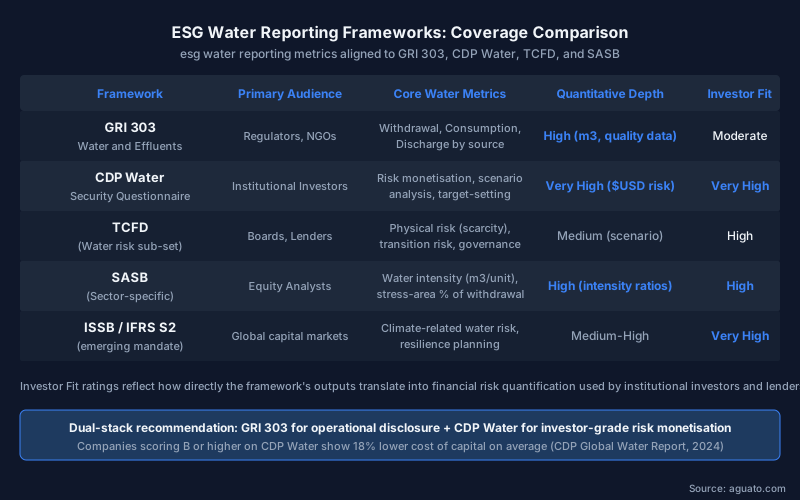
The practical recommendation: build GRI 303 operational data first because it populates every other framework. Layer CDP Water responses on top for investor-grade risk monetisation. Use SASB structures in your annual report for analyst readability. TCFD scenario analysis comes last and requires the basin-level withdrawal data that GRI 303 produces.
| Framework | Primary Reader | Core Water Metrics | Cost to Implement | Risk of Non-Disclosure | Best For | |---|---|---|---|---|---| | GRI 303 | Regulators, NGOs | Withdrawal, consumption, discharge by source | $15,000 to $40,000/year | Reputational, supply chain | All organisations, mandatory baseline | | CDP Water | Institutional investors | Risk monetisation ($USD), scenario analysis, targets | $40,000 to $120,000/year | Financing exclusion, score penalty | Water-intensive sectors, listed companies | | SASB (sector) | Equity analysts | Intensity ratios (m3/unit output), stress-area % | $10,000 to $30,000/year | Analyst comparability gap | Annual report integration, 10-K filers | | ISSB / IFRS S2 | Boards, lenders | Physical risk scenarios, governance structure | $30,000 to $80,000/year (incremental) | Regulatory penalty (2027+) | EU, UK, Australia mandated entities |
A pattern that recurs in industrial disclosure programmes: companies invest heavily in GRI 303 compliance and then submit a CDP questionnaire that scores C- because the GRI data was collected without the basin-level disaggregation CDP requires. The fix is not expensive, but it requires the data architecture decision before the first annual collection cycle, not after.
## The eight core water metrics every industrial facility must track
Eight metrics cover the vast majority of investor, regulator, and standard-body requests. Build measurement and reporting systems around these eight before adding bespoke indicators.
Metric 1: Total water withdrawal (m3/year) by source. This means municipal supply, groundwater, surface water, and rainwater tracked separately. A mixed-source facility that reports only "total municipal" is already non-compliant with GRI 303 and will receive CDP score deductions. Source disaggregation matters because each source carries different stress-area risk and different regulatory exposure.
Metric 2: Total water consumption (m3/year). Consumption is withdrawal minus discharge. For many industrial processes, the gap is significant: a cooling tower consuming 5,000 m3/day may discharge only 1,200 m3/day, with the difference lost to evaporation. Investors care about consumption, not just withdrawal, because consumed water is gone from the watershed permanently.
Metric 3: Water intensity (m3 per unit of production). This is the normalisation metric that makes year-on-year comparison meaningful and enables cross-site benchmarking. Define the production unit consistently: tonnes of product for manufacturers, revenue for service businesses, megawatt-hours for power generators. Intensity reduction is the KPI investors use to assess management quality, independent of production volume changes.
Metric 4: Percentage of withdrawal from water-stressed areas. Use WRI Aqueduct or a comparable basin-stress database to classify each facility's primary water source. If more than 25% of your total withdrawal comes from high or extremely high stress basins, CDP will assign you a higher risk weight and investors will model curtailment scenarios. This metric drives more investor questions than any other single data point.
Metric 5: Water recycled and reused as a percentage of total use. A recycling rate below 10% at a water-intensive site signals underinvestment in [industrial water reuse and recycling](/resources/industrial-water-reuse-recycling) infrastructure and is increasingly a flag in screening tools. Best-practice facilities in semiconductor and food processing achieve 30 to 60% reuse rates through closed-loop systems and process water recovery.
Metric 6: Discharge volume and quality parameters. Report total discharge volume plus the key quality parameters: total suspended solids, chemical oxygen demand, pH, and any sector-specific parameters (nutrients for food processing, heavy metals for mining). Non-compliance with discharge consent conditions generates a regulatory breach record that must be disclosed separately.
Metric 7: Number and volume of significant spills or exceedances. Any event where discharge parameters exceeded consent limits by more than 20% must be disclosed. Track frequency, volume, and the financial consequence (regulatory fine plus remediation cost). A single significant spill can cost $50,000 to $500,000 and will generate a CDP mandatory question the following year.
Metric 8: Reduction target and progress delta. State a specific, time-bound target for intensity reduction (e.g. "25% reduction in water intensity per tonne of output by 2030 against a 2020 baseline"). Report annual progress. Investors use target credibility and progress tracking to differentiate companies with genuine water stewardship programmes from those with aspirational statements. Targets without baselines score zero on CDP.
For the most accurate intensity baseline, you need operational data from your treatment systems as well as your production records. The right answer depends on your process water quality, your reuse potential, and your site-specific constraints. [Post your project](/post-project) and qualified water treatment and monitoring specialists will scope the measurement infrastructure against your actual production data.
## Building the data collection pipeline: from meter to investor
The biggest execution gap in water reporting is not framework knowledge. It is the absence of a reliable data pipeline from operational measurement to formatted disclosure. Companies that discover this gap in October, when the CDP questionnaire is due in November, produce poor-quality responses or skip questions. Both outcomes hurt the score.
The pipeline has four stages: data sources, aggregation and normalisation, KPI calculation, and disclosure formatting. Most industrial facilities have adequate data sources already in place, SCADA systems, utility meters, and lab reports, but the aggregation and normalisation stage is typically manual, inconsistent, and person-dependent.
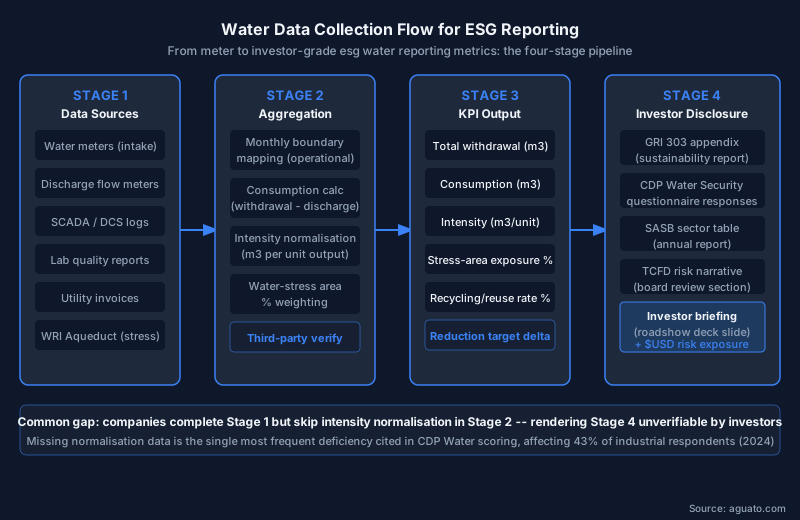
Stage 1 data sources include: utility meter readings (intake), effluent flow meters (discharge), SCADA or DCS logs for process water volumes, laboratory analysis reports for quality parameters, utility invoices as a cross-check, and WRI Aqueduct classification for each facility's primary water source. If a facility lacks sub-metered data for individual process streams, the first investment priority is sub-metering at the process boundary rather than software.
Stage 2 aggregation is where most programmes break down. It requires boundary mapping (which processes and buildings are within the operational boundary), consumption calculation (withdrawal minus discharge, accounting for evaporative losses), intensity normalisation (total consumption divided by production volume for each reporting period), and stress-area weighting (what percentage of each source draws from a high-stress basin). Manual spreadsheet aggregation works for single sites with simple water balances. Multi-site operations with shared infrastructure or multiple water sources need automated consolidation.
Stage 3 KPI calculation produces the eight metrics above. The calculation methodology must be documented, consistent year-over-year, and defensible in a third-party assurance review. Material changes to methodology require a restatement and disclosure note.
Stage 4 disclosure formatting maps calculated KPIs to the specific question references in each framework. GRI 303-3 asks for withdrawal by source in a specific format. CDP W8.1 asks for the same data but with additional basin and stress classification columns. Building the mapping table once saves weeks of reformatting each reporting cycle.
Third-party assurance of water data is no longer optional for companies with a CDP score ambition above C. Assurance costs $15,000 to $50,000 per year depending on site count and scope, and it dramatically reduces the risk of a restatement caused by a methodology error found by an investor's diligence team. The value of assurance is not the clean opinion. It is the errors it catches before publication.
## Water stress mapping and exposure quantification
Water stress mapping converts an abstract basin classification into a financial exposure number that belongs in a CFO briefing. Without monetisation, water stress is a sustainability concern. With monetisation, it is a balance sheet line item that CFOs and treasurers will actually manage.
The standard tool for basin-level stress assessment is [WRI Aqueduct](dofollow:https://www.wri.org/aqueduct), a publicly available geospatial database that scores water stress, depletion risk, and regulatory risk at the sub-basin level. Run each facility's GPS coordinates through Aqueduct. Sites in the "high" (score 3 to 4) or "extremely high" (score 4 to 5) stress bands carry materially different risk profiles than sites in lower-stress basins.
To monetise stress exposure, use the following framework. Take total annual withdrawal from a high-stress basin and apply three scenarios. Scenario A (cost increase): municipal tariff increases 15% in response to scarcity, model the annual OPEX impact. For a facility withdrawing 200,000 m3/year at $0.80/m3, a 15% increase costs $24,000/year. Scenario B (volume curtailment): abstraction licence reduces by 20%, model the production volume impact at your gross margin per unit. Scenario C (supply disruption): calculate the cost of sourcing alternative supply or installing onsite storage to bridge a 30-day disruption. The CDP questionnaire asks for exactly this structure in sections W2 and W3, and investors use it to model worst-case exposure.
The [most efficient water solution](/resources/most-efficient-water-solution) for a stressed-basin facility is almost always some combination of recirculation upgrades, process optimisation to cut consumption per unit, and localised [industrial rainwater harvesting](/resources/industrial-rainwater-harvesting-systems) or condensate recovery. The case for investing in [industrial water reuse and recycling](/resources/industrial-water-reuse-recycling) is strengthened directly by stress-area exposure because the avoided-withdrawal cost in a stressed basin is higher than in an unstressed one.
Understanding [water operational risk and fluid management](/resources/water-operational-risk-fluid-management) at a system level is the prerequisite for credible stress-exposure quantification. Investors reject stress disclosures that list basin classifications without linking them to operational continuity plans.
## Setting credible reduction targets investors will accept
Investors have learned to distinguish science-based water targets from marketing copy. A target that says "we aim to improve our water efficiency over time" scores zero. A target that says "we will reduce water intensity (m3/tonne of output) by 30% by 2030 against a 2019 baseline, with interim milestones of 10% by 2025 and 20% by 2027, verified annually by a third-party auditor" scores in the B range on CDP before any other data is submitted.
The Science Based Targets Network (SBTN) water targets methodology, published in 2023, is the emerging standard for setting location-specific water targets that align with basin-level sustainability thresholds rather than arbitrary corporate ambition levels. An SBTN-aligned target demonstrates that you have assessed whether the basin can sustain your current withdrawal level under a stressed future scenario. That is a materially different claim from a percentage reduction target set against an internal baseline.
For most industrial operations, the realistic reduction levers are in this order of impact and cost-effectiveness. First, optimise cycles of concentration in cooling systems (free, reduces evaporative consumption by 10 to 25%). Second, reclaim and reuse process condensate (capital cost $50,000 to $300,000, payback 1 to 3 years at current water prices in stressed regions). Third, upgrade to a [most efficient water solution](/resources/most-efficient-water-solution) at the point of highest consumption (capital cost $200,000 to $2 million, 5 to 15-year payback depending on source water cost and treatment requirements). Fourth, substitute freshwater with treated effluent or reclaimed water for non-potable process uses (requires quality characterisation, treatment investment, and potentially regulatory approval).
Document each lever with a project name, an estimated m3/year saving, a capital cost, a commissioning date, and the contribution to the intensity target. This project register becomes the backbone of your CDP W4 section (targets and initiatives) and is precisely what an investor wants to see: a credible plan with accountable steps, not an aspiration.
## Failure modes: restatements, scoring penalties, and financing consequences
Three failure modes generate material financial consequences, not just reputational embarrassment.
Failure mode 1: Boundary mismatch. A company discloses water data for its owned and operated facilities but excludes significant outsourced processing operations that use substantial water on its behalf. An investor's diligence team identifies the omission from facility permit data. The company restates two years of disclosures, receives a CDP score downgrade from C to D, and loses inclusion in two sustainability index funds. The annual index-related capital withdrawal in a mid-cap company can be $15 million to $80 million. Decision: boundary mapping must be done before any data collection begins, not after.
Failure mode 2: Missing normalisation. An operations-focused disclosure reports absolute water volumes but not intensity ratios. A year of production expansion increases absolute withdrawal by 18% while intensity per unit improved by 8%. Without intensity data, institutional investors see a headline 18% increase and model it as deterioration. The stock experiences an unexplained 3% sector-relative underperformance in the quarter the sustainability report is published. Decision: always report both absolute and intensity metrics, always.
Failure mode 3: Unverified quality data. A company reports discharge compliance in its GRI 303 appendix. An NGO submits a regulatory data request and discovers three consent exceedances in the preceding two years that were not disclosed. The gap between internal reporting and actual consent records becomes a governance story in a financial newspaper. Decision: reconcile disclosed compliance performance against the regulatory permit register before each publication cycle.
A fourth mode is worth naming even though its consequences are slower. Companies that do not disclose esg water reporting metrics at all are progressively excluded from ESG-screened funds, green bond eligibility lists, and supply chain approved-vendor lists for large buying organisations with Scope 3 water targets. The [consulting services](/consulting-services) market for water ESG disclosure has grown at over 25% annually since 2021 precisely because industrial companies discovered this exclusion risk later than their peers.
## Technology investment decision framework
The right monitoring and reporting infrastructure depends on three variables: number of sites, complexity of water balance (number of sources and discharge points), and target disclosure depth (GRI-only versus CDP-A ambition).
If TDS or flow complexity is low AND the facility count is 1 to 3: manual sub-metering with quarterly data consolidation in a structured spreadsheet is sufficient for GRI 303 compliance at a total annual cost of $8,000 to $25,000 including staff time. CDP responses at this scale can be built manually.
If facility count is 4 to 15 OR stress-area withdrawal exceeds 30%: invest in an automated data aggregation platform. Water ESG software platforms (Salesforce Sustainability Cloud, Enablon, Intelex, or dedicated water platforms) consolidate SCADA and meter data automatically, apply the boundary and intensity calculations, and output pre-formatted responses for GRI, CDP, and SASB. Platform costs range from $30,000 to $120,000 per year in SaaS licensing, and reduce annual staff time by 60 to 75% at multi-site organisations.
If facility count exceeds 15 OR you are targeting CDP A-List OR a lender requires third-party verified water data: engage a specialist [consulting-services](/consulting-services) firm to design and implement the data architecture. The one-time design and implementation cost is typically $80,000 to $200,000; the ongoing assurance and reporting cost is $40,000 to $100,000 per year. At this scale, the cost of a restatement or a CDP score downgrade typically exceeds five to ten years of consulting fees in financing cost impact.
Decision framework summary. If annual withdrawal is below 50,000 m3 and site count is below 4: manual GRI 303 is adequate. If withdrawal is 50,000 to 500,000 m3 or site count is 4 to 15: automated platform justified. If withdrawal exceeds 500,000 m3 or site count exceeds 15 or CDP A-List is the target: specialist programme design plus third-party assurance is required.
[Desalination energy consumption](/resources/desalination-energy-consumption) decisions at water-stressed sites benefit from this same framework. A facility investing in desalination to reduce stress-area withdrawal exposure should capture the avoided-withdrawal volume as a demonstrable contribution to its water intensity target and its CDP W4 disclosure.
## Real-world examples: three industrial disclosure programmes
Example 1: Food and beverage processor, 12 sites, EU and US. Industry: Food processing. Problem: CDP score of D+ for three consecutive years due to missing basin-level data and no monetised risk disclosure. Solution: Implemented an automated water data platform at all 12 sites, ran WRI Aqueduct classification for every site, built a monetised risk model for the three highest-stress locations, and commissioned third-party assurance. Why it worked: the basin classification revealed that four sites drew primarily from high-stress basins. The CEO used the monetised exposure ($2.3 million in modelled annual risk) to justify a $1.8 million capital programme for process water recycling. Why the earlier approach failed: the company had GRI 303 data but it was aggregated at the country level, not the basin level, making CDP W2 unanswerable. Trade-off: platform plus assurance costs $85,000/year. The company achieved CDP B in year one of the new programme and reduced its green bond coupon by 22 basis points on a EUR 150 million issuance.
Example 2: Semiconductor fabrication, single large site, Taiwan. Industry: Electronics manufacturing. Problem: local water authority announced a 15% allocation reduction for the coming dry season, triggering an investor question about production volume impact at the quarterly earnings call. Solution: the facility had invested in a high-purity [industrial water reuse and recycling](/resources/industrial-water-reuse-recycling) circuit the previous year, achieving 42% internal reuse. The disclosed reuse rate was what allowed the investor relations team to respond with a specific number ("our net withdrawal per wafer start declined 18% versus prior year; the 15% allocation cut will reduce production output by an estimated 3 to 5% for one quarter"). Why it worked: the SCADA data and sub-metering were already in place. The disclosure team had pre-built the intensity model, so the calculation was available in 24 hours of the allocation announcement. Trade-off: the reuse investment cost $4.2 million; the avoided production loss in the curtailment quarter was estimated at $11 million in gross margin.
Example 3: Industrial chemicals, 3 sites, UK. Industry: Specialty chemicals. Problem: a large B2B buyer added a Scope 3 water target clause to its vendor qualification requirements, requiring suppliers to disclose water intensity per tonne of product and demonstrate a year-on-year improvement trend. The company had never formally tracked intensity. Solution: the sustainability director engaged a water engineering specialist to install sub-metering at all three sites, map the water balance for each process line, and calculate a two-year intensity baseline from existing SCADA records. This required specialist interpretation of treatment chemistry and process water flows. The baseline calculation alone required 6 to 8 weeks of specialist time at a cost of roughly $35,000. Why it worked: the baseline was defensible because it was built from metered data verified against utility invoices, not from estimates. The buyer accepted the disclosure and retained the company on the approved-vendor list. Trade-off: the alternative was losing a customer worth $1.8 million/year in revenue.
The right data collection approach depends on your facility's specific water balance, your treatment infrastructure, and your target framework depth. [Post your project](/post-project) so water monitoring and ESG reporting specialists can assess your current infrastructure and scope the measurement investment against your actual reporting requirements.
## FAQ
### What are esg water reporting metrics and which frameworks require them?
ESG water reporting metrics are quantified operational measurements covering water withdrawal, consumption, intensity, discharge quality, and water-stress exposure, reported under frameworks including GRI 303, CDP Water, SASB, and ISSB/IFRS S2. GRI 303 requires withdrawal by source and discharge quality. CDP Water adds basin-level monetised risk and reduction targets. SASB requires sector-specific intensity ratios. ISSB S2 requires scenario-based physical risk analysis. A credible programme produces all eight core metrics described in this article and maps them to whichever frameworks your investors and lenders require.
### How do I calculate water intensity for ESG reporting?
Water intensity is total water consumption (in cubic metres) divided by a consistent unit of production output, such as tonnes of product, revenue, or megawatt-hours generated. Calculate consumption as total withdrawal minus total discharge, accounting for evaporative losses separately where possible. Define the production unit before the first reporting period and keep it consistent. If the production mix changes significantly, provide a restated intensity series using the new unit alongside the original series. SASB standards specify the production unit for each sector, so check the relevant SASB standard before setting your own.
### What does a CDP Water score mean and how is it calculated?
CDP Water scores run from A (leadership) to D- (non-disclosure), and the score reflects both the completeness of your water disclosure and the quality of your water management programme. A-List status requires evidence of best-practice risk monetisation, verified reduction targets aligned to basin thresholds, and board-level governance of water risk. The most common reason industrial companies score C rather than B is missing basin-level withdrawal disaggregation (needed for W1) and absent monetised risk scenarios (needed for W2). Third-party assurance of water data is required for A-List.
### Which water-stressed basin tool should I use for ESG reporting?
WRI Aqueduct is the standard reference tool for basin-level water stress classification and is accepted by CDP, SASB, and most institutional investors. Run each facility's GPS coordinates through Aqueduct's water risk atlas to receive a baseline water stress score (0 to 5), interannual variability score, and seasonal variability score. Sites scoring 3 to 4 (high) or above 4 (extremely high) require stress-specific disclosures and monetised risk scenarios under CDP Water sections W2 and W3. The [WRI Aqueduct tool](dofollow:https://www.wri.org/aqueduct) is publicly available and free to use.
### How much does it cost to build a water ESG reporting programme?
For a single-site operation targeting GRI 303 compliance, total annual cost including sub-metering, data collection, and report preparation runs $15,000 to $40,000. For a multi-site operation (4 to 15 sites) targeting CDP B, the cost rises to $50,000 to $150,000 per year including platform licensing, staff time, and third-party assurance. For organisations with more than 15 sites or targeting CDP A-List, expect $100,000 to $300,000 per year in full programme cost. The one-time cost of programme design and data infrastructure build typically adds $80,000 to $250,000 in the first year. The most common budget mistake is underestimating the cost of baseline data collection at sites with inadequate sub-metering.
### What is the difference between water withdrawal and water consumption in ESG terms?
Water withdrawal is the total volume abstracted from any source including municipal supply, groundwater, and surface water. Water consumption is the portion that is not returned to any water body because it was evaporated, incorporated into a product, or disposed of through a non-return route. For investors, consumption is the more material metric because consumed water is permanently removed from the watershed. A cooling-tower-heavy operation may withdraw 10 million m3/year but consume 6 to 7 million m3 of that through evaporation. The gap matters to basin-level sustainability assessments and to facilities pursuing [desalination-based](/resources/desalination-energy-consumption) supply augmentation where consumed-water cost is the financial driver.
### When is third-party assurance of water data required?
Third-party assurance is required for CDP A-List scoring, for inclusion in most green bond frameworks, and increasingly for supply chain qualification by large industrial buyers with Scope 3 water commitments. It is also required when water data is included in a regulated financial report (annual report or 10-K) in jurisdictions where ESG disclosures in financial reports carry the same audit liability as financial data. For companies that rely on unaudited water data in investor communications, the risk is that a material error in disclosed metrics generates a securities liability exposure if it affects investment decisions. Engage [engineering and consulting specialists](/consulting-services) for assurance scoping before your first CDP submission at scale.