Modern SWRO with energy recovery runs 2.5 to 4 kWh/m3; legacy thermal hits 22. Energy is 30 to 50% of water cost. Where the kWh go, and how to cut the bill.
Energy is the single largest controllable cost in desalination. On a seawater reverse-osmosis plant it accounts for 30 to 50% of the cost of every cubic metre of water produced, and on legacy thermal plants it can exceed 60%. A 50,000 m3/day seawater plant running at 3.5 kWh/m3 instead of 5.0 kWh/m3 saves roughly USD 2.4 million a year in electricity at USD 0.12/kWh. That gap is not exotic engineering. It is the difference between a modern energy-recovery configuration and one specified five years too late.
The number that matters is specific energy consumption, the kilowatt-hours required per cubic metre of permeate. It is the KPI that decides whether a desalination project clears its business case, and it is the first number a procurement team should demand from any technology proposal, normalised to the same feed-water salinity and recovery rate. A vendor quoting "best in class energy" without stating the feed TDS and the recovery assumption is quoting a number you cannot use.
This guide covers what specific energy consumption actually measures, the benchmark ranges by technology, where the kilowatt-hours go inside a seawater RO train, the levers that cut the bill (energy recovery, membrane selection, feed salinity, recovery rate, renewables), the failure modes that inflate energy cost, and a threshold-based framework for deciding which configuration fits your site.
## The decision in brief
- Specify energy recovery. A modern energy-recovery configuration on a 50,000 m3/day seawater plant, instead of a legacy no-recovery design, saves USD 35 million to 55 million in electricity over the plant's 20-year life, the largest single controllable line item in the entire project. - Add variable-speed pumps and low-energy membranes. Add right-sized variable-speed pumps and low-energy membranes to the energy-recovery configuration and the lifecycle saving over the plant's 20-year life climbs past USD 60 million. - Do not sign on a headline membrane-only SEC. The biggest cost of doing nothing is letting a vendor quote a headline membrane-only SEC and signing a contract that excludes 30% of the real energy bill.
You then discover at commissioning that the delivered cost per cubic metre is 30 to 40% above the business-case assumption, a gap that no operational tuning can close once the plant is built.
## What specific energy consumption actually measures
Specific energy consumption (SEC) is the total electrical (and, for thermal plants, thermal) energy a desalination process consumes per cubic metre of product water. It is expressed in kWh/m3, and it is the only honest way to compare two plants of different size, technology, or vintage. A 200,000 m3/day plant and a 5,000 m3/day plant are comparable on SEC even though their total power draw differs by 40x.
The figure is governed by physics before it is governed by engineering. The theoretical minimum energy to separate fresh water from seawater at 35,000 mg/L TDS and 50% recovery is about 1.06 kWh/m3, set by the thermodynamics of osmotic pressure. No process beats that floor. Real seawater RO plants run at 2.5 to 4 times the theoretical minimum because pumps, membranes, and pre-treatment all introduce losses. The gap between the thermodynamic floor and your actual SEC is the entire engineering problem.
Two variables move SEC more than any vendor feature:
- Feed-water salinity. Osmotic pressure rises with TDS, so the high-pressure pump has to work harder against saltier feed. Brackish water at 3,000 mg/L needs roughly 1 to 2.5 kWh/m3; open-ocean seawater at 35,000 mg/L needs 2.5 to 4; the hypersaline Arabian Gulf at 45,000 mg/L pushes 4 to 5. Salinity is not a knob you turn, it is a site condition you inherit, and it sets the baseline every other lever works against. - Recovery rate. The fraction of feed that becomes product. Push recovery higher and you concentrate the reject brine, raising its osmotic pressure and the pressure the pump must overcome. There is an energy-optimal recovery for every feed, and chasing maximum recovery to cut intake cost frequently raises energy cost faster than it saves.
The U.S. Department of Energy treats desalination energy intensity as a national efficiency target precisely because the lever is so large. Per the [U.S. Department of Energy's water-energy nexus analysis](dofollow:https://www.energy.gov/eere/water/water-energy-nexus), the energy embedded in water supply and treatment is one of the most under-managed industrial loads in the economy, and desalination sits at the high-intensity end of that curve.
A procurement team should treat any SEC quote as meaningless until three numbers are attached to it: feed TDS, recovery rate, and whether the figure includes intake and post-treatment or only the RO membrane block. Vendors who quote "membrane-only" SEC are excluding 25 to 40% of the real energy bill.
## Energy benchmarks by desalination technology
The technology choice sets the energy ceiling before site optimisation begins. The spread is enormous: modern seawater RO with energy recovery runs at one-fifth the energy of a legacy multi-stage flash thermal plant. The benchmark table below normalises the major routes at typical industrial duty so the comparison is on equal footing.
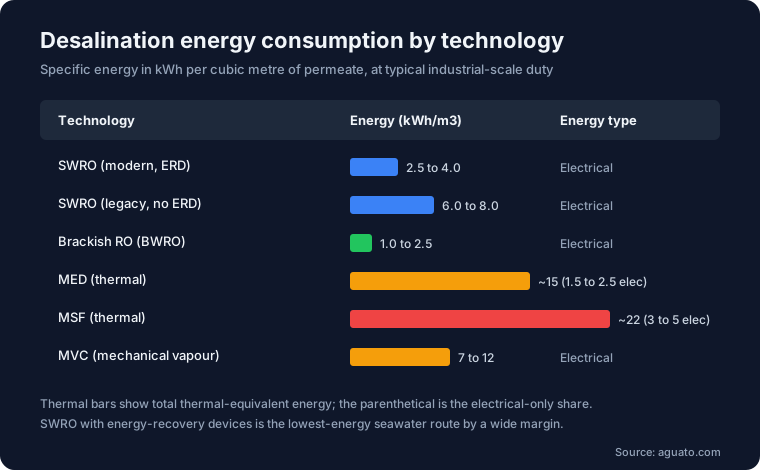
The diagram makes one fact unmissable: the thermal-versus-membrane decision dwarfs every downstream optimisation. A site that inherits an MSF thermal plant is starting from 20-plus kWh/m3 of thermal-equivalent energy; a site that specifies modern SWRO starts at 3. No amount of pump tuning closes a gap that large. The table below restates the benchmarks with the cost and best-fit columns a procurement lead needs.
| Technology | Specific energy (kWh/m3) | Energy type | Best for | Main risk | |---|---|---|---|---| | SWRO, modern with ERD | 2.5 to 4.0 | Electrical | Seawater, new builds, cost-driven | Membrane fouling raises pressure | | SWRO, legacy no ERD | 6.0 to 8.0 | Electrical | Older plants pending retrofit | Paying 2x the energy bill | | Brackish RO (BWRO) | 1.0 to 2.5 | Electrical | Inland brackish, industrial reuse | Scaling at high recovery | | MED (thermal) | ~15 (1.5 to 2.5 elec) | Thermal + elec | Sites with waste heat or cogeneration | Stranded without cheap heat | | MSF (thermal) | ~22 (3 to 5 elec) | Thermal + elec | Gulf legacy, power-water cogeneration | Highest energy cost of all routes | | MVC (mechanical) | 7 to 12 | Electrical | Small, remote, brine concentration | High electrical intensity per m3 |
The reason thermal desalination survives at all is co-location with cheap or waste heat. A multi-effect distillation (MED) plant bolted onto a power station's low-grade steam can be economic even at 15 kWh/m3 thermal, because that thermal energy would otherwise be rejected to a cooling tower. Strip away the waste heat and the same plant is indefensible against RO. This is why the energy comparison must always be a delivered-cost comparison: a thermal kilowatt-hour from waste steam and an electrical kilowatt-hour from the grid are not priced the same. The deeper trade-off between thermal and membrane routes, and the conditions under which each wins, is covered in our guide to [reverse osmosis systems and where membrane processes deliver value](/resources/reverse-osmosis-systems).
Not sure whether your feed water and energy prices favour membrane or thermal desalination? The right call depends on your actual feed TDS and electricity tariff, not on a brochure benchmark, so the productive next step is to put the comparison in front of specialists who will scope it against your real numbers.
For industrial buyers, the practical takeaway is sharper than the textbook one. Unless your site has genuinely free or near-free waste heat, the energy math has already decided in favour of membranes. The only open question is which membrane configuration, and that is where site optimisation earns its keep. The brackish-versus-seawater split inside the membrane camp is just as consequential: a plant treating inland brackish feed at 1 to 2.5 kWh/m3 operates in a different cost universe from one fighting open-ocean salinity at 2.5 to 4, and the two should never be benchmarked against the same target. Establishing which universe your feed sits in is the first step, and it determines everything the next section unpacks about where the kilowatt-hours actually go and which of them are recoverable. A buyer who skips that step and benchmarks a seawater plant against a brackish energy figure will reject sound proposals as overpriced and accept unsound ones as bargains, an error that surfaces only after the contract is signed and the first electricity bill arrives.
## Where the energy goes in a seawater RO train
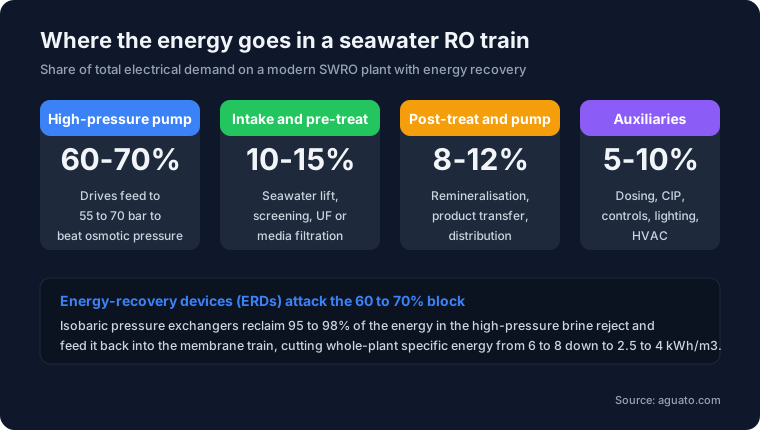
Once membranes are chosen, the energy bill concentrates in one place. On a modern SWRO plant, the high-pressure pump consumes 60 to 70% of total electrical demand, because it has to raise the feed to 55 to 70 bar to overcome the osmotic pressure of seawater. Everything else (intake, pre-treatment, post-treatment, auxiliaries) splits the remaining third. Knowing this distribution is what lets you target capital where it actually moves the SEC needle, because a percentage point shaved off the dominant block is worth far more than the same effort spent on the auxiliaries.
The single most important efficiency technology in modern desalination attacks that 60 to 70% block directly. Energy-recovery devices (ERDs) capture the pressure energy in the high-pressure brine reject (which leaves the membranes at nearly the same pressure it entered) and transfer it back into the incoming feed. Isobaric pressure exchangers, the dominant ERD type, reclaim 95 to 98% of that brine energy. The effect on whole-plant SEC is dramatic: a plant that would run at 6 to 8 kWh/m3 without recovery runs at 2.5 to 4 with it. An ERD retrofit is frequently the highest-return single capital project available on an older desalination asset, with payback periods of 2 to 4 years at typical industrial electricity prices.
The remaining energy blocks reward attention in proportion to their share:
- Intake and pre-treatment (10 to 15%). Open intakes with conventional media filtration are cheaper to build but carry higher fouling load, which raises membrane operating pressure over time. Ultrafiltration pre-treatment costs more energy upfront but holds the membranes at lower pressure for longer. The pre-treatment choice is a slow-burning energy decision, and our guide to [membrane filtration system selection](/resources/membrane-filtration-system) covers where UF pre-treatment pays for its own energy premium. - Post-treatment and product pumping (8 to 12%). Remineralisation and lifting product water into the distribution network. Largely fixed by site geography, but oversized product pumps run inefficiently at part load, a common and avoidable waste. - Auxiliaries (5 to 10%). Dosing, clean-in-place, controls, lighting, HVAC. Small individually, but a poorly instrumented plant lets these creep, and they rarely appear in the headline SEC quote.
The opportunity here is concrete. Two plants with identical feed water and identical membranes can differ by 40% in delivered energy cost based on whether they were specified with a modern ERD, right-sized pumps operated near their best-efficiency point, and pre-treatment matched to the fouling load. None of those are exotic. All of them are decided at the procurement and design stage, where they are cheap, and all of them are expensive to fix once the concrete is poured.
## The levers that cut energy consumption
Beyond the ERD, four levers move specific energy consumption, and each carries a trade-off a buyer must price deliberately. The mistake is treating them as independent dials. They interact, and optimising one in isolation frequently degrades another.
Membrane selection. High-permeability, low-energy membranes reduce the feed pressure needed for a given flux, cutting pump energy by 5 to 15%. The trade-off: low-energy membranes can have looser salt rejection, so a second pass may be needed for high-purity duty, which adds energy back. For potable seawater desalination the low-energy membrane usually wins; for ultrapure or [boron](/elements/boron)-sensitive duty the calculus shifts. Membrane chemistry is a data problem before it is a procurement problem, the right answer depends on your specific feed and product spec.
Recovery-rate optimisation. Every feed has an energy-optimal recovery. Below it, you pump too much feed for too little product; above it, you fight rising brine osmotic pressure. For open-ocean seawater the sweet spot is typically 40 to 50% recovery; pushing to 55%+ to reduce intake size can raise SEC by 0.3 to 0.6 kWh/m3. The right recovery balances intake cost, energy cost, and brine-disposal cost together, never one alone.
Variable-frequency drives and part-load operation. Desalination plants rarely run at constant full load. Demand swings seasonally and daily. A plant with fixed-speed pumps throttles flow with valves, wasting energy as heat. Variable-frequency drives (VFDs) match pump speed to actual demand and can cut energy 5 to 12% on plants with significant load variation. The payback is fastest where demand is most variable.
Renewable and off-peak coupling. Because the dominant cost is electrical, the price per kilowatt-hour matters as much as the quantity. Solar-coupled RO, batteries that shift production to off-peak tariffs, and grid arbitrage can cut the delivered energy bill 15 to 40% without touching SEC at all. The trade-off is capital intensity and the operational complexity of a variable-power plant. Per the [International Renewable Energy Agency's analysis of renewable desalination](dofollow:https://www.irena.org/Energy-Transition/Technology/Water-and-energy), the falling cost of solar PV has made renewable-coupled desalination cost-competitive in high-irradiation, high-water-stress regions, reframing energy from a pure efficiency problem into a procurement-and-financing problem.
[cta:nepti-dark]
The levers above are not equally available to every site, and their interactions are exactly the kind of multi-variable trade-off that defeats spreadsheet intuition. The energy-optimal recovery rate for your feed, the membrane that minimises lifecycle cost rather than nameplate energy, and the value of off-peak coupling against your tariff structure all depend on numbers specific to your project. Characterising those numbers before you engage vendors is what separates a defensible energy spec from a vendor's default package. It also reframes the conversation with bidders, who are then proposing against your optimised target rather than their standard configuration.
The order of attack matters as much as the levers themselves. On an existing plant, the sequence that maximises return is almost always: confirm the ERD is present and performing, then right-size and VFD the pumps, then evaluate membrane replacement at the next scheduled change-out, then assess renewable or off-peak coupling as a separate financing decision. Doing them out of order, replacing membranes before fixing a missing ERD, spends capital on the small lever while the large one stays untouched.
## CAPEX, OPEX, and the cost of a wrong energy spec
Energy is an OPEX problem that is decided at the CAPEX stage. The configuration choices that set your SEC (ERD, pump sizing, membrane type, pre-treatment) are made once, at build, and they govern the energy bill for the 20-year life of the asset. This is why an energy spec error is so expensive: it is not a single bad year, it is two decades of paying more per cubic metre than a competitor with the same feed water.
| Decision | CAPEX impact | Annual energy impact (50,000 m3/day) | Lifecycle (20yr) | |---|---|---|---| | Specify modern ERD | +USD 1.5M to 3M | Save USD 2M to 3M/yr | Save USD 35M to 55M | | Right-size and VFD pumps | +USD 0.3M to 0.8M | Save USD 0.4M to 1M/yr | Save USD 7M to 18M | | Low-energy membranes | Cost-neutral to +USD 0.5M | Save USD 0.3M to 0.8M/yr | Save USD 5M to 14M | | Off-peak or solar coupling | +USD 5M to 20M | Save USD 1.5M to 4M/yr | Net positive in high-tariff regions |
The numbers assume USD 0.10 to 0.14/kWh industrial electricity and 3.5 kWh/m3 baseline SEC. They scale roughly linearly with plant size, so a 200,000 m3/day plant multiplies these figures by four. The cost-of-failure is symmetrical: a plant built without an ERD on a 50,000 m3/day duty is overpaying USD 2 to 3 million every year, and the only fix is a mid-life retrofit that costs more than specifying it correctly at build and incurs production downtime to install.
There is a quieter cost most business cases miss: energy-price exposure. A high-SEC plant is more sensitive to electricity-price volatility than a low-SEC one. When grid prices spike, the inefficient plant's water cost spikes harder, and in deregulated markets that volatility can swing the annual water budget by double-digit percentages. A low-SEC plant with off-peak coupling is not just cheaper on average, it is more predictable, which is worth real money to a CFO building a multi-year water budget. The full method for building that lifecycle case is laid out in our guide to [water treatment plant design from engineering through commissioning](/resources/water-treatment-plant-design).
Defining the energy target, the membrane strategy, and the recovery assumption in your tender is the highest-leverage hour a procurement team spends on a desalination project. Bring your feed TDS, target capacity, and electricity tariff to the table, and qualified providers will scope the energy trade-offs against your actual numbers, returning proposals you can compare line by line on delivered cost per cubic metre rather than on headline SEC alone.
The capital decisions above are only half the story. A correctly specified plant can still bleed energy if the procurement process lets the wrong assumptions slip into the contract, or if the team optimises one variable while quietly degrading another. The most expensive desalination energy mistakes are not failures of engineering, they are failures of specification, and they show up not as a dramatic breakdown but as a water cost that runs 30 to 40% above the business-case number for two decades. The section below catalogues the four that recur most often, with the dollar cost of each and the decision that would have avoided it.
## Where desalination energy decisions go wrong
The expensive mistakes in desalination energy are rarely technical failures. They are procurement and specification failures that lock in a high energy bill before the plant runs a single cubic metre.
The missing or undersized ERD. A plant is specified without energy recovery to shave 5% off CAPEX, or with an undersized ERD that cannot handle the full brine flow. The outcome: the high-pressure pump carries the entire load, SEC sits at 6 to 8 kWh/m3, and the plant overpays USD 2 million-plus a year on a 50,000 m3/day duty. The correct decision was to treat the ERD as non-negotiable on any seawater plant above a few thousand m3/day. The cost of getting it wrong compounds for 20 years.
Chasing recovery past the energy optimum. A team pushes recovery to 55 or 60% to cut intake and brine-disposal volume, not realising the rising brine osmotic pressure has raised SEC by 0.4 to 0.6 kWh/m3 and accelerated scaling. The plant now spends more on energy and more on antiscalant and cleaning than it saved on intake. The correct decision was to model the energy-recovery-disposal cost as one integrated optimisation, not three separate savings hunts.
Specifying membrane-only SEC in the tender. The contract guarantees an SEC figure that excludes intake, pre-treatment, and post-treatment. The plant meets its contractual SEC and still delivers water at 30% higher real energy cost than the buyer budgeted, because the excluded blocks were never optimised. The correct decision was to specify whole-plant SEC at the product-water boundary, measured at the meter, with the feed TDS and recovery rate fixed in the guarantee.
Ignoring part-load efficiency. A plant sized for peak demand runs most of the year at 50 to 70% load, where fixed-speed pumps are wildly inefficient. The annual energy bill runs 8 to 12% above what VFDs would deliver. The correct decision was to match the pump and drive strategy to the actual demand profile, not the nameplate peak. Worse, fouling compounds the problem, a plant that lets fouling raise operating pressure is paying an invisible energy tax that grows every month between cleans, the same dynamic that drives the economics of [industrial water filtration and pre-treatment](/resources/industrial-water-filtration).
The pattern across all four is the same: a small CAPEX saving or an unexamined assumption at the specification stage becomes a permanent, compounding OPEX penalty. Energy in desalination is not a thing you optimise after commissioning. It is a thing you win or lose in the tender.
## Decision framework: matching configuration to site
Use this threshold-based logic to narrow the configuration before engaging vendors. It is not a substitute for site-specific modelling, but it eliminates the obviously wrong choices and frames the right questions.
1. Is there genuinely free or near-free waste heat on site? If yes (co-located power station, industrial process rejecting low-grade steam) then thermal MED is worth evaluating. If no, then membranes win on energy, stop considering thermal. 2. What is the feed TDS? Below 5,000 mg/L use brackish RO at 1 to 2.5 kWh/m3. Around 35,000 mg/L use seawater RO at 2.5 to 4. Above 45,000 mg/L (hypersaline or high-recovery brine) expect 4 to 5 and evaluate whether two-stage or brine-concentration steps are needed. 3. Is the plant above ~3,000 m3/day seawater duty? If yes, an isobaric ERD is mandatory, not optional. Below that, smaller turbocharger-style recovery may be the practical choice. 4. What is the demand profile? Constant base load favours fixed efficient pumps. Variable load (seasonal, daily, demand-following) justifies VFDs, expect 5 to 12% energy savings where load swings widely. 5. What is the electricity tariff structure and is there high solar irradiation? Flat cheap power means optimise SEC directly. High or volatile tariffs plus good irradiation means evaluate solar coupling and off-peak production as a financing decision separate from the SEC decision. 6. What is the product-water purity spec? Potable or general industrial favours low-energy high-permeability membranes. Ultrapure, boron-limited, or pharmaceutical duty may require a second pass, which adds energy and changes the membrane calculus, see our guide to [ultrapure water production methods and standards](/resources/ultrapure-water-production).
Run those six steps and the configuration space collapses from "every desalination technology" to "two or three membrane configurations worth a detailed quote." That is the point at which a vendor conversation becomes productive: you are comparing scoped proposals against a defined energy target, not auditioning brochures. The peer-reviewed literature collected in the [Desalination journal's coverage of energy and process optimisation](dofollow:https://www.sciencedirect.com/journal/desalination) is the reference of record for the benchmark ranges above and for the membrane and recovery trade-offs that drive them.
When you are ready to put real numbers against this, compare vetted [water treatment equipment manufacturers](/providers) on Aguato, filter by desalination technology and region, and request scoped proposals so the energy and recovery trade-offs above are priced against your actual feed water rather than a brochure benchmark.
## FAQ
### What is a good energy consumption figure for seawater desalination?
A modern seawater reverse-osmosis plant with energy recovery should deliver 2.5 to 4 kWh per cubic metre of product water at open-ocean salinity (around 35,000 mg/L TDS) and 40 to 50% recovery. Figures above 5 kWh/m3 on seawater usually indicate a missing or underperforming energy-recovery device, fouled membranes, or inefficient pumping. Brackish water at lower salinity runs much lower, typically 1 to 2.5 kWh/m3.
### Why is reverse osmosis more energy-efficient than thermal desalination?
Reverse osmosis separates salt from water mechanically, by pushing feed against a membrane, rather than by boiling and condensing water as thermal processes do. Phase change (evaporation) is energy-intensive, so multi-stage flash and multi-effect distillation consume 15 to 22 kWh/m3 of thermal-equivalent energy versus 2.5 to 4 for modern RO. Thermal desalination remains viable only where waste heat or very cheap steam is available, otherwise membranes win the energy comparison decisively.
### How much do energy-recovery devices reduce desalination energy cost?
Isobaric energy-recovery devices reclaim 95 to 98% of the pressure energy in the high-pressure brine reject and feed it back into the membrane train. On a seawater plant this cuts whole-plant specific energy from roughly 6 to 8 kWh/m3 down to 2.5 to 4, a reduction of 40 to 55%. On a 50,000 m3/day plant that is roughly USD 2 to 3 million a year in electricity, with retrofit payback periods commonly in the 2 to 4 year range.
### Does pushing the recovery rate higher save energy?
Not usually. Higher recovery concentrates the reject brine, raising its osmotic pressure and the feed pressure the pump must overcome. Beyond the energy-optimal recovery (typically 40 to 50% for open-ocean seawater), specific energy rises and scaling accelerates. Higher recovery can reduce intake and brine-disposal volumes, so the right recovery balances energy, intake, and disposal cost together rather than maximising any one.
### Can renewable energy make desalination cheaper?
Yes, in the right conditions. Because electricity is the dominant cost, the price per kilowatt-hour matters as much as the quantity consumed. In high-irradiation, high-water-stress regions, solar-coupled RO and off-peak production scheduling can cut the delivered energy bill by 15 to 40% without changing the plant's specific energy consumption. The trade-off is higher capital cost and the operational complexity of running a plant on variable power.
### What feed-water salinity does my desalination energy figure depend on?
Specific energy consumption rises with feed salinity because osmotic pressure rises with total dissolved solids. Brackish water (around 3,000 mg/L) needs about 1 to 2.5 kWh/m3; standard open-ocean seawater (35,000 mg/L) needs 2.5 to 4; hypersaline sources such as the Arabian Gulf (45,000 mg/L) push 4 to 5. Any energy benchmark is meaningless unless the feed TDS and recovery rate are stated alongside it.