Manufacturers that fail to close their water loop face discharge costs rising 30 to 60% by 2030. This framework maps technology selection to recovery targets and ROI.
Water costs that once rounded to zero on a plant P&L now carry enough weight to influence capital allocation decisions. Across food and beverage, automotive, semiconductor, and textile manufacturing, raw water intake and discharge fees have climbed 30 to 60% in the last decade in water-stressed regions, and several EU member states are signalling mandatory reuse targets under the revised Industrial Emissions Directive that will apply to plants above certain thresholds from 2027 onward. A facility drawing 5,000 cubic metres per day and discharging 60% of that volume is carrying an avoidable cost exposure of $180,000 to $420,000 per year at current tariffs in central Europe and the US Southwest, before factoring in the fines that follow a permit breach. Water circularity in manufacturing is no longer a sustainability footnote; it is a cash-flow line item.
The contrarian truth that experienced plant engineers know, but procurement teams often resist, is that the highest-cost circularity projects are rarely the ones that went to ZLD. The most expensive failures are the partial reuse schemes built without a full water audit, where a plant invested $500,000 in membrane infrastructure only to discover that upstream process chemistry fouled the membranes within 18 months, tripling projected OPEX. Circularity is an engineering problem before it is a water problem, and the sequence of decisions matters as much as the technology selected.
This article builds a practical, numbers-anchored framework for water circularity in manufacturing. It covers how to audit your current water loop, how to map recovery targets to the right treatment train, how to frame the business case for CFO approval, and where the common failure modes concentrate. It is written for plant and operations leaders responsible for uptime and cost, procurement and capital projects teams structuring vendor selection, and sustainability directors translating site-level reductions into credible ESG disclosures.
## The decision in brief
- Recover 70% of intake through a staged programme. If your plant recovers 70% of its current water intake through a staged Tier 2 circularity programme, a 1,000 m3/day facility drawing water at $2.50/m3 saves $1.28 million in net intake and discharge costs over the first five years. - Weigh that saving against the capital. That $1.28 million five-year saving sits against a typical CAPEX of $800,000 to $1.4 million for the staged Tier 2 programme. - The water bill is not the real exposure. The biggest cost of doing nothing is the regulatory non-compliance exposure that arrives when a discharge permit tightens and the plant has no installed recovery capacity.
That exposure forces a compressed $2 million to $5 million emergency capital programme at 2x to 3x the cost of a planned phased installation.
## What water circularity in manufacturing actually means
Water circularity in manufacturing means recovering, treating, and returning process water to productive use rather than discharging it as waste after a single pass. The practical spectrum runs from simple in-process recycling (recovering rinse water in a plating line, for example) through cross-process cascade reuse (feeding lower-quality recovered water into cooling towers rather than drains) all the way to full zero liquid discharge, where essentially no liquid effluent leaves the site boundary.
The distinction matters because the business case, the capital requirement, and the technical complexity are radically different across that spectrum. A basic in-process recycling loop might cost $50,000 to $200,000 in capital and deliver a two-year payback through reduced intake volumes. A full ZLD system for a high-TDS industrial effluent stream can cost $2 million to $10 million or more, with a payback horizon of five to ten years and a strong dependency on a stable regulatory or water-scarcity premium to justify the numbers. Most plants benefit most from a staged approach: close the easy loops first, bank the savings, and fund the next tier of recovery.
The common mistake is treating circularity as a binary choice between "business as usual" and "full ZLD." The four-tier cascade model below gives procurement and operations teams a structured path that connects each investment level to a defensible financial return, which is what a CFO approval actually requires.
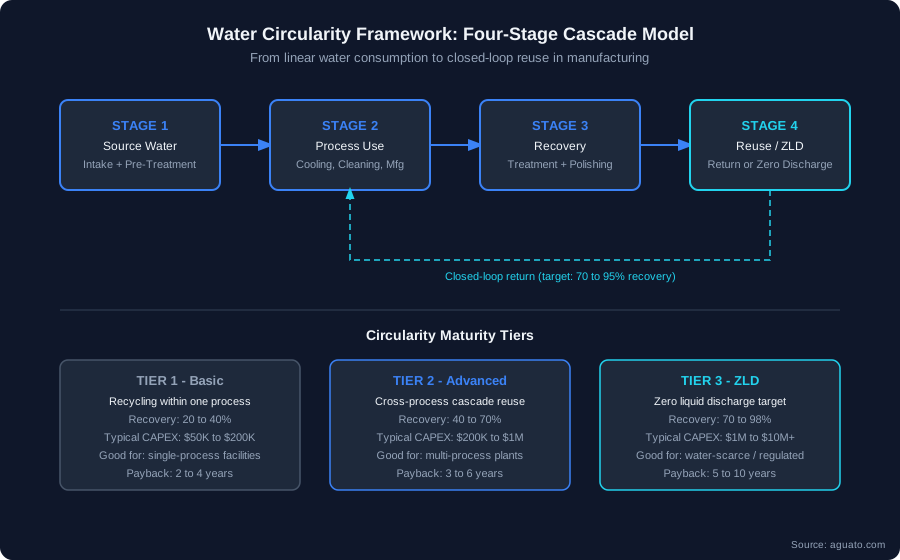
The three circularity tiers in the diagram above translate to different capital commitments and recovery rates. Tier 1 (basic recycling within one process) recovers 20 to 40% of intake volume at a CAPEX of $50,000 to $200,000. Tier 2 (cross-process cascade) recovers 40 to 70% at $200,000 to $1 million. Tier 3 (ZLD-oriented) reaches 70 to 98% but demands $1 million to $10 million-plus and is only financially rational in specific cost-of-water and regulatory contexts. The right tier is determined by your site water cost, discharge constraints, and production process chemistry, not by sustainability ambition alone.
## The water audit: your non-negotiable first step
No technology selection for water circularity in manufacturing is defensible without a full site water audit, and this is where most failed projects trace their root cause. A proper audit maps every water input point, every point of use, every quality degradation mechanism, and every discharge point, and it quantifies flow rates and water quality parameters at each node. Without it, you are selecting equipment for a system you have not characterized.
A pattern that recurs in industrial installations is the assumption that a facility's largest effluent stream is also its best reuse candidate. That is often wrong. The largest stream is frequently the most contaminated, while a smaller, cleaner stream from a different process stage offers a 70 to 80% quality match for a cooling tower or pre-rinse application at a fraction of the treatment cost. The audit surfaces these hidden value streams.
The minimum audit deliverables that a treatment designer needs are: total daily water balance (m3/day by circuit), TDS and conductivity at each major node, COD and BOD for organic-laden streams, suspended solids concentration, specific contaminant flags (heavy metals, PFAS, oils, process chemicals), temperature profile, and pH range. [The US EPA's Water Management guidelines](dofollow:https://www.epa.gov/watersense/industrial-and-commercial-water-use) provide a solid audit methodology framework that translates to both regulatory reporting and technology scoping. A facility that invests $15,000 to $40,000 in a properly scoped third-party water audit before technology selection consistently avoids the $200,000 to $500,000 retrofit costs that follow a misspecified system.
## Four-stage cascade model for closing the loop
The cascade model structures water circularity in manufacturing as four sequential stages: source water intake and pre-treatment, process use and quality degradation, recovery and treatment, and reuse or terminal discharge. The circularity is achieved by feeding the output of Stage 4 back into Stage 2 or Stage 3, bypassing or reducing Stage 1 intake.
Stage 1: Source water intake. The quality and volume entering the plant determines the baseline chemistry for all downstream decisions. Groundwater, municipal supply, and surface water each arrive with different TDS, hardness, and microbiological profiles that must be matched to process requirements. Pre-treatment at this stage is a cost lever: softening or partial demineralisation here is almost always cheaper than treating the same hardness after it has been concentrated through multiple use cycles.
Stage 2: Process use. This is where water quality degrades through contact with product, heat, chemicals, and biological activity. The key engineering metric is the concentration factor: how much have TDS and target contaminants multiplied relative to the intake? A cooling tower running at a cycles-of-concentration of 5 has a blowdown TDS five times the makeup water TDS. A rinse cascade in a metal finishing line may exit at 10 to 50 times the incoming TDS of the cleaning bath chemistry.
Stage 3: Recovery and treatment. This stage is the heart of the circularity investment. The treatment train must reduce contaminants to the level required by the target reuse application, which is often considerably lower than the level required for regulatory discharge. Reuse quality specifications are frequently stricter than discharge permits, which surprises procurement teams budgeting only to a compliance standard.
Stage 4: Reuse or terminal discharge. Recovered water is returned to a process use point at the appropriate quality tier: high-quality polish for sensitive processes, mid-grade for cooling or utility use, lower-grade for scrubber feed or site irrigation. Anything that cannot be recovered economically exits as a regulated discharge or, in ZLD configurations, as a solid or semi-solid waste stream.
[cta:nepti]
The cascade model makes one thing clear: the biggest efficiency gains come from matching water quality to use requirements, not from treating everything to the highest possible standard. Over-treating recovered water for a cooling tower application is a direct OPEX waste. The economic optimum is a tiered quality matrix where each recovered stream is matched to the least-demanding application that still meets quality, not the most demanding one.
## Technology selection framework: matching treatment to recovery targets
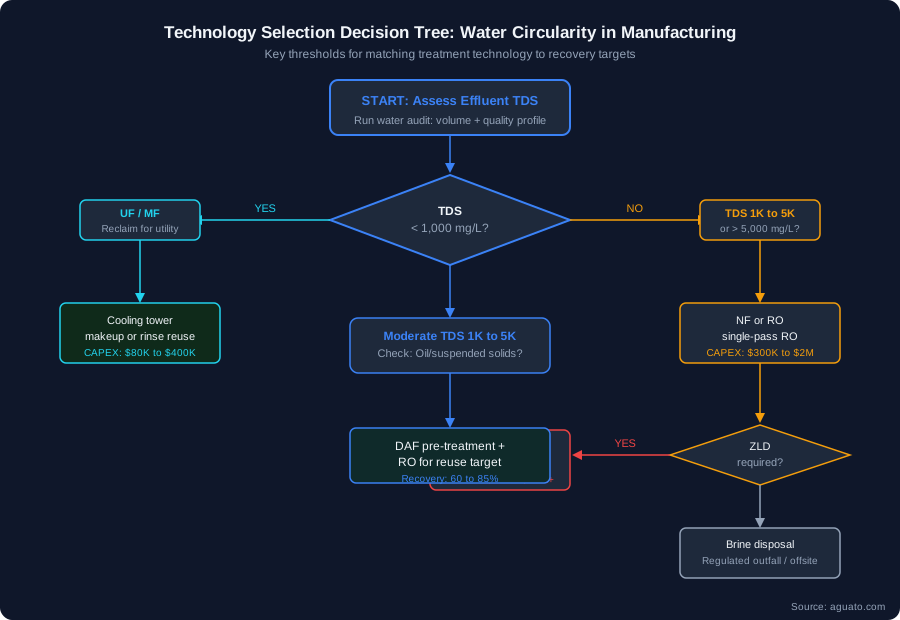
Treatment technology selection for water circularity in manufacturing follows a branching logic tree driven primarily by TDS, suspended solids loading, and the target application quality. The decision sequence below translates audit data into a defensible equipment shortlist.
If TDS is below 1,000 mg/L and the effluent is free of oils and suspended solids above 50 mg/L: ultrafiltration (UF) or microfiltration (MF) alone is sufficient for most cooling tower makeup or site utility reuse targets. Capital cost for a packaged UF skid at 100 to 500 m3/day capacity runs $80,000 to $400,000. OPEX is dominated by membrane replacement and cleaning, typically $0.08 to $0.18 per m3 treated.
If TDS is 1,000 to 5,000 mg/L: a UF-RO train is the standard specification. The UF protects the RO membranes from fouling, and the RO delivers the TDS reduction needed for high-quality reuse. At this TDS level, single-pass RO typically achieves 75 to 85% recovery. Capital for a UF-RO system at 200 to 1,000 m3/day is $300,000 to $2 million depending on pre-treatment complexity and recovery target.
If TDS exceeds 5,000 mg/L, or if the application demands recovery above 90%: the system enters high-recovery RO territory (second-pass, BWRO, or SWRO-equivalent pressure) or requires brine concentration technology. This is where costs escalate sharply. High-recovery RO at TDS above 5,000 mg/L requires higher operating pressures (40 to 80 bar), more aggressive antiscalant dosing, and more frequent chemical cleaning, all of which add OPEX.
If the facility must achieve ZLD or near-ZLD (95%+ recovery): a mechanical vapour recompression (MVR) evaporator or brine concentrator is needed downstream of the RO. This is the highest-cost configuration, at $2 million to $10 million-plus in capital, with energy consumption of 8 to 25 kWh per m3 of water recovered. ZLD is financially rational only when the cost of water is above approximately $4 to $6 per m3, when discharge fees and fines exceed $1 million per year, or when there is no legal discharge pathway.
The presence of oils, process chemicals, or high suspended solids triggers pre-treatment steps before any membrane stage. Dissolved air flotation (DAF) removes oil and suspended solids to below 10 mg/L, making the downstream membrane train viable. Without DAF or equivalent pre-treatment, membrane fouling will compress the payback horizon from 5 years to 18 months, requiring a costly replacement cycle before the system has paid for itself.
[ISO 24521:2016 on managing basic on-site domestic wastewater services](dofollow:https://www.iso.org/standard/64638.html) provides a useful reference framework for water quality classification and reuse standards that procurement teams can reference when setting internal quality acceptance criteria for recovered water.
## Cost benchmarks and the real CAPEX-OPEX trade-off
The table below compares the major technology options for water circularity in manufacturing across capital cost, operating cost, recovery rate, risk profile, and best-fit application. These are market ranges drawn from real tender and commissioning data; your site-specific quote will vary by feed water chemistry, site integration complexity, and vendor selection.
| Technology | CAPEX (per m3/day capacity) | OPEX ($/m3 treated) | Recovery Rate | Key Risk | Best For | |---|---|---|---|---|---| | UF/MF alone | $400 to $900 | $0.08 to $0.18 | 90 to 95% permeate yield | Fouling if feed SS >200 mg/L | Low-TDS streams, cooling makeup | | UF + single-pass RO | $1,200 to $2,800 | $0.22 to $0.45 | 75 to 85% | Scaling at high recovery | Mid-TDS industrial effluent | | DAF + UF + RO | $1,800 to $3,500 | $0.30 to $0.60 | 70 to 85% | DAF chemistry cost; sludge disposal | Oily wastewater, food/bev | | High-recovery RO (>90%) | $2,500 to $5,000 | $0.50 to $1.10 | 88 to 93% | Energy and cleaning frequency | Water-scarce sites, high water cost | | RO + brine concentrator (ZLD) | $8,000 to $20,000 | $2.50 to $6.00 | 95 to 98% | High energy; crystallizer scaling | Regulated discharge-free zones |
A procurement lead can read this table directly: the step from basic UF-RO to ZLD is a 5 to 10x increase in CAPEX per m3/day and a 5 to 10x increase in OPEX per m3 treated. That cost jump must be justified by either a regulatory imperative or a water cost/scarcity premium that closes the financial model. In most mid-latitude European and North American markets, the ZLD financial case does not clear a standard 15% hurdle rate on water cost alone. It requires a discharge prohibition or a regulatory fine scenario to tip the NPV.
The right answer depends on your site's water cost, discharge permit, and process chemistry. [Post your project](/post-project) and qualified treatment providers will scope the trade-off against your actual numbers and provide a budgetary CAPEX estimate within the ranges above.
## Failure scenarios: where circularity projects go wrong
A circularity project that is technically sound on paper can still destroy its business case through predictable operational failures. Four failure modes concentrate the majority of real-world losses.
Failure Mode 1: Membrane fouling from under-specified pre-treatment. A chemical plant in Germany committed $800,000 to a UF-RO reuse system for its cooling blowdown stream, based on an intake water analysis that did not account for the oil carryover from a compressor seal failure mode that occurred roughly once per quarter. The first major fouling event occurred 14 months post-commissioning, requiring a full membrane replacement at $140,000 and a 3-week production disruption costing an estimated $220,000 in lost output. The correct decision was to include a small coalescing oil separator upstream at $22,000. Total avoided loss: $360,000.
Failure Mode 2: Concentration factor runaway in closed-loop cooling. Closing the cooling tower loop without recalculating chemical dosing requirements for the new, higher cycles-of-concentration is a common operational mistake. A food processing plant in the US Midwest tightened its cooling tower cycles from 4 to 8 after installing a blowdown recovery RO system. Silica scaling on heat exchanger tubes followed within six months because the antiscalant dose was not recalculated for the new saturation index. Descaling and tube replacement cost $180,000. The correct decision was a $3,000 water chemistry review at the point of system commissioning.
Failure Mode 3: Reuse quality mismatch. A textile manufacturer invested $1.1 million in a membrane bioreactor (MBR) system to recover dyeing process water for reuse in subsequent dyeing cycles. The recovered water met the TOC specification set by the engineering contractor but contained residual coloured micro-pollutants that caused shading defects in light-coloured fabric runs. The resulting product rejection rate cost $320,000 in quality losses before the specification was corrected to include a UV advanced oxidation polishing step. The correct decision was to validate the reuse specification against the most sensitive process application, not the average.
Failure Mode 4: Brine disposal not scoped in ZLD design. A battery component manufacturer targeting ZLD discovered post-commissioning that its crystallizer was producing a mixed-salt solid waste stream that could not be classified as a non-hazardous solid under local regulations. The result was an unexpected hazardous waste contract at $210/tonne, adding $380,000 per year to OPEX that was not in the original financial model. ZLD is not zero-waste: it converts liquid waste to solid waste, and the regulatory classification and disposal cost of that solid stream must be scoped in the pre-investment phase.
## Real-world examples: three manufacturing sectors
Example 1: Semiconductor fab, Taiwan. A 300mm wafer fab drawing 8,000 m3/day implemented a four-stage reuse system: ultrapure water (UPW) reject recovery, rinse water cascade, cooling tower blowdown RO, and final polish for non-critical utility reuse. The cascade system achieved 72% overall water recovery, reducing net intake to 2,240 m3/day. At a local industrial water tariff of $1.80/m3, the annual saving was $3.7 million. Total CAPEX was $9.5 million. Payback: 2.6 years. The critical success factor was a detailed water quality matrix developed before design freeze, which correctly identified six distinct quality tiers within the plant's water demand.
Example 2: Food and beverage processing, UK. A dairy processing facility generating 1,200 m3/day of high-COD effluent installed a DAF-MBR-RO train targeting 60% recovery for CIP pre-rinse and cooling use. The system delivered 58% recovery in practice, short of the 65% design target because of higher-than-forecast fat loading from a new product line. The trade-off was accepted: the shortfall was compensated by a complementary programme of water efficiency measures in the production process, which reduced total generation by 12%. Net water cost saving: $185,000 per year on a CAPEX of $1.4 million. Payback: 7.6 years, which only cleared the hurdle rate because of a parallel reduction in effluent discharge fees of $90,000 per year.
Example 3: Automotive paint shop, Czech Republic. An OEM paint shop treating 450 m3/day of mixed rinse water and booth water deployed a coagulation-DAF-UF-RO train with a brine concentrator for the final 15% concentrate stream. The full ZLD configuration cost $6.8 million and was mandated by a provincial water authority that withdrew the facility's discharge permit as part of a regional watershed protection order. The business case was thus driven by regulatory compliance rather than pure financial return. The effective cost of ZLD compliance was $420,000 per year in annualised CAPEX and OPEX, versus the alternative of relocating the paint shop at an estimated $35 million in capital cost. ZLD was the right answer, but only because the regulatory context made it so.
## ESG reporting and regulatory alignment
Water circularity in manufacturing sits at the intersection of operational finance and ESG disclosure. The reporting frameworks that matter for most multinationals are the CDP Water Security questionnaire, the GRI 303 standard (water and effluents), and the emerging TNFD nature-related disclosure framework, which treats water as a natural capital asset. A facility that can demonstrate a measured reduction in water withdrawal intensity (m3 per tonne of product) and a documented closed-loop recovery rate is consistently ranked higher on CDP Water Security scoring, which increasingly feeds into supplier qualification requirements from major consumer goods companies.
The regulatory trajectory is unambiguous. The EU's revised Industrial Emissions Directive, the US EPA's effluent guidelines programme, and comparable frameworks in India (CPCB norms), China (GB standards), and Australia (state-level licence conditions) are all tightening discharge limits and water withdrawal allocations. A plant that has not mapped its current water balance and modelled its exposure to a 20% tariff increase and a 30% reduction in permitted discharge volume is carrying unquantified regulatory risk on its balance sheet.
For sites operating across multiple regions, the [UN-Water SDG 6 GLAAS Framework](dofollow:https://www.unwater.org/publications/un-water-global-analysis-and-assessment-of-sanitation-and-drinking-water-glaas) provides a useful benchmark for country-level water stress context that supports materiality assessments under TCFD and TNFD disclosures.
A pattern that recurs when sustainability teams submit their first CDP Water Security responses is the discovery that their site-level water data is inconsistent across locations, making portfolio-level reporting unreliable. Investing in water metering, sub-metering, and a real-time water balance dashboard at the point of circularity system installation converts a one-off project into a permanent data infrastructure asset that supports ESG reporting for a decade or more.
For a multi-site manufacturing group, the value of standardised water data goes beyond ESG: it enables the central engineering team to benchmark sites against each other, identify the highest-return circularity investments across the portfolio, and build a capital plan that a Group CFO can approve with confidence. This is why the water audit is the investment that pays back most reliably regardless of which recovery tier a site ultimately targets.
## Procurement strategy: structuring the RFP and vendor selection
Procuring a water circularity system is materially different from procuring a utility service or a standard piece of process equipment. The performance guarantee, the water quality specification, and the recovery rate commitment are all negotiable, and all carry direct financial implications over the 15 to 20-year system life.
The four non-negotiables in any circularity RFP are: (1) a guaranteed minimum recovery rate under worst-case feed water conditions, not just design-point conditions; (2) a performance guarantee covering treated water quality at the reuse point, not just at the membrane permeate; (3) a defined cleaning and maintenance schedule with committed response times; and (4) a brine or concentrate disposal specification confirming the solid or liquid waste stream meets regulatory classification requirements.
Vendor independence is a material procurement risk in water circularity systems. Membrane cartridges, chemical dosing consumables, and software licences can all be structured as vendor lock-ins that inflate OPEX by 30 to 60% over a system's life compared to an open-specification procurement. Request open-specification membrane compatibility and chemical dosing vendor neutrality as standard terms. The CAPEX difference between a proprietary and open-specification system of the same capacity is often less than 5%, but the OPEX difference over 15 years can be $300,000 to $800,000 for a mid-scale installation.
When to use a technology-neutral EPC versus a design-build specialist: for systems below $500,000 in CAPEX, a design-build specialist with relevant sector experience typically delivers faster and more cost-effectively than a technology-neutral EPC, because the engineering overhead is lower. Above $1 million, and particularly for multi-stream systems integrating pre-treatment, membrane, and brine management, a technology-neutral EPC with a performance-based contract structure gives the buyer stronger protection against the misspecification risk described in the failure scenarios section above.
[Browse qualified water circularity treatment providers](/industrial-water-treatment-companies) to compare capabilities and build a shortlist for your RFP. You can also explore [industrial water reuse and recycling systems](/resources/industrial-water-reuse-recycling) and [zero liquid discharge technology options](/resources/zero-liquid-discharge) to frame your technology scope before issuing the tender.
## FAQ
### What is water circularity in manufacturing and how does it differ from water recycling?
Water circularity in manufacturing is a systemic approach to recovering, treating, and returning water to productive use within the manufacturing process, minimising net intake and eliminating or radically reducing discharge. Water recycling typically refers to a single-stream loop within one process step, while circularity encompasses the full water value chain across all process stages, with cascade reuse matching water quality to application requirements rather than treating all recovered water to a single standard.
### What recovery rate is realistic for a typical industrial facility?
For most manufacturing plants, a well-designed Tier 2 circularity programme can achieve 50 to 70% water recovery without ZLD-class capital investment. The realistic ceiling depends heavily on the industry: semiconductor fabs can achieve 70 to 80% through ultrapure water reject recovery alone; food and beverage plants typically reach 50 to 65% because of high organic loading and strict reuse quality requirements; automotive plants in water-scarce regions have demonstrated 80 to 90% through multi-stage membrane and evaporation trains.
### When does zero liquid discharge make financial sense for water circularity?
ZLD crosses the financial threshold when the cost of water (intake plus discharge) exceeds approximately $4 to $6 per cubic metre, when a discharge permit is withdrawn or a prohibition is in force, or when the regulatory fine exposure exceeds $1 million per year. Below these thresholds, the energy and capital cost of brine concentration and crystallisation typically cannot be recovered over a reasonable payback horizon. ZLD should always be evaluated against the alternative of high-recovery RO (85 to 93%), which costs 4 to 6x less and often satisfies the regulatory requirement at a fraction of the capital.
### What are the most common causes of water circularity project failure?
The four leading causes are: under-specified pre-treatment that results in membrane fouling within 12 to 24 months; reuse quality specifications not validated against the most sensitive downstream process; concentration factor runaway in closed cooling loops not accompanied by recalculated chemical dosing; and brine or concentrate disposal costs not included in the financial model. All four are preventable through a proper water audit, independent technology review, and a performance-guaranteed contract structure. See the failure scenarios section of this article for cost-quantified case examples.
### How does water circularity connect to ESG and CDP Water Security reporting?
A measured reduction in water withdrawal intensity (m3 per tonne of product) and a documented recovery rate are the two core metrics that lift CDP Water Security scores from Band C to Band A. Under GRI 303, organisations must disclose total water withdrawal, recycled and reused volumes, and water withdrawal in areas of high water stress. A circularity programme that is metered and documented provides the data infrastructure for all major frameworks (CDP, GRI 303, TNFD) simultaneously, converting the capital project into a permanent ESG data asset. The [UN-Water GLAAS Framework](dofollow:https://www.unwater.org/publications/un-water-global-analysis-and-assessment-of-sanitation-and-drinking-water-glaas) provides country-level water stress context for materiality assessments.
### How should I structure the RFP for a water circularity system?
The four non-negotiables are: a guaranteed minimum recovery rate under worst-case feed conditions; a treated water quality guarantee at the reuse point; a defined maintenance schedule with response time commitments; and a brine/concentrate disposal specification. Beyond these, insist on open-specification membrane compatibility and chemical dosing vendor neutrality. For systems above $1 million, a technology-neutral EPC with a performance-based contract structure provides stronger protection against misspecification risk than a proprietary design-build approach. [Post your project](/post-project) to receive structured bids from pre-qualified providers who can respond to all four requirements.
### What is the role of decision-intelligence tools in water circularity planning?
Decision-intelligence platforms like [Nepti](/nepti) model your site water matrix and generate a ranked comparison of technology options with projected capital cost, operating cost, and recovery rate for each configuration, which is the core input for a defensible CFO presentation. Rather than relying on a single vendor's proposal, which is naturally scoped to that vendor's product line, a modelling tool that works across the full technology landscape surfaces the trade-offs between, for example, high-recovery RO versus ZLD for your specific TDS and volume profile, before you issue the RFP.