Evaporation and crystallization convert brine concentrate into dry solids, cutting discharge liability to zero. Here is what each stage costs and where systems fail.
A facility discharging 500 cubic metres per day of brine concentrate at 50,000 mg/L TDS faces a liability that is growing faster than its treatment budget. Tightening effluent limits across the US, EU, India, and Gulf states are converting what was once a routine permit condition into a capital-allocation decision with a $5 million to $30 million price tag. Evaporation and crystallization in ZLD systems are the two technologies that close the loop entirely, converting liquid brine into dry solids with zero permitted liquid discharge and, in favourable cases, saleable byproduct salt. The primary keyword to understand here is evaporation crystallization zld: the sequence of thermal concentration steps that turns a wastewater problem into a solid-waste management problem.
The counterintuitive reality is that crystallizers are rarely the most expensive line item in a ZLD project. The biggest cost driver is the brine concentrator upstream of the crystallizer, and the biggest risk is specifying the wrong evaporator type for a feed that scaling ions will foul in under 18 months. Most system failures trace back not to crystallizer selection but to inadequate feed pre-treatment and an underestimated silica load. The payback arithmetic only works if the system runs at design recovery for the first five years.
This article covers the full ZLD thermal train from brine concentrator to crystallizer to solid-waste handling: how each stage works mechanically, when to deploy each configuration, how to build the business case for capital approval, where systems fail operationally, and what the decision framework looks like at each threshold. It is written for operations teams who own the reliability risk, procurement leads who need to defend the CAPEX, and sustainability directors who need the water-recovery numbers to close an ESG reporting gap.
## The decision in brief
- Specify the thermal train correctly. A correctly specified ZLD thermal train recovering 97% of a 500 m3/day brine stream, at a combined avoided-disposal and recovered-water value of $6 per cubic metre, recovers approximately $1.07 million per year. - Expect a long payback on those values alone. That $1.07 million per year sits against a $12 million to $18 million CAPEX, which is a payback of 11 to 17 years at those values alone. - The permit fine is not the biggest exposure. The biggest cost-of-doing-nothing is the enforced shutdown of a production line while regulators process a consent order, not the permit fine itself.
At a $50 million revenue facility, that enforced shutdown runs $140,000 per day in lost contribution.
## What ZLD thermal treatment actually means
Zero liquid discharge thermal treatment is the stage of the ZLD process train where membrane technology hands off to heat. Reverse osmosis can concentrate brine to roughly 70,000 to 80,000 mg/L TDS before osmotic pressure makes further concentration uneconomic; beyond that threshold, evaporation and crystallization take over and drive the system to a solid cake. The output is not just a compliance solution: at some sites, recovered sodium chloride or sodium sulfate commands $80 to $200 per tonne on commodity markets, partially offsetting OPEX.
ZLD thermal treatment is not a single technology. It is a cascade of concentration steps, each designed to handle a progressively saltier, harder-to-process stream. A correctly designed cascade routes the feed through the lowest-cost concentration technology first, preserving the expensive crystallizer for only the final, most concentrated fraction. Getting that split wrong by routing too much volume to the crystallizer inflates OPEX by $1.50 to $4.00 per cubic metre of feed water processed.
The [zero liquid discharge](/resources/zero-liquid-discharge) concept is increasingly mandated in water-stressed basins. Thermal ZLD represents the highest-cost, highest-assurance tier of that compliance hierarchy, and it is the tier that separates facilities which can grow their permitted volume from those that cannot.
## How evaporation works in a ZLD brine concentrator
A brine concentrator is a thermal evaporator that takes the reject stream from a reverse osmosis or electrodialysis system, typically at 30,000 to 80,000 mg/L TDS, and concentrates it further to 150,000 to 250,000 mg/L TDS, producing a distillate stream that is essentially deionised water and a concentrated brine slurry that feeds the crystallizer. The dominant configuration is mechanical vapour recompression (MVR or MVC), which compresses the vapour generated by evaporation and uses it as the heat source for the next evaporation pass, achieving a specific energy consumption of 20 to 30 kWh per cubic metre of feed processed. Thermal vapour recompression (TVR) uses low-cost steam instead and can achieve 8 to 15 kWh per cubic metre where waste steam is available.
The heat-exchange surface inside a brine concentrator is the critical wear item. Scale from calcium carbonate, calcium sulfate, barium sulfate, and silica deposits onto tube walls and forces a CIP (clean-in-place) cycle that typically consumes 4 to 8 hours per event. Facilities that underestimate silica loading enter a cycle of accelerating CIP frequency, shortened tube bundle life (design life 7 to 10 years, actual life as short as 3 years), and unplanned downtime that alone can cost $15,000 to $40,000 per event in lost production or disposal fees.
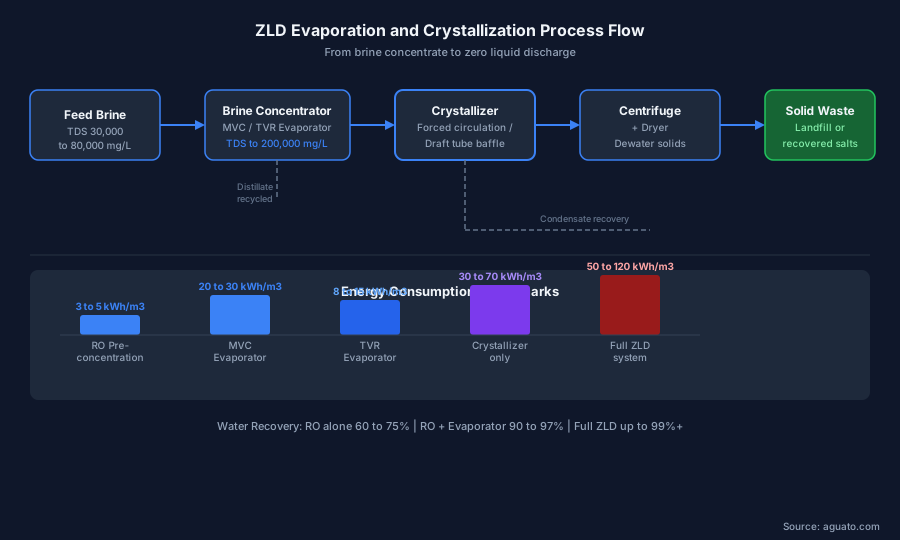
The distillate from the brine concentrator typically recovers 85 to 95% of the inlet water volume at a quality of 5 to 50 mg/L TDS, suitable for boiler makeup, cooling tower makeup, or process reuse. That recovered water is the primary financial lever: at a replacement cost of $2 to $8 per cubic metre (depending on local water tariff and treatment cost), a 100 m3/day brine concentrator recovering 90 m3 of distillate generates $65,000 to $260,000 per year in avoided water-purchase cost before any reduction in disposal fees is accounted for.
For context on how thermal evaporation compares energetically to membrane pre-concentration, the [desalination energy consumption](/resources/desalination-energy-consumption) analysis provides a useful benchmark: RO operates at 3 to 5 kWh/m3 for the bulk of the volume, making the membrane-to-thermal handoff point a critical optimisation variable.
## Crystallizer configurations and when each wins
A crystallizer takes the concentrated brine from the evaporator, typically at 150,000 to 250,000 mg/L TDS, and drives it to saturation, nucleating and growing solid salt crystals that are then separated by centrifuge and dried. The two dominant configurations are forced-circulation (FC) crystallizers and draft-tube baffle (DTB) crystallizers, each with a different sweet spot in terms of salt chemistry, particle size requirement, and scaling resistance. A third configuration, spray drying, is relevant for volumes below 50 m3/day and for feeds where the capital cost of a conventional crystallizer is difficult to justify.
Forced-circulation crystallizers pump slurry through an external heat exchanger and back into the crystallizer vessel. They tolerate highly variable feed and are robust to upsets, but produce a relatively fine crystal (50 to 200 microns) that is harder to centrifuge efficiently. CAPEX is $2 million to $6 million for a system handling 50 to 200 m3/day of concentrated brine. OPEX runs $8 to $18 per cubic metre of feed processed at the crystallizer inlet.
Draft-tube baffle crystallizers circulate slurry internally with a draft tube and produce larger, more uniform crystals (200 to 600 microns) that centrifuge to lower moisture content (typically 8 to 15% w/w versus 15 to 25% for FC). The larger particle size matters if recovered salt is a saleable product: commodity buyers specify minimum particle size. DTB CAPEX is $3 million to $8 million for the same capacity range, but the lower-moisture cake reduces dryer energy consumption by 15 to 25%, recovering part of the capital premium over a 10-year horizon.
A pattern that recurs in industrial installations is the mismatch between crystallizer type and salt portfolio. Plants with a dominant single salt (NaCl or Na2SO4) and clean feed chemistry run FC crystallizers well. Plants with mixed chloride-sulfate chemistry, or with silica and [calcium](/elements/calcium) that was not adequately pre-treated, experience rapid fouling of the heat-exchange surface in FC units and benefit from DTB's gentler internal circulation. That mismatch, when it happens, typically costs $500,000 to $1.5 million to correct in a retrofit.
## Evaporation crystallization ZLD technology comparison
The table below compares the four main evaporation and crystallization configurations used in ZLD systems. All CAPEX figures are for a system treating 100 m3/day of brine concentrate at the inlet to that unit; full ZLD system cost is the sum of the applicable stages.
| Technology | CAPEX (100 m3/day unit) | OPEX ($/m3 feed) | Water Recovery | Scaling Risk | Best For | |---|---|---|---|---|---| | MVC Brine Concentrator | $2M to $5M | $8 to $18 | 85 to 95% | Medium (CIP required) | High-volume RO reject, waste heat unavailable | | TVR Brine Concentrator | $1.5M to $4M | $4 to $10 | 85 to 92% | Medium | Sites with waste steam at 3 to 5 bar | | Forced Circulation Crystallizer | $2M to $6M | $12 to $25 | 95 to 99% (added on top of evaporator) | Low to Medium | Single dominant salt, variable feed quality | | Draft Tube Baffle Crystallizer | $3M to $8M | $15 to $30 | 95 to 99% (added on top of evaporator) | Low | Mixed salt chemistry, saleable crystal product | | Spray Dryer | $0.8M to $2.5M | $18 to $40 | 98 to 99.5% | Low | Small volumes below 50 m3/day, mixed or variable salts |
The right answer for your site depends on your actual feed-water chemistry, energy cost, and water-value profile. [Post your project](/post-project) and qualified ZLD providers will scope the technology selection and unit CAPEX against your actual numbers.
[cta:nepti]
## Feed pre-treatment: the stage most projects underspec
Feed pre-treatment for a ZLD evaporator is not optional chemistry. Silica above 200 mg/L in the brine concentrator feed will foul heat-exchange surfaces within 6 to 18 months regardless of antiscalant dosing, and calcium carbonate or barium sulfate at elevated concentrations will do the same. The consequence is not merely increased CIP frequency: permanent silica scale bonds to heat-transfer surfaces and cannot be removed by standard acid CIP, requiring mechanical cleaning or tube-bundle replacement at $150,000 to $600,000 per event.
The standard pre-treatment train for a ZLD brine concentrator feed includes lime softening to reduce calcium and magnesium below 5 mg/L as CaCO3, sodium hydroxide or ferric chloride precipitation to reduce silica below 50 mg/L, and pH adjustment to 6.5 to 8.5 to control carbonate scaling. [Sludge dewatering and treatment](/resources/sludge-dewatering-treatment) is an integral downstream step because lime softening generates 50 to 150 kg of sludge per cubic metre of feed treated, and that sludge must be handled before it can compound the solid-waste load entering the crystallizer.
The lime-softening step adds $0.80 to $2.50 per cubic metre of feed processed in chemical cost, but that cost must be weighed against the avoided $150,000 to $600,000 tube-bundle replacement event. On a system treating 100 m3/day, the break-even is reached in under 24 months in almost every scenario.
## Decision framework: threshold-based technology selection
The following threshold-based framework reflects the decision points that recur across industrial ZLD projects. It is not a substitute for a detailed feed-water characterisation and pilot study, but it provides a defensible starting point for capital budgeting.
If feed TDS entering the ZLD train is below 30,000 mg/L: RO alone may achieve 95%+ recovery. Evaluate selective ion exchange for specific contaminants before committing to thermal treatment. Thermal ZLD at this feed concentration is typically uneconomic unless disposal fees exceed $15 per cubic metre.
If feed TDS is 30,000 to 80,000 mg/L after RO preconcentration: A brine concentrator (MVC or TVR) is the primary thermal unit. A downstream crystallizer may or may not be required depending on whether the 10 to 15% bleed from the brine concentrator can be landfilled as a liquid or must be solidified for compliance.
If feed TDS exceeds 80,000 mg/L at the brine concentrator outlet, or if a crystallizer is mandated by permit: Match crystallizer type to salt chemistry using the table above. FC for single-salt streams, DTB for mixed or product-quality requirements.
If silica exceeds 200 mg/L in the brine concentrator feed: Mandate lime softening or high-pH silica precipitation before the evaporator. Build the sludge-handling system into the capital estimate from day one.
If volume entering the crystallizer is below 50 m3/day: Evaluate spray drying as a capital-efficient alternative. Spray dryer CAPEX of $0.8 million to $2.5 million versus $2 million to $8 million for a crystallizer is a meaningful difference at small scale, even though OPEX per cubic metre is higher.
If water value exceeds $5 per cubic metre (local tariff plus treatment cost): The recovered-distillate credit typically drives the ZLD payback period below 7 years, making the project approvable on NPV alone without relying on avoided disposal fees.
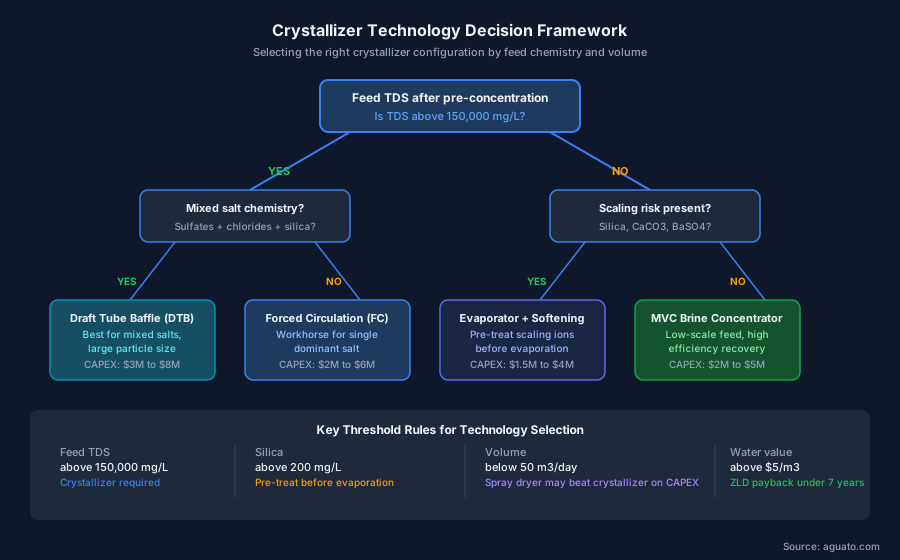
The decision framework above is a starting point. [Industrial water treatment companies](/industrial-water-treatment-companies) that specialise in ZLD will run a water-matrix model against your actual feed data before committing to a configuration recommendation.
## Real-world examples and trade-offs
Example 1: Power plant cooling-tower blowdown, US Southwest
A 500 MW coal-fired plant was discharging 800 m3/day of cooling-tower blowdown at 12,000 mg/L TDS. State regulators issued a consent order requiring ZLD within 36 months. The project team installed a 4-stage RO train concentrating blowdown to 70,000 mg/L TDS, an MVC brine concentrator at 200 m3/day (the 75% reject from RO), and a forced-circulation crystallizer at 20 m3/day (the 10% reject from the brine concentrator). Total CAPEX: $14.2 million. OPEX: $4.20 per cubic metre of original feed. Payback: 6.8 years against avoided disposal fees and recovered water at $3.80 per cubic metre local replacement cost. The trade-off accepted was a 22-month construction programme that required interim trucking of brine at $0.90 per cubic metre, adding $530,000 in interim costs.
Example 2: Textile dyeing facility, South Asia
A 2,000-worker textile plant in Gujarat, India was discharging 600 m3/day of dye-heavy wastewater at 25,000 mg/L TDS and 4,500 mg/L COD. The state Pollution Control Board had issued a closure notice. The installed train included advanced oxidation for COD reduction, multi-effect evaporation (not MVC) exploiting waste steam from the boiler house at 6 bar, and a draft-tube baffle crystallizer producing mixed salt cake at 1.8 tonnes per day. Total CAPEX: $6.8 million. OPEX: $3.10 per cubic metre of feed, lower than expected because waste steam reduced evaporator energy cost by 60%. The trade-off was the mixed salt cake (sodium chloride contaminated with dye residuals) had no commodity value and required hazardous-waste landfill at $45 per tonne. A follow-up selective crystallization stage to separate salt streams was quoted at an additional $2.1 million and declined on ROI grounds. The textile-specific colour-removal stack that feeds this kind of ZLD architecture (and the discharge-versus-reuse architecture decision that determines whether the plant ever reaches a ZLD train at all) is covered in our [textile wastewater colour removal guide](/resources/textile-wastewater-color-removal).
Example 3: Pharmaceutical wastewater, EU (Western Europe)
A pharmaceutical manufacturer in Germany was generating 50 m3/day of process wastewater at 90,000 mg/L TDS, dominated by sodium sulfate. EU Industrial Emissions Directive compliance required 99%+ water recovery. The chosen configuration was a TVR brine concentrator (3.5 bar steam from existing utility) at 40 m3/day and a DTB crystallizer at 5 m3/day producing high-purity sodium sulfate at 99.2% purity for resale to detergent manufacturers at EUR 95/tonne (approximately $105/tonne). Total CAPEX: EUR 3.4 million ($3.74 million). Annual byproduct revenue: EUR 95,000 ($105,000). OPEX offset by byproduct revenue reduced net OPEX from EUR 18.20 to EUR 12.80 per cubic metre. The lesson: small volume plus high-purity single-salt chemistry is the profile where DTB and selective crystallization deliver the best lifecycle economics.
## Failure scenarios: what goes wrong and what it costs
Scenario 1: Silica fouling of brine concentrator tubes
Decision: Operator specifies only antiscalant dosing for silica control, declining the $380,000 lime-softening pre-treatment stage. Outcome: Silica scales to heat-transfer surfaces at month 14. CIP with hydrofluoric acid blend recovers 60% of capacity; tube bundle replacement required at month 28. Cost: $420,000 for tube bundle plus $180,000 in lost production during 14-day outage plus $95,000 in emergency brine trucking. Total unplanned cost: $695,000 against $380,000 avoided. Correct decision: Install lime softening from commissioning. The chemistry does not negotiate.
Scenario 2: Crystallizer scaling from barium sulfate carry-over
Decision: Pre-treatment train uses generic antiscalant dosed at standard rate. Feed water characterisation did not identify elevated [barium](/elements/barium) at 8 mg/L. Outcome: Barium sulfate (Ksp = 1.1 x 10⁻¹⁰) precipitates preferentially on crystallizer heat exchanger at month 9. Removal requires chemical dissolution with EDTA at $220/litre concentration, consuming 180 litres per cleaning event. Cost: $39,600 per cleaning event, required quarterly after month 9. Annual additional OPEX: $158,400. Over a 10-year operating period: $1.58 million against a $25,000 feed characterisation study and $60,000 targeted antiscalant reformulation. Correct decision: Full feed-water characterisation including trace metals before finalising antiscalant specification.
Scenario 3: Crystallizer undersizing driven by feed-volume optimism
Decision: Capital project team bases crystallizer sizing on nominal RO recovery of 85%, implying 15% reject. Actual RO recovery under production conditions averages 72%, implying 28% reject. Outcome: Crystallizer operates at 187% of design hydraulic load from month 3. Crystal slurry residence time drops from 4 hours to 2.1 hours, producing a fine, uncentrifugable crystal fraction that overloads the cake dryer. Cost: $1.1 million centrifuge upgrade plus $340,000 in dryer modification. Three months of reduced throughput cost $620,000 in lost production. Correct decision: Size crystallizer on worst-case RO recovery (65 to 70%) not nominal. The $280,000 in additional crystallizer vessel cost is a fraction of the retrofit.
Understanding [brine management and disposal](/resources/brine-management-disposal) practices for the volumes that escape ZLD treatment is critical to avoiding permit violations during system commissioning and startup.
## Building the business case for capital approval
ZLD systems are capital-intensive and the business case must be built in the language of the CFO, not the engineer. The four financial levers that make or break ZLD capital approval are: avoided disposal cost, recovered water value, regulatory penalty avoidance, and water-scarcity optionality. None of these is small and none of them belongs in the narrative as a qualitative benefit.
Avoided disposal cost is the easiest to quantify. Industrial brine disposal at a licensed facility runs $0.40 to $6.00 per cubic metre in the US, $1.20 to $12.00 in the EU, and up to $25 per cubic metre in water-stressed Middle East jurisdictions where trucking distances are long. For a 500 m3/day facility, the annual disposal bill at $3 per cubic metre is $547,500. At $8 per cubic metre, it is $1.46 million per year. Those are the avoided-cost numbers that ZLD CAPEX must beat on NPV.
Recovered water value is the second lever. A ZLD train recovering 98% of 500 m3/day at a replacement water cost of $4 per cubic metre generates $693,000 per year in avoided water purchases. At $8 per cubic metre in a stressed basin, that number reaches $1.39 million per year.
Regulatory risk is harder to put a precise number on but is often the deciding factor. [Industrial water treatment companies](/industrial-water-treatment-companies) that have worked through consent orders report that the cost of a single enforcement action, including legal fees, remediation bonds, and reputational impact on operating permit renewals, typically runs $500,000 to $5 million for a mid-size facility. That risk premium belongs in the ZLD financial model as a probability-weighted annual cost.
Water-scarcity optionality is the ESG lever. Facilities operating in basins with water-risk scores above 3.0 on the [WRI Aqueduct tool](dofollow:https://www.wri.org/aqueduct) face the real possibility of production curtailment as withdrawals are capped. A ZLD system that recycles 98% of process water insulates production against that risk for the life of the asset. For a manufacturing facility with $50 million in annual revenue, even a 5% curtailment probability translates to a $2.5 million expected annual exposure. Quantifying that exposure and presenting it as a reduction in enterprise risk is what converts a compliance project into a strategic investment in the capital committee.
For facilities that need a structured comparison of technology options before entering the CAPEX process, the Nepti platform models your water matrix and produces a ranked comparison of ZLD technology configurations with cost projections calibrated to your feed chemistry and volume, so you enter the RFP process with a defensible technology specification rather than a vendor's preference. Visit [/nepti](/nepti) to run the analysis.
The [US EPA guidance on zero liquid discharge and brine minimization](dofollow:https://www.epa.gov/sites/default/files/2019-10/documents/guide_to_industrial_assessments_for_pollution_prevention_and_energy_efficiency.pdf) provides a regulatory framework baseline for US-regulated facilities building a compliance case. For EU Industrial Emissions Directive applicability, the [EUR-Lex Industrial Emissions Directive](dofollow:https://eur-lex.europa.eu/legal-content/EN/TXT/?uri=CELEX%3A32010L0075) establishes the best-available-techniques reference documents that define the regulatory floor.
The full ZLD financial model should include a sensitivity table showing CAPEX payback at water values of $2, $4, $6, and $8 per cubic metre, and at disposal costs of $1, $3, $6, and $10 per cubic metre. That 4x4 matrix gives the capital committee a clear view of which combinations make the project approvable and which require a policy change or technology option to close the gap. The [industrial water reuse and recycling](/resources/industrial-water-reuse-recycling) case library provides real project IRR data to anchor those sensitivity ranges.
## FAQ
### What is the difference between a brine concentrator and a crystallizer in a ZLD system?
A brine concentrator takes dilute reject brine, typically at 30,000 to 80,000 mg/L TDS, and concentrates it to 150,000 to 250,000 mg/L TDS while recovering clean distillate water; a crystallizer takes that concentrated brine past the saturation point, nucleating and growing solid salt crystals that are separated by centrifuge and dryer into a dry cake. The brine concentrator handles the bulk of the volume (typically 85 to 95% of the feed exits as distillate) and dominates the energy and capital cost of the ZLD train. The crystallizer handles only the final 5 to 15% of the volume but is essential for achieving true zero liquid discharge.
### How much energy does a full ZLD evaporation and crystallization system consume?
A full ZLD system combining a mechanical vapour recompression brine concentrator and a forced-circulation crystallizer typically consumes 50 to 120 kWh per cubic metre of original feed water processed. The wide range reflects the proportion of the feed volume that reaches each stage, the salt chemistry (which governs CIP frequency and heat-transfer efficiency), and whether waste steam is available to substitute for electrical vapour recompression. RO pre-concentration at 3 to 5 kWh/m3 handles the bulk-volume reduction and is the most energy-efficient part of the ZLD train; the thermal stages handle only the residual concentrated fraction.
### What feed pre-treatment does a ZLD evaporator require?
The non-negotiable pre-treatment steps for a ZLD brine concentrator feed are lime softening to reduce calcium and magnesium below 5 mg/L as CaCO3, silica precipitation to below 50 mg/L, and pH adjustment to 6.5 to 8.5. Silica above 200 mg/L will foul heat-transfer surfaces irreversibly within 6 to 18 months. Barium above 2 to 3 mg/L requires targeted antiscalant selection. Skipping pre-treatment to save capital is a false economy: a single tube-bundle replacement event costs $150,000 to $600,000 against $300,000 to $800,000 for the avoided pre-treatment train.
### How long does a ZLD evaporation and crystallization system take to pay back?
Payback period for a ZLD thermal system ranges from 4 to 18 years depending on three variables: local water tariff (replacement cost of recovered water), disposal cost per cubic metre of brine, and volume treated. At a combined water-plus-disposal value of $8 per cubic metre, a well-designed system can achieve payback in 5 to 7 years on OPEX savings alone. At $3 per cubic metre combined, payback extends to 12 to 18 years and the project typically requires a regulatory compliance driver to reach approval. The [WRI Aqueduct water-risk tool](dofollow:https://www.wri.org/aqueduct) can anchor the water-scarcity component of the financial model.
### When should a draft-tube baffle crystallizer be chosen over forced circulation?
Choose a draft-tube baffle (DTB) crystallizer when the feed contains mixed salt chemistry (sulfates plus chlorides), when recovered salt must meet commodity-buyer particle-size specifications, or when the concentrate contains organics or scaling ions that would rapidly foul the external heat exchanger of a forced-circulation unit. DTB CAPEX is 30 to 50% higher than forced circulation for the same capacity, but the larger, more uniform crystals it produces reduce centrifuge energy and dryer throughput requirements by 15 to 25%, and open the door to byproduct salt revenue that can reach $80 to $200 per tonne for high-purity sodium chloride or sodium sulfate streams.
### What is the typical water recovery rate for a ZLD system with evaporation and crystallization?
A correctly designed ZLD train combining RO pre-concentration, a brine concentrator, and a crystallizer achieves overall water recovery of 97 to 99.5% of the original feed volume. The RO stage typically recovers 60 to 75% of feed as permeate; the brine concentrator recovers 85 to 95% of the RO reject as distillate; the crystallizer converts the remaining liquid to a solid cake. The residual moisture in the dried cake is typically 3 to 8% w/w, meaning the liquid discharge is effectively zero for permit purposes in all major regulatory frameworks.
### How does silica affect evaporation and crystallization in ZLD systems?
Silica is the single most common cause of premature failure in ZLD evaporator systems because it forms amorphous silica scale at concentrations above 200 to 400 mg/L that bonds permanently to heat-transfer surfaces and cannot be removed by standard acid CIP cycles. Silica concentration rises proportionally with the concentration factor in the evaporator, so a feed stream entering at 150 mg/L silica will reach 2,250 mg/L at a 15x concentration factor, well into the precipitation zone. The correct mitigations are high-pH silica precipitation in pre-treatment to below 50 mg/L before the evaporator, supplemented by pH control inside the evaporator to keep silica in the more soluble monomeric form. Facilities that manage silica correctly extend tube-bundle life to the design 7 to 10 years; those that do not average 2 to 4 years.