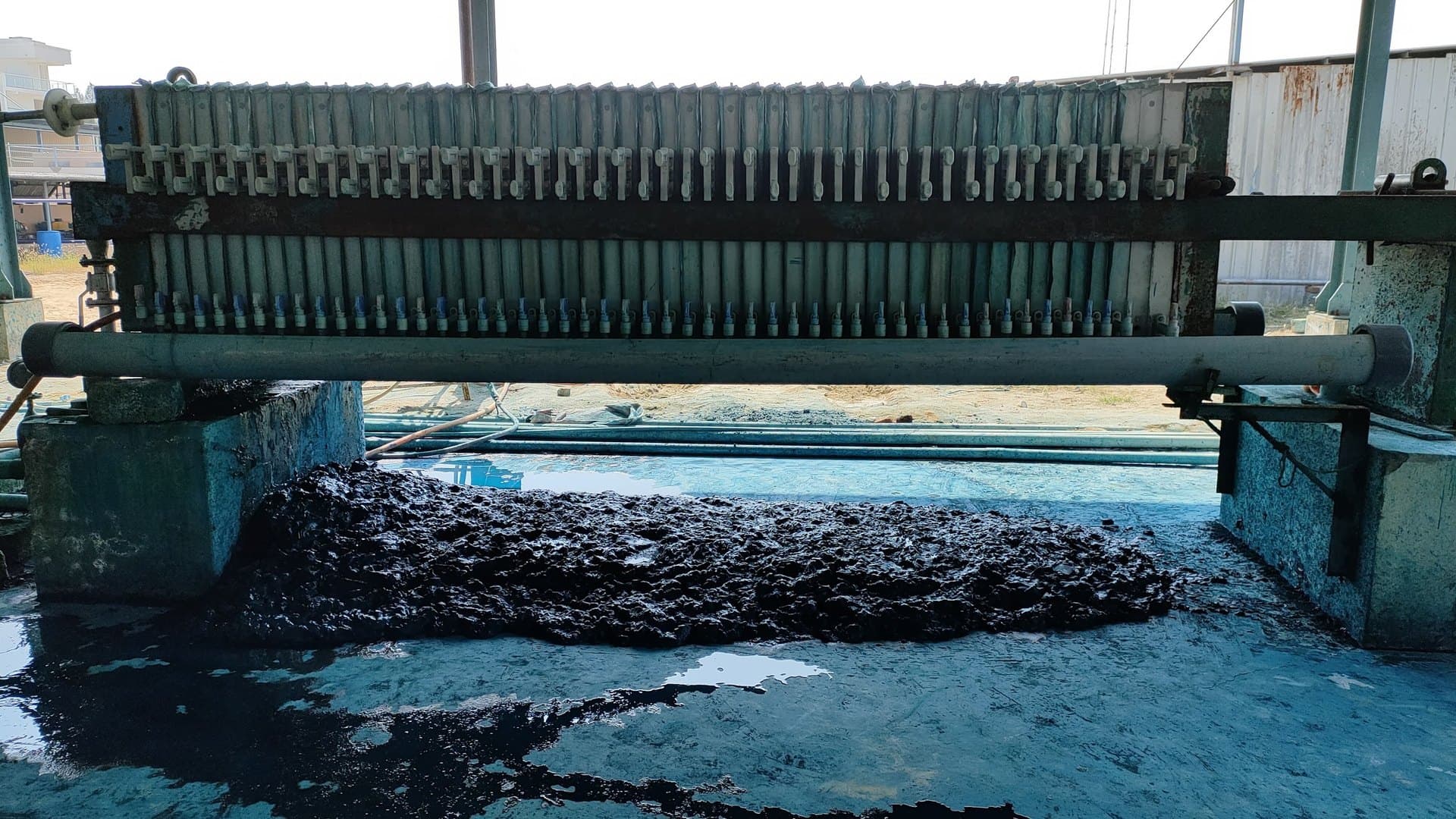
Cake dryness determines your hauling bill. Raising from 20% to 35% DS saves $49K to $128K per year. Full CAPEX, OPEX, and technology comparison for centrifuge, belt press, screw press.
Sludge dewatering is the step that determines whether your solids-handling programme is a manageable operating cost or a runaway liability. A mid-size industrial wastewater plant generating 500 tonnes of dry solids per year, shipping cake at 20% dry solids, will pay $48,000 to $128,000 more in hauling and tipping fees every year than a peer site achieving 35% cake dryness with the right dewatering technology. That cost difference dwarfs the annual OPEX premium of almost any equipment upgrade. And it compounds annually as landfill tipping fees, which have risen nearly 30% in real terms since 2016, continue climbing.
The technology decision most operations teams make is driven by the lowest capital price in the vendor proposal, not by a modelled lifecycle cost. That is the structural flaw in almost every sludge project. A centrifuge that looks expensive at $500,000 CAPEX can be the cheapest option over fifteen years when its superior cake dryness reduces hauling volume by 40%. A belt filter press that comes in at $180,000 can be the most expensive choice if its polymer consumption and wash-water demand erode the margin. Vendors will recommend whatever they sell.
This guide covers the five mainstream dewatering technologies and when each is appropriate, the full CAPEX and OPEX cost structure, a numeric decision framework for technology selection, the disposal route economics that almost always dominate lifecycle cost, failure modes and what they cost to resolve, and how to structure an RFP that forces vendors to compete on lifecycle cost rather than sticker price. It is written for the operations and environmental teams that live with the equipment and the capital projects leads who have to defend the budget line.
## The decision in brief
- Buy the 35% cake, not the 20% cake. If you invest in a dewatering technology that achieves 35% cake DS rather than accepting 20% from the lowest-CAPEX option, a mid-size industrial plant generating 500 dry tonnes per year saves $49,000 to $128,000 annually in hauling and tipping fees alone. - The equipment premium pays back in 3 to 7 years. That saving gives a simple payback of 3 to 7 years on the equipment premium and a 15-year NPV advantage of $400,000 to $1,200,000 at a 7% discount rate. - Disposal cost escalation is the biggest cost. The biggest cost of doing nothing is disposal cost escalation: US landfill tipping fees have risen 30% in real terms since 2016 and are projected to continue at 3 to 5% annually.
Every year of delay compounds the legacy cost of underperforming dewatering into the operating budget with no natural ceiling.
## What sludge dewatering actually does
Sludge dewatering is the mechanical or thermal removal of water from sludge to reduce its volume before disposal, reuse, or further treatment. Raw digested sludge typically contains 96 to 99% water; a dewatering step raises the dry solids content to 15 to 50%, cutting the mass to be hauled by 60 to 90%. The residue, called cake, is solid enough to be stackable and truck-haulable, which is what transforms sludge from a liquid-waste problem into a manageable solids-disposal problem.
The single most consequential output metric is cake dry solids (DS) percentage. Every percentage point of additional dryness reduces the wet mass leaving the site and directly reduces hauling cost. For a plant shipping 500 dry tonnes per year, the difference between 20% and 35% cake DS is roughly 1,070 fewer wet tonnes hauled annually. At US 2024 combined hauling-and-tipping costs of $45 to $120 per wet tonne, that is $48,000 to $128,000 saved every year, before any adjustment for polymer or energy differences. That number is what should anchor every technology comparison, not the nameplate CAPEX.
[Industrial wastewater treatment](/resources/industrial-wastewater-treatment) programmes generate several distinct sludge streams. Primary sludge from gravity settling is relatively dense (3 to 6% DS) and dewaters readily. Waste activated sludge (WAS) from biological treatment is fine, gelatinous, and notoriously difficult to dewater, often requiring higher polymer doses and more aggressive mechanical energy. Mixed or digested sludge falls in between. The technology that performs well on one stream may perform poorly on another, which is why bench-scale and pilot testing is non-negotiable before a major capital commitment.
## The five dewatering technologies compared
The core technology decision sits between five options, each with a distinct performance envelope, OPEX profile, and appropriate application range.
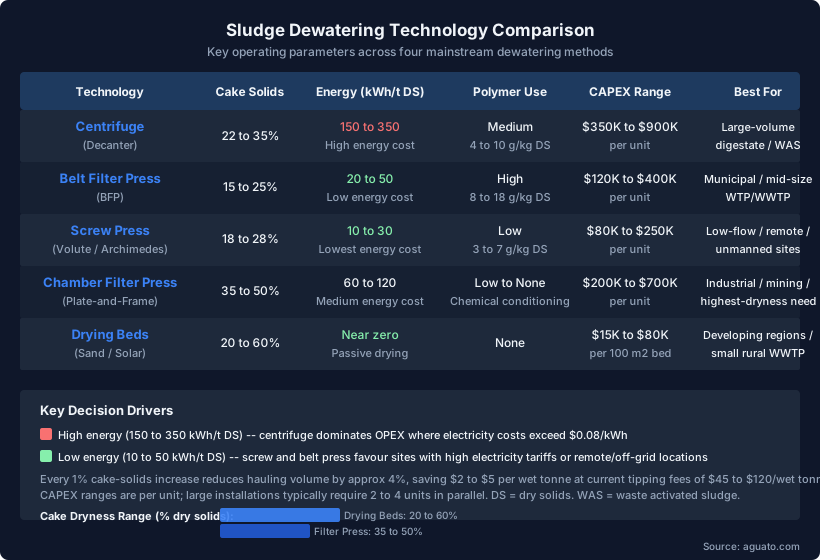
Centrifuge (decanter centrifuge). A rotating bowl spins at 2,000 to 4,000 rpm, generating centrifugal forces that separate solids from liquid in seconds. Cake DS typically reaches 22 to 35% on digested sludge. Energy consumption is high at 150 to 350 kWh per tonne of dry solids, and rotating parts wear continuously, generating maintenance costs of $15,000 to $60,000 per year per unit. The centrifuge earns its CAPEX premium of $350,000 to $900,000 in large-volume applications where throughput-per-footprint matters and labour-to-attend is limited. It does not tolerate abrasive or gritty sludge without accelerated wear.
Belt filter press (BFP). Two tensioned porous belts compress conditioned sludge between rollers, squeezing free water out mechanically. Energy consumption is low at 20 to 50 kWh per tonne DS, but polymer demand is high at 8 to 18 grams per kilogram DS. Belt wash-water consumption runs 5 to 15 m3 per tonne DS, which adds to effluent load and chemical cost. Cake DS of 15 to 25% is typically lower than a centrifuge on the same feed. CAPEX is $120,000 to $400,000 per unit. The BFP suits mid-size municipal and industrial plants where electricity is expensive, throughput is moderate, and trained operators are available. Belt replacement at $3,000 to $8,000 per belt set every 3,000 to 5,000 operating hours is the most predictable maintenance line.
Screw press (volute or Archimedes screw). A rotating screw compresses sludge along a tapering barrel, draining filtrate through a perforated drum or winding screen. Energy consumption is the lowest of any mechanical option at 10 to 30 kWh per tonne DS, roughly one-tenth the centrifuge. Polymer demand is also low at 3 to 7 grams per kilogram DS. Cake DS reaches 18 to 28% on biological sludge. The screw press is fully automatable, runs unattended, and handles intermittent flow without the warm-up requirements of a centrifuge. CAPEX of $80,000 to $250,000 makes it the entry-level mechanical dewatering option. Its limitation is throughput: a single screw press unit handles 0.5 to 5 dry tonnes per day, making it unsuitable for large-volume primary sludge applications without multiple units in parallel.
Chamber filter press (plate-and-frame). High-pressure pumping forces sludge into chambers between filter plates. The applied pressure (7 to 15 bar) squeezes cake to 35 to 50% DS, the highest dryness achievable mechanically. Energy consumption runs 60 to 120 kWh per tonne DS. Polymer is often not required when lime and ferric conditioning is used instead. CAPEX ranges from $200,000 to $700,000 per unit, and the batch operation means capital must cover peak throughput rather than average. Chamber filter presses are the technology of choice for mining, chemical, and hazardous-waste sludge where disposal route regulations require maximum dryness, or where incineration is the end route and calorific value must be preserved.
Sand drying beds. Sludge is spread over sand beds and dried by gravity drainage and evaporation over days or weeks. Energy cost is near zero. Footprint is enormous: a bed serving 500 dry tonnes per year requires roughly 3,000 to 5,000 m2. Cake DS varies from 20 to 60% depending on climate and sludge type. CAPEX of $15,000 to $80,000 per 100 m2 makes the initial investment look cheap, but land cost and climate dependency make this option viable primarily in arid developing-country applications or small rural utilities where land is free and labour costs are very low.
The technology comparison table above is the starting point for a procurement decision, not the ending point. A site-specific lifecycle cost model using your actual sludge volume, actual polymer dose response from jar testing, actual electricity tariff, and actual disposal route cost will always override the generic benchmark. Across projects we have seen in industrial and municipal environments, the disposal route economics dominate the lifecycle NPV in most cases, often contributing 40 to 60% of total cost over 15 years.
## How to choose: a numeric decision framework
Most technology decisions go wrong because the selection criteria are qualitative ("centrifuges are reliable") rather than numeric. The following threshold-based framework reduces a complex multi-variable choice to a defensible, auditable process.
Step 1: Sludge volume and composition. If your plant generates more than 5 dry tonnes per day, the screw press is likely insufficient as a sole dewatering unit without a bank of 4 or more machines. Above 10 dry tonnes per day, centrifuge or belt filter press is the primary candidate. If WAS makes up more than 60% of your sludge feed, assume polymer demand will be at the high end of any technology range; adjust your OPEX model accordingly.
Step 2: Target cake DS and disposal route. If your disposal route is incineration or co-firing, cake DS must be at least 30% for auto-thermal operation; at 35% or above, gate fees at some facilities drop significantly. If your route is agricultural land application, most Class B permits accept 20% DS. If your route is landfill, every percentage point of DS above 18% is a hauling saving. Map your disposal route first, then set the DS target, then select the technology that achieves it at minimum lifecycle cost.
Step 3: Site constraints. A screw press needs 30% less floor area than a belt press of equivalent throughput and has no wash-water demand. For brownfield retrofits, footprint and utility connections often constrain the choice more than economics. A centrifuge needs sound structural flooring rated for dynamic loads; a belt press needs a wash-water supply line of 3 to 5 bar. These are real constraints, not secondary considerations.
Step 4: Energy tariff and polymer cost. If your electricity tariff exceeds $0.10/kWh, the centrifuge's 150 to 350 kWh/t DS energy cost becomes a significant OPEX line. A mid-size centrifuge running 2,000 hours per year at 250 kWh/t DS on 50 t DS throughput spends $25,000 per year on electricity alone at $0.10/kWh. The screw press doing the same work spends $3,000. That $22,000 annual gap compounds over 15 years; it often more than offsets the higher CAPEX of a better-drying technology.
Step 5: Lifecycle cost model. Build a 15-year NPV model covering CAPEX (including installation, civil works, and electrical), annual energy cost, annual polymer cost, annual maintenance and belt/parts cost, annual labour-to-attend, and annual disposal cost (wet tonnes x cost per wet tonne). The technology with the lowest NPV wins, not the lowest CAPEX. The [industrial wastewater treatment process](/resources/industrial-wastewater-treatment-process) design should integrate the sludge train into the lifecycle model from feasibility stage, not as a retrofit after liquid-train design is frozen.
Not sure which configuration fits your site? [Browse verified industrial water treatment providers](/industrial-water-treatment-companies) who specialise in solids handling, filter by technology and region, and request scoped proposals that include a 15-year lifecycle cost model as a mandatory deliverable.
## CAPEX and OPEX: the full cost structure
Buyers consistently underestimate the total installed cost of dewatering systems because vendor quotes cover the equipment package only. The full CAPEX includes civil works, structural modifications, electrical and instrument connections, polymer dosing and conditioning equipment, sludge feed pumps, and commissioning. A good rule of thumb is to multiply the equipment CAPEX by 1.5 to 2.2 to get to total installed cost.
CAPEX ranges (total installed cost, single train): - Screw press (0.5 to 5 t DS/day): $120,000 to $500,000 installed - Belt filter press (2 to 20 t DS/day): $280,000 to $900,000 installed - Centrifuge (5 to 40 t DS/day): $600,000 to $2,000,000 installed - Chamber filter press (1 to 15 t DS/day): $400,000 to $1,500,000 installed
Large installations typically run 2 to 4 parallel trains for redundancy. A single-train design that goes offline for maintenance shuts down your entire solids-handling programme; two trains at 50% design capacity each is almost always the right engineering answer, even though it roughly doubles the equipment budget.
OPEX breakdown (per tonne of dry solids processed, indicative ranges):
Energy cost runs $0.50 to $35 per t DS, spanning from a screw press at low electricity tariffs to a centrifuge at $0.15/kWh. Polymer costs $40 to $200 per t DS depending on sludge type, polymer product, and dose. Maintenance parts run $5 to $40 per t DS, covering belt and roller replacement for BFP and scroll and wear rings for centrifuge. Labour adds $5 to $25 per t DS depending on automation level and shift structure. Disposal (hauling plus tipping) runs $90 to $600 per t DS on a dry-solids basis, a range that collapses to a single number once you know your cake DS and your disposal route cost per wet tonne.
The disposal line is the most sensitive variable in the model. A plant achieving 35% cake DS spends $180 to $340 per tonne DS on disposal at $63 average US landfill tipping fee plus $25 hauling. A plant stuck at 20% cake DS spends $315 to $600 per tonne DS on disposal for the same dry solids throughput, because it is moving 75% more wet mass. The equipment that achieves higher dryness is often the cheapest lifecycle option even at 2x the CAPEX. Vendors will not volunteer this arithmetic; the buyer must build it.
[Browse providers who can deliver solids-handling scoping and OPEX benchmarking](/consulting-services) before you freeze your technology specification.
## Disposal route economics and how they drive technology choice
Sludge disposal is the operating cost that most engineering reports bury in the assumptions. It should be the headline number that drives every upstream technology decision.
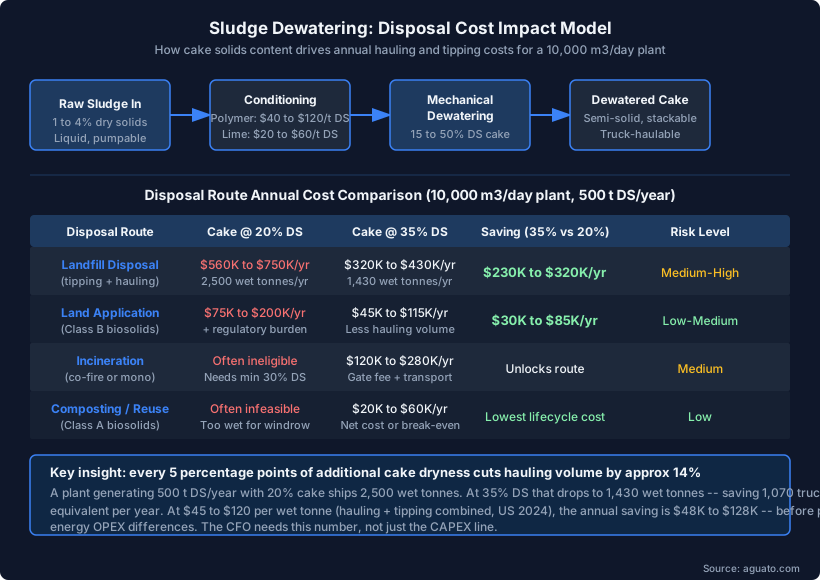
US average landfill tipping fees reached $62.28 per ton in 2024, a 10% increase over 2023 and up 30% in real terms since 2016. The Northeast US averages $80.67 per ton. Add hauling costs of $15 to $40 per wet tonne depending on distance, and total disposal cost runs $45 to $120 per wet tonne. For a plant generating 500 dry tonnes per year at 20% DS, that means 2,500 wet tonnes hauled at a cost of $113,000 to $300,000 annually, before polymer and energy. At 35% DS, the same plant hauls 1,430 wet tonnes at $64,000 to $172,000 per year. The $49,000 to $128,000 annual saving does not require any change in operations or regulatory posture. It simply requires better dewatering equipment.
The four main disposal routes each have a different DS threshold that governs viability.
Landfill disposal accepts sludge cake at any DS above roughly 15%, but facilities increasingly apply surcharges below 20% DS as free-liquid content creates leachate management costs. The minimum-dryness trend is tightening, not loosening.
Agricultural land application (Class B biosolids) is the lowest-cost route where it is permitted: $15 to $40 per wet tonne application cost versus $45 to $120 for landfill. Regulatory permits require pathogen reduction (typically anaerobic digestion or lime stabilisation) and metals compliance. [Phosphorus](/elements/phosphorus) loading limits are the binding constraint in many US states and European Member States, and they are tightening. Sites relying on this route should model a backup route in their NPV because permit conditions can change at the regulatory cycle, not the project lifecycle.
Incineration or co-firing requires cake DS of at least 28 to 30% for auto-thermal operation without auxiliary fuel. Above 35% DS, some co-firing facilities pay a gate fee offset because the cake contributes calorific value. This is the route that makes a chamber filter press economically rational: the 45 to 50% DS cake it produces qualifies for the best incineration terms and eliminates polymer costs with lime conditioning.
Composting and resource recovery requires 35% or higher DS for windrow or aerated static pile composting. When it works, composted biosolids can be sold or given away as soil amendment, turning a disposal cost into a break-even or small revenue stream. The [dissolved air flotation](/resources/dissolved-air-flotation-daf) unit upstream can improve primary sludge thickening and reduce the volume entering the dewatering system, cutting total conditioning and hauling costs before the cake even leaves the site.
A pattern that recurs across industrial installations is that sites underinvest in dewatering because they benchmark disposal cost on the current contract price rather than the 15-year trend. Contracts reset every 3 to 5 years. A tipping fee that is $55 per tonne today will likely be $75 to $90 per tonne in 10 years based on the observed trajectory. The lifecycle NPV model should stress-test disposal cost at plus 25% and plus 50% above the base case to ensure the selected technology remains the right choice even under an adverse disposal pricing scenario.
[cta:nepti]
## Conditioning: polymer and chemical costs
Conditioning is the step that makes mechanical dewatering possible. Without it, the fine colloidal particles in sludge would blind filter media, cause centrifuges to spin liquid cake, and prevent gravity thickening from working. Conditioning is also where the most variable and least-understood cost sits in the OPEX model.
Polymer conditioning uses cationic polyacrylamide (PAM) to aggregate fine sludge particles into flocs large enough for mechanical separation. Polymer costs run $1.00 to $2.50 per kilogram of active product, and optimal dose is determined by jar testing with the actual sludge. Dose varies from 3 grams per kilogram DS for well-digested primary sludge to 20 grams per kilogram DS for WAS that has been heat-treated or poorly conditioned upstream. At a dose of 10 g/kg DS and a polymer price of $1.80/kg, polymer adds $18 per tonne DS to OPEX. At 500 dry tonnes per year, that is $9,000 annually. A site with poorly optimised polymer dose running at 18 g/kg DS spends $16,200 instead. The difference looks small in isolation; combined with the disposal savings from better dryness, the optimisation payback is typically 6 to 18 months.
Lime and ferric conditioning is used in chamber filter press applications to achieve maximum cake dryness and eliminate biological activity. Lime (Ca(OH)2) addition at 150 to 300 kg per tonne DS, combined with ferric chloride at 30 to 80 kg per tonne DS, produces a dense floc that presses to 40 to 50% DS. The lime also raises pH above 12, meeting Class A pathogen reduction requirements under [US EPA 40 CFR Part 503](dofollow:https://www.epa.gov/biosolids/biosolids-laws-and-regulations) without a thermal treatment step. Chemical cost runs $30 to $90 per tonne DS at current commodity prices, lower than polymer for high-DS applications and with the added benefit of pathogen reduction qualifying the cake for a wider range of beneficial reuse routes.
Thermal hydrolysis (THP) as a pre-treatment step before anaerobic digestion and dewatering has become standard practice for large municipal wastewater plants. THP (operating at 150 to 180 degrees C, 6 to 8 bar) breaks down cell walls, doubles biogas yield, and improves dewatering characteristics of the resulting digestate. Cake DS typically reaches 28 to 35% with a centrifuge on THP digestate, versus 18 to 25% without. The capital cost of a THP unit is $2,000,000 to $5,000,000 for a 50 dry tonne per day system, with an energy penalty of 50 to 100 kWh per tonne DS. The biogas uplift of 80 to 120 kWh per tonne DS (at 60% methane conversion efficiency) typically more than offsets the energy penalty, and the improved disposal economics add further value. THP is not appropriate for small plants below 10 dry tonnes per day, where the capital cannot be amortised over the throughput.
## Failure modes and what they cost
The failure modes that produce the most expensive consequences are not mechanical failures. They are specification failures that manifest slowly over months or years.
Wrong technology for feed sludge type. A belt filter press specified for primary sludge that then receives 80% WAS after a biological process expansion is a recurring scenario. WAS at high ratios blinds the belts, doubles polymer consumption, and cuts cake DS from 22% to 14%. The result is hauling volume increases by 50%, belt replacement frequency doubles, and the operations team spends 2 hours per shift chasing belt alignment and polymer dosing. The cost is $40,000 to $120,000 per year in incremental polymer, belts, and disposal. The correct response is either a return-activated-sludge thickening step upstream, or replacement of the BFP with a centrifuge. Both options cost far more than a proper pilot test would have.
Undersized conditioning system. Polymer dosing systems that cannot maintain a consistent dose within 5% of target are the most common root cause of poor cake DS and centrate quality. Centrifuge centrate with total suspended solids above 800 mg/L returns a solids load to the front of the treatment plant, consuming aeration capacity and increasing overall sludge production. A poorly tuned polymer system can add 5 to 15% to total plant sludge generation over a year. The fix is an automated inline polymer dilution and dosing system with real-time torque feedback from the centrifuge, costing $15,000 to $40,000 and paying back in 12 to 24 months.
Scroll and wear ring failure on centrifuge. The internal scroll of a decanter centrifuge wears at a rate that depends on sludge grit content. A municipal digested sludge with good grit removal upstream has scroll wear life of 8,000 to 15,000 hours. An industrial sludge with poor grit removal can wear the scroll to rebuild tolerance in 2,000 to 4,000 hours. Scroll rebuild cost runs $60,000 to $150,000 per event, and the unit is typically offline for 6 to 10 weeks. For a plant with a single dewatering centrifuge and no backup, that means 6 to 10 weeks of sludge being held in digesters or liquid-hauled at $180 to $350 per liquid tonne. Total event cost including parts, labour, and emergency disposal easily reaches $200,000 to $500,000.
Disposal route disruption. A landfill that stops accepting dewatered sludge, a composting facility that goes out of business, or a land application permit that is suspended can strand a plant with nowhere to send its cake. Disposal route concentration is a risk that should appear in every plant operational risk register. [Water operational risk and fluid management](/resources/water-operational-risk-fluid-management) programmes designed with a primary and a secondary route are measurably more resilient: transition to the backup route takes days, not months, because the contracts and logistics are already in place.
Foaming and scaling in digestion upstream. Filamentous organisms and fats, oils and grease (FOG) ingress cause foaming in anaerobic digesters, which reduces effective digester volume and compromises dewatering characteristics of the digestate. Foam control agents at $5 to $15 per event cost little individually but can total $20,000 to $60,000 annually in a poorly managed plant. Addressing the root cause upstream (FOG pre-treatment, targeted wasting, SRT optimisation) costs $30,000 to $150,000 in process modifications but eliminates the ongoing polymer and foam-control premium.
## Sector-specific examples
Food and beverage processing. A large dairy processing facility generating 8 dry tonnes per day of combined primary and biological sludge evaluated three dewatering options. The centrifuge delivered 28% cake DS, the belt press delivered 19%, and the screw press bank (six units) delivered 22%. At the site disposal route (landfill at $95 per wet tonne combined), the centrifuge saved $420,000 per year in disposal versus the belt press, against a CAPEX premium of $650,000. The lifecycle NPV favoured the centrifuge by $2.8 million over 15 years at a 7% discount rate. The procurement team had initially rejected the centrifuge on CAPEX grounds. The specification was only reopened after a lifecycle cost model was presented showing the disposal savings, which the original equipment vendor had not provided.
Mining and mineral processing. A copper concentrator operating a tailings thickening and dewatering circuit chose chamber filter presses over centrifuges for a specific reason: the nearby haul route priced disposal by wet tonne of material moved, and the filter press 44% average cake DS cut haul cycles by 38% versus a centrifuge producing 28% cake. Water recovery was also higher, critical in an arid basin where [mining wastewater treatment](/resources/mining-wastewater-treatment) and water reuse are regulatory priorities. The filter press batch operation was managed by sizing two presses in parallel, each running 4 cycles per day. The combined installed capital of $1,200,000 versus $800,000 for two centrifuges was recovered in 3.5 years from hauling savings alone.
These examples share a common lesson: the technology selection becomes clear once the lifecycle cost model is built with real disposal route costs, not assumed ones. The failure mode in both cases would have been accepting the lowest-CAPEX option without modelling disposal economics.
## Structuring the RFP and evaluating vendor proposals
A sludge dewatering RFP that does not mandate lifecycle cost submissions will receive comparable CAPEX quotes and incomparable OPEX estimates, making evaluation impossible. Vendors know this. The buyer job is to level the playing field.
Guaranteed cake DS at named feed conditions. Require vendors to specify a guaranteed minimum cake DS (not a "typical" value) at the pilot-tested or reference-plant feed sludge composition, DS content, and temperature. This becomes a performance bond in the contract. Vendors who cannot offer a guarantee are telling you something about their confidence in the technology for your specific feed.
Performance-linked polymer dose guarantee. Specify the maximum polymer dose (in grams per kilogram DS) at which the guaranteed cake DS must be achieved. This prevents vendors from padding their polymer assumption to deliver an easier-to-reach dryness. Some vendors in the belt press market are comfortable quoting 12 g/kg DS while running their reference sites at 18 g/kg DS on similar sludge.
15-year lifecycle cost model as a mandatory submission. Require vendors to submit a spreadsheet model covering CAPEX, installation, energy (using your local tariff), polymer (using quoted dose x current market price), maintenance schedule and parts costs, and labour estimate. You supply the disposal cost per wet tonne; vendors fill in their projected wet tonne volume based on their guaranteed cake DS. This makes the disposal saving explicit and auditable.
Site visit to a reference installation on comparable feed. Insist on a reference site visit, not just a reference list. A site visit to a facility running the same technology on the same sludge type for more than 3 years tells you more than any vendor data sheet. Ask to see the maintenance log, not just the performance log.
Pilot test before award. For projects above $500,000 installed cost, a 2 to 4 week mobile pilot test on your site is standard practice and costs $15,000 to $40,000 including sludge analysis. The pilot provides jar test data for polymer optimisation, real cake DS data on your feed, and centrate quality data. It is the most valuable $20,000 a project team can spend, and many vendors will offer it at no cost because a successful pilot test converts to a won order.
The right technology depends on your feed water characteristics, sludge composition, and disposal route. [Post your project on Aguato](/post-project) and qualified solids-handling specialists will scope the technology comparison and lifecycle cost model against your actual numbers.
## Regulatory and ESG considerations
Sludge disposal is one of the most tightly regulated aspects of industrial water management, and the regulatory direction across all major jurisdictions is toward tighter limits, not looser ones. Understanding the regulatory trajectory over a 10 to 15 year asset life is part of any defensible technology decision.
US EPA Part 503 Biosolids Rule sets the standards for sewage sludge use and disposal, including pathogen reduction (Class A and Class B), vector attraction reduction, and cumulative pollutant loading limits for metals including arsenic, cadmium, copper, lead, mercury, molybdenum, nickel, selenium, and zinc. For industrial sludge that qualifies as biosolids, compliance with Part 503 is the gateway to land application. The European equivalent, the [EU Sewage Sludge Directive](dofollow:https://environment.ec.europa.eu/topics/water/water-policy_en), is currently under revision with proposed tightening of metal and PFAS limits that could restrict land application for a wider category of industrial sludge in coming years.
Sustainability directors increasingly face internal and investor pressure to document the carbon footprint of sludge disposal. A facility shipping liquid sludge by tanker has a measurably higher Scope 3 emissions profile than one shipping dewatered cake by truck, and the difference becomes reportable under GHG Protocol accounting. The carbon argument is the one that converts ESG budget into engineering budget: better dewatering is measurably greener, and the savings are auditable against the site water and waste targets.
PFAS in biosolids is the emerging regulatory risk with the highest potential impact on land application as a disposal route. The US EPA PFAS Strategic Roadmap and state-level actions (Michigan, Maine, and others have already restricted or banned PFAS-impacted biosolids from agricultural land) create a tail risk for any facility relying on land application as its primary disposal route. The conservative posture is to assume land application will face additional restrictions over the next 10 years and model disposal economics with landfill or incineration as the backstop, even if the current regulatory environment permits land application.
For facilities inside an [industrial water treatment plant design](/resources/water-treatment-plant-design) or process redesign, the solids-handling design should be integrated from the start, not retrofitted after the liquid train is fixed. The sludge volume, characteristics, and disposal route should be defined in the feasibility study, not the detailed design phase.
Not sure how the regulatory landscape applies to your specific sludge classification? [Browse verified consulting services providers](/consulting-services) to find regulatory and process engineers with current knowledge of Part 503, the EU Sewage Sludge Directive revision, and emerging PFAS guidance for your jurisdiction.
## FAQ
### What is sludge dewatering and why does it matter?
Sludge dewatering is the mechanical removal of water from wastewater treatment sludge to produce a semi-solid cake that can be safely transported and disposed of. It matters commercially because disposal is priced per wet tonne: raising cake dry solids from 20% to 35% cuts the wet mass hauled by 43%, reducing annual hauling and tipping costs by $49,000 to $128,000 for a plant generating 500 dry tonnes per year. The step also determines which disposal routes are available, since incineration and composting require minimum cake dryness thresholds of 28 to 35% DS before they become viable or cost-effective.
### Which sludge dewatering technology produces the driest cake?
Chamber filter presses (plate-and-frame) consistently produce the highest cake dry solids of any mechanical dewatering technology, typically 35 to 50% DS with lime-ferric conditioning. Centrifuges achieve 22 to 35% DS on well-digested sludge. Belt filter presses and screw presses typically reach 15 to 28% DS. The driest cake is not always the most economic choice: filter presses are batch-operated, require significant footprint, and carry higher maintenance cost. The right technology is the one with the lowest 15-year lifecycle cost for your specific sludge volume, disposal route, and site constraints.
### How much does a sludge dewatering system cost?
Total installed cost ranges from $120,000 to $500,000 for a screw press system serving 0.5 to 5 dry tonnes per day, $280,000 to $900,000 for a belt filter press, $600,000 to $2,000,000 for a centrifuge system, and $400,000 to $1,500,000 for a chamber filter press. These installed cost ranges include conditioning equipment, sludge feed pumps, civil works, and electrical connections. Equipment-only quotes from vendors will be 50 to 100% lower than total installed cost. Operating cost (energy, polymer, maintenance, and disposal combined) typically exceeds the original CAPEX within 3 to 5 years of operation, which is why lifecycle modelling matters more than the purchase price.
### What is cake dry solids (DS) and how is it measured?
Cake dry solids percentage is the mass of solid material remaining after drying a representative cake sample to constant weight at 105 degrees C, expressed as a percentage of the original wet cake mass. It is measured by weighing a known mass of fresh cake, oven-drying it for 24 hours, and reweighing. A cake that weighs 100 grams fresh and 28 grams dry has a DS of 28%. This single number determines the wet mass shipped per tonne of dry solids processed and is the most consequential performance metric for any dewatering system. Vendors sometimes report DS on polymer-conditioned floc samples rather than pressed cake; insist on guaranteed final cake DS values from pilot tests, not from a data sheet.
### How is polymer dose optimised for sludge dewatering?
Polymer dose is optimised by jar testing: small batches of sludge are conditioned with increasing polymer doses under defined mixing conditions, and the resulting floc is evaluated for cake release and drainage rate. The optimal dose is the lowest dose that achieves target cake DS without excess polymer carry-over into the centrate or filtrate, which would increase return loads to the liquid train. Optimal doses shift as sludge characteristics change with season, feed variability, or upstream process changes. Fully automated polymer dosing systems with real-time torque or centrate turbidity feedback maintain the optimal dose continuously and reduce polymer consumption by 10 to 20% compared to manual setpoint control, at a cost of $15,000 to $35,000 for the automation upgrade.
### What are the main sludge disposal routes and which is cheapest?
The four main disposal routes in order of typical cost are: land application as Class B biosolids ($15 to $40 per wet tonne where permitted), composting or beneficial reuse (break-even to $20 per wet tonne where markets exist), landfill disposal ($45 to $120 per wet tonne including hauling), and incineration or co-firing ($80 to $200 per wet tonne gate fee plus transport, partially offset by energy credit at some facilities). Land application is cheapest but faces increasing regulatory scrutiny, particularly from PFAS contamination concerns and phosphorus loading limits. The [US EPA biosolids regulations](dofollow:https://www.epa.gov/biosolids/biosolids-laws-and-regulations) set the floor for land application eligibility in the US; European facilities must comply with the EU Sewage Sludge Directive. Every facility should model at least two disposal routes in its NPV to manage route disruption risk over the asset life.
### How long does a sludge dewatering system last and what maintenance does it need?
A well-maintained centrifuge has a mechanical life of 15 to 20 years, with major overhauls (scroll rebuild, bearing replacement) every 8,000 to 15,000 operating hours at $60,000 to $150,000 per event. Belt filter press belts require replacement every 3,000 to 5,000 hours at $3,000 to $8,000 per belt set, with rollers lasting 5 to 8 years. Screw presses are the lowest-maintenance option with screen and screw replacement intervals of 10,000 to 20,000 hours. Chamber filter presses require regular cloth replacement every 2 to 5 years per plate-set at $20,000 to $80,000 per replacement, plus hydraulic system maintenance. In all cases, the maintenance cost per tonne of dry solids processed is highest when the system is oversized for actual throughput, because the fixed maintenance events still occur on calendar intervals regardless of how much sludge the machine has processed.