The wrong industrial water storage tank costs operators $50,000 to $500,000 in rework. Here is how to match concrete, bladder, steel, or GRP to duty, volume, and budget.
The industrial water storage tank market looks deceptively simple from the outside: a vessel holds water, water is used, the vessel refills. In practice, procurement teams that treat tank selection as a commodity decision routinely absorb costs of $50,000 to over $500,000 in rework, liner retrofits, and emergency hire charges when the original choice turns out to be wrong for the duty. A 2,000 m3 in-situ concrete reservoir commissioned for a fire-water reserve that develops alkali-silica cracking after eight years, or a pillow bladder specified for a permanent process buffer that fails its liner at 18 months of continuous chemical exposure, both represent the same root error: mismatching tank technology to the application before a single cubic metre of concrete is poured or a roll of fabric is delivered.
The consequences scale with the volume stored. Fire-water reserves, potable buffer stores, and emergency response stockpiles each carry regulatory minimums. A factory that cannot demonstrate the required 2-hour fire-fighting volume to its insurer faces policy invalidation; a water utility that cannot produce NSF/ANSI 61 certification paperwork for its potable-service reservoir faces enforcement action from the EPA or equivalent authority. The financial exposure in these cases far exceeds the difference in installed cost between tank types.
This guide gives procurement engineers, plant managers, and CFOs a structured way to compare concrete, bladder and pillow, steel, GRP (Glass Reinforced Plastic), FRP (Fibre Reinforced Plastic), and HDPE tanks across every dimension that determines total cost of ownership: installed CAPEX per cubic metre of storage, service life, site footprint, mobility, regulatory compliance burden, and operational risk. Hard numbers, real case studies, and a threshold-based decision framework follow.
## The decision in brief
- Replace prescriptive procurement with a threshold-based comparison. A plant or utility that replaces a reactive, technology-prescriptive tank procurement approach with a threshold-based comparative process typically saves 15 to 25 percent on installed CAPEX. - Get the material right on the single tank. Over a 40-year asset life on a 1,000 m3 permanent concrete reservoir versus a two-cycle-relined steel equivalent, the NPV advantage of the correct material selection is approximately $70,000 to $130,000, before accounting for downtime avoidance. - Multiply across the estate. Across a multi-site estate with 10 or more storage assets, the total financial leverage of systematic selection is in the range of $500,000 to $2 million over the asset lives involved.
Staying with reactive, technology-prescriptive procurement keeps the $50,000 to $500,000 rework exposure that comes from mismatching tank type to duty.
## The Five Tank Technologies at a Glance
Industrial water storage is served by five principal material families, each with a different cost profile, service life expectation, and suitability envelope. Understanding where each technology sits on the risk-cost curve is the first step toward a defensible procurement decision.
Concrete tanks (in-situ cast or precast) are the backbone of large-scale permanent storage. Installed costs typically run $80 to $250 per m3 of usable capacity, depending on site conditions, wall thickness, and specification for potable or non-potable duty. Properly designed and maintained concrete tanks last 40 to 60 or more years. The American Water Works Association (AWWA) standards D110 and D115 cover prestressed and wire-wound concrete tanks respectively, and compliance with these standards is a near-universal requirement for municipal potable service.
Bladder and pillow tanks (flexible fabric vessels) occupy the opposite end of the permanence spectrum. These are purpose-built for temporary, emergency, or relocatable storage duties. Installed costs range from $20 to $80 per m3 for smaller units, and service life is typically 5 to 15 years depending on UV exposure, chemical contact, and handling frequency. Their defining advantage is near-zero civil works requirement: a bladder tank rated for 500 m3 can be deployed on a flat graded surface in 24 to 48 hours by a small crew.
Carbon steel and stainless steel tanks (bolted or welded construction) cover a wide middle ground. CAPEX runs $50 to $180 per m3. Carbon steel requires internal epoxy or glass lining for potable or corrosive-liquid duty; stainless steel commands a 30 to 50 percent premium but eliminates most corrosion risk. Service life is 20 to 40 years, dependent on coating maintenance cycles every 10 to 15 years.
GRP and FRP tanks combine good corrosion resistance with relatively light weight. Installed costs of $90 to $220 per m3 sit above steel but below complex in-situ concrete, and service life is 25 to 35 years. GRP and FRP are particularly favoured for chemical storage and for small to medium potable reserves where NSF/ANSI 61 pre-certified panels are available off the shelf from multiple manufacturers.
HDPE tanks (High Density Polyethylene, modular or moulded) offer fast installation and good chemical resistance at $40 to $130 per m3. They are capped at around 500 m3 for single-vessel moulded units, though modular panel systems can reach larger capacities. Service life is 20 to 30 years. HDPE is the most common choice for chemical dosing day-tanks, small process buffer stores, and low-volume rainwater harvesting applications.
[cta:nepti-dark]
With the five technology families established, the next step is to compare them directly. The matrix below sets out installed cost, service life, capacity range, and best-fit duty side by side, so the trade-offs that drive a defensible procurement decision are visible at a glance.
## Tank-Type Comparison: Cost, Lifespan, and Best Use
The table below consolidates the five tank families across the dimensions that drive procurement decisions. All CAPEX figures represent installed cost excluding major civil infrastructure (foundations, earthworks, access roads) because civil costs vary enormously by site. NSF/ANSI 61 potable-water certification compliance typically adds $15,000 to $40,000 or more in lining, testing, and documentation costs for concrete and steel tanks; GRP and HDPE panels are more commonly available pre-certified from the manufacturer.
| Tank type | Installed CAPEX (USD per m3) | Service life | Capacity range | Best use | |---|---|---|---|---| | Concrete (in-situ / precast) | $80 to $250 | 40 to 60+ years | 100 to 100,000+ m3 | Large permanent potable or fire reserve | | Bladder / pillow | $20 to $80 | 5 to 15 years | 0.5 to 5,000 m3 | Temporary, emergency, relocatable | | Steel (carbon / stainless) | $50 to $180 | 20 to 40 years | 50 to 10,000 m3 | Medium permanent, fast install | | GRP / FRP | $90 to $220 | 25 to 35 years | 5 to 5,000 m3 | Corrosive duty, pre-certified potable | | HDPE | $40 to $130 | 20 to 30 years | 0.5 to 500 m3 | Chemical day-tanks, small buffers |
Three observations on this matrix. First, the lowest CAPEX option is almost never the lowest total-cost-of-ownership option over a 20-year horizon, particularly once you factor in relining cycles for steel tanks and replacement intervals for bladder tanks in permanent-adjacent duty. Second, the footprint differential between concrete and bladder storage at the same volume is smaller than most engineers expect: a 500 m3 bladder pillow tank typically requires a cleared flat area of roughly 25 to 35 m by 10 to 15 m, which is not dramatically smaller than a precast concrete equivalent. What changes is the civil works burden, not the footprint. Third, potable certification is not a binary add-on: specifying NSF/ANSI 61 compliance from the outset shapes the entire procurement path, from material selection to inspection regime to documentation chain.
One critically underrated dimension is capacity range by technology. Bladder tanks are commercially available from as little as 0.5 m3 up to around 5,000 m3 for specialist military or disaster-response units, though the economic sweet spot is 10 to 1,000 m3. In-situ concrete is the only technology routinely used above 50,000 m3, where it has no practical competitor. GRP panel tanks top out at around 5,000 m3 per installation in practice. Matching the technology to the volume band before evaluating cost is essential.
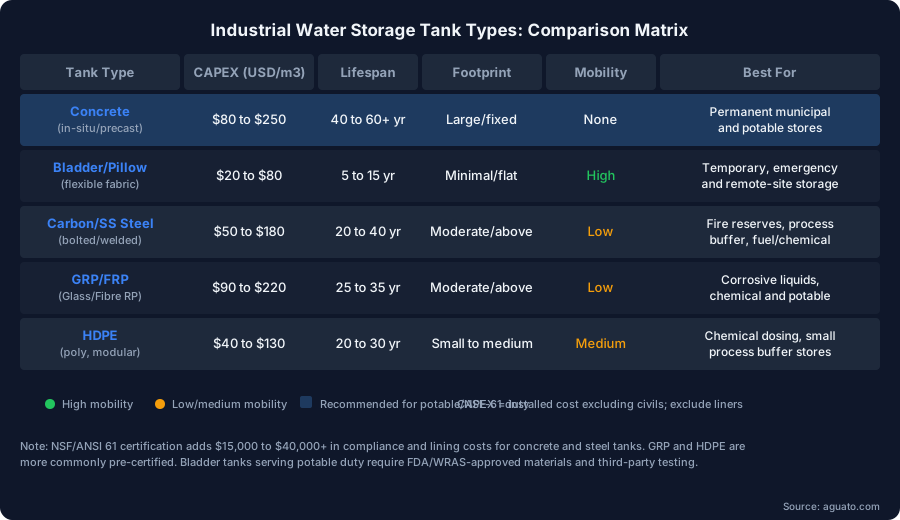
Read together, these dimensions show why the cheapest tank at purchase is frequently the most expensive over its service life. The regulatory layer adds a further constraint that can override the cost ranking entirely, which is where the next section begins.
## Regulatory Landscape: NSF/ANSI 61, AWWA, and ISO
Water storage tanks in contact with drinking water or water destined for human consumption must comply with [NSF/ANSI 61](dofollow:https://www.nsf.org/knowledge-library/nsf-ansi-61-drinking-water-system-components-health-effects), the North American standard governing health effects of materials in contact with potable water. This standard applies to liners, coatings, sealants, and gaskets as well as the tank body itself. Failure to specify NSF/ANSI 61 compliant materials in a potable-service application is not merely a regulatory risk; it creates liability exposure for every litre of water consumed downstream.
For concrete tanks, the AWWA D110 and D115 standards define design, fabrication, and testing requirements for wire-wound and prestressed concrete tanks respectively. The AWWA D103 standard covers factory-coated bolted steel tanks, and AWWA D100 governs welded carbon steel tanks. These standards are not optional for any facility connected to a regulated water supply: utility engineers and insurers will ask for compliance documentation.
At the international level, ISO 28765 covers the design and construction of prestressed concrete tanks for liquids. For facilities operating under both North American and European or Asian regulatory regimes, aligning to both NSF/ANSI 61 and the relevant ISO standard from the outset avoids costly retrospective compliance work.
For non-potable industrial applications such as fire-water reserves, cooling-tower make-up stores, and process buffer tanks, the regulatory bar is lower but not absent. Fire codes in most jurisdictions mandate minimum reserve volumes and flow rates that must be demonstrated during commissioning and annual inspection, and secondary-containment rules apply to tanks storing certain chemicals. The [NFPA 22 standard for water tanks for private fire protection](dofollow:https://www.nfpa.org/codes-and-standards/nfpa-22-standard-development/22) defines the design, capacity, and inspection requirements that property insurers reference when validating a site's fire-water reserve.
A pattern that recurs at tank commissioning audits is worth flagging. The single most common documentation failure is the absence of a chain-of-custody certificate for the internal coating or liner, proving that the material applied on site is the same NSF/ANSI 61 certified product specified in the design. This costs nothing to get right at procurement and can delay commissioning by weeks if missed.
## Real-World Applications and Trade-Offs
Case study 1: Emergency fire-water reserve at a petrochemical site. A mid-size petrochemical terminal in the Gulf Coast region required 3,500 m3 of dedicated fire-water reserve as a condition of their property insurer and site fire plan. The initial specification called for two bolted carbon steel tanks with epoxy-glass lining, estimated at $580,000 installed. A value-engineering review substituted one in-situ concrete ring-beam tank at 3,500 m3 for $490,000 installed, with a projected 50-year service life and zero relining requirement for the first 25 years. The saving of $90,000 at construction was amplified by avoided relining costs of $120,000 at the 12-year cycle that the steel option would have required, giving a 20-year net present value advantage of approximately $180,000 for the concrete solution. The trade-off: an 11-month construction programme versus 14 weeks for the steel option, which created a temporary insurance gap managed with a 1,000 m3 hire bladder at $28,000 for the duration.
Case study 2: Emergency water storage for a humanitarian response. A logistics operator supporting emergency water distribution after a flooding event in Southeast Asia needed 800 m3 of potable-grade storage deployable within 72 hours at three separate distribution points. Pillow bladder tanks, 8 units of 100 m3 each in potable-approved fabric, were airfreighted and deployed by 6-person crews in 36 hours per site. Total deployed cost including fabric, frames, liner, and logistics was approximately $85,000. After a 90-day deployment the tanks were deflated, packed, and reused at a subsequent event, reducing the per-event cost significantly. The key limitation: the approved flexible liner required full drainage, UV inspection, and patch-testing every 30 days in potable-water service, adding 12 hours of technician time per month per site.
Case study 3: Industrial rainwater harvesting at a manufacturing campus. A European automotive manufacturer integrated 2,400 m3 of underground concrete cisterns into a new paint-shop building as part of an [industrial rainwater harvesting systems](/resources/industrial-rainwater-harvesting-systems) programme. The decision to specify concrete over GRP panel tanks reflected two constraints: the tanks were below-slab (ruling out any above-ground option), and the facility required 40-year design life with no disruption to production for maintenance. Concrete cisterns at $185 per m3 installed cost $444,000; the GRP equivalent above-grade would have been $165 per m3 for the vessels alone, but site access and structural integration for below-grade installation would have pushed total cost above the concrete figure while reducing design life to 25 years. The concrete solution also provided inherent thermal mass that reduced summer temperature swings in the collected water, lowering biological treatment demand.
The common thread across all three cases is that the winning technology was chosen against the specific duty, the permanence, the volume, the compliance class, and the site, rather than against a generic preference for one material. Buyers who run a like-for-like comparison across qualified suppliers in every relevant technology family consistently land a better total cost than those who default to whatever material their last project used.
A defensible decision needs a way to anticipate where the wrong choice bites, which is why the failure analysis below is as important as the cost table above.
## Failure Scenarios: When the Wrong Tank Costs You
The most expensive tank decisions are the ones that look correct at purchase but reveal their flaws in service. Four failure patterns recur across industries.
Failure pattern 1: Bladder tank specified for permanent high-cycle duty. A food and beverage plant specified a 250 m3 pillow bladder as a permanent process water buffer because the bladder supplier offered the lowest tender price at $32 per m3 installed. Within 18 months, the continuous fill-and-drain cycling and exposure to chlorinated make-up water had degraded the liner's internal reinforcement. A pinhole failure at 22 months caused 14 hours of production downtime valued at $340,000. Emergency replacement with a GRP tank cost $67,000. The total cost of the wrong decision: $372,000, against an incremental saving of $22,000 at procurement. The correct specification for permanent high-cycle duty is a rigid tank.
Failure pattern 2: Concrete cracking and leaching in corrosive service. An industrial laundry installed a 400 m3 in-situ concrete tank for recovered hot water reuse. The water chemistry, with elevated sodium hydroxide and detergent surfactants, was not properly characterised at design. Alkaline attack on the cement matrix caused surface carbonation and microfissuring within 6 years. The tank was not lined because the duty was classified as non-potable and the specification omitted a chemical resistance check. Remediation required applying a specialist sulphate-resistant epoxy lining at $48,000, and four weeks of downtime. A 316L stainless steel or GRP tank would have been the correct selection; the cost differential at procurement was $28,000. Concrete is excellent for chemically stable waters (pH 6 to 9, no aggressive ions) but requires careful evaluation for anything outside that envelope.
Failure pattern 3: Undersized fire-water reserve. A distribution warehouse specified a 600 m3 steel fire-water reserve based on a preliminary fire-risk assessment conducted before the facility's racking configuration was finalised. When the insurer reviewed the completed facility with high-bay racking, the required minimum reserve was recalculated at 1,100 m3. Installing a second tank required new civil works, pipework, and pump upgrades at a total cost of $195,000. A modular bolted steel tank was used for the expansion, selected for speed over economy. Proper fire-risk quantification before procurement is far cheaper than expansion after commissioning.
Failure pattern 4: GRP tank UV degradation in exposed tropical site. A water utility in a high-UV-index tropical environment specified GRP panel tanks for a rural water supply without specifying UV-stabilised resin. Surface degradation and microcracking appeared within 5 years, shortening effective service life by an estimated 12 years. The corrective measure, applying a white UV-resistant gel-coat, cost $18,000 per tank and required taking each tank out of service. The manufacturer's standard GRP product was designed for temperate climates; the correct specification was a UV-resistant grade available at a 12 percent premium from the same supplier.
## Threshold-Based Decision Framework
The decision framework below is built on numeric thresholds rather than qualitative preferences. Apply the questions in sequence: the first threshold that eliminates a technology narrows the field, and the final choice emerges from the remaining options on a cost-and-risk basis.
Threshold 1: Permanence. If the storage requirement is temporary (defined as less than 2 years at a fixed location) or must be relocatable, specify a bladder or pillow tank. If the requirement is permanent or expected to exceed 2 years, proceed to Threshold 2.
Threshold 2: Potability. If the stored water must meet potable standards (NSF/ANSI 61 in North America, BS EN 805 in the UK/EU), eliminate any tank material or coating not pre-certified for potable contact. In practice this steers toward pre-certified GRP/FRP panels, NSF-61 compliant HDPE, or concrete with a certified liner, and adds a minimum of $15,000 to the project budget for testing and documentation.
Threshold 3: Volume. Apply the following technology bands: under 50 m3, HDPE moulded or small GRP panel; 50 to 500 m3, GRP/FRP bolted or steel bolted; 500 to 5,000 m3, precast concrete or welded steel; over 5,000 m3, in-situ concrete reservoir.
Threshold 4: Site footprint and civil works tolerance. If the site prohibits significant civil works (temporary hardstanding, restricted access, above-grade structural constraints), eliminate in-situ concrete and large welded steel. Favour precast concrete, GRP panels, HDPE modular, or bladder depending on volume.
Threshold 5: Chemical compatibility. If the stored liquid is outside pH 6 to 9, contains aggressive ions (chloride above 200 mg/L, sulphate above 400 mg/L), or contains organic solvents, rule out unlined carbon steel and standard concrete. Favour stainless steel, GRP/FRP with chemical-resistant resin, or specialist-lined HDPE.
Threshold 6: Budget model. If the project must be structured as an operating expense rather than capital expenditure, a Water-as-a-Service (WaaS) hire or lease model for modular tanks or bladders is available from specialist providers. The monthly equivalent cost of leasing a 200 m3 modular steel tank typically runs $1,200 to $2,500 per month versus a one-time CAPEX of $18,000 to $36,000 for the same unit, implying a financial crossover at approximately 15 to 18 months for permanent duty. See [Water as a Service: WaaS models explained](/resources/water-as-a-service-waas) for a detailed CAPEX vs OPEX comparison.
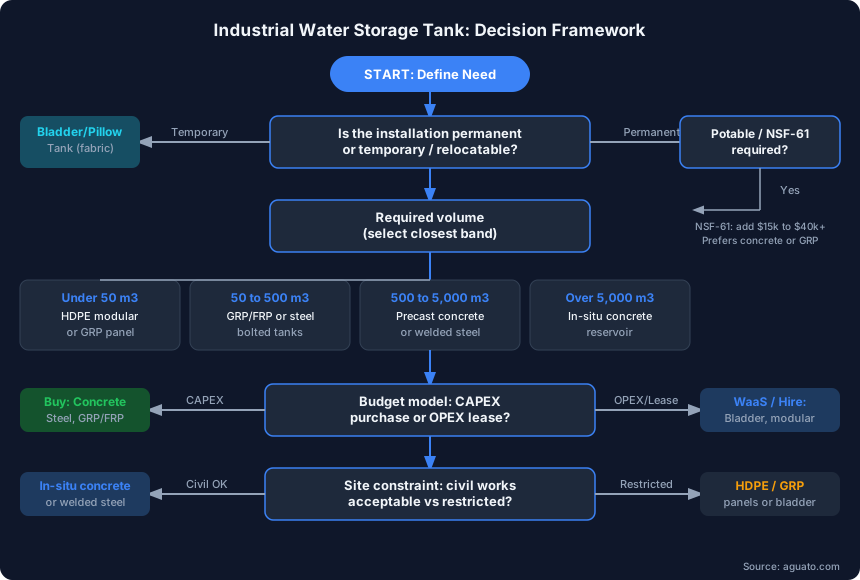
Worked through in sequence, the framework rarely leaves more than two viable technologies in contention, and the final choice between them comes down to the lifecycle cost comparison and the budget model the organisation can accommodate. The discipline of the framework is that it forces the elimination questions, permanence, potability, volume, site constraint, chemical compatibility, before any vendor conversation begins, which prevents the most expensive failure mode of all: letting a supplier's strongest product define the specification rather than the duty.
## CAPEX vs OPEX: Ownership Models for Water Storage
Tank procurement has traditionally been a capital purchase, but the last decade has seen a meaningful shift toward operating expense models, particularly for bladder and modular steel units. The drivers are familiar: asset-light balance sheet targets, uncertainty about future production volumes, and the capital prioritisation pressure that pushes engineering projects behind core-business investments.
Understanding the full cost of ownership requires accounting for four cost categories over the asset life: initial installed CAPEX, inspection and maintenance (including relining cycles), downtime risk during maintenance windows, and end-of-life removal or replacement. For a 1,000 m3 in-situ concrete reservoir, these costs over 40 years might break down as $180,000 installed, $60,000 in inspection and minor repair, and $0 in relining, giving a 40-year total of $240,000, or $6,000 per year. For a bolted steel equivalent, the 20-year relining cycle at $70,000 and a mid-life inspection programme adds approximately $110,000 in lifecycle costs over 40 years, giving a total of approximately $310,000 or $7,750 per year. The concrete option is cheaper in NPV terms for any site where civil works costs are comparable between the two options.
The [water treatment CAPEX vs OPEX decision framework](/resources/water-treatment-capex-opex) that applies to treatment plant procurement applies equally to storage: the key variable is the discount rate. At high discount rates (above 10 percent), the lower CAPEX of bladder and modular options looks more attractive even if lifecycle costs are higher. At low discount rates (below 5 percent), the long-life concrete option dominates on NPV.
For process industries with irregular production volumes, a hybrid approach is increasingly common: a permanent concrete or steel base tank sized for minimum sustained demand, supplemented by hired modular or bladder capacity during seasonal peaks. This structure keeps the balance sheet capital deployment modest while maintaining supply security, and it converts the peak-demand portion of storage from a stranded capital asset into a flexible operating line.
The final question is execution: which suppliers can actually deliver the chosen technology to standard, and how to run a comparison that keeps them honest. The fragmented tank market makes that harder than it sounds, which is why a structured sourcing approach pays for itself.
## Finding Qualified Tank Suppliers
Procurement of industrial water storage tanks is a specialist procurement activity. The market is fragmented: concrete tank companies, bladder and pillow tank companies, steel tank fabricators, GRP panel manufacturers, and HDPE moulders each operate in largely separate supplier ecosystems. Sourcing across all five technology families to run a true technology-comparison tender requires either a dedicated procurement function or access to a structured marketplace.
For concrete and precast reservoir work, [concrete tank companies](/concrete-tank-companies) listed on the Aguato marketplace include specialist civil contractors with AWWA D110/D115 certification experience. For flexible storage options including emergency response pillow tanks and modular deployable units, [bladder and pillow tank companies](/bladder-pillow-tank-companies) provide rapid-deployment solutions with NSF/ANSI 61 approved materials where required.
The most effective procurement approach for large projects is to issue a technology-neutral tender at the specification stage, define the performance requirements (volume, service life, potable compliance, site access), and let qualified suppliers from all technology families respond. This approach regularly delivers 15 to 25 percent savings against a technology-prescriptive specification because it allows suppliers to compete on their strongest technology rather than forcing a single material onto the whole project.
[AWWA water industry standards](dofollow:https://www.awwa.org/Publications/Standards) provide the canonical reference for engineers writing performance specifications for potable and non-potable storage. Any supplier responding to a properly written tender should be able to demonstrate compliance with the applicable AWWA standard or equivalent national standard as part of their proposal.
For project-specific procurement support, the Aguato marketplace connects buyers with pre-vetted suppliers across all tank technology families, with structured evaluation tools that support technology-comparative selection. The [Nepti](/nepti) decision intelligence layer helps quantify risk and shortlist suppliers against your specific duty requirements before you commit a single line of the capital budget.
## FAQ
What is the cheapest industrial water storage tank type per m3 of capacity? Bladder and pillow tanks have the lowest installed cost per m3, typically $20 to $80, because they require minimal civil works. However, they have the shortest service life at 5 to 15 years and are suited to temporary or relocatable duty only. For permanent storage, in-situ concrete offers the lowest lifecycle cost despite higher initial CAPEX.
Do industrial water storage tanks need NSF/ANSI 61 certification? Only tanks storing water that will be used for human consumption require NSF/ANSI 61 compliance. Non-potable applications such as fire-water reserves, cooling tower make-up, and process buffer storage do not require NSF/ANSI 61, though site-specific regulations may impose other material standards. Always confirm the end-use water classification before specifying.
How long does a concrete water storage tank last? A properly designed and maintained concrete tank built to AWWA D110 or D115 (for prestressed construction) or to equivalent national standards typically has a design life of 40 to 60 years. The main longevity risks are alkali-silica reaction (ASR) in the aggregate, carbonation at inadequate cover depth, and chemical attack from aggressive stored water.
What is the difference between GRP and FRP water tanks? GRP (Glass Reinforced Plastic) and FRP (Fibre Reinforced Plastic) describe the same family of composite resin tanks. GRP is the more common European and Asian terminology; FRP is more common in North America. Both describe tanks made from a polymer resin matrix reinforced with glass fibres. Performance and cost are essentially equivalent across the naming convention.
How do I choose between a concrete tank and a steel tank for a fire-water reserve? The decision turns on volume, project programme, and lifecycle budget. Concrete is preferred above 1,000 m3 and where a 40-year or longer design life is required, because it eliminates the relining cycle that steel requires every 10 to 15 years. Steel bolted tanks are preferred where programme speed is critical (installation in weeks rather than months) and where volumes are below 3,000 m3. At volumes of 1,000 to 3,000 m3, a full lifecycle cost comparison is warranted because the programme saving from steel may be offset by two or three relining cycles over a 40-year life.
Can bladder tanks store potable water? Yes, but only if the bladder fabric and liner are manufactured from materials that comply with FDA, NSF/ANSI 61, or WRAS (Water Regulations Advisory Scheme) requirements for potable contact, depending on jurisdiction. Potable-grade bladder tanks also require more rigorous inspection and maintenance protocols, including periodic testing of liner integrity and more frequent decontamination.
What is the typical payback period for a permanent concrete tank versus a hire bladder solution? For a permanent duty application, the financial crossover between CAPEX concrete ownership and OPEX bladder hire typically falls at 18 to 36 months, depending on the hire rate and tank volume. Beyond that horizon, owned permanent storage is almost always cheaper on a net present value basis. The exception is where production volumes are uncertain: if there is a realistic chance that the storage volume requirement drops significantly within 5 years, the option value of a hired, returnable bladder can justify the premium over the owned concrete alternative.