Electrocoagulation cuts chemical reagent spend by 60 to 90% and sludge volume by up to 50%, but its higher CAPEX only pays back at the right duty profile. Here is how to decide.
The choice between electrocoagulation and chemical coagulation looks like a technology debate. It is actually a cost and compliance debate with a technology wrapper. A mid-size metal-finishing plant spending $180,000 per year on ferric chloride and alum, plus $40,000 on sludge disposal, is looking at a problem that electrocoagulation can cut by 60 to 90% on the reagent line alone, while simultaneously reducing sludge volume by 30 to 50%. The numbers are real. The trade-off is whether the CAPEX to get there is defensible.
Chemical coagulation has been the default for industrial wastewater treatment for more than a century. It works across virtually every feed chemistry, scales without limit, and every equipment supplier on the planet knows how to spec it. Electrocoagulation is not new either, but it has reached commercial maturity only in the last fifteen years, driven by tighter discharge limits on heavy metals and [phosphorus](/elements/phosphorus), rising chemical costs, and a wave of plant managers who have run out of floor space for the clarifier basins that chemical coagulation demands. The question is not which technology is better in absolute terms. The question is which one is better for your stream, your footprint, your chemistry, and your 10-year cost envelope.
This article walks through both technologies in detail: how each works, where each wins, where each fails, a threshold-based decision framework with numeric cut-points, real-world examples from [industrial wastewater treatment](/resources/industrial-wastewater-treatment) applications, and a direct cost comparison you can take to a capital approval meeting. It is written for operations directors evaluating a treatment upgrade, procurement leads building an RFP, and sustainability teams that need to justify reduced chemical consumption in an ESG report.
## The decision in brief
- Price the chemical coagulation line honestly. A site running 150 m3/day of heavy-metals-laden wastewater through chemical coagulation at $0.45/m3 combined reagent and disposal cost is spending $61,700 per year on that single line. - Switch to electrocoagulation for a payback under 3 years. Switching to electrocoagulation at $0.10/m3 OPEX saves $51,000 per year, so a $150,000 installed EC system pays back in under 3 years. - A missed consent costs more than the OPEX. The biggest cost-of-doing-nothing is a missed discharge consent caused by a slug load event, which in the UK and EU carries a regulatory enforcement cost of $25,000 to $150,000 per incident.
On top of that comes the reputational consequence of a public register entry that appears in every supplier audit for the next five years.
## What electrocoagulation is and how it works
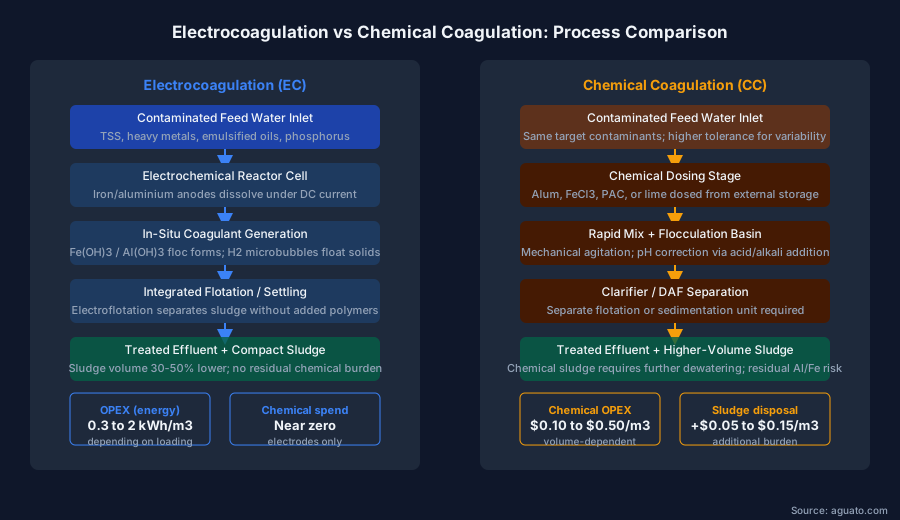
Electrocoagulation (EC) generates coagulant in-situ by passing direct current through sacrificial metal electrodes, typically [iron](/elements/iron) or aluminium, submerged in the wastewater stream. The electrochemical dissolution of those anodes produces Fe(II)/Fe(III) or Al(III) ions that hydrolyse immediately into metal hydroxide flocs, destabilising suspended solids, emulsified oils, and dissolved metals without any externally added reagent. Simultaneously, hydrogen microbubbles generated at the cathode provide an integrated electroflotation mechanism that lifts the floc to the surface, often eliminating the need for a separate dissolved air flotation unit.
The reaction happens entirely within the electrode cell. Feed water enters, coagulant forms from the electrode material, floc aggregates and floats or settles, and clarified effluent exits. The system footprint is a fraction of a conventional clarifier train because the coagulation and flotation steps are combined. Electrode assemblies occupy 0.5 to 3 m2 of floor space for units treating 10 to 50 m3/hour, compared with 15 to 60 m2 for an equivalent chemical coagulation plus [dissolved air flotation (DAF)](/resources/dissolved-air-flotation-daf) installation.
One operational reality that vendors understate: electrode passivation. Over time, scale and oxidised films form on electrode surfaces and reduce current efficiency, sometimes by 20 to 40% within weeks if not managed. The practical mitigation is polarity reversal on a timed cycle (typically every 15 to 30 minutes), which is standard on modern controllers, plus periodic acid cleaning. Plants that skip this step end up with a system delivering 60% of rated capacity at full energy draw. Factor in an electrode replacement schedule of 6 to 18 months depending on current density and feed chemistry when building the OPEX model.
## What chemical coagulation is and how it works
Chemical coagulation destabilises suspended and colloidal particles by adding soluble metal salts, most commonly aluminium sulphate (alum), ferric chloride, ferrous sulphate, or polyaluminium chloride (PAC), directly to the wastewater stream. The coagulant ions neutralise the surface charge on particles, allowing them to aggregate into larger flocs that can be settled or floated by a downstream clarifier or [DAF unit](/resources/dissolved-air-flotation-daf). A flocculation aid (polymer) is typically dosed after the coagulant to accelerate floc growth and improve capture efficiency.
The chemistry is well characterised. Optimum coagulation with alum occurs at pH 6.5 to 7.5; ferric chloride is effective across a wider pH window of 4 to 9, which makes it the default choice for high-variability streams. Dosing rates depend on the contamination load: typical coagulant doses run 20 to 200 mg/L for suspended solids removal, rising to 100 to 500 mg/L for phosphorus precipitation or [heavy metals removal](/resources/heavy-metals-removal-water). Each kg of coagulant added generates roughly 2 to 5 kg of wet sludge. That sludge carries a residual chemical burden that may classify it as a controlled waste in some jurisdictions, adding a disposal cost layer that rarely shows up in equipment proposals.
The practical advantage of chemical coagulation is its tolerance for variability. Feed water with fluctuating TDS, pH swings, or intermittent slug loads is easier to manage by adjusting chemical dose than by retuning an electrochemical system. A pattern that recurs in industrial installations is that plants with batch-discharge patterns, tanneries, textile mills, metal-treatment shops, choose chemical coagulation precisely because the dose can be dialled up or down in real time without any electrical system reconfiguration. That operational flexibility has real value and should not be dismissed when the feed chemistry is genuinely unpredictable. For the textile-specific application, where coagulation sits at the front of a multi-stage colour-removal train rather than as a stand-alone solution, see our [textile wastewater colour removal guide](/resources/textile-wastewater-color-removal) for the dye-class decision matrix that determines whether EC or chemical coagulation wins for a given fabric mix.
## Electrocoagulation vs chemical coagulation: direct performance comparison
The table below summarises the key decision variables for a procurement lead building a treatment train specification.
| Parameter | Electrocoagulation | Chemical Coagulation | Best for | |---|---|---|---| | CAPEX (100 m3/day duty) | $80,000 to $180,000 | $30,000 to $80,000 | CC for lowest upfront spend | | Chemical reagent OPEX | Near zero (electrodes only) | $0.10 to $0.50/m3 | EC for continuous high-volume flows | | Energy OPEX | 0.3 to 2 kWh/m3 | 0.05 to 0.2 kWh/m3 | CC for energy-sensitive sites | | Sludge volume | 30 to 50% lower than CC | Baseline reference | EC for costly sludge disposal regimes | | Footprint | 0.5 to 3 m2 per 50 m3/h | 15 to 60 m2 equivalent | EC for space-constrained brownfield sites | | Heavy metals removal | Excellent (Fe/Cu/Ni/Cr/Pb/As) | Good (with correct pH/dose) | EC for complex metals matrices | | Emulsified oil removal | Excellent (electroflotation) | Moderate (requires polymer) | EC for oily wastewater | | Flow rate ceiling | Up to 500 m3/day commercial; scalable via parallel cells | Unlimited; proven at 50,000+ m3/day | CC for large municipal/industrial scale | | Feed chemistry variability | Sensitive; needs stable pH 5 to 9 | High tolerance; dose adjustable in real time | CC for batch or variable discharge | | Operator skill required | Moderate (electrical + water chemistry) | Low (dosing pump adjustment) | CC for sites with limited technical staff | | Regulatory chemical risk | None (no COSHH/REACH storage) | Yes (H2SO4 for pH, bulk coagulant) | EC for COMAH-adjacent or urban sites | | Payback period | 2 to 5 years (at $0.15+/m3 OPEX saving) | n/a (lower CAPEX baseline) | EC where chemical OPEX is high |
The cost crossover point is approximately $0.12/m3 in combined chemical and sludge disposal savings. Below that threshold, the CAPEX premium of EC is hard to justify on cost alone, though regulatory and footprint drivers may still tip the decision. Above $0.12/m3 in savings, a 200-cell EC installation at 100 m3/day typically achieves payback in 2 to 4 years.
## Cost analysis: CAPEX, OPEX, and total cost of ownership
CAPEX for a packaged electrocoagulation system treating 50 to 200 m3/day runs $80,000 to $250,000 depending on electrode configuration, integration complexity, and whether a polishing filter is required downstream. A chemical coagulation system at the same duty, including coagulant storage, dosing pumps, a flash mix tank, flocculation basin, and a settling clarifier, costs $30,000 to $90,000 installed. The EC premium is real, typically 1.5 to 2.5x the chemical alternative at equivalent flow.
OPEX is where the equation flips for the right site profile. A plant treating 150 m3/day of [oily wastewater](/resources/oily-wastewater-treatment) at $0.35/m3 in chemical and polymer spend, plus $0.10/m3 in chemical sludge disposal, carries a combined OPEX of $0.45/m3 or approximately $24,700 per year on a 150-day operating year. At 250 operating days the number reaches $41,000. An EC system at the same duty runs energy at roughly $0.04 to $0.12/m3 (0.3 to 2 kWh/m3 at $0.08/kWh industrial tariff) plus electrode replacement at $0.02 to $0.05/m3. Total EC OPEX: $0.06 to $0.17/m3, a saving of $0.28 to $0.39/m3. At 250 operating days and 150 m3/day, that is $10,500 to $14,600 per year in savings. A $150,000 CAPEX premium pays back in 10 to 14 years at that profile, which is marginal. Move the chemical dose up to $0.50/m3, which is not unusual for high-phosphorus or high-metals streams, and the payback drops to 5 to 7 years.
The sludge disposal cost is frequently the overlooked lever. Chemical coagulation sludge from a 150 m3/day metals-laden stream typically generates 200 to 800 kg of wet cake per day depending on loading. At a controlled waste disposal rate of $80 to $150 per tonne, annual disposal costs reach $5,800 to $43,800. EC sludge for the same stream runs 30 to 50% lower in volume and may fall below the controlled waste threshold depending on metals content, reducing or eliminating that disposal line entirely. Factor this into the TCO model before writing the CAPEX approval document.
A 10-year total cost of ownership model for a 150 m3/day duty with high chemical loading typically shows EC at $350,000 to $480,000 total (CAPEX + OPEX + electrode replacement) versus chemical coagulation at $280,000 to $420,000. The ranges overlap, which is why the decision cannot be made on cost alone without characterising the actual feed chemistry and disposal costs. The right answer depends on your feed water and duty profile. [Post your project](/post-project) and qualified providers will scope the trade-off against your actual numbers.
## Where electrocoagulation wins
Electrocoagulation consistently outperforms chemical coagulation in four specific scenarios, and these are not edge cases: they account for a large share of industrial wastewater treatment upgrade projects in the 2020s.
Heavy metals at moderate to high concentration. EC achieves >95% removal of copper, nickel, chromium, lead, arsenic, and zinc in a single pass where chemical coagulation often requires multiple pH adjustment steps and elevated coagulant doses to reach equivalent discharge limits. The electrochemical mechanism captures metals via adsorption onto freshly precipitated hydroxide floc and direct electrodeposition, a dual mechanism that outperforms chemical precipitation alone on mixed-metals matrices. This matters directly for [heavy metals removal from water](/resources/heavy-metals-removal-water) in electroplating, PCB manufacture, and metal-finishing applications where discharge consents are tightening.
Emulsified oil and grease removal. The hydrogen microbubble flotation generated in an EC cell is naturally suited to emulsified oil, breaking the emulsion electrochemically and floating the oil layer without the polymer addition that chemical coagulation requires. Removal rates of 90 to 99% on oil and grease are regularly achieved on cutting fluid, rolling oil, and produced water streams. Chemical coagulation on the same streams typically requires a polymer at $0.05 to $0.15/m3 additional cost plus a separate DAF unit at $50,000 to $120,000 additional capital.
Space-constrained brownfield installations. A packaged EC unit treating 50 m3/hour fits in the footprint of a standard shipping container. The same duty in chemical coagulation requires a coagulant storage room, mixing tanks, a flocculation tank, and a clarifier or DAF vessel. Urban industrial sites, food processing plants mid-refurbishment, and offshore platforms have driven a wave of EC installations where the footprint constraint was the primary decision driver, not the chemistry.
Sites with chemical storage restrictions. COMAH thresholds, COSHH regulations, and urban planning restrictions on bulk chemical storage have made chemical coagulation less viable at some sites in the UK, EU, and increasingly in US industrial zones near residential areas. A bulk ferric chloride store above the threshold quantity triggers major hazard designation. EC eliminates that risk entirely: the only consumable is electrode metal.
[cta:nepti]
## Where chemical coagulation wins
Chemical coagulation is not a legacy technology waiting to be replaced. It has structural advantages in several scenarios where EC's characteristics work against it.
High-volume continuous flows above 500 m3/day. The economics of EC electrode systems and power supplies currently make the technology less competitive at large scale. A municipal wastewater plant treating 5,000 m3/day or an industrial site producing 2,000 m3/day of relatively low-contamination process water will find that chemical coagulation delivers equivalent results at a fraction of the CAPEX and a manageable OPEX. The cost-per-unit-volume of EC infrastructure does not fall as steeply with scale as conventional civil treatment structures do.
Variable or batch discharge streams. Tanneries, textile mills, and batch chemical manufacturing plants produce wastewater in bursts with widely varying contamination loads. An operator can increase chemical dose by 50% in five minutes to handle a slug load. An EC system requires a current density increase (higher power draw) and potentially a hydraulic residence time adjustment, which is manageable but less forgiving. Chemical coagulation is the lower-risk choice where the feed profile is genuinely unpredictable.
Low-contamination, high-volume polish applications. A tertiary polishing step on an already-treated effluent stream, bringing suspended solids from 50 mg/L down to 10 mg/L for reuse, is best served by a small chemical dose at very low cost. EC's CAPEX and electrode complexity are disproportionate for a light-duty polishing application. A simple in-line coagulant dosing point and a small filter provides the same result for a fraction of the cost. For broader context on this kind of staged treatment, the [industrial wastewater treatment process](/resources/industrial-wastewater-treatment-process) article covers where coagulation sits in the full treatment sequence.
Sites without reliable power quality. EC systems require stable DC power with consistent current control. Sites with unreliable grid supply, significant voltage fluctuation, or where power interruptions are frequent experience performance degradation and increased electrode corrosion. Chemical coagulation requires only gravity-fed or low-pressure dosing, which is far more robust in challenging power environments.
## Decision framework: threshold-based technology selection
The following cut-points are derived from published performance data and operational experience. Use them as a first-pass filter before commissioning a detailed feasibility study.
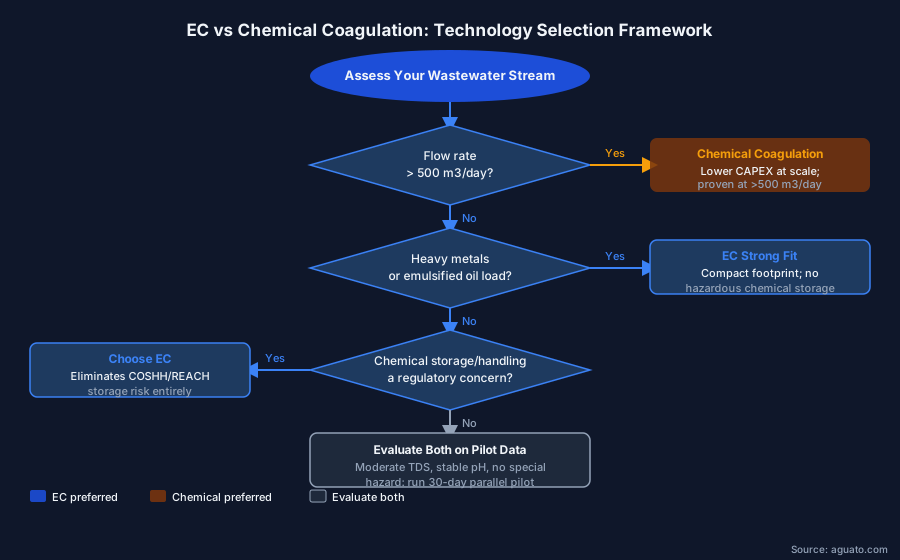
Choose electrocoagulation when: - Combined chemical reagent and sludge disposal OPEX exceeds $0.15/m3 - Flow rate is 10 to 500 m3/day (the commercial sweet spot for packaged EC) - Feed contains heavy metals at >1 mg/L or emulsified oil at >50 mg/L - Available floor space is less than 10 m2 for the treatment unit - Chemical storage is restricted by regulation, planning, or insurance - ESG reporting requires a measurable reduction in chemical consumption
Choose chemical coagulation when: - Flow rate exceeds 500 m3/day continuously - Feed chemistry varies by more than 2 pH units or 500 mg/L TSS on a daily cycle - Existing chemical dosing infrastructure is already in place (marginal upgrade case) - Capital budget is constrained and payback must be under 2 years - Operator technical capability is limited (simpler to train and troubleshoot) - TDS is below 200 mg/L (EC performance degrades at low conductivity; salt addition is possible but adds cost)
Consider a hybrid system when: - Primary treatment is EC for metals/oils, with a chemical polishing step for residual suspended solids - The site has an existing chemical clarifier that can be retained for peak flow handling while EC handles the base load - Pilot data shows EC achieving 85 to 90% removal with chemical coagulation as a trim step providing the final 5 to 10%
If TDS is below 500 mg/L, add conductivity-enhancing salts (NaCl at 0.5 to 1 g/L) to the EC feed and re-evaluate performance before ruling it out. If TDS exceeds 3,000 mg/L, verify that electrode corrosion rates remain within acceptable limits for the planned replacement schedule. Navigating this kind of multi-variable assessment across site-specific data is where [Nepti](/nepti) adds the most value: it models your water matrix and produces a ranked comparison of technology options with cost projections, turning a 6-week feasibility exercise into a same-session output.
## Failure scenarios and what they cost
Both technologies have characteristic failure modes. Understanding them before specification prevents the most expensive outcomes.
EC failure mode 1: Electrode passivation without polarity reversal control. A metal-finishing plant in the Midlands UK installed an EC system without automated polarity reversal, relying on manual acid cleaning every two weeks. Within 90 days, electrode efficiency had dropped by 35%. Effluent discharge consent was breached for nickel (limit 0.5 mg/L, actual 1.8 mg/L), triggering a formal notice and a $28,000 retrofit to add automated polarity reversal plus controller upgrade. Correct decision: specify polarity reversal as non-negotiable on the procurement spec and verify it is included in the factory acceptance test.
EC failure mode 2: Low conductivity feed without correction. A food processing plant attempted to treat low-TDS rinse water (TDS 150 mg/L) with EC without conductivity adjustment. Current efficiency was poor, electrode dissolution was uneven, and COD removal was 42% against a target of 85%. The plant spent $35,000 on a secondary chemical coagulation step before the root cause was identified. Correct decision: measure feed conductivity before system sizing and build a salt dosing step into the EC design if TDS is below 500 mg/L.
Chemical coagulation failure mode 1: Under-dosing during slug load events. A textile dyehouse operating on a manual dosing regime missed a surge discharge from an upstream batch process. COD in the effluent reached 8x consent limit for a 4-hour period. The resulting regulatory enforcement action cost $62,000 in penalties plus $18,000 in emergency consultant fees. Correct decision: automated inline turbidity or COD monitoring with closed-loop dose control, adding approximately $12,000 to the installation cost.
Chemical coagulation failure mode 2: Sludge classification escalation. A printed circuit board plant assumed chemical sludge from ferric chloride coagulation would be classified as non-hazardous waste. A regulatory audit reclassified it as controlled waste due to copper and nickel content, increasing disposal costs from $45/tonne to $185/tonne retroactively. The annual disposal bill increased by $87,000. Correct decision: sample and characterise sludge before assuming disposal route; factor the realistic disposal cost into the OPEX model from day one.
The [water treatment chemicals](/resources/water-treatment-chemicals) sector has published guidance on sludge characterisation for coagulant-derived residuals. Reference it before finalising your disposal cost assumptions.
## Real-world examples
Example 1: Metal finishing, 80 m3/day, EC retrofit A precision engineering subcontractor in the EU was spending $210,000 per year on ferric sulphate, caustic soda for pH adjustment, and polymer, plus $55,000 on controlled-waste sludge disposal. A packaged EC system was installed for $145,000. After 12 months, combined reagent and disposal costs had fallen to $28,000 per year, a saving of $237,000 per year. The payback was 7.3 months. The reduction in sludge volume by 48% also freed up one of two sludge storage tanks for other site use. The trade-off: the EC system requires more skilled operator attention than the previous chemical plant, and two electrode replacements were needed in the first 18 months due to an unexpectedly aggressive chloride content in the feed.
Example 2: Food and beverage effluent, 400 m3/day, chemical coagulation retained A dairy processing facility evaluated EC as an alternative to its existing PAC (polyaluminium chloride) coagulation and DAF system. The flow was 400 m3/day of variable-composition effluent with TSS swings from 200 to 2,400 mg/L over a 12-hour production cycle. The EC pilot over 30 days showed good average performance but two high-load events produced effluent above consent limits because the current density could not be increased quickly enough to match the surge. The facility retained chemical coagulation with upgraded automated dose control at $22,000, achieving consistent consent compliance at an incremental cost far below the $320,000 EC system CAPEX.
Example 3: Mining wastewater, hybrid EC plus chemical polish A copper mine in South America treating 250 m3/day of acid rock drainage (ARD) with pH 2.8 to 4.2 and elevated iron, arsenic, and manganese deployed a hybrid system. EC handled primary metals removal (Fe, As, Mn, Cu), achieving >98% removal, with a chemical lime addition as a final pH correction and polishing step. The hybrid approach cost $190,000 installed and eliminated the need for a separate full-scale chemical coagulation train estimated at $280,000. The hybrid also produced 35% less sludge than a pure chemical approach on the same stream, a significant advantage given the remote site logistics for sludge transport. This pattern aligns with how [mining wastewater treatment](/resources/industrial-wastewater-treatment) projects are increasingly being specified where multiple contaminants and constrained disposal routes overlap.
## Regulatory and ESG angle
The regulatory environment is tightening on three fronts simultaneously, and both coagulation technologies are affected differently by each.
Discharge limit tightening is the most immediate driver. The EU Urban Wastewater Treatment Directive revision (2024) and the US EPA's industrial effluent guidelines are progressively lowering consent limits for phosphorus (from 2 mg/L to 0.5 mg/L in many EU member states by 2027), total nitrogen, and a growing list of metals. EC's superior metals removal and its ability to reach sub-1 mg/L phosphorus removal without the elevated chemical doses that chemical coagulation requires makes it the more future-proof choice in jurisdictions where limits are expected to tighten further. The [EPA industrial effluent guidelines](dofollow:https://www.epa.gov/eg/industrial-effluent-guidelines) provide the current framework for US industrial discharge standards.
Chemical management regulations are creating cost and risk premiums for chemical coagulation at some sites. The EU REACH regulation and the UK's retained REACH post-Brexit impose registration and safety data obligations on coagulant suppliers and handling requirements on users. While these are manageable at scale, they add friction to small and mid-size operations. EC eliminates the REACH-regulated chemical from the treatment chain entirely, which matters for ESG reporting and for sites seeking ISO 14001 certification where chemical input minimisation is a scored criterion.
ESG reporting is the third lever. A 60 to 90% reduction in chemical reagent consumption is a quantifiable environmental metric that feeds directly into GRI 303 (water) and GRI 306 (waste) disclosures. Sustainability directors at multi-site manufacturers are increasingly specifying EC at new facilities not because it always delivers the lowest cost, but because the chemical elimination narrative is cleaner in an annual ESG report than a cost-optimised chemical coagulation process running at $0.40/m3 in reagents. The [Water Research Foundation's industrial water reuse guidance](dofollow:https://www.waterrf.org) provides benchmarks for chemical use intensity in treated effluent programmes that can anchor ESG reporting.
The procurement dimension: when writing an RFP for a coagulation treatment upgrade, specify the outcome (discharge consent compliance, sludge volume ceiling, chemical spend limit) rather than the technology. That framing allows qualified bidders to propose EC, chemical coagulation, or a hybrid on the merits of your site data. Vendors proposing only their preferred technology in response to an open-ended spec should be pressed to provide a lifecycle cost comparison against the alternative. The [water treatment chemical companies](/water-treatment-chemical-companies) category on Aguato lists vendors who cover both chemical dosing supply and EC systems, enabling like-for-like comparison without managing two separate procurement processes.
For multi-site operations where treatment chemistry varies by facility, the [online vs lab water quality monitoring comparison](/resources/water-quality-monitoring-online-vs-lab) article is directly relevant: real-time inline monitoring is what enables the automated dose control that makes either technology reliable at the plant scale, and the sensor economics are now favourable enough to include in the base specification. The EU's [BAT reference documents for industrial wastewater treatment](dofollow:https://eippcb.jrc.ec.europa.eu/reference/) (BREF) set the technical baseline for what constitutes best available technique in each industrial sector, which directly determines whether EC or chemical coagulation qualifies as the compliant approach under an industrial emissions permit.
## FAQ
### What is electrocoagulation used for in industrial wastewater treatment?
Electrocoagulation is used to remove heavy metals, emulsified oils, suspended solids, phosphorus, and certain organics from industrial wastewater without adding external chemical reagents. It is most commonly deployed in metal finishing, food and beverage, textile, mining, and produced water applications where chemical reagent costs or sludge disposal constraints make conventional chemical coagulation expensive. Removal efficiencies of 90 to 99% are achievable on copper, nickel, chromium, and emulsified oil in an appropriately sized EC reactor.
### How does electrocoagulation compare to chemical coagulation in terms of cost?
Electrocoagulation carries a higher CAPEX of $80,000 to $250,000 for a 100 m3/day duty versus $30,000 to $90,000 for chemical coagulation, but its OPEX is typically 60 to 90% lower on chemical reagent spend. The cost crossover depends on the actual chemical dose and sludge disposal costs at your site. Sites spending more than $0.15/m3 on combined chemicals and disposal typically see EC pay back its CAPEX premium within 2 to 5 years. Sites with low chemical loading or large flow volumes above 500 m3/day generally find chemical coagulation more cost-effective over a 10-year horizon.
### What are the disadvantages of electrocoagulation?
Electrocoagulation is sensitive to feed water conductivity, requires stable electrical supply, and demands more skilled operation than a chemical dosing system. At TDS below 200 mg/L, current efficiency drops significantly and salt addition becomes necessary, adding to OPEX. Electrode passivation must be managed through automated polarity reversal and periodic acid cleaning; systems without this feature degrade in performance within weeks. The technology also has a commercial flow-rate ceiling around 500 m3/day for packaged systems, beyond which parallel-cell installations become expensive relative to conventional treatment.
### Can electrocoagulation remove phosphorus effectively?
Yes. Electrocoagulation achieves phosphorus removal to below 0.5 mg/L, meeting the tightened EU Urban Wastewater Treatment Directive limits, at chemical doses effectively zero since the coagulant is generated from the iron or aluminium electrode. Chemical coagulation can achieve the same limit but requires a coagulant dose of 100 to 400 mg/L ferric chloride to precipitate phosphorus to that level, generating a correspondingly large sludge volume. For sites facing the post-2027 EU phosphorus discharge limits, EC is frequently the more economic path to compliance at flow rates below 300 m3/day.
### What industries use electrocoagulation most commonly?
Metal finishing, printed circuit board manufacturing, food and beverage processing, textile dyeing, oil and gas produced water treatment, and mining acid rock drainage are the dominant electrocoagulation application sectors. These industries share a common profile: complex mixed-contaminant streams (metals, oils, colour, suspended solids), often at moderate flow rates where EC's compact footprint and chemical-free operation provide the greatest competitive advantage over chemical coagulation. Adoption in the textile and food sectors has accelerated since 2018 as ESG reporting requirements have created demand for measurable chemical input reduction.
### How long do electrocoagulation electrodes last?
Electrocoagulation electrodes have a service life of 6 to 24 months depending on current density, feed water chemistry, and whether polarity reversal is in service. Iron electrodes dissolve faster than aluminium at equivalent current density because iron is sacrificed at a higher rate per unit of coagulant produced, but iron is also significantly cheaper to replace. Electrode replacement cost typically runs $0.02 to $0.05/m3 of treated water and must be included in the OPEX model. Polarity reversal, automated cleaning cycles, and avoiding current densities above the rated maximum are the three operational practices that maximise electrode life.
### How do I choose between electrocoagulation and chemical coagulation for my site?
The primary filter is combined chemical reagent and sludge disposal cost: if this exceeds $0.15/m3 and your flow is below 500 m3/day, electrocoagulation is worth detailed evaluation. Secondary filters are feed contaminant type (EC is strongly preferred for heavy metals and emulsified oil), available footprint (EC requires 70 to 90% less floor space), and chemical storage restrictions. If your feed chemistry is highly variable, batch-discharge, or your flow exceeds 500 m3/day, chemical coagulation is likely the lower-risk choice. A 30-day parallel pilot on a representative sample of your effluent is the only reliable way to validate removal efficiency before committing to a full installation.