Wrong dosing control costs 30 to 50% more in chemical spend and permits the failures that generate $30,000 to $400,000 events. Full control architecture comparison, CAPEX/OPEX, and spec guide inside.
Chemical dosing systems are the most consequential variable in industrial water treatment, and the most under-engineered. A cooling tower running with a $120,000 closed-loop dosing controller and proper chemical programmes costs roughly $0.08 to $0.18 per cubic metre to treat. The same tower operated on manual batch dosing and guesswork costs $0.25 to $0.55 per cubic metre, ships corrosion products into heat exchangers, and produces a Legionella risk that regulatory agencies take personally. The chemical spend is rarely the issue. The control strategy is.
Most plant managers inherit dosing systems specified by the commissioning contractor, tuned to the first chemical supplier who showed up, and never revisited unless something breaks. The result is systematic overdosing of scale inhibitors (expensive, generates disposal obligations), underdosing of biocides (creates biofilm faster than any audit will catch it), and pH swings that corrode whatever the scale inhibitor was protecting. The failure mode is slow, quiet, and cumulative. And vendors will recommend whatever chemistry they sell.
This guide covers what chemical dosing control systems actually are, the four control architectures and their real cost profiles, the threshold-based decision framework for upgrading from manual to automated control, what failure modes cost when they materialise, and how to specify a system that procurement and operations will both defend. It is written for the plant engineers who own the water chemistry programme and the procurement leads who have to cost-justify the control hardware.
## The decision in brief
- Move from timer-based to closed-loop dosing control. A manufacturing plant that upgrades from timer-based to closed-loop dosing control on a three-tower, 1,500 m3/h cooling system saves $55,000 to $95,000 per year in chemical spend alone. - Expect payback inside 30 months. The $80,000 to $150,000 control investment on that three-tower cooling system reaches full payback in 18 to 30 months on the chemical saving alone. - The overspend is not the biggest cost. The biggest cost of doing nothing is the single corrosion or Legionella event that the degraded control architecture permits, not the ongoing overspend.
That single event runs $30,000 to $400,000 in direct cost and months of regulatory correspondence to close.
## What chemical dosing systems do and why control strategy matters
A chemical dosing system delivers treatment chemicals into a water circuit at a controlled rate to maintain target water quality parameters within defined limits. The hardware is straightforward: one or more metering pumps, a chemical storage tank, injection fittings, and some form of control signal. The discipline is in the control strategy, which determines whether the pump output is correlated to actual water quality or to a fixed schedule that has nothing to do with what the water is doing.
The commercial case for investing in proper control comes down to three numbers: chemical unit cost, equipment replacement cost, and regulatory cost-of-failure. Across projects in the cooling water and boiler treatment space, chemical spend accounts for 30 to 60% of water treatment OPEX. A closed-loop pH control system that holds pH within plus-or-minus 0.2 units of the target, instead of the plus-or-minus 1.0 unit typical of manual dosing, uses 20 to 35% less acid or alkali to achieve the same average chemistry. On a 500 m3/h cooling tower consuming $80,000 per year in pH correction chemistry, that precision is worth $16,000 to $28,000 per year before considering the equipment protection benefit.
[Browse verified water treatment chemical companies](/water-treatment-chemical-companies) to find suppliers who offer both chemistry and dosing system packages, or separate chemistry from hardware to benchmark each independently.
The [World Health Organization's guidelines on water quality monitoring and chemical safety in drinking-water systems](dofollow:https://www.who.int/publications/i/item/9789241549950) establish the international baseline for chemical treatment parameters and are the authoritative reference for minimum dosing performance standards in health-sensitive applications.
## The four chemical dosing control architectures
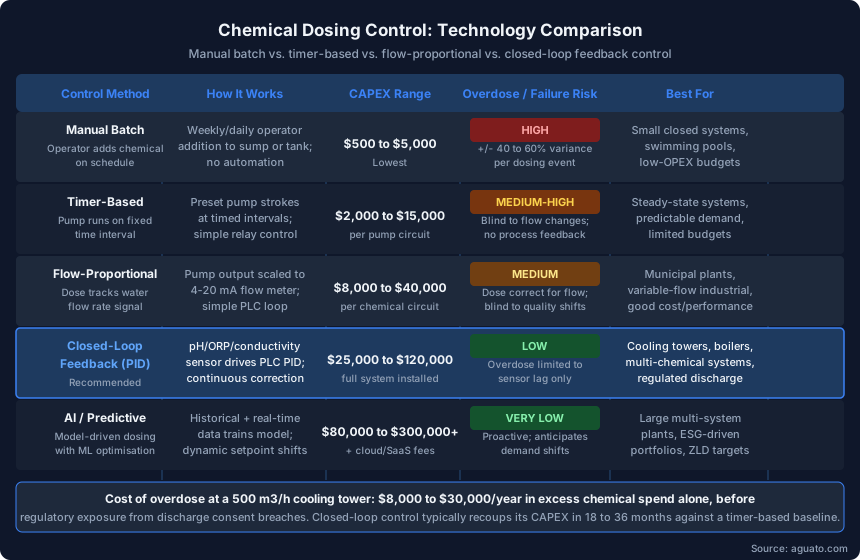
The choice of control architecture is the single most consequential specification decision. It determines accuracy, labour demand, chemical efficiency, and failure risk for the entire life of the installation. Getting it right at the design stage is straightforward. Retrofitting a more capable control architecture later is expensive and disruptive.
### Manual batch dosing
An operator adds a measured volume of chemical to the system sump, tank, or header at a defined interval, typically daily or weekly. There is no pump, no signal, no feedback. The dosing event is uncorrelated with actual system demand, flow rate, or water quality. The cost of the hardware is essentially zero. The cost of the chemistry is significantly higher than it should be, and the cost of the consequences is higher still.
Manual dosing is appropriate for very small closed systems, less than 50 m3 total volume, with stable feed water and predictable demand. In any system above that scale, or any system where the regulatory consequence of a water quality excursion is significant (cooling towers subject to Legionella risk assessment, boilers subject to steam purity limits, discharge-controlled systems), manual batch dosing is not a cost-saving measure. It is a deferred liability.
### Timer-based automatic dosing
A metering pump runs for a preset duration at a preset interval, injecting a fixed volume of chemical regardless of system conditions. The operator sets the stroke rate and frequency during commissioning and adjusts it periodically based on water test results. This is the most common configuration in the installed base, largely because it requires no instrumentation beyond the pump itself.
The limitation is structural. Timer-based dosing cannot respond to changes in flow rate, feed water quality, or seasonal shifts in evaporation rate. A cooling tower that doubles its load in summer, increasing its cycles of concentration and blowdown rate, receives exactly the same chemical dose it received in winter. The result is systematic underdosing in peak demand conditions, which is precisely when biofilm and scale risk are highest. Overdosing in low-demand periods is equally common and adds unnecessary chemical cost and discharge load.
### Flow-proportional dosing
A flow meter signal drives the pump output directly: as flow increases, dose rate increases proportionally. This eliminates the load-dependency problem of timer-based systems and dramatically reduces the overdose/underdose amplitude. The control logic is simple enough to implement with a basic signal conditioner rather than a full PLC, which keeps the hardware cost in the $8,000 to $40,000 per chemical circuit range.
Flow-proportional control is appropriate as the minimum standard for any open-circuit cooling tower above 200 m3/h flow rate, any boiler makeup system above 10 m3/h, and any discharge-controlled process. It does not respond to changes in water chemistry, so it cannot compensate for feed water quality shifts or changes in system contamination load. It is a significant improvement over timer-based systems and a reasonable baseline for straightforward applications with stable feed water.
### Closed-loop feedback control (PID)
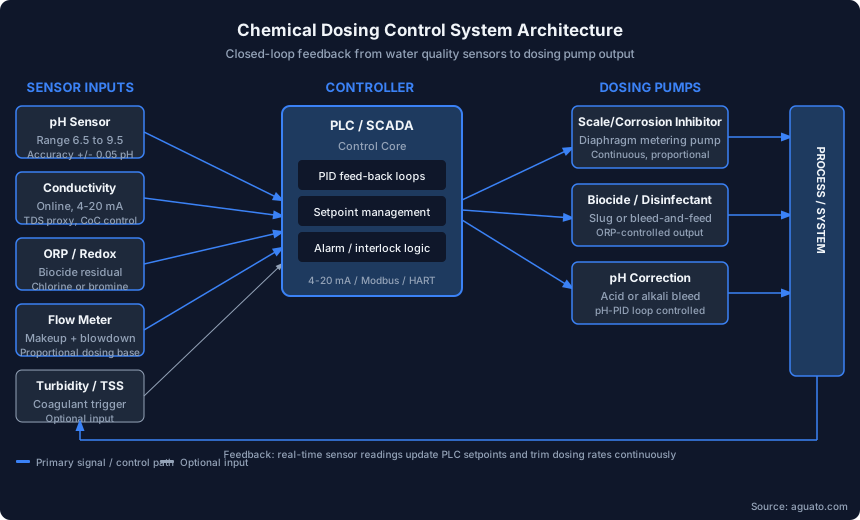
A process sensor (pH, ORP, conductivity, turbidity, or free [chlorine](/elements/chlorine)) sends a real-time signal to a PLC, which runs a proportional-integral-derivative (PID) algorithm to continuously adjust pump output and hold the measured parameter at the target setpoint. This is the architecture that actually controls water chemistry rather than approximating it.
The accuracy gain over timer-based systems is significant. A well-tuned pH PID loop holds the system pH within plus-or-minus 0.1 to 0.2 units. A timer-based system, in the hands of a competent operator, achieves plus-or-minus 0.5 to 1.0 units over the same measurement window. That range difference translates directly into corrosion rate variability, scale formation probability, and biocide efficacy. Closed-loop control also provides the data trail that regulatory and insurance bodies increasingly expect to see during audits and incident investigations.
## Chemicals dosed and their control logic
Understanding what each chemical class does informs the correct sensor and control strategy for each dosing circuit. Multi-chemical systems require coordinated control logic because some treatment programmes interact: high-pH phosphonate scale inhibitors perform differently from neutral-pH polymer programmes, and biocide efficacy is strongly pH-dependent.
Scale inhibitors and dispersants: Typically dosed on a flow-proportional or bleed-and-feed basis correlated to makeup water volume. The target is maintaining inhibitor residual above a threshold concentration in the circulating water. Closed-loop control requires an inline residual analyser (phosphonate-specific photometric or conductivity-based), which adds $15,000 to $40,000 to the system cost but prevents both under-concentration (scale formation) and over-concentration (excess discharge load). For most cooling tower applications, flow-proportional dosing to a defined bleed rate is the practical minimum.
Corrosion inhibitors: The mechanisms and control logic for corrosion inhibitors in open recirculating systems are detailed in the guide to [cooling water corrosion control](/resources/cooling-water-corrosion-control), which covers both film-forming inhibitors (azoles, molybdates, silicates) and anodic/cathodic inhibitor programmes. Dosing control is typically flow-proportional with periodic grab-sample verification of residual.
Biocides and disinfectants: This is the chemical class where control accuracy most directly affects regulatory risk. An oxidising biocide such as sodium hypochlorite or stabilised bromine is most effectively controlled by ORP (oxidation-reduction potential) feedback, with a setpoint typically in the 200 to 400 mV range for cooling systems. Non-oxidising biocides (isothiazolone-based or glutaraldehyde) are dosed on a slug or bleed-and-feed programme correlated to volume turnover. The [guide to water treatment chemicals](/resources/water-treatment-chemicals) covers selection criteria for each biocide class and the resistance patterns that make programme rotation necessary.
pH correction: Acid (typically sulfuric) or alkali (sodium hydroxide or sodium carbonate) dosing is the most common application for closed-loop PID control. The pH sensor is the most established and lowest-cost online water quality measurement available, and the PID response to pH is well-characterized. The consequence of uncontrolled pH is severe: pH above 9.0 in a phosphate-treated cooling system precipitates calcium phosphate scale; pH below 7.0 accelerates steel and concrete corrosion. The control precision of a pH PID loop pays for itself rapidly.
Anti-scalants for membrane systems: In reverse osmosis and nanofiltration applications, anti-scalant dosing is critical to membrane life. Dosing is typically flow-proportional to feed flow, with the dosing rate calculated from feed water analysis. Online calcium and conductivity monitoring can refine the dose in real-time. Membrane life of 5 to 7 years under properly controlled anti-scalant dosing versus 2 to 3 years without it represents a membrane capital cost saving of $40,000 to $150,000 per system over a 15-year plant life.
## CAPEX and OPEX: the full cost picture
The cost of a dosing control system depends on the number of chemical circuits, the control architecture, the degree of SCADA integration, and the site's instrumentation specification. The comparison below covers the four main configurations for a representative single-cooling-tower installation with three chemical circuits (scale inhibitor, biocide, and pH correction).
CAPEX breakdown for a three-circuit closed-loop system (2025 USD):
- Metering pumps (3 circuits, diaphragm type): $6,000 to $18,000 - Dosing panel (GRP or stainless enclosure, wiring, controls): $4,000 to $12,000 - PLC/controller and HMI: $8,000 to $25,000 - pH and ORP sensors with flow cells: $4,000 to $10,000 per sensor pair - Conductivity analyser for cycles-of-concentration control: $3,000 to $8,000 - Chemical storage tanks (3 x 1,000 L IBC or equivalent): $3,000 to $9,000 - Containment bunding and secondary containment: $2,000 to $6,000 - Installation, commissioning, and factory acceptance testing: $8,000 to $20,000 - Total installed, three-circuit closed-loop system: $38,000 to $108,000
For comparison, a timer-based three-circuit system without instrumentation runs $12,000 to $30,000 installed. The gap is $26,000 to $78,000. Across a typical 10-year system life, the closed-loop system recovers that gap through chemical efficiency alone (20 to 35% savings), the prevention of one equipment replacement event attributable to chemistry failure, and reduced operator time. The numbers close in 18 to 36 months for most industrial cooling systems.
OPEX comparison per year, 500 m3/h cooling tower:
| OPEX Item | Timer-Based | Closed-Loop PID | Annual Saving | |---|---|---|---| | Scale inhibitor chemical | $28,000 to $38,000 | $20,000 to $28,000 | ~25% | | Biocide chemical | $22,000 to $32,000 | $16,000 to $24,000 | ~27% | | pH correction chemical | $18,000 to $26,000 | $12,000 to $18,000 | ~31% | | Operator labour (testing and adjustment) | $12,000 to $18,000 | $6,000 to $10,000 | ~45% | | Instrument calibration and maintenance | none | $4,000 to $8,000 | -$6,000 | | Annual OPEX total | $80,000 to $114,000 | $58,000 to $88,000 | ~25% |
A pattern that recurs across industrial installations in the cooling water sector: plants that inherited timer-based systems from the original equipment supplier are frequently paying 30 to 50% more per m3 for water treatment than comparable sites on closed-loop control. The excess spend is invisible in the budget because it appears as "chemical cost" rather than "control deficiency." The only way to surface it is a lifecycle cost audit against benchmark data.
[Operations and maintenance specialists](/operations-and-maintenance) who manage water treatment programmes across multiple sites carry benchmark data that lets procurement teams compare their chemical unit costs against what closed-loop control achieves on similar-specification systems.
## Sensor selection and placement: where most systems fail
The sensors are where chemical dosing control systems earn or fail to earn their cost. A well-specified sensor in the wrong location produces accurate data about the wrong thing. A low-specification sensor in the right location produces unreliable data that the PLC faithfully optimises around, producing systematic error in a direction that is difficult to diagnose.
pH sensors: The two most common placement errors are locating the pH sensor at the chemical injection point (instead of well downstream after mixing) and using a glass membrane sensor in a high-fouling stream without a self-cleaning mechanism. Both produce readings that drift within weeks of commissioning. The correction is straightforward: place the pH electrode at least 10 pipe diameters downstream of the injection point in a well-mixed zone, install a wiper-type or ultrasonic cleaning mechanism in any application where biological growth or particulate fouling is possible, and budget for electrode replacement every 12 to 18 months in industrial service.
ORP sensors: ORP is a strong biocide residual indicator for oxidising programmes, but it is temperature-compensated only for the reference junction, not for the chemistry. At the same ORP reading, a system at 30 degrees Celsius has meaningfully different oxidising capacity from one at 20 degrees Celsius. Applications in variable-temperature streams should verify ORP with periodic free chlorine or free [bromine](/elements/bromine) measurements and use the correlation to calibrate the ORP setpoint seasonally.
Conductivity sensors: Conductivity is used as a proxy for total dissolved solids to control the blowdown valve and cycles of concentration in cooling systems. Sensor fouling is the principal failure mode. Contacting conductivity sensors in high-fouling streams develop biofilm on the electrodes that falsely depresses the reading, which drives the controller to reduce blowdown and inadvertently concentrates the system beyond design limits. Toroidal (inductive) conductivity sensors have no electrodes in contact with the process and are the correct specification for any cooling water or industrial stream with significant biofilm potential.
Flow meters: Proportional dosing depends on the flow signal. A flow meter that has drifted by 15% causes a 15% systematic bias in every proportional dose. Electromagnetic flow meters with no moving parts are the standard for chemical treatment applications. Mechanical turbine meters require quarterly inspection in any stream carrying scale inhibitor or corrosion product, as deposits accumulate on the rotor and impeller.
The [AWWA Manual M54 on instrumentation and control for water and wastewater systems](dofollow:https://www.awwa.org/Portals/0/files/publications/documents/M54LookInside.pdf) provides the accepted engineering standards for sensor selection, installation, and maintenance intervals in water treatment applications, and is the reference used by most major water treatment engineering firms when specifying dosing control systems.
[cta:nepti-dark]
## Control system integration and SCADA connectivity
A dosing controller that cannot export its data to the plant SCADA or BMS is a system that cannot be audited, cannot trigger remote alarms, and cannot contribute to the ESG and water efficiency reporting that sustainability directors increasingly need to produce quarterly. This is not a theoretical concern: insurance underwriters and environmental regulators are converging on the expectation that cooling systems and process water circuits have auditable dosing logs.
The standard communications protocols for dosing controller integration are Modbus TCP/RTU, Profibus, BACnet (for HVAC-integrated systems), and OPC-UA for modern SCADA architectures. A dosing controller that supports only a proprietary protocol or analog 4-20 mA output for a single parameter is not fit for purpose on a site with a functioning SCADA. Specify at minimum Modbus TCP connectivity and confirm the controller's register map is documented and open before purchase.
Data logging at the controller level should capture: pump run-time per circuit, actual stroke rate, sensor readings at 1-minute or 5-minute intervals, alarm events with timestamps, and calibration records. A chemical treatment audit that cannot produce these logs is not an audit. The logs also provide the operational continuity that [O&M service providers](/resources/water-quality-monitoring-online-vs-lab) need when taking over a site from a previous contractor: a complete record of what was dosed, when, and with what sensor readings driving the decision.
Remote monitoring capability, where the SCADA or cloud platform flags parameter excursions to an operator's mobile device or the treatment contractor's control room, is no longer optional for multi-site operations. A 500 m3/h cooling tower that develops a biocide dosing fault on a Friday afternoon and goes undetected until Monday morning has 60-plus hours of uncontrolled biofilm growth. The cost of a Legionella-related enforcement action, including the investigation, remediation, and legal exposure, typically exceeds $200,000. A remote monitoring subscription from a water treatment O&M provider costs $5,000 to $15,000 per year. The math is straightforward.
Not sure which monitoring configuration fits your site? [Post your project on Aguato](/post-project) and qualified dosing control and water treatment providers will scope the remote monitoring and control options against your actual system size, chemical programme, and SCADA architecture.
## Failure modes and the real cost of getting it wrong
The most expensive outcome in dosing control is not a dramatic system failure. It is a system that operates in a degraded state for months without producing an obvious alarm, accumulating damage that becomes visible only when a heat exchanger is opened for maintenance or a boiler tube fails.
Scale breakthrough from sustained underdosing: A scale inhibitor dose that is 25 to 40% below target does not produce scale immediately. It produces scale over 3 to 9 months, as the inhibitor threshold concentration in the circulating water drops below the minimum inhibitory level. The first indication is typically a reduction in heat transfer efficiency: a chiller that previously delivered 900 kW at 5 degrees Celsius delta-T now requires 980 kW to achieve the same output. By that point, the scale deposit on the condenser tubes is already 0.5 to 1.5 mm thick. Descaling a large chiller condenser costs $15,000 to $50,000 in labour and chemical, plus downtime. The dosing fault that caused it cost nothing to fix at the time it occurred.
Biocide failure and biofilm accumulation: An ORP sensor that has drifted low causes the controller to overdose oxidising biocide to compensate, increasing chemical cost and discharge load. An ORP sensor that has drifted high causes the controller to underdose, allowing biofilm to establish. A cooling tower with established biofilm that produces a positive Legionella culture result triggers a notification requirement in most jurisdictions. The remediation protocol (superchlorination, physical cleaning, specialist contractor, regulatory correspondence) costs $30,000 to $80,000 per event, not including the reputational exposure if the system is linked to a confirmed case. The [ASHRAE Standard 188 on Legionella prevention in building water systems](dofollow:https://www.ashrae.org/technical-resources/bookstore/ansi-ashrae-standard-188-2021) is the authoritative framework for water management programme design in the US, and its monitoring requirements drive the sensor specification needed to demonstrate compliance.
pH excursion and rapid corrosion: A pH PID loop that loses its sensor signal defaults to the last known output in most controller configurations. If the sensor fails open-circuit and the controller drives the acid pump to maximum output, a cooling system can drop from pH 8.2 to pH 5.5 within 4 to 8 hours, depending on system volume and buffering capacity. At pH 5.5, mild steel corrodes at 1 to 3 mm per year and copper alloys corrode at 0.5 to 1.5 mm per year. A heat exchanger bundle that costs $40,000 to $150,000 to replace can be rendered non-functional within 48 hours of an undetected pH runaway. The prevention is a high and low pH alarm with pump interlock, which every closed-loop pH system should include as standard.
Chemical overdose and discharge consent breach: A pump that has drifted high due to a calibration error or a stuck check valve injects excess chemistry that bypasses the intended system and reaches the drain. If the chemical is a regulated substance (biocides, certain scale inhibitors, phosphate-based corrosion inhibitors), a discharge consent breach generates a regulatory notice, potential enforcement action, and the obligation to report and remediate. The administrative cost alone runs $20,000 to $80,000 per incident. Dosing panel secondary containment, interlocked drain valves, and a flow-paced maximum dose limiter are the engineering controls that prevent this class of failure.
Across projects we have seen in the cooling water and process water sector, the plants with the worst track record on water treatment chemistry almost always share one characteristic: the dosing system was specified by the chemical supplier, not the engineering team. Chemical suppliers have an inherent incentive to specify systems that require more chemical. The buyer's job is to specify the control system independently, then let chemistry suppliers compete on performance within that control architecture.
## How to specify and procure a dosing control system
The specification process that produces the most defensible procurement outcome starts with the water chemistry requirements and works backward to the control hardware, not the other way around.
Step 1: Define the water quality targets. For each chemical circuit, specify the operating setpoint, the acceptable control band (plus-or-minus X units), and the alarm threshold. These should come from the system design (heat exchanger material, corrosion allowance, regulatory discharge limit) and be formally documented before any vendor is approached.
Step 2: Choose the control architecture based on the tolerance. If the control band is wider than plus-or-minus 0.5 pH units, flow-proportional dosing may be adequate. If the control band is tighter than plus-or-minus 0.3 pH units, or if ORP must be held within 50 mV, closed-loop PID is the minimum adequate architecture. Document the rationale.
Step 3: Specify sensors independently of the pump supplier. Sensor quality determines system accuracy. Specify the sensor type, accuracy class, measurement range, and maintenance interval. Require independent calibration records at commissioning and a traceable calibration verification method (buffer solutions, ORP standards, conductivity standards). Do not allow the dosing pump vendor to select the sensor without engineering review.
Step 4: Require a factory acceptance test (FAT). The FAT should include a simulated process run demonstrating PID loop response to a step change in the measured parameter, alarm testing, and communications connectivity verification. A dosing system that has not passed a FAT will consume 2 to 4 times the commissioning time on site.
Step 5: Benchmark the OPEX. Require the vendor to provide a 10-year lifecycle cost model including chemical consumption at the specified control accuracy, sensor replacement intervals, pump maintenance costs, and projected calibration labour. Vendors who will not provide this model are telling you something about how confident they are in their system's performance.
The right answer depends on your water chemistry, system size, and site regulatory context. [Browse verified chemical dosing and water treatment providers](/water-treatment-chemical-companies) on Aguato, filter by technology specialism and system size, and request proposals from 3 to 5 specialists with documented site references in your sector.
## Sector examples: cooling towers and boiler dosing
These examples represent patterns that recur across the sectors described, not named facilities.
Example 1: Heavy manufacturing cooling tower campus, Midwest US
A large manufacturing campus operating six evaporative cooling towers with a combined recirculating flow of 3,200 m3/h had seven separate chemical treatment programmes, each managed by a different service contractor using a mix of timer-based and manual batch systems. Annual chemical spend was $580,000. A water treatment audit against site-specific water quality data showed that two of the six towers were routinely overdosed on scale inhibitor by 35 to 50% due to inaccurate blowdown timing. Three towers had ORP control setpoints that had not been adjusted for seasonal temperature changes, producing systematic biocide over-residual in winter (wasted chemistry and discharge load) and under-residual in summer (biofilm risk window). The site consolidated to a single integrated dosing control platform with flow-proportional blowdown on all six towers and ORP-feedback biocide control. Total installed cost of the control upgrade: $310,000. Annual chemical spend the following year: $390,000. Payback on the control investment: 18 months. The 12% improvement in chiller efficiency from cleaner tubes added another $60,000 per year in energy savings.
Example 2: Pharmaceutical boiler house, high-purity steam application
A pharmaceutical manufacturing site producing purified steam for autoclave sterilisation had a two-boiler installation operating at 10 bar gauge. The original dosing system was a timer-based sodium sulphite oxygen scavenger dose and a separate phosphate programme. Boiler blowdown analysis showed that total dissolved solids were routinely 30 to 60% above the target limit because the blowdown controller's conductivity sensor had fouled and was reading 20% low. The site was effectively running at cycles of concentration significantly above design without realising it. Carry-over of dissolved solids into the steam was detectable in condensate conductivity, creating a risk to autoclave validation. The intervention was a toroidal conductivity sensor replacement, a closed-loop blowdown controller, and a flow-proportional oxygen scavenger system with a closed-loop phosphate residual controller. Total cost: $48,000. The risk of a validation failure requiring steam system shutdown and re-validation, estimated at $400,000 to $1.2 million in production and quality cost, was eliminated. For sites that need both chemical dosing and broader O&M programme management, [specialist operations and maintenance providers](/resources/operations-and-maintenance) deliver the cross-site benchmark data that internal teams rarely have access to.
## When to upgrade your existing system
The upgrade decision follows predictable patterns. The threshold conditions that indicate a closed-loop upgrade is justified are as follows.
Chemical cost benchmarking: If your annual chemical spend per m3 of circulating water volume exceeds the sector benchmark by 20% or more, the most likely cause is a dosing control deficiency rather than unusual feed water chemistry. The benchmark for a well-operated industrial cooling tower is $0.08 to $0.18 per m3 circulating volume per year for a standard three-chemical programme (scale inhibitor, biocide, pH correction). Costs above $0.25 per m3 warrant a control audit.
Regulatory signal: A Legionella positive culture result, a discharge consent notice from the environmental regulator, or a requirement to demonstrate dosing compliance documentation for insurance or regulatory purposes are all events that require a system upgrade rather than a chemistry adjustment. The documentation requirement alone cannot be met by a timer-based system.
Equipment condition signal: If corrosion or scale deposits are found during a heat exchanger inspection or boiler tube inspection, and the water chemistry records cannot demonstrate control within specification, the dosing system is a contributing cause and the correct fix is the control architecture, not the chemical selection.
Operational change: Any increase in system capacity (larger cooling load, higher pressure boiler, new process integration), feed water quality change (new water source, seasonal variation in hardness or alkalinity), or discharge consent tightening requires reassessment of the dosing control architecture. Modelling your specific water matrix and operational profile before committing to a control upgrade is where [Nepti's decision-intelligence platform](/nepti) adds value: it models your water chemistry and simulates which control configuration minimises treatment cost and equipment risk for your actual operating conditions.
The [water quality monitoring guide](/resources/water-quality-monitoring-online-vs-lab) covers the online versus laboratory testing decision in detail, including where real-time monitoring adds value that grab sampling cannot provide. That decision is inseparable from the dosing control specification: the sensors that drive the dosing controller are the same infrastructure that provides the monitoring data trail required for audits.
When the dosing and monitoring specification is settled, compare vetted [water treatment suppliers](/providers) on Aguato, filter by chemical dosing and instrumentation experience, and request scoped proposals so the control-architecture decision above is priced against your audit and reporting requirements.
## FAQ
### What is a chemical dosing control system?
A chemical dosing control system is an automated assembly of metering pumps, sensors, and a programmable controller that delivers treatment chemicals into a water circuit at a rate determined by real-time water quality measurements. The system measures a parameter such as pH, ORP, or conductivity, compares the reading to a target setpoint, and adjusts the dosing pump output to maintain the target value. The alternative is manual or timer-based dosing, which delivers a fixed amount of chemical regardless of whether the water needs it. For industrial cooling and boiler systems, automated control reduces chemical waste by 20 to 35% and significantly reduces the risk of equipment damage from sustained chemistry excursions.
### How much does a chemical dosing system cost to install?
A basic timer-based three-circuit dosing system for a single cooling tower costs $12,000 to $30,000 installed. A closed-loop feedback system with pH, ORP, and conductivity sensors, PLC controller, and SCADA integration runs $38,000 to $108,000 installed for the same three-circuit scope. Large multi-tower or multi-boiler installations with centralised control and remote monitoring can run $150,000 to $400,000. The closed-loop premium over a timer-based system typically recovers itself through chemical savings within 18 to 36 months, before accounting for avoided equipment damage costs.
### What sensors are needed for a closed-loop chemical dosing system?
The core sensor set for a cooling tower application is a pH sensor (for acid or alkali dose control), an ORP sensor (for oxidising biocide control), and a conductivity sensor (for blowdown control and cycles of concentration monitoring). A flow meter on the makeup line enables proportional dosing for continuous-feed chemicals. More sophisticated programmes add a free chlorine or free bromine analyser, a turbidity sensor for coagulant control, or a specific inhibitor residual analyser. Sensor selection should match the chemical programme: there is no value in installing an ORP sensor on a non-oxidising biocide programme.
### What is the difference between flow-proportional and closed-loop dosing?
Flow-proportional dosing adjusts pump output in proportion to the measured water flow rate. It correctly accounts for changes in demand but cannot respond to changes in water chemistry. Closed-loop dosing adjusts pump output based on a measured water quality parameter such as pH or ORP. It responds to both flow changes and chemistry changes, but only for the parameter being measured. The best configurations combine both: flow-proportional dosing as the base rate for continuous inhibitor chemicals, overlaid with closed-loop pH and ORP control. This approach achieves the accuracy of closed-loop control with the steady base-load coverage of proportional dosing.
### How often do chemical dosing system sensors need calibrating?
pH electrodes in industrial cooling water service should be calibrated with buffer solutions weekly for the first month after installation, then monthly once stability is confirmed. ORP sensors should be verified monthly against a known ORP standard. Conductivity sensors should be verified every 3 months against a calibrated reference solution. Flow meters should be verified annually unless process conditions suggest drift. These intervals assume a standard industrial cooling water environment. High-fouling, high-temperature, or chemically aggressive streams may require more frequent calibration, and the calibration records must be logged and timestamped to support regulatory and insurance audits.
### Can a chemical dosing system connect to a building management or SCADA system?
Yes. Modern dosing controllers support Modbus TCP/RTU, BACnet, Profibus, and OPC-UA protocols for integration with building management systems, industrial SCADA platforms, and cloud monitoring services. When specifying a dosing controller for a site with an existing SCADA, confirm the required protocol and request the controller's Modbus register map before purchase. Some lower-cost dosing controllers support only a proprietary software interface, which creates long-term vendor dependency and prevents independent audit of dosing records, a requirement that insurance underwriters and environmental regulators increasingly impose.
### What regulations govern chemical dosing in industrial cooling water systems?
In the United States, cooling tower chemical dosing is governed by state environmental discharge permits for blowdown discharge under Clean Water Act NPDES requirements, OSHA requirements for chemical storage and handling, and the ASHRAE Standard 188 water management programme requirements for Legionella prevention. In the UK, the Health and Safety Executive L8 Approved Code of Practice and HSG274 technical guidance establish the legal framework for cooling tower water treatment and dosing records. Non-compliance with discharge permits can trigger fines of $10,000 to $50,000 per violation per day in US jurisdictions, making auditable dosing logs a financial necessity as much as a regulatory one.