Online sensors cost $8,000 to $35,000 upfront but cut lab expense 60 to 80% for high-frequency testing. The right choice depends on your sampling cadence.
Online water quality monitoring costs $8,000 to $35,000 per parameter upfront and delivers continuous data at near-zero marginal cost per reading. Laboratory analysis costs $15 to $300 per sample and produces results in 24 to 72 hours. For industrial sites with compliance testing frequencies above twice per day, the online case wins on lifecycle cost within 18 to 36 months. For sites with weekly or monthly sampling requirements, lab analysis remains the lower-cost answer across a five-year horizon, and the online specification is an over-investment.
The procurement decision is rarely between "online only" or "lab only." Most industrial water programmes run a hybrid architecture where online sensors handle high-frequency operational parameters (pH, conductivity, turbidity, dissolved [oxygen](/elements/oxygen)) and the lab handles low-frequency compliance parameters (metals, organics, microbiology). The right split depends on which parameters drive the largest cost-of-getting-it-wrong and how often getting it wrong matters enough to justify the sensor capital cost and the maintenance burden that continuous monitoring brings.
This guide covers what online and lab monitoring actually measure, the cost mechanics over a five-year asset life, the four industrial contexts where each method wins, the hybrid architectures that most plants run, and the failure modes that turn a sound monitoring investment into a quietly compounding operational drag.
## The decision in brief
- Go online when you sample more than twice a week. Online water quality monitoring costs $8,000 to $35,000 per parameter upfront and breaks even against lab analysis in 18 to 36 months when sampling frequency exceeds twice per week. - Above daily cadence, online cuts five-year cost by 30 to 50%. For industrial sites with compliance testing cadences above daily, online monitoring also eliminates the sample-collection labour tail and the 24 to 72-hour data lag that makes lab results operationally useless on fast-changing processes. - Keep weekly-sampled parameters in the lab. Deploying $50,000 to $150,000 in online sensors on weekly-sampled compliance parameters is the opposite mistake, where the lab answer is 40 to 60% cheaper on lifecycle and operationally sufficient.
The cost of doing nothing is paying $15,000 to $60,000 per year in lab fees and sample-shipping logistics for parameters that could be monitored continuously at near-zero marginal cost once the sensor CAPEX is absorbed.
## What online and lab monitoring actually measure
Online monitoring uses sensors installed in-line or in a bypass loop to produce continuous readings of a specific water quality parameter. The sensor transmits data to a SCADA system, data historian, or cloud platform at intervals ranging from one second to 15 minutes. Common online parameters include pH, conductivity, turbidity, dissolved oxygen, chlorine residual, oxidation-reduction potential (ORP), and total suspended solids (TSS). Advanced online analysers exist for ammonia, nitrate, phosphate, total organic carbon (TOC), and hardness, but their capital cost and maintenance frequency are 2 to 5× higher than basic electrochemical sensors. According to [ISO 5667-23:2011 guidance on sampling techniques for water quality monitoring](dofollow:https://www.iso.org/standard/32355.html), ASHRAE industry standard for Legionella monitoring and control in building water systems, directly relevant to online monitoring frequency and compliance protocols.
Laboratory analysis takes a discrete grab sample or composite sample collected manually or via an autosampler, ships it to an accredited lab (in-house or third-party), and produces a certified analytical result using wet chemistry, spectroscopy, chromatography, or microbiology culture methods. Lab methods cover the full periodic table plus thousands of organic compounds, microbial species, and radiological contaminants that no field sensor can detect. Turnaround time is 24 to 72 hours for routine analysis, up to 14 days for complex organics or trace metals.
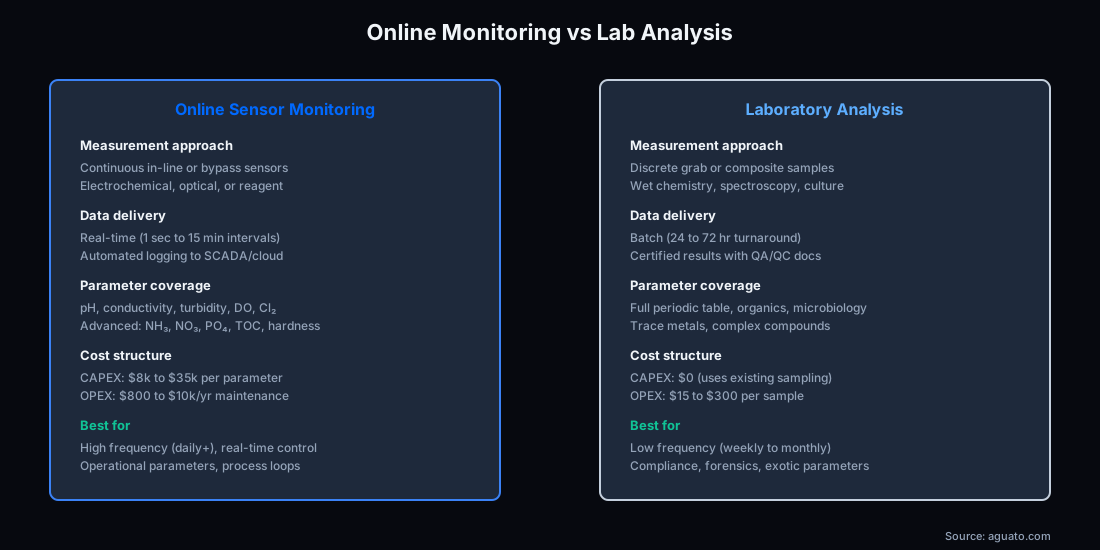
The architectural difference is not "one is better than the other." It is that online sensors answer the question "what is happening right now and how fast is it changing" while lab analysis answers "what compounds are present at what concentrations and does that concentration violate a regulatory threshold." A cooling tower pH sensor tells you whether the treatment programme is holding pH at setpoint in real time. A lab metals panel tells you whether your blowdown discharge violates copper, zinc, or chromium limits once per month. The first prevents an operational upset; the second prevents a consent violation. Different failure modes, different cost consequences, different monitoring architectures.
For a deeper look at the parameters that matter most in cooling systems, see our [cooling tower water treatment guide](/resources/cooling-tower-water-treatment), which breaks down the chemistry programmes and the monitoring cadence each parameter requires.
## Cost mechanics: CAPEX, OPEX, and the breakeven timeline
The lifecycle comparison over five years for a single monitored parameter:
| Cost element (5-year horizon, 1 parameter) | Lab analysis (twice weekly) | Online sensor | Delta | |---|---|---|---| | Equipment CAPEX | $0 (uses existing sampling ports) | $8,000 to $35,000 (sensor + transmitter + integration) | +$8,000 to $35,000 | | Sample collection labour (5-yr) | $12,000 to $28,000 (technician time + shipping) | $0 | −$12,000 to $28,000 | | Lab analysis fees (5-yr) | $15,600 to $62,400 ($30 to $120 per sample × 520 samples) | $0 | −$15,600 to $62,400 | | Sensor calibration and maintenance (5-yr) | $0 | $4,000 to $18,000 (reagents + membranes + technician time) | +$4,000 to $18,000 | | Data management and SCADA integration | $0 (results logged manually) | $2,000 to $8,000 (historian licence + cloud storage) | +$2,000 to $8,000 | | Total 5-year cost | $27,600 to $90,400 | $14,000 to $61,000 | −$13,600 to $29,400 (online wins) |
For twice-weekly sampling at routine lab pricing, online monitoring breaks even in 18 to 36 months and runs 30 to 50% lower total cost over five years. The breakeven timeline shortens as sampling frequency rises. At daily sampling, breakeven drops to 12 to 18 months. At weekly sampling, the lab cost line drops below the online CAPEX threshold and lab wins on lifecycle.
The table above assumes a basic electrochemical sensor (pH, conductivity, turbidity, DO). Advanced analysers for nutrients, TOC, or metals cost $25,000 to $80,000 per parameter and have higher maintenance OPEX, which pushes the breakeven timeline out to three to five years. Those analysers make economic sense only when the cost-of-failure on that parameter is large enough to justify continuous monitoring, typically in pharmaceutical water-for-injection (WFI) loops, semiconductor ultrapure water (UPW) systems, or municipal drinking water treatment where a single excursion triggers a boil-water notice.
For industrial wastewater compliance, see our [industrial wastewater treatment guide](/resources/industrial-wastewater-treatment), which covers the monitoring requirements tied to NPDES permits and the sampling frequency that determines whether online makes sense.
[Browse verified water quality testing providers](/providers) to compare lab service pricing and online sensor suppliers for your specific parameter list.
## Where online monitoring wins
Online monitoring is the correct choice when four conditions converge.
1. High sampling frequency driven by operational control loops. When a process depends on a water quality parameter staying within a tight band (pH ±0.2 units, conductivity ±50 µS/cm) and the cost of an excursion is production downtime, quality defect, or equipment damage, continuous feedback is non-negotiable. Examples: reverse osmosis permeate quality monitoring in pharmaceutical production, boiler feedwater chemistry in power generation, rinse water conductivity in semiconductor fabrication. The sensor is not just a monitoring tool; it is the input signal to an automated dosing or blowdown control loop.
2. Compliance reporting frequency above twice per day. Per [EPA guidance on NPDES permit monitoring requirements](dofollow:https://www.epa.gov/npdes/npdes-permit-basics), facilities with effluent limits that require sub-daily exceedance detection must deploy online monitoring with automated alarm systems. Manual grab sampling cannot satisfy the reporting requirement when the permit specifies "no instantaneous excursion above X mg/L." Online is not an optimisation at that point; it is a regulatory mandate.
3. Rapid process variability where lag-time in lab results creates blind spots. Industrial processes with feed-water composition that varies hour-to-hour (surface water intakes during storm events, variable industrial influent to a wastewater plant, seasonal algae blooms affecting raw water turbidity) need real-time visibility to adjust treatment chemical dosing or divert off-spec batches before they reach downstream equipment. A 24-hour lab turnaround on a parameter that swings 3× in six hours is operationally useless.
4. Remote or unmanned sites where sample collection logistics are prohibitive. Offshore oil platforms, remote mining operations, rural water treatment plants with skeleton crews, these sites cannot sustain twice-weekly manual sampling without helicopter access or multi-hour road trips. Online monitoring eliminates the logistics tail and reduces the site to a quarterly calibration visit instead of 100+ annual sample trips.
Industries where online monitoring is now the baseline specification: pharmaceutical water systems, power generation boiler chemistry, semiconductor UPW, data centre cooling loops with tight temperature control, food and beverage CIP (clean-in-place) rinse verification, municipal drinking water [chlorine](/elements/chlorine) residual compliance.
## Where lab analysis still rules
Lab analysis remains the lower-cost and operationally simpler choice for five contexts.
1. Low-frequency compliance parameters. Monthly or quarterly discharge monitoring for metals (copper, zinc, chromium, nickel), organics (BTEX, PAHs, chlorinated solvents), or microbiology (total coliform, E. coli) cannot justify a $50,000 to $150,000 online analyser when the compliance cost of a single missed sample is under $5,000. The lab sample at $150 to $300 per test is the right economic answer.
2. Parameters without reliable online sensors. Many regulated parameters lack a commercially proven online sensor at reasonable cost. Examples: trace organics below 1 µg/L, speciated metals (hexavalent chromium versus total chromium), specific microbial pathogens, endocrine disruptors, pharmaceuticals in wastewater. These require lab-based chromatography, mass spectrometry, or culture methods that have no field-portable equivalent.
3. Forensic investigations and root-cause analysis. When a treatment process fails and the operational team needs to know "what happened and why," a comprehensive lab workup (full metals scan, organics screen, microbiology culture with speciation) provides diagnostic depth that no sensor panel can match. Online sensors tell you when a parameter went out-of-range; the lab tells you what contaminant caused it.
4. New process start-up and commissioning. During the first 90 to 180 days of a new water treatment system, the process is unstable and the team is still tuning chemical dosing, hydraulic residence times, and membrane cleaning intervals. Running full lab panels weekly or biweekly during this phase characterises the system behaviour across a wide parameter set without committing to online CAPEX before the final process is proven.
5. Sites with existing accredited in-house labs. Pharmaceutical, chemical, and food manufacturing sites frequently operate ISO/IEC 17025 accredited labs on-site for product testing. Marginal cost to add water samples to that lab's routine workload is under $20 per sample, which makes online monitoring economically uncompetitive unless sampling frequency exceeds daily.
For industrial sites managing multiple water streams with different monitoring needs, the right answer is almost never "online everywhere" or "lab everywhere." It is a segmented architecture.
## The hybrid architecture most plants run
Most industrial water programmes operate a three-tier monitoring architecture.
Tier 1 (online, continuous): Operational control parameters. pH, conductivity, turbidity, dissolved oxygen, chlorine residual, temperature. These parameters drive automated control loops (chemical dosing, blowdown valves, filter backwash triggers) and need sub-minute response times. Sensor cost per parameter: $3,000 to $15,000. Installed on process-critical loops only: RO feed and permeate, boiler feedwater, cooling tower basin and blowdown, final effluent before discharge.
Tier 2 (online or grab, daily to weekly): Compliance and trending parameters. Hardness, alkalinity, silica, phosphate, ammonia, nitrate, suspended solids. These parameters inform treatment programme adjustments and satisfy permit reporting where grab samples are acceptable. Online deployment justified when the parameter directly affects CAPEX-intensive equipment (silica in steam turbines, hardness in membrane systems) or when permit requires daily reporting. Otherwise, manual grab samples sent to a third-party lab at $30 to $80 per test.
Tier 3 (lab, monthly to quarterly): Regulatory and forensic parameters. Metals, organics, microbiology, advanced chemical oxygen demand (COD), biological oxygen demand (BOD), total Kjeldahl nitrogen (TKN). These parameters satisfy NPDES discharge limits, verify treatment efficacy, and provide root-cause data when process upsets occur. Always lab-based; no online alternative exists at reasonable cost.
For cooling systems where water chemistry directly affects equipment life, see our [industrial water chiller guide](/resources/industrial-water-chiller) and [HVAC water treatment overview](/resources/hvac-water-treatment), which detail the monitoring cadence that matches the duty.
[Post your monitoring requirement](/post-project) and get scoped proposals from lab service providers and sensor suppliers in parallel, so you can compare the hybrid architecture cost against single-method approaches.
## Maintenance burden and the hidden OPEX delta
Online sensors require calibration, cleaning, membrane replacement, and reagent replenishment on schedules ranging from weekly (pH, ORP) to quarterly (conductivity, turbidity). The maintenance labour cost is the single largest OPEX line that procurement teams under-count when specifying online monitoring, and it is the primary failure mode that turns a sound sensor investment into a quietly degrading data source.
Maintenance frequency and annual cost by parameter type:
| Parameter | Calibration frequency | Consumables cost per year | Technician time per year | Total annual maintenance OPEX | |---|---|---|---|---| | pH, ORP | Weekly to biweekly | $400 to $1,200 (buffers, electrodes) | 20 to 40 hours | $1,600 to $4,000 | | Conductivity | Monthly | $200 to $600 (electrode cleaning, KCl standards) | 8 to 16 hours | $800 to $2,000 | | Turbidity, TSS | Biweekly | $300 to $800 (standards, cleaning reagents) | 12 to 24 hours | $1,200 to $2,800 | | Dissolved oxygen | Monthly | $600 to $1,800 (membranes, electrolyte) | 12 to 20 hours | $1,800 to $3,600 | | Chlorine residual | Weekly | $800 to $2,000 (reagents, DPD tablets) | 24 to 48 hours | $2,400 to $5,600 | | Ammonia, nitrate, phosphate | Weekly to monthly | $1,500 to $4,000 (reagent packs, membranes) | 30 to 60 hours | $4,000 to $10,000 |
Lab analysis has zero maintenance burden on the client side. The cost line is fixed per sample and includes all consumables, technician time, and QA/QC internally at the lab. Online monitoring shifts that burden to the plant operations team, and the burden scales with the number of deployed sensors.
A pharmaceutical plant running 12 online sensors (pH, conductivity, TOC on four parallel RO trains) spends $18,000 to $45,000 per year on sensor maintenance, a cost line that did not exist when the same parameters were monitored via daily grab samples sent to the on-site lab at $25 per sample. The online CAPEX case won on the frequency argument; the ongoing maintenance OPEX turned into an unbudgeted recurring cost that the finance team flagged 18 months post-install.
The maintenance burden is manageable when the sensor count is under 10 and the plant has trained instrumentation technicians on staff. It becomes prohibitive when sensor count exceeds 20 or when the site relies on third-party service contracts for calibration, which typically cost 15 to 25% of sensor CAPEX per year.
## Compliance and audit trail requirements
Regulatory frameworks treat online monitoring and lab analysis differently, and the compliance requirement frequently dictates the monitoring method regardless of cost.
Under EPA NPDES permits, continuous monitoring with online sensors is required when the permit specifies "instantaneous maximum" or "daily maximum" effluent limits and the parameter can reasonably be monitored continuously. Per [40 CFR Part 122.21](dofollow:https://www.ecfr.gov/current/title-40/chapter-I/subchapter-D/part-122), pH and temperature must be monitored continuously if they are permit parameters; metals, organics, and microbiology can be monitored via grab samples at monthly or quarterly frequency unless the permit authority specifies otherwise.
Online sensors must be calibrated per manufacturer specifications, and calibration records must be maintained for audit. Sensor drift between calibrations is acceptable as long as it does not result in a permit exceedance. Lab analysis must be performed by an accredited lab (state-certified or ISO/IEC 17025 for drinking water, NELAP-accredited for NPDES compliance), and chain-of-custody documentation must accompany every sample from collection to result reporting.
For pharmaceutical and food manufacturing, online sensors on critical process water loops (WFI, purified water, CIP rinse verification) must be validated per FDA 21 CFR Part 11 if the data is used in batch release decisions. Lab analysis does not require Part 11 validation because the lab result is a static record, not a dynamic process input.
The audit trail difference matters when a regulatory inspection occurs. Online data is time-stamped and tamper-evident if logged to a compliant historian, but sensor drift or calibration lapses create data-integrity questions. Lab data is slower and coarser but carries third-party accreditation and formal QA/QC documentation that satisfies auditors with less scrutiny.
For sites under Legionella monitoring requirements, see our [legionella risk assessment guide](/resources/legionella-risk-assessment), which details the sample frequency and lab culture methods required under HSE L8 and ASHRAE Guideline 12.
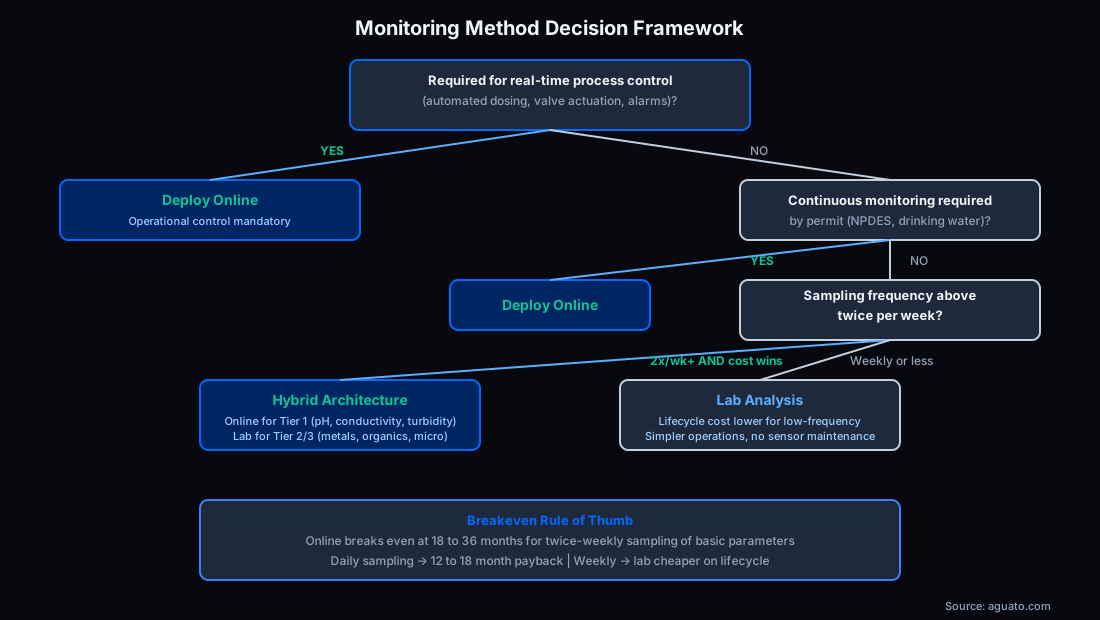
## Decision framework: online, lab, or hybrid?
Run through this sequential check before specifying monitoring equipment.
1. Is the parameter required for real-time process control (automated dosing, valve actuation, alarm triggering)? Yes → online. No → continue.
2. Does the permit or regulation require continuous monitoring or sub-daily reporting? Yes → online. No → continue.
3. Is the parameter one of pH, conductivity, turbidity, DO, chlorine residual, or temperature? Yes → continue. No → skip to step 5 (exotic parameter, probably lab-only).
4. Is current or planned sampling frequency above twice per week? Yes → run lifecycle cost comparison (use the table in section 2); if breakeven is under three years, specify online. No → lab is the right answer.
5. Does a commercially proven online sensor exist for the parameter at under $50,000 per unit? No → lab-only. Yes → continue.
6. Is the cost-of-failure on a single excursion above $20,000 (downtime, off-spec product, equipment damage, consent breach)? Yes → online justified. No → lab sufficient.
7. Does the site have trained instrumentation staff or a service contract budget for sensor maintenance? No → lab is operationally simpler. Yes → online is feasible.
If the answer path leads to "online," deploy sensors on Tier 1 parameters only and retain lab analysis for Tier 2 and Tier 3. Full-stack online deployment (15+ sensors covering every process stream) is justified only in pharmaceutical WFI, semiconductor UPW, or municipal drinking water plants where regulatory and liability exposure is extreme.
## Where monitoring decisions go wrong
Three failure patterns recur.
1. Specifying online sensors because "real-time data is better" without running the lifecycle cost comparison. A food manufacturing plant specified online TOC, hardness, and nitrate sensors on its RO feed line at $85,000 total CAPEX, replacing a twice-weekly lab programme that cost $6,500 per year. The sensors required $12,000 per year in maintenance, and the data was logged but never acted upon because the RO cleaning schedule was fixed quarterly regardless of feed-water variability. Payback was negative over five years. Correct decision: keep the lab programme and add online conductivity and pressure-drop monitoring (the parameters that actually predict membrane fouling) for under $15,000.
2. Under-budgeting sensor maintenance and running degraded sensors for months. A municipal wastewater plant installed online ammonia and nitrate sensors to optimise aeration basin control. Maintenance budget was set at $2,000 per year per sensor based on vendor list pricing for reagents. Actual cost was $7,000 per year per sensor once technician time and unplanned membrane replacements were included. After 14 months, calibration frequency slipped from monthly to quarterly, and sensor drift caused the plant to over-aerate by 18%, costing $22,000 in excess blower energy before the issue was caught. The sensors were technically functional but operationally misleading.
3. Treating lab results as "ground truth" without recognising sample degradation. An industrial site with a 48-hour lab turnaround collected ammonia samples on Monday morning and received results Wednesday afternoon. Ammonia is biologically unstable and degrades in sample bottles unless acidified and chilled within 15 minutes of collection. The site did not acidify; lab results consistently read 30 to 50% lower than actual process concentrations. Treatment programme was under-dosed for nine months, leading to nitrification in the cooling tower and a $95,000 system cleaning and repassivation event. Correct procedure: acidify ammonia samples to pH under 2 immediately or deploy online ammonia monitoring on high-risk loops.
[Try Nepti](/nepti) to model the monitoring frequency and method mix that minimises total water-programme cost for your specific feed water, process duty, and compliance perimeter.
## FAQ
### What parameters can be monitored online versus in a lab?
Basic electrochemical and optical parameters (pH, conductivity, turbidity, dissolved oxygen, chlorine residual, temperature, ORP) are reliably monitored online with sensors costing $3,000 to $15,000 per parameter. Nutrients (ammonia, nitrate, phosphate), hardness, TOC, and silica can be monitored online with advanced analysers at $25,000 to $80,000 per parameter. Metals, organics, and microbiology require lab analysis; no field-portable online sensor exists at industrial scale.
### How often do online sensors need calibration?
PH and ORP sensors need weekly to biweekly calibration. Conductivity and turbidity sensors need monthly calibration. Dissolved oxygen membranes need replacement every three to six months. Nutrient analysers (ammonia, nitrate, phosphate) need reagent replenishment weekly to monthly and full calibration monthly. The calibration burden is the largest ongoing OPEX line for online monitoring and is frequently under-budgeted at procurement.
### Is online monitoring required for NPDES compliance?
Under EPA regulations, continuous online monitoring is required when the permit specifies instantaneous maximum limits or when the parameter variability is high enough that grab samples cannot reasonably characterise compliance. pH and temperature are typically required to be monitored continuously if they are permit parameters. Metals, organics, and microbiology are typically monitored via monthly or quarterly grab samples unless the permit authority requires otherwise.
### Can online sensors replace lab analysis entirely?
No. Online sensors handle operational and high-frequency compliance parameters. Lab analysis remains necessary for low-frequency compliance parameters (metals, organics, microbiology), forensic investigations when process upsets occur, and parameters without commercially proven online sensors. Most industrial sites run a hybrid architecture with 4 to 12 online sensors and monthly to quarterly lab panels.
### What is the breakeven timeline for online versus lab monitoring?
For twice-weekly sampling of basic parameters (pH, conductivity, turbidity) at routine lab pricing ($30 to $120 per sample), online monitoring breaks even in 18 to 36 months and runs 30 to 50% lower total cost over five years. At daily sampling, breakeven drops to 12 to 18 months. At weekly sampling, lab analysis remains the lower-cost method across a five-year horizon.
### What happens if an online sensor drifts out of calibration?
Sensor drift between scheduled calibrations is normal and acceptable as long as the drift does not cause a permit exceedance or process control failure. Most online systems include automated drift-detection alarms that trigger when a sensor reads outside expected bounds. Sensor data logged during drift periods may be flagged as suspect in compliance reports but is not automatically invalidated. Calibration records must be maintained for audit.
### How do I choose between online and lab for a new monitoring programme?
Start with the decision framework in section 8. If the parameter drives real-time process control or requires sub-daily compliance reporting, online is mandatory. If sampling frequency is above twice per week and a proven sensor exists under $50,000, run the lifecycle cost comparison. If the cost-of-failure on a single excursion exceeds $20,000, online is justified. Otherwise, lab analysis is the simpler and often lower-cost answer.