Closed-circuit cooling towers cost 1.5 to 2× more upfront and pay back fast where process water purity, Legionella exposure, or downtime risk dominate the cost equation. When to choose each.
A closed-circuit cooling tower keeps the process water sealed inside a coil while a separate evaporative spray loop handles heat rejection on the outside. That single architectural choice rewrites your CAPEX, your treatment chemistry, your Legionella exposure, and the cost of a single downtime event, and it is the difference between a USD 30,000 to 55,000 capital premium and a USD 100,000 to 500,000 downtime exposure, depending on the duty.
Open-circuit (evaporative) towers cost 30 to 50% less to install and continue to be the default specification for general industrial cooling. But across data centres, pharmaceutical clean utilities, food and beverage plants, hospital chiller plant, and any process where the cooling water touches a regulated product or a high-precision heat exchanger, closed-circuit fluid coolers are increasingly winning the lifecycle math. The premium is real. So is the payback.
This guide covers what a closed-circuit cooling tower actually is, the five configurations available, the cost mechanics over a 15-year horizon, the specific industries where it wins, and the failure modes that turn a sound capital decision into a regretted one.
## The decision in brief
- Pay the premium where failure is costly. Closed-circuit towers cost 1.5 to 2.0 times more upfront than equivalent open-circuit towers and recover that premium over a 15-year horizon when downtime cost-of-failure exceeds USD 50,000 per event or the process water touches a regulated product. - Match the tower to the sector. In food, pharma, data centres, and healthcare, lifecycle cost runs 15 to 35% lower than open-circuit. In commercial-building HVAC with managed Legionella risk, lifecycle cost runs 5 to 15% higher and the open-circuit specification is correct. - Decide on lifecycle cost, not tower CAPEX. Make the procurement decision on lifecycle cost with operations cost lines included, not on tower CAPEX in isolation. A 1.8 times CAPEX delta on a 1,000 kW duty is USD 30,000 to 55,000.
The downtime exposure on the wrong specification can be USD 100,000 to 500,000 across two cooling seasons.
## What a closed-circuit cooling tower actually does
A closed-circuit cooling tower (also called a closed-circuit fluid cooler) cools a process fluid by passing it through a sealed coil while an external spray of water and induced air evaporatively cools that coil from the outside. The process fluid never contacts the atmosphere, the spray water, or any external surface that is exposed to airborne contamination.
Open-circuit towers do the opposite. The process water IS the cooling water, it gets sprayed across fill, picks up airborne dust and microbial load, and circulates straight back through the heat exchangers in your plant. Every contaminant that enters the tower also enters the equipment downstream of it.
The architectural difference looks small on a P&ID drawing. It dictates almost everything about the lifecycle:
- Process water purity, closed-circuit keeps the loop chemistry whatever you initially filled it with. Open-circuit concentrates contaminants by 3 to 10× through cycles of concentration before blowdown removes them. - Heat-exchanger fouling rate, closed-circuit eliminates the airborne fouling vector entirely on the process side. Open-circuit fouling accelerates with every kilogram of dust per cubic metre of inlet air. - Legionella exposure, open-circuit creates a Legionella-relevant aerosol from the same water that touches the chiller barrel. Closed-circuit confines that aerosol to the spray loop, separated from the regulated process side by the coil wall. - Treatment chemistry surface area, closed-circuit needs corrosion control on the (small) sealed coil loop and a full programme on the (smaller) spray loop. Open-circuit needs the full programme on the entire system volume.
Per the [AHRI Standard 1500 closed-circuit cooling tower certification programme](dofollow:https://www.ahrinet.org/certification/closed-circuit-cooling-tower-ccct), a closed-circuit cooling tower is certified on its capacity to reject heat at a defined approach to wet-bulb temperature with the coil-side fluid sealed. That standard is what lets a procurement team compare two manufacturers on equal terms, the alternative is comparing nameplate capacities measured under inconsistent conditions.
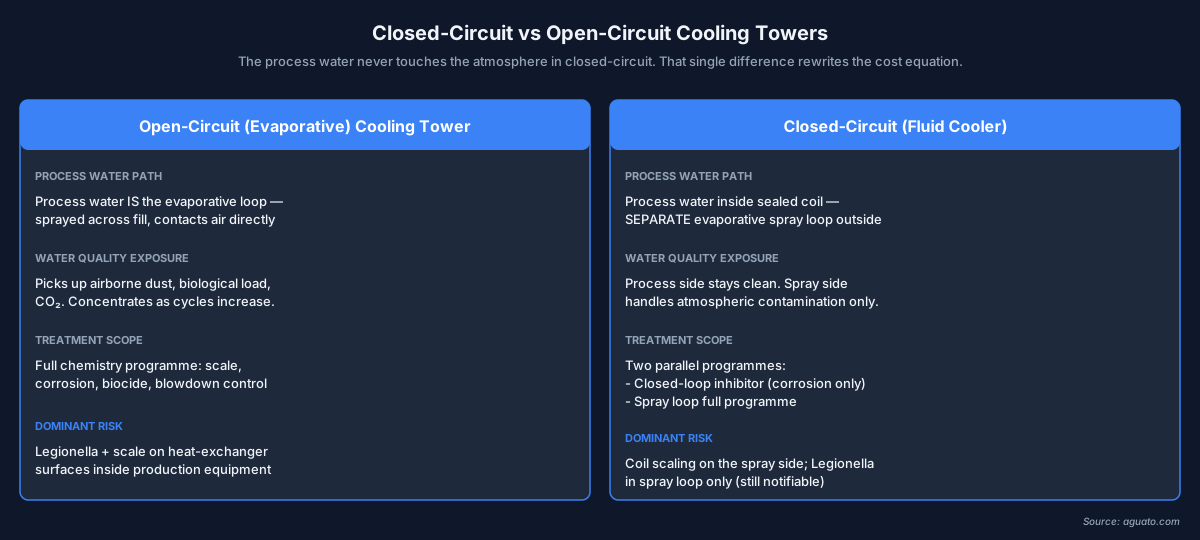
The architectural difference matters most where the dominant risk dimension on the right of the diagram, coil scaling on a small spray loop versus heat-exchanger fouling and Legionella exposure on the entire process loop, translates directly into your annual maintenance budget and your insurance position. Two plants with identical heat-rejection duty can sit on opposite sides of a 20% lifecycle-cost gap based on this single decision, and the gap compounds across every cooling season the equipment runs.
The five-configuration question follows next: once the open-versus-closed call is made, the closed-circuit family itself splits into five variants with very different water and energy footprints.
## The five configurations and their water and energy trade-offs
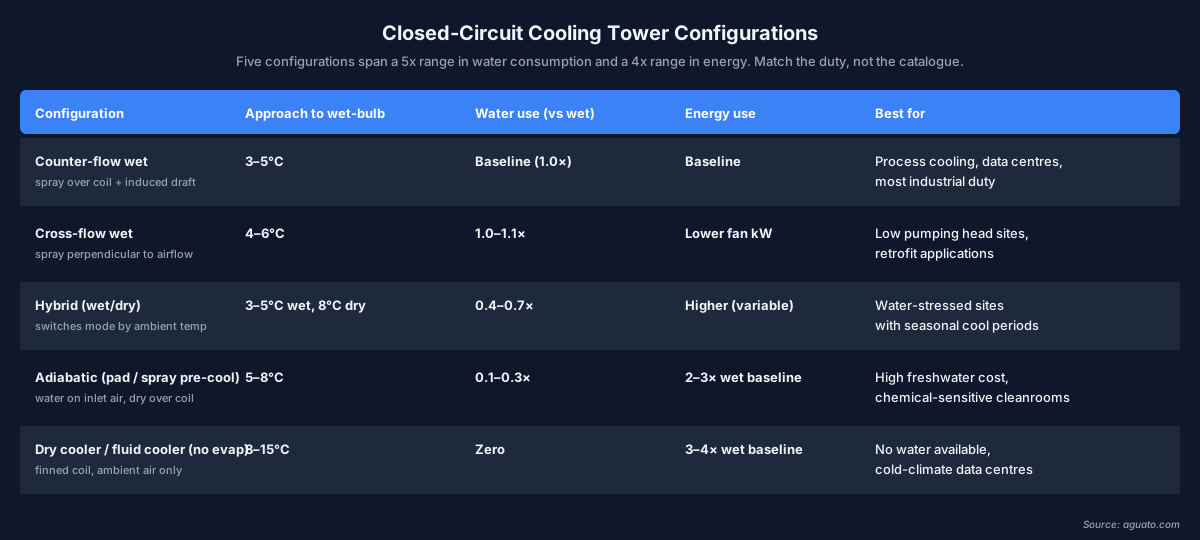
Closed-circuit fluid coolers come in five configurations, and the procurement decision is rarely between "open" and "closed." It is among five closed-circuit variants that span a 5× range in water consumption and a 4× range in fan energy. The catalogue distinctions look subtle, "wet vs hybrid vs adiabatic vs dry" reads like a marketing axis on a vendor brochure, but the operating-cost spread between them at the same heat-rejection capacity is large enough that picking the wrong one rarely produces a single failure mode; it produces a quietly compounding annual penalty that the operations team carries for the asset's full service life.
The configuration question is best understood as a two-axis choice: how aggressively the design relies on evaporation versus dry sensible heat, and how tightly the design needs to approach the local wet-bulb temperature. Counter-flow wet sits at one corner of that grid (full evaporation, tightest approach); dry fluid coolers sit at the opposite corner (no evaporation, widest approach). Hybrid, adiabatic, and cross-flow occupy the middle of the grid in different ways, and the right answer for a given site depends on where the local water cost, water-stress regulatory exposure, and process duty land that site on the grid.
The fan-energy axis matters more than most procurement teams price in. A dry cooler at the same rejected-heat capacity runs 3 to 4× the fan kW of a wet baseline because it has to move much more air to compensate for the absent latent heat path. Over a 15-year asset life on a 1,000 kW duty in a high-electricity-cost region, that energy delta alone can erase the water-cost savings and then some. The configuration table below normalises water and energy at the same reference duty so the comparison is on equal footing.
The selection logic in practice:
- Counter-flow wet is the baseline. It delivers the tightest approach to wet-bulb (3 to 5°C), packs more capacity per footprint, and is the default specification for process cooling, data centres, and heavy industrial duty. Energy and water use are the reference point. - Cross-flow wet trades a slightly looser approach (4 to 6°C) for lower fan kW and lower pumping head. It is the right answer for retrofit installations where the existing pump set cannot handle counter-flow pressure drop. - Hybrid wet/dry towers run dry above a switch-over temperature (typically 15 to 20°C wet-bulb) and switch to evaporative mode in summer. They cut annual water use by 30 to 60% in temperate climates and are now the default for water-stressed regions, regardless of CAPEX premium. - Adiabatic pre-cool uses a fine spray on the inlet air, not the coil. The coil stays dry. Water use drops to 10 to 30% of a wet baseline, but fan energy is 2 to 3× higher. Adiabatic systems suit cleanroom HVAC and pharma-adjacent process cooling where droplet-borne contamination is unacceptable. - Dry fluid coolers use no water at all. Approach to ambient is 8 to 15°C, much wider, so capacity per dollar is low. They are the right choice in the Nordic data-centre belt or where freshwater is unavailable, not where they are merely "cleaner."
The wet-bulb approach is the engineering KPI that determines whether a configuration is fit for the duty. A 5°C tighter approach reduces compressor head pressure on the connected chiller plant by enough to deliver 4 to 8% chiller energy savings, frequently more than the cooling-tower fan energy delta between configurations. Optimising the cooling tower in isolation is a common procurement mistake. The right comparison is total electrical demand at the building meter, not at the tower terminals.
## Where closed-circuit wins, where open-circuit still rules
The cost equation flips on five specific dimensions. When two or more apply, closed-circuit almost always wins on lifecycle. When none apply, open-circuit is the right answer.
| Decision dimension | Closed-circuit wins when... | Open-circuit wins when... | |---|---|---| | Process water purity | Process fluid touches a regulated product (food, pharma, semiconductor) or a precision exchanger (plate-and-frame) | Process is robust to dust loading and condenser fouling | | Legionella exposure | Plant is healthcare, hospitality, or a UK/EU regulated site under HSE L8 | Plant has good Legionella programme, accepts the regulatory burden, and operates outside healthcare risk zones | | Downtime cost | A single unplanned chiller-side cleaning costs more than USD 50,000 in lost output | Routine cleaning fits inside scheduled shutdown windows | | Glycol or specialty fluid | The loop carries propylene glycol, ethylene glycol, or a heat-transfer oil that is too valuable to lose to drift | Plain water is the heat-transfer fluid | | Geographic water cost | Site is in a water-stressed basin and water cost exceeds USD 1.50/m³ | Water is plentiful and unconstrained at the site |
Industries where closed-circuit is now the default specification:
- Pharmaceutical and biotech, process water touches sterile or near-sterile equipment; cross-contamination is unacceptable; FDA inspections review cooling-water logs. - Data centres, precision plate-and-frame exchangers foul rapidly with airborne dust, and rack-side temperature variability translates directly into compute throughput. - Food and beverage, direct or near-direct contact with product means no aerosol-borne contaminants in the cooling chain. - Hospitals and healthcare, Legionella aerosol risk is non-negotiable; closed-circuit isolates the regulated risk to the spray loop alone, which under [the UK HSE L8 Approved Code of Practice](dofollow:https://www.hse.gov.uk/pubns/books/l8.htm) reduces the regulated water volume that needs full Legionella sampling and chlorine residual control. - Steel and aluminium continuous casting, high-precision casting moulds need stable temperature and zero variability from fouling; the cost of a casting upset is 100 to 1,000× the water-cost premium.
Industries where open-circuit still wins:
- General-duty HVAC in commercial real estate where Legionella risk is managed and process precision is irrelevant. - Heavy industrial cooling (refining, large petrochemical, primary metals) where the loops are large enough that the closed-circuit CAPEX premium becomes prohibitive and the process is robust. - Power generation thermal cycles where the cooling tower IS the process, not a service to it.
The fit-for-duty filter above is the procurement gate, but it does not produce a number that survives a budget conversation. That requires running the lifecycle math at a specific reference duty, with every cost line broken out across the asset's full service life, because the closed-circuit case wins or loses on cost lines that sit inside operations and downtime, not procurement.
A common pattern: the CAPEX premium gets quoted in the bid review and the operations savings get assumed away. The next section runs the numbers at a 1,000 kW reference duty across a 15-year horizon, tower CAPEX, treatment chemistry, water and sewer, heat-exchanger cleaning, downtime exposure, and energy delta, so the procurement-versus-operations split sits in plain view and the right answer can be defended at the budget review with a single line item the CFO can read.
## CAPEX, OPEX, and the 15-year payback math
The capital premium for closed-circuit is roughly 1.5 to 2.0× an equivalent open-circuit tower for the same cooling capacity. For a 1,000 kW (≈285 ton) duty:
| Cost element (15-year horizon, 1,000 kW duty) | Open-circuit | Closed-circuit | Delta | |---|---|---|---| | Tower CAPEX | USD 35,000 to 55,000 | USD 65,000 to 110,000 | +USD 30,000 to 55,000 | | Treatment chemistry (15-yr OPEX) | USD 90,000 to 140,000 | USD 50,000 to 80,000 (spray loop only) | −USD 40,000 to 60,000 | | Water and sewer (15-yr OPEX) | USD 75,000 to 180,000 | USD 60,000 to 150,000 | −USD 15,000 to 30,000 | | Heat-exchanger cleaning and descaling | USD 60,000 to 180,000 | USD 8,000 to 25,000 | −USD 50,000 to 155,000 | | Unplanned downtime exposure (1 to 2 events) | USD 100,000 to 500,000 | USD 0 to 50,000 | −USD 100,000 to 450,000 | | Energy delta (fans + pumping) | Baseline | +USD 6,000 to 15,000 | +USD 6,000 to 15,000 |
For a process cooling duty in food, pharma, or data-centre service, the closed-circuit lifecycle cost is 15 to 35% lower than open-circuit despite the CAPEX premium. The single largest swing factor is unplanned downtime, and that variable sits inside the operations cost line, not the procurement line, which is why it is routinely under-counted in procurement-led tower decisions.
For an HVAC duty in a low-risk commercial building, the math reverses. Closed-circuit lifecycle cost is 5 to 15% higher than open-circuit, and the open-circuit specification is correct.
The right way to test the decision is feed-water-specific. Plug the tower into [Nepti's water-decision model](/nepti), Nepti characterises the process duty, the local feed water, the regulatory environment, and the downtime cost-of-failure, and produces a ranked configuration comparison with 15-year lifecycle cost projections. Procurement teams running this model before tendering save 8 to 18% on the wrong configuration being specified, almost entirely by avoiding the over-specification of closed-circuit on duties where open-circuit is correct.
[cta:nepti-dark]
The lifecycle math above depends on a chemistry programme that runs reliably across two parallel loops, the sealed coil side and the atmospheric spray side, for 15 years without degradation. The two loops have completely different chemistry profiles, completely different sampling cadences, and completely different failure modes when the programme drifts. Operators who treat the closed-circuit architecture as "one programme on a smaller system" inherit a USD 50,000 to 150,000 fill replacement they could have prevented for under USD 1,500 in spray-loop dosing.
The architecture and the chemistry are inseparable: get the chemistry programme right and the OPEX numbers in the table above hold; treat the spray loop as an afterthought and they don't. The next section breaks down the chemistry on each side, what gets dosed, at what concentration, how often it gets sampled, and what the realistic annual cost looks like at the 1,000 kW reference duty.
## Treatment chemistry on a closed loop
The treatment chemistry difference is large enough to matter on its own.
Closed-loop side (sealed coil): - One-shot fill of corrosion inhibitor at commissioning, typically nitrite-borate, molybdate, or an azole-blended formulation at 800 to 1,500 mg/L active concentration. - Annual sample for pH, conductivity, inhibitor residual, and dissolved [iron](/elements/iron). - Top-up dosing only if the loop is opened for maintenance. - Total annual chemistry cost for a 1,000 kW closed loop: USD 800 to 2,000.
Spray-loop side (atmospheric-exposed): - Full programme equivalent to an open-circuit tower at the same heat-rejection duty: scale inhibitor (phosphonate or polymer at 2 to 8 mg/L), corrosion inhibitor (azoles, zinc), oxidising biocide ([chlorine](/elements/chlorine) or bromine), non-oxidising biocide (rotation), and a dispersant. - Conductivity-based blowdown control with cycles of concentration set against feed-water TDS, see our [cooling tower water treatment guide](/resources/cooling-tower-water-treatment) for the full programme structure and the [cooling tower blowdown deep-dive](/resources/cooling-tower-blowdown) for setpoint engineering and the discharge-permit perimeter. - Annual chemistry cost for a 1,000 kW spray loop: USD 4,000 to 7,500 (versus USD 7,000 to 12,000 for an equivalent-duty open-circuit tower, because the spray loop volume is smaller and the system is harder for contaminants to enter).
The Legionella programme follows [ASHRAE Guideline 12-2020 on managing the risk of legionellosis associated with building water systems](dofollow:https://www.ashrae.org/technical-resources/bookstore/legionellosis-guideline-12-2020) on the spray loop only. Closed-circuit reduces the regulated water volume that needs Legionella sampling and chlorine residual control by 60 to 80%. For a healthcare or pharma site, that is not just a cost saving, it is a smaller compliance perimeter and a faster sampling cycle. For the broader Legionella programme structure, see the [legionella risk assessment guide](/resources/legionella-risk-assessment).
## Where closed-circuit decisions go wrong
Three failure patterns recur, and each represents a recognised procurement-led mistake.
1. Specifying closed-circuit because it is "more efficient", without process duty justification. A general-duty HVAC retrofit specified closed-circuit on a vendor recommendation, paying the 1.8× CAPEX premium against an open-circuit baseline that would have been correctly engineered for the application. Lifecycle cost was 11% higher; payback was negative. The mistake was treating a vendor preference as a decision criterion. Correct decision: characterise the process duty against the five-dimension comparison table above before specifying configuration.
2. Sizing the spray loop on coil capacity, not on heat-rejection capacity. A 600 kW data-centre installation specified the spray loop on a heat-exchanger area calculation, not on actual heat rejection at peak summer wet-bulb. The result: the tower could not maintain a 5°C approach in July; chiller compressors ran at higher head pressure; chiller energy went up 7% during the warmest 60 days of the year. Cost: USD 18,000 in the first cooling season, plus a six-month capacity bottleneck. Correct decision: size against the worst-case wet-bulb (1% ASHRAE design condition for the location), not the typical or peak duty.
3. Neglecting the spray-loop chemistry because "it is closed-circuit." An aluminium casting plant assumed the closed architecture eliminated the need for a serious spray-loop chemistry programme. Six months later the spray-loop fill was scaled, fan capacity was 30% degraded, and a USD 150,000 fill replacement was the cheapest available option. The closed-circuit architecture protects the process side. The spray side is fully exposed to atmospheric and biological contamination and needs the equivalent of a full open-circuit programme.
In every case, the decision quality starts with characterising the duty before specifying the architecture.
## Decision framework: should you go closed-circuit?
Run the duty through this sequential check.
1. Process water purity: Does the process touch a regulated product, a precision exchanger, or a glycol/oil loop? Yes → closed-circuit. No → continue. 2. Legionella exposure: Is the site healthcare, hospitality, hospital chiller plant, or a UK/EU site under HSE L8? Yes → closed-circuit. No → continue. 3. Downtime cost: Does a single unplanned heat-exchanger cleaning cost more than USD 50,000 in lost output, off-spec product, or schedule disruption? Yes → closed-circuit. No → continue. 4. Specialty fluid: Does the loop carry glycol (more than 20% concentration), heat-transfer oil, or any non-water fluid that is expensive to replace? Yes → closed-circuit. No → continue. 5. Water cost: Does the site face freshwater cost above USD 1.50/m³ or operate in a regulated water-stressed basin? Yes → consider hybrid wet/dry closed-circuit. No → continue. 6. All five answers no: Open-circuit is the right specification. Build the chemistry programme around it.
If two or more answers are "yes," the closed-circuit lifecycle case is strong enough to absorb the CAPEX premium. If only one is "yes," compare configurations against open-circuit on a 15-year basis before specifying. The lifecycle delta in the "one yes" zone is small enough that the right answer depends on local water cost, local labour cost, and local downtime exposure, characterise before specifying.
The decision framework above produces an architecture choice and a configuration choice; what it does not produce is the one number that survives a five-minute conversation with a CFO who has not read the article. That number is the dollar gap between the CAPEX premium and the avoided downtime exposure on the wrong specification, and it is the difference between a procurement decision that gets approved on first review and one that gets sent back to "look at the lower bid one more time."
The CAPEX delta is small enough to absorb. The downtime delta is large enough to matter. Framing both at the same scale, and in the language the finance team uses, is what closes the case.
## FAQ
### Is a closed-circuit cooling tower the same as a fluid cooler?
The terms are used interchangeably in industry. AHRI Standard 1500 lists the equipment as "closed-circuit cooling tower" or "closed-circuit fluid cooler"; manufacturers' catalogues use both. Functionally they are identical, a coil that keeps the process fluid sealed, with an external evaporative or air-only cooling mechanism on the outside.
### How much more does a closed-circuit cooling tower cost than an open-circuit one?
On capital cost, 1.5 to 2.0× for the same heat-rejection capacity. On 15-year lifecycle cost, the closed-circuit total is typically 15 to 35% lower for process cooling, food, pharma, healthcare, and data-centre duty, and 5 to 15% higher for general-duty commercial HVAC. The lifecycle math depends critically on the cost of an unplanned downtime event, sites with downtime exposure above USD 50,000 per event almost always recover the CAPEX premium.
### Can I retrofit an open-circuit tower as closed-circuit?
Not directly. The architecture is fundamentally different, the heat exchange happens inside a coil, not across fill. A retrofit is effectively a new tower install with an existing pad and existing connections, and rarely makes economic sense unless the existing tower is at end-of-life or has chronic Legionella, fouling, or compliance issues that justify the full replacement.
### Do closed-circuit cooling towers eliminate Legionella risk?
No. They confine Legionella risk to the spray loop, which is still a Legionella-relevant aerosol-producing system regulated under ASHRAE Guideline 12, HSE L8 (UK), and equivalent national codes. Closed-circuit reduces the regulated water volume by 60 to 80% and removes the process-side cross-contamination vector, it does not remove the spray-side compliance burden.
### How does adiabatic cooling fit into the closed-circuit decision?
Adiabatic pre-cool is a closed-circuit configuration where water is sprayed on the inlet air, not on the coil. The coil stays dry. Water consumption drops to 10 to 30% of a wet-baseline closed-circuit tower, but fan energy is 2 to 3× higher and capacity-per-footprint is lower. Adiabatic suits water-stressed sites, cleanrooms, and pharma-adjacent process cooling where coil wetting is unacceptable.
### What treatment chemistry does the sealed coil loop need?
A one-shot dose of corrosion inhibitor at commissioning, typically nitrite-borate, molybdate, or an azole-blended formulation, at 800 to 1,500 mg/L active concentration. Annual sampling confirms inhibitor residual, pH, and dissolved iron. Top-up dosing is needed only if the loop is opened for maintenance. The spray-loop side needs a full open-circuit-equivalent chemistry programme: scale, corrosion, biocide, dispersant, and conductivity-based blowdown control.
### When is dry cooling (no water) the right answer?
When freshwater is unavailable, when the climate makes evaporative cooling marginal (Nordic data-centre belt, high-altitude desert sites), or when the site has a zero-liquid-discharge constraint that makes blowdown disposal expensive. Dry coolers have wider approach to ambient (8 to 15°C), higher fan energy (3 to 4× wet baseline), and lower capacity-per-footprint than wet or hybrid configurations. They are correct for narrow site contexts, not as a default upgrade from wet cooling.