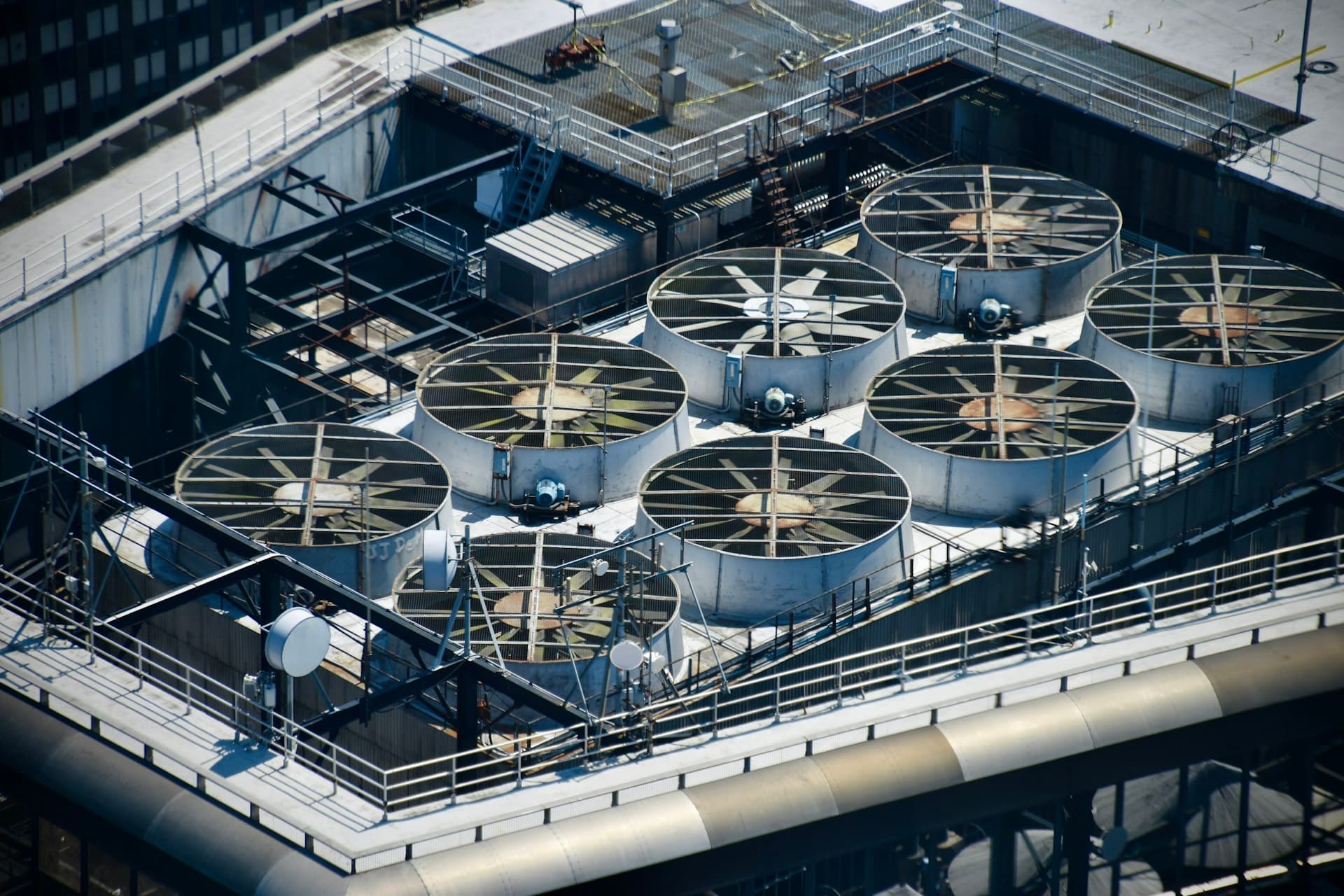
The five axes that define cooling tower types, heat-rejection method, draft, flow configuration, circuit, construction, and a selection matrix mapping site conditions to the right type.
Specifying the wrong cooling tower type for a 5 MW industrial duty costs $200,000 to 600,000 over its 20-year service life, in oversized fans running at part-load, water tariffs you didn't have to pay, summer downtime when the unit can't hit process temperature, and a chemistry programme fighting a configuration it shouldn't be in. Multiply that across a portfolio of three sites and you have a seven-figure number that nobody on the project remembers signing off.
Cooling tower selection is not one decision. It is five interlocking decisions: heat-rejection method (wet, dry, or hybrid), draft (natural vs mechanical), flow configuration (counterflow vs crossflow), circuit type (open vs closed), and construction approach (factory-assembled vs field-erected). Each interacts with site climate, water cost, compliance regime, and process integrity needs. Vendors will quote whatever they sell. Most don't model the lifecycle cost of the alternatives, that is the buyer's job, and the cost of skipping it is the largest avoidable expense on a typical industrial cooling project.
This guide is for plant managers replacing an underperforming tower, procurement leads running a new cooling RFP, and sustainability directors building a multi-site water-reduction business case. It walks through each classification axis with the threats and opportunities at each fork, ends with a selection matrix mapping common site conditions to the right type, and closes with the dollar number that should be in your next CFO conversation.

## The decision in brief
- Fix the wrong-spec tower first. Replacing one wrong-spec cooling tower in your portfolio with the right configuration for the site saves $200,000 to 600,000 over its 20-year service life. - Know where the saving sits. Water cost accounts for $120,000 to 280,000, energy cost for $60,000 to 180,000 from right-sized fans and pumps, and avoided emergency CAPEX from a mid-life retrofit for $150,000 to 400,000 if the original was wrong enough to demand replacement. - Multiply across the portfolio. For a multi-site operator with three or more cooling towers, the portfolio-level number runs into seven figures, each tower judged on its wet-bulb climate, water cost, process integrity needs and compliance regime.
The biggest cost of doing nothing is letting an incumbent vendor specify the same induced-draft package they always sell, regardless of your site, the single decision where every six-figure mistake in this article begins.
## The Five Ways Cooling Towers Are Classified
Every cooling tower belongs to one option on each of five axes. Read together, these five choices fully describe the tower:
- Heat-rejection method, how the water gives up its heat: by evaporation (wet), by direct sensible exchange to air (dry), or both (hybrid). - Draft method, how air moves through the tower: by buoyancy in a tall stack (natural-draft) or by fans (mechanical-draft, which subdivides into induced and forced). - Flow configuration, how water and air meet inside the fill: against each other (counterflow) or perpendicular to each other (crossflow). - Circuit type, whether process water contacts the cooling air directly (open-circuit) or stays sealed inside a coil (closed-circuit). - Construction approach, whether the tower ships as a pre-assembled unit (factory-assembled) or is built on site from components (field-erected).
A typical industrial process cooling tower at a chemical plant might be: wet, mechanical-draft (induced), counterflow, open-circuit, factory-assembled. A power-station tower might be: wet, natural-draft, crossflow, open-circuit, field-erected. The five axes do not lock together, almost any combination exists in some form.
The rest of this guide covers each axis individually, then closes with a matrix that ties them back together against site conditions. For the underlying physics behind any of these types, see the [how does a cooling tower work](/resources/how-does-a-cooling-tower-work) explainer.
## Wet, Dry, and Hybrid
The first and most consequential decision: how does the tower actually move heat to the atmosphere?
Wet (evaporative) cooling towers vaporise a small fraction of the circulating water, typically 1.5 to 2.5% per pass. Each kilogram of water that evaporates absorbs ~2,260 kJ of latent heat from the bulk water that did not evaporate. This is why wet towers reject more heat per dollar of capital and per square metre of footprint than dry alternatives. The trade is water consumption (3 to 6 m³ per MWh of rejected heat) and continuous chemistry management. The [evaporative cooling tower](/resources/evaporative-cooling-tower) article covers the wet-tower decision framework in depth.
Dry coolers (air-cooled heat exchangers) transfer heat across finned tubes from the process fluid directly to ambient air. No water consumption, no Legionella risk, no chemistry programme. The cost is much lower performance per unit area: a dry cooler is bounded by ambient dry-bulb temperature, which on a hot summer day in a temperate climate can sit 8 to 12 °C above the wet-bulb that constrains a wet tower. To match the same heat duty, dry coolers typically need 30 to 50% more surface area. Energy use also rises: fans run harder to push more air across smaller temperature differences.
Hybrid wet-dry towers integrate both modes in one unit. Below a configurable wet-bulb threshold (often 4 to 8 °C), the spray system shuts off and the tower runs as a dry cooler, no water consumption, no biocide demand. Above the threshold, sprays activate and the tower transitions to evaporative operation. Annual water savings of 20 to 40% are typical in temperate climates while preserving full hot-day performance.
| Aspect | Wet (evaporative) | Dry (air-cooled) | Hybrid wet-dry | |---|---|---|---| | CAPEX (per kW) | $80 to 280 | $200 to 500 | $250 to 600 | | Water consumption | 3 to 6 m³/MWh | None | 2 to 4 m³/MWh (annual avg) | | Annual OPEX driver | Water + chemistry | Fan electricity | Mixed; lowest in temperate climates | | Footprint | Smallest | 30 to 50% larger | ~10% larger than wet | | Hot-day performance | Best | Worst | Equal to wet above wet-bulb threshold | | Compliance burden | Highest (Legionella) | Lowest | Moderate | | Best for | Hot wet-bulb climates with water access | Cold/moderate climates, water-stressed sites with low duty | Water-stressed sites needing hot-day capacity |
The choice depends on local climate, water cost and availability, and process integrity requirements. Sites with both water stress and high summer wet-bulb often default to hybrid as the only configuration that meets all constraints. The ASHRAE Standard 90.1 sets minimum efficiency requirements for cooling towers across these categories, see [ASHRAE 90.1-2022 standard for energy efficiency in commercial buildings](dofollow:https://www.ashrae.org/technical-resources/bookstore/standard-90-1) for current thresholds.
Not sure whether wet or hybrid is right for your specific climate and water cost? [Browse verified cooling tower providers](/providers), request scoped proposals from 3 to 5 specialists who can model the lifecycle cost for your actual site conditions.
## Natural-Draft vs Mechanical-Draft
The second axis is how air moves through the tower:
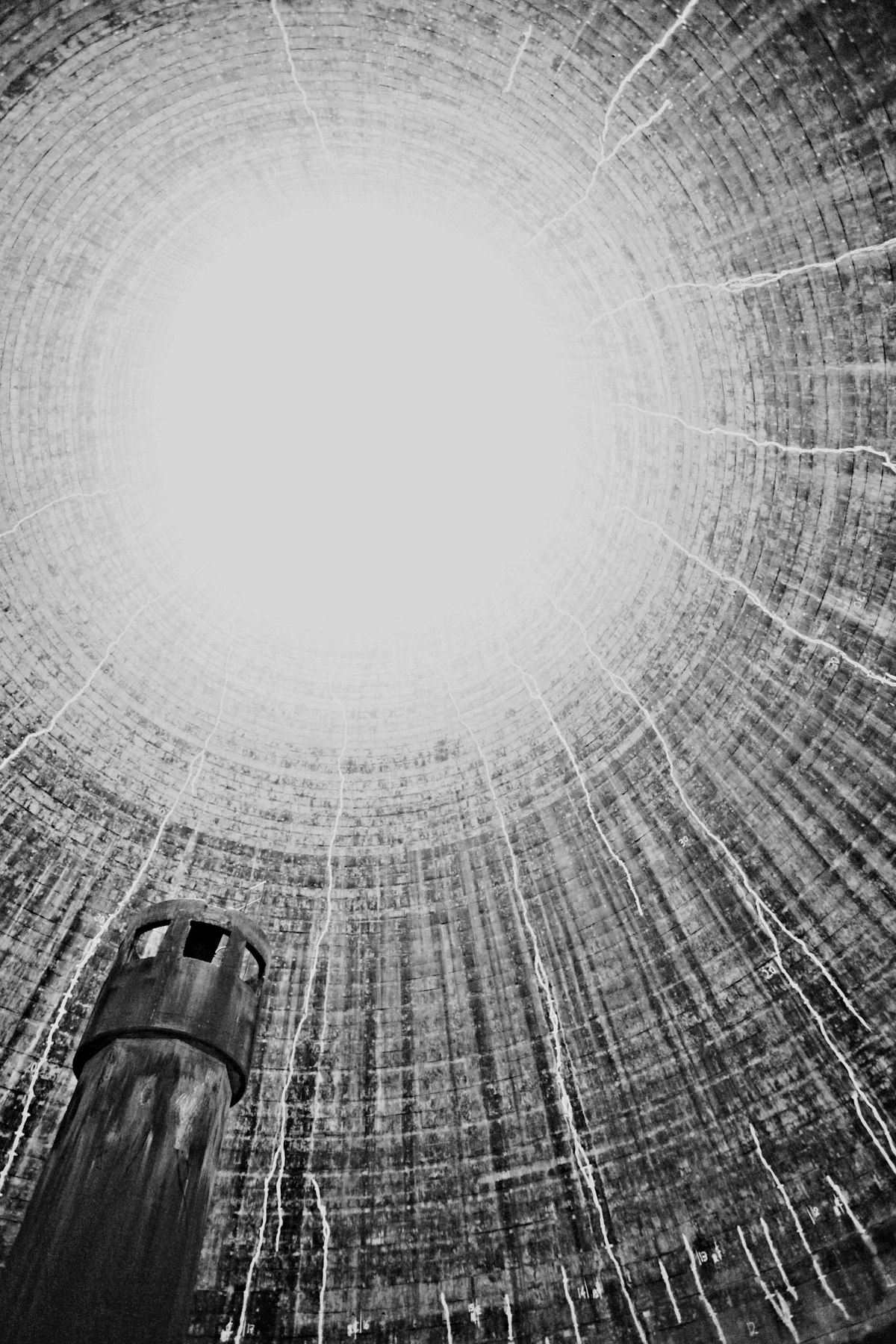
Natural-draft towers rely on the chimney effect: warm, moist air inside the tower is less dense than ambient air outside, so it rises naturally. The shape that maximises this, the iconic hyperbolic concrete profile seen at large power stations, accelerates the air column and generates enough draft for heat rejection of 200 to 1,000 MW per tower. No fans means no fan power consumption, no fan maintenance, and very long service life (60+ years for the concrete shell). The cost is enormous capital and footprint: hyperbolic towers run 100 to 200 m tall and require deep foundation work. Practical only at very large duty in plants with abundant land.
Mechanical-draft towers use fans to move air. Two sub-types:
- Induced-draft towers place the fan at the top, pulling air upward through the fill. This is the dominant industrial design for medium and large duty (1 MW, 50 MW). Air leaving the tower is already saturated and slow-moving when it hits the fan, which helps with recirculation prevention. Most factory-assembled and field-erected industrial towers are induced-draft. - Forced-draft towers place the fan at the side, pushing air into the tower. Smaller and quieter for low-duty applications, but recirculation is harder to control because warm exhaust air can be drawn back into the inlet. Common in HVAC and small process duty up to ~2 MW.
Within the mechanical-draft family, fan choice matters: large axial fans are standard for medium/large industrial duty; smaller centrifugal fans are common in factory-assembled units where ducting and acoustics dominate. Modern installations often use variable-frequency drives (VFDs) on the fans to vary airflow with load, cutting energy use by 30 to 50% versus single-speed operation. The Cooling Technology Institute's [ATC-105 thermal performance certification](dofollow:https://www.cti.org/atcs/atc-105.shtml) defines how mechanical-draft tower performance is measured for procurement acceptance.
## Counterflow vs Crossflow
The third axis describes how water and air meet inside the fill:
Counterflow towers move water downward and air upward, opposite directions through the same volume of fill. Thermodynamically, this maximises temperature gradient at every point and gives the best thermal performance per unit fill volume. The cost is taller equipment: counterflow towers are typically 30 to 50% taller than equivalent crossflow towers because the air must travel the full height of the fill in one pass. Counterflow dominates large industrial and field-erected installations where height is acceptable.
Crossflow towers move water downward but air horizontally across the fill. The shorter air path lets the tower be wider rather than taller. Crossflow dominates the factory-assembled HVAC market and applications where height limits matter, rooftop installations, sheltered plant rooms, sites under planning height restrictions. Performance per cubic metre of fill is lower than counterflow, but the lower height and easier maintenance access often win.
Crossflow towers are also more tolerant of fouling-prone water: their open splash-fill or inverted-V louvre designs allow suspended solids to wash through rather than build up on film fill surfaces. Mining sites and other harsh-chemistry installations often default to crossflow with splash fill for this reason.
| Aspect | Counterflow | Crossflow | |---|---|---| | Tower height | 30 to 50% taller | Shorter, wider | | Thermal performance per m³ fill | Higher | Lower | | Fouling tolerance | Lower (film fill) | Higher (splash fill option) | | Maintenance access | Harder (taller stack) | Easier (side access) | | Acoustic profile | Quieter (taller draws air at lower velocity) | Slightly noisier | | Best for | Large industrial, field-erected, height tolerated | HVAC, factory-assembled, rooftop, fouling-prone water | | Typical cost difference | Baseline | 5 to 15% lower installed for same duty |
Either configuration achieves the same approach to wet-bulb when correctly sized, the choice is driven by site geometry, fouling tolerance, and maintenance access, not by which delivers cooler water.
## Open vs Closed-Circuit
The fourth axis is whether the process water touches the cooling air directly:
Open-circuit towers run the process water itself through the tower fill. Single loop, fewer pumps, no intermediate heat exchanger. CAPEX is lower, typically $80 to 180 per kW of rejected heat for industrial duty. The downside is that the process loop is constantly exposed to airborne contaminants, dissolved gases, and biological load. Continuous chemistry, biocide, scale inhibitor, dispersant, corrosion inhibitor, is non-negotiable. Open-circuit is the default for most industrial process cooling, power generation, and HVAC chiller condenser cooling where the loop can tolerate dosed treatment chemistry.
Closed-circuit towers seal the process fluid inside a coil, then spray a separate recirculating water stream over the coil to cool it evaporatively. Process loop never contacts open air. CAPEX runs 25 to 60% higher than open-circuit, roughly $130 to 280 per kW for the same duty range, because the coil is the cost driver. OPEX often lands lower across the equipment lifetime: less chemistry, less coil cleaning, longer service intervals. Closed-circuit also enables hybrid wet-dry operation more cleanly than open-circuit can.
| Aspect | Open-circuit | Closed-circuit | |---|---|---| | CAPEX (per kW) | $80 to 180 | $130 to 280 (25 to 60% higher) | | Annual chemistry cost | $0.10 to 0.40 per m³ make-up | 30 to 60% lower | | Process loop integrity | Exposed to air, dust, microbes | Sealed inside coil | | Legionella risk on process side | Highest | Lowest | | Hybrid wet-dry capability | Limited | Full (key advantage) | | Service life | 20 to 25 years (chemistry-driven degradation) | 25 to 30 years (coil-driven) | | Best for | Standard industrial process, HVAC condenser, power gen | Food, pharma, glycol/oil loops, water-stressed sites |
Closed-circuit is the right choice when:
- Process fluid must stay clean (food, pharmaceutical, high-purity water systems) - Process fluid is glycol or oil that must not contact open water - Site water quality is poor and chemistry control on an open loop would be difficult - Hybrid winter dry operation is wanted to cut water consumption
For mid-size industrial process cooling without these constraints, open-circuit usually wins on lifecycle cost. See [cooling tower water treatment](/resources/cooling-tower-water-treatment) for the chemistry programme that comes with open-circuit operation, and the [closed-circuit cooling tower decision guide](/resources/closed-circuit-cooling-tower) for the 15-year payback math on the alternative architecture.
If your process loop has any of the integrity flags above and the spec is still open-circuit, it's worth a second opinion before signing the order. [Post your project](/post-project) and you'll get scoped proposals from independent providers covering both architectures with lifecycle costs side by side.
[cta:nepti-dark]
## Factory-Assembled vs Field-Erected
The fifth axis is construction approach:
Factory-assembled (or "package") towers ship as complete pre-engineered units in standard sizes, typically up to 5 MW per cell, with multiple cells installed in parallel for larger duties. Built in a factory under controlled conditions, shipped on a truck, lifted into place, and connected to piping and power on site. Installation time is days, not months. Factory-assembled towers dominate the HVAC market and small/medium industrial installations.
Field-erected towers are designed and built on site from individual components, structural framing, basin, fill, mechanical equipment. This is the only practical approach for very large duties (>10 MW per cell) and for sites with footprint or geometry constraints that no standard package can meet. Construction takes weeks to months, requires site cranes and rigging, and ties up engineering and project management resources. Common in power generation, refining, and large petrochemical sites.
| Aspect | Factory-assembled | Field-erected | |---|---|---| | Typical duty per unit | Up to 5 MW per cell | 5 MW, hundreds of MW | | Lead time | 4 to 10 weeks | 3 to 9 months | | Install time on site | Days | Weeks to months | | Engineering / PM overhead | Low (pre-engineered) | High (custom design) | | Cost-per-MW (5 to 15 MW range) | Cheaper installed | Cheaper above ~15 MW | | Maintenance modularity | Replace whole cell | Component-level repair | | Best for | HVAC, sub-15 MW industrial, multi-cell parallel | Large industrial, power gen, custom geometry |
The cost crossover is roughly 5 to 15 MW total duty: below that, factory-assembled is almost always cheaper installed; above that, field-erected starts to win on $/MW because the per-unit shipping and assembly overhead of multiple package cells becomes significant. For very large hyperbolic natural-draft towers, field erection is mandatory, there is no "package" option at that scale.
## Selection Matrix
Tying the five axes together against common site conditions:
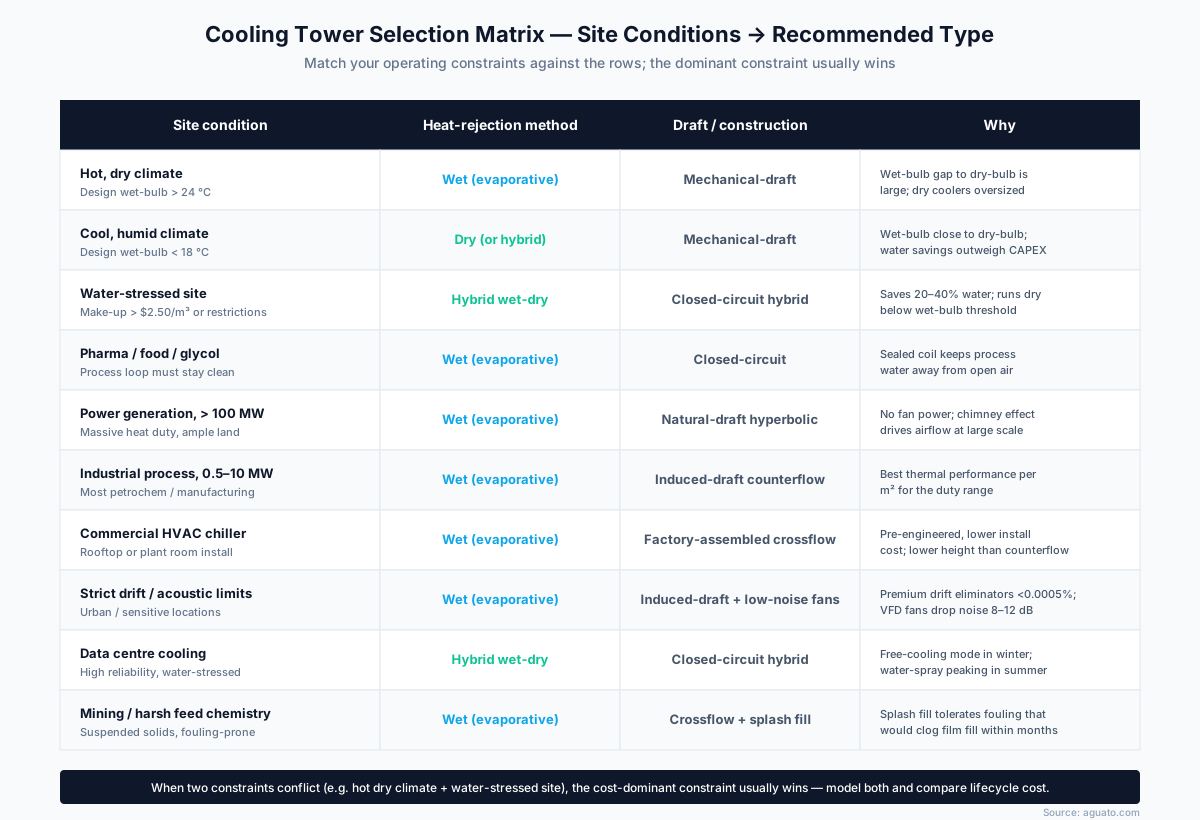
A few patterns are worth highlighting from the matrix:
- Hot dry climate + abundant water → wet evaporative every time. The wet-bulb gap is too large to leave on the table. - Water-stressed site of any climate → consider hybrid wet-dry first; the 20 to 40% water savings usually justify the higher CAPEX within 5 to 8 years. - Pharma, food, or glycol process loops → closed-circuit, full stop. The cost premium is the ticket of admission for keeping process water sealed. - Large power generation (>100 MW per tower) → natural-draft hyperbolic still wins on lifecycle cost where land permits. - Most mid-size industrial process cooling → induced-draft counterflow open-circuit. The "default" answer for 80% of process plants. - Commercial HVAC chillers → factory-assembled crossflow. Lower height and pre-engineered installation matter more than peak thermal performance.
When two constraints conflict, most often hot dry climate combined with water-stressed site, model both options in detail. Lifecycle cost over 20 years usually breaks the tie; first-cost comparisons mislead. Sites that struggle to choose without a model are exactly where decision-intelligence platforms like [Nepti](/nepti) earn their keep, because the trade-offs depend on multiple climate, cost, and chemistry inputs that change with location and year.
## Where Type Selection Goes Wrong (And What It Costs)
Three failure modes recur across project reviews. Each carries a six- or seven-figure correction cost that sits squarely on the buyer, not the vendor.
Failure 1: Choosing dry cooling in a hot wet-bulb climate to "save water". The dry cooler under-performs on the 30 to 80 hottest hours of the year, exactly when the process most needs cooling. For a continuous-process plant, that's 6 to 12 MWh of lost production output per affected hour at typical industrial margins, plus emergency chiller hire at $3,000 to 8,000/day to bridge the gap. Sites in 28 °C+ design wet-bulb climates that pick dry cooling typically discover this in the first July, write a $150,000 to 400,000 corrective cheque, and end up retrofitting hybrid mode anyway. The water savings were real but they were valued at zero hours when the plant was offline.
Failure 2: Specifying open-circuit for a glycol, food-grade, or pharma process loop. The loop fouls within 6 to 18 months, chemistry programme cost rises $25,000 to 80,000/year trying to compensate, and product-quality incidents start to surface. The only fix is a closed-circuit retrofit at 2 to 3× the original CAPEX, a 5 MW open-circuit tower replacement could be $400,000 to 700,000 including downtime, plus another $60,000 to 120,000/year in lost production margin during the changeover. The closed-circuit premium upfront would have been $100,000 to 250,000 on the original build. Every food and pharma site that overruled this on first-cost grounds has the same story.
Failure 3: Picking factory-assembled cells for a 20+ MW industrial duty. Four 5 MW package cells installed in parallel cost 30 to 55% more lifecycle ($/MW) than a single field-erected tower, occupy 50% more footprint, and require 4× the chemistry-monitoring touchpoints. On a 20 MW industrial duty the gap is typically $400,000 to 800,000 over 20 years, compounded by higher pump head requirements (more electrical OPEX) and weaker thermal performance because parallel cells don't share airflow optimally. The cost-crossover is around 5 to 15 MW total duty; above that, field-erected wins. The US Department of Energy's [Federal Energy Management Program guidance on cooling towers](dofollow:https://www.energy.gov/femp/cooling-towers) lays out the cost analysis for federal-scale installations and the principles transfer cleanly to private industry.
The pattern across all three failures is the same: a vendor sold what they had, and nobody on the buyer side ran the lifecycle cost on the alternative. Independent comparison is the cheapest insurance policy in industrial cooling, measured in tens of thousands of dollars of analysis cost preventing hundreds of thousands of dollars of corrective spend.
## Decision Framework
Before specifying a tower type, walk through five questions in sequence:
1. Climate, what is the local 1% design wet-bulb? If > 24 °C, default to wet. If < 18 °C, evaluate dry or hybrid first. 2. Water, is make-up water reliably available at < $2.50/m³, with no discharge restrictions? If no, default to hybrid wet-dry. 3. Process loop integrity, does the process fluid need to stay sealed (pharma, food, glycol, ultra-pure)? If yes, closed-circuit. If no, open-circuit. 4. Duty and site, under 5 MW or constrained access? Factory-assembled. Over 15 MW with land available? Field-erected. Between 5 to 15 MW? Cost both options. 5. Compliance and acoustics, strict drift limits, urban location, or sensitive Legionella regime? Premium drift eliminators (≤0.0005% rated) and VFD low-noise fans become mandatory line items in the spec.
A tower specified through this sequence will be the right type for the site. Skipping any step is how the wrong type gets ordered, and cooling tower mistakes are expensive to fix because the equipment is the operational bottleneck for the entire process.
## Frequently Asked Questions
### What are the main types of cooling towers?
Cooling towers are classified across five axes: heat-rejection method (wet, dry, or hybrid), draft (natural or mechanical), flow configuration (counterflow or crossflow), circuit (open or closed), and construction (factory-assembled or field-erected). A specific tower is described by its choice on each axis, for example, "factory-assembled induced-draft counterflow open-circuit wet" describes a typical mid-size industrial process tower.
### What is the difference between open and closed-circuit cooling towers?
In an open-circuit tower the process water itself sprays through the tower fill, it is both the cooling medium and the cooled fluid. In a closed-circuit tower the process fluid stays sealed inside a coil while a separate spray-water loop cools the coil externally. Open-circuit is cheaper but exposes the process loop to air contamination; closed-circuit costs 25 to 60% more but keeps process water sealed.
### What is the difference between counterflow and crossflow cooling towers?
In counterflow the air moves upward through the fill while water falls downward, opposite directions, maximising temperature gradient. In crossflow the air moves horizontally across the fill while water falls downward. Counterflow gives better thermal performance per unit fill volume; crossflow allows shorter towers and easier maintenance access.
### When should I choose a hybrid wet-dry cooling tower?
Choose hybrid when water cost or availability is constrained AND climate has a meaningful cool season. Below a configurable wet-bulb threshold (4 to 8 °C), the tower runs as a dry cooler with zero water consumption; above it, evaporative mode activates. Annual water savings of 20 to 40% are typical, with the higher CAPEX typically paying back within 5 to 8 years at industrial water tariffs of $2/m³ or higher.
### Why are some cooling towers shaped like giant hyperbolic structures?
The hyperbolic concrete profile maximises the chimney effect, buoyant warm moist air rises, accelerated by the curved geometry of the tower. This generates enough natural draft to reject 200 to 1,000 MW of heat per tower without any fans. Practical only at very large duty (mostly thermal power generation) where the capital and footprint are justified by zero fan power and 60+ year service life.
### Are dry cooling towers worth the higher cost?
Dry cooling towers cost more, take more area, and perform worse on hot days, they are worth it only where water cost or availability makes wet cooling impossible, or where Legionella regulations make wet operation impractical. In temperate climates with adequate water, wet always wins on lifecycle cost. In water-stressed regions or for low-cooling-duty applications, dry or hybrid pays off.
### Which cooling tower type lasts longest?
Natural-draft hyperbolic concrete towers last 60+ years for the concrete shell; mechanical components inside need refresh every 15 to 25 years. Mechanical-draft galvanised-steel and FRP towers last 20 to 30 years with proper maintenance. PVC fill needs replacement every 8 to 15 years across all wet types. Closed-circuit coils typically need refresh at year 15 to 20 due to internal corrosion.