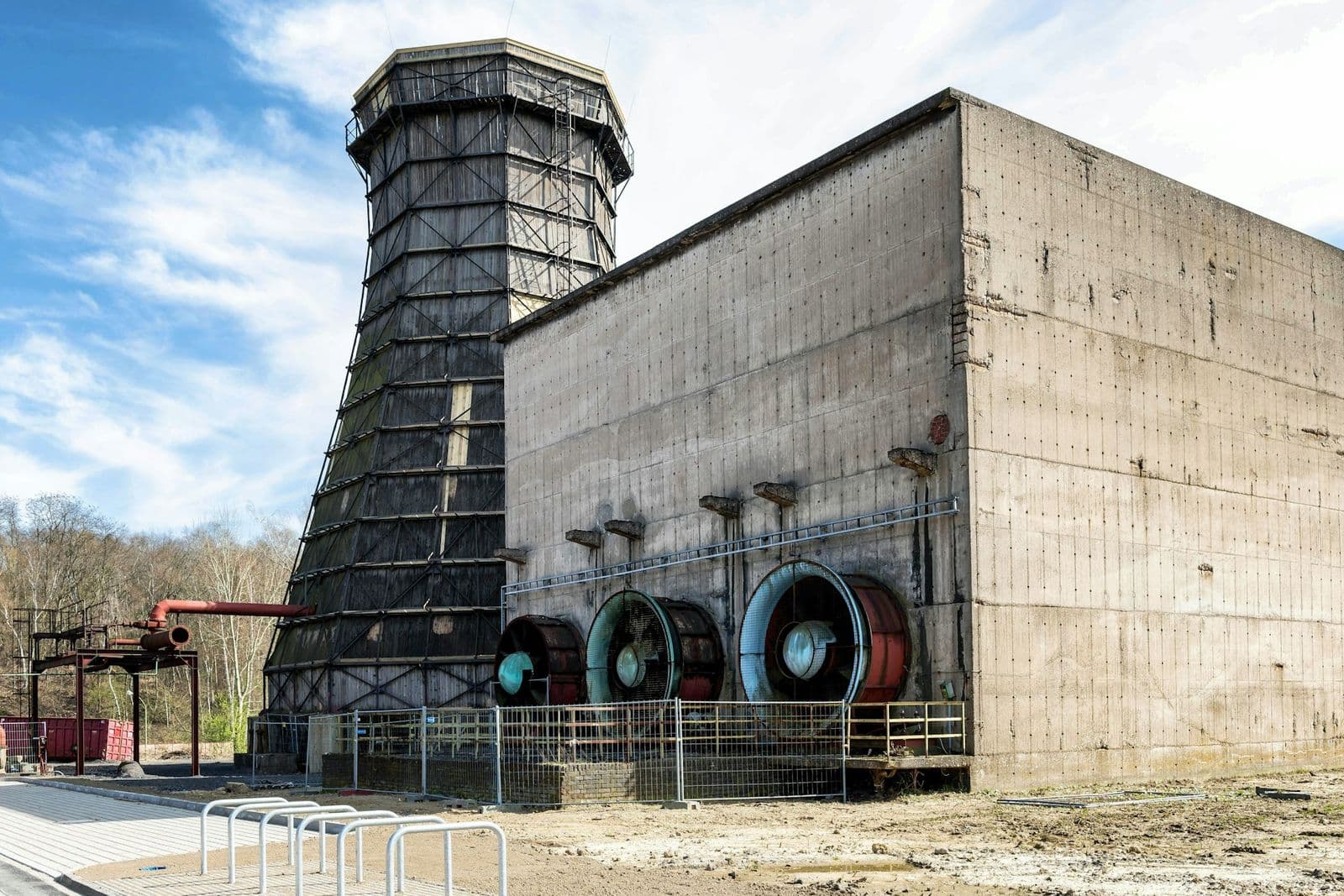
How cooling towers reject industrial heat, the three mechanisms, the components, and the airflow + water-flow choreography that determines real-world performance.
A cooling tower rejects industrial process heat to the atmosphere. It does this by bringing warm water and ambient air into intimate contact across a high-surface-area fill, allowing roughly 1 to 3% of the water to evaporate. That tiny evaporation does most of the cooling work, because vaporising one kilogram of water absorbs about 2,260 kJ of energy, and that energy comes from the bulk water that did not evaporate.
The result is one of the most efficient heat-rejection mechanisms available to industry: a 5 MW cooling tower can deliver an 8 to 14 °C drop in water temperature using a fan that consumes 1 to 2% of the heat being rejected, in a footprint smaller than the equivalent dry-cooled heat exchanger. The trade is water consumption, biological-fouling risk, and a thermodynamic ceiling tied to ambient humidity.
This guide walks through the physics, the components, and the process step by step. It is for plant operators, junior engineers, and procurement leads who need to understand how a cooling tower actually works, not as a black box, but as a system whose behaviour follows directly from the underlying heat- and mass-transfer mechanisms.
## What a Cooling Tower Does
In any process that generates waste heat, power generation, refining, food processing, large HVAC chillers, data-centre cooling, the heat has to go somewhere. A cooling tower transfers that heat from the process water loop to the atmosphere by evaporating a small fraction of the loop water and discharging the resulting saturated air.
The tower itself is a contact apparatus, not a refrigeration device. It does not "make" cold water in the way a chiller does. It removes heat from already-warm water and returns it cooler. The temperature it reaches depends on the wet-bulb temperature of the local air, the lowest temperature evaporative cooling can theoretically achieve.
Two reference frames help:
- A chiller moves heat from a low-temperature source (chilled water) to a higher-temperature sink (cooling water) using a refrigeration cycle. It needs electrical input. - A cooling tower rejects heat from cooling water to the atmosphere. It needs a fan and a circulation pump but no refrigeration cycle.
Most large industrial systems use both: chillers produce low-temperature water for the process; cooling towers reject the chillers' condenser heat. The [industrial water chiller](/resources/industrial-water-chiller) and the cooling tower work as a pair.
## The Three Heat-Transfer Mechanisms
Cooling towers use three mechanisms simultaneously, but the proportions are highly unequal:
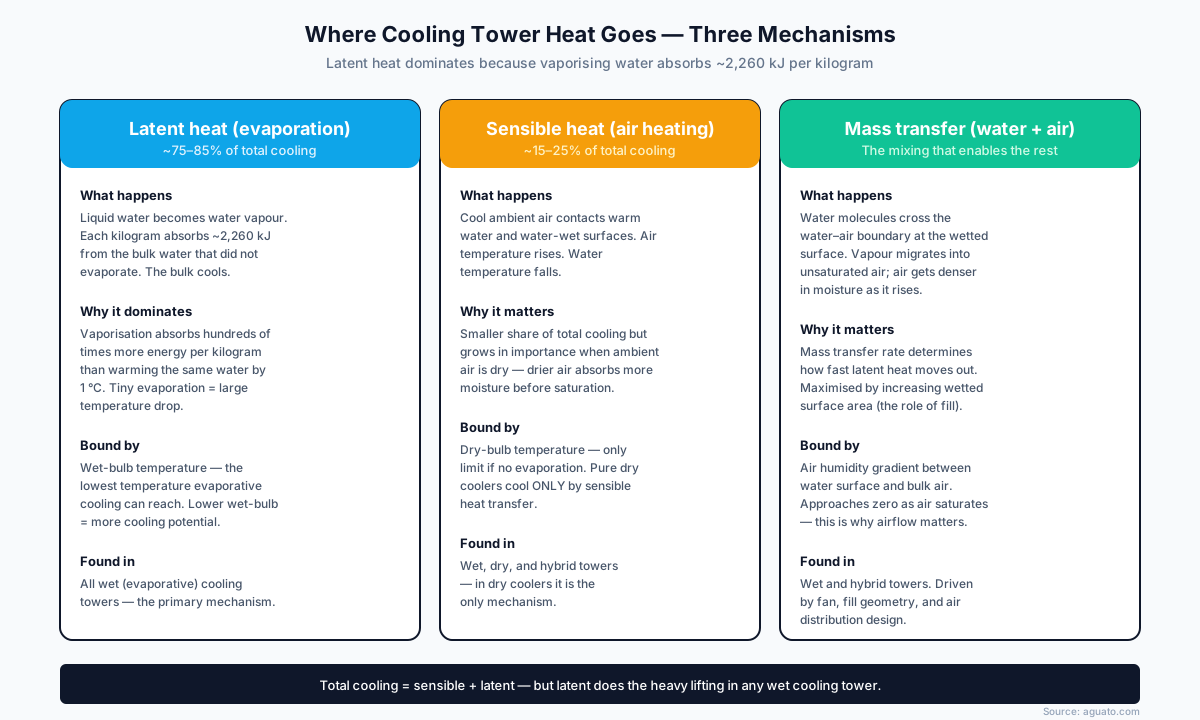
Latent heat (evaporation) dominates. As water evaporates from the wetted surface of the fill, each kilogram absorbs ~2,260 kJ from the surrounding bulk water. A typical tower evaporates 1.5 to 2.5% of the circulating flow per pass, which is enough to deliver a 5 to 10 °C temperature drop in the bulk water. This is why cooling towers are so much more compact than dry-air heat exchangers handling the same heat load, phase change carries vastly more energy per kilogram than warming a stream by a few degrees.
Sensible heat (direct contact) contributes 15 to 25%. As cool ambient air contacts warm water and warm fill surfaces, air temperature rises and water temperature falls, straightforward conduction-and-convection heat transfer. The drier the ambient air, the more sensible cooling continues to grow as the air rises through the tower.
Mass transfer (vapour diffusion) is the enabling mechanism behind latent heat. Water molecules migrate across the water-air boundary into unsaturated air. The driving force is the humidity gradient: dry air pulls more moisture; saturated air cannot accept any more. This is why airflow design and fill geometry matter so much, they control how quickly the air becomes saturated and stops absorbing vapour. Reference texts on cooling tower thermal performance, like the [ASHRAE Handbook on HVAC Systems and Equipment](dofollow:https://www.ashrae.org/technical-resources/ashrae-handbook), develop the mass-transfer formulation in detail.
The total cooling at any point in the tower is the sum of latent + sensible. In a wet tower, latent dominates almost everywhere. In a dry cooler, latent is zero, only sensible matters, which is why dry coolers need 30 to 50% more area for the same duty.
## Cooling Tower Anatomy
A typical industrial induced-draft counterflow tower has six core components, each with a specific role:
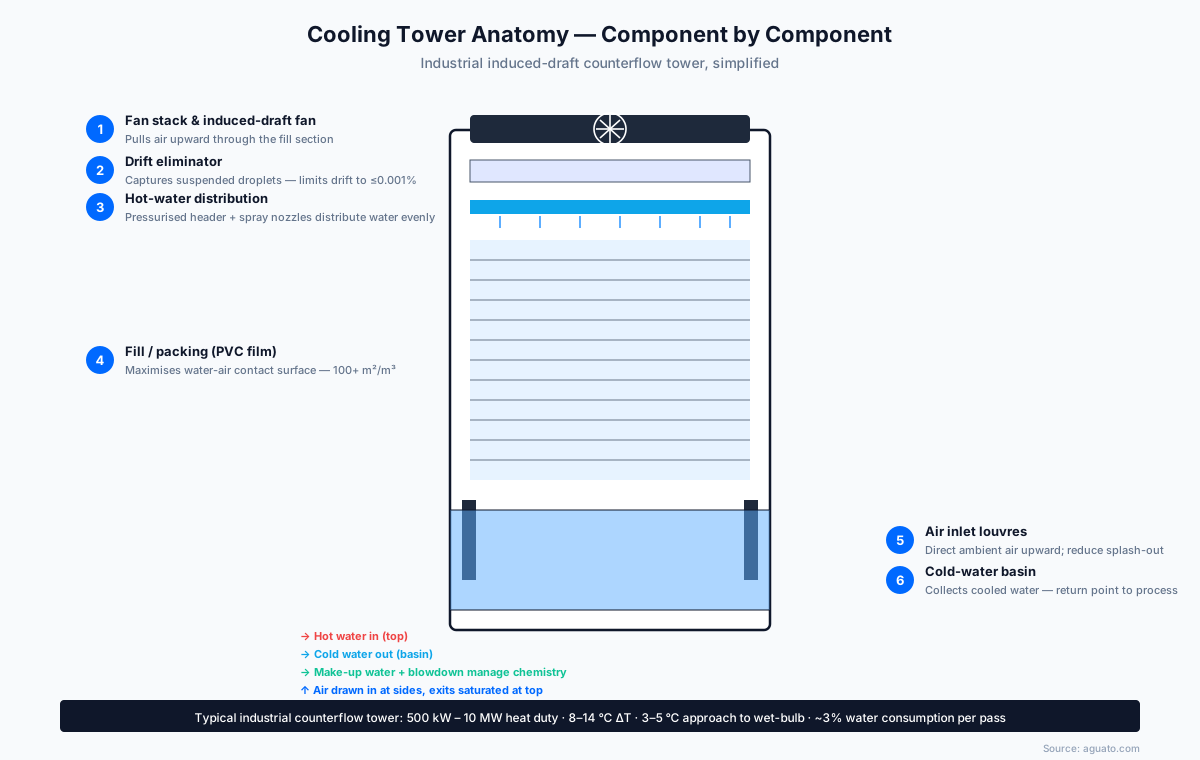
1. Fan stack and induced-draft fan. The fan sits at the top of the tower and pulls air upward through the fill section. Induced-draft is the dominant industrial design because the fan handles already-cooled, vapour-saturated air and recirculation of warm exhaust air back into the inlet is minimised.
2. Drift eliminator. Below the fan, a packed assembly of curved or zigzag plates captures suspended water droplets before the air leaves the tower. Modern eliminators reduce drift, actual liquid water carried out by the airflow, to under 0.001% of circulating flow. This matters because drift carries any chemistry and any biological load straight into the surrounding environment.
3. Hot-water distribution. Pressurised headers at the top of the fill distribute incoming process water across the entire tower cross-section. Spray nozzles, splash distribution decks, or open-trough systems are common. Distribution uniformity is one of the under-appreciated performance levers, a 10% maldistribution can cost 1 to 2 °C of approach.
4. Fill (also called packing). The heart of the tower. Modern PVC film fill creates more than 100 m² of wetted surface per cubic metre of fill volume. Water flows downward as a thin film on the fill surfaces while air flows upward through the gaps. The film maximises water-air contact area, accelerating mass transfer and therefore latent heat removal. Splash fill (a coarser open structure) is used where fouling-prone water would clog film fill.
5. Air inlet louvres. Angled blades at the base of the tower direct ambient air upward into the fill while preventing splash-out and partial recirculation. Louvre orientation affects both airflow uniformity and acoustics.
6. Cold-water basin. The cooled water collects in the open basin below the fill, where suction lines feed the cold-water pump that returns water to the process. The basin also receives make-up water (replacing evaporation, drift, and blowdown) and is the take-off point for blowdown (a continuous bleed that limits dissolved-solids concentration).
Surrounding the active components is the tower casing, typically galvanised steel or fibreglass-reinforced plastic for industrial duty, and structural framing rated for wind, snow, and seismic loads per local codes.
## The Cooling Process Step by Step
Walking through one complete water cycle:
1. Hot water enters at the top. Process water flows from the heat source (condenser, jacket cooler, oil cooler, or process exchanger) into the tower's distribution system. Inlet temperature for industrial duty typically runs 35 to 42 °C.
2. Distribution spreads the water. Spray nozzles or splash decks lay the water evenly over the top of the fill. The goal is uniform wetted-surface coverage, every square metre of fill should see comparable flow.
3. Water descends through fill as a thin film. Inside the fill, flow becomes laminar over the fill surfaces. The thin film maximises the water-air contact area and the temperature gradient at the surface.
4. Air enters at the base and rises through fill. The induced-draft fan at the top creates negative pressure inside the tower, drawing ambient air through the louvres and upward through the fill. Air enters at the local dry-bulb temperature and leaves saturated at a temperature very close to the inlet wet-bulb plus a small approach.
5. Heat and mass transfer happen in the fill. Latent heat moves from bulk water to air via evaporation; sensible heat moves from water to air via direct contact. Every cubic metre of fill height contributes incremental cooling, until the air saturates, which is the practical limit.
6. Cooled water collects in the basin. Cold water, typically 5 to 10 °C cooler than the inlet, with a 3 to 5 °C approach to the design wet-bulb temperature, collects in the basin and is pumped back to the process.
7. Saturated air exits the top. Vapour-laden air rises through the drift eliminators (where suspended droplets are stripped out), past the fan, and into the atmosphere. The visible "plume" on cool days is condensed water vapour from this stream.
8. Make-up water replaces losses. A float valve, level sensor, or controlled pump tops up the basin to replace evaporation, drift, and blowdown.
9. Blowdown limits TDS. A continuous bleed of basin water to drain (or to a treatment system) keeps dissolved-solids concentration within a target range. Cycles of concentration, the ratio of basin TDS to make-up water TDS, typically settles between 4 and 6 for a well-tuned tower.
The process runs continuously while the heat source is online. Larger towers add chemical dosing, sidestream filtration, and continuous monitoring of basin chemistry (pH, conductivity, biocide residual, silica) to keep the system within design tolerances. Most industrial sites also run a [dedicated cooling tower water treatment programme](/resources/cooling-tower-water-treatment) covering scale, corrosion, microbiology, and Legionella compliance.
[cta:nepti-dark]
## How Wet, Dry, and Hybrid Towers Differ
The same heat-transfer principles apply across cooling tower types, what changes is which mechanisms are active.
Wet (evaporative) cooling towers use latent + sensible heat transfer. They are the highest-performing per dollar of capital but consume water and require chemistry management. Open-circuit and closed-circuit variants both belong here. For the open-vs-closed and decision-framework view, see the [evaporative cooling tower](/resources/evaporative-cooling-tower) article.
Dry coolers (air-cooled heat exchangers) use only sensible heat transfer, process fluid passes through finned tubes, ambient air blows across the fins, and heat moves directly. No water consumption, no Legionella risk, no chemistry programme. The cost is much lower performance per unit area, especially in hot climates: a dry cooler is bounded by ambient dry-bulb temperature, which can be 5 to 15 °C above the wet-bulb on the worst days of the year.
Hybrid wet-dry towers combine both modes. Below a configurable wet-bulb threshold (often 4 to 8 °C), the water sprays shut off and the tower runs as a dry cooler, no water consumption, no biocide demand. Above the threshold, sprays activate and the tower transitions to evaporative operation. This saves 20 to 40% of annual water consumption in temperate climates while preserving full hot-day performance.
The choice depends on climate, water cost, water availability, process integrity requirements, and compliance regime, a topic covered in detail in the evaporative cooling tower decision framework.
## What Determines Cooling Tower Performance
Six factors define the thermal performance of a wet cooling tower:
- Design wet-bulb temperature. The dominant input. Tower selection and sizing are anchored to local design wet-bulb (typically the 1% or 0.4% exceedance value). Get this wrong and the tower under-performs on the hottest hours of the year. - Heat rejection load. Higher load demands either more fill height, more circulating flow, or both. Field upgrades to existing towers often add fill before they touch the fan. - Approach. The temperature difference between cold-water outlet and design wet-bulb. Industrial towers typically design for 3 to 5 °C approach. Tighter approach roughly doubles tower volume per °C. - Range. The temperature drop across the tower (inlet minus outlet). Range and approach together set the duty: load = circulating flow × range × specific heat. - L/G ratio. The ratio of water mass flow to air mass flow. Optimal L/G depends on fill type and design conditions, typical industrial values run 1.0 to 2.0. Off-design L/G hurts both thermal performance and water consumption. - Fill condition. Fouled, scaled, or partially collapsed fill is the single most common cause of degraded thermal performance in operating towers. A fill inspection every 2 to 3 years is cheap insurance. The [AHRI standards for cooling tower thermal performance](dofollow:https://www.ahrinet.org/standards) define how performance is measured at acceptance and during operating life.
A tower that meets its design rated performance on the day it commissioned will degrade by 1 to 3% per year if maintenance is reactive instead of preventive. Sites that monitor approach and L/G continuously catch the drift early; sites that don't usually find out at the next heatwave.
## Frequently Asked Questions
### Why do cooling towers produce visible plumes?
The plume is condensed water vapour, not smoke. As warm saturated air leaves the tower top and contacts cooler ambient air, the vapour content exceeds saturation and condenses into tiny droplets that scatter light. Plumes are most visible on cold humid days; on hot dry days they often disappear within metres of the fan stack.
### Does a cooling tower cool the water below the air temperature?
It can, that's the entire point of evaporative cooling. A wet tower cools the water close to the wet-bulb temperature, which on a hot dry day can sit 8 to 12 °C below the dry-bulb. So yes, the cold water leaving the tower can be colder than the surrounding air on a hot day. Dry coolers cannot do this, they're stuck above the dry-bulb.
### How much water does a cooling tower lose to evaporation?
Roughly 1.5 to 2.5% of the circulating flow rate per pass, varying with the temperature drop and ambient conditions. For a 5 MW industrial tower running continuously, that's around 50 to 80 m³/day of evaporation alone, before drift and blowdown.
### What's the difference between a cooling tower and a condenser?
A condenser is a heat exchanger where a vapour (steam, refrigerant, process vapour) condenses to liquid by giving up its latent heat to a cooling fluid. A cooling tower rejects that absorbed heat to the atmosphere. They sit in series: the condenser is the heat-rejection point inside the process; the cooling tower is the heat-rejection point to the environment.
### What is "approach" in a cooling tower?
Approach is the temperature difference between the cold-water leaving temperature and the wet-bulb of the inlet air. A 4 °C approach in a 24 °C wet-bulb climate produces 28 °C cold water on the design day. Smaller approach means higher performance but bigger tower; the trade-off is set during sizing.
### Why does a cooling tower need a fan?
The fan moves a steady mass of air through the fill so that air leaves the tower before it saturates. Without forced airflow (fan or natural draft from a tall stack), saturated air would stagnate inside the fill and evaporative cooling would stop. Fan power typically runs 1 to 3% of the heat load.
### How long does a cooling tower last?
Properly maintained galvanised-steel and fibreglass towers last 20 to 30 years. PVC fill needs replacement every 8 to 15 years depending on water chemistry and biological load. Drift eliminators usually need one replacement during a tower's service life, and basin liners or coatings often need refresh at year 15 to 20.