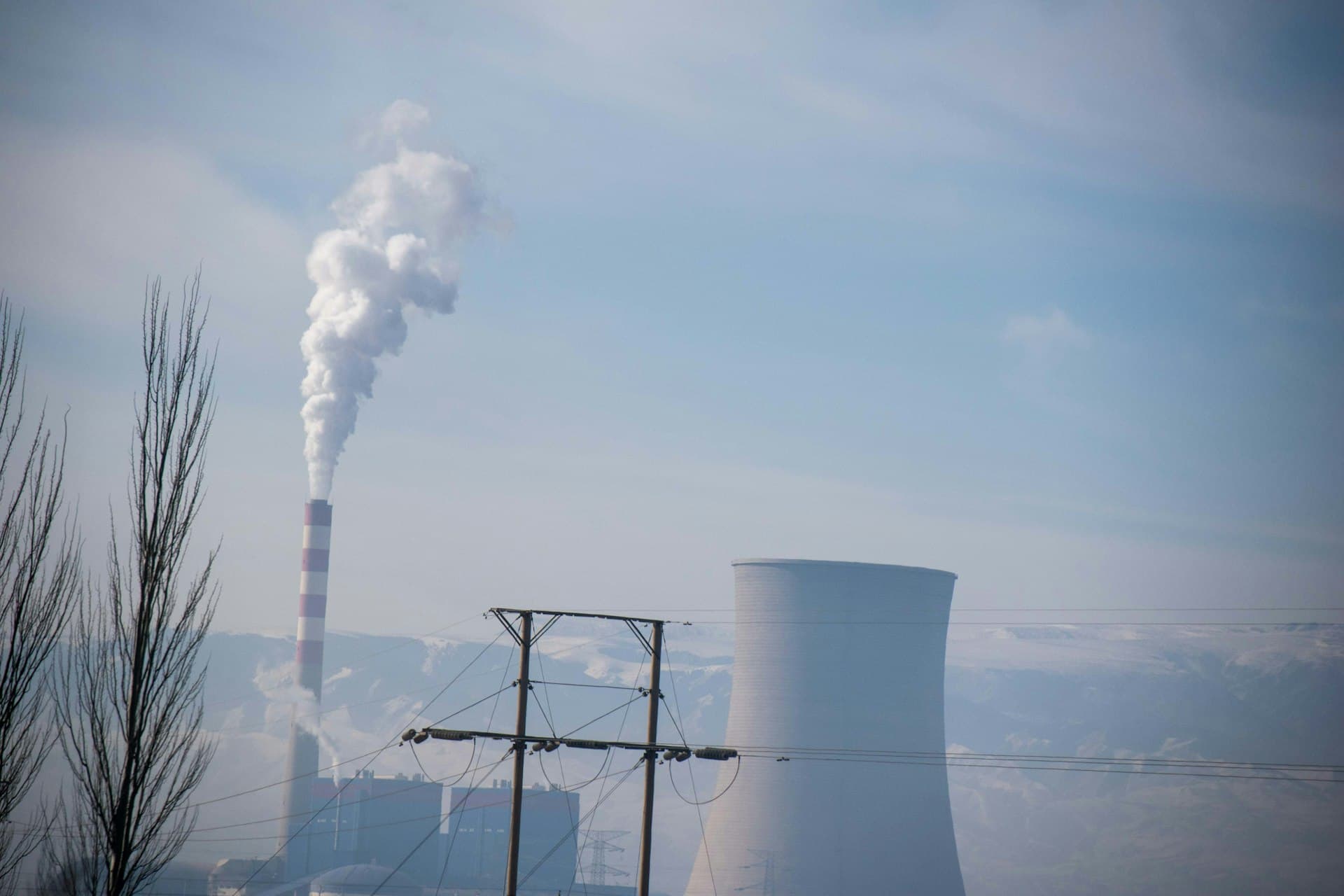
How evaporative cooling towers reject industrial heat through water phase change, where they outperform dry coolers, and the climate, water, and compliance limits that decide fit.
An evaporative cooling tower rejects industrial heat by evaporating a small fraction of the circulating water, typically 1.5 to 2.5% per pass. That phase change carries away ~75 to 85% of the total heat load through latent heat alone, which is why evaporative towers reject more heat per dollar of capital and per kilowatt of fan power than any dry alternative.
The trade is water and risk. Every megawatt of rejected heat consumes roughly 3 to 6 m³ of water per hour depending on cycles of concentration, and every wet tower carries a Legionella exposure profile that has to be actively managed. Dry coolers don't have either problem, but they need 30 to 50% more surface area, run hotter on the worst days of the year, and cost more to operate where ambient design wet-bulb sits below 24 °C.
This guide is for engineers and procurement leads choosing between evaporative and dry cooling, or sizing a replacement tower. It covers the thermodynamics that bound performance, where evaporative wins on cost and footprint, where it loses on water and compliance, and the threshold-based logic that decides fit for a specific site.
## What Evaporative Cooling Actually Does
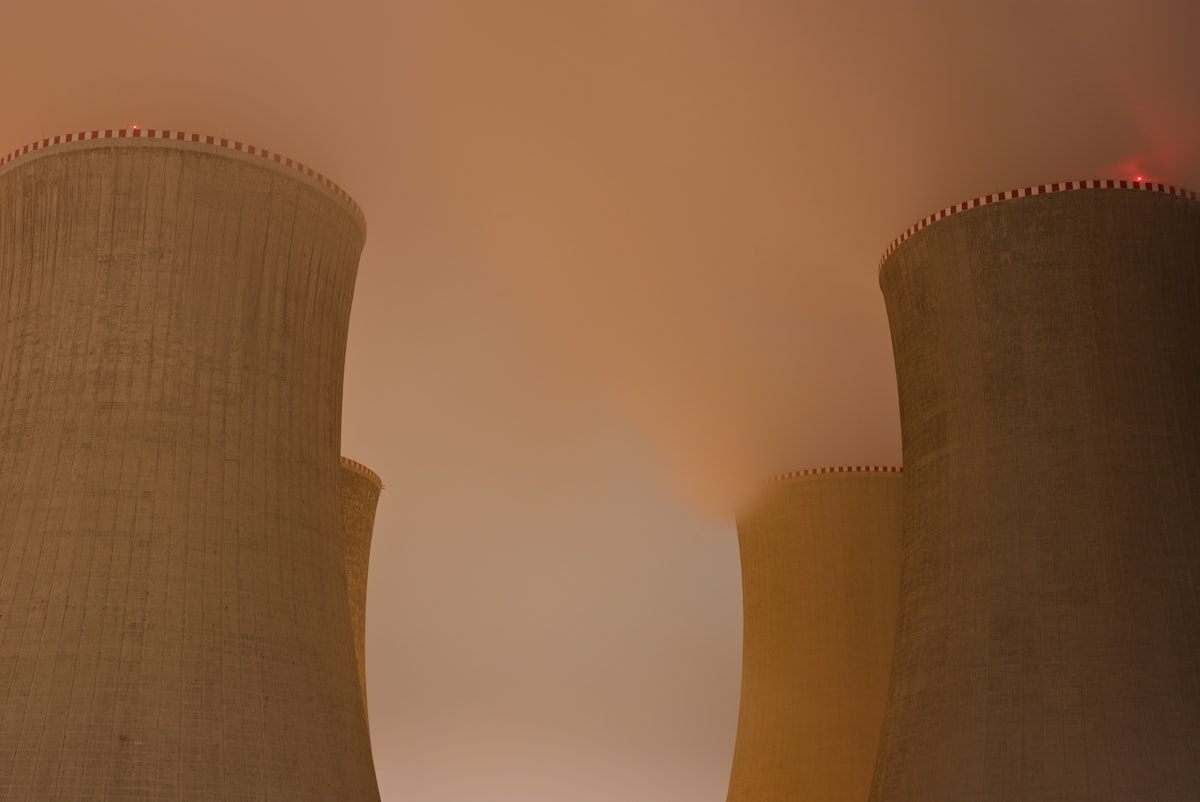
An evaporative cooling tower is a direct-contact heat and mass exchanger between a hot water stream and ambient air. Hot water sprays through a high-surface-area fill while air is drawn upward by induced or forced draft. A tiny portion of the water evaporates into the air, and the energy required to vaporise it (the latent heat of vaporisation, ~2,260 kJ per kg of water at typical operating conditions) comes from the bulk water that did not evaporate. That bulk water cools, falls into the basin, and returns to the process.
This is fundamentally different from a dry cooler (also called an air-cooled heat exchanger), which moves heat across a finned-tube surface from process fluid to air without water contact. Dry coolers are limited by ambient dry-bulb temperature; evaporative towers are limited by wet-bulb temperature, which is always lower. In a 35 °C summer with 50% relative humidity, dry-bulb is 35 °C but wet-bulb is around 26 °C, a 9 °C cooling potential the dry cooler simply cannot reach.
That gap is the entire commercial argument for evaporative cooling. In hot, dry climates the gap widens further; in cool, humid climates it shrinks toward zero, and dry cooling starts to make economic sense.
## How an Evaporative Cooling Tower Works
The process is straightforward in principle and tightly engineered in practice:
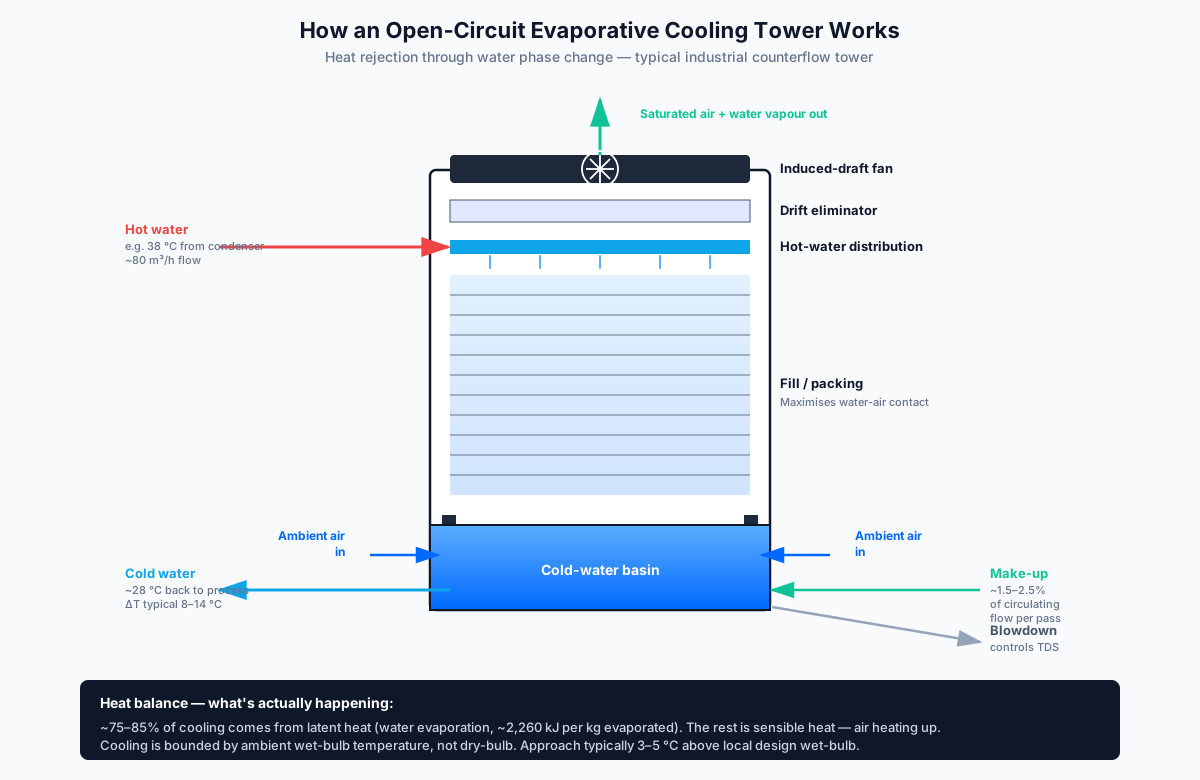
1. Hot water enters at the top through pressurised distribution headers. Typical industrial counterflow towers receive water at 35 to 40 °C from condensers, jacket coolers, or process heat exchangers, at flows ranging from 50 to 5,000 m³/h depending on duty.
2. Spray nozzles distribute the water evenly across the top of the fill. Distribution uniformity matters more than people realise, a 10% maldistribution can cost 1 to 2 °C of approach.
3. Fill (also called packing) maximises water-air contact. Modern PVC film fill creates 100+ m² of wetted surface per m³ of fill volume. The water flows down as a thin film while air flows upward through the gaps. Splash fill is used where fouling water would clog film fill but delivers ~20% lower thermal performance per unit volume.
4. Air is induced upward by a fan mounted at the top (induced-draft) or pushed by a fan at the side (forced-draft). Induced-draft is the dominant industrial design for thermal performance and recirculation prevention.
5. Drift eliminators capture suspended water droplets before the air leaves the tower. Modern eliminators reduce drift to under 0.001% of the circulating flow rate, important because drift carries chemical and biological contamination into the surrounding environment.
6. Cooled water collects in the basin typically 5 to 10 °C cooler than the inlet, then returns to the process via the cold-water pump. Make-up water replaces what evaporated, drifted, and was bled off as blowdown.
The thermodynamic limit on cooling is the approach, how close the cold water gets to the ambient wet-bulb temperature. Industrial towers are usually specified for 3 to 5 °C approach to local design wet-bulb. A tower designed for 4 °C approach in a 24 °C wet-bulb climate will deliver 28 °C cold water on the design day. For a deeper engineering reference on cooling tower thermal performance, see [ASHRAE's position document on Legionellosis and cooling tower management](dofollow:https://www.ashrae.org/file%20library/about/position%20documents/pd_legionellosis-2017-06-29.pdf).
## Industrial Applications
Evaporative cooling towers are the default heat-rejection system across large process industries because the cost-per-MW of rejected heat is roughly half that of dry-cooled alternatives. The applications cluster in five places:
- Power generation, steam-cycle condensers reject 60 to 70% of fuel input as low-grade heat. Wet cooling towers handle this duty across most thermal and combined-cycle plants where water is available. - Petrochemical and refining, heat rejection from distillation columns, reactors, and intercoolers. Fouling-tolerant fill and aggressive water chemistry control are standard. Sites integrating multiple cooling loops often run [industrial water chiller](/resources/industrial-water-chiller) systems alongside cooling towers for low-temperature duty. - HVAC for commercial buildings and data centres, air-conditioning chillers reject 1.2 to 1.4 kW of heat per kW of cooling delivered. Cooling towers paired with water-cooled chillers dominate where ambient wet-bulb sits above 22 °C in summer. - Food and beverage processing, pasteurisation, fermentation, and sterilisation cycles reject substantial waste heat. Closed-circuit towers are common because the process fluid (often glycol) must stay sealed. - Manufacturing process cooling, injection moulding, metal-rolling mills, semiconductor fabs. Reliability and tight temperature control matter more than absolute lowest cost.
In each of these settings the question is not "should we use a cooling tower", that's already decided by physics and economics. The question is which configuration, water chemistry, and treatment regime fits the site. Independent reviews of these decisions, scoped against site water and discharge constraints, sit at the heart of the [cooling tower water treatment](/resources/cooling-tower-water-treatment) workflow.
## Open vs Closed-Circuit Systems
The single most consequential architecture decision is open versus closed circuit. Both use the same evaporative thermodynamics; they differ in whether the process fluid contacts the spray water:
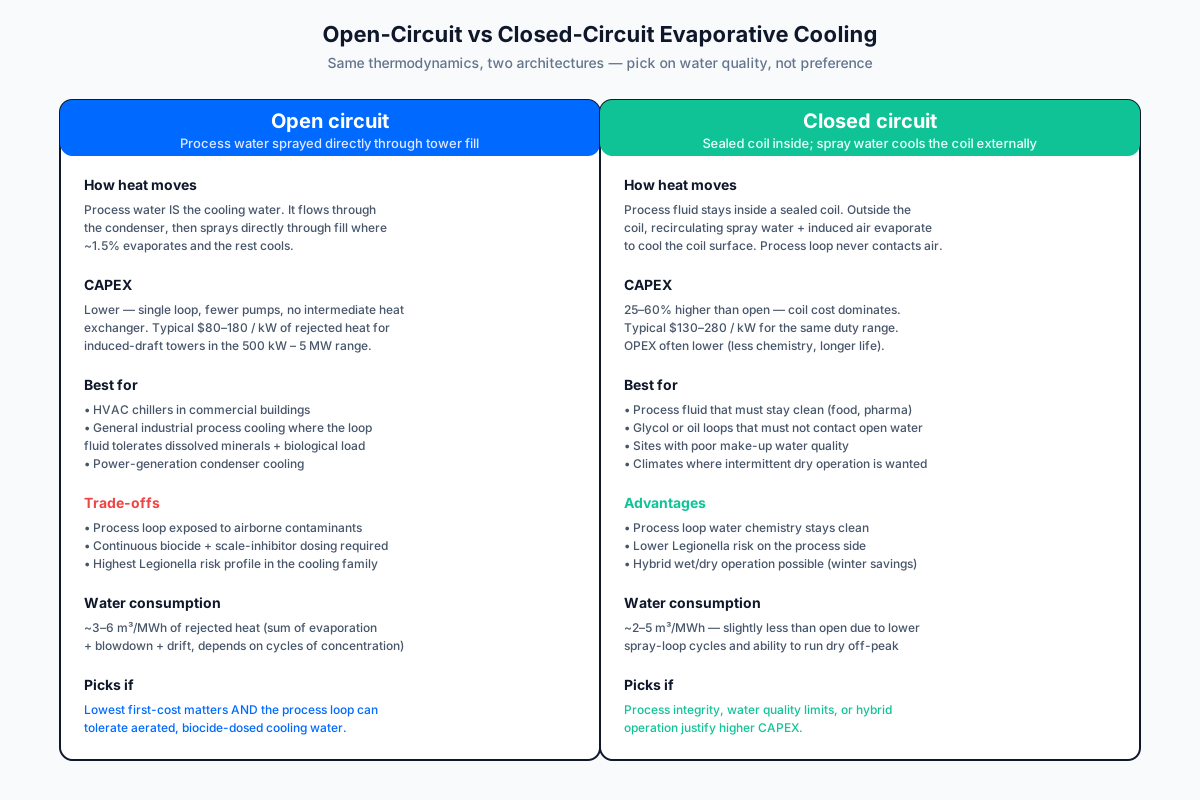
Open circuit is the dominant industrial design. The process water itself sprays through the fill, it is both the cooling medium and the cooled fluid. Single loop, fewer pumps, lower capital. The drawback is that the process loop is constantly exposed to airborne contaminants, dissolved gases, and biological load. Continuous chemistry, biocide, scale inhibitor, dispersant, corrosion inhibitor, is non-negotiable.
Closed circuit seals the process fluid inside a coil, then sprays a separate recirculating water stream over the coil to cool it evaporatively. The process loop stays clean. CAPEX runs 25 to 60% higher because of the coil itself, but OPEX often lands lower across the equipment lifetime: less chemistry, less coil cleaning, longer service intervals. Closed-circuit towers also support hybrid wet-dry operation, dry below a wet-bulb threshold to save water in winter and shoulder seasons.
The general decision rule: open circuit for general industrial cooling where the loop tolerates dissolved minerals and biological load; closed circuit when the process fluid must stay clean (pharma, food contact, high-purity water systems, or glycol loops), or when winter dry operation pays back the higher CAPEX. For the full lifecycle math and the five-dimension decision framework on this choice, see our dedicated guide on [closed-circuit cooling tower configurations and when each wins](/resources/closed-circuit-cooling-tower).
## CAPEX, OPEX, and Water Footprint
For a 2 MW heat-rejection duty in a moderate climate (design wet-bulb ~24 °C):
- Open-circuit induced-draft tower (CAPEX): $160,000 to 360,000 installed, equivalent to $80 to 180 per kW of rejected heat. - Closed-circuit tower (CAPEX): $260,000 to 560,000 installed, $130 to 280 per kW. - Annual energy use (fan + circulating pump): ~3 to 5% of the rejected heat load, so a 2 MW tower running 6,000 hours/year consumes 360 to 600 MWh. - Annual water consumption (open circuit, 4 cycles of concentration): roughly 20,000 to 30,000 m³/year for the same 2 MW continuous duty. - Chemistry programme: $0.10 to 0.40 per m³ of make-up water for biocide + corrosion + scale-inhibitor blend. Sites under HSE L8 or Legionella-equivalent compliance regimes often run higher.
The OPEX line that surprises new operators is water cost itself. In water-stressed regions, industrial water tariffs of $1.50 to 3.50 per m³ push annual water spend on a 2 MW open-circuit tower into $30,000 to 100,000 territory. That single cost line is what shifts decisions toward closed-circuit hybrid systems or, in extreme cases, dry cooling. The US Department of Energy's Federal Energy Management Program publishes a useful framework for [cooling tower water management benchmarks](dofollow:https://www.energy.gov/femp/best-management-practice-10-cooling-tower-management) that holds up well outside government-facility contexts.
Cycles of concentration is the other lever, running at 6 cycles instead of 3 cuts make-up water by roughly 30% but doubles the corrosion and scale risk if the make-up chemistry isn't right. Most industrial towers settle between 4 and 6 cycles after a year of dialling in.
[cta:nepti-dark]
## Where Evaporative Cooling Fails
Three failure modes show up across every project review:
1. Wet-bulb assumption errors. A tower sized for "average summer wet-bulb" instead of design wet-bulb (the 1% or 0.4% exceedance value from ASHRAE climate data) will under-perform on the 30 to 50 hottest hours of the year. That's exactly when the process most needs the cooling. Always size for design wet-bulb and confirm the local climate data isn't 20 years old.
2. Make-up water quality drift. Cooling towers are concentrators by design. Whatever is dissolved in the make-up water becomes 3 to 6× concentrated in the basin. Sites that switch to a different make-up water source (utility blend changes, switch from municipal to bore water, recycle integration) often see scale, fouling, or corrosion appear within months. Continuous monitoring of basin TDS, conductivity, and silica is the cheapest insurance available.
3. Legionella exposure unmanaged. Open-circuit towers aerosolise basin water and disperse it through drift eliminators. Drift eliminators capture 99.999% of droplets but the residual still travels, Legionella outbreaks have been traced to towers up to 6 km from the cluster site. UK HSE L8, French ICPE 2921, US ASHRAE 188, and Australian state cooling-water regulations all impose written risk-assessment regimes that demand named responsibility, monthly biocide audit, and quarterly basin cleaning. Sites that fall behind on this don't get a polite warning. See [legionella risk assessment](/resources/legionella-risk-assessment) for the audit framework.
A practical rule from project reviews: most evaporative cooling tower failures are not equipment failures. They are upstream water chemistry failures, sizing errors based on stale climate data, or compliance gaps that surface only when something goes wrong.
## Decision Framework
Use this threshold-based logic to choose between evaporative and dry cooling, and between open and closed-circuit:
Step 1, Climate. What is the local design wet-bulb temperature? - If design wet-bulb is < 18 °C year-round → dry cooling is competitive on lifecycle cost; evaluate before defaulting to wet. - If design wet-bulb is 18 to 24 °C → evaporative wins on CAPEX and footprint but check water cost and discharge limits. - If design wet-bulb is > 24 °C → evaporative is almost always the right answer; dry cooling will need 40%+ more area and won't reach process-temperature targets on peak days.
Step 2, Water availability and cost. Is make-up water reliably available at < $2.50/m³? - Yes → evaporative is economically straightforward. - No (e.g. desert sites, water-stressed cities, drought-restricted regions) → consider closed-circuit hybrid for water savings, or dry cooling if the climate allows.
Step 3, Process loop integrity. Does the process fluid need to stay sealed (pharma, food contact, glycol, high-purity)? - Yes → closed circuit. - No → open circuit unless other factors override.
Step 4, Compliance regime. Is the site subject to HSE L8, ASHRAE 188, ICPE 2921, or equivalent? - Yes → factor compliance OPEX (monthly audits, quarterly cleaning, written risk assessment, named duty-holder) into the OPEX calculation. This adds typically $15,000 to 60,000/year per tower for industrial sites.
Most projects finish this framework with one preferred configuration and one fallback. Having both costed out in parallel is what separates a 4-week design cycle from a 12-week one.
## Frequently Asked Questions
### How much water does an evaporative cooling tower use?
Roughly 3 to 6 m³ per MWh of rejected heat, distributed across evaporation (~75% of total water loss), blowdown (~20%), and drift (~5%). A 2 MW tower running 6,000 hours per year typically consumes 20,000 to 30,000 m³ annually. Cycles of concentration is the main lever, higher cycles cut make-up water but tighten the chemistry tolerance.
### What's the difference between an evaporative cooling tower and a chiller?
A cooling tower rejects heat to the atmosphere through evaporation. A chiller moves heat from a low-temperature source (process fluid) to a higher-temperature sink (cooling water) using a refrigeration cycle. Most industrial systems use both: the chiller produces low-temperature water for the process; the cooling tower rejects the chiller's condenser heat to the atmosphere.
### How close to ambient wet-bulb can an evaporative tower cool?
Industrial towers are typically specified for a 3 to 5 °C approach to local design wet-bulb. Tighter approach is possible but costs disproportionate fan and fill investment. A 1 °C approach roughly doubles tower size compared to a 5 °C approach.
### Are evaporative cooling towers banned in some jurisdictions?
They are not banned, but they are increasingly regulated in water-stressed regions. Several Spanish autonomous communities, parts of Australia and California, and Gulf cities now require water-use justification for new wet cooling installations above a duty threshold. This shifts new builds toward closed-circuit hybrid systems.
### Can an evaporative cooling tower run dry in cool weather?
Open-circuit towers cannot, the spray system is the heat-transfer mechanism. Closed-circuit hybrid towers can: below a wet-bulb threshold (often 4 to 8 °C) the spray pumps shut off and the tower runs as an air-cooled heat exchanger. This typically saves 20 to 40% of annual water use in temperate climates.
### How long do evaporative cooling towers last?
Properly maintained galvanised-steel and FRP towers last 20 to 30 years. PVC fill typically needs replacement every 8 to 15 years depending on water chemistry. Drift eliminators are usually replaced once during a tower's service life. Stainless-steel basin retrofits are common at year 15 to 20 and extend life by another decade.
### What size cooling tower do I need?
Size to design wet-bulb temperature, peak heat-rejection load, and target cold-water temperature. Rough rule-of-thumb: a 1 MW industrial tower typically occupies 8 to 12 m² of footprint and 4 to 7 m of height. Detailed sizing requires the actual rejected heat load, design wet-bulb from the [Cooling Technology Institute's certified performance standards](dofollow:https://www.cti.org/codes-and-standards/), and the approach the process can accept.