MF, UF, NF, and RO each fit a different performance window. The wrong membrane class adds USD 40,000 to 250,000 per year in unnecessary energy and reagent cost over a 15-year service life. This guide covers the four classes, the four module configurations, and the failure modes that destroy membrane economics.
A membrane filtration system is the most over-specified piece of industrial water equipment on most plants. A 1,000 m3/day plant running RO where nanofiltration would meet the spec burns USD 40,000 to 80,000 per year in unnecessary energy alone, and over a 15-year service life that is USD 600,000 to 1.2M of CFO-visible OPEX you didn't need to spend. The reverse mistake, specifying UF where the discharge consent actually requires RO-grade TDS removal, sits the operator in front of a 12-month consent breach and a USD 100,000 to 500,000 retrofit. The decision is straightforward once you know what each membrane class actually does, and which module configuration tolerates your specific feed water. Almost no one runs that decision properly at FEED stage.
The four membrane classes, microfiltration, ultrafiltration, nanofiltration, reverse osmosis, span six orders of magnitude in pore size and one order of magnitude in operating pressure. They are not interchangeable: each removes a different fraction of contaminants and each rejects a different chunk of your CAPEX and OPEX budget. The four module configurations, spiral wound, hollow fiber, tubular, flat sheet, span an even wider range in fouling tolerance: a spiral-wound RO element will fail catastrophically on water a tubular UF system would shrug off.
This guide is for capital-projects engineers, plant managers, and procurement leads specifying a membrane system. It covers what each membrane class actually removes (and lets through), which module configuration matches which feed water, the CAPEX/OPEX numbers that drive selection, and the failure modes that destroy membrane economics on real plants.
## Why the Class Decision Matters Commercially
Membrane class is a decision the plant lives with for 15 to 20 years. RO at 65 bar costs roughly 2 to 3× the energy of NF at 12 bar treating the same flow; UF at 3 bar costs 1/10th the energy of either, and on seawater duty the pumping energy dominates the whole cost equation, as our guide to [desalination energy consumption](/resources/desalination-energy-consumption) sets out. If the spec is a discharge consent of "TDS under 1,000 mg/L" and the actual feed sits at 1,200 mg/L TDS, NF achieves it. RO over-shoots and burns money for two decades. If the spec is "ultrapure water for semiconductor rinse" at conductivity under 0.1 µS/cm, only RO + EDI achieves it; nothing tighter works.
The class decision sits upstream of the module decision, and both sit upstream of the CIP-cleaning regime, the antiscalant programme, and the recovery target. Get the class wrong and every downstream parameter is also wrong. The [American Water Works Association membrane treatment guidance](dofollow:https://www.awwa.org/resources-tools/water-knowledge/water-treatment) notes that membrane selection is the single most-revisited engineering decision in industrial water, and the one most likely to be over-specified by EPC contractors who bid the safer, more expensive option to insulate themselves from feed-water variability they didn't characterise.
The honest framing: pick the loosest membrane class that meets the spec, and use the module configuration that tolerates your dirtiest realistic feed. Tighter than necessary loses money for the asset's lifetime; looser than necessary breaches consent. Most plants miss in both directions on different parameters in the same train.
## The Four Membrane Classes
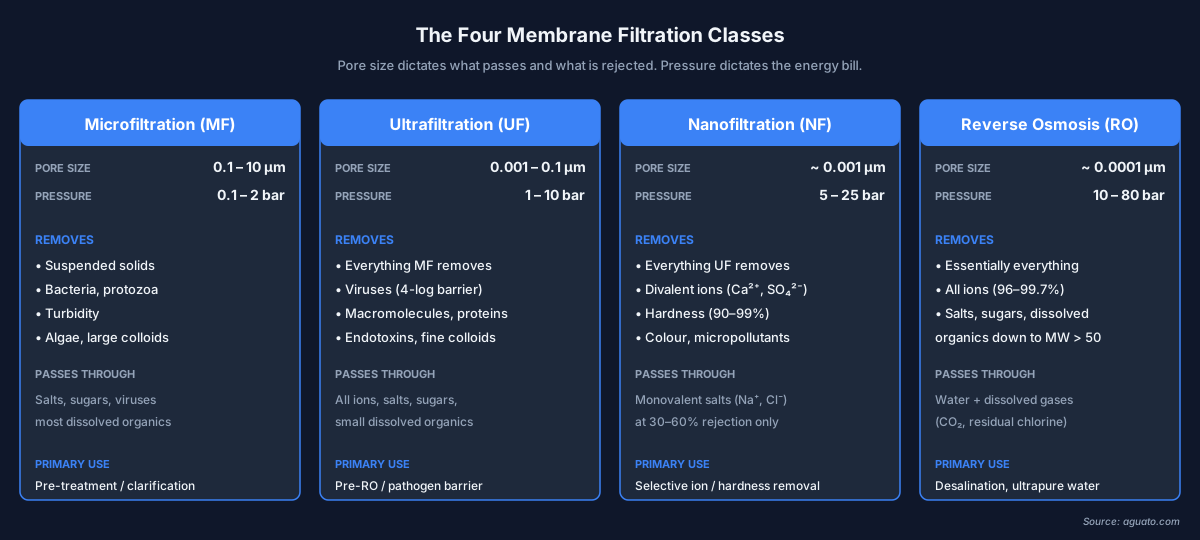
| Class | Pore size | Pressure | Removes | Passes | Primary use | |---|---|---|---|---|---| | Microfiltration (MF) | 0.1 to 10 µm | 0.1 to 2 bar | Suspended solids, bacteria, protozoa, turbidity | All ions, viruses, dissolved organics | Pre-treatment / clarification | | Ultrafiltration (UF) | 0.001 to 0.1 µm | 1 to 10 bar | Above + viruses (4-log), proteins, endotoxins | All salts, sugars, small organics | Pre-RO / pathogen barrier | | Nanofiltration (NF) | ~ 0.001 µm | 5 to 25 bar | Above + divalent ions, hardness, colour | Monovalent salts (Na⁺, Cl⁻) at low rejection | Selective ion / hardness removal | | Reverse osmosis (RO) | ~ 0.0001 µm | 10 to 80 bar | Essentially everything; 96 to 99.7% salt rejection | Water + dissolved gases | Desalination, ultrapure water |
The four classes are sequenced. Most industrial plants use two or three in series, for example, MF or UF as pre-treatment to RO, or UF + NF where divalent rejection without full desalination is the duty. The [comparison piece on RO vs NF vs UF](/resources/ro-vs-nf-vs-uf-comparison) walks the trade-offs in detail; what follows here focuses on the system-level decisions that determine total cost. Membrane integrity testing standards are codified in [ASTM E1294 and related standards on membrane characterisation](dofollow:https://www.astm.org/products-services/standards-and-publications.html), every commissioning should include integrity test results referencing one of these standards.
The economic insight: each class jump (MF→UF→NF→RO) roughly doubles the energy cost per m³ but removes a class of contaminants the previous one cannot. The plant that picks the loosest class meeting its spec wins on OPEX for 15+ years. The plant that picks one class tighter than needed accepts a 30 to 50% higher OPEX for nothing.
## Module Configurations: Spiral, Hollow Fiber, Tubular, Flat Sheet
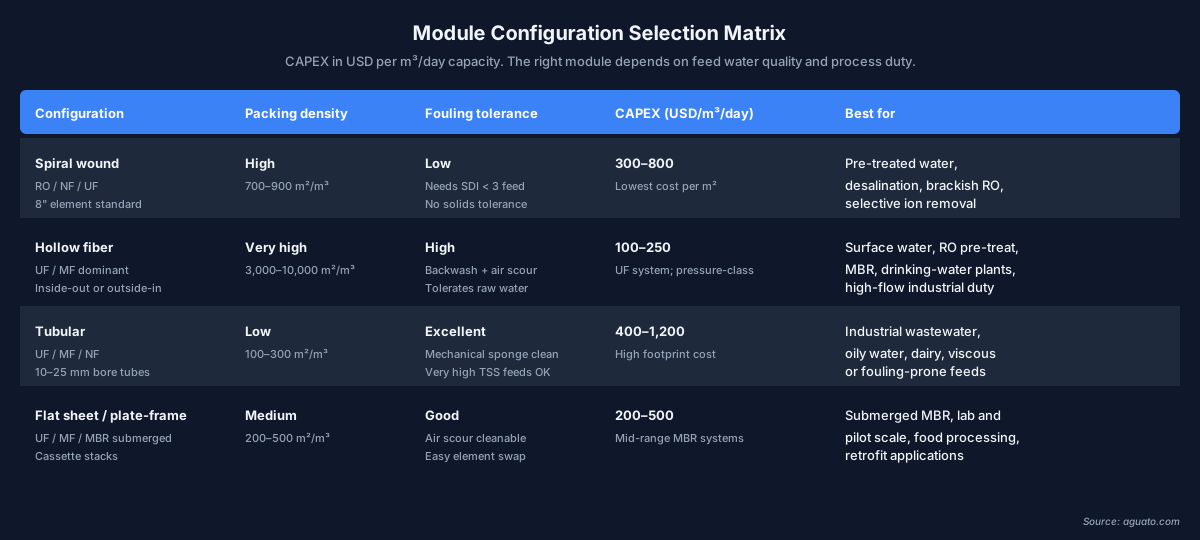
Module configuration is the second decision and equally important. The same membrane chemistry (e.g., polyamide RO) is sold in spiral-wound elements at one CAPEX and as tubular cartridges at 3 to 4× the CAPEX. Why specify the more expensive form? Because the cheap form catastrophically fails on dirty feed. The material decision is the third, polymeric versus ceramic, and on tough-feed UF and MF duty (dairy, brewing, refinery effluent, pharmaceutical SIP, offshore produced water, mining hydrometallurgy), [ceramic membranes](/resources/ceramic-membranes) run 30 to 60% lower on 15-year TCO despite a 3 to 5× installed CAPEX premium because they survive cleaning chemistry and replacement frequency that polymeric does not.
| Configuration | Packing density | Fouling tolerance | CAPEX (USD/m³/day) | Best for | |---|---|---|---|---| | Spiral wound | High (700 to 900 m²/m³) | Low, needs SDI < 3 | 300 to 800 | Pre-treated water, desalination, brackish RO | | Hollow fiber | Very high (3,000 to 10,000 m²/m³) | High, backwash + air scour | 100 to 250 | Surface water, RO pre-treat, MBR, drinking water | | Tubular | Low (100 to 300 m²/m³) | Excellent, sponge cleanable | 400 to 1,200 | Industrial wastewater, oily water, viscous feeds | | Flat sheet / plate-frame | Medium (200 to 500 m²/m³) | Good, air scour cleanable | 200 to 500 | Submerged MBR, food processing, retrofit |
The decision rule: packing density determines CAPEX per m² of membrane area; fouling tolerance determines OPEX over membrane life. Spiral-wound RO is the cheapest by far per m² but requires a clean feed (SDI under 3). Tubular UF is 3 to 4× more expensive per m² of footprint but tolerates SDI 10+ on raw industrial wastewater. The match between feed quality and module fouling-tolerance is the single biggest determinant of whether your membrane life is 5 years or 5 months.
## Selection Decision Framework
The full decision logic for a new membrane system, in operational order:
1. Characterise the feed water, full ion balance, TSS, SDI, BOD/COD, oil/grease, micropollutants, temperature, hourly/daily variability. Without this data every downstream choice is guesswork. A 3-month sampling programme covering all process variations is the minimum for credible design. 2. Define the permeate spec, what the discharge consent or process requires. TDS, hardness, specific contaminants, pathogen log-reduction credit, conductivity ceiling. Convert this into the membrane class that meets it (loosest possible). 3. Calculate the recovery target, water recovery percentage drives concentrate volume, scaling potential, and antiscalant requirement. Brackish RO typically runs 70 to 85% recovery; seawater RO at 40 to 50%; UF at 90%+. Recovery decisions interact with [zero liquid discharge](/resources/zero-liquid-discharge) economics on the concentrate side. 4. Pick the module configuration, match fouling tolerance to feed quality. Pre-treated municipal water → spiral wound. Surface water with seasonal turbidity → hollow fiber. Industrial wastewater with TSS over 100 mg/L → tubular or flat sheet. 5. Specify pre-treatment, every membrane class except hollow-fiber UF on raw water requires upstream conditioning. SDI reduction (UF or media filtration), antiscalant dosing, dechlorination, pH adjustment. Pre-treatment is typically 30 to 50% of total system CAPEX and gets cut first in value-engineering. Don't. 6. Build in CIP and instrumentation, clean-in-place chemistry, conductivity at permeate and concentrate, differential pressure, flow per train, online TOC if reuse-grade. Online instrumentation catches fouling before it becomes irreversible; manual readings catch it after.
The decision rule for skipping the framework: if the EPC bid does not include feed-water characterisation data and an explicit recovery + cleaning regime, the bid is not engineering, it is procurement of equipment. The right choice depends on your specific feed water, recovery target, and consent regime, [browse verified membrane filtration providers](/providers) and request scoped proposals from 3 to 5 specialists with reference plants in your sector, rather than letting one EPC contractor's catalogue drive the spec.
## CAPEX and OPEX Economics
Membrane filtration economics break into four buckets, and the relative weights are different for every project.
CAPEX (in USD per m³/day of capacity), a useful rule of thumb but always confirm against scoped quotes: - MF / UF systems: 100 to 250 per m³/day for hollow-fiber pressure-class. Submerged systems run lower per m² but need tank infrastructure. - NF systems: 300 to 700 per m³/day. Spiral wound dominates. Driven by membrane area + pre-treatment. - Brackish RO: 400 to 900 per m³/day at 70 to 85% recovery. Higher-recovery designs (85%+) cost more on antiscalant + concentrate handling. - Seawater RO: 1,200 to 2,500 per m³/day at 40 to 50% recovery. Energy-recovery devices (ERDs) are non-optional above 1,000 m³/day capacity. - MBR systems: 600 to 1,400 per m³/day. Flat sheet cheaper than hollow fiber per m², but flux lower.
OPEX in USD per m³ treated: - Energy: UF 0.05 to 0.15 / NF 0.20 to 0.45 / Brackish RO 0.25 to 0.50 / Seawater RO 2.50 to 5.00 (with ERD) - Membrane replacement: amortised over 5 to 10 year life. Spiral-wound RO elements at USD 400 to 900 each, hollow-fiber UF modules at USD 1,500 to 4,000 each. - Chemicals: antiscalant + CIP at USD 0.05 to 0.20 per m³ depending on feed. - Labour: typically 0.05 to 0.15 USD per m³ at industrial scale.
Concentrate / brine handling is the most-underestimated cost line. RO at 75% recovery sends 25% of feed volume to concentrate disposal, at industrial water tariffs of USD 0.50 to 2.00/m³ for tanker disposal or sewer discharge fees, that adds USD 0.13 to 0.50/m³ to total water cost. Factor this into the LCOE before financial close, not after commissioning.
The CFO insight: system economics are dominated by OPEX, not CAPEX, for any plant operating more than 5 years. Cheap membranes that need replacement every 2 years cost more lifecycle than premium membranes lasting 7. Specify based on lifecycle cost, not unit price.
[cta:nepti-dark]
## Industry-Specific Patterns
The right membrane system varies sharply by sector. The same flow rate carries very different system costs at different sites.
Power generation. Demin water for boilers needs RO + EDI, typically 500 to 5,000 m³/day at brackish-RO economics. Conductivity spec under 0.1 µS/cm. Pre-treatment dominated by softening + dechlorination. Failure mode: [chlorine](/elements/chlorine) attack on TFC membranes when SBS dosing fails.
Food and beverage. Process water often needs only UF for pathogen / particulate removal; juice and dairy concentration uses NF or RO for selective ion / sugar concentration. Sanitary design (3-A or EHEDG) and CIP at 80 to 85°C drive module selection toward stainless tubular or flat sheet. Spiral wound elements in food duty must be sanitary-grade with FDA-compliant glue lines.
Pharmaceutical and semiconductor. Ultrapure water systems require RO + EDI + polishing UF to meet [USP Purified Water (PW) and Water for Injection (WFI) standards](dofollow:https://www.uspbpep.com/usp31/v31261/usp31nf26s1_c1231.asp), or semiconductor SEMI F63 standards. CAPEX per m³/day runs 2 to 4× the brackish-RO baseline because of redundancy, validation, and 316L stainless construction. Hot-water sanitisation at 80°C demands membranes rated for the duty.
Industrial wastewater. UF or MBR is the standard polish before RO for water reuse. Tubular UF at sites with TSS over 100 mg/L. Hollow-fiber UF with chemically-enhanced backwash where TSS is moderate. The full sequence is covered in the [step-by-step industrial wastewater treatment process walkthrough](/resources/industrial-wastewater-treatment-process).
Mining. Brackish-RO at acid mine drainage sites for sulphate compliance. Spiral wound on lime-treated, clarified feed. Recovery limited by gypsum saturation. The [mining wastewater treatment guide](/resources/mining-wastewater-treatment) covers the full chemistry context.
Oil and gas. Tubular UF or MF for oily-water polish ahead of discharge or reuse. Spiral wound RO contraindicated on residual hydrocarbon feeds, the polyamide layer is degraded by hydrocarbons over time. The [oily wastewater treatment guide](/resources/oily-wastewater-treatment) covers the membrane positioning in detail.
## Where Membrane Systems Fail
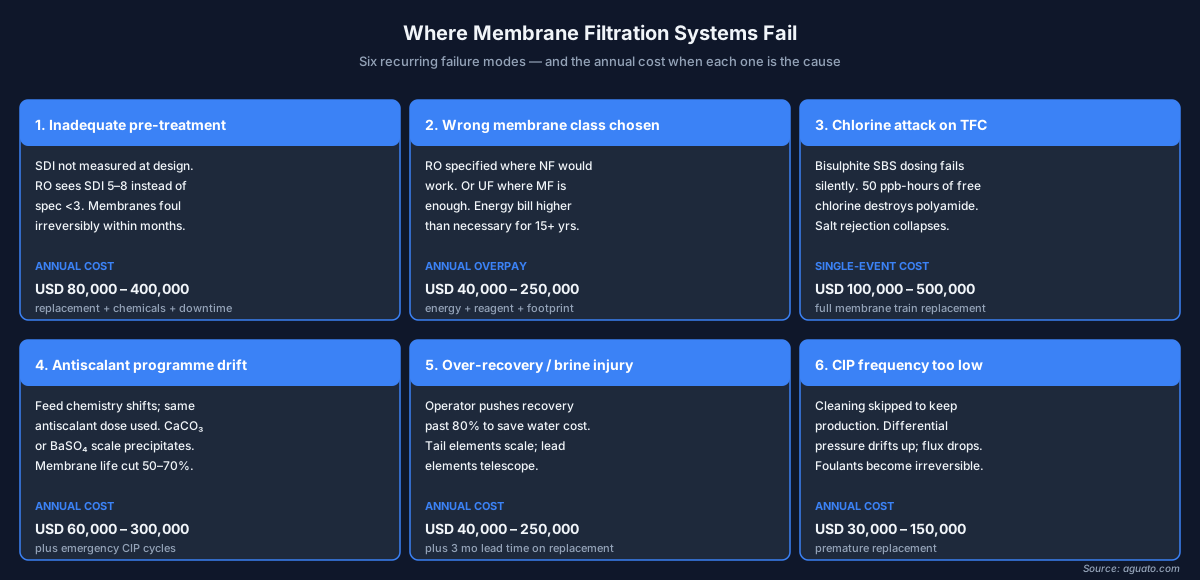
The six recurring failure modes:
Inadequate pre-treatment. SDI not measured at design. RO sees SDI 5 to 8 instead of spec under 3. Membranes foul irreversibly within months. Cost: USD 80,000 to 400,000 per year in replacement, chemicals, downtime.
Wrong membrane class chosen. RO specified where NF would work. Or UF where MF is enough. Energy bill higher than necessary for 15+ years. Cost: USD 40,000 to 250,000 per year in unnecessary energy, reagent, and footprint cost.
Chlorine attack on TFC. Bisulphite (SBS) dosing fails silently. Just 50 ppb-hours of free chlorine destroys polyamide composite membranes. Salt rejection collapses overnight. Cost: USD 100,000 to 500,000, full membrane train replacement event.
Antiscalant programme drift. Feed chemistry shifts; same antiscalant dose used. CaCO₃ or BaSO₄ scale precipitates on membrane surface. Membrane life cut 50 to 70%. Cost: USD 60,000 to 300,000 per year plus emergency CIP cycles.
Over-recovery / brine injury. Operator pushes recovery past 80% to save water cost. Tail elements scale; lead elements telescope from pressure imbalance. Cost: USD 40,000 to 250,000 per year plus 3-month lead time on replacement elements.
CIP frequency too low. Cleaning skipped to keep production running. Differential pressure drifts up; flux drops. Foulants become irreversible. Cost: USD 30,000 to 150,000 per year in premature replacement.
The pattern across all six: each fails not because the engineering was wrong on day one, but because the operating discipline, feed monitoring, dosing programme, cleaning regime, was treated as optional. Real membrane system engineering is a continuous-operations problem, not a one-off install.
If you replace one wrong-spec membrane train with the right configuration matched to your actual feed and a credible operating envelope, you save USD 200,000 to 1,500,000 per year in OPEX over the life of the asset, and you avoid USD 500,000 to 5M+ in catastrophic-replacement events that happen every 3 to 5 years on the wrong-spec systems. The biggest cost-of-doing-nothing is letting the EPC contractor specify the conservative high-recovery RO + premium membranes for a duty that NF + spiral wound at 70% recovery would meet, that single decision is where every seven-figure membrane mistake begins.
## FAQ
### What's the practical difference between MF, UF, NF, and RO?
Pore size and operating pressure. MF (0.1 to 10 µm, low pressure) removes suspended solids, bacteria, and turbidity. UF (0.001 to 0.1 µm) adds viruses and macromolecules. NF (~0.001 µm, mid pressure) adds divalent ions and hardness. RO (~0.0001 µm, high pressure) removes essentially everything except water and gases. Each class jump roughly doubles energy cost but removes a contaminant class the previous one cannot.
### Which module configuration should I specify?
Match fouling tolerance to feed quality. Spiral wound is the cheapest per m² but needs SDI under 3, fine for pre-treated water and desalination, fatal for industrial wastewater. Hollow fiber tolerates surface water and raw industrial flows with backwashing. Tubular is the most expensive per m² but tolerates very high TSS and viscous feeds, used for oily water, dairy, and refractory wastewater. Flat sheet sits in between and dominates submerged MBR systems.
### What does a membrane filtration system cost?
CAPEX ranges from USD 100/m³/day for simple hollow-fiber UF to USD 2,500/m³/day for seawater RO with energy recovery. OPEX runs from USD 0.10/m³ (UF) to USD 5/m³ (seawater RO). Lifecycle cost is dominated by energy and membrane replacement, not CAPEX, for any plant operating more than 5 years. Always price the concentrate disposal, it's the most-underestimated line item.
### How long do membranes last?
5 to 10 years for well-operated systems on well-conditioned feed. Spiral-wound RO elements typically replace at 5 to 7 years; hollow-fiber UF at 7 to 10 years. Cut by 50 to 70% on systems with antiscalant programme drift, chlorine excursions, or over-recovery operation. Replacement cost on a 1,000 m³/day RO is USD 30,000 to 80,000 per replacement cycle.
### Do I need pre-treatment before my membrane system?
Yes, almost always. The exception is hollow-fiber UF designed for raw surface water with chemically-enhanced backwash. Everything else needs SDI reduction, antiscalant dosing, dechlorination, and pH adjustment. Pre-treatment is typically 30 to 50% of total system CAPEX. Cutting it in value-engineering is the most expensive false economy in industrial water.
### Can I run RO at 90% recovery to save water?
Almost never. Brackish RO is bounded by gypsum, calcium carbonate, and silica saturation in the concentrate; pushing past 80% recovery scales the tail elements and damages lead elements through pressure imbalance. Stay at 70 to 85% with a credible antiscalant programme. If 90%+ recovery is the genuine objective, design a two-stage RO or RO + brine concentrator, not a single-stage system pushed past its envelope.
### What's the right CIP regime?
Triggered by 15% normalised flux decline or 15% differential-pressure increase, whichever comes first. Typical chemistry: alkaline (pH 11) for organic foulants, acidic (pH 2) for inorganic scale, plus surfactant/detergent for biofilm. Frequency varies, surface-water UF every 1 to 4 weeks, brackish RO every 3 to 6 months, ultrapure RO every 6 to 12 months. Skipping CIP is the single biggest cause of premature membrane death; the chemicals are cheaper than the replacement elements.