Ceramic membranes cost 3 to 5× polymeric UF on installed CAPEX and run 30 to 60% lower on 15-year total cost of ownership for tough-feed industrial duties. On dairy whey, brewing, offshore produced water, refinery effluent MBR, pharmaceutical WFI, semiconductor UPW, and mining hydrometallurgy, ceramic is now the lifecycle-cost-optimal specification. This guide covers the five operating dimensions that flip the math, the CAPEX-OPEX numbers on a 1,000 m³/day duty, the seven-industry application matrix, and the four failure modes that ruin ceramic economics when the technology is mis-specified.
Ceramic membranes are the technology procurement teams reject on first quote and adopt on second refurbishment. Installed CAPEX runs 3 to 5× equivalent polymeric ultrafiltration or microfiltration, the per-square-metre price tag is the first thing that lands on a CFO's desk, and the lifecycle case never gets made because the project specification was already locked at the polymeric default by the time anyone with a chemistry background was in the room. On tough-feed industrial duties, dairy whey, brewery yeast removal, offshore produced water, refinery effluent MBR, pharmaceutical WFI prep, semiconductor UPW polish, mining acid leachates, the 15-year total cost of ownership runs 30 to 60% lower than a polymeric equivalent, and the gap widens every year because polymeric replacement cycles compound while ceramic ones don't.
The CAPEX premium is real. So is the OPEX advantage. The mistake is treating the choice as a single number on a bid sheet, installed dollars per cubic metre per day, when the binding lifecycle number is installed dollars per cubic metre per day across a 15-year asset life that the polymeric option will not survive on the feed water in front of you. Polymeric UF on tough industrial duty replaces every 3 to 5 years; ceramic UF replaces every 15 to 20 years. The two technologies are not interchangeable line items at different price points, they are different asset classes with different depreciation curves, and the bid review that treats them as substitutes is the bid review that costs the plant USD 800,000 to 4,500,000 over the asset's service life.
This guide is for capital-projects engineers, plant managers, and procurement leads tendering an industrial UF or MF system. It covers what ceramic membranes actually are at the materials-science level, the five fouling and chemistry conditions where they decisively beat polymeric, the installed CAPEX and 15-year OPEX numbers that drive selection, the industry-by-industry application matrix that defines where the premium earns out, and the failure modes that ruin ceramic economics on the projects where they have been mis-specified.
## The decision in brief
- Buy ceramic on 15-year TCO, not installed CAPEX. Ceramic membranes cost 3 to 5 times polymeric on installed CAPEX and run 30 to 60% lower on 15-year total cost of ownership for tough-feed industrial duties. - Know where ceramic wins and where it does not. On dairy whey, brewing, offshore produced water, industrial MBR, pharmaceutical WFI, semiconductor UPW and mining hydrometallurgy duties, ceramic is now the lifecycle-cost-optimal specification. On clean-feed municipal-equivalent UF and light-duty drinking-water polish, polymeric remains correctly specified. - Put the premium next to what it avoids. A 3 to 5 times CAPEX premium on a 1,000 m³/day duty is USD 550,000 to 1,350,000. The avoided replacement OPEX plus downtime exposure across the asset's life is USD 800,000 to 4,500,000.
The premium recovers across two replacement cycles polymeric would have triggered and ceramic does not, plus avoided downtime exposure on chemistry the polymeric would not have survived, even though the bid sheet says the opposite.
## What ceramic membranes actually are
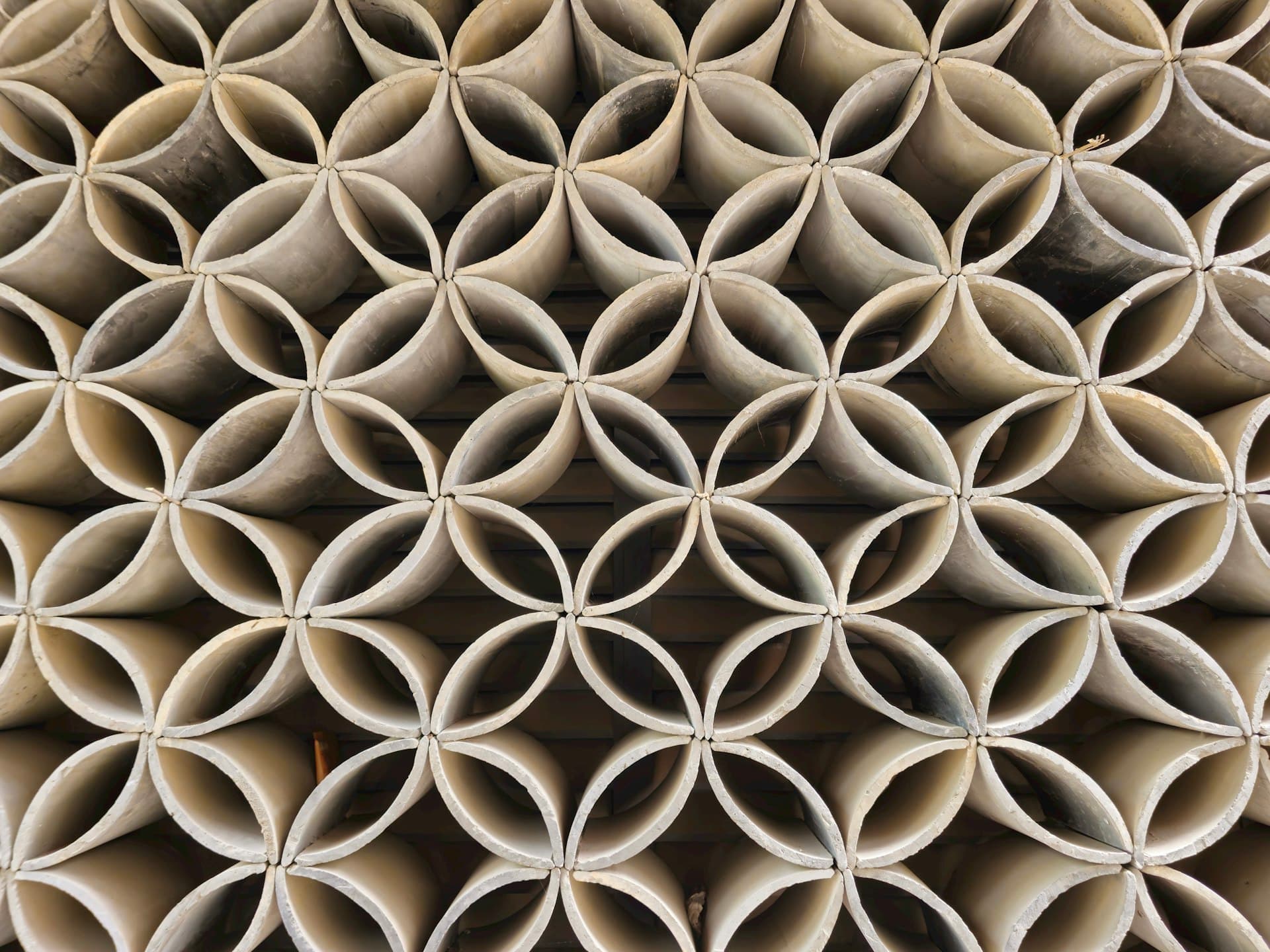
Ceramic membranes are pressure-driven separation barriers made from sintered inorganic oxides or carbides, alumina (α-Al₂O₃), zirconia (ZrO₂), titania (TiO₂), [silicon](/elements/silicon) carbide (SiC), or composites of those, with a graded pore structure that funnels feed water through a coarse support layer into a thinner active layer that does the actual size-exclusion separation. They are membranes the way a sintered metal frit is a membrane: rigid, monolithic, mechanically and chemically inert, and dimensioned to outlast the plant they sit inside. Polymeric membranes, PVDF, PES, polyamide thin-film composite, polysulfone, are the opposite: flexible, organic, fouled by the same chemistry that protects the equipment around them, and engineered for swap-out rather than survival.
The materials science is what drives every downstream economic difference:
- Mechanical integrity. A ceramic monolith holds its dimensional stability under transmembrane pressures that crush polymeric fibres. Operating at 4 to 8 bar across a high-TSS feed is routine for ceramic and reckless for hollow-fibre polymeric. - Chemical inertness. The covalent oxide or carbide bonds in a ceramic matrix do not react with caustic, acid, oxidants, or solvents at the concentrations used for industrial CIP. Polymeric membranes carry a documented [chlorine](/elements/chlorine)-hour budget, a pH window, and a temperature ceiling, and every CIP cycle consumes some of that budget. - Thermal stability. Ceramic membranes operate continuously at 90 °C+ and tolerate steam sanitisation at 121 °C. PVDF maxes out at 50 to 60 °C; polyamide at 45 °C; PES at 50 °C. The temperature delta sits at the heart of every pharma, dairy, and food-grade hygiene argument. - Pore structure. Modern ceramic UF membranes deliver nominal pore sizes down to 0.01 µm with molecular-weight cutoffs of 1 kDa, comparable to polymeric UF but with a tighter pore-size distribution. The narrower distribution is what gives ceramic the consistency-of-rejection numbers polymeric struggles to match across a multi-year run.
Per the [Membrane Society of Australasia overview of inorganic membrane standards and applications](dofollow:https://www.membranes-amsi.org/), ceramic membranes have moved from "niche, expensive" to "default specification on tough-feed industrial UF and MF" across food and beverage, oil and gas, and microelectronics over the last 15 years. The shift is driven by lifetime cost, not unit cost, and the procurement teams catching up are the ones running TCO models instead of bid-sheet comparisons.
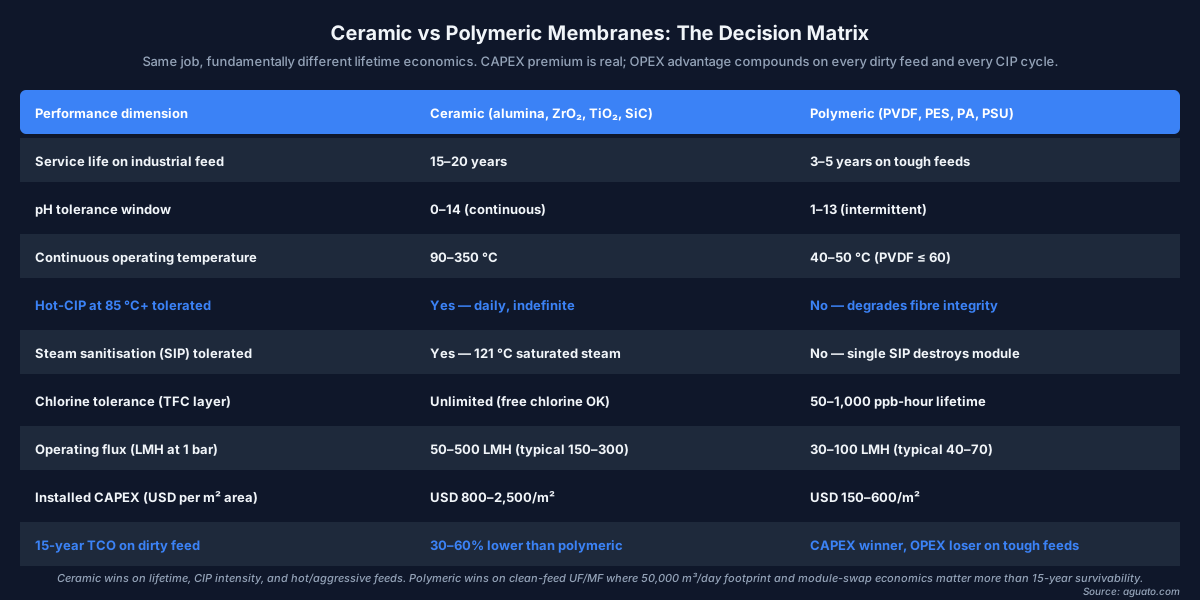
The dimensions that flip the lifecycle math are not the headline performance numbers on a manufacturer datasheet, pore size, flux, rejection, which are broadly comparable between the two technology families on clean-feed duty. The dimensions that matter are the ones at the bottom of the table: lifetime under CIP intensity, pH and temperature window, and CAPEX-per-square-metre amortised across actual service life. Get those right and the case for ceramic builds itself; ignore them and the bid sheet wins on first quote and the plant pays for it on every replacement cycle.
## Ceramic vs polymeric: the five dimensions that flip the math
Five operating conditions decisively flip the lifecycle math toward ceramic. When two or more apply to your feed water, the polymeric specification is almost certainly the more expensive option over a 15-year horizon, even though the bid sheet says the opposite.
1. Hot CIP intensity above 70 °C. Daily cleaning at 80 to 90 °C is standard practice in dairy, brewing, and food processing for bioburden control. Polymeric UF degrades visibly after 200 to 400 hot CIP cycles, fibre integrity collapses, transmembrane pressure rises uncontrolled, and a module that nameplate-lives ten years lasts eighteen months in actual service. Ceramic monoliths run the same cycles indefinitely. The dairy industry calls this "the CIP wall" and it is the dimension that pushed European whey-processing plants to ceramic UF in the 2010s.
2. pH excursions outside 2 to 12. Acid mine drainage at pH 1.5, caustic CIP at pH 13.5, citric acid CIP at pH 1.8, these are routine cleaning chemistries on industrial duty. Polymeric tolerates intermittent excursions inside a 1 to 13 pH window with a documented hour-budget. Ceramic tolerates the full 0 to 14 range continuously. On mining hydrometallurgy and refinery wastewater, the pH excursion alone forces ceramic.
3. Solvent or hydrocarbon exposure. Produced water carrying dispersed aromatic hydrocarbons, refinery effluent with residual solvents, pharmaceutical permeate carrying mother-liquor solvents, polymeric polyamide TFC layers swell and fail; PVDF survives but with reduced flux and shortened life. Ceramic SiC is inert to virtually all industrial solvents at standard process concentrations.
4. Free-chlorine or strong oxidant exposure. Thin-film composite polyamide membranes carry a documented chlorine tolerance of 50 to 1,000 ppb-hours over the membrane lifetime. A single uncontrolled chlorine event, pretreatment dose runaway, biocide rotation overlap with a sample line, can consume that budget in hours. Ceramic membranes have no chlorine budget. On feed water requiring continuous free-chlorine or biocidal control, ceramic is the only credible option.
5. High-TSS or abrasive feed water. Industrial MBR sludge above 15 g/L MLSS, refinery effluent with asphaltene particulates, mining tailings water with quartz fines, the abrasive load mechanically grinds hollow-fibre polymeric membranes from the outside, with measurable mass loss after 6 to 12 months. Ceramic monoliths are rated to operate at MLSS up to 25 g/L without measurable mechanical wear.
Each dimension on its own does not always justify ceramic CAPEX. But the dimensions overlap on most industrial duty: dairy whey ticks dimensions 1 and 2; produced water ticks 3, 4, and 5; refinery MBR ticks 2, 3, and 5; semiconductor UPW polish ticks 4. A duty that ticks zero dimensions, clean municipal-equivalent feed at ambient temperature with gentle CIP, is the duty where polymeric is correctly specified and ceramic is mis-specified. For the broader four-class context, microfiltration, ultrafiltration, nanofiltration, reverse osmosis, and which module configuration matches which feed water, see our [membrane filtration system guide](/resources/membrane-filtration-system).
## Module configurations: tubular, monolithic, multi-channel
Ceramic membranes ship in three module geometries, and the choice has a material effect on installed CAPEX, footprint, fouling tolerance, and cleaning chemistry. The configuration question is rarely solved at FEED stage, it gets decided by which manufacturer the procurement team is talking to, and the result is a 20 to 40% CAPEX gap between configurations that are nominally interchangeable.
- Single-channel tubular. Each membrane is a single tube, typically 10 to 25 mm internal diameter, 1 to 1.2 m long. Lowest packing density (50 to 100 m² per m³ of installed equipment) and highest CAPEX per square metre of membrane area, but the most fouling-tolerant configuration available, the wide channel handles solids loadings other geometries cannot. Used for mining tailings water, refinery oily wastewater, and any feed where solids carryover spikes are routine. - Monolithic multi-channel. A single ceramic block with 7, 19, 37, or 61 parallel flow channels, each 2.5 to 6 mm internal diameter, length 0.85 to 1.2 m. Mid-range packing density (150 to 300 m² per m³) and CAPEX, and the dominant configuration for industrial UF and MF on moderate-TSS feeds. Used for dairy, brewing, [microfiltration](/resources/microfiltration) on food-grade duty, and produced-water polish. - Flat-sheet/disc-stack. Used for specific specialty applications including small-scale pharmaceutical and laboratory-grade prep where steam sanitisation and individual-disc replacement are valued more than packing density.
The configuration decision is feed-specific. A polymeric default of "spiral-wound hollow fibre for everything" does not translate to ceramic, a ceramic-monolithic system on a feed that should have been single-channel tubular will plug within months on solids carryover, and the operator will conclude that "ceramic doesn't work for this duty" when the real failure was the channel-size decision. Match channel size to the 99th-percentile particle-size distribution of the feed, not the mean.
For applications where the binding constraint is dissolved-solids removal (TDS reduction below 1 g/L) rather than suspended solids or microorganisms, ceramic UF is the pretreatment layer ahead of polymeric RO, not a substitute for it. Ceramic does the protection work that lets the RO membrane achieve its design life. See [nanofiltration](/resources/nanofiltration) and [ultrafiltration](/resources/ultrafiltration) for the dissolved-vs-suspended cutoff decision in detail.
[cta:nepti-dark]
## CAPEX, OPEX, and the 15-year payback math
The installed CAPEX delta between ceramic and polymeric UF is the single number that decides most procurement conversations, and it is also the single number that misleads them. On installed cost alone, ceramic runs USD 800 to 2,500/m² of membrane area against USD 150 to 600/m² for polymeric, a 3 to 5× premium that frequently rises to 5 to 7× when the comparison is normalised on flux instead of area (ceramic operates at 2 to 4× the LMH of polymeric, which partially offsets the area premium on a per-cubic-metre-per-day basis).
For a 1,000 m³/day industrial UF duty on a tough feed:
| Cost element (15-year horizon, 1,000 m³/day duty) | Polymeric UF | Ceramic UF | Delta | |---|---|---|---| | Membrane CAPEX (installed) | USD 250,000 to 450,000 | USD 800,000 to 1,800,000 | +USD 550,000 to 1,350,000 | | Skid + ancillaries CAPEX | USD 350,000 to 650,000 | USD 500,000 to 900,000 | +USD 150,000 to 250,000 | | Membrane replacement (15-yr OPEX) | USD 600,000 to 1,800,000 (4× cycles) | USD 0 to 250,000 (0 to 1 cycle) | −USD 600,000 to 1,550,000 | | Chemistry (CIP + biocide) | USD 180,000 to 400,000 | USD 90,000 to 220,000 | −USD 90,000 to 180,000 | | Energy delta (15-yr OPEX) | Baseline | +USD 80,000 to 180,000 | +USD 80,000 to 180,000 | | Downtime exposure | USD 200,000 to 800,000 (per failure) | USD 0 to 100,000 | −USD 200,000 to 700,000 | | Disposal of replaced modules | USD 40,000 to 120,000 | USD 0 to 30,000 | −USD 40,000 to 90,000 |
For a tough-feed industrial duty, dairy, brewing, produced water, refinery effluent, semiconductor, the 15-year ceramic TCO runs 30 to 60% lower than polymeric despite the CAPEX premium. The single largest swing factor is membrane replacement frequency, which moves the bulk of the cost from the procurement CAPEX line (where it shows up once at financial close) to the operations OPEX line (where it shows up every 3 to 5 years and is silently absorbed by the maintenance budget). The procurement-versus-operations split is what kills the ceramic business case on most tendering exercises, the CAPEX-line stakeholder sees the +USD 550,000 to 1,350,000 membrane premium; the OPEX-line stakeholder rarely gets surveyed before the procurement decision is locked.
For a clean-feed duty in municipal-equivalent water or simple drinking-water polish, the math reverses. Ceramic 15-year TCO runs 10 to 25% higher than polymeric because the replacement-frequency savings disappear when polymeric is allowed to live out its full design life. On those duties, polymeric is correctly specified.
The right way to test the decision is feed-water-specific. Plug the duty into [Nepti's water-decision model](/nepti), Nepti characterises the actual feed water, the local CIP intensity, the regulatory environment, and the downtime cost-of-failure, and produces a ranked technology comparison with 15-year lifecycle cost projections. Procurement teams running this model before tendering save 12 to 22% on the wrong technology being specified, almost entirely by avoiding the ceramic-on-clean-feed and polymeric-on-tough-feed mistakes that recur across industries.
The lifecycle table above assumes the ceramic system is operated with chemistry and cleaning protocols matched to the technology. Operators who treat ceramic UF as "polymeric but more expensive", running it at polymeric flux, polymeric CIP frequency, and polymeric module-swap economics, extract roughly half the lifetime advantage the technology can deliver. The chemistry and the architecture are inseparable, and the next section maps the industry-by-industry duties where the lifecycle case is most defensible.
## Industry application matrix: where ceramic wins
Ceramic membranes are now the default specification across seven industry duties, and a credible alternative in another five. The application matrix below tracks the seven where the premium most reliably earns out, and what specifically about each duty drives the choice.
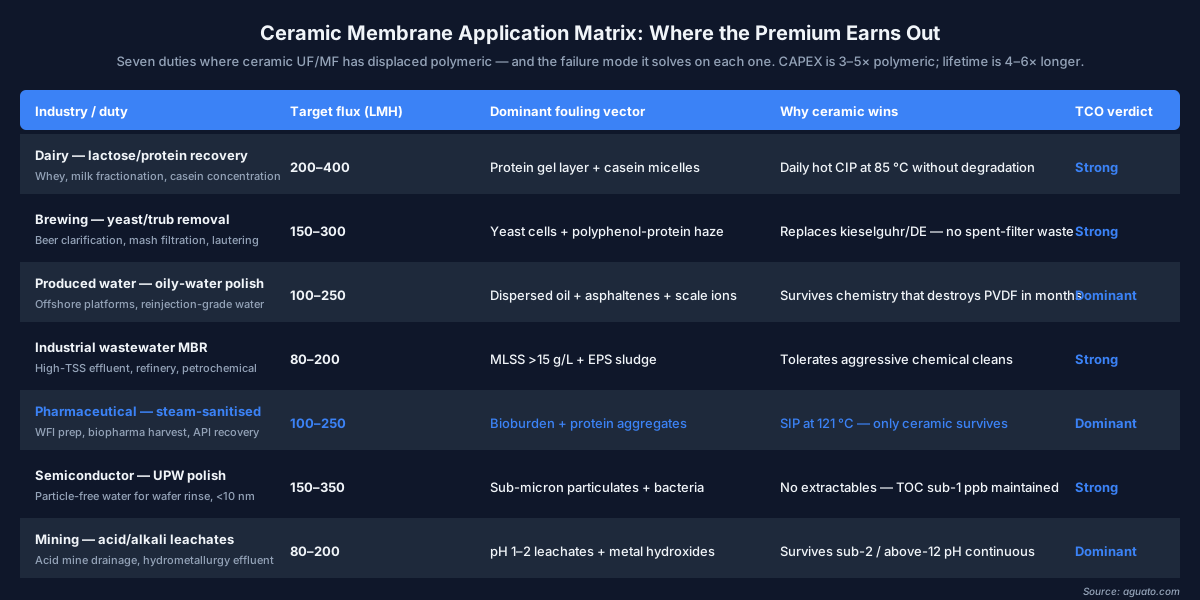
Dairy, lactose, protein, and whey fractionation. Whey processing is the single largest commercial application of ceramic UF in the world. Daily hot CIP at 85 °C is non-negotiable for bioburden control, and the protein-gel-layer fouling on the membrane surface needs aggressive caustic-and-acid cleans that destroy polymeric fibres in months. Ceramic UF in milk fractionation lasts 15 to 20 years against polymeric's 3 to 4. The American Dairy Products Institute has been a key driver of this transition, for the protein-recovery quality and regulatory framework on US dairy, see [the National Dairy Council overview](dofollow:https://www.usdairy.com/about-us/national-dairy-council).
Brewing, beer clarification and yeast removal. Ceramic UF has displaced kieselguhr (diatomaceous earth) filtration on most large modern breweries, eliminates the spent-filter-aid waste stream, reduces beer-loss yields by 1 to 2%, and operates at 150 to 300 LMH against polymeric's 40 to 80 LMH. The polyphenol-protein haze fouling on the membrane surface tolerates aggressive cleaning that polymeric does not survive. Capital is heavy; payback on a 500,000 hL/year brewery runs 3 to 5 years on filter-aid savings alone.
Produced water, oily-water polish for reinjection-grade water. Ceramic UF is the polish-stage technology of choice when offshore platforms move from overboard discharge to reinjection. The combination of dispersed-oil tolerance, asphaltene resistance, and acid/caustic compatibility makes it the only credible option on most produced water streams. See the [offshore produced water treatment guide](/resources/offshore-produced-water-treatment) for the five-stage train architecture and where ceramic UF sits relative to hydrocyclones, IGF, and MPPE.
Industrial wastewater MBR. High-TSS biological-treatment effluent with MLSS above 15 g/L is the duty that broke polymeric MBR economics on heavy industrial sites. Ceramic MBR runs at MLSS up to 25 g/L without mechanical wear, tolerates the aggressive chemical-cleaning protocols required for refinery and petrochemical effluent, and replaces polymeric in the duty where suspended-solids loading is the binding constraint. For the broader treatment-train context see [oily wastewater treatment](/resources/oily-wastewater-treatment) and the [industrial wastewater treatment process](/resources/industrial-wastewater-treatment-process).
Pharmaceutical, steam-sanitised duty. WFI prep, biopharma harvest, API recovery, and cell-culture media filtration all require steam-in-place sanitisation at 121 °C. Polymeric cannot survive a single SIP cycle. Ceramic UF is the only commercially available membrane technology that withstands continuous steam sanitisation under GMP, and the regulatory premium on sterilisation reliability, particularly for US-market biopharma, makes the CAPEX a non-decision. The [USP <1231> framework for Water for Pharmaceutical Purposes](dofollow:https://www.usp.org/) sets the validation envelope for steam-sanitised systems and is the operative reference document on US pharmaceutical UF specification.
Semiconductor, UPW polish. Ultra-pure water for wafer rinse cannot tolerate any extractable organic compounds from the membrane material. Polymeric UF leaches sub-ppb TOC into the permeate at concentrations that are unmeasurable in most industrial duties but disqualifying for sub-10 nm semiconductor processes. Ceramic UF is materially inert and contributes zero extractables to the permeate. The application is small in volume but high in margin, and the technology choice is fixed by the materials-science constraint.
Mining, acid mine drainage and hydrometallurgy. pH 1 to 2 leachates from copper, gold, and nickel hydrometallurgy operations dissolve polymeric membranes on contact. Ceramic UF operates continuously across the full pH range and survives the iron-and-aluminium hydroxide scaling that fouls every alternative technology. For the broader [mining wastewater treatment](/resources/mining-wastewater-treatment) context, lime neutralisation, sulphide precipitation, and the failure modes on under-spec'd acid-drainage plants, see our dedicated guide.
## Where polymeric still rules
Ceramic membranes are not always correct. Three duty profiles continue to make polymeric the right specification:
- High-volume clean-feed municipal-equivalent UF. Drinking-water UF plants treating low-TSS surface or groundwater at 50,000 to 500,000 m³/day cannot justify the ceramic CAPEX. The polymeric specification is correct and lifecycle-cost-optimal. The duty has been the home territory of hollow-fibre PVDF for two decades and will remain so. - Compact-footprint applications with limited CIP intensity. Small commercial UF plants on bottled-water lines, low-throughput pre-RO pretreatment on light feeds, and similar light-duty applications run hollow-fibre polymeric at design life because the CIP intensity does not consume the chlorine or temperature budget. - Highly modular swap-out maintenance models. Some operators prefer the polymeric "module swap as routine maintenance" model over the ceramic "no swap, monitor flux decline" model on operational simplicity grounds. The economics are typically wrong, but the operations philosophy is legitimate and the choice belongs with the asset operator.
For the broader four-class decision context, when ultrafiltration is correctly specified at all, versus microfiltration upstream or nanofiltration downstream, see the [RO vs NF vs UF comparison](/resources/ro-vs-nf-vs-uf-comparison) and the [ultrafiltration systems guide](/resources/ultrafiltration).
## Where ceramic decisions go wrong
Four failure patterns recur on ceramic membrane installations, and each represents a recognised mistake.
1. Specifying ceramic on a clean-feed duty because it is "more durable." A municipal-equivalent UF plant on filtered river water specified ceramic on a vendor recommendation, paying a 4× CAPEX premium against a hollow-fibre PVDF baseline that would have lasted 12 to 15 years on the feed water in front of it. Lifecycle cost was 22% higher; payback was negative. The mistake was treating "more durable" as a decision criterion without testing it against the feed water. Correct decision: characterise the feed against the five-dimension comparison framework above before specifying material.
2. Sizing the system on polymeric flux assumptions. A 2,000 m³/day refinery effluent plant specified ceramic membranes but sized the skid for 60 LMH (polymeric-equivalent flux). The result: a system 3× the membrane area it actually needed, paying 3× the membrane CAPEX it should have paid, with the ceramic operating at 25% of design flux for the asset's life. The mistake was carrying polymeric assumptions into the ceramic specification. Correct decision: size against the ceramic-membrane manufacturer's flux curves for the specific feed water.
3. Neglecting feed-water solids characterisation on a small-channel monolithic system. A semiconductor UPW polish specified a 19-channel monolithic module with 3 mm channel diameter against a feed water that had been characterised on mean particle size, not 99th-percentile particle size. The actual feed had a thin tail of 100 to 200 µm particles that the channel size could not handle; the module plugged at 18% design throughput within two months. The mistake was inadequate feed characterisation. Correct decision: characterise the feed across the full particle-size distribution before specifying channel geometry.
4. Running ceramic on polymeric CIP frequency and missing the chemistry advantage. An industrial dairy plant installed ceramic UF and ran the CIP programme inherited from its polymeric predecessor, caustic-only, 60 °C, two cycles per day. The ceramic system performed adequately but never delivered the flux-recovery numbers the technology is capable of. The operator concluded "ceramic is not worth the premium" and reverted to polymeric on the next plant expansion. The mistake was failing to redesign the CIP programme around the ceramic chemistry envelope (90 °C, full pH range, oxidant-tolerant). Correct decision: rebuild the cleaning programme on the ceramic technology's chemistry envelope, not the polymeric one.
In every case, the decision quality starts with characterising the duty before specifying the material, and continues with running the membrane on the chemistry the material actually supports.
## Decision framework: should you specify ceramic?
Run the duty through this sequential check.
1. CIP intensity: Does the duty require daily hot CIP at 70 °C+ or weekly aggressive caustic/acid cleans? Yes → ceramic. No → continue. 2. pH window: Does the cleaning chemistry or feed-water chemistry span pH below 2 or above 12? Yes → ceramic. No → continue. 3. Oxidant exposure: Does the feed water carry continuous free chlorine, ozone, peroxide, or another strong oxidant at process-relevant concentrations? Yes → ceramic. No → continue. 4. Steam sanitisation requirement: Does the duty require SIP at 121 °C (typically pharmaceutical, biopharma, or specific food-grade applications)? Yes → ceramic. No → continue. 5. High-TSS or abrasive feed: Does the feed carry MLSS above 15 g/L or measurable abrasive particulates? Yes → ceramic. No → continue. 6. All five answers no: Polymeric UF is the right specification. Build the operating programme around it.
If two or more answers are "yes," the ceramic lifecycle case is strong enough to absorb the CAPEX premium. If only one is "yes," run the 15-year TCO model against polymeric on the specific feed water before specifying. The lifecycle delta in the "one yes" zone is small enough that local energy costs, local labour costs, and downtime exposure can flip the answer either way, characterise before specifying.
The decision framework above produces a material choice and a configuration choice; what it does not produce is the one number that survives a five-minute conversation with a CFO who has not read the article. That number is the dollar gap between the CAPEX premium and the avoided replacement OPEX across a 15-year horizon, and it is the difference between a procurement decision that gets approved on the merits and one that gets sent back to "look at the lower bid one more time" because the OPEX case never got modelled.
Closing the OPEX case the procurement committee asked for means pricing the ceramic premium against real replacement-cycle data. Compare vetted [water treatment equipment manufacturers](/providers) on Aguato, filter by ceramic and polymeric membrane experience, and request scoped proposals so the 15-year cost gap above is grounded in supplier-confirmed figures.
## FAQ
### What is a ceramic membrane in plain English?
A ceramic membrane is a rigid, inorganic filtration barrier made from sintered alumina, zirconia, titania, or silicon carbide that performs the same job as a polymeric ultrafiltration or microfiltration membrane, separating contaminants from water by size exclusion at the sub-micron scale, but is dimensionally stable, chemically inert, and thermally robust in ways no polymer can match. It costs 3 to 5× more on installed CAPEX and lasts 4 to 6× longer in service, which is why it dominates industrial UF and MF on tough-feed duties (dairy, brewing, produced water, refinery effluent, pharmaceutical, semiconductor, mining) and is still the wrong specification on clean-feed municipal-equivalent UF.
### How much do ceramic membranes cost compared to polymeric?
Installed CAPEX runs USD 800 to 2,500/m² of membrane area for ceramic against USD 150 to 600/m² for polymeric, a 3 to 5× premium. On flux-normalised basis (cost per m³/day of throughput) the premium narrows to roughly 2 to 3× because ceramic operates at 2 to 4× the LMH of polymeric. On 15-year lifecycle cost, the ceramic TCO is typically 30 to 60% lower for tough-feed industrial duties and 10 to 25% higher for clean-feed municipal-equivalent duties. The lifecycle math depends critically on replacement frequency (polymeric 3 to 5 years on tough feeds vs ceramic 15 to 20 years) and chemistry compatibility, sites with aggressive CIP, pH excursions, or oxidant exposure almost always recover the CAPEX premium.
### What materials are ceramic membranes made from?
Four materials dominate commercial ceramic membranes: alumina (α-Al₂O₃), the workhorse for general UF and MF; zirconia (ZrO₂), typically a tighter active layer over an alumina support, used for tighter UF pore sizes; titania (TiO₂), used where photocatalytic membrane regeneration is part of the process; and silicon carbide (SiC), the newest and most chemically inert option, used on aggressive feeds and high-temperature duty. Many commercial modules are composites: a coarse alumina support layer with a thinner, finer zirconia or titania active layer that does the actual separation. The material choice is feed-specific and is decided alongside the channel-geometry choice.
### Can ceramic membranes survive steam sanitisation?
Yes, and this is the dimension that fixes ceramic as the only commercially viable option for pharmaceutical and biopharma applications. Saturated steam at 121 °C is a routine SIP protocol that ceramic monoliths tolerate indefinitely. Polymeric membranes do not survive a single SIP cycle. For pharmaceutical UF on US-market WFI prep, biopharma harvest, or API recovery duty, the regulatory framework under USP <1231> Water for Pharmaceutical Purposes (referenced in the Pharmaceutical section above) effectively mandates ceramic on any system that needs in-place sterilisation. The economics of the CAPEX premium become irrelevant against the regulatory premium.
### Do ceramic membranes foul?
Yes, every membrane fouls. The difference is that ceramic responds to aggressive chemical cleaning that polymeric does not survive, so the achievable cleaning rigor is much higher. On a typical industrial duty, ceramic membranes run a daily caustic CIP at 80 to 90 °C and a weekly acid CIP at pH 2, chemistry that would destroy polymeric in a few cycles, and recover near-baseline flux indefinitely. The recurring fouling mechanism depends on the feed: protein gel layers in dairy, polyphenol-protein haze in brewing, asphaltene scaling in produced water, EPS-sludge biofouling in MBR. The fouling is real; the cleaning recovery is what differentiates ceramic.
### What is the typical flux of a ceramic UF membrane?
Operating flux for ceramic UF runs 100 to 300 LMH on industrial duty, with some applications reaching 400 to 500 LMH on clean-feed polish. Polymeric UF typically runs at 30 to 80 LMH on the same duties. The flux delta is one of the underappreciated economic levers: a ceramic system delivers the same throughput as a polymeric system from roughly one-third the membrane area, which partially offsets the per-square-metre CAPEX premium. The flux advantage is most pronounced on clean feeds; on heavily fouled feeds, both technologies converge toward 60 to 100 LMH after fouling-equilibrium establishment.
### When should I not specify ceramic membranes?
When the feed water is clean, the CIP intensity is light, and the duty volume is large. Drinking-water UF plants at 50,000 to 500,000 m³/day on filtered surface or groundwater are the canonical "polymeric wins" duty, the membrane area required at ceramic CAPEX is prohibitive, and the polymeric replacement cycle of 8 to 12 years on a clean feed extracts the full design life of the technology. Similarly, small-scale RO pretreatment on light feeds, bottled-water UF on prefiltered municipal water, and any duty where the binding economic constraint is footprint per m³/day rather than chemistry compatibility, are duties where polymeric is correctly specified.