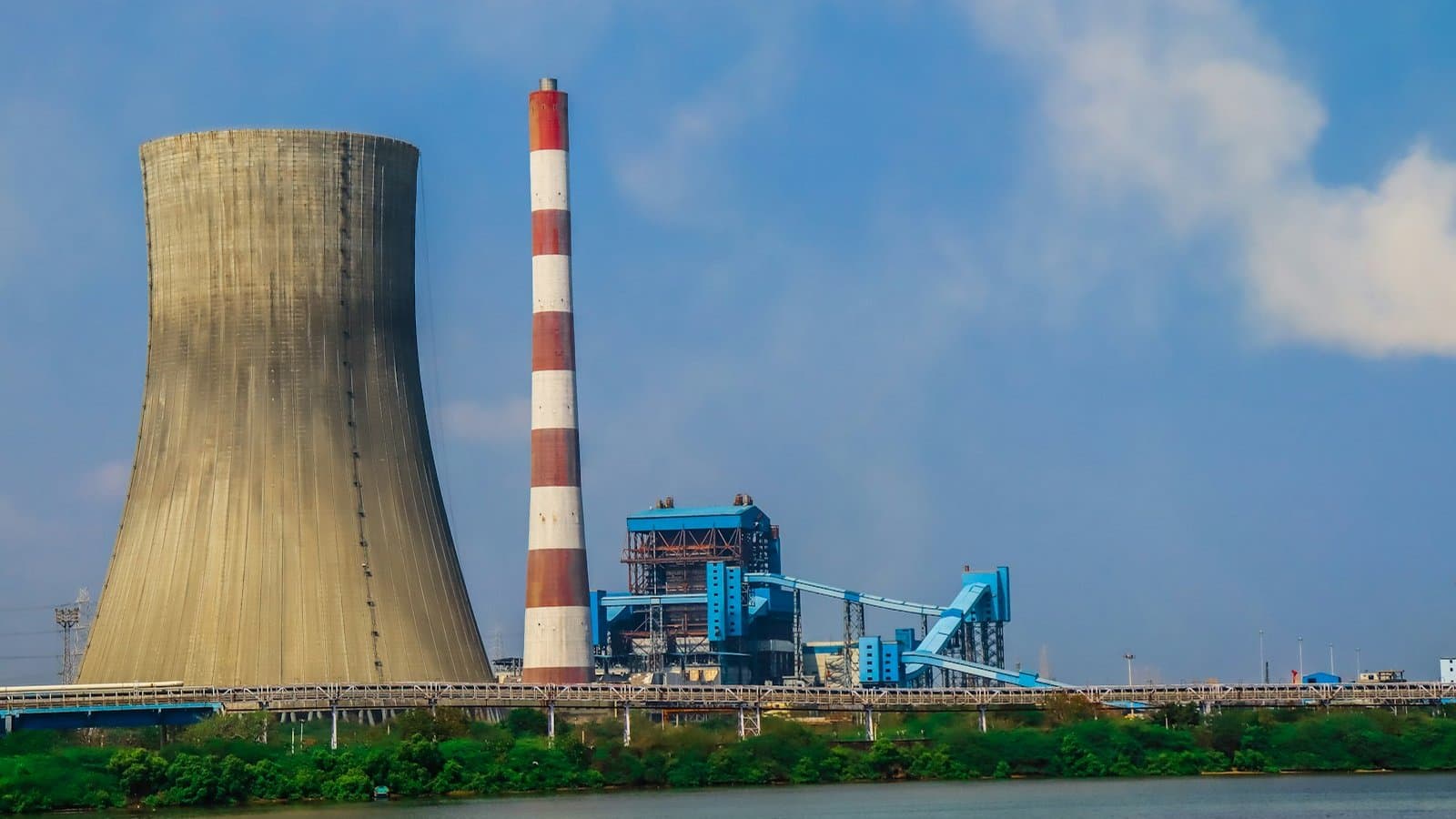
Most industrial cooling towers run blowdown wrong by 15 to 30%. The wrong setpoint costs USD 8,000 to 35,000/year on a 5 MW duty in wasted make-up and chemistry; under-blowdown costs USD 50,000 to 250,000 in scale damage. This guide covers cycles of concentration, the three control methods, the five recurring failure modes, and the discharge-permit perimeter most operators under-cost.
Cooling tower blowdown is the most-misunderstood operating decision on a wet cooling system. It looks like a single number on a controller, a conductivity setpoint, but it sits at the intersection of make-up water cost, chemistry spend, scale risk, Legionella programme integrity, and the site's discharge permit. A 5 MW industrial cooling system run with the wrong blowdown setpoint typically wastes USD 8,000 to 35,000/year in unnecessary make-up water and chemistry, while a system run with too little blowdown silently scales heat-exchanger tubes at a cost of USD 50,000 to 250,000 per descale event and 2 to 6 weeks of reduced thermal capacity in the meantime.
The decision is not "open the drain valve more often." It is: at what conductivity setpoint, controlled by what method, sampled how often, balanced against what feed-water TDS, and discharged under what permit limit. Get those five answers right and blowdown becomes a small recurring line item. Get any of them wrong and the system pays for it across two cost lines that procurement teams almost never connect, water bill on one side and unplanned chiller downtime on the other.
This guide covers what blowdown actually is, the cycles-of-concentration math that drives the optimum, the three control methods on offer, the five recurring failure modes, the discharge-permit perimeter most sites under-cost, and the short decision framework that produces the right setpoint for your specific feed water.
## The decision in brief
- Blowdown is a cost decision. It connects three CFO-visible cost lines: water and sewer at USD 30,000 to 180,000/year on a 5 MW duty, the chemistry programme at USD 6,000 to 15,000/year, and unplanned chiller cleaning and downtime at USD 50,000 to 250,000 per event. - Engineer the programme properly. Conductivity-based control, monthly probe calibration, quarterly chemistry panels and annual discharge sampling cost roughly USD 4,000 to 8,000/year more than a bare-bones manual-timer programme and prevent 90% of the avoidable scale and discharge-breach costs. - Count the payback in avoided events. Expect 0 to 2 events over a 15-year horizon depending on programme integrity. Payback against a single avoided descale event is 10 to 30 times, and against a single sewer-authority violation it is larger and harder to quantify.
Run the cycles target on actual feed water and actual permit limits, not on whatever the chemistry vendor's standard recommendation prints out.
## What cooling tower blowdown actually is
Blowdown is the controlled discharge of a small portion of the recirculating cooling tower water to drain. Its purpose is to prevent dissolved solids from concentrating to the point where they precipitate out as scale on the fill, the basin, or, worst, the tubes of the heat exchangers connected downstream of the tower.
The mechanism is simple. As water evaporates from the tower, the dissolved minerals it carried in remain behind. Each pound of evaporated water concentrates the basin chemistry by a measurable amount. Without blowdown, [calcium](/elements/calcium), silica, magnesium, sulphate, and chloride accumulate until the water becomes supersaturated and starts depositing solids on every wetted surface in the system.
Per the [ASHRAE Handbook chapter on cooling towers](dofollow:https://handbook.ashrae.org/Handbooks/S16/SI/s16_ch40/s16_ch40_si.aspx), the engineering term for this concentration ratio is "cycles of concentration", the ratio of dissolved solids in the recirculating water to dissolved solids in the make-up water. A tower running at 4 cycles has 4× the make-up TDS in the basin. A tower running at 8 cycles has 8×. The blowdown rate is what determines that ratio.
The mass balance is fixed. Evaporation removes pure water, drift removes a tiny amount of water as droplets, and blowdown removes basin water at concentrated TDS. Make-up water = evaporation + drift + blowdown. Drift is typically <0.002% of recirculating flow on modern fill, small enough to ignore in the math. Evaporation is roughly 1.5 to 2.5% of recirculating flow per pass for an industrial tower. The remaining variable, blowdown, is the only one the operator controls.
That is why blowdown sits at the centre of the cooling-tower OPEX equation. Every other variable is set by the duty, the climate, the fill design, and the operating philosophy. Blowdown is set by a controller. The controller is set by a person. The person needs the right cycles-of-concentration target. Get that target wrong by 1 cycle in either direction and the annual cost of the mistake compounds across every operating hour the tower runs.
The cooling-tower water treatment programme, scale inhibitor, corrosion inhibitor, biocide rotation, dispersant, assumes a specific cycles-of-concentration band. Operate outside that band and the chemistry is no longer dosing the system the formulation was designed for. For the broader chemistry programme structure, see our [cooling tower water treatment guide](/resources/cooling-tower-water-treatment); for the equipment context, see [how cooling towers work](/resources/how-does-a-cooling-tower-work) and our [evaporative cooling tower deep-dive](/resources/evaporative-cooling-tower).
## Cycles of concentration: the math that sets the optimum
The water-savings curve from increasing cycles is steep at the bottom and flat at the top. Going from 2 cycles to 3 cycles cuts blowdown in half. Going from 5 cycles to 8 cycles cuts blowdown by another 40%, but the percentage of total make-up water saved at that step is small enough that the chemistry burden, scaling risk, and probe-calibration discipline required to operate there usually exceeds the savings.
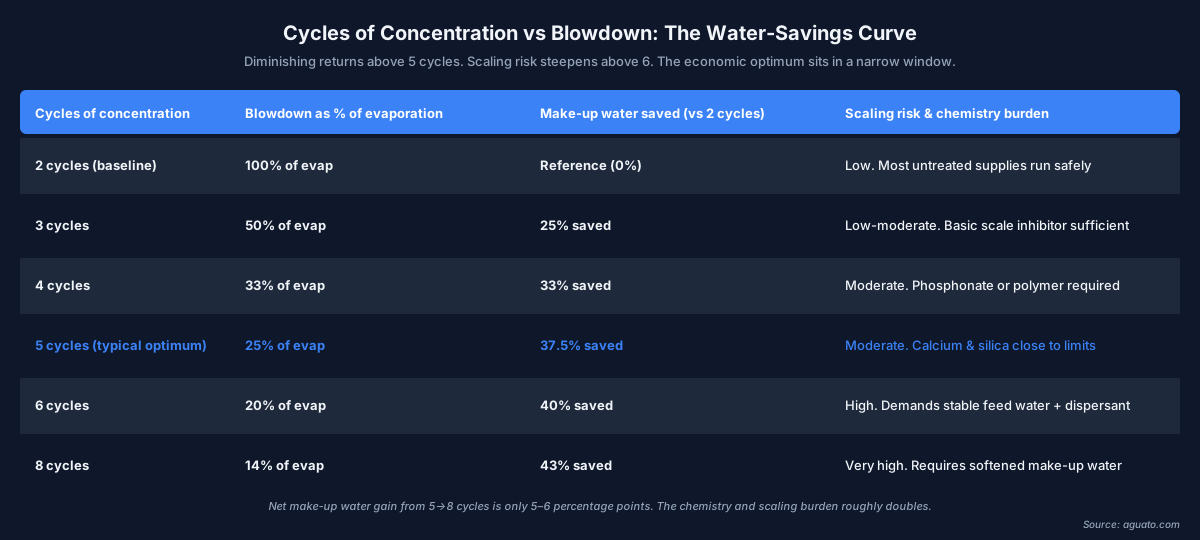
The decision pattern visible in the table above is the engineering shape of every blowdown decision: most of the available water savings from 2 cycles to 8 cycles is realised by the time you reach 5 cycles, and the marginal gain from each additional cycle compresses sharply while the operating burden expands. The cooling tower industry has converged on 4 to 6 cycles as the typical operating band for industrial duty on standard municipal feed water for exactly this reason. It is the band where chemistry is manageable, scaling risk is bounded, water savings are most of the available pool, and the capital required for setpoint enforcement is modest.
The cycles target depends on the feed-water characteristics, not on a generic best practice:
- Calcium hardness, the dominant scale-forming species. The Langelier Saturation Index (LSI) of the basin water at peak temperature is the relevant decision variable. Most programmes target LSI between 0 and +2.0; positive but not strongly scaling. - Silica, limits cycles in many feed waters. Silica solubility caps at ~150 to 180 mg/L in ambient basin water; some cooling tower programmes hit the silica limit before they hit the calcium limit. - Chlorides + sulphate, sets the corrosion environment. High chloride concentrates rapidly through cycles and accelerates pitting on stainless components. - Conductivity, the operational proxy for total dissolved solids. The conductivity setpoint on the controller is what the basin sees; it is what gets enforced in real time.
A site running on hard municipal feed (300 to 400 mg/L total hardness, 30 to 50 mg/L silica) typically operates at 3.5 to 4.5 cycles. A site running on softened or partial-softened feed can run safely at 6 to 8 cycles because the calcium has been removed before it enters the basin. Softening on the make-up water shifts the cycles ceiling upward; the OPEX trade is softener regenerant cost vs blowdown water saved at higher cycles. Run that math at the local water tariff and softener regenerant cost before specifying anything.
## Three ways to control blowdown, and where each wins
How blowdown gets controlled is the second decision after where the setpoint sits. Three control methods dominate the field, and the right one depends on water cost, chemistry spend, and operating discipline.
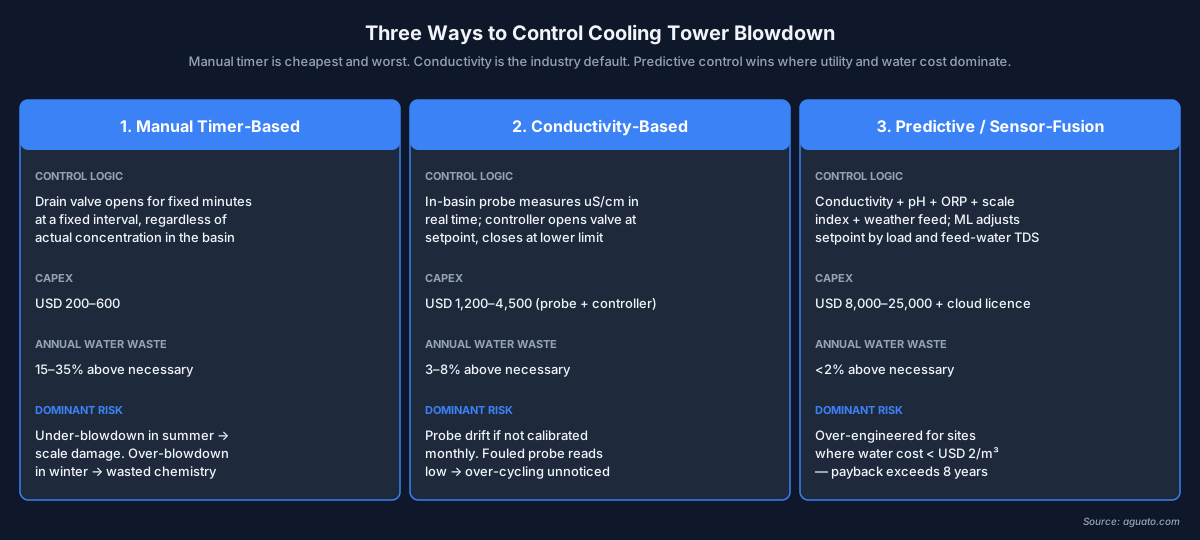
Manual timer-based control is the cheapest and the worst. The drain valve opens for a fixed number of minutes at a fixed interval, regardless of what the basin chemistry is actually doing. Water cost is wasted in winter (when evaporation is low and cycles take longer to reach setpoint) and water cost is wasted in summer (when high evaporation pushes cycles above setpoint between drain pulses, leaving the system to scale). It is correct only for very small towers (<50 kW), where the cost of a controller exceeds the lifetime water savings.
Conductivity-based control is the industry default for towers above 200 kW duty. An in-basin probe reads conductivity in real time; the controller opens the blowdown valve at setpoint and closes it at a slightly lower deadband, holding cycles in a tight band. Annual water waste typically falls to 3 to 8% above the theoretical minimum. CAPEX is USD 1,200 to 4,500 for the probe-and-controller package. Payback is 6 to 18 months on any tower with water cost above USD 1.00/m³.
Predictive / sensor-fusion control layers conductivity with pH, ORP (oxidation-reduction potential, a proxy for biocide residual), Langelier Saturation Index calculation, weather feed, and load forecasting. The setpoint adjusts dynamically as feed-water TDS shifts seasonally, as biocide residual decays, and as ambient wet-bulb pushes evaporation rate up or down. Annual water waste falls below 2%. CAPEX is USD 8,000 to 25,000 plus a cloud-monitoring licence. The right answer for sites where water cost exceeds USD 2/m³, where the duty is above 1 MW, or where the discharge permit places hard limits on TDS, biocide residual, or chromate. It is over-engineered for general-duty HVAC where water cost is municipal and the duty is small.
| Control method | CAPEX | Annual water waste | Best for | |---|---|---|---| | Manual timer | USD 200 to 600 | 15 to 35% above necessary | Very small towers (<50 kW), legacy installations | | Conductivity-based | USD 1,200 to 4,500 | 3 to 8% above necessary | Default for industrial duty 200 kW+ | | Predictive sensor-fusion | USD 8,000 to 25,000 | <2% above necessary | Large duty, high water cost, tight permit |
The control-method decision is also a maintenance-discipline decision. Manual timers need almost no attention but waste water all year. Conductivity probes need monthly calibration and quarterly cleaning; if the probe fouls, the controller silently runs at the wrong setpoint until something downstream visibly fails. Predictive systems need someone who reads the dashboard. Pick the method the site can actually maintain.
## The discharge-permit perimeter most operators under-cost
Blowdown is not just water leaving the system. It is wastewater leaving the site. Every blowdown event is a regulated discharge event under most national wastewater permits, and the permit conditions are what set the upper bound on how concentrated the basin chemistry can become before it has to leave. The [Cooling Technology Institute's published toolkit and standard specifications](dofollow:https://www.cti.org/toolkit) is the authoritative US-side reference for thermal certification, water management, and the discharge-side controls a compliant programme has to support, every procurement team should require evidence of CTI-aligned engineering from any vendor specifying tower or controller equipment.
In the US, cooling tower blowdown discharged to a sewer or surface water is regulated under the EPA's effluent guidelines and NPDES permitting framework, with parameter-specific limits on:
- Total Suspended Solids (TSS), typically capped at 30 to 100 mg/L for direct discharge. - Free available [chlorine](/elements/chlorine) and total residual oxidants, biocide residual carried in the blowdown stream. EPA limits free chlorine discharge to no more than 2 hours per day per unit. - pH, most permits specify a 6.0 to 9.0 pH band on discharge. - Temperature, direct surface-water discharge often capped at 30°C or local water-quality criteria. - Heavy metals (zinc, copper, chromium), corrosion inhibitor residuals frequently trigger limits below 1 mg/L. - Biochemical Oxygen Demand (BOD₅), biocide and organic dispersant residuals contribute.
In the EU, the equivalent regime sits inside the Industrial Emissions Directive (IED) BREF for cooling systems, with parameter limits set by national environmental agencies. In the UK, discharges are regulated under the Environmental Permitting Regulations and the relevant water-company trade-effluent consent.
The compliance trap is that blowdown chemistry is set by basin chemistry, which is set by cycles of concentration, which is set by the conductivity setpoint. Push cycles too high to chase water savings and the discharge stream concentrates beyond permit. Most operators only discover they have crossed the line when a sewer-authority sample comes back with a violation notice attached.
The correct workflow is the inverse: characterise the discharge limits first, back-calculate the maximum permissible basin concentration for each regulated parameter, and set the conductivity setpoint at the most restrictive of those constraints OR the scaling/corrosion ceiling on the chemistry side, whichever is lower. Most procurement-led tower designs do not run this exercise. They set conductivity at "what the chemistry vendor recommended" and discover the permit problem in year 2.
For sites running biocides, every site with an open evaporative loop, the discharge perimeter overlaps with the [Legionella risk assessment programme](/resources/legionella-risk-assessment): the same biocide that controls Legionella in the basin is the residual that gets sampled on discharge. Programme integrity on one side becomes a compliance line item on the other.
[cta:nepti-dark]
## Five blowdown failure modes you will recognise
Five recurring patterns dominate field experience. Each is a recognised mistake, each has a USD-grade consequence, and each has a documented corrective action.
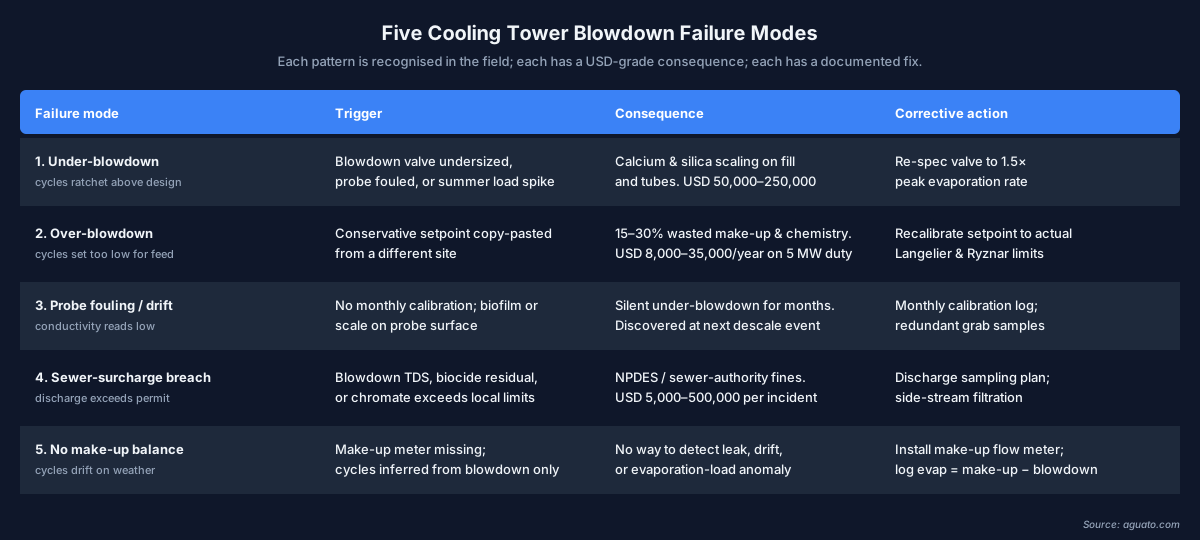
1. Under-blowdown. Cycles ratchet above design, usually because the blowdown valve was undersized at commissioning, the conductivity probe is fouled, or summer load spiked evaporation beyond what the valve can match. Calcium and silica scale on fill, basin sumps, and (worst) chiller condenser tubes. A 5 MW tower with a 6-month run at 6 cycles instead of the design 4 cycles has typically deposited enough hardness scale on the chiller barrel to drop chiller COP by 8 to 15%. Cost: USD 50,000 to 250,000 in restoration descale plus 2 to 6 weeks of capacity-reduced operation. Corrective action: re-spec the blowdown valve to 1.5× peak evaporation rate so it can keep up under summer load.
2. Over-blowdown. Cycles set too low for the actual feed water, usually because a conservative setpoint was copy-pasted from a different site with worse feed quality, or because no one updated the setpoint after a softener was installed. 15 to 30% wasted make-up water and chemistry. On a 5 MW duty in a region with USD 2.50/m³ water and USD 8,000/year chemistry budget, the annual cost of running at 3 cycles when 5 cycles is correct is USD 8,000 to 35,000. Corrective action: recalculate the cycles ceiling against actual feed water Langelier and Ryznar indices and update the setpoint on a documented basis.
3. Probe fouling and drift. A conductivity probe coated in biofilm, scale, or copper oxide reads low. The controller thinks the basin is below setpoint and stops blowing down. Cycles silently rise; scaling proceeds undetected for months. The mistake usually surfaces at the next chiller cleaning when scale thickness on tubes exceeds expectations. Corrective action: monthly calibration log against a portable reference meter; redundant grab-sample analysis quarterly; physical probe cleaning at every site visit.
4. Sewer-surcharge breach. Blowdown TDS, biocide residual, or chromate corrosion inhibitor exceeds local permit limits. Sewer-authority or NPDES fines ranging from USD 5,000 for a notice-of-violation to USD 500,000+ for repeat or willful breaches. The fix is downstream of the tower: side-stream filtration to drop TSS, dechlorination injection on the discharge line for free chlorine, or substituting a non-regulated corrosion inhibitor for chromate-containing legacy products. Corrective action: a documented discharge sampling plan that matches the permit's parameter list and frequency, with corrective steps pre-defined for each parameter.
5. No make-up balance. Site has a blowdown meter but no make-up flow meter. Cycles get inferred from blowdown alone and the calculation breaks the moment evaporation load shifts. Drift, leak, or anomaly is invisible until something downstream visibly fails. Corrective action: install a make-up flow meter; log evaporation as (make-up − blowdown − drift); compare against weather and load to detect anomalies in real time.
## Sampling, calibration, and the audit trail
Blowdown control fails silently. The conductivity probe drifts low; the controller obeys; cycles climb; scale forms; nothing alarms. The first visible failure is usually a chiller efficiency report six months later.
The defence against silent failure is sampling discipline:
- Daily, log conductivity from the controller display and the basin grab sample. Discrepancy >5% triggers probe inspection. - Weekly, log make-up flow, blowdown flow, and calculated cycles. Compare against expected cycles at current setpoint. Drift >10% triggers root-cause investigation. - Monthly, calibrate the conductivity probe against a portable reference meter at two points (low and high range). Document the calibration curve. Replace the probe if it cannot hold calibration. - Quarterly, full basin chemistry panel: pH, conductivity, calcium hardness, total alkalinity, chloride, sulphate, silica, ORP, biocide residual. Cross-reference against the chemistry programme's design assumptions. Update setpoint if feed-water characteristics have shifted. - Annually, full discharge sampling against permit parameter list. Confirm compliance margin.
The sampling discipline is the audit trail. In any compliance breach investigation, sewer authority, EPA, HSE, the first question is "show me the records." A site that can produce a 12-month log of daily conductivity, weekly make-up flow, monthly calibration, and quarterly chemistry panel is in a fundamentally different position from a site that hands over a manila folder of sticky notes. The cost of running the discipline is roughly USD 2,000 to 4,000/year in operator time on a 5 MW duty. The cost of not running it, when something goes wrong, can be six figures plus a regulator on site for a month.
## Decision framework: where should your blowdown setpoint be?
Run the cooling tower duty through this sequence to land the right blowdown setpoint:
1. Characterise the make-up feed water. Get a current lab analysis: total hardness, calcium, magnesium, alkalinity, silica, chlorides, sulphate, conductivity, pH. Without this, no defensible decision is possible. 2. Calculate the cycles ceiling on the chemistry side. Using LSI, RSI, and silica saturation, find the highest cycles the chemistry programme can hold without exceeding scale-formation thresholds. Add a 0.5 to 1.0 cycle safety margin. 3. Calculate the cycles ceiling on the discharge side. Using the discharge permit limits, calculate the maximum basin concentration that produces a compliant discharge for each regulated parameter. Convert to cycles. Add a 10 to 20% margin. 4. Take the lower of the two ceilings. This is your operating cycles target. Convert to a conductivity setpoint using the make-up feed-water conductivity × cycles target. 5. Choose the control method. Conductivity-based controller is the default for any duty above 200 kW. Predictive control becomes economic above 1 MW or where water cost exceeds USD 2/m³. 6. Specify the audit trail. Daily log, weekly cycles calculation, monthly probe calibration, quarterly basin chemistry panel, annual discharge sampling.
Run this through Nepti's water-decision model, Nepti characterises the duty, the local feed water, the regulatory environment, and the chemistry programme, then produces a ranked configuration with cycles target, control-method recommendation, and a 15-year OPEX projection. Sites running this model before tendering save 6 to 14% on chemistry and water OPEX, almost entirely by avoiding the over-conservative setpoints and the under-instrumented control methods that get specified by default.
The decision framework above produces a setpoint, a control method, and an audit trail. What it does not produce is the one number that survives a five-minute conversation with a CFO who has not read the article. That number is the dollar gap between the OPEX waste at the wrong setpoint and the downtime exposure if the right setpoint is missed in the other direction, and it is the case that gets made or lost in the budget review.
## FAQ
### What is cooling tower blowdown in plain English?
It is the controlled discharge of a small portion of recirculating cooling tower water to drain. The purpose is to remove dissolved solids that have concentrated as water evaporated, so that the basin chemistry stays below the threshold where minerals would precipitate as scale on heat-exchanger tubes and tower fill. Without blowdown, every wet cooling tower would silently destroy itself within months of commissioning.
### How many cycles of concentration is correct?
Most industrial cooling towers operate at 4 to 6 cycles on standard municipal feed water. The exact number depends on feed-water hardness, silica, chloride, and the discharge permit. Sites with softened make-up can run at 6 to 8 cycles; sites with very hard or high-silica feed water are typically capped at 3 to 4 cycles. The right answer is feed-water-specific, there is no single industry default, despite vendor recommendations that often default to 4 cycles regardless of context.
### What is the difference between blowdown and bleed-off?
The terms are used interchangeably in industry. "Bleed-off" is more common in HVAC contexts and smaller commercial systems; "blowdown" is more common in heavy industrial and power-generation systems. Functionally identical, controlled discharge of recirculating water to drain at a setpoint determined by conductivity or cycles of concentration.
### How is blowdown rate calculated?
Blowdown rate (m³/hr) = Evaporation rate / (Cycles − 1), with drift typically <0.002% of recirculating flow added back into the make-up calculation. For a 5 MW duty with 8.5 m³/hr evaporation running at 5 cycles, the theoretical blowdown rate is 8.5 / 4 = 2.13 m³/hr, plus drift, plus any deliberate over-blowdown to manage chemistry below the calculated maximum.
### Can I reduce blowdown by softening the make-up water?
Yes, often. Softening removes calcium and magnesium hardness from the make-up stream, which raises the cycles ceiling on the chemistry side. Sites that move from 4 cycles to 7 cycles after softening typically cut blowdown by 50 to 60%. The trade is the softener regenerant cost (sodium chloride or potassium chloride) plus the OPEX of running the softener. Run the math at local water and salt prices before specifying.
### Is cooling tower blowdown regulated as wastewater?
Yes, in every major jurisdiction. In the US it is regulated under [EPA effluent guidelines and the NPDES permitting framework](dofollow:https://www.epa.gov/eg/learn-about-effluent-guidelines); in the EU under the Industrial Emissions Directive BREF for cooling systems and national environmental-agency rules; in the UK under Environmental Permitting Regulations and water-company trade-effluent consents. Blowdown TDS, biocide residual, free chlorine, pH, temperature, and heavy metals are typical regulated parameters. Compliance is the operator's responsibility and the audit trail starts with sampling records.
### How often should the conductivity probe be calibrated?
Monthly is standard practice for industrial duty. The probe is the input to the controller; if it drifts, the controller operates the blowdown valve at the wrong setpoint and the system silently scales or wastes water. Monthly calibration against a portable reference meter at two points (low and high range), plus quarterly physical cleaning, is the discipline that keeps a conductivity-based control system honest over a 10 to 15-year service life.
### What is "zero liquid discharge" in cooling tower context?
Zero liquid discharge (ZLD) is a configuration where blowdown is treated and recovered on site rather than discharged. The blowdown stream goes through a brine concentrator and crystalliser, producing distilled water that returns to make-up and a solid salt residue for off-site disposal. ZLD is correct where discharge permits are unavailable, where freshwater is severely cost-constrained, or where the discharge perimeter is regulated to a level that conventional blowdown cannot meet. CAPEX is high (USD 1.5 to 8M for a typical industrial duty); OPEX is dominated by the energy required to drive evaporation. The decision is feed-water- and permit-specific.