Ion exchange removes dissolved ions from water with near-perfect selectivity, achieving conductivities below 0.1 microsiemens per centimetre that RO alone cannot reach. But at feed TDS above 500 mg/L, the regenerant cost makes it uneconomic without pre-treatment. The complete guide to sizing, configuration, and the RO versus IX versus hybrid decision.
Ion exchange is the technology that gets specified when RO is not enough. That framing is too narrow, but it captures the core use case: there are water quality specifications, particularly for boiler make-up water, pharmaceutical water for injection, and semiconductor ultrapure water, that RO produces at the wrong quality or with unacceptable variability, and that ion exchange reliably achieves. There are also feed water chemistries, particularly low-TDS source waters with problematic specific ion concentrations, where IX is cheaper to operate than RO over the plant's life.
Ion exchange is not a single technology. It is a family of processes that share the principle of reversibly exchanging ions between a solid resin phase and a liquid phase. Water softening, deionisation, demineralisation, nitrate removal, hardness reduction, and selective contaminant removal are all ion exchange applications, each with different resin types, regeneration chemistry, vessel configurations, and operating logic. Understanding which variant applies to a given application is the core engineering decision.
This guide covers how ion exchange works at the process level, the resin types and their selection, the system configurations from single-bed softening to mixed-bed UPW polishing, how to size and specify an IX system, the regenerant chemistry and its cost implications, and where the IX versus RO decision should fall for common industrial applications.
## The decision in brief
- Lead with the cost of missing water quality, not resin chemistry. In power generation, a single boiler scale-up event caused by demineralised water specification failure can mean 3 to 6 weeks of outage for tube replacement, with lost generation revenue of hundreds of thousands of euros per week for a mid-sized thermal plant. - Compare the annual budget with one outage. The annual operating cost of a robust IX demineralisation system is typically 150,000 to 500,000 euros for a medium industrial facility. One boiler outage attributable to water quality failure exceeds that annual budget many times over. - Treat the pharmaceutical mixed bed as quality risk control. An out-of-specification WFI batch costs the batch, the investigation, the retest programme, in some cases the regulator notification, and the reputational consequence under GMP scrutiny. The IX system's value is measured in batch invalidation events avoided.
If the cost, probability and consequence of a water quality failure event exceed the amortised capital cost of a robust IX system, the business case closes itself.
[Browse water purification specialists on Aguato](/water-purification-companies) who have experience with pharmaceutical and power sector IX applications. Use [Aguato's Nepti tool](/nepti) to model your feed water TDS and ion profile against the IX sizing and operating cost before talking to vendors.
## What ion exchange is and how it works
An ion exchange resin is a cross-linked polymer matrix with ionic functional groups that have an affinity for specific ions in solution. In its loaded (spent) form, the functional groups are occupied by the exchanged ions. In its regenerated (service) form, the functional groups carry the regenerant ion, either hydrogen (H+) for cation resins or hydroxide (OH-) for anion resins.
When water passes through the resin bed, dissolved ions in the water exchange with the regenerant ions on the resin. In a hydrogen-form cation resin, all dissolved cations (Ca2+, Mg2+, Na+, K+) exchange with H+. The water leaving the cation vessel has lost its cations and gained H+ ions in exchange, making it acidic. In a hydroxide-form anion resin, all dissolved anions (Cl-, SO42-, NO3-, HCO3-, SiO2) exchange with OH-. The water leaving the anion vessel has lost its anions and gained OH- ions in exchange. Combining the two, H+ and OH- combine to form water: the result is demineralised or deionised water with TDS well below 1 mg/L.
The selectivity of ion exchange is one of its most valuable properties. Resins can be formulated to prefer specific ions over others, enabling selective removal of problematic contaminants (nitrate, arsenic, perchlorate) from a background of less problematic ions. This selectivity is something RO cannot easily achieve. RO removes all dissolved solids proportionally. IX removes specific ions preferentially.
The regeneration step reverses the exchange: a concentrated solution of the regenerant ion (H2SO4 or HCl for cation regeneration, NaOH for anion regeneration) is passed through the spent resin, displacing the absorbed ions into the regenerant waste and restoring the resin's exchange capacity. The regenerant waste contains all the ions that were removed from the water plus excess regenerant, and must be treated and disposed of.
## Resin types
The four primary IX resin categories each serve different treatment objectives:
Strong acid cation (SAC) resin in hydrogen form removes all dissolved cations including Ca, Mg, Na, K, Fe, Mn. In [sodium](/elements/sodium) form (softening), it removes only hardness cations (Ca2+, Mg2+) by exchanging them for Na+. SAC resin operates across the full pH range and is the workhorse of industrial water treatment. Sulfonated polystyrene divinylbenzene (PS-DVB) is the dominant matrix. Regeneration uses sulphuric acid (H2SO4) or hydrochloric acid (HCl).
Weak acid cation (WAC) resin in hydrogen form removes only hardness cations associated with bicarbonate alkalinity. It has much higher regeneration efficiency than SAC (nearly stoichiometric, versus 150 to 300% excess for SAC), making it economically attractive when only alkalinity-associated hardness needs to be removed. WAC resin cannot remove sodium or potassium from water because these cations are not bound in bicarbonate form. It is commonly used in the first stage of two-stage demineralisation to reduce the load on the SAC column.
Strong base anion (SBA) resin in hydroxide form removes all anions including Cl-, SO42-, NO3-, SiO2, CO2. Silica removal is critical for high-pressure boiler make-up water because silica carryover to steam turbine blades causes blade erosion. SBA resins are classified as Type I (trimethylamine quaternary ammonium groups, better silica removal, lower capacity) and Type II (dimethylethanolamine quaternary groups, higher capacity, poorer silica at high temperature). Regeneration uses sodium hydroxide (NaOH). Temperature affects NaOH regeneration efficiency significantly: warm NaOH (40 to 45 degrees Celsius) improves silica removal from resin compared to ambient temperature.
Weak base anion (WBA) resin removes only strong acid anions (Cl-, SO42-, NO3-) and cannot remove CO2 or SiO2. It is substantially cheaper to operate than SBA because NaOH regeneration is more efficient. WBA is used in the first stage of a two-stage anion system to remove the bulk of strong acid anions, leaving only CO2 and SiO2 for the SBA polisher.
## System configurations
The three main IX system configurations represent increasing water quality targets and increasing complexity.
Softening (sodium cycle): A single vessel of SAC resin in sodium form softens water by exchanging Ca2+ and Mg2+ for Na+. The product has zero hardness but unchanged TDS, conductivity, and alkalinity. Regeneration uses sodium chloride (common salt, NaCl) brine. This is the most common industrial IX application: boiler pre-treatment at moderate pressures, cooling tower make-up, laundry, food processing. Investment is low, regeneration is cheap, and the chemistry is well-understood.
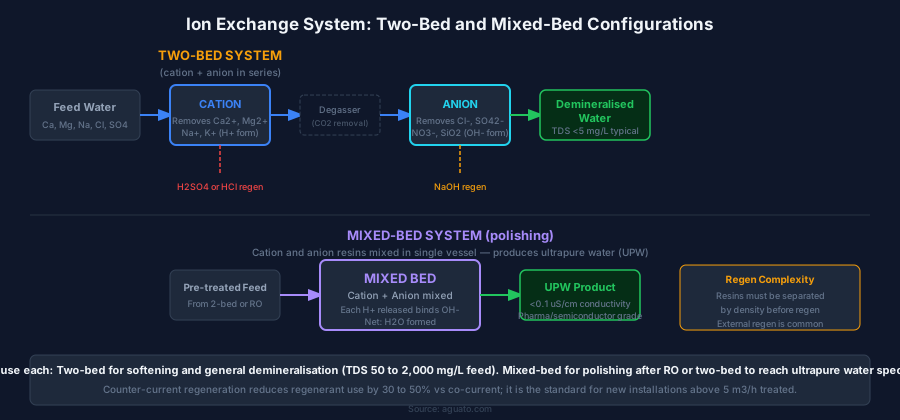
Two-bed deionisation (SAC-SBA): Acid-form SAC followed by hydroxide-form SBA produces demineralised water at TDS below 5 mg/L and conductivity below 2 microsiemens per centimetre. A degasser between the cation and anion vessels removes CO2 from the acidified cation effluent, reducing the load on the anion resin and improving run time. This configuration suits high-pressure boiler make-up (up to approximately 130 bar steam pressure), pharmaceutical purified water (PW) applications, and industrial process water.
Mixed-bed deionisation (UPW polishing): A single vessel containing an intimate mixture of SAC (H+ form) and SBA (OH- form) resins achieves conductivities below 0.1 microsiemens per centimetre and resistivities above 10 megohm-centimetres. Each H+ released by the cation resin immediately combines with the adjacent OH- released by the anion resin, forming water in situ. Mixed-bed IX produces the highest quality water achievable by any pressure-driven process, which is why it is the final polishing stage in semiconductor UPW systems and pharmaceutical WFI (water for injection) production. Regeneration is complex: resins must be hydraulically separated by density before individual acid and caustic regeneration, then remixed. External regeneration at a specialist service centre is standard for many pharmaceutical mixed-bed applications.
The process diagrams below show both configurations.
## Ion exchange vs RO: the decision framework
This is the question that most engineers get wrong because they apply the answer from their last project rather than evaluating the specific feed and product water chemistry.
IX wins when: Feed TDS is below approximately 200 to 500 mg/L and the target is near-zero TDS. Regenerant disposal is cheap (soft water area, no sodium discharge limits). Specific ion removal (nitrate, arsenic, silica, boron) is the primary objective. UPW quality is required and mixed-bed polishing will follow RO in any case, so might as well go full IX from lower TDS feed.
RO wins when: Feed TDS is above 500 mg/L, making IX regenerant cost uneconomic. The product water specification is for general process water, not UPW. The waste stream must be minimised (RO concentrate is simpler to handle than IX regenerant waste in many jurisdictions). The site has good energy supply but poor acid/caustic logistics.
Hybrid RO + IX wins when: The target is UPW or WFI from a moderate to high-TDS source. RO removes 95 to 99% of TDS, passing low-TDS permeate to a mixed-bed polisher that reaches UPW specification with minimal regeneration frequency. This is the dominant configuration in semiconductor fabs, power generation, and pharmaceutical facilities globally.
The comparison diagram below quantifies the decision factors.
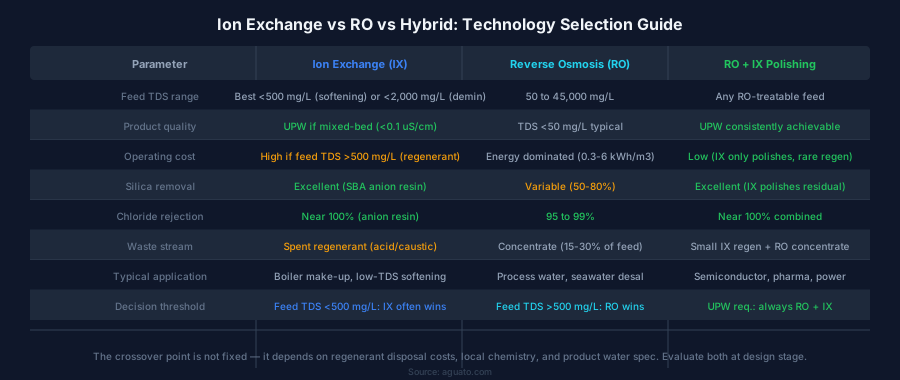
The decision threshold is not a fixed TDS number. It depends on: the local cost of regenerant chemicals (H2SO4 and NaOH), the disposal cost of spent regenerant (which contains strong acid/caustic and all the stripped ions), the local cost of electricity for RO pumping, and the target product water quality. In regions with cheap electricity and expensive acid/caustic disposal, RO wins at lower TDS than in regions with the reverse cost structure. [Browse RO system specialists on Aguato](/reverse-osmosis-companies) to get comparative quotes for your specific feed chemistry.
## System sizing
IX system sizing requires three inputs: the feed water analysis (all cation and anion concentrations), the design flow rate, and the required run time between regenerations.
Ion load calculation: The total cation load in equivalents per hour is the product of flow rate times the sum of all cation concentrations expressed in milliequivalents per litre (meq/L). For calcium at 100 mg/L, the meq/L is 100/20 = 5 meq/L (molecular weight 40 divided by valence 2). Total anion load is calculated equivalently for all anions. This is the quantity the resin must exchange per hour of operation.
Bed volume and run time: The operating exchange capacity of a commercial SAC resin in hydrogen form is typically 1.5 to 1.8 equivalent kilograms per litre of resin (Eq/L) under standard regeneration. Dividing the run time (hours between regenerations) by the exchange capacity and the ion load gives the required resin volume. In practice, systems are sized for 8 to 24 hours between regenerations. Very short run times mean high regenerant consumption and operating cost. Very long run times mean large vessels and high capital cost.
Service velocity and bed depth: The standard service velocity for IX resin is 5 to 40 bed volumes per hour (BV/h), with 10 to 20 BV/h typical for demineralisation applications. Bed depth should be at least 1 metre and ideally 1.5 to 2 metres for adequate contact time and buffer against channelling.
According to [AWWA guidance on ion exchange for water treatment](dofollow:https://www.awwa.org), undersized IX systems with bed depths below 0.8 metres and service velocities above 40 BV/h consistently show early breakthrough, where treated water quality deteriorates before nominal run time has elapsed, leading to more frequent regeneration and higher operating cost than the design predicted.
[Use the Aguato Nepti tool](/nepti) to model your feed water analysis against IX sizing calculations before engaging vendors. Understanding the design basis before the first vendor conversation avoids the situation where each vendor sizes to a different set of assumptions and the comparison is not apples-to-apples.
## Regeneration chemistry: co-current vs counter-current
Co-current regeneration passes the regenerant solution in the same direction as service flow: down through the resin bed. This is simpler to implement and lower in capital cost, but less efficient in regenerant use. The leading end of the resin bed (where feed water enters first) sees fresh regenerant and is well-regenerated. The trailing end sees diluted regenerant after it has passed through the well-exhausted upper portion, and is less well-regenerated. The result is that the treated water quality starts high and declines toward the end of the run, as the poorly regenerated lower portion is first to break through.
Counter-current regeneration passes regenerant in the opposite direction to service flow: up through the resin bed. The leading end of the resin bed (top in downflow service) sees the most dilute regenerant (exhausted at the bottom, regenerant enters at bottom and exits at top), which is actually well-positioned because the top of the bed is least exhausted in service. The trailing end sees the freshest regenerant, and the bottom of the bed, which sees feed water last and exhausts last, is the most thoroughly regenerated. Counter-current systems produce consistently higher product water quality throughout the run, and achieve 30 to 50% lower regenerant chemical consumption for the same operating capacity. The capital cost is 15 to 25% higher due to the more complex vessel internals required. Counter-current regeneration is the standard specification for any new industrial IX installation above 5 m3/h.
## Industrial applications: power, pharma, food and beverage
Power generation: High-pressure power station boilers (above 40 bar steam pressure) require demineralised make-up water to prevent scaling, foaming, and turbine blade erosion. The specification is typically TDS below 0.5 mg/L and silica below 0.01 mg/L. RO produces water at TDS of 5 to 20 mg/L from typical river water, insufficient for high-pressure boiler make-up without IX polishing. The dominant configuration is SAC degasser SBA mixed-bed, or for the highest pressure applications RO plus mixed-bed. The [boiler water treatment guide](/resources/boiler-water-treatment) covers the downstream chemistry programme needed once demineralised water is produced.
Pharmaceutical: The USP and Ph.Eur. monographs for Purified Water (PW) specify conductivity below 1.3 microsiemens per centimetre at 25 degrees Celsius and TOC below 500 parts per billion. Water for Injection (WFI) requires the same conductivity and a bacterial endotoxin limit. RO alone typically achieves PW specification from clean source water. WFI by membrane was accepted by the EU pharmacopoeia in 2017, enabling RO plus UF plus mixed-bed to replace distillation. The [pharmaceutical water treatment guide](/resources/pharmaceutical-water-treatment-usp) covers the full PW and WFI system design in detail.
Food and beverage: Process water for beverage production must meet both microbiological and chemical specifications. IX softening removes hardness that causes scaling in heat exchangers and pasteurisers. Selective nitrate removal via anion exchange is used in regions where source water nitrate exceeds 50 mg/L NO3 (the EU limit). Ion exchange does not produce a sterile water stream, and microbiological control requires UV or chlorination in addition to IX.
Semiconductor / microelectronics: Ultrapure water for wafer rinsing in semiconductor fabrication requires resistivity above 18 megohm-centimetres, TOC below 1 part per billion, particle counts in the parts per trillion range, and dissolved oxygen near zero. This specification is achieved by a treatment train of RO, UV, mixed-bed IX, ultrafiltration, and dissolved gas removal, with the mixed-bed polishing as the final quality step. [Post your water treatment project on Aguato](/post-project) to compare specialist proposals from vendors experienced in semiconductor UPW systems.
## Operational costs: regenerant chemicals and waste disposal
The operating cost of an IX system is dominated by three elements: regenerant chemical cost, regenerant waste disposal cost, and resin replacement cost.
Regenerant chemical cost for a SAC-SBA two-bed system treating 100 m3/h of 200 mg/L TDS feed water is typically 0.05 to 0.20 euros per m3 treated, depending on the local price of H2SO4 and NaOH. Counter-current regeneration reduces this by 30 to 50% versus co-current. At 300 mg/L TDS feed, regenerant cost rises to 0.10 to 0.35 euros per m3. At 600 mg/L TDS, regenerant cost at 0.25 to 0.70 euros per m3 starts to approach or exceed RO operating cost at the same flow rate. This is the economic crossover point that drives the IX versus RO decision for moderate TDS feeds.
Regenerant waste disposal is a significant cost that is often underestimated. Spent SAC regenerant contains 5 to 8% H2SO4 plus all the stripped cations (calcium, magnesium, sodium at concentration multiples of the feed). Spent SBA regenerant contains 1 to 4% NaOH plus all stripped anions. These streams must be neutralised before discharge to sewer, and in many jurisdictions the total dissolved solids load must be within the trade effluent consent limit. Sites with restricted sewer discharge or high disposal cost should include this in the IX versus RO cost comparison.
Resin replacement cost: Well-maintained SAC resin lasts 10 to 20 years. SBA resin, particularly Type I SBA, degrades more quickly through organic fouling and oxidative degradation, and may need replacement or reactivation every 5 to 10 years. Resin replacement cost is a step-change capital event that should be provisioned for in the operational budget from commissioning.
## Where ion exchange systems underperform
Wrong resin type specified for the application: Using SAC sodium-form softening when the application needs deionisation, or specifying Type I SBA for a system that will see high organic loading, are the most common specification errors. Each error degrades performance and increases operating cost in ways that can only be fixed by resin replacement.
Feed water not analysed adequately before design: IX systems are sensitive to feed water components that RO often tolerates better. [Iron](/elements/iron) above 0.1 mg/L fouls SAC resin by precipitating as iron hydroxide in the resin bed. Manganese causes similar fouling. Organic matter in the feed, particularly humic substances, fouls SBA resin preferentially, reducing run time and product quality over time. Pre-treatment to remove iron, manganese, and organics before the IX system is not optional on feedwaters with significant concentrations of these components.
Regenerant concentration not optimised: Using excess regenerant does not improve resin capacity; it increases chemical cost and waste load. Using insufficient regenerant causes premature breakthrough in the next service run. The regenerant dose should be calculated from the resin manufacturer's guidelines for the specific ion load, and adjusted based on effluent quality monitoring over the first 6 to 12 months of operation.
Channelling in the resin bed: If resin beads fracture due to osmotic shock (rapid change between concentrated regenerant and dilute service water) or physical damage, channels form through the bed that allow untreated water to pass without contact with resin. Channelling is detected by a sudden drop in run time and treated water quality that is not explained by feed water changes. Prevention requires proper resin loading (no voids), appropriate backwash to classify and settle the bed, and controlled regenerant concentration to avoid osmotic shock.
[Browse industrial water treatment specialists on Aguato](/industrial-water-treatment-companies) who have experience commissioning IX systems in your industry. [Post your project on Aguato](/post-project) to compare proposals on the specific resin configuration and regeneration chemistry that suits your feed water and product specification.
## FAQ
### What is the difference between water softening and deionisation by ion exchange?
Water softening uses IX resin in sodium form to exchange calcium and magnesium ions for sodium. The result is zero-hardness water, but TDS, conductivity, and alkalinity are largely unchanged. Deionisation uses IX resin in hydrogen form (cation) and hydroxide form (anion) to remove all dissolved cations and anions, producing water with near-zero TDS. Softening is appropriate for scale prevention. Deionisation is required for boiler make-up, pharmaceutical water, and UPW applications where TDS must be near zero.
### At what feed TDS does RO become more economic than ion exchange?
The crossover depends on local regenerant chemical and disposal costs, but as a general guideline: IX is competitive with RO for feed TDS below approximately 200 to 300 mg/L in regions with cheap acid and caustic and inexpensive waste disposal. Between 300 and 600 mg/L, the economics overlap and site-specific evaluation is needed. Above 600 mg/L, RO pre-treatment ahead of a small IX polishing stage is almost always more economical than standalone IX.
### What causes IX resin to degrade and how long does it last?
SAC resin degrades primarily through osmotic cracking (pressure cycling stress on resin beads), oxidative attack from free chlorine (chlorine must be removed before IX systems), and iron fouling from precipitation within the bed. Well-maintained SAC resin lasts 10 to 20 years. SBA resin degrades primarily through organic fouling (humic substances accumulate on anion resin and are not removed by standard NaOH regeneration) and through hydrolysis of the quaternary ammonium groups at elevated temperature. Type I SBA lasts 5 to 15 years depending on feed water organic content.
### Can IX be used without pre-treatment?
For low-TDS, clean source waters (municipal water supply, low-iron groundwater), IX can operate without extensive pre-treatment. For surface water or industrial feeds with suspended solids, organics, iron, or manganese, pre-treatment is required. Iron fouling, in particular, is irreversible above certain concentrations and can destroy a resin bed in months. The minimum pre-treatment for surface water feeds is typically coagulation/filtration to remove suspended solids and iron.
### How is regeneration waste from IX systems disposed of?
Spent SAC regenerant is an acidic brine containing 3 to 8% H2SO4 (or HCl) plus the stripped cations at concentrations 10 to 50 times the feed water. Spent SBA regenerant is an alkaline brine with 1 to 4% NaOH plus stripped anions. The two streams are typically combined in a neutralisation tank, brought to pH 6 to 9, and discharged to sewer under a trade effluent consent. In areas with TDS or chloride discharge limits, the neutralised waste may need further treatment or off-site disposal. Some large IX users blend spent regenerant into a ZLD system to avoid any liquid discharge.
### What is counter-current regeneration and why does it matter?
Counter-current regeneration passes the regenerant through the resin bed in the opposite direction to service flow. This ensures the freshest regenerant contacts the portion of the bed that sees the cleanest water last in service, producing a higher-quality leading edge to the treated water and reducing regenerant chemical consumption by 30 to 50% compared to co-current designs. Counter-current systems cost 15 to 25% more in capital but almost always pay back the premium within 2 to 3 years through reduced chemical and waste disposal costs.