Over-specify a pharmaceutical water grade and you double the capital cost; under-design the loop and a microbial excursion quarantines product at $500K to $5M. Here is how to set USP grade, train, and validation defensibly.
Pharmaceutical water is the only utility on a drug-manufacturing site that is also a raw material, a finished-product ingredient, and a regulated quality attribute at the same time. Specify the wrong grade or the wrong distribution design for a pharmaceutical water system, and the cost is rarely the equipment, it is the USD 500,000 to 5 million you lose when a regulator finds a microbial excursion in a Water for Injection loop and quarantines every batch made since the last clean result. The water itself costs USD 0.50 to 4.50 per cubic metre to produce. The consequence of producing it wrong is measured in recalled lots, FDA Form 483 observations, and the slow erosion of a site's inspection record.
This guide is written for the people who actually carry the risk on a pharmaceutical water project: validation managers signing off on Installation and Operational Qualification, procurement leads scoping a USP Purified Water or WFI system against three vendor proposals, quality directors who will defend the design in an audit, and capital project sponsors deciding whether to distil or to use membrane-based generation. It covers the USP water grades and what each one legally requires, the treatment trains that hit those specifications reliably, the validation framework that turns a compliant design into a compliant facility, the failure modes that produce six-figure deviations, and what the numbers actually look like across the common system sizes.
## The decision in brief
- Set the water grade from a documented, product-driven risk assessment. Together with a distribution loop designed for genuine dead-leg-free turbulent recirculation from day one, this avoids the two most expensive failure modes in pharmaceutical water: a USD 500K to 3M microbial excursion that quarantines product, and a USD 1M-plus over-specification penalty that compounds across the facility's 20-year life. - Design the distribution loop for dead-leg-free turbulent recirculation from day one. Value-engineering the loop to save a few percent of capital looks prudent on the day and becomes the most expensive line on a quality investigation two years later. - The water itself is cheap. It costs USD 0.50 to 4.50 per cubic metre. Budget the validation as a critical-path activity and the water system stops being the thing that delays your facility's first commercial batch.
The cost of doing nothing is letting a vendor specify WFI where Purified Water suffices, or value-engineering the distribution loop, because both decisions look prudent on the day and become the most expensive line on a quality investigation two years later.
## What pharmaceutical water actually is, and why it is regulated as a material
In most industries, water is a utility you buy by the cubic metre and forget about. In pharmaceutical manufacturing, water is the most-used raw material in the building, often accounting for 70% or more of the volume in a finished liquid product, and it is regulated as a material with a compendial monograph, a specification, a release test, and a quality history. The United States Pharmacopeia (USP), the European Pharmacopoeia (Ph. Eur.), and the Japanese Pharmacopoeia each publish water monographs that define exactly what conductivity, total [organic carbon](/elements/carbon) (TOC), microbial count, and (for WFI) endotoxin level a given grade must meet before it can touch product.
The reason this matters commercially is that the water system is not a side utility you can value-engineer at the end of the project. It is on the critical path for the entire facility's validation, and a water system that is not qualified blocks every downstream process that depends on it. A pharmaceutical company cannot release a single commercial batch until its water system has passed a multi-phase qualification protocol, which on a new site can take 12 months from mechanical completion. That timeline is the real cost driver. A water system delay does not cost you the price of the equipment, it costs you the gross margin on every batch you cannot make while the system is still in qualification.
An opinionated view that survives every project: the most expensive pharmaceutical water mistake is over-specifying the grade. Teams default to WFI because it sounds safer, when USP Purified Water would satisfy the product requirement at a fraction of the capital, validation, and operating cost. Specifying WFI where Purified Water suffices can double the system capital cost and add 30 to 50% to the annual operating cost for the entire life of the facility, with no quality benefit whatsoever. The grade should be driven by the product monograph and the route of administration, not by an abundance of caution that nobody ever quantified.
[cta:nepti-dark]
The discipline that prevents this error is to start from the product, not from the water. A solid-dose tablet line and a sterile injectable line have radically different water requirements, and conflating them is how a project ends up paying for a distillation plant the product never needed. The next section lays out the grades so the requirement can be set defensibly.
## USP water grades: PW, HPW, and WFI explained
There are three pharmaceutical water grades that matter for most manufacturing decisions, and the gap between them is both a quality gap and a cost gap. Understanding exactly what each grade requires is the foundation of every defensible water system specification, because the grade decision cascades into the treatment train, the distribution design, the sanitisation method, and the entire validation effort.
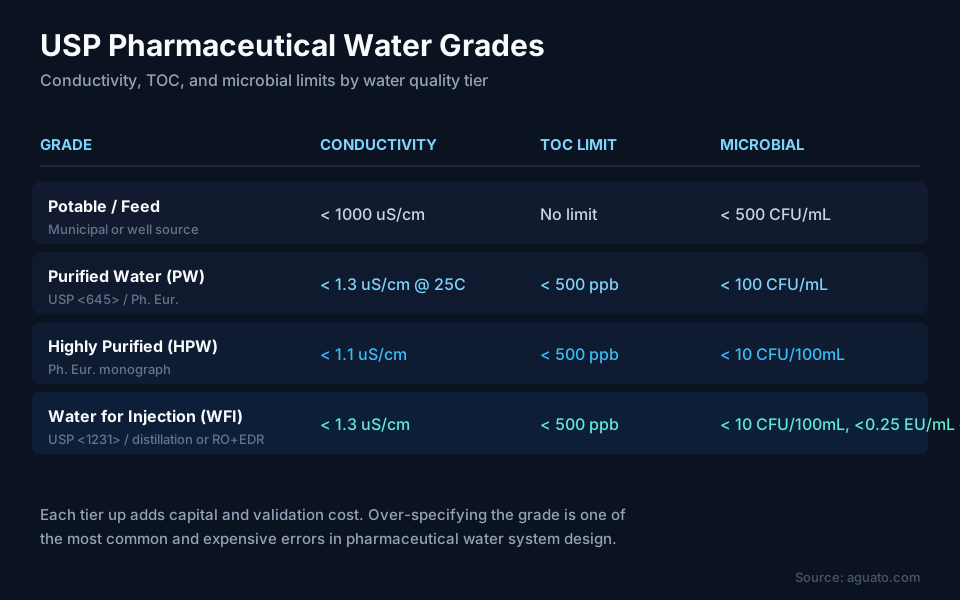
USP Purified Water (PW) is the workhorse grade for most non-sterile manufacturing. The monograph requires conductivity below roughly 1.3 microsiemens per centimetre at 25 Celsius (via the staged USP <645> test), TOC below 500 parts per billion, and a microbial action limit typically set at 100 colony-forming units per millilitre. Purified Water is used in oral solid dosage, topical products, and as the feed water to generate higher grades. It does not carry an endotoxin specification, which is the single biggest reason it is cheaper to produce and validate than WFI.
Highly Purified Water (HPW) is a Ph. Eur. grade (the USP does not have a separate HPW monograph) positioned between Purified Water and WFI. It meets the same chemical specification as WFI, including the endotoxin limit, but can be produced by methods other than distillation, such as a double-pass reverse osmosis train with ultrafiltration. HPW is used where WFI-equivalent quality is needed but the application does not strictly mandate WFI under the relevant regulation.
Water for Injection (WFI) is the highest routine grade and the one with the tightest specification. It meets the Purified Water chemical limits and adds a bacterial endotoxin limit of less than 0.25 endotoxin units per millilitre and a microbial action limit of less than 10 CFU per 100 millilitres. WFI is the water that goes into injectable, infusion, and other parenteral products, where pyrogens from bacterial endotoxin could cause a fever response or worse in a patient. For these applications, the [route of administration drives the standard the FDA expects under current Good Manufacturing Practice in 21 CFR 211](dofollow:https://www.accessdata.fda.gov/scripts/cdrh/cfdocs/cfcfr/cfrsearch.cfm?cfrpart=211), and the agency does not accept Purified Water for a sterile injectable.
The practical decision rule is this: if the product is non-sterile and taken orally or applied topically, USP Purified Water is almost always the correct grade. If the product is sterile and injected, WFI is mandatory. The grey zone, where HPW or a justified Purified Water specification is defensible, is narrow and should always be supported by a documented risk assessment, not a vendor's recommendation. Setting the grade correctly is the highest-leverage decision in the entire project.
## The treatment train for USP Purified Water
A USP Purified Water system is a sequence of unit operations, each removing a specific class of contaminant, arranged so that the polishing stages are protected from fouling by the pre-treatment stages. The dominant modern architecture is reverse osmosis followed by electrodeionization, and understanding why that combination won is the key to evaluating any vendor proposal.
Pre-treatment conditions the municipal or well feed so the membranes downstream survive. A multimedia or carbon filter removes suspended solids and chlorine (which destroys polyamide RO membranes), a water softener or antiscalant dosing system controls hardness scaling, and on hard feed water a degree of dechlorination is non-negotiable. Pre-treatment is cheap relative to the rest of the system, but skipping or under-sizing it is the single most common cause of premature membrane failure, which is why a defensible design always over-provisions here.
Reverse osmosis does the heavy lifting, rejecting 95 to 99% of dissolved salts, most organics, and effectively all microorganisms and endotoxin by size exclusion. A single RO pass typically takes municipal feed conductivity from several hundred microsiemens down to single digits. The reject stream carries the concentrated contaminants to drain, at a recovery rate of 70 to 85% depending on feed chemistry, and that reject volume is a real operating cost and increasingly an [industrial water reuse opportunity](/industrial-water-reuse-companies) that well-designed plants capture.
Electrodeionization (EDI) replaces the old mixed-bed ion exchange resin as the final polishing step on modern systems. EDI uses an electric field and ion-exchange membranes to continuously remove residual ions, producing water above 16 megohm-centimetre resistivity (well inside the Purified Water conductivity limit) without the regenerant chemicals that made ion exchange a hazardous-waste and compliance headache. The continuous, chemical-free operation of [electrodeionization systems](/resources/electrodeionization-edi) is the reason RO+EDI displaced RO+ion-exchange for new pharmaceutical builds. For the underlying water purification fundamentals, the [industrial water purification guide](/resources/industrial-water-purification) covers how these stages combine across applications.
Final conditioning maintains the water quality in the loop: ultraviolet units at 254 nanometres for microbial control and at 185 nanometres for TOC reduction, and ultrafiltration where additional endotoxin assurance is wanted. The output feeds a storage and distribution loop, which is where the system either holds its quality or loses it. To compare scoped designs from specialists who can defend each unit operation against your feed chemistry, [browse qualified water purification system suppliers](/water-purification-companies) rather than accepting a single vendor's standard package.
## Generating Water for Injection: distillation vs membrane
For decades, WFI could only be produced by distillation in most regulatory jurisdictions, because the phase change in a still provides a physical barrier that endotoxin cannot cross. That changed when the Ph. Eur. and later the major regulators accepted membrane-based WFI generation (reverse osmosis combined with ultrafiltration or other suitable techniques) provided the system is validated to consistently meet the WFI specification including endotoxin, an approach the [World Health Organisation good manufacturing practices for pharmaceutical water systems](dofollow:https://www.who.int/publications/i/item/WHO-TRS-1033) sets out in detail for inspectors and manufacturers alike. This opened a genuine capital-versus-operating-cost decision that did not exist before.
Distillation (multiple-effect stills or vapour-compression stills) remains the gold standard for endotoxin assurance because the phase change is inherently robust. The trade-off is energy: a multiple-effect still is one of the most energy-intensive pieces of equipment in a pharmaceutical plant, and the operating cost is dominated by steam and cooling. Distillation also produces hot WFI directly, which suits a hot distribution loop, and that integration can be an advantage on a sterile site where the loop runs hot anyway.
Membrane-based generation (typically double-pass RO plus ultrafiltration, sometimes with EDI) carries lower energy cost and lower capital cost, but a higher validation and monitoring burden because the endotoxin barrier is a membrane integrity question rather than a phase change. The system must demonstrate, through extensive qualification and ongoing monitoring, that it reliably holds the endotoxin specification. For sites with cheap thermal energy, distillation often still wins on lifecycle cost. For sites with expensive energy and a strong validation capability, membrane generation can be 20 to 40% cheaper to operate.
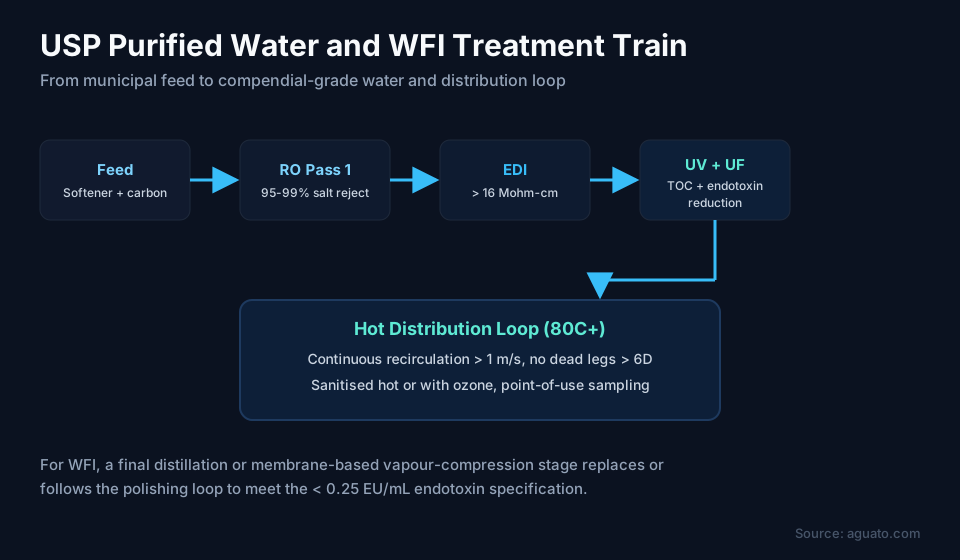
The decision rule that holds: if energy is cheap and the site lacks deep validation expertise, distil. If energy is expensive and the validation function is strong, membrane generation is worth the qualification effort. Either way, the endotoxin specification is the binding constraint, and the design must be proven against it across the full range of feed-water and load conditions, not just at the design point. This is also where a [Nepti decision intelligence platform](/resources/nepti-decision-intelligence-water-treatment) run pays for itself, by modelling lifecycle cost across distillation and membrane options before any vendor is engaged.
## Storage and distribution: where most systems actually fail
A perfectly designed generation system feeding a poorly designed distribution loop will fail its qualification, and distribution is where the majority of real-world pharmaceutical water excursions originate. The generation equipment makes compliant water for a moment. The distribution loop has to keep it compliant for years, against the relentless tendency of any stored water to grow a biofilm.
The core principle is continuous, turbulent recirculation. WFI and Purified Water are stored in a tank and circulated through a loop that returns to the tank, never sitting stagnant. The loop is designed for a Reynolds number that guarantees turbulent flow (typically a velocity above 1 metre per second), because laminar flow lets a boundary layer form on the pipe wall where bacteria colonise. Dead legs, sections of pipe with no flow, are the cardinal sin: any branch longer than six pipe diameters from the recirculating main creates a stagnant pocket where biofilm establishes, and that biofilm is the source of the microbial excursion that quarantines a batch.
Sanitisation strategy is the other half of the distribution design. Hot loops run continuously above 80 Celsius (WFI is often stored and distributed hot at 80 to 85 Celsius), which suppresses microbial growth thermodynamically and is the most robust approach. Cold or ambient loops require periodic sanitisation, either thermal (heating the loop above 80 Celsius on a schedule) or chemical (ozone, which is then destroyed by UV before the points of use). Ozonated cold loops have become popular for Purified Water because they cut the energy cost of a permanently hot loop while maintaining microbial control, but they add the complexity of ozone generation, monitoring, and destruction. The choice of [water disinfection approach](/water-disinfection-companies) for the loop is a lifecycle-cost decision that interacts with energy price and the product's temperature sensitivity.
The material of construction is non-negotiable: electropolished 316L stainless steel with sanitary fittings and a documented surface roughness specification, sloped to drain. The validation will examine weld quality, surface finish, and drainability, and a loop that cannot be fully drained for sanitisation is a loop that will eventually fail a microbial test. This is the layer where cutting cost is most tempting and most punishing, because the consequence shows up not at commissioning but six to eighteen months into operation as a creeping microbial trend.
## Validation, qualification, and the data integrity burden
A pharmaceutical water system is not finished when it is mechanically complete. It is finished when it is qualified, and qualification is a structured, documented, multi-phase exercise that is itself a major cost and schedule item. Underestimating the validation effort is one of the most common ways a water project blows its budget and timeline, because the validation cost is often invisible in the equipment quotation.
The qualification framework follows the standard pharmaceutical model: Design Qualification (the design meets the user requirements), Installation Qualification (it was installed as designed), Operational Qualification (it operates within specification across the operating range), and Performance Qualification (it consistently produces water meeting specification over time). For water systems specifically, Performance Qualification is split into three phases. Phase 1 runs intensive daily sampling of every point of use for two to four weeks to demonstrate the system can produce compliant water and to set operating parameters. Phase 2 continues daily sampling for a further two to four weeks to confirm consistency. Phase 3 extends sampling over a full year to capture seasonal feed-water variation. Commercial product cannot be released on the basis of Phase 1 and 2 alone in most interpretations, which is why the water system is on the critical path for the entire facility. The phased qualification expectation is laid out in the [FDA inspection guide for high purity water systems](dofollow:https://www.fda.gov/inspections-compliance-enforcement-and-criminal-investigations/inspection-guides/high-purity-water-systems-793), which remains the reference auditors apply when they examine a site's water data.
The data integrity burden is its own cost centre. Conductivity, TOC, and temperature are typically monitored continuously and recorded by a validated data system, and the microbial and endotoxin results from the sampling programme must be trended, investigated when out of trend, and defended in an audit. The cost of the validation documentation, the sampling programme, and the ongoing monitoring infrastructure routinely runs 20 to 40% of the total project cost on a WFI system, and it is the part most likely to be underestimated at the budgeting stage. Building the [industrial water quality testing](/resources/industrial-water-quality-testing) regime into the project from day one, rather than bolting it on at qualification, is what separates a project that finishes on time from one that drifts.
## Capital and operating cost ranges by system size
The table below gives realistic ranges across the system sizes most pharmaceutical projects encounter. Figures are indicative installed cost including pre-treatment, generation, storage, and a distribution loop, and exclude the facility's cleanroom and process integration scope. Operating cost is per cubic metre of compliant water produced.
| System | Grade | Typical capacity | Installed capex | OPEX per m3 | Main cost driver | |---|---|---|---|---|---| | Small lab / pilot | Purified Water | 0.5 to 2 m3/h | $150K to $500K | $0.80 to $2.00 | Validation overhead per m3 | | Mid solid-dose site | Purified Water | 2 to 8 m3/h | $400K to $1.2M | $0.50 to $1.20 | RO reject, membrane life | | Sterile / injectable | WFI (membrane) | 1 to 5 m3/h | $800K to $2.5M | $1.00 to $3.00 | Validation, UF integrity | | Sterile / injectable | WFI (distillation) | 1 to 6 m3/h | $1.2M to $4.0M | $1.50 to $4.50 | Steam and cooling energy | | Large multi-product | PW + WFI loops | 8 to 20 m3/h | $2.5M to $8M | $0.60 to $2.50 | Distribution loop, sanitisation |
The single most important thing the table shows is that the validation and distribution overhead, not the generation equipment, dominates the cost at small scale. A 1 cubic metre per hour WFI system costs nearly as much to validate as a 5 cubic metre per hour system, so the cost per cubic metre falls sharply with scale. This is why centralising water generation across a multi-product site usually beats installing separate small systems per product line, a decision that is best made before the facility layout is locked, when the [most efficient water treatment solution](/resources/most-efficient-water-solution) can still be designed in.
OPEX is dominated by energy on distillation systems and by membrane replacement plus reject water on membrane systems. The reject water from a double-pass RO WFI system can reach 30 to 40% of the feed, and on a water-stressed site that reject is both a cost and a sustainability liability that an [industrial water reuse and recycling](/resources/industrial-water-reuse-recycling) strategy can partially recover.
## Failure scenarios and what they cost
The microbial excursion in a WFI loop. A dead leg created during a maintenance modification (a capped branch left longer than six pipe diameters) seeds a biofilm. Over four months the microbial trend creeps up, then a routine sample exceeds the 10 CFU per 100 mL action limit. Quality must now investigate, and the investigation reaches back to the last in-specification result, potentially quarantining weeks of production. On an injectable line, the cost of quarantined and potentially scrapped batches plus the investigation and loop re-sanitisation routinely runs USD 500,000 to 3 million, and the regulatory consequence (a Form 483 observation that becomes a warning letter if the root cause is systemic) can dwarf the direct cost.
Over-specification of grade. A solid-dose generics manufacturer specifies WFI for a process that needed only Purified Water, on the reasoning that WFI is safer. The result is a distillation plant that costs USD 1.5 million more in capital than the Purified Water system the process required, plus USD 150,000 to 300,000 per year in additional energy for a hot loop the product did not need, for the entire 20-year facility life. The total cost of doing nothing about the over-specification, once the system is built and validated, is effectively unrecoverable. The correct decision was a documented risk assessment at the user-requirement stage.
Validation scope underestimate. A project budgets the water system on the equipment quotation and treats validation as a minor line item. The three-phase Performance Qualification, the documentation, and the year-long Phase 3 monitoring turn out to cost 35% of the project, and the facility's release of commercial product slips by four months because the water system was not on the critical path in the project schedule. The lost gross margin on four months of delayed production typically exceeds the entire water system capital cost. The fix was to schedule and budget the qualification as a critical-path activity from the start.
## Real-world examples across three sectors
Industry: sterile injectables, Western Europe. A contract manufacturer building a new fill-finish line chose membrane-based WFI generation (double-pass RO plus ultrafiltration) over distillation, on the basis of high local electricity cost and a strong in-house validation function. The membrane system cost USD 900,000 installed versus a USD 1.6 million quote for an equivalent multiple-effect still, and the operating cost ran 35% lower. The trade-off was a more intensive endotoxin monitoring programme and a 12-week Phase 1 and 2 qualification that the validation team had to staff heavily. The lesson is that membrane WFI is a genuine option now, but only for sites with the validation maturity to defend the endotoxin barrier.
Industry: oral solid dose generics, South Asia. A generics manufacturer initially specified WFI for a tablet and capsule facility, reflecting a conservative quality culture. A late-stage risk assessment, prompted by a procurement review, confirmed that USP Purified Water met every product requirement. Re-specifying to a Purified Water RO+EDI system cut the water system capital by USD 1.1 million and the annual operating cost by USD 180,000, with zero quality impact. The lesson is that the grade decision should be a documented, product-driven risk assessment, not a default, and that a procurement challenge to an over-conservative quality specification can fund itself many times over.
Industry: biologics, North America. A biologics manufacturer experienced a creeping microbial trend in its ambient Purified Water loop over eight months. Investigation traced it to a sample valve installed as a dead leg during a facility expansion. The remediation (re-engineering the branch, sanitising the loop, and a full investigation) cost USD 640,000 in direct expense and a batch quarantine, and triggered a Form 483 observation at the next inspection. The corrective action was a hot-water sanitisation upgrade and a dead-leg audit of the entire loop. The lesson is that distribution-loop hygiene, not generation quality, is where pharmaceutical water systems actually fail in service.
## FAQ
### What grade of water does USP require for pharmaceutical manufacturing?
It depends on the product and route of administration. USP Purified Water (conductivity below ~1.3 uS/cm, TOC below 500 ppb, no endotoxin limit) is required for most non-sterile oral and topical products. Water for Injection (the same chemical limits plus an endotoxin limit below 0.25 EU/mL) is mandatory for sterile injectable and parenteral products. The grade should be set by a documented risk assessment based on the product monograph, not by a default to the highest grade.
### What is the difference between Purified Water and Water for Injection?
The chemical specifications (conductivity and TOC) are essentially the same. The critical difference is that WFI adds a bacterial endotoxin limit (below 0.25 EU/mL) and a tighter microbial action limit (below 10 CFU per 100 mL), because WFI goes into injectable products where pyrogens could harm a patient. WFI is therefore more expensive to produce, distribute (often hot), and validate than Purified Water.
### Can Water for Injection be produced without distillation?
Yes. Major pharmacopoeias, including the Ph. Eur. and USP, now accept membrane-based WFI generation (typically double-pass reverse osmosis plus ultrafiltration) provided the system is validated to consistently meet the WFI specification including endotoxin. Membrane generation usually has lower energy and capital cost than distillation but a higher validation and monitoring burden, so the choice depends on energy price and the site's validation capability.
### Why do pharmaceutical water systems use a continuous recirculation loop?
Stored water grows biofilm. A continuous, turbulent recirculation loop (velocity above ~1 m/s, no dead legs longer than six pipe diameters) prevents the stagnant boundary layers where bacteria colonise. Combined with hot storage or periodic sanitisation, recirculation is what keeps the water within its microbial specification between the generation system and the points of use. Dead legs and stagnant branches are the single most common source of microbial excursions.
### How long does it take to validate a pharmaceutical water system?
A full Performance Qualification runs in three phases: Phase 1 and Phase 2 each involve intensive daily sampling of every point of use for two to four weeks, and Phase 3 extends sampling over a full year to capture seasonal feed-water variation. Commercial product release typically requires completing Phases 1 and 2, so the water system is on the critical path for facility startup, and the full qualification including documentation can represent 20 to 40% of the project cost.
### How much does a pharmaceutical water system cost?
Installed capital ranges from roughly $150K to $500K for a small Purified Water lab system, $400K to $1.2M for a mid-sized solid-dose site, $800K to $2.5M for a membrane WFI system, and $2.5M to $8M for a large multi-product facility with separate PW and WFI loops. Operating cost runs $0.50 to $4.50 per cubic metre, dominated by energy on distillation systems and by membrane replacement plus reject water on membrane systems. Validation overhead dominates cost at small scale.