Electrodeionization eliminates chemical regeneration at the ultrapure water polishing stage. EDI saves $36,500 to $85,800 per year at 500 m3/day versus mixed-bed IX.
Electrodeionization strips the last traces of dissolved ions from RO permeate without a single litre of acid or caustic. A semiconductor fab running 500 m3/day of ultrapure water at 18.2 MOhm-cm resistivity avoids purchasing, storing, and disposing of roughly 30 to 50 tonnes of regeneration chemicals every year when it uses EDI instead of mixed-bed ion exchange. At a blended chemical cost of $400 to $600 per tonne including waste disposal, that is $12,000 to $30,000 in annual savings at a single site. That math is why every new high-purity water specification written in the last decade defaults to EDI at the polishing stage.
The technology looks elegant on paper: pass DC current through a cell packed with ion-exchange resin and flanked by ion-selective membranes, and the ions migrate out of the product stream continuously, the resin regenerates in place electrically, and the plant runs without batch cycles or chemical storage. But the elegance is conditional. EDI fails predictably when the RO pretreatment is undersized, when hardness or organics breakthrough the upstream train, or when operators mistake the continuous output for a "set and forget" system that needs no monitoring. And vendors will recommend whatever they sell.
This guide covers how EDI works at the process level, when it makes engineering and commercial sense versus the alternatives, the full CAPEX and OPEX picture with normalised cost ranges, the failure modes that cause most of the warranty calls, and a threshold-based decision framework for choosing polishing technology against your actual feed water and flow profile. It is written for the people who specify, procure, and operate these systems.
## The decision in brief
- Replace mixed-bed IX polishing with RO-EDI. A correctly specified RO-EDI train replacing a mixed-bed IX polishing stage at 500 m3/day saves $36,500 to $85,800 per year in chemical and labour OPEX. - Recover the premium in 3 to 5 years. The CAPEX premium of $200,000 to $350,000 is recovered in 3 to 5 years, after which the train generates pure savings for the remaining 15 to 20 years of system life. - The cost of doing nothing is not the chemical bill alone. A single quality excursion in a semiconductor or pharmaceutical process that traces back to a post-regeneration hold failure or a hardness breakthrough in an IX system can cost $500,000 to $2,000,000 in lost batch or yield.
That risk does not appear in the IX procurement case, but it is the number that shifts the decision when operations and finance are in the same room.
## What electrodeionization actually does
Electrodeionization is a continuous membrane-electrochemical process that removes dissolved ionic species from water to produce resistivity values of 15 to 18.2 MOhm-cm, meeting the ASTM D1193 Type I specification for ultrapure water. Unlike conventional deionisation, EDI achieves this without periodic shutdown for chemical regeneration. The business consequence is straightforward: continuous high-purity output, no chemical procurement cycle, and no hazardous waste stream from spent regenerant.
The process operates on RO permeate, not on raw feed water. The RO stage upstream does the heavy lifting, removing 95 to 99% of dissolved solids. EDI then polishes the remaining 1 to 40 microsiemens per centimetre of conductivity down to below 0.067 microsiemens per centimetre (18.2 MOhm-cm resistivity). Specifying EDI without the RO stage is one of the most common errors in scope documents. You cannot run municipal mains water or even softened water through an EDI module and expect ultrapure output.
A pattern that recurs across industrial installations is the assumption that EDI is just a "plug-in" polisher. It is better described as the final stage of a tightly integrated train. Its performance is determined more by what comes before it than by the module itself. Providers listed under [water purification companies](/water-purification-companies) who offer integrated system design will scope the full train, not just the EDI module.
## How the EDI cell works: the electrochemical mechanism
The EDI cell consists of alternating dilute and concentrate compartments separated by cation-exchange membranes (CEM) and anion-exchange membranes (AEM), with a packed bed of mixed ion-exchange resin in the dilute compartment. A DC electrical field is applied across the stack. Cations migrate through the CEM toward the cathode. Anions migrate through the AEM toward the anode. Both are captured in adjacent concentrate compartments and continuously flushed to drain or recirculated. The result is a product stream that continuously loses ionic load without any batch cycle.
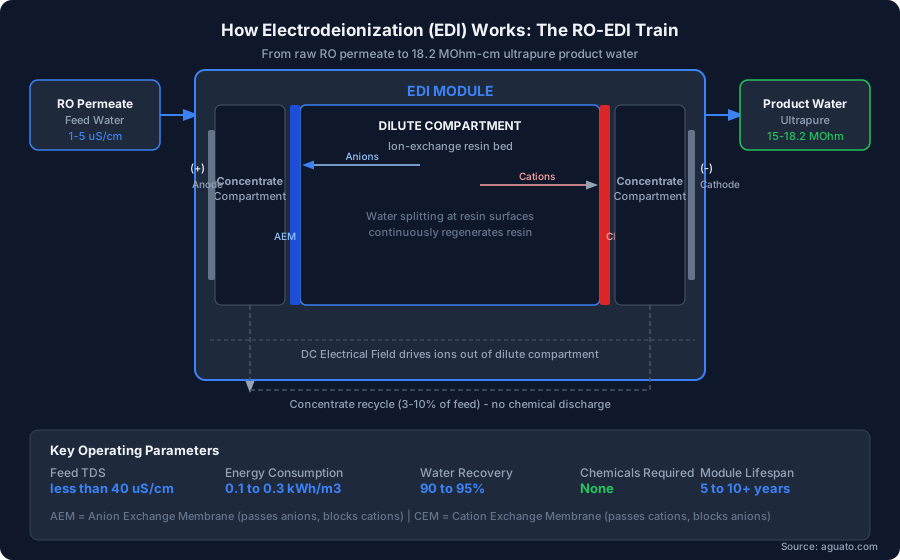
The critical differentiator from standard electrodialysis is the resin bed. The ion-exchange resin inside the dilute compartment does two jobs simultaneously: it provides the ionic pathway that allows the current to pass at low voltage even when the feed conductivity is very low (below 5 microsiemens per centimetre), and it extends the residence time of ions under the electrical field. Without the resin, achieving ultrapure quality at practical flow rates would require impractical voltages. With it, the system operates at 100 to 150 V DC and draws 0.1 to 0.3 kWh per cubic metre of product water.
The resin is regenerated in place, continuously, by the water-splitting reaction at the resin bead surface. Water molecules dissociate into hydrogen ions and hydroxide ions at the resin-membrane interface when the local current density is high enough. These ions regenerate the resin beads electrically, sustaining their ion-exchange capacity indefinitely. This is the mechanism that eliminates chemical regeneration. It is also the mechanism that fails when feed water hardness is too high, because calcium and magnesium precipitate in the resin bed and physically block the ion-exchange sites.
[ASTM D5391-23](dofollow:https://store.astm.org/d5391-23.html), the standard test method for electrical conductivity and resistivity of flowing high-purity water, defines the measurement protocols that EDI product water must meet for industrial acceptance. Any EDI commissioning report should reference D5391-23 as the measurement basis for resistivity claims, so that different vendors' performance data can be compared on the same basis.
## Where EDI fits in the treatment train
EDI occupies the final polishing position in a high-purity water train. The standard configuration is: raw water intake, pre-filtration and media filtration, softening (if hardness is present), cartridge filtration, reverse osmosis (single or double pass), a degassing or CO2 removal stage, and then the EDI module. Some trains insert activated carbon before the RO to remove [chlorine](/elements/chlorine) and organics, or a UV system for TOC reduction before the EDI.
The RO stage must deliver permeate conductivity below 30 to 40 microsiemens per centimetre for the EDI to operate within design. Some high-purity applications specify a second-pass RO (double-pass configuration) that delivers conductivity below 5 microsiemens per centimetre, reducing the load on the EDI and extending module life. Double-pass RO adds roughly 30 to 50% to the RO capital cost but can halve the EDI operating load and improve product resistivity consistency. Browse the selection and design options among [reverse osmosis systems](/reverse-osmosis-systems) providers to scope the upstream configuration before fixing the EDI specification.
For procurement teams scoping a new ultrapure water project, this means the EDI line item in the CAPEX budget is only part of the story. The upstream RO configuration, degassing, and any organics control are co-determinants of EDI performance and must be specified together. A scope document that specifies EDI without specifying the RO permeate quality tolerance is leaving a cost gap open that will be filled by change orders during commissioning.
[cta:nepti-dark]
## Feed water requirements: the make-or-break parameters
The single most important principle in EDI application engineering is this: the EDI module does not fix upstream problems, it amplifies them. Feed water that is marginally outside specification will degrade a module that would otherwise last 10 years down to a 2 to 3 year replacement cycle. That failure mode is worth $15,000 to $40,000 per module replacement at industrial scale, not counting lost production.
The critical feedwater parameters for EDI are:
- Conductivity: Below 30 microsiemens per centimetre, ideally below 10 microsiemens per centimetre. Above 40 microsiemens per centimetre, the electrical load exceeds module design and current efficiency drops sharply. - Hardness: Below 1 mg/L as CaCO3, and below 0.1 mg/L for critical pharmaceutical and semiconductor applications. Hardness causes irreversible scaling of the ion-exchange resin. There is no in-situ recovery. - Free chlorine: Must be undetectable. Target below 0.02 ppm. Chlorine oxidises ion-exchange membranes and resin, causing permanent permeability loss within weeks of exposure. An activated carbon pre-filter with a post-carbon SDI monitor is the minimum protection. - [Organic carbon](/elements/carbon) (TOC): Below 0.5 mg/L in feed. High organics foul the membranes and consume ion-exchange capacity. UV/H2O2 treatment upstream is specified in pharmaceutical trains. - Silica: Below 1 to 2 mg/L. EDI handles silica better than mixed-bed IX because the electrical field converts silicic acid to ionised form more efficiently, but elevated silica still shortens resin life. - Temperature: 10 to 38 degrees Celsius operating range, with optimal performance at 20 to 25 degrees Celsius. Below 10 degrees Celsius, resin kinetics slow and product quality degrades. - SDI (silt density index): Below 1 NTU from the RO permeate stage.
Across projects we have seen, the failures that generate the most expensive warranty disputes are not module defects. They are hardness breakthroughs from a softener that was not sized for peak flows, and chlorine pulses from a carbon filter that bypassed during maintenance. Both are upstream problems blamed on the EDI module. Not sure which pretreatment configuration fits your feed water profile? [Post your project on Aguato](/post-project) and qualified ultrapure water specialists will scope the full upstream train against your actual water analysis.
## EDI vs. the alternatives: a technology comparison
Three technologies compete for the polishing position in a high-purity water train: EDI, mixed-bed ion exchange (MB-IX), and two-bed ion exchange (2B-IX). Understanding the trade-off requires looking at the full lifetime cost picture, not the equipment purchase price. The buyer who awards on lowest CAPEX and ignores chemical OPEX, labour, and waste disposal is optimising the wrong number.
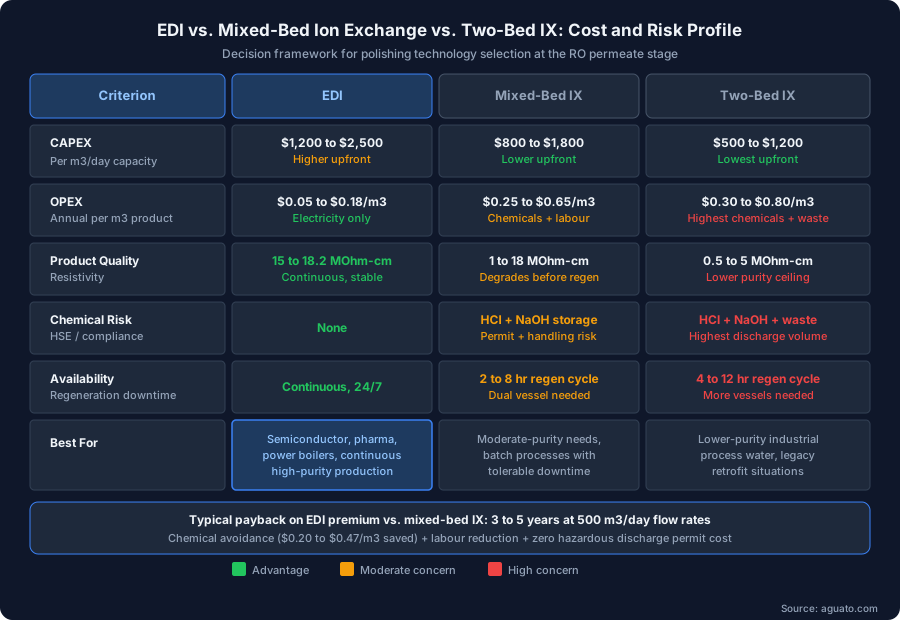
| Criterion | EDI | Mixed-Bed IX | Two-Bed IX | |---|---|---|---| | CAPEX per m3/day capacity | $1,200 to $2,500 | $800 to $1,800 | $500 to $1,200 | | OPEX per m3 product | $0.05 to $0.18 | $0.25 to $0.65 | $0.30 to $0.80 | | Product resistivity | 15 to 18.2 MOhm-cm, stable | 1 to 18 MOhm-cm, declining | 0.5 to 5 MOhm-cm | | Chemical risk | None | HCl and NaOH storage | Highest discharge volume | | Operational downtime | Continuous | 2 to 8 hr regen cycle per vessel | 4 to 12 hr regen cycle | | Module or resin life | 5 to 10+ years | 2 to 5 years resin cycle | 2 to 4 years resin cycle | | Best for | Semiconductor, pharma, power boiler | Moderate purity with tolerable downtime | Legacy or lower-purity industrial water |
The OPEX gap between EDI and mixed-bed IX is the decisive financial argument at any facility running more than 200 m3/day. At 500 m3/day, the $0.20 to $0.47/m3 OPEX saving on EDI versus MB-IX amounts to $36,500 to $85,800 per year. The EDI CAPEX premium of roughly $200,000 to $350,000 over a comparable MB-IX system pays back in 3 to 5 years, with chemical avoidance, reduced labour, and eliminated waste disposal costs all contributing.
The case for mixed-bed IX over EDI is real in three situations: flow rates below 20 m3/day where EDI module cost per unit output is hard to justify, sites where the capital budget is constrained and the payback horizon matters less than day-one cost, and retrofit situations where an RO stage is not present and installing one is not economically viable. The [ion exchange water treatment](/ion-exchange-water-treatment) article covers the design and application cases where IX remains the preferred selection.
Browse verified providers of [demineralized water production](/demineralized-water-production) systems to compare integrated EDI and IX offerings side by side and request proposals scoped to your specific flow rate and purity target.
## CAPEX and OPEX: what electrodeionization actually costs
The installed cost of an EDI system depends on flow rate, product quality target, and the degree of upstream pretreatment included in the scope. Indicative ranges for a complete EDI polishing skid (modules, rectifier, monitoring instrumentation, controls), not including the upstream RO:
- Small systems (1 to 20 m3/hr): $80,000 to $200,000 installed - Medium systems (20 to 100 m3/hr): $200,000 to $600,000 installed - Large systems (100 to 500 m3/hr): $600,000 to $2,000,000+ installed
Normalised per m3/day of product capacity, EDI sits at $1,200 to $2,500/m3/day for a complete polishing skid. The full RO-EDI train including pretreatment typically runs $3,500 to $6,000/m3/day for pharmaceutical-grade systems, and $2,500 to $4,500/m3/day for industrial boiler feed and power applications.
OPEX has three components. Energy accounts for 0.1 to 0.3 kWh per m3 of product water at standard feed conductivity below 10 microsiemens per centimetre. At $0.10/kWh, this is $0.01 to $0.03/m3. If the RO permeate conductivity runs at the high end (30 to 40 microsiemens per centimetre), energy consumption climbs to 0.4 to 0.6 kWh/m3. Parts and maintenance covers module replacement every 5 to 10 years at $8,000 to $25,000 per module depending on size, plus annual maintenance contracts at $15,000 to $40,000/year for medium systems. Monitoring and consumables include conductivity and resistivity probe replacement every 2 to 3 years, and cartridge filter replacements at $2,000 to $8,000/year.
The chemical cost for EDI is zero. For mixed-bed IX running the same flow, regeneration chemicals typically cost $0.15 to $0.45/m3 of product water, and waste neutralisation and disposal adds another $0.05 to $0.15/m3. The total chemical OPEX for MB-IX at 100 m3/day is $7,300 to $21,900 per year. That number does not appear in the EDI OPEX column, and it is frequently omitted from procurement comparisons that focus only on hardware pricing.
Not sure which system configuration fits your site? [Post your project on Aguato](/post-project) and qualified EDI and ultrapure water providers will scope the full train against your feed water analysis and production targets.
## Industries and applications where EDI earns its premium
EDI is not universal. It earns its CAPEX premium in four sectors where continuous ultrapure output, zero chemical exposure, and GMP-compatible operation are non-negotiable.
### Semiconductor and microelectronics
Chip manufacturing requires ultrapure water at 18.2 MOhm-cm resistivity with total organic carbon below 1 ppb and particle counts below 5 per millilitre at 0.05 micrometre. A semiconductor fabrication plant typically consumes 2,000 to 10,000 m3/day of ultrapure water. The water recovery loop is tightly monitored: a single hardness event exceeding 0.1 mg/L CaCO3 in the EDI feed can contaminate a production batch worth $500,000 to $2,000,000 in finished wafers. In this sector, the cost of an EDI module failure is measured in wafer yield, not in water cost.
### Pharmaceutical and bioprocessing
USP Purified Water and Water for Injection specifications require conductivity below 1.3 microsiemens per centimetre at 25 degrees Celsius. GMP requires continuous online monitoring with audit trails. EDI's continuous operation makes automated GMP documentation straightforward: there are no regeneration cycle logs, no chemical batch records, and no post-regen quality hold periods. A mixed-bed IX system requires quality hold verification after every regeneration cycle before the vessel returns to production. At a facility with 6 regeneration cycles per week, that is 300+ hold-and-test events per year, each requiring a QC sign-off. A typical pattern across pharmaceutical EDI projects is that the GMP documentation saving alone accounts for 15 to 25% of the total OPEX reduction claim in the business case.
### Power generation and boiler feed water
Ultrahigh-pressure boilers and heat recovery steam generators in combined-cycle power plants require boiler feed water with conductivity below 0.1 microsiemens per centimetre to prevent corrosion and scaling on turbine blades. A blade replacement event on a large gas turbine costs $3,000,000 to $8,000,000 in parts and scheduled maintenance downtime. EDI provides the continuous high-purity output that eliminates the risk of post-regen quality excursions that characterise IX-based systems in this duty. Providers in the [industrial water treatment companies](/industrial-water-treatment-companies) sector who work in power generation will recognise this risk profile and specify accordingly.
### Laboratory and critical process water
Type I ultrapure water per [ASTM D1193](dofollow:https://www.astm.org/Standards/D1193.htm) specifies resistivity above 18 MOhm-cm, TOC below 50 ppb, sodium below 1 ppb, and silica below 3 ppb. Laboratories running analytical instrumentation including ICP-MS, HPLC, and cell culture work require this quality continuously. EDI systems for laboratory applications are available from 50 litres per hour to several m3/hr, with installed costs from $25,000 to $120,000 for a complete RO-EDI point-of-use system.
## Failure modes: what goes wrong and what it costs
Most EDI failures are not module failures. They are upstream pretreatment failures that manifest in the EDI module. Understanding the failure chain is the difference between a 10-year module life and a 2-year replacement cycle.
### Hardness breakthrough
Decision: Undersized softener or bypassed softening, or softener regeneration failure during peak flow. Operational outcome: Calcium and magnesium precipitate as carbonates and hydroxides inside the EDI dilute compartment resin bed, physically blocking ion-exchange sites. The precipitation is irreversible. Product resistivity drops from 18 MOhm-cm to 1 to 5 MOhm-cm within days to weeks. Cost: Module replacement at $8,000 to $25,000 per module, plus lost production at $500 to $5,000 per hour depending on process. Correct decision: Size the softener for 120% of peak flow, install hardness monitors at the RO permeate stage with automatic EDI feed isolation below 0.1 mg/L CaCO3 trip point.
### Chlorine exposure
Decision: Carbon filter exhausted or bypassed, allowing chlorinated mains water to reach the EDI. Operational outcome: Chlorine oxidises the AEM and CEM membranes within 24 to 72 hours of sustained exposure above 0.05 ppm. The membranes develop micro-holes that allow ion back-migration. Product resistivity plateaus below 5 MOhm-cm regardless of electrical input. Cost: Full membrane stack replacement at $15,000 to $60,000 per module, or full module replacement. This failure is not covered by standard warranties. Correct decision: Install duplicate carbon filters with continuous online chlorine monitoring and an automatic feed shutoff. Test for chlorine breakthrough monthly.
### Organic fouling
Decision: High TOC in RO permeate from biogrowth in the RO train or from inadequate upstream organics removal. Operational outcome: Organics adsorb onto the ion-exchange membranes, reducing ion mobility. The effect is cumulative and initially reversible with acidic cleaning, but prolonged fouling becomes permanent. Product resistivity drift, typically a decline from 18.2 to 14 to 16 MOhm-cm over 6 to 12 months, is the first signal. Cost: $3,000 to $8,000 for a cleaning cycle with specialised reagents, plus 24 to 48 hours of offline time. Repeated fouling shortens the module replacement interval from 7 to 10 years to 3 to 5 years, costing an extra $10,000 to $20,000 in lifecycle CAPEX per module. Correct decision: Monitor RO permeate TOC continuously. Install UV at 185 nm upstream of the EDI to drive TOC below 50 ppb before the module.
### CO2 and silica overload
Decision: Inadequate degassing of the RO permeate, allowing dissolved CO2 to accumulate in the EDI feed. Operational outcome: CO2 is a weakly ionised species that consumes ion-exchange capacity without migrating efficiently under the electrical field at low conductivity. High CO2 loading forces the EDI to operate at elevated current to maintain product quality, increasing energy consumption from 0.2 to 0.5 kWh/m3 to 0.8 to 1.2 kWh/m3. Cost: Increased energy cost of $0.05 to $0.10/m3 ongoing, plus accelerated resin fatigue reducing module life by 20 to 30%. Correct decision: Install a forced-draft degassing tower or a membrane degasser between the RO and EDI. CO2 removal to below 5 mg/L before the EDI feed is the standard specification.
Browse [water purification companies](/water-purification-companies) who offer full-train design including degassing stages and upstream instrumentation to avoid the most common commissioning-stage surprises.
## How to specify and select an EDI system
A defensible EDI specification requires seven inputs, all of which should be in the RFP before vendors are invited to respond.
1. Flow rate: m3/hr of product water, plus the peak demand profile (24/7 continuous, 8/5 batch, surge demands). EDI systems are sized for the continuous flow rate but must be capable of the peak without quality excursion. 2. Product quality: Minimum acceptable resistivity in MOhm-cm, maximum TOC in ppb, and any specific ion limits (silica, sodium, boron) required for the application. 3. Feed water analysis: RO permeate conductivity, hardness, chlorine residual, TOC, silica, temperature, and pH. If the RO does not yet exist, use the RO design specification as the basis. 4. Number of service hours: Annual hours of operation. A 24/7 plant covering 8,760 hours per year faces very different membrane fatigue dynamics from a 2,000-hour-per-year laboratory system. 5. Water recovery requirement: Site water balance constraints. Standard EDI delivers 90 to 95% recovery. If the site requires higher water efficiency, specify a concentrate recirculation or recycling loop. 6. Electrical supply: Available DC or AC power, voltage stability. Rectifiers accept 380 to 480 V AC three-phase input and produce regulated DC output, but voltage stability within 5% variation is required for consistent module performance. 7. Vendor qualification: For pharmaceutical sites, vendors should hold ISO 9001 certification and the system should be designed for GAMP 5 validation. For semiconductor applications, request references with 18.2 MOhm-cm commissioning data from operating installations.
The selection error that occurs most often in competitive bid processes is awarding on lowest CAPEX without normalising the bid scope. Vendor A includes the degassing stage. Vendor B excludes it. The apparent $40,000 CAPEX saving from Vendor B disappears the moment the degasser is added back to scope. Compare bids on delivered water quality per dollar of 5-year lifecycle cost, not on hardware purchase price. Need to benchmark technology options against your specific site parameters before issuing the RFP? [Model your water matrix with Nepti](/nepti), which simulates which treatment train minimises cost and risk for your feed water and duty profile and produces a ranked comparison of EDI versus IX alternatives with 5-year cost projections.
## Sustainability and regulatory position
EDI's competitive position on sustainability is unambiguous, and it is becoming a procurement decision driver in ESG-governed organisations. The elimination of acid and caustic regenerant chemicals removes three cost and risk categories simultaneously: chemical procurement and storage (a COSHH/OSHA compliance item), spent regenerant neutralisation and disposal (a regulated waste stream), and accidental release risk (a reportable environmental event in most jurisdictions).
A 500 m3/day mixed-bed IX system generating 3 to 5% blowdown volume produces 15 to 25 m3/day of chemically contaminated waste requiring neutralisation before discharge. Achieving pH-neutral effluent within permit limits requires either a neutralisation tank at $20,000 to $60,000 capital cost or off-site disposal contracts at $80 to $200 per tonne. An EDI system at the same capacity produces only clean concentrate at 5 to 10% of feed volume, suitable for direct discharge or RO rejection recirculation with no neutralisation step. The [US EPA industrial effluent guidelines](dofollow:https://www.epa.gov/eg/industrial-effluent-guidelines) set the framework for discharge permit requirements that chemical regeneration waste must meet. For sites in regulated catchments or those seeking ISO 14001 certification, EDI's zero-chemical discharge profile substantially simplifies the environmental management system.
The [water purification companies](/water-purification-companies) sector is seeing this regulatory convergence drive procurement toward EDI in new-build projects. Facilities that have not yet quantified the waste disposal cost and compliance risk embedded in their IX operations are typically underestimating their total cost of ownership by 15 to 30%. The switch from IX to EDI is rarely a technology argument at board level. It is a risk and liability argument, and the CFO who owns the environmental compliance budget is usually the one who closes it.
## FAQ
### What is electrodeionization and how does it differ from ion exchange?
Electrodeionization is a continuous electrochemical process that removes dissolved ions from water using a DC electrical field, ion-selective membranes, and an ion-exchange resin bed in the dilute compartment. Unlike conventional ion exchange, EDI regenerates the resin in place electrically through the water-splitting reaction, eliminating the need for periodic chemical regeneration with acids and caustic. The practical result is continuous operation, no chemical consumption, no hazardous waste, and a consistent product water resistivity of 15 to 18.2 MOhm-cm rather than the declining-curve performance of a conventional IX vessel between regeneration cycles.
### What feed water quality does EDI require?
EDI requires RO-pretreated feed water, typically with conductivity below 30 microsiemens per centimetre, hardness below 1 mg/L as CaCO3, free chlorine below 0.02 ppm, total organic carbon below 0.5 mg/L, and silica below 1 to 2 mg/L. Temperature should be between 10 and 38 degrees Celsius. The single most damaging contaminant is hardness: even brief hardness breakthrough above 1 mg/L causes irreversible scaling of the ion-exchange resin. Chlorine is the second critical parameter, as oxidative attack on the membranes is irreversible and typically not covered by standard warranties.
### How much energy does an EDI system consume?
Typical EDI energy consumption is 0.1 to 0.3 kWh per cubic metre of product water when feed conductivity is below 10 microsiemens per centimetre. At $0.10/kWh, this is $0.01 to $0.03 per m3 of ultrapure water. Energy consumption increases to 0.4 to 0.8 kWh/m3 if the RO permeate conductivity is high (30 to 40 microsiemens per centimetre) or if dissolved CO2 loading is elevated due to insufficient upstream degassing. EDI's energy footprint is roughly 5 to 15% of the total RO-EDI train energy consumption, with the high-pressure RO pumps dominating the electricity bill.
### How does EDI compare to mixed-bed ion exchange on total lifecycle cost?
For facilities running 200 m3/day or more of ultrapure water, EDI typically delivers lower total lifecycle cost than mixed-bed IX over a 10-year horizon. The EDI CAPEX premium of $200,000 to $350,000 over a comparable MB-IX system is offset by chemical OPEX savings of $0.20 to $0.47/m3 (chemicals, labour, waste disposal), amounting to $36,500 to $85,800 per year at 500 m3/day. At that scale, payback is 3 to 5 years. Below 20 m3/day, the per-unit capital cost of EDI makes IX more economical unless continuous operation or GMP compliance requirements drive the selection.
### What industries use electrodeionization as their primary polishing technology?
The four primary sectors are semiconductor and microelectronics manufacturing (requiring 18.2 MOhm-cm continuous quality for wafer rinsing), pharmaceutical and bioprocessing facilities (requiring USP Purified Water quality with GMP documentation), power generation (ultrahigh-pressure boilers and HRSG units requiring below 0.1 microsiemens per centimetre boiler feed water), and critical laboratory and research applications. Each of these sectors requires either continuous high-purity output, the absence of chemical regeneration cycles, or both. Oil and gas, food and beverage, and municipal advanced treatment are secondary markets where EDI is used selectively.
### How long do EDI modules last and what maintenance is required?
EDI modules typically operate for 5 to 10 years or more with proper pretreatment. The primary maintenance requirements are: quarterly inspection of cartridge pre-filters immediately upstream, annual performance testing of conductivity and resistivity probes per ASTM D5391-23 methodology, annual rectifier servicing, and monitoring of product resistivity trend for early warning of membrane or resin degradation. Module replacement costs $8,000 to $25,000 per module for industrial sizes. The major accelerators of early module failure are hardness scaling, chlorine oxidation, and elevated TOC, all of which are upstream pretreatment failures rather than module defects.
### Can EDI remove silica and carbon dioxide effectively?
EDI removes dissolved silica more effectively than conventional mixed-bed ion exchange because the electrical field converts silicic acid (a weakly ionised species) to a more ionised form that migrates under the applied potential. Product water silica below 0.1 mg/L is achievable from a feed with silica below 1 mg/L. For CO2 removal, EDI is less efficient than a dedicated degassing stage: CO2 consumes ion-exchange capacity without migrating efficiently under low-conductivity conditions. The recommended practice is to install a membrane degasser or forced-draft tower upstream of the EDI to reduce CO2 below 5 mg/L before the module, then rely on the EDI to handle residual ionised carbonate species. This combination consistently delivers product TOC and carbonate levels within semiconductor and pharmaceutical specifications.