Wrong resin type costs USD 15,000 to 500,000 per failure event. How to select ion exchange resin, size the system, and avoid the five failure modes that wreck industrial IX plants.
Ion exchange water treatment is one of the most commercially consequential decisions in industrial water management, yet it is also one of the most frequently under-specified. A correctly sized and configured ion exchange system running on the right resin type cuts hardness, dissolved solids, and specific contaminants to exacting tolerances that membranes alone cannot match. A poorly specified one exhausts ahead of schedule, fouls irreversibly, and hands the plant a water quality crisis at the worst possible moment. The difference between those two outcomes is rarely exotic engineering. It is the quality of the selection decision made before the purchase order is signed.
The fundamental tension in ion exchange procurement is that the technology is highly application-specific, but most vendor proposals default to whatever resin type the supplier sells most of. Strong acid cation resin is not interchangeable with weak acid cation resin. Mixed bed is not the right answer for every high-purity requirement. The choice of resin type, regeneration regime, and pre-treatment train determines lifecycle cost, regenerant consumption, and effluent quality for the 10 to 15 year life of the resin charge. Getting it right at specification stage costs nothing extra. Getting it wrong costs between USD 15,000 and USD 500,000 per failure event, depending on what the contaminated water touches downstream.
This guide covers what ion exchange water treatment is and how it works, the four main resin categories and when each applies, how to build a threshold-based selection decision, CAPEX and OPEX benchmarks with real cost ranges, the five failure modes that account for the majority of unplanned expenditure in industrial IX installations, and a practical decision framework for procurement teams who need to evaluate competing proposals without relying on a single vendor's recommendation.
## The decision in brief
- Specify the resin and pre-treatment correctly. With the correct resin type and pre-treatment train for your feed water, a well-designed industrial IX demineralisation system delivers product water at USD 0.20 to 0.55 per m3 over a 10-year life. - Price the mis-specified system. A mis-specified system on the same duty runs USD 0.60 to 1.20 per m3 once premature resin replacement and elevated regenerant costs are included. For a 20 m3/h plant at 8,000 hours per year, that gap is USD 500,000 to 1,200,000 over the resin life. - Silica leakage is the biggest cost of doing nothing. A single silica contamination event in a downstream boiler or turbine can cause a forced outage costing USD 80,000 to 500,000 in lost production and mechanical remediation.
The root cause of that outage is traceable directly to the SBA resin type or regeneration temperature chosen at specification stage.
## How ion exchange water treatment works
Ion exchange is a reversible chemical reaction in which dissolved ions in water are swapped for ions held on a solid polymer resin matrix. The resin is a porous bead, typically 0.3 to 1.2 mm in diameter, carrying fixed ionic groups that attract oppositely charged ions from the water passing through the vessel. When a cation resin in hydrogen form contacts a water stream carrying calcium, magnesium, or sodium, it releases hydrogen ions and captures the hardness and alkali cations in their place. The treated water exits depleted of those species and, depending on whether an anion vessel follows, either softened or demineralised. For a full engineering guide covering system configurations, sizing, and the IX versus RO decision, see [Ion Exchange Systems: A Complete Guide for Industrial Users](/resources/ion-exchange-systems-industrial).
The process runs until the resin's exchange capacity is exhausted, at which point the vessel is taken offline and regenerated. The U.S. Environmental Protection Agency's technical guidance on [ion exchange for drinking water treatment](dofollow:https://www.epa.gov/ground-water-and-drinking-water/national-primary-drinking-water-regulations) establishes bed volume capacity, regenerant efficiency, and leakage rates as the three parameters that define system performance and regulatory compliance. Regeneration passes a concentrated chemical solution (acid for cation resin, caustic for anion resin) through the bed in the reverse direction, releasing the captured ions as a waste brine and restoring the resin to its working form. A correctly designed regeneration cycle returns the resin to 90 to 95% of its original capacity. A poorly executed one returns 60 to 70%, and the gap accumulates over hundreds of cycles into permanent capacity loss.
The critical variable is bed volume capacity, expressed as equivalents of ions removed per litre of resin. Cation resins typically deliver 1.6 to 2.2 equivalents per litre; anion resins run 1.0 to 1.6 equivalents per litre. Those numbers, combined with the feed water ionic load and the target effluent quality, define the run length between regenerations and the size of the vessel needed. A vendor who quotes resin volume without disclosing the bed volume capacity assumption is giving you a number you cannot use to evaluate the proposal.
## Resin types and selection criteria
The four main resin categories behave differently in service and respond differently to regeneration. Using the wrong one is not a minor inefficiency. It is a design error that becomes visible only after commissioning, when the system either fails to reach target effluent quality or exhausts three times faster than the duty cycle demands.
Strong acid cation (SAC) resin operates across the full pH range of 0 to 14 and removes all cationic species: calcium, magnesium, [sodium](/elements/sodium), potassium, heavy metals, and ammonium. It is the workhorse for water softening and the cation stage in two-bed or mixed-bed demineralisation. Regeneration uses hydrochloric acid or sulphuric acid. The main vulnerability is [iron](/elements/iron): dissolved iron above 0.3 mg/L oxidises inside the vessel and coats exchange sites with iron hydroxide precipitate, cutting capacity progressively and irreversibly without pre-removal. SAC resin costs USD 8,000 to 25,000 per cubic metre of resin, with total installed system cost at 3x to 5x that figure once vessel, pipework, instrumentation, and regeneration system are included.
Strong base anion (SBA) resin removes all anionic species including chloride, sulphate, nitrate, bicarbonate, silica, and carbon dioxide. It requires caustic soda (NaOH) for regeneration and is available in two functional forms. Type I has higher chemical stability and better silica removal efficiency; Type II has slightly lower silica removal but requires less caustic and is more cost-effective where silica is not the critical contaminant. For boiler feed demineralisation where silica leakage causes turbine blade deposits, Type I is non-negotiable. The chemical regeneration requirement, typically 80 to 120 kg NaOH per cubic metre of resin per cycle, makes SBA the highest-OPEX resin in most plants, and this cost is frequently underestimated at the procurement stage.
Weak acid cation (WAC) and weak base anion (WBA) resins operate over a narrower pH window but deliver substantially lower regenerant consumption because they are partially self-regenerating under certain conditions. WAC resin removes only hardness associated with bicarbonate alkalinity (calcium and magnesium bound to HCO3-), releasing CO2 as a regeneration product rather than requiring strong acid in the same quantity. Where the feed has high temporary hardness relative to permanent hardness, WAC upstream of SAC reduces total acid consumption by 40 to 60% and is the economically dominant choice. The constraint: WAC cannot remove neutral salt hardness (hardness balanced against chloride or sulphate), so a feed with high permanent hardness still requires SAC capacity downstream.
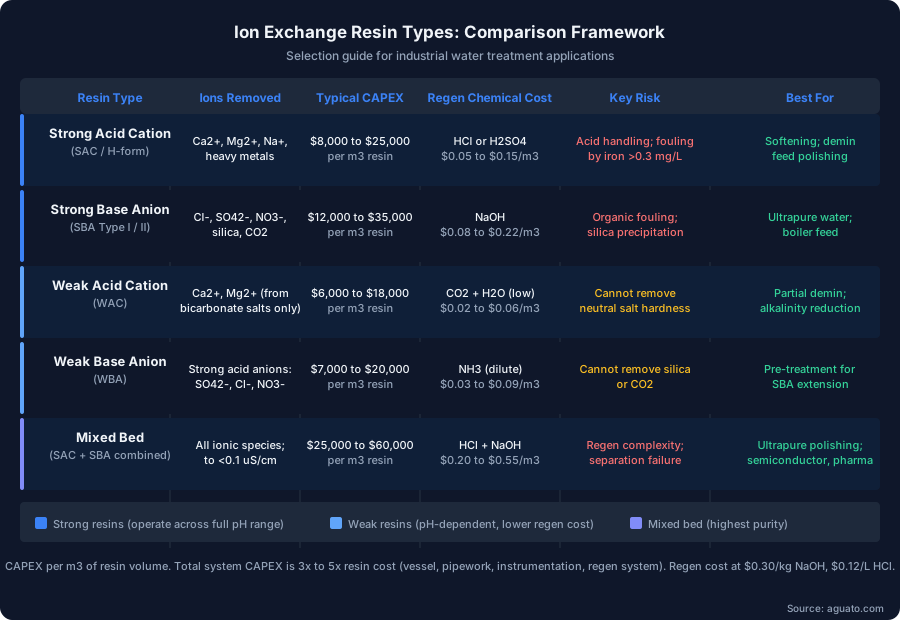
The comparison framework makes the trade-off structure clear. Strong resins are versatile and used across the widest feed-water range. Weak resins are cheaper to operate where the feed chemistry suits them. Mixed bed delivers the highest effluent purity but carries the highest capital and operational cost. The right answer for your site is a function of your feed water's ionic composition, your effluent quality target, and your budget for regenerant chemicals over the resin's lifetime.
## Threshold-based selection framework
Most published guidance presents ion exchange selection as a matrix of factors. Experienced practitioners make it faster by working to numeric thresholds that route the decision directly. The thresholds below are drawn from patterns across industrial installations and are not substitutes for a full treatability study, but they correctly route the majority of industrial decisions without requiring one.
Feed TDS and target effluent: - Feed TDS below 500 mg/L, target effluent 1 to 50 mg/L: softening-only with SAC in sodium form is frequently sufficient. No acid regeneration required; salt (NaCl) regeneration. - Feed TDS 500 to 2,000 mg/L, target effluent below 10 uS/cm conductivity: two-bed demineralisation (SAC-H + SBA) is the standard design. Cost-effective and well-proven. - Feed TDS 2,000 to 5,000 mg/L, target ultrapure (below 1 uS/cm or 18 Mohm-cm): reverse osmosis pre-treatment followed by mixed bed polishing. Using IX alone at this TDS level is uneconomic; regenerant consumption per cubic metre of product water becomes excessive. - Feed TDS above 5,000 mg/L: IX is not the primary desalination step. RO or nanofiltration handles bulk TDS reduction; IX polishes the permeate. [Reverse osmosis systems](/reverse-osmosis-companies) are required upstream.
Silica in feed: - Feed silica below 10 mg/L: SBA Type II is acceptable and lower-cost. - Feed silica 10 to 50 mg/L: SBA Type I with hot caustic regeneration (50 to 60 degC) required. - Feed silica above 50 mg/L: ultrafiltration or clarification pre-treatment plus SBA Type I. Silica precipitation on resin above this threshold causes catastrophic capacity loss.
Iron in feed: - Dissolved iron below 0.1 mg/L: SAC without iron-specific pre-treatment is acceptable. - Dissolved iron 0.1 to 0.5 mg/L: greensand filter or oxidation-filtration upstream mandatory. - Dissolved iron above 0.5 mg/L: IX is not appropriate without dedicated iron removal pre-treatment. Iron will irreversibly foul the cation resin within 6 to 12 months of operation.
Hardness type: - If temporary hardness (as CaCO3) represents more than 70% of total hardness: WAC upstream of SAC reduces acid consumption by 40 to 60% and should be the default design. - If permanent hardness dominates: WAC contributes little; SAC alone is the right choice.
These thresholds are where the design process starts. The wrong decision at any branch point is a cost locked into the asset for a decade. Not sure which branch your feed water puts you on? [Post your project parameters](/post-project) and qualified IX specialists will scope the correct train configuration against your actual feed analysis.
## Ion exchange versus reverse osmosis: when each wins
Ion exchange and reverse osmosis both reduce dissolved solids, but they do it by fundamentally different mechanisms and serve different points on the treatment train. Treating them as interchangeable is one of the most common errors in industrial water procurement.
Reverse osmosis rejects all dissolved species by pressure-driven filtration through a semi-permeable membrane. It handles bulk TDS reduction efficiently at recoveries of 70 to 85% but produces a reject brine that requires disposal. It cannot target specific ionic species: it either rejects broadly or does not. Ion exchange, by contrast, targets specific ions with near-total selectivity. It can remove hardness while leaving sodium, remove nitrate while leaving chloride, or strip silica to trace levels unreachable by RO alone. That selectivity is the reason IX survives in pharmaceutical, semiconductor, and power generation applications where RO alone cannot meet the product water specification.
The cost crossover matters in both directions. At feed TDS below approximately 1,000 mg/L, IX-only demineralisation is competitive with RO in both capital and operating cost, and its higher chemical sensitivity to specific ions often makes it the better specification. Above 2,000 mg/L, the regenerant chemical cost of IX grows faster than the energy cost of RO, and the combination of RO-primary plus IX-polishing consistently delivers lower lifecycle cost. The comparison of [reverse osmosis systems and ultrapure water production requirements](/resources/ultrapure-water-production) is where this hierarchy becomes important for high-purity applications.
A pattern that recurs in industrial installations is the misapplication of IX alone where the feed TDS is high enough that an RO pre-treatment stage would have cut the IX regenerant bill by 60 to 70%. The IX system exhausts two to three times faster than designed, the regeneration frequency overwhelms the operators, and the plant runs semi-permanently on bypass. The fix is always to add RO upstream, which should have been specified from the start but was omitted to save CAPEX. The operational and chemical cost of running the IX at high TDS typically pays for the RO retrofit in 18 to 30 months, making it one of the more expensive false economies in industrial water treatment.
| Criterion | Ion Exchange | Reverse Osmosis | Combined RO + IX | |---|---|---|---| | Feed TDS sweet spot | Below 1,000 mg/L | 500 to 15,000 mg/L | Above 2,000 mg/L for high-purity target | | Specific-ion targeting | Excellent (selective) | Poor (broad rejection) | RO bulk removal, IX polishes target ions | | CAPEX per m3/day capacity | USD 500 to 2,500 | USD 800 to 3,500 | USD 1,200 to 5,000 | | OPEX: energy | Low (0.1 to 0.3 kWh/m3) | Moderate (0.4 to 1.5 kWh/m3) | Moderate (0.5 to 1.8 kWh/m3) | | OPEX: chemicals | High (regenerants) | Low (antiscalant only) | Low to moderate | | Reject/waste | Regenerant brine | Concentrate (20 to 30%) | Both streams | | Uptime risk | Exhaustion if TDS spikes | Fouling if SDI > 5 | Redundancy improves both risks | | Best for | Softening, demin polishing, specific ion | Bulk TDS reduction | Ultrapure water: semiconductor, pharma, power |
The table is the decision a procurement lead should reach before issuing an RFP. A buyer who issues a tender for "IX demineralisation system" without defining the feed TDS threshold and the target effluent quality will receive proposals built on wildly different assumptions, and comparing them on price alone will select the wrong technology 40% of the time.
## CAPEX and OPEX: what ion exchange actually costs
Ion exchange is frequently pitched as the low-capital alternative to membrane treatment. That is true for small systems and low-TDS feeds. It stops being true quickly as system capacity or feed TDS rises, and it is almost never true when you count the 10-year present value of regenerant chemicals.
CAPEX ranges (installed, including vessel, pipework, instrumentation, regeneration system): - Softening-only (SAC-Na): USD 15,000 to 80,000 for capacity of 5 to 50 m3/h - Two-bed demineralisation (SAC-H + SBA): USD 60,000 to 350,000 for 5 to 50 m3/h - Mixed bed polishing (post-RO): USD 30,000 to 180,000 for 5 to 50 m3/h - Full demineralisation train (WAC + SAC + WBA + SBA + MB): USD 200,000 to 1,200,000 for 10 to 100 m3/h
These ranges compress at the bottom for standard packaged units and expand at the top for custom-engineered skids with redundancy, automated regeneration, and quality monitoring. The normalised CAPEX is approximately USD 800 to 3,500 per m3/day of capacity depending on configuration, which positions it comparably to or below [industrial water treatment](/industrial-water-treatment-companies) membrane alternatives for small to medium duties.
OPEX structure (two-bed demin, 10 m3/h, feed TDS 400 mg/L): - Regenerant chemicals: USD 0.08 to 0.22 per m3 product water (the dominant variable cost) - Energy (pumps, backwash, instrumentation): USD 0.04 to 0.10 per m3 - Resin replacement (amortised over 10-year life): USD 0.03 to 0.08 per m3 - Labour (manual regeneration): USD 0.05 to 0.15 per m3; automated systems reduce to USD 0.01 to 0.03 - Total OPEX: USD 0.20 to 0.55 per m3 for a well-designed two-bed system
The most common budgeting error is to cost the resin replacement on the nominal 10-year life while operating in conditions that actually require replacement every 4 to 6 years due to organic fouling or iron poisoning. That error doubles the amortised resin cost in the OPEX model without flagging itself until the first resin charge fails prematurely.
Vendor selection note: Vendors optimise their own margin, not your lifecycle cost. A vendor selling SAC and SBA will not volunteer that WAC upstream would cut your acid bill by half. A resin supplier will not tell you that carbon pre-treatment would extend resin life by three years. The buyer's job is to model the lifecycle cost of the correct train configuration, compare it to proposals, and identify what each proposal is leaving out.
## Pre-treatment requirements and feed water quality
Ion exchange systems do not operate in isolation. They are the polishing stage of a treatment train, and their performance is entirely contingent on what the pre-treatment stages deliver to the IX vessel inlet. The most expensively designed IX system fails predictably if the pre-treatment is wrong.
The critical feed quality parameters are:
- Turbidity below 1 NTU: Suspended solids bed down in the resin and create high-resistance channels, reducing contact time and capacity. Multi-media filtration or ultrafiltration pre-treatment is required above 1 NTU. [Industrial water filtration](/industrial-water-filtration-companies) systems are the standard first stage. - Iron below 0.3 mg/L (dissolved): As discussed in the threshold framework, dissolved iron oxidises in the cation vessel and causes irreversible fouling. Greensand filtration or chemical oxidation plus filtration is required. - Total organic carbon (TOC) below 2 mg/L for anion resin: Humic and fulvic acids from natural organic matter are strongly adsorbed onto SBA resin and cannot be fully removed by regeneration. Activated carbon or coagulation-filtration is required upstream when surface water or high-TOC groundwater is the feed. The AWWA's [water treatment technical resources](dofollow:https://www.awwa.org/resources-hub/) establish TOC management as the decisive operating variable for anion resin longevity. - Temperature below 40 degC: Resin physical integrity degrades faster above 40 degC. Hot process condensate applications require specialty high-temperature resins at 1.5 to 2x the cost of standard types. - Chlorine residual zero: Free chlorine oxidises resin bead structure directly. Activated carbon or sodium bisulphite dosing upstream of the IX vessel is required wherever the feed carries chlorination residual. Even 0.1 mg/L continuous exposure degrades cation resin capacity measurably within 6 months.
Across projects we have seen, the most common pre-treatment failure is chlorine exposure from treated municipal supply. The operations team assumes the water is "soft" because it is from a municipal softener, does not dechlorinate before the IX vessel, and then wonders why the cation resin life is three years instead of ten. The chlorine residual is invisible on a standard water quality report and is only caught by a complete analytical package that specifies it explicitly.
[cta:nepti-dark]
## Regeneration strategy and chemical costs
Regeneration is where the economics of ion exchange are made or lost. It is also the most operator-sensitive part of the system: a correctly automated regeneration sequence delivers consistent effluent quality and maximum resin life; a manually operated or poorly calibrated one wastes chemical, degrades resin prematurely, and produces inconsistent product water.
Co-current versus counter-current regeneration. In co-current regeneration, the regenerant flows in the same direction as the service flow. It is simpler to implement but leaves a slightly higher residual ion concentration at the resin bed outlet, which means the first product water after regeneration is of lower quality. Counter-current regeneration flows the regenerant in the opposite direction to service flow, driving the regeneration front toward the outlet end of the bed and producing a purer product water immediately after regeneration. Counter-current reduces regenerant consumption by 20 to 40% for the same effluent quality and is the standard specification for high-purity applications. The CAPEX premium over co-current is modest (15 to 25%), and the OPEX saving pays it back in 1 to 3 years at typical regeneration frequencies.
Regenerant chemical cost by system type: - SAC softening (NaCl): USD 3 to 8 per regeneration cycle for a 1 m3 resin bed - SAC demin (HCl): USD 12 to 30 per regeneration cycle for a 1 m3 resin bed - SBA demin (NaOH): USD 20 to 55 per regeneration cycle for a 1 m3 resin bed - Mixed bed (HCl + NaOH combined): USD 45 to 110 per regeneration cycle for a 1 m3 resin bed
The regenerant chemical bill scales directly with regeneration frequency, which scales directly with throughput volume and feed TDS. A system running at 10 m3/h on 800 mg/L TDS feed regenerates four to six times more often per day than the same system on 200 mg/L feed, and the chemical cost rises proportionally. Modelling that frequency correctly over 10 years is the single most important number in the IX lifecycle cost calculation.
Automation payback. A fully automated regeneration controller, conductivity-triggered by effluent quality rather than run on a fixed time or volume schedule, reduces reagent consumption by 15 to 25% by avoiding premature regeneration during low-load periods and preventing exhaustion (and downstream contamination) during high-load periods. An automation upgrade on an existing manually controlled system typically costs USD 15,000 to 40,000 installed and delivers payback in 1 to 3 years through chemical savings alone, not counting the value of improved and more consistent effluent quality.
## Failure modes and financial impact
Five failure modes account for the majority of unplanned expenditure in industrial IX installations. Each follows a predictable pattern: a wrong decision at the design or operational stage, an operational consequence that is initially invisible, and a financial impact that arrives after months of silent degradation.
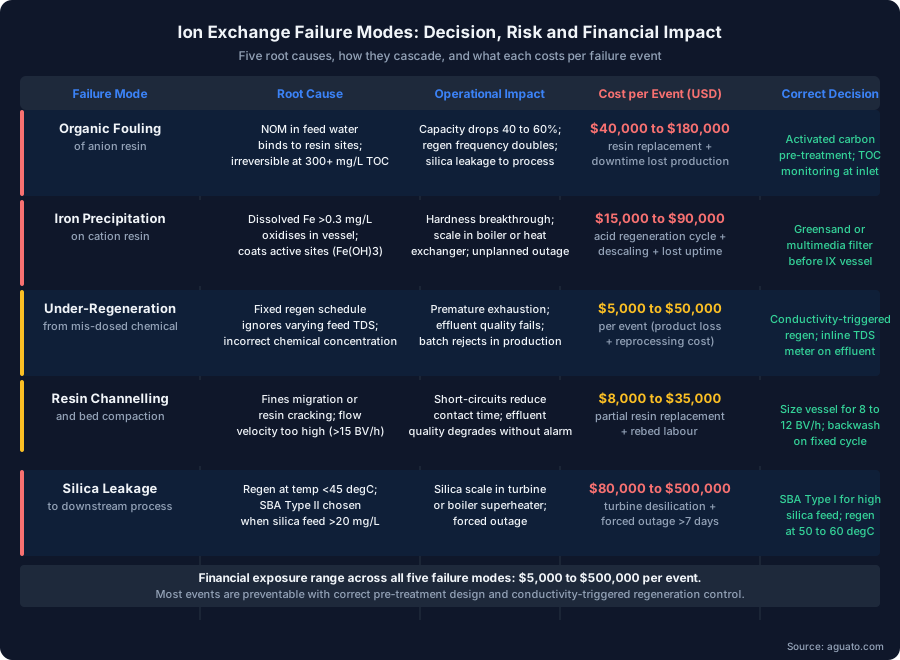
The diagram above maps the five failure modes against their financial exposure. Three observations from the cost pattern stand out.
First, the highest-cost failures (silica leakage to turbines, organic fouling causing resin replacement) are both pre-treatment failures, not IX design failures. The damage happens upstream of the IX vessel and manifests inside it. This means the IX system can be perfectly designed and still fail catastrophically because the pre-treatment was wrong.
Second, under-regeneration is the most frequent failure by occurrence but not the most expensive by event. Its cost accumulates in product-quality incidents and increased resin degradation rather than in a single dramatic event. It is the failure mode that is easiest to prevent (a conductivity-triggered controller eliminates it) and most commonly left unaddressed because the events look like "soft" quality variability rather than a hard system failure.
Third, iron precipitation and channelling are both velocity-management problems. Iron accumulates faster at lower superficial velocities because the contact time with resin is longer. Channelling occurs at too-high velocities. The correct design window is 8 to 12 bed volumes per hour (BV/h), and most failure events cluster at installations where the vessel was sized without reviewing the feed water quality data or where flow rates changed after commissioning without a resin bed review.
The total financial exposure across these five failure modes for a medium-sized industrial demineralisation plant (20 m3/h, 8,000 hours per year) is USD 40,000 to 180,000 per year when one or more pre-treatment or operational deficiencies are present. Eliminating them through correct specification and automated regeneration brings that figure to near-zero. The specification investment is measured in engineering hours. The failure cost is measured in five or six figures.
## Ion exchange in industrial sectors: real-world patterns
Ion exchange is not a single application. The requirements, resin choices, and failure modes differ substantially by sector, and a specification appropriate for one sector can be actively wrong for another.
Power generation boiler feed. This is the most demanding IX application by effluent quality. High-pressure boilers (above 100 bar) and supercritical units require feed water with conductivity below 0.1 uS/cm and silica below 10 to 20 parts per billion. The typical treatment train is: clarification, multimedia filtration, two-bed demin (SAC-H + SBA Type I with hot caustic regen), followed by mixed-bed polishing. The critical failure mode in this sector is silica leakage: a single event where silica exceeds specification can deposit on turbine blades, causing forced outage that costs USD 80,000 to 500,000 in lost generation and mechanical cleaning. The correct design response is SBA Type I with regeneration temperature above 50 degC and continuous silica analysers on the effluent rather than periodic grab sampling. A typical full demineralisation train for a 200 MW power station operates at 80 to 120 m3/h and represents a CAPEX investment of USD 800,000 to 2,500,000 installed.
Pharmaceutical and semiconductor ultrapure water. Both sectors require product water in the 1 to 18 Mohm-cm range, beyond what two-bed demineralisation alone reliably delivers. The standard architecture in both is: RO primary (reducing TDS by 95 to 99%), followed by mixed-bed polishing to remove the residual ionic load. The IX mixed bed in this architecture is a polishing stage, not a bulk demineralisation stage, which radically improves its economics: the RO permeate arriving at the mixed bed has TDS below 10 to 20 mg/L, so the bed runs for 50 to 200 m3 per kg of resin before exhaustion rather than the 5 to 20 m3 per kg typical of a high-TDS primary service application. This is why [ultrapure water production](/resources/ultrapure-water-production) consistently uses RO-plus-MB architecture rather than IX alone. The financial consequence of specification error in pharmaceutical applications is a batch rejection event rather than an equipment failure, and at USD 50,000 to 500,000 per rejected batch in drug intermediate synthesis, the cost of inadequate product water quality is immediate and visible.
Industrial softening for cooling tower makeup. This is the highest-volume, lowest-purity IX application. The goal is hardness removal to below 17 mg/L as CaCO3 (1 grain per gallon), sufficient to prevent carbonate scale in heat exchangers and [cooling tower water treatment](/resources/cooling-tower-water-treatment) circuits. SAC in sodium form, regenerated with sodium chloride, is the universal choice. The key economics question is whether a whole-house softener or point-of-use softener is appropriate: whole-house requires larger resin volume and more frequent regeneration, but protects the entire cooling circuit; point-of-use is cheaper but leaves non-cooling circuits at risk. The financial consequence of under-specified softening is carbonate scale in heat exchangers, reducing heat transfer efficiency by 10 to 25% and potentially causing tube failures in severe cases. Descaling and tube replacement for a medium-sized heat exchanger typically costs USD 20,000 to 60,000 per event.
Not sure which architecture fits your sector and feed? [Browse verified water softener and demineralisation providers](/water-softener-companies), filter by sector experience and technology, and request scoped proposals from 3 to 5 specialists.
## Decision framework for procurement teams
A procurement team evaluating IX proposals is exposed to a systematic information asymmetry. The vendor knows the technology. The buyer knows the application. The proposals bridge that gap imperfectly, and the buyer who relies solely on the vendor's recommendation is making decisions in the vendor's interest, not their own.
The four-step evaluation framework below is designed to reverse that asymmetry.
Step 1: Fix the water analysis before issuing the RFP. A full feed water analysis must be in hand before any proposal is invited. The analysis must include: TDS, hardness (temporary and permanent separately), silica, iron (dissolved and total), TOC, turbidity, pH range, temperature range, and conductivity. Any proposal built on assumed or estimated feed water values is not comparable against one built on actual data. This is the step most commonly skipped under time pressure, and it is the step where the most expensive specification errors originate.
Step 2: Define the effluent quality target in measurable terms. "Soft water" is not a spec. "Hardness below 17 mg/L as CaCO3, conductivity below 50 uS/cm, silica below 0.1 mg/L, 8,000 hours per year" is a spec. Proposals against a defined spec are comparable. Proposals against a vague performance description are not, and the cheapest bid almost always achieves the cheapest compliance interpretation.
Step 3: Require lifecycle cost modelling, not just CAPEX. Instruct vendors to provide the 10-year present-value cost including resin replacement, regenerant chemical consumption at the specified throughput and feed TDS, energy, and maintenance. A system that quotes USD 60,000 CAPEX but USD 0.45/m3 OPEX is more expensive over 10 years than a system at USD 90,000 CAPEX and USD 0.25/m3 OPEX for any throughput above roughly 200,000 m3/year. That arithmetic is invisible in a CAPEX comparison and visible only in a lifecycle model.
Step 4: Ask the pre-treatment question. "What pre-treatment does your proposal assume, and what is the consequence if the feed exceeds specification on iron, TOC, or silica?" A vendor who cannot quantify the consequence of a feed-quality exceedance is selling you a system that will fail under foreseeable conditions without flagging it. A vendor who quantifies it is selling you a system with a defined operating envelope and a clear pathway to protect it. The [water treatment chemicals](/water-treatment-chemical-companies) and pre-treatment configuration are as consequential as the IX vessel itself.
For complex or high-purity applications, using a decision-intelligence tool to model the water matrix and simulate which treatment train minimises cost and risk before engaging vendors is the standard of care that defensible procurement requires. [Nepti](/nepti) models your water chemistry and produces a ranked comparison of technology options with cost projections, giving you a vendor-independent baseline to evaluate proposals against.
## FAQ
### What is ion exchange water treatment and what contaminants does it remove?
Ion exchange water treatment is a process in which dissolved ions in water are replaced by ions held on a solid polymer resin matrix, removing specific contaminants through a selective chemical reaction rather than physical filtration. Cation resins remove hardness ions (calcium, magnesium), sodium, potassium, and heavy metals. Anion resins remove chloride, sulphate, nitrate, bicarbonate, silica, and dissolved CO2. Combined in a two-bed or mixed-bed configuration, ion exchange can produce demineralised water with conductivity below 0.1 uS/cm, which no other single technology delivers at comparable cost for feeds below 1,000 mg/L TDS. The technology is used in boiler feed water treatment, pharmaceutical water purification, semiconductor ultrapure water, industrial softening, and selective ion removal across a wide range of industrial applications.
### When should I use ion exchange instead of reverse osmosis?
Ion exchange is the preferred choice when your feed TDS is below approximately 1,000 mg/L and you need to remove specific ions to trace levels, particularly silica, hardness, or heavy metals, where RO's broad-rejection approach is either over-specified or under-performing. At feed TDS above 2,000 mg/L, the regenerant chemical cost of IX alone typically exceeds the energy and membrane cost of RO, making a combined RO-primary plus IX-polishing train the economically dominant architecture. Ion exchange is also preferred when continuous product water flow is required without a reject stream disposal problem, when the feed temperature or chemistry makes membranes unsuitable, or when a specific ion (such as nitrate or uranium) must be removed selectively without full demineralisation.
### How often does ion exchange resin need to be regenerated?
Regeneration frequency depends on three variables: feed water TDS (higher TDS exhausts the resin faster), throughput volume (more water processed per hour means more ions loaded per hour), and the resin's working capacity in equivalents per litre. A softener on 300 mg/L hardness-as-CaCO3 feed at 5 m3/h might regenerate every 24 to 48 hours. The same vessel on 600 mg/L feed at the same flow rate would regenerate every 12 to 24 hours. A correctly automated conductivity-triggered controller regenerates the vessel when the effluent quality actually degrades, rather than on a fixed time schedule, reducing chemical consumption by 15 to 25% and eliminating exhaustion events. The EU's Drinking Water Directive, updated in 2023, [sets stricter limits on ion exchange regeneration byproducts](dofollow:https://environment.ec.europa.eu/topics/water/drinking-water_en) discharged to surface water, making controlled regeneration frequency an environmental compliance issue as well as an operational one.
### What is the lifespan of ion exchange resin and what causes premature failure?
Well-operated strong acid cation and strong base anion resins in a correctly designed and pre-treated system last 8 to 12 years. Weak acid and weak base resins are more physically robust and can reach 12 to 15 years. Premature failure is caused by four main mechanisms: oxidative degradation from chlorine residual in the feed (the most common cause on municipal-supply-fed systems), organic fouling of anion resin by natural organic matter above 2 mg/L TOC, iron precipitation on cation resin from dissolved iron above 0.3 mg/L, and osmotic shock from rapid concentration swings during regeneration. All four are preventable with correct pre-treatment and regeneration protocol. A resin charge that fails after 3 to 5 years almost always does so for one of these four reasons, and the root cause is found in the pre-treatment design, not in the resin specification.
### How much does an industrial ion exchange system cost to install and operate?
Installed CAPEX for a two-bed demineralisation system (SAC-H plus SBA) ranges from USD 60,000 for a 5 m3/h packaged skid to USD 350,000 for a 50 m3/h engineered system, with the normalised figure approximately USD 1,000 to 3,500 per m3/day of capacity. Operating cost on a feed TDS of 400 mg/L runs USD 0.20 to 0.55 per m3 of product water, with regenerant chemicals representing 40 to 60% of that OPEX. At higher feed TDS the OPEX rises steeply: a feed at 1,500 mg/L increases regeneration frequency by 3x to 4x and can push OPEX to USD 0.80 to 1.50 per m3, at which point an RO pre-treatment stage becomes economically justified. Full demineralisation trains for high-purity applications (power, pharmaceutical) range from USD 200,000 to USD 1,200,000 installed for 10 to 100 m3/h capacity.
### What pre-treatment is required before an ion exchange system?
The minimum pre-treatment for any IX system is turbidity removal to below 1 NTU, typically via multimedia filtration or cartridge filtration. Beyond that, the specific pre-treatment depends on feed chemistry. Iron removal (greensand or oxidation-filtration) is required if dissolved iron exceeds 0.3 mg/L. Dechlorination via activated carbon or sodium bisulphite dosing is required if the feed carries any chlorine residual. Activated carbon or coagulation-filtration for organic removal is required if TOC exceeds 2 mg/L and anion resin is in the train. Temperature control is needed for feeds above 40 degC. The cost of pre-treatment is typically 20 to 40% of the IX system CAPEX and is the most commonly under-budgeted line item in IX procurement, surfacing only when the resin fails prematurely.
### Can ion exchange remove nitrate, heavy metals, and pharmaceutical contaminants?
Ion exchange removes nitrate selectively using nitrate-selective anion resins (sulphate-over-nitrate selectivity reversed by resin design), achieving effluent nitrate below 10 mg/L-N from feeds carrying 50 to 100 mg/L-N. Heavy metals including lead, cadmium, chromium, nickel, and arsenic (in ionic form) are removed by cation resin or chelating resin, with chelating resins offering substantially higher selectivity for heavy metals in the presence of high-hardness competition. Pharmaceutical contaminants that are charged (APIs, hormone metabolites in ionic form) are partially removed by IX but with variable and feed-specific efficiency; pharmaceutical effluent treatment more commonly uses activated carbon or advanced oxidation in combination with IX. Ion exchange for nitrate removal is covered in EPA guidance on public water system treatment technologies, and the technology is increasingly specified for agricultural groundwater remediation where nitrate contamination exceeds the 10 mg/L-N drinking water standard.