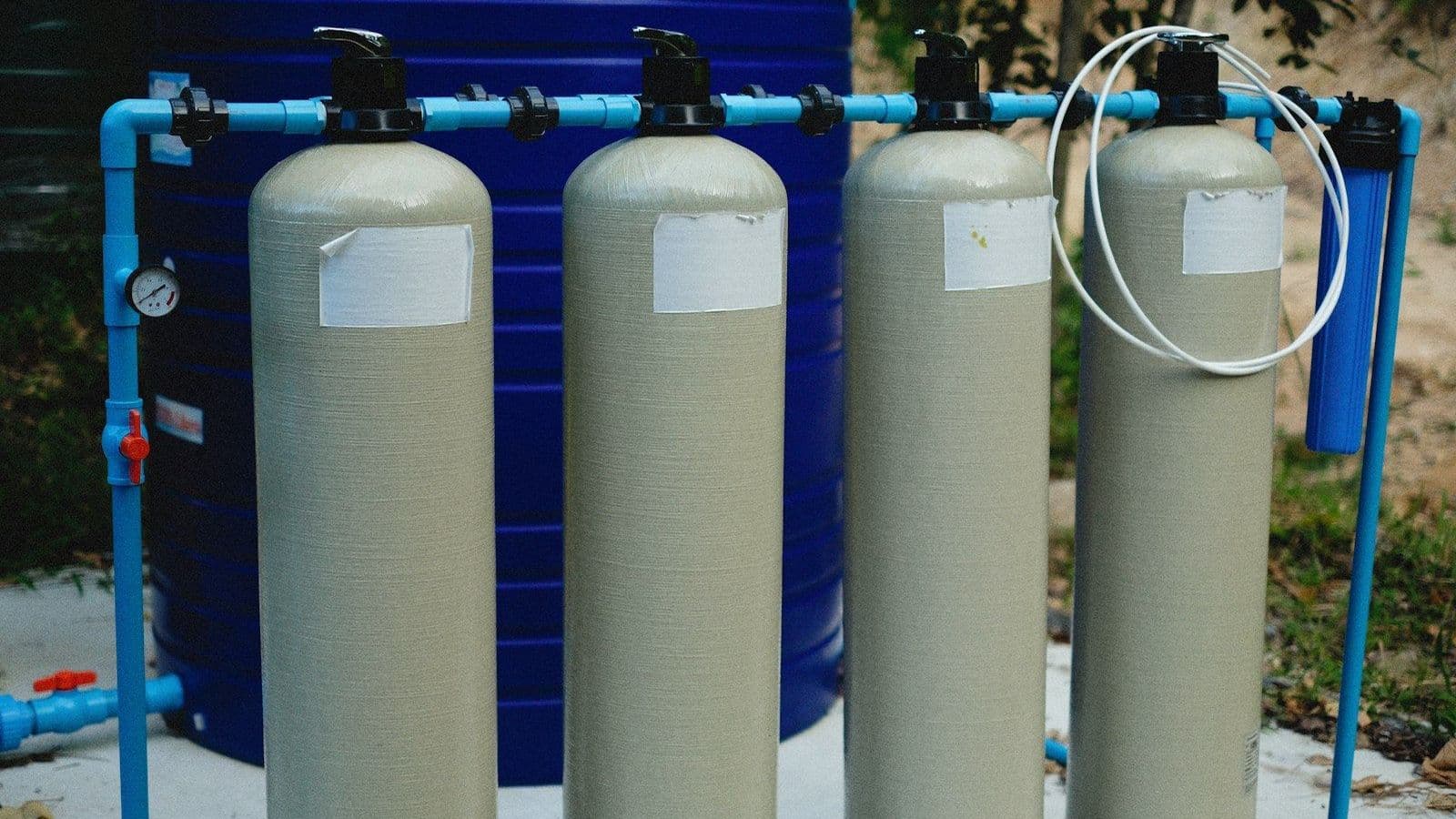
Hard water costs industrial operations far more than most engineers account for. This guide covers ion exchange softening in depth, how it works, how to size it correctly, and the failure modes that cost plants money.
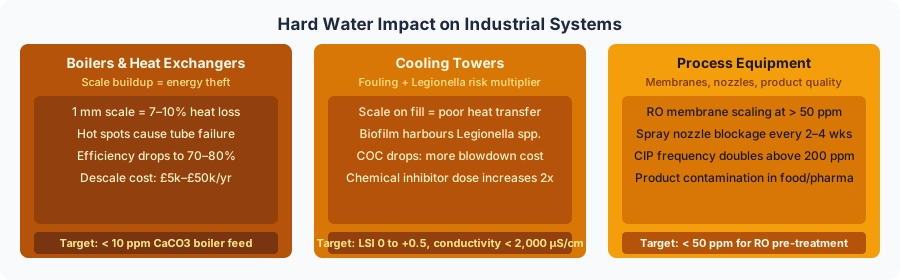
Hard water is the most undercosted water quality problem in industrial operations. Scale accumulates silently, 1 mm of calcium carbonate on a heat transfer surface increases fuel consumption by 7 to 10%, and the cost of that scale reaches multiples of what prevention would have cost long before anyone notices the efficiency loss. In boilers, cooling towers, RO membrane systems, and heat exchangers, the financial consequences of unaddressed hardness are calculable and consistent, yet capital planning decisions continue to treat softening as optional.
Ion exchange softening is a mature, well-understood technology. The hardware is not the decision, the decisions that determine whether a softening project delivers a 6 to 18 month payback or becomes a recurring maintenance problem are sizing and configuration. An undersized softener running short regeneration cycles consumes 40 to 60% more salt per cubic metre of treated water than a correctly sized unit, while still allowing hardness breakthrough at peak flows. The technical knowledge to avoid this is available; the question is whether it was applied at the specification stage.
This article covers what hard water actually costs across the main industrial system types, how ion exchange softening works, how to size a system correctly, and where projects go wrong.
## What Hard Water Actually Costs Industrial Operations
Hard water is not a nuisance, it is a measurable operating cost with a calculable return on investment. Most industrial facilities that have not quantified this cost are significantly underestimating the financial impact of running without adequate softening.
The cost mechanisms are well-established. In boilers, 1 mm of calcium carbonate scale on heat transfer surfaces increases fuel consumption by 7 to 10%. A medium-sized industrial boiler consuming 500,000 kWh/year of gas will waste $44,000, $63,000 annually due to a 2 mm scale layer, before accounting for increased maintenance, tube failure risk, and descaling costs. The [Water Quality Association, ion exchange standards](dofollow:https://www.wqa.org/learn-about-water/treatment-technologies/ion-exchange) documents that scale prevention through softening consistently delivers payback periods of 6 to 18 months in boiler and heat exchanger applications. For the full treatment programme that softening sits within, see the [boiler water treatment guide](/resources/industrial-boiler-water-treatment).
In [cooling tower water treatment](/resources/cooling-tower-water-treatment), hardness interacts with concentration cycles to create scale at the most thermally stressed surfaces, the fill media, distribution nozzles, and heat exchanger tubes. Fouled fill reduces cooling efficiency, increases blowdown frequency (and hence makeup water and chemical costs), and creates conditions conducive to Legionella biofilm formation. The combination of reduced efficiency and elevated biological risk represents both a financial and a legal liability.
For [HVAC water treatment](/resources/hvac-water-treatment) applications, the impact of hardness on closed system inhibitor consumption is often overlooked: calcium and magnesium ions compete with corrosion inhibitors for surface adsorption sites, reducing inhibitor effectiveness at equivalent dosing levels.
In RO membrane systems, inlet hardness above 50 mg/L CaCO3 creates a direct scaling risk on the membrane surface, particularly in the concentrate stages. A softener protecting an RO train is protecting an asset worth 10 to 50x the softener's own capital cost.
The single most common mistake in industrial water treatment capital planning is installing an undersized softener to reduce upfront cost, then spending 3 to 5x the saving on chemical treatment, descaling, and premature equipment failure over the following 3 years.
## How Ion Exchange Softening Works
Ion exchange softening uses a strong acid cation (SAC) resin in [sodium](/elements/sodium) form to exchange hardness ions ([calcium](/elements/calcium) Ca2+ and magnesium Mg2+) for sodium ions (Na+). The exchange is selective, divalent calcium and magnesium ions bind more strongly to the resin than monovalent sodium, so they displace sodium from the resin sites as water passes through the bed.
The resin consists of sulphonated polystyrene divinylbenzene (PS-DVB) copolymer beads, 0.3 to 1.2 mm in diameter, with functional sulphonate groups (-SO3-) that carry the exchangeable cations. In service mode, the reaction is:
Ca2+ (in solution) + 2 Na-R (resin) → Ca-R2 (resin) + 2 Na+ (in solution)
The resin has a finite exchange capacity, typically 40 to 120 grams of CaCO3 equivalent per litre of resin depending on resin type and regeneration efficiency. Once exhausted (hardness breakthrough), the resin is regenerated using a 8 to 12% sodium chloride (NaCl) brine solution that reverses the exchange reaction:
Ca-R2 (resin) + 2 NaCl (brine) → 2 Na-R (resin) + CaCl2 (waste brine)
The regeneration produces a calcium-rich waste brine stream that is discharged to drain. This is the primary environmental consideration of ion exchange softening, high-chloride, high-TDS waste brine that may require management under trade effluent consent in some jurisdictions.
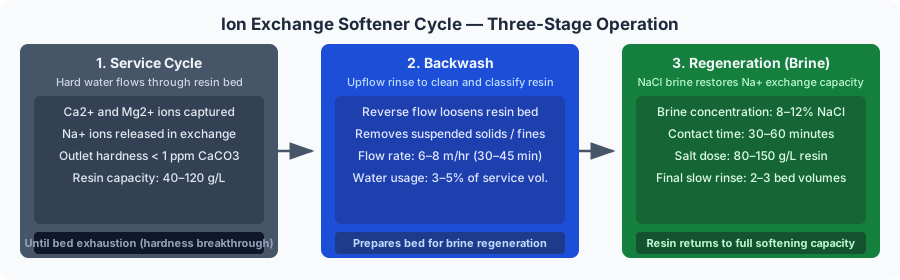
The backwash step before regeneration is critical and frequently misunderstood. Backwash does not regenerate the resin, it classifies the resin bed (smaller particles float to the top, larger sink), removes accumulated suspended solids, and breaks up any channelling or compaction that has developed during the service cycle. Skipping or shortening backwash causes progressive resin bed compaction, reducing contact time and increasing pressure drop across the vessel.
Resin life under normal industrial service conditions is 7 to 15 years, degrading through mechanical attrition (bead breakage from pressure cycles), osmotic shock (caused by excessive salt concentration during regeneration), and oxidative degradation (caused by chlorine or other oxidants in the feed water, a critical design consideration). Feed water with free chlorine above 0.1 mg/L requires a carbon pre-filter or dechlorination ahead of the softener vessel to prevent resin oxidation.
## Sizing an Industrial Water Softener
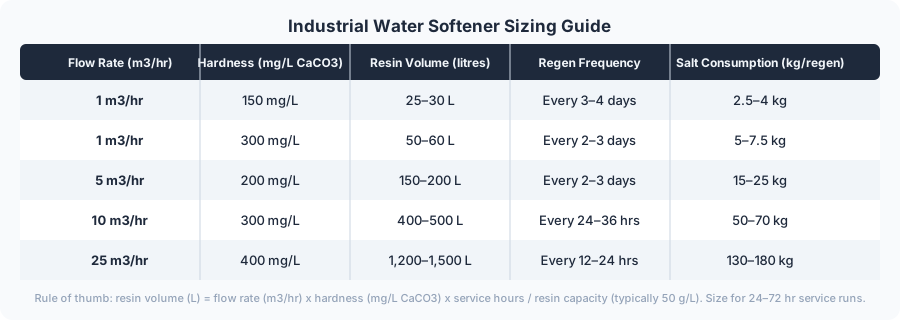
Correct sizing requires three inputs: peak service flow rate (m3/hr), feed water hardness (mg/L CaCO3), and target service run duration (hours between regenerations).
The resin volume calculation is straightforward:
Resin volume (litres) = [Flow rate (m3/hr) x Hardness (mg/L CaCO3) x Service hours] / Resin capacity (g CaCO3/L)
Using a design resin capacity of 50 g CaCO3/L (conservative, accounting for incomplete regeneration efficiency):
- 5 m3/hr at 300 mg/L CaCO3, targeting 24-hour service runs: 5 x 300 x 24 / 50 = 720 litres resin
Add 15 to 20% safety factor for feed water variability and to avoid hardness breakthrough before target run time.
Salt consumption is approximately 100 to 150 g NaCl per litre of resin per regeneration at normal efficiency (roughly 6 to 9 g NaCl per gram of calcium removed, against a stoichiometric minimum of 2.9 g/g). Over-salting (using excess brine) does not proportionally increase resin capacity but does increase brine discharge volume, water consumption for rinsing, and operating costs. Under-salting produces incomplete regeneration, leaving a residual hardness "heel" that accumulates over successive cycles.
To model your specific hardness profile before commissioning a softener, [model your hardness profile with Nepti](/nepti) and get a data-backed specification rather than a rule-of-thumb estimate.
The [Water Research, scaling and fouling in industrial systems](dofollow:https://www.sciencedirect.com/journal/water-research) literature documents that undersized softeners operating with short service cycles have 40 to 60% higher salt consumption per m3 of treated water compared to correctly-sized units, due to the fixed overhead of backwash and slow-rinse water in each regeneration cycle.
[cta:nepti-dark]
## Simplex vs Duplex vs Twin-Alternating: Which Configuration?
Simplex (single vessel): One resin vessel in service, one offline during regeneration. Provides softened water except during regeneration (typically 60 to 90 minutes). Acceptable when the process can tolerate a short interruption or when a blending bypass is acceptable during regeneration. Lowest capital cost. Appropriate for batch processes, intermittent service, or where hardness-tolerant buffer tanks provide coverage.
Duplex (two vessels in parallel): Two identical vessels operating in rotation, one in service while the other regenerates. Provides continuous softened water supply with zero interruption. Capital cost is approximately 1.7x simplex for the same throughput capacity (second vessel plus additional valves and controls). Standard specification for continuous industrial processes including boiler feed, RO pre-treatment, and continuous food processing lines.
Twin-alternating with separate service and standby: One vessel in service, one on standby fully regenerated, and a third in regeneration. Provides maximum security of supply and allows maintenance without process interruption. Appropriate for critical applications where any hardness breakthrough would cause immediate process or product quality impact, pharmaceutical water systems, high-pressure boilers above 16 bar, brewery bright beer tanks.
Most industrial applications are well-served by duplex configuration. The additional capital cost versus simplex is recovered within 12 to 18 months through continuous operation and elimination of any hardness events during switchover.
## Where Softener Projects Go Wrong
Feed water not characterised before design. Iron above 0.1 mg/L in the feed fouls cation resin within months, causing progressive capacity loss and pressure drop increase. Iron fouling requires periodic acid regeneration to restore capacity, a complication not needed if iron removal had been designed upstream. Silica above 40 mg/L can precipitate as silica scale within the resin bed under some conditions. Manganese above 0.05 mg/L has the same fouling effect as iron. Always test feed water for full cation panel, iron, manganese, silica, and free chlorine before specifying a softener.
Undersized brine tank. The brine tank must hold at least 2 to 3 regenerations' worth of salt to allow for weekend or holiday periods without salt replenishment. A brine tank sized for only one regeneration on a continuously operating plant means salt replenishment is required every 24 hours, a maintenance burden that gets missed, resulting in hardness breakthrough.
No hardness monitoring on the outlet. An automatic hardness alarm on the softener outlet is a $250, $625 addition that prevents a $62,500 descaling event or RO membrane replacement campaign. Many specifiers omit it to reduce cost. Do not.
Incorrect salt specification. Industrial water softeners require vacuum-grade (PDV) or tablet-grade sodium chloride, high-purity salt with low insoluble content. Rock salt or de-icing salt contains insoluble impurities that accumulate in the brine tank and block the brine valve. The cost saving on salt quality is vastly outweighed by the maintenance cost of blocked brine systems.
Commissioning without flushing. New resin contains manufacturing residuals that impart a high TDS to the first few bed volumes of treated water. Resin must be fully regenerated and rinsed at least twice before being placed in service for sensitive applications (boiler feed, food contact water, pharmaceutical).
For [industrial wastewater treatment](/resources/industrial-wastewater-treatment) systems where softener regeneration brine becomes a process effluent stream, the chloride load must be factored into the overall effluent consent. High-chloride brine from continuous softener operation can push effluent chloride above acceptable limits for some receiving waters.
To compare specifications from [qualified softener suppliers](/providers), post your project requirements on the Aguato platform. For guidance from [HSE on boiler water treatment](/resources/hvac-water-treatment) and the downstream implications of feed water hardness, see the [HSE, boiler water treatment guidance](dofollow:https://www.hse.gov.uk/boilers/index.htm).
## When Softening Is Not Enough
Ion exchange softening removes hardness (calcium and magnesium) and replaces it with sodium. It does not reduce TDS, in fact it slightly increases TDS because two Na+ ions replace one Ca2+ ion (higher molecular weight exchange). This is important for several downstream applications:
Boiler applications above 16 bar: High-pressure boiler water chemistry requires not just softening but full or partial demineralisation (TDS below 0.5 to 2 mg/L depending on boiler pressure class). Softened water fed to a high-pressure boiler will cause carryover and superheater damage due to sodium salt concentration in steam. Above 30 bar, a full demineralisation train (SAC + SBA strong base anion resin, or EDI) is required.
RO feed water: Softening protects RO membranes against hardness scale but does not reduce TDS, organics, or other parameters that affect RO performance. A softener-RO combination is the standard train, with the softener protecting membranes and the RO providing final TDS reduction.
Silica-critical applications: Softening does not remove silica. For applications where silica scaling is a problem (high-pressure boilers, certain semiconductor process water applications), desilication through lime softening or mixed-bed demineralisation is required in addition to or instead of ion exchange softening.
[Post your project](/post-project) if your application sits at the boundary of softening and demineralisation, specifying the wrong treatment train for a critical water system is a costly error that the right engineering input at the front end prevents.
## FAQ
### What hardness level requires industrial softening?
There is no universal threshold, but as a practical guide: hardness above 150 mg/L CaCO3 creates significant scale risk in boilers, heat exchangers, and cooling systems over typical service periods. Above 300 mg/L, scale formation is rapid and untreated systems will show measurable fouling within weeks. Below 100 mg/L, scale risk is lower but chemical treatment (scale inhibitors) may still be required for sensitive applications. Many UK mains supplies are in the 150 to 400 mg/L range, making softening relevant for the majority of industrial users.
### Can ion exchange softeners handle variable flow rates?
Yes, within limits. Most ion exchange vessels can handle flow rates from 25% to 125% of their design service flow without significant impact on outlet quality, provided the bed depth and contact time remain sufficient. Very low flow rates can cause channelling (water finding preferential paths through the resin bed). Very high flow rates reduce contact time, potentially causing early hardness breakthrough. Design the vessel for peak flow with a check that minimum expected flow does not fall below 20 to 25% of design flow.
### How often should softener resin be replaced?
Properly maintained resin in clean feed water applications lasts 10 to 15 years. Resin life is shortened by: chlorine in feed water (use a carbon filter), iron fouling (install iron removal upstream), mechanical damage from water hammer (design for gentle pressure transitions), osmotic shock from very high or variable salt concentrations during regeneration, and bacterial colonisation of the resin bed (periodic disinfection with dilute hypochlorite prevents this). Annual capacity testing (measuring actual exchange capacity versus theoretical) identifies resin degradation before it causes service problems.
### What is the environmental impact of softener regeneration brine?
Softener regeneration produces a concentrated brine waste containing calcium chloride and sodium chloride, typically at 3,000 to 8,000 mg/L chloride. In most jurisdictions, this can be discharged to foul sewer under trade effluent consent, subject to chloride limits. In sensitive catchments where receiving water chloride limits are strict, continuous softener operation may require brine concentration and collection for off-site disposal. This adds significant cost and must be accounted for in the project economics. Ion exchange regeneration brine is not classified as hazardous waste under UK/EU regulations unless the softener is treating chemically contaminated water.
### What is the difference between a water softener and a demineraliser?
A water softener (SAC in Na form) exchanges only the hardness cations (Ca2+, Mg2+) for Na+. It reduces hardness to near-zero but does not reduce TDS, chloride, nitrate, silica, or other dissolved minerals. A demineraliser (mixed-bed ion exchange or two-bed SAC + strong base anion resin) removes essentially all dissolved ions, producing water with conductivity below 0.1 µS/cm in a high-quality mixed-bed system. Demineralised water is required for high-pressure boilers, pharmaceutical water systems (WFI), and many electronics manufacturing processes. Softened water is appropriate for medium-pressure boilers, cooling systems, HVAC, and RO pre-treatment.