AOP treatment costs $0.50 to $5 per m3 but prevents $200,000+ discharge violations. Know exactly when advanced oxidation processes industrial duty justifies the CAPEX.
When a facility discharges effluent containing PFAS, endocrine-disrupting compounds, or pharmaceutical residues and conventional biological treatment has already been optimised, the next conversation is about advanced oxidation processes industrial teams cannot avoid. Regulators in the US, EU, and UK have tightened limits on emerging contaminants to single-digit parts-per-trillion, and non-compliance penalties routinely run $10,000 to $50,000 per day. A single consent-order violation at a pharmaceutical or specialty-chemicals plant can cost $200,000 to $1,000,000 when you add legal fees, remediation, and the reputational damage that delays the next permit renewal by 12 to 18 months. Pulp and paper mills lean on these same oxidation stages to break down the colour and AOX that biology leaves behind, a challenge covered in depth in our [pulp and paper wastewater treatment guide](/resources/pulp-paper-wastewater-treatment).
The catch is that advanced oxidation processes (AOP) are expensive to run and, in many situations, entirely unnecessary. The wrong specification adds $1 to $5 per cubic metre of treated water to the operating cost with no measurable compliance benefit. The right specification eliminates a liability that no amount of biological polishing or carbon adsorption can address. The decision is almost always a function of your specific contaminant matrix, your discharge consent, and what is upstream in the treatment train, not a generic technology preference.
This guide covers what AOP is, why the hydroxyl radical is both the technology's power and its Achilles heel, how to match each AOP variant to the right feed-water profile, what the capital and operating costs actually look like across the main process configurations, and the failure modes that have turned sound engineering decisions into six-figure write-offs. It is written for operations teams evaluating a polishing step, capital-projects leads scoping a new treatment line, and ESG directors trying to future-proof discharge compliance against tightening regulation.
## The decision in brief
- Replace standalone GAC polishing with UV/H2O2. If you replace standalone GAC polishing with a UV/H2O2 stage on a 300 m3/day pharmaceutical effluent stream carrying a refractory active compound, you save approximately $180,000 per year in GAC regeneration costs. - Eliminate the breakthrough risk. The same UV/H2O2 stage also eliminates the breakthrough risk that generates a $200,000 to $500,000 consent-violation event on that 300 m3/day pharmaceutical effluent stream. - The permit-renewal delay is the biggest cost. The biggest cost of doing nothing is the permit-renewal delay: a facility that cannot demonstrate compliance with emerging contaminant limits at renewal typically faces a 12 to 24-month enforcement timeline.
That enforcement timeline carries daily penalties that compound faster than any AOP CAPEX.
## What advanced oxidation processes actually do
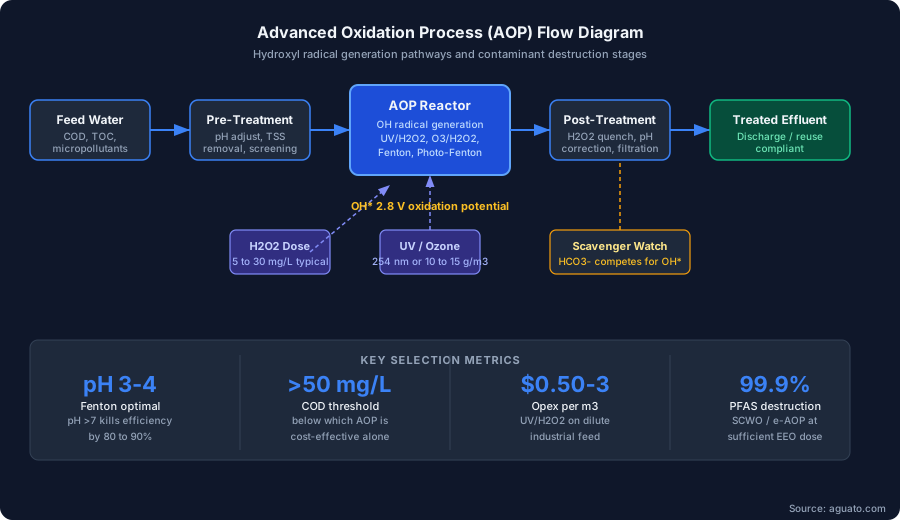
Advanced oxidation processes are a family of chemical and photochemical treatment methods that generate highly reactive hydroxyl radicals (OH*) in solution to non-selectively oxidise and mineralise organic contaminants that resist conventional biological or physical-chemical treatment. The hydroxyl radical sits at 2.8 volts of oxidation potential, roughly 1.5x stronger than ozone and 2.0x stronger than hydrogen peroxide alone, which is why AOP can destroy compounds that pass through activated sludge, GAC adsorption, and membrane filtration unchanged.
What makes the technology genuinely valuable, and genuinely expensive, is that same non-selectivity. The hydroxyl radical does not discriminate between PFAS, pharmaceuticals, and dissolved bicarbonate. Every milligram of alkalinity, dissolved organic carbon, or suspended solids that competes for OH* is wasted reagent cost. A poorly characterised feed water can multiply the hydrogen peroxide or ozone demand three to five times over the theoretical stoichiometric requirement, which translates directly into operating cost that was never in the project budget.
A pattern that recurs in industrial installations is that operators spec AOP as a standalone polishing stage without fully characterising the inorganic scavenger load first. Alkalinity above 200 mg/L as CaCO3 can cut effective OH* yield by 60 to 80%, meaning you are spending $3 per cubic metre to achieve what a properly engineered system would deliver for $0.80. The feed-water matrix analysis is not optional; it is the central number in every AOP business case.
The chemistry was first formalised in the 1980s, but industrial deployment at scale has accelerated sharply since 2015 as PFAS, pharmaceutical active compounds (PACs), and endocrine-disrupting chemicals (EDCs) entered discharge consent frameworks. [The US EPA's revised contaminant candidate list and PFAS National Primary Drinking Water Regulation (2024)](dofollow:https://www.epa.gov/sdwa/and-polyfluoroalkyl-substances-pfas) establishes maximum contaminant levels at 4 ng/L for PFOA and PFOS, a target that makes AOP the only credible treatment option for impacted sites.
## The hydroxyl radical: power and limitation
The hydroxyl radical has a half-life measured in microseconds in aqueous solution. It reacts at near-diffusion-limited rates with most organic molecules (rate constants of 10^8 to 10^10 M-1 s-1), which is the source of the technology's remarkable destruction efficiency. The limitation is that it must be generated continuously, on-site, from a precursor: hydrogen peroxide decomposed by UV light, ozone catalysed by peroxide or UV, an [iron](/elements/iron)-catalysed Fenton reaction, or an electrochemical anodic oxidation.
Each generation pathway has a different sensitivity to feed-water matrix. This is where most AOP specifications go wrong. Turbid feed water blocks UV penetration, cutting photon delivery to the H2O2 molecule and collapsing radical yield. High bicarbonate scavenges OH* faster than the target contaminant can be oxidised. High iron and manganese in a UV/H2O2 system deposit on the lamp sleeve and drop UV transmittance by 20 to 40% within 90 days if sleeve cleaning is not automated.
The opinionated view: AOP is a polishing technology, not a workhorse. Specifying it on high-strength waste is like using a scalpel to fell a tree. Pre-treat to below COD 500 mg/L with biological or coagulation-sedimentation steps first, then deploy AOP on the dilute, low-scavenger residual. Every dollar spent on upstream treatment quality reduces AOP operating cost by two to four dollars on a lifecycle basis.
## The four main AOP configurations for industrial use
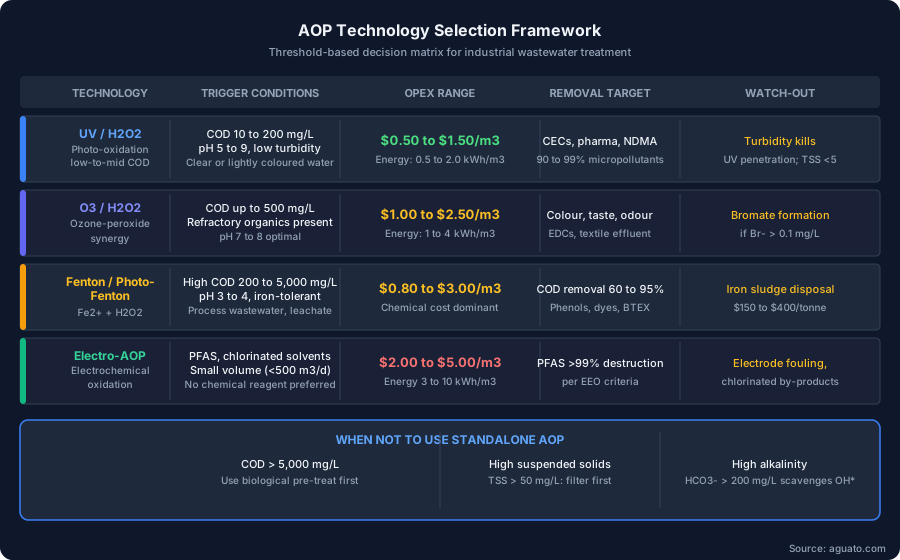
UV/H2O2 is the most widely deployed advanced oxidation process in industrial settings. UV radiation at 254 nm photolyses hydrogen peroxide into two hydroxyl radicals. Typical H2O2 doses run 5 to 30 mg/L on clean industrial feed; actual demand depends on the UV transmittance of the feed water and the target EEO (electrical energy per order of magnitude) reduction. Capital cost for a packaged UV/H2O2 reactor system runs $120,000 to $600,000 for capacities of 100 to 1,000 m3/day, with operating costs of $0.50 to $1.50 per m3 on low-turbidity, low-alkalinity feed.
Ozone-based AOP (O3/H2O2 or O3/UV) uses ozone either alone or catalysed by peroxide or UV to generate OH*. Ozone alone at neutral pH generates some OH*, but the O3/H2O2 combination achieves substantially higher radical yields by accelerating the ozone decomposition pathway. This configuration handles higher COD loads (up to 500 mg/L) and is the preferred route for colour and odour removal in textile and food-and-beverage effluent. Capital cost for a 500 m3/day ozone-AOP system runs $400,000 to $1,200,000 including the ozone generator, contact vessel, and off-gas destruct. Operating cost: $1.00 to $2.50 per m3.
Fenton and Photo-Fenton reactions use ferrous iron (Fe2+) as a catalyst for hydrogen peroxide decomposition. The reaction is highly efficient at low pH (3 to 4), making it suitable for acidic industrial wastewater such as leachate, chemical plant effluent, and high-strength process streams with COD up to 5,000 mg/L. The major disadvantage is iron sludge generation: 0.5 to 2 kg of iron-hydroxide sludge per cubic metre treated, at disposal costs of $150 to $400 per tonne. Photo-Fenton (adding UV) extends effectiveness to near-neutral pH but at higher energy cost. Operating cost: $0.80 to $3.00 per m3 before sludge disposal.
Electro-AOP (electrochemical oxidation) generates OH* at a boron-doped diamond (BDD) or mixed metal oxide (MMO) anode without chemical reagents. It is the only AOP technology capable of reliably destroying PFAS to below 4 ng/L (per EPA MCL) because the anodic OH* attacks the fluorocarbon backbone directly. Energy consumption is high at 3 to 10 kWh/m3, and electrode fouling on chloride-rich streams generates chlorinated by-products that require monitoring. Capital cost: $500,000 to $2,000,000 for 50 to 200 m3/day capacity. For low-volume, high-value PFAS destruction the economics can still work; the numbers fail at high flow rates.
[Contact qualified providers who have scoped AOP systems on your specific contaminant matrix](/post-project) before committing capital. AOP sizing is feed-water-specific; catalogue numbers mislead badly.
[cta:nepti-dark]
## When AOP is necessary versus when it is overkill
AOP is necessary when you face contaminants that are non-biodegradable, non-adsorbable onto carbon at a cost-effective regeneration cycle, and present at concentrations that exceed your discharge consent. The shortlist: PFAS, certain pharmaceutical actives (notably certain cytostatics and hormones), NDMA, some chlorinated solvents, 1,4-dioxane, and highly recalcitrant industrial dyes. None of these are reliably mineralised by conventional biological treatment operating at reasonable hydraulic retention times.
AOP is overkill when: your target compound is biodegradable and you simply have not optimised your biological system; your COD is above 1,000 mg/L (AOP on high-strength waste is prohibitively expensive per unit COD removed); or your discharge consent is achievable with GAC polishing at $0.10 to $0.30 per m3 versus AOP at $1 to $3 per m3. A surprisingly common scenario encountered in consulting is a facility spending $400,000 per year on UV/H2O2 to meet a total organic carbon limit that could be met by reactivating an idle GAC column already on site.
The ESG framing is compelling but can mislead: AOP generates measurable sustainability credentials (low sludge, no concentrated brine, genuine contaminant mineralisation rather than phase transfer) but only if the process is correctly applied. Installing AOP as a visible sustainability investment without a rigorous process rationale simply shifts cost to shareholders while adding complexity that can fail.
[Explore disinfection and oxidation providers on the Aguato marketplace](/industrial-water-disinfection) to benchmark what suppliers are quoting for your contaminant class.
## Threshold-based decision framework
The decision to deploy AOP hinges on five parameters. Use these cut-points before engaging vendors.
COD of feed entering AOP stage: If COD exceeds 500 mg/L, pre-treat biologically or with coagulation/sedimentation first. Running UV/H2O2 on 2,000 mg/L COD feed inflates operating cost by 8 to 12x versus running it on 150 mg/L COD feed. If COD is below 50 mg/L and your only target is a trace micropollutant, UV/H2O2 is usually the most cost-effective route.
Alkalinity (bicarbonate and carbonate): If total alkalinity exceeds 200 mg/L as CaCO3, OH* scavenging by HCO3- will dominate the radical consumption. Either reduce alkalinity with acidification or switch to an ozone-based system where ozone itself contributes to contaminant degradation independently of OH*.
Turbidity and suspended solids: For UV-based systems, TSS must be below 5 mg/L and UV transmittance above 70% at 254 nm. Above these thresholds, UV dose delivery collapses and H2O2 consumption escalates. Screen and filter before the AOP reactor.
Target compound and its treatability class: PFAS requires electro-AOP or SCWO (supercritical water oxidation) for genuine mineralisation. Pharmaceuticals and NDMA are well-served by UV/H2O2. High-COD process streams with phenols and BTEX suit Fenton. Refractory colour and ODC: ozone-AOP.
Discharge consent stringency: If the limit is above 100 ng/L for your target compound, GAC adsorption may achieve compliance at lower cost. AOP becomes necessary when limits drop below 10 to 50 ng/L for micropollutants that break through GAC rapidly.
The [EU Industrial Emissions Directive revision (2022)](dofollow:https://eur-lex.europa.eu/legal-content/EN/TXT/?uri=CELEX%3A32022L0362) has introduced emerging contaminant monitoring obligations that translate into tighter site-specific discharge permits across member states from 2024 onward, meaning many facilities that passed their last permit renewal without AOP will need to re-evaluate at the next renewal cycle.
## Capital and operating costs: what to actually budget
The table below gives real ranges for the four main configurations. All costs are USD and assume a 500 m3/day flow rate on industrial effluent with moderate pre-treatment.
| Technology | Capex (500 m3/d) | Opex per m3 | Risk | Best For | |---|---|---|---|---| | UV / H2O2 | $180,000 to $500,000 | $0.50 to $1.50 | Low: lamp fouling, H2O2 residual | Trace micropollutants, NDMA, pharma effluent | | O3 / H2O2 (ozone-AOP) | $450,000 to $1,200,000 | $1.00 to $2.50 | Medium: bromate if Br- present; off-gas safety | Colour, EDCs, textile, food and beverage | | Fenton / Photo-Fenton | $120,000 to $400,000 | $0.80 to $3.00 | Medium: iron sludge disposal; pH adjustment | High-strength acid wastewater, leachate | | Electro-AOP (BDD) | $500,000 to $2,000,000 | $2.00 to $5.00 | High: electrode fouling, chlorinated by-products | PFAS destruction, small high-value volumes | | GAC polishing (baseline) | $60,000 to $200,000 | $0.10 to $0.30 | Low: regeneration frequency vs breakthrough | Adsorbable organics, conservative limits | | Biological polishing (baseline) | $80,000 to $350,000 | $0.05 to $0.20 | Low: HRT sensitivity, inhibitory compounds | Biodegradable COD, BOD-limited consent |
A procurement lead reviewing this table should extract the central trade-off: AOP costs 5 to 25x more per cubic metre than biological polishing and 3 to 10x more than GAC, which is defensible if and only if the target contaminant cannot be managed by those cheaper alternatives. The CAPEX ranges are wide because AOP sizing is feed-water-specific. A detailed treatability study ($15,000 to $50,000) before CAPEX approval is not a nice-to-have; it typically cuts equipment sizing by 20 to 40% and CAPEX by $100,000 to $300,000 on a mid-sized installation.
## Failure scenarios and what they cost
Scenario 1: Specifying UV/H2O2 without alkalinity control. A specialty chemicals plant installs a 300 m3/day UV/H2O2 system targeting 90% removal of a refractory intermediate. Feed water alkalinity is 280 mg/L. The system achieves only 35 to 40% removal because bicarbonate is scavenging 70% of the hydroxyl radical before it contacts the target compound. Decision: oversized H2O2 dose and increased lamp power. Operational outcome: H2O2 consumption triples, energy increases 2.5x, operating cost rises from a budgeted $1.20/m3 to $3.80/m3. Discharge consent is still not met. Correct decision: reduce feed alkalinity to below 80 mg/L with acidification ($0.05/m3 additional cost) or switch to an O3-based configuration where ozone contributes directly to COD oxidation independent of OH* scavenging. Cost of wrong decision: $280,000 in excess annual operating cost plus $90,000 in capital modifications.
Scenario 2: Deploying Fenton on a variable-pH stream. A metal-finishing facility uses Fenton oxidation to treat rinse water containing EDTA-chelated heavy metals and organic complexants. Influent pH fluctuates between 2.5 and 8.5 across shifts due to inconsistent upstream process control. At pH above 5, ferrous iron precipitates and the reaction collapses to near-zero efficiency. Decision: proceed without pH buffering. Operational outcome: treatment efficiency varies 10 to 90% across shifts, spot-check sampling catches a discharge event at COD 840 mg/L against a consent limit of 150 mg/L. Regulatory notice of violation: $40,000. Capital remediation to add pH dosing and buffering: $65,000. Correct decision: install inline pH monitoring and automated acid-dosing at the AOP inlet at a capital cost of $18,000.
Scenario 3: Using AOP alone on high-COD landfill leachate. A waste management operator installs O3/H2O2 as the primary treatment stage for fresh leachate with COD 8,000 mg/L. Ozone demand is 4.5x higher than the pilot study (which used aged, partially stabilised leachate) because fresh leachate contains high fulvic acid and ammonium that compete for ozone. Operating cost runs $9.20/m3 against a budgeted $2.50/m3. Decision: run the system at reduced ozone dose to control cost. Operational outcome: COD removal drops to 28%, BOD/COD ratio remains too low for the planned downstream biotreatment. The biological system fails to nitrify consistently, and total nitrogen limits are breached. Correct decision: pre-treat with coagulation-flocculation and sedimentation to reduce COD to 2,000 mg/L before AOP, then route to biological treatment. Cost of wrong decision: $1.1M in excess operating cost over 24 months before the treatment train was redesigned.
These are not edge cases. They are the three most common failure modes encountered when facilities move from pilot data to full-scale operation without adequately characterising the variation in feed-water composition across seasons and production cycles.
## Real-world examples across three industries
Pharmaceutical manufacturing (Germany). A generics API plant faced a consent limit of 0.1 mg/L for a recalcitrant synthetic intermediate in its combined process effluent. Biological treatment achieved 60% removal; GAC achieved 85% but required monthly regeneration at $22,000 per cycle. UV/H2O2 at 40 mJ/cm2 with 20 mg/L H2O2 achieved 99.2% removal on a 180 m3/day stream with UV transmittance of 78%. Operating cost: $0.95/m3. Trade-off: UV sleeve fouling by iron and manganese required automated CIP every 21 days; without it, UV transmittance dropped from 78% to 48% within six weeks and removal fell to 72%. The CIP system added $28,000 to the capital cost but was the item that made the system reliable. Why it worked: the feed was low-alkalinity (68 mg/L) and low-turbidity after biological clarification.
PFAS-impacted groundwater remediation (US Midwest). A manufacturing site with PFOA at 420 ng/L in extracted groundwater required treatment to below the EPA 4 ng/L MCL. UV/H2O2 achieved only 60% removal (final concentration 168 ng/L) because PFOA is notoriously resistant to OH* attack at the ether-fluorocarbon bond. Electro-AOP with a BDD anode array at 8 kWh/m3 reduced PFOA to 2.1 ng/L on a 45 m3/day system. Capital cost: $780,000. Operating cost: $4.20/m3. Trade-off: the high energy cost was justified by the liability value of regulatory compliance. Without treatment, monitored natural attenuation modelling indicated consent would not be met for 40+ years, and the EPA had issued a compliance schedule with $37,500/day penalties for non-compliance.
Textile dyehouse (Turkey, EU-export compliant). A woven fabric finisher producing reactive-dye effluent at 400 to 800 mg/L colour (Pt/Co) and COD 1,200 mg/L required decolouration for a major EU retailer's wastewater audit. O3/H2O2 at 15 mg/L ozone and 8 mg/L H2O2 reduced colour by 96% and COD by 52% at a cost of $1.65/m3 on the 600 m3/day discharge. Trade-off: the 52% COD removal was insufficient for consent compliance alone; a downstream biotreatment polishing step (MBBR, $180,000 capital) was required to meet the 90 mg/L COD limit. Why it worked: ozone-AOP mineralised the chromophore structures that caused colour, reducing the biological oxygen demand enough for the biofilm reactor to complete mineralisation without inhibition. A standalone ozone dose at the same capital cost achieved only 60% colour removal because without peroxide the reaction was ozone-direct rather than OH*-mediated.
[Browse water treatment chemical providers and AOP specialists](/water-treatment-chemical-companies) to find vendors who have worked on your specific effluent type.
## Combining AOP with biological and membrane treatment
AOP almost always performs better as part of a hybrid treatment train than as a standalone stage. The pattern that achieves the best cost-per-unit-removal is: biological treatment to reduce biodegradable COD to below 150 mg/L, followed by membrane filtration (UF or MF) to achieve TSS below 5 mg/L and prepare the AOP feed, followed by AOP for refractory-compound destruction, followed by granular activated carbon polishing to scavenge residual H2O2 and any AOP by-products.
Membrane filtration before AOP is particularly valuable for UV-based systems. A UF permeate typically delivers UV transmittance of 85 to 92% at 254 nm compared to 50 to 70% for clarified-but-unfiltered secondary effluent. That transmittance improvement reduces the UV dose required by 30 to 40% and cuts the H2O2 demand proportionally, translating to a 25 to 35% reduction in AOP operating cost. The UF system pays for itself in AOP reagent savings within 18 to 36 months on flows above 200 m3/day.
[The Aguato guide to industrial wastewater treatment processes](/resources/industrial-wastewater-treatment-process) covers the full treatment train architecture and how to sequence technologies for cost-optimised compliance. For PFAS specifically, the decision framework in [our PFAS removal guide](/resources/pfas-removal-water-treatment) sets out the comparative performance data across treatment options including AOP, sorbents, and membrane rejection.
Nepti models the full water matrix, including scavenger load, UV transmittance, and target-compound treatability class, to produce a ranked comparison of AOP variants with projected capital and operating costs against your actual feed-water data. This is materially different from vendor sizing tools that assume ideal feed conditions. [See how Nepti models AOP for your site](/nepti).
[The WHO guidance on chemical contaminants in drinking water provides peer-reviewed treatability reference data for most regulated micropollutants](dofollow:https://www.who.int/publications/i/item/9789241549950) and is the most defensible benchmark to cite in a CAPEX approval document when justifying AOP over lower-cost alternatives.
## FAQ
### What are advanced oxidation processes and how do they work in industrial wastewater treatment?
Advanced oxidation processes generate hydroxyl radicals (OH*) in solution to non-selectively destroy organic contaminants that resist biological or physical-chemical treatment. The hydroxyl radical at 2.8 V oxidation potential attacks carbon-[hydrogen](/elements/hydrogen), carbon-carbon, and carbon-fluorine bonds, mineralising refractory compounds to CO2, water, and inorganic salts. Industrial AOP configurations include UV/H2O2, O3/H2O2, Fenton reaction, and electro-AOP, each suited to different feed-water matrices and contaminant classes.
### When is AOP necessary versus when is GAC or biological treatment sufficient?
AOP is necessary when target compounds are non-biodegradable, non-adsorbable at economically viable GAC regeneration cycles, and present at concentrations that exceed discharge consent limits. If your target compound is biodegradable, optimise biological HRT and loading first. If it adsorbs well onto activated carbon and your consent limit is above 100 ng/L, GAC at $0.10 to $0.30/m3 is almost always cheaper than AOP at $0.50 to $5/m3. AOP becomes the necessary choice for PFAS below 10 ng/L, NDMA, certain pharmaceuticals, and chlorinated solvents with restricted biodegradability.
### What is the operating cost of UV/H2O2 AOP per cubic metre?
UV/H2O2 AOP runs $0.50 to $1.50 per m3 on well-characterised low-turbidity, low-alkalinity industrial feed. Energy accounts for 40 to 60% of that figure (0.5 to 2.0 kWh/m3); hydrogen peroxide at 5 to 30 mg/L dose accounts for most of the rest. Feed water with alkalinity above 200 mg/L or TSS above 5 mg/L can increase operating cost three to five times over design because of OH* scavenging and UV transmittance loss. A treatability study before final sizing is the most cost-effective investment in an AOP project.
### Can AOP destroy PFAS compounds?
Conventional UV/H2O2 AOP achieves limited PFAS destruction because the carbon-fluorine bond is highly resistant to OH* attack. Electro-AOP with a boron-doped diamond anode and supercritical water oxidation (SCWO) are the only technologies that achieve greater than 99% PFAS mineralisation reliably. Electro-AOP at 8 kWh/m3 on a 45 m3/day system has been demonstrated to reduce PFOA from 420 ng/L to below 2 ng/L, meeting the 4 ng/L EPA MCL. For PFAS-impacted groundwater or process water, the [EPA PFAS treatment technology guide](dofollow:https://www.epa.gov/pfas/drinking-water-treatment-technologies-pfas) provides the most current performance benchmarks.
### What pre-treatment does AOP require?
AOP requires feed water with TSS below 5 mg/L, UV transmittance above 70% (for UV-based systems), and ideally alkalinity below 150 mg/L as CaCO3. In practice this means AOP almost always sits downstream of biological treatment and membrane filtration (UF or MF) in an industrial treatment train. Skipping pre-treatment and sending high-strength, turbid, or high-alkalinity feed directly to AOP is the most reliable way to blow the operating budget.
### What are the main risks and failure modes of industrial AOP systems?
The most common failures are OH* scavenging by alkalinity, UV transmittance loss from lamp fouling, and incorrect sizing based on pilot data that does not reflect full-scale feed variability. Fenton systems additionally suffer from iron sludge disposal costs that were underestimated in the OPEX model, and electro-AOP systems suffer electrode fouling on high-chloride feeds that generates chlorinated by-products. All of these are manageable with proper feed characterisation and instrumentation, but none can be engineered out after the system is built.
### How do I choose between UV/H2O2, ozone-AOP, Fenton, and electro-AOP for my site?
The choice is primarily driven by feed COD level, target contaminant class, and available utilities, not by a generic technology preference. Use UV/H2O2 for trace micropollutants on clean, low-alkalinity feed (COD below 200 mg/L). Use O3/H2O2 for colour, EDCs, and moderate COD (up to 500 mg/L) where bromate formation risk is managed. Use Fenton for high-strength acid streams (COD 200 to 5,000 mg/L) where iron sludge disposal is acceptable. Use electro-AOP only for PFAS or other fluorinated compounds in small, high-value volumes where the $2 to $5/m3 operating cost is justified by the regulatory liability it eliminates.