UV vs chlorination is the disinfection decision most industrial sites get wrong. Wrong choice risks $500,000+ Legionella incidents or batch failures. Full cost and framework inside.
Choosing between UV vs chlorination is one of the most consequential water treatment decisions an industrial operator makes, and most get it wrong the first time. A pharmaceutical manufacturer that chlorinates its purified water loop exposes every batch downstream to disinfection byproducts it cannot fully remove. A food plant that installs UV on a cooling tower circuit discovers, expensively, that UV offers no residual protection in the 300 metres of pipe between the system and the furthest cooling coil. Each wrong call carries a price tag: regulatory action, product failures, or a Legionella outbreak that costs between $500,000 and $5 million to remediate depending on jurisdiction and severity.
The industry does not help buyers make this decision clearly. A UV equipment supplier will model every scenario as a UV win. A water chemical distributor will frame chlorination as the safe, proven choice. Both arguments have merit in the right context, and neither supplier has a structural incentive to recommend the other technology even when it fits better. The buyer's job is to run the comparison against site-specific data, not to trust a vendor proposal built around the vendor's own product line.
This guide covers how each technology works and why the mechanism matters for your application, the threshold-based decision framework for choosing between UV, chlorination, or a combined approach, full CAPEX and OPEX benchmarks with real cost ranges, the failure modes that produce the worst outcomes in each approach, sector-level examples from food processing and pharmaceutical manufacturing, and the CFO-level case for getting the decision right the first time.
## The decision in brief
- Choose disinfection to avoid one incident. A decision that avoids one Legionella outbreak investigation or one pharmaceutical batch failure pays back its entire 10-year capital and operating cost. - Price the incident, not the OPEX. The financial cost of a confirmed Legionella incident in an industrial setting runs $500,000 to $5 million once legal fees, remediation, regulatory response and reputational damage are included. - Specify for the application. Specifying the right disinfection technology for your application, with validated dose, the correct residual strategy and independent engineering oversight, eliminates that exposure entirely.
The biggest cost of doing nothing is not the incremental OPEX of an under-optimised system. It is the single incident that the wrong system design makes inevitable.
## How UV disinfection works and where it excels
UV disinfection inactivates pathogens by delivering ultraviolet light at 254 nm directly into a water stream as it passes through a reactor chamber. The UV photons damage the DNA and RNA of bacteria, viruses, and protozoa at the molecular level, preventing replication without introducing any chemical into the water. The key performance metric is UV dose, expressed in millijoules per square centimetre (mJ/cm2), which is the product of UV intensity and contact time.
The mechanism has a critical practical implication: UV disinfection requires low-turbidity water to work. Suspended solids, colour, and [iron](/elements/iron) all absorb UV energy before it reaches a target organism, reducing the effective dose. The practical threshold is a UV transmittance (UVT) of at least 75%, which corresponds to roughly 1 NTU turbidity or less. A system specified for clear pre-filtered water and then fed turbid raw water will deliver a fraction of its rated dose and produce undertreated effluent while the operator believes the system is working.
For industrial [water disinfection applications](/industrial-water-disinfection), UV offers three advantages that chlorination cannot match: it provides excellent inactivation of chlorine-resistant protozoa including Cryptosporidium and Giardia at a dose of 40 mJ/cm2, it generates no disinfection byproducts (DBPs), and it requires no chemical storage or handling on site. On a 2,000 m3/day food-grade process water system, eliminating chemical handling alone reduces site safety overhead by $15,000 to $30,000 per year in training, storage compliance, and handling labour.
The limitation that trips up most engineering teams is that UV leaves no residual. The moment water leaves the UV reactor and enters a pipe network, microbial growth can resume. UV is a point-of-treatment technology, not a distribution technology.
[cta:nepti-dark]
For pharmaceutical manufacturing loops, semiconductor fab water, and RO permeate polishing, the absence of residual is irrelevant because the water is consumed or used immediately after treatment. For a large cooling tower circuit with 200 metres of pipe and a basin that sits warm for extended periods, the absence of residual is a design-limiting constraint that forces a different choice or a combined approach.
Browse verified [water disinfection providers](/water-disinfection-companies) and filter by UV technology and industry sector to find specialists with relevant project experience before you finalise your design.
## How chlorination works and where it fits
Chlorination adds a controlled dose of [chlorine](/elements/chlorine), as sodium hypochlorite (liquid bleach), calcium hypochlorite (granular), or gaseous chlorine, to water to create hypochlorous acid (HOCl) and hypochlorite ion (OCl-). Hypochlorous acid is the active disinfectant. Its ratio to the less effective hypochlorite ion is pH-dependent, which is why chlorination systems that do not also control pH often underperform their design specification.
The defining commercial advantage of chlorination is the residual. Free chlorine at 0.2 to 0.5 mg/L persists through a distribution network, suppressing regrowth throughout the piping system. This makes chlorination the standard approach for cooling tower water treatment, large process water distribution loops, and any application where water travels significant distances from the disinfection point to the use point. For facilities already managing complex [cooling tower water treatment](/cooling-tower-treatment) programmes, chlorination integrates directly into existing chemical management workflows.
Chlorination is also a mature, well-understood technology. Equipment costs are low, operators are familiar with it, and regulatory frameworks for drinking water and industrial use are built around it. For a procurement team under time and budget pressure, sodium hypochlorite dosing systems start at $3,000 to $15,000 installed for smaller flows and scale to $25,000 to $40,000 for larger industrial circuits.
The commercial risk that chlorination carries is the formation of disinfection byproducts. When chlorine reacts with naturally occurring organic matter in water, it produces trihalomethanes (THMs), haloacetic acids (HAAs), and other regulated compounds. The [WHO guidelines for drinking water quality](dofollow:https://www.who.int/publications/i/item/9789241549950) set THM limits at 300 micrograms per litre total for chloroform and related compounds, but industrial process water exposed to organic-rich feed can exceed these concentrations under normal chlorination conditions. For a food or pharmaceutical process, a THM exceedance is not a compliance footnote. It is a product contamination event.
A pattern that recurs across industrial sites: operators increase chlorine dose when they see persistent bacterial counts, which increases DBP formation, which then creates a different compliance problem. The correct response is usually to address the biofilm source rather than the chlorine dose.
## UV vs chlorination: direct technology comparison
The right technology choice depends on feed water quality, application type, distribution geometry, and the regulatory regime governing the process. No single technology is universally superior.
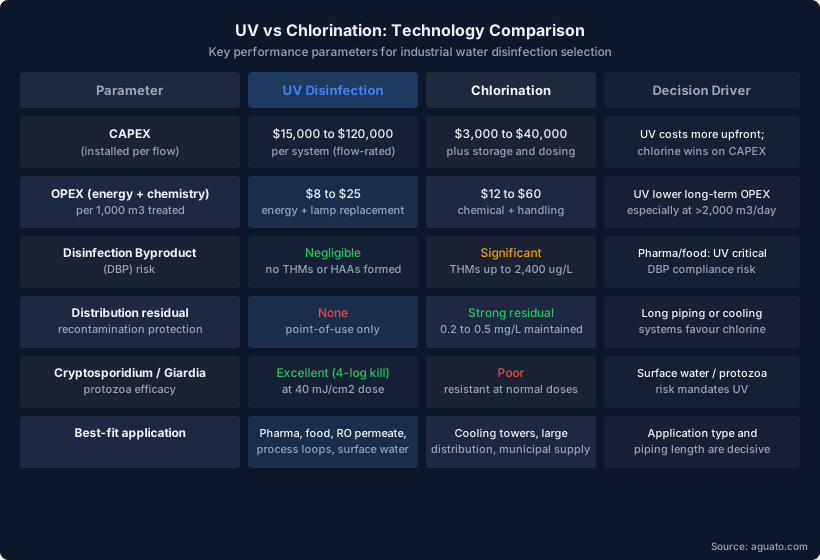
| Parameter | UV Disinfection | Chlorination | Verdict | |---|---|---|---| | CAPEX (installed) | $15,000 to $120,000 | $3,000 to $40,000 | Chlorine lower upfront | | OPEX per 1,000 m3 | $8 to $25 | $12 to $60 | UV lower at scale | | DBP formation | None | Significant (THMs, HAAs) | UV cleaner | | Distribution residual | None | Strong (0.2 to 0.5 mg/L) | Chlorine essential for long loops | | Cryptosporidium kill | Excellent (4-log at 40 mJ/cm2) | Poor (resistant at normal dose) | UV required for protozoa | | Chemical handling | None | Required (storage, dosing) | UV safer operationally | | Water quality sensitivity | Turbidity and UVT-sensitive | pH-sensitive | Both require monitoring | | Regulatory maturity | Growing acceptance | Fully established | Chlorine broader base | | Best-fit application | Pharma, food, RO permeate | Cooling towers, long distribution | Application-driven |
The comparison table shows that no technology dominates across all parameters. A procurement lead using this table can identify the two or three rows most material to their application and weight the decision accordingly. A pharmaceutical water loop prioritises the DBP row and the residual row differently than a cooling tower circuit does. Vendors will not make this distinction for you.
## Decision framework: which technology fits your site
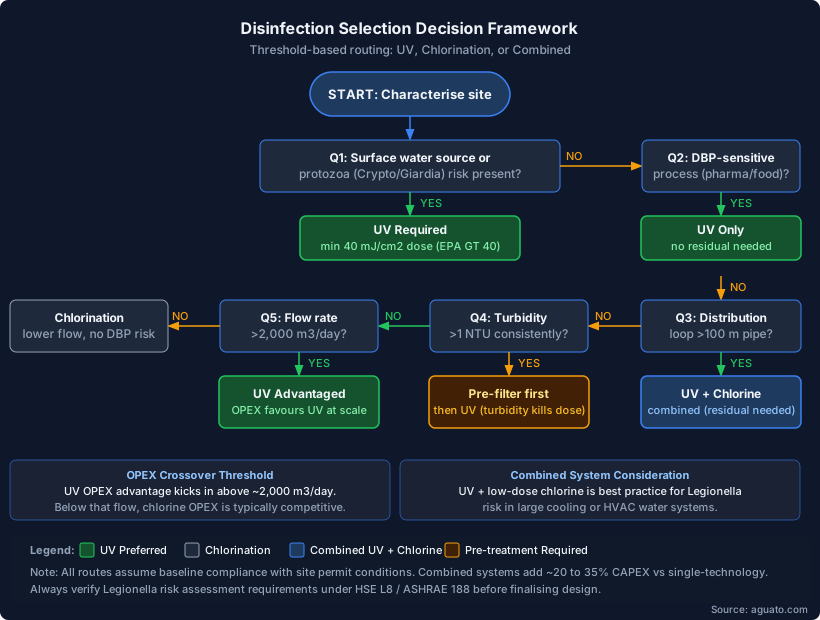
The first and most important question is not which technology is better, but what you are actually protecting against. The answer determines both the technology choice and the dose or concentration required.
If your source water is surface water or has documented protozoa risk, UV is not optional. Chlorine cannot reliably inactivate Cryptosporidium parvum at safe residual concentrations. The [EPA UV Disinfection Guidance Manual](dofollow:https://www.epa.gov/ground-water-and-drinking-water/ultraviolet-disinfection-guidance-manual) sets the validated dose requirements for Cryptosporidium and Giardia inactivation, with 10 mJ/cm2 for 3-log Giardia reduction and 10 mJ/cm2 for 4-log Cryptosporidium reduction on validated systems. This is non-negotiable in food, beverage, and pharmaceutical applications that draw from surface or surface-influenced sources.
If your application is DBP-sensitive, chlorination is the wrong primary technology. Pharmaceutical water for injection (WFI), food-contact surfaces, and beverage process water all operate under product specifications or regulatory frameworks that are incompatible with chronic THM exposure at chlorination-treatment concentrations.
If your distribution system is long or complex, UV alone will not hold. Any piping network over roughly 100 metres, or any system with a warm basin or reservoir downstream of the treatment point, requires either chlorine residual or a combined approach. Bacteria that survive in biofilm inside the pipe will not be touched by a UV reactor installed at the inlet.
The threshold-based routing works as follows. For Legionella risk in cooling or HVAC water systems where [biofilm control in industrial water](/resources/biofilm-control-industrial-water) is a primary concern, a combined approach is best practice: UV reduces the bulk microbial load and inactivates chlorine-resistant organisms, while a low-dose biocide maintains residual suppression in the circuit. This combination lets operators run lower total chemical dose, reducing both DBP formation and cost.
Not sure which configuration fits your site? [Post your project](/post-project) and qualified disinfection specialists will scope the trade-off against your actual feed water chemistry, flow rates, and regulatory requirements.
For flow rates above 2,000 m3/day on clean pre-filtered water, UV OPEX becomes clearly advantaged over chlorination. The crossover point depends heavily on electricity costs and chemical pricing in your region, but as a rule of thumb, UV begins to win on total lifecycle cost above that flow threshold when water quality is adequate. Below 500 m3/day on groundwater without organic load and with a simple point-of-use circuit, chlorination remains the lower-cost choice across both CAPEX and OPEX.
## CAPEX and OPEX: what each technology actually costs
Cost modelling for disinfection is frequently done badly. Projects compare UV CAPEX to chlorination CAPEX and declare chlorination cheaper, without accounting for the ten-year chemical bill, the Legionella liability premium, or the product batch failure risk that a DBP exceedance can produce.
### UV system costs
A small UV system sized for 100 m3/hour with a validated dose of 40 mJ/cm2 costs $15,000 to $35,000 installed. A mid-range industrial UV system for 500 m3/hour runs $40,000 to $80,000. Large-scale UV systems for municipal or large-industrial service ranging from 1,000 to 5,000 m3/hour fall between $80,000 and $300,000 depending on validation requirements and bypass configuration.
OPEX breaks down as follows. Energy consumption for a medium-pressure UV system runs 0.01 to 0.04 kWh per m3 at typical industrial doses, which at $0.12/kWh translates to $1.20 to $4.80 per 1,000 m3. Low-pressure lamps, which are more energy-efficient, reduce energy cost by 20 to 40% versus medium-pressure but require more lamps for equivalent dose in high-flow applications. Lamp replacement for a typical industrial system costs $200 to $800 per lamp and lamps run 8,000 to 12,000 hours before needing replacement, so annual lamp costs on a 4-lamp system are $400 to $1,200. Sleeve cleaning and quartz sleeve replacement add $300 to $800 per year on most systems. Total OPEX including energy, lamps, and maintenance runs $8 to $25 per 1,000 m3 on systems operating within their design envelope.
### Chlorination system costs
A sodium hypochlorite dosing system for a small circuit up to 50 m3/hour costs $3,000 to $12,000 installed. A mid-range system with automated amperometric control for 200 m3/hour costs $15,000 to $30,000. For on-site generation of hypochlorite (electrolytic chlorination), which eliminates chemical delivery logistics, installed cost runs $40,000 to $150,000 depending on capacity, with OPEX primarily in salt and electricity.
Bulk sodium hypochlorite for industrial use costs $0.30 to $0.60 per kilogram of available chlorine (as 12% solution). At a typical dose of 2 to 5 mg/L for primary disinfection, chemical cost runs $5 to $15 per 1,000 m3 treated. Where higher doses are needed for biofilm control or shock treatment, costs rise to $20 to $60 per 1,000 m3. pH adjustment chemicals (sodium hydroxide or sulphuric acid to maintain optimal pH 6.5 to 7.5) add $3 to $8 per 1,000 m3 on systems with variable feed water alkalinity. Total OPEX for a well-managed chlorination system runs $12 to $40 per 1,000 m3 under normal operating conditions, rising to $40 to $60 per 1,000 m3 on difficult source water.
### Payback on the UV premium
A site treating 1,500 m3/day that switches from chlorination to UV for a DBP-sensitive application pays a CAPEX premium of roughly $25,000 to $60,000. At an OPEX saving of $15 to $35 per 1,000 m3, annual OPEX saving is $8,200 to $19,200. Payback runs 1.5 to 7 years depending on CAPEX premium and flow volume. On higher-flow sites, payback is faster and the NPV advantage of UV grows significantly over a 10 to 15-year asset life. For a capital project team putting together a defensible technology selection, the lifecycle cost comparison over ten years almost always closes the gap between UV and chlorination, and often inverts it.
## Disinfection byproducts and regulatory risk
Disinfection byproducts are the most underestimated operational risk in chlorination-based industrial water systems, particularly in food, beverage, and pharmaceutical processing.
When chlorine reacts with humic substances, fulvic acids, and other natural organic matter in source water, it produces a family of compounds collectively classified as DBPs. The most common and regulated are trihalomethanes (chloroform, bromodichloromethane, dibromochloromethane, and bromoform) and haloacetic acids. Both are classified as potential human carcinogens at chronic exposure levels, and both are regulated in drinking water across the EU, US, and most other jurisdictions.
For industrial process water used in food or pharmaceutical manufacturing, the risk is product contamination. A batch produced with process water containing THMs at 200 to 500 micrograms per litre may not meet finished product specifications, particularly where water directly contacts product. Contamination events of this type result in batch rejections, regulatory investigations, and customer notification that have cost food manufacturers $2 million to $15 million per incident when regulatory action and brand damage are included.
UV disinfection produces no THMs or HAAs. This is not because UV is a "natural" technology in any marketing sense, but because UV does not add any reactive chemical to the water. The photochemical mechanism damages microbial DNA without producing halogenated organic compounds. For applications where DBP exposure is a compliance risk, this is the decisive argument for UV regardless of the CAPEX premium.
The right answer depends on your feed water organic load and regulatory regime. [Connect with engineering consultants](/consulting-services) who specialise in industrial water treatment compliance to get a DBP risk assessment before locking in disinfection technology.
## Legionella and biofilm: where the choice becomes critical
Legionella pneumophila is the failure mode that turns a disinfection system decision into a criminal liability question. Every major Legionella outbreak investigation ultimately reveals two failures: inadequate residual disinfection in the distribution circuit, and a biofilm community established in the piping that protected Legionella from whatever treatment was being applied.
UV alone cannot control a Legionella risk in a large cooling or HVAC water circuit. The reason is simple: UV treats water passing through the reactor but has no effect on biofilm attached to pipe walls, on organisms in standing water in basin corners, or on water in dead legs that may not flow through the UV chamber regularly. A correctly dosed UV system in series with a Legionella risk management programme and low-dose residual biocide is best practice.
[HSE guidance on Legionella risks in water systems](dofollow:https://www.hse.gov.uk/legionnaires/legionella-risks-water-systems.htm) and ASHRAE 188 in the US both recognise UV as a supplementary control measure rather than a standalone Legionella control technology in cooling water systems. The engineering rationale is the absence of residual: Legionella that re-enters the circuit after the UV treatment point, whether from an air intake, a make-up water source, or an upstream dead zone, faces no barrier to colonisation.
For a proper Legionella programme, the starting point is a documented [Legionella risk assessment](/resources/legionella-risk-assessment) that maps the circuit, identifies dead legs and warm zones, and sets the control parameters. Disinfection technology selection follows from that assessment, not the other way around.
Across projects where cooling towers were managed on UV alone without residual biocide, a consistent pattern emerges: Legionella counts remain below action levels during clean-circuit phases, then spike within 4 to 8 weeks when fouling begins to establish in basin dead zones or poorly flushed side arms. The spike is not a UV failure in the strict sense, but it is an outcome failure that the UV-only design cannot prevent. The cost of a remediation programme following a Legionella exceedance in a large industrial site runs $80,000 to $250,000 before legal and regulatory costs.
## Real-world sector patterns
### Food and beverage processing
A large soft drinks concentrate manufacturer drawing surface water from a river abstraction needed to treat 800 m3/day of process water for direct product contact use. The source water had documented Cryptosporidium detections from upstream agricultural runoff. Chlorination was the existing system, running at 3 to 4 mg/L free chlorine after coagulation and sand filtration.
The problem was twofold: THM formation at the chlorination dose needed to address protozoa risk was producing concentrate batches that failed taste panel assessments, with chloroform at concentrations above 80 micrograms per litre contributing a detectable off-taste at the product concentration factor. Simultaneously, a Cryptosporidium-positive batch had prompted a regulator review of the treatment train.
The solution was UV installed downstream of the sand filter at a validated dose of 40 mJ/cm2, reducing chlorine dose to 0.5 mg/L as a downstream residual for distribution. Cryptosporidium risk was eliminated. THM formation dropped from 180 to 220 micrograms per litre to 22 to 35 micrograms per litre. Chemical cost fell by $38,000 per year. The UV system CAPEX was $62,000 installed, giving a payback of under 2 years on chemical savings alone, before accounting for the compliance risk eliminated. The pattern is typical across food and beverage sites drawing from surface sources.
### Pharmaceutical sterile manufacturing
A sterile injectables manufacturer needed to produce water for injection at a new facility. The initial specification included an ozone loop for bulk water purification and UV as a final polishing step before WFI storage. During design review, a value engineering exercise proposed removing the UV step to save $45,000 in CAPEX.
The decision analysis turned on one number: a single batch failure on a sterile injectable product attributed to microbiological contamination costs $800,000 to $2.5 million when manufacturing downtime, QA investigation, regulatory notification, and potential product recall are included. The UV step was retained. The UV system ran for four years without a microbiological exceedance on the WFI loop. The $45,000 "saving" would have represented negative NPV from the first incident.
This is a pattern across pharmaceutical capital projects. The disinfection step that gets value-engineered out is rarely the line item that was actually over-specified. It is the one that looks like a redundancy until it is the only thing standing between a batch and a rejection. Vendors reviewing the engineering specification have no financial interest in flagging this. An independent review does.
## Where industrial disinfection projects fail
Disinfection system failures in industrial settings follow predictable patterns. Understanding the failure modes before selection prevents the most expensive outcomes.
UV dose inadequacy from turbidity exceedance. UV systems specified for pre-filtered water frequently operate outside their validated dose range when pre-treatment performance degrades. A 0.5 NTU increase in inlet turbidity reduces available UV dose by 15 to 25% on most commercial reactors. The system continues to run with no alarm, producing under-dosed water. Microbiological exceedances appear 4 to 12 weeks later, by which point contaminated product may have shipped. The fix is automated UVT and turbidity monitoring with dose alarm interlocks. Systems without these controls are operating blind.
Chlorination without pH control. A chlorination system dosed to 2 mg/L free chlorine at pH 8.5 delivers disinfection roughly equivalent to 0.5 mg/L at pH 7.0. Operators who observe inadequate microbiological kill at pH 8.5 and respond by increasing chlorine dose are compounding both the cost and DBP problem. The fix is pH control to 6.5 to 7.5, where hypochlorous acid predominates and disinfection efficiency is 3 to 5 times higher per unit chlorine.
UV in a system with biofilm-colonised piping. UV installed as a remedial measure on a system already colonised by biofilm in the distribution network will reduce inlet organism counts but will not address the downstream biofilm reservoir. New growth from the biofilm re-seeds the treated water. The failure mode is recurrent microbiological exceedances despite a UV system that validates correctly on clean-water lamp tests. Pre-treatment of the distribution system with a high-dose biocide shock, followed by UV installation, is the correct sequence.
Chemical misfeed on chlorination. Over-dosing of sodium hypochlorite during an automatic dosing event, typically when a level sensor faults or a dosing pump fails open, produces free chlorine spikes to 5 to 20 mg/L. At these levels, corrosion to copper and mild steel fittings accelerates dramatically, and product contamination risk is acute. The fix is secondary residual monitoring with a high-set shutoff, not just a dosing pump flow meter.
For [industrial water quality testing](/resources/industrial-water-quality-testing) that can diagnose which failure mode is active on a given system, inline sensors for UVT, turbidity, free and total chlorine, and pH provide the minimum viable monitoring set. Lab testing alone on a grab-sample schedule is inadequate for real-time dose control. A facility treating 1,000 m3/day with grab-sample-only monitoring has at minimum 8 to 12 hours of undetected exposure per sampling interval.
## Selecting and qualifying providers
The disinfection equipment market is not short of suppliers. It is short of suppliers who will scope a system against your actual application rather than their standard product range. This distinction matters enormously for UV, where a reactor validated for drinking water at 40 mJ/cm2 may not be validated for your specific water matrix, flow range, and regulatory requirement.
When evaluating UV suppliers, require the following: a validated dose-response curve for the reactor at your actual UVT and flow range, third-party validation data to the NSF/ANSI 55 Class A standard or equivalent for drinking-water-adjacent applications, and a demonstration that the sensor alarm setpoints are calibrated to actual dose delivery rather than lamp intensity as a proxy.
For chlorination suppliers, the key qualification is demonstrated experience with automated residual control rather than simple pump dosing. A system that adjusts chlorine dose in real time based on amperometric free chlorine measurement at the point of use is materially lower risk than one that doses on a fixed pump rate with manual weekly checks.
Both technologies benefit from an independent engineering review of the proposed design before purchase commitment. A vendor who designed and will install the system has a structural conflict of interest when it comes to assessing whether the system is sized conservatively enough for your worst-case feed water conditions. For a treatment train that covers [industrial water purification](/resources/industrial-water-purification) across multiple quality steps, the disinfection technology choice must be evaluated in the context of the upstream pre-treatment performance, not in isolation.
The economics and complexity of the selection decision are exactly why specialist engineering input pays for itself. [Explore engineering and consulting firms](/consulting-services) that focus on industrial water treatment and disinfection to get an independent specification review before you commit to CAPEX.
Across facilities that have evaluated disinfection technology selection with independent engineering input, the most common finding is that the initial vendor recommendation reflected the vendor's product range rather than the optimal technology for the application. In a recurring pattern seen across projects in pharma, food, and industrial processing, roughly 40% of initial vendor recommendations required significant revision after independent review, either for undersizing relative to worst-case conditions or for specification mismatch between technology and application type.
Not sure which system design fits your operating profile? [Post your project](/post-project) and qualified providers will scope the right disinfection approach against your actual site conditions, feed water quality, and compliance requirements.
## FAQ
### What is the main difference between UV and chlorination for industrial water disinfection?
UV disinfection inactivates pathogens by damaging their DNA with ultraviolet light, leaving no residual in the water and producing no disinfection byproducts. Chlorination adds a reactive chemical that kills organisms and persists through the distribution network as a residual, but reacts with organic matter to form THMs and haloacetic acids. The fundamental trade-off is residual protection versus chemical cleanliness. For applications with long distribution loops or biofilm risk, chlorine residual is essential. For DBP-sensitive processes such as pharmaceutical or food production, UV is the cleaner choice.
### Can UV disinfection kill Legionella effectively in a cooling tower?
UV at an adequate dose inactivates Legionella pneumophila in the bulk water stream passing through the reactor. However, UV provides no residual protection in the distribution system, and Legionella that colonises biofilm on pipe walls or in basin dead zones is not exposed to the UV treatment. For Legionella control in cooling towers and large HVAC water circuits, UV alone is not sufficient. Best practice is UV combined with a low-dose residual biocide to maintain suppression throughout the circuit, consistent with the requirements set out in HSE L8 guidance and ASHRAE 188.
### What UV dose is required for industrial water disinfection?
UV dose is the product of UV intensity (in mW/cm2) and exposure time (in seconds), expressed in mJ/cm2. For 4-log inactivation of Cryptosporidium, the validated minimum dose is 10 mJ/cm2, though industrial systems typically specify 40 mJ/cm2 to provide safety margin and account for ageing lamps and variable UVT. For bacteria and viruses, 16 to 30 mJ/cm2 achieves 4-log reduction. Always verify that your system is validated at your actual flow rate and water transmittance, not just at clean-water laboratory conditions. A reactor validated on clean water will underperform on turbid or coloured feeds.
### How do disinfection byproducts from chlorination affect industrial processes?
When chlorine reacts with natural organic matter in source water, it produces trihalomethanes and haloacetic acids, both regulated as potential carcinogens. In food and pharmaceutical manufacturing, these compounds can contaminate product streams, cause failed batch specifications, and trigger regulatory investigations. THM concentrations above 80 micrograms per litre can cause detectable off-tastes in beverage products at typical concentration factors. For any process where water contacts product directly, a DBP risk assessment before selecting chlorination as the primary disinfection technology is not optional. The cost of a single batch failure from DBP contamination typically exceeds the CAPEX premium of a UV system many times over.
### When does a combined UV plus chlorine system make sense?
Combined UV and chlorine is best practice when the application requires both protozoa inactivation and distribution residual, which is most common in large cooling circuits, HVAC water systems, and municipal-adjacent industrial supply where source water carries protozoa risk and the distribution system is long enough to require residual protection. The UV step reduces bulk organism counts and handles chlorine-resistant pathogens, while a reduced chlorine dose maintains residual. The combined approach typically allows a 50 to 70% reduction in chlorine dose versus chlorination alone, reducing DBP formation while maintaining system-wide protection.
### What maintenance does a UV disinfection system require and what does it cost?
UV system maintenance centres on lamp replacement and quartz sleeve cleaning. Lamps degrade over their operational life of 8,000 to 12,000 hours and must be replaced when output falls below the minimum validated intensity, typically triggering a dose alarm. Quartz sleeves accumulate mineral scale and biofilm on the outer surface, reducing UV transmission into the water. Sleeve cleaning frequency depends on water hardness and iron content, ranging from monthly on hard water to annually on softened feeds. Annual maintenance cost on a typical industrial system runs $800 to $2,500 depending on system size and water quality. Budget UV systems without automated sleeve wipers or UVT monitoring will require more frequent manual intervention and carry higher undetected-failure risk.
### How do I choose between UV and chlorination for a cooling tower system?
For a cooling tower, the decision matrix strongly favours a combined approach. Cooling towers recirculate warm water in an open loop with continuous atmospheric exposure, creating ideal conditions for Legionella and biofilm development. UV reduces bulk microbial load and addresses chlorine-resistant organisms, but cannot protect the basin, sump, or far reaches of the circuit without residual. A low-dose oxidising biocide such as sodium hypochlorite at 0.2 to 0.5 mg/L free residual maintains suppression in the distribution circuit. The combination allows lower total chemical dose than chlorination alone while providing broader pathogen coverage. Factor in a formal Legionella risk assessment under applicable regulations before finalising the treatment programme.