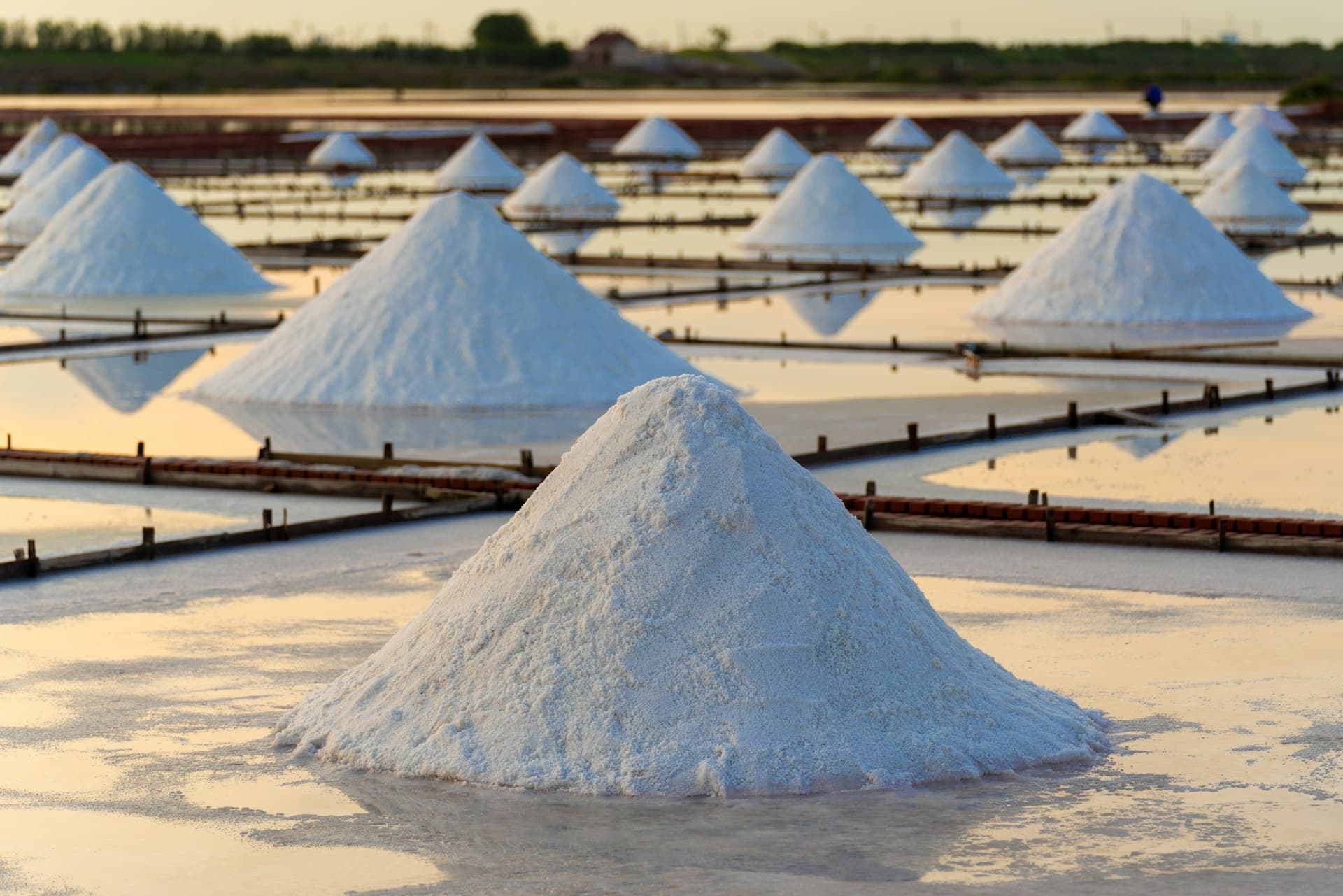
Desalination brine disposal costs $5 to $55 per cubic metre and faces tightening coastal discharge regulations. Valorization converts that liability into recovered water, salts, and minerals worth $80 to $15,000 per tonne.
Every cubic metre of desalinated water generates 1.5 to 3 litres of concentrated reject, and that reject is costing the global desalination industry an estimated $400 million per year in disposal alone. Coastal operators face permit tightening that is making ocean discharge progressively harder to defend: EU Urban Wastewater Treatment Directive revisions and Gulf Cooperation Council brine discharge limits have both tightened since 2022, and several Middle Eastern regulators now require environmental impact assessments for any new outfall above 10,000 cubic metres per day of concentrate. The brine valorization desalination conversation is no longer an R&D curiosity. It is a compliance timeline with a CFO-visible cost line attached.
The conventional response, pump the concentrate back to sea or inject it underground, transfers the cost rather than eliminating it. Disposal runs $5 to $55 per cubic metre depending on geography, volume, and salinity. At a 100,000-cubic-metre-per-day plant producing 30% concentrate, that disposal cost compounds to $54 million per year at the high end of the range. The contrarian insight is that the same stream carrying that liability also contains sodium chloride, [magnesium](/elements/magnesium), calcium, potassium, and in some geographies [lithium](/elements/lithium) at concentrations that make commercial extraction viable. The brine is not waste. It is an unmined feedstock.
This article covers what brine valorization is, which technologies extract value from concentrate streams, how to evaluate the business case with real cost data, the failure modes that have killed early projects, and a threshold-based decision framework for plant managers and capital projects leads deciding whether valorization belongs in their next CAPEX plan. It is written for industrial desalination operators, mining and oil-and-gas water managers, and sustainability directors who need to translate technical options into financeable outcomes.
## The decision in brief
- Convert disposal cost into a valorization programme. Converting your current concentrate disposal cost of $10 to $25 per cubic metre into a staged valorization programme eliminates $3.6 million to $9 million per year per 1,000 cubic metres per day of concentrate at a mid-size desalination plant. - Count the revenue side as well. The same programme simultaneously generates salt, chemical, and mineral revenues that add $1.5 million to $6 million annually at the same scale. - Plan the deployment before regulation forces it. The biggest cost of doing nothing is a regulatory-forced ZLD retrofit in 5 to 8 years at 30 to 50% higher capital cost than a planned deployment today.
That retrofit is compounded by three to four years of accumulated disposal costs at tightening permit tariff rates and the reputational exposure of a consent notice on the company's ESG disclosure.
## What brine valorization is and why simple disposal is losing
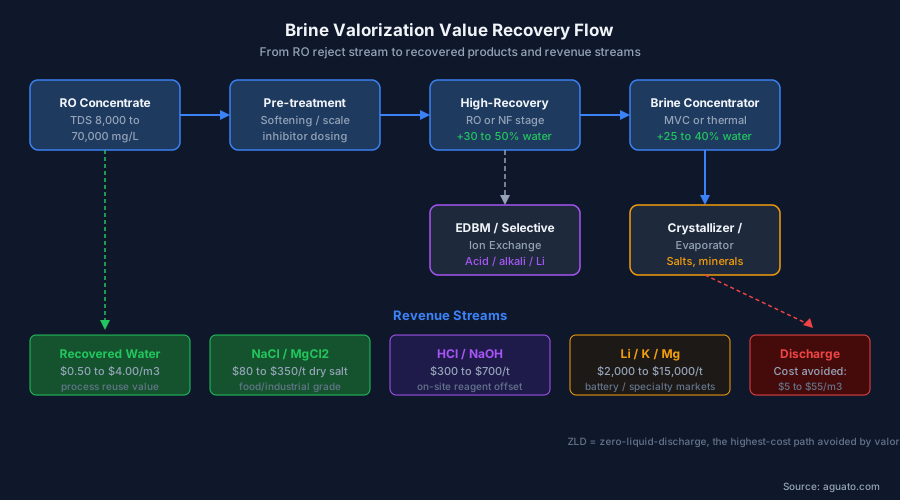
Brine valorization is the conversion of desalination concentrate from a disposal problem into a suite of recovered products: purified water, industrial-grade salts, acids, alkalis, and specialty minerals. The term covers a spectrum from simple high-recovery secondary reverse osmosis, which squeezes 20 to 30% more permeate from first-pass concentrate at $0.80 to $2.50 per cubic metre incremental cost, all the way to zero-liquid-discharge evaporative crystallization systems that eliminate discharge entirely at $8 to $22 per cubic metre of feed processed.
The regulatory pressure is the forcing function. [According to the International Desalination Association](dofollow:https://idadesal.org), over 16,000 desalination plants worldwide produce roughly 95 million cubic metres per day of fresh water, generating concentrate volumes that existing coastal ecosystems are increasingly unable to absorb without measurable salinity gradients. Environmental regulators in the EU, California, Saudi Arabia, and Australia have all signalled that outfall permits will tighten over the next five to ten years. Operators who design now for valorization avoid a stranded-asset problem in their concentrate handling infrastructure.
The business case is not identical at every site. A seawater RO plant in an arid coastal region with an LNG facility next door has access to low-cost waste heat that fundamentally changes the thermal evaporation economics. A brackish groundwater RO system in a mining region may sit 50 kilometres from any viable salt market, which collapses the revenue side of the crystallization argument. The first failure of early valorization projects was assuming the technology business case generalises. It does not. Site chemistry, local energy cost, logistics to end markets, and regulatory timeline all interact and all need site-specific modelling before any capital commitment.
## What is actually in your brine: feed chemistry drives the business case
The composition of your concentrate determines which valorization pathway generates positive returns, and a surprising number of operators have never fully characterized what they are disposing of. A typical seawater RO concentrate at 45,000 to 70,000 mg/L TDS contains sodium at 15,000 to 25,000 mg/L, chloride at 25,000 to 40,000 mg/L, magnesium at 1,200 to 2,500 mg/L, calcium at 600 to 1,200 mg/L, sulfate at 3,500 to 6,000 mg/L, and potassium at 550 to 900 mg/L. At those concentrations and at volumes of tens of thousands of cubic metres per day, the mineral inventory is commercially significant.
Brackish water concentrate is a different profile. Depending on the aquifer, a brackish RO plant may produce concentrate at 3,000 to 20,000 mg/L TDS with elevated silica, barium, or strontium that precipitate aggressively in any thermal evaporation unit. Mining-derived brines frequently contain elevated lithium at 50 to 400 mg/L, which is the figure that has driven serious investment in selective extraction: lithium carbonate prices sustained above $6,000 per tonne make extraction economics viable at feed concentrations above 100 mg/L Li with recovery rates above 80%.
A pattern that recurs in industrial installations is the undercharacterisation of the monovalent-versus-divalent split. Nanofiltration between the primary RO and any downstream valorization step can separate the divalent stream (magnesium, calcium, sulfate) from the monovalent stream (sodium chloride) at a separation factor of 85 to 95%, enabling two parallel product trains instead of one mixed-salt disposal problem. The capital cost of that NF stage, $600,000 to $2.2 million for a 10,000-cubic-metre-per-day feed, is frequently the most efficient capital deployment in the entire valorization scheme because it unlocks the economics of both downstream trains simultaneously. See [nanofiltration](/nanofiltration) and [reverse osmosis systems](/reverse-osmosis-systems) for the membrane selection mechanics that determine which NF configuration handles your specific divalent load.
## Pre-treatment and feed-water characterization for valorization
Inadequate pre-treatment is the single most common cause of valorization project failure after commissioning, and it is almost always a cost the project team knew about but deferred. Scaling species, principally calcium carbonate, calcium sulfate, silica, and barium sulfate, precipitate in concentration ratios that occur 30 to 50% below theoretical saturation when temperature gradients, residence time, and pH swings combine in evaporator bodies. The remediation cost of descaling a fouled MVC unit is $80,000 to $350,000 per event, plus 10 to 21 days of unplanned downtime.
The pre-treatment train for valorization feed typically needs to handle three requirements that primary RO pre-treatment does not address. First, pH control to above 9.5 to carbonate-stabilise the feed and prevent calcium carbonate nucleation in the concentrator. Second, antiscalant chemistry redesigned for the elevated TDS of concentrate rather than raw feed, because the polymers that work at 1,000 mg/L feed may be overwhelmed at 40,000 mg/L. Third, silica management, either through selective adsorption or lime precipitation, when silica concentrations exceed 120 to 150 mg/L in the concentrate (which corresponds to roughly 30 to 50 mg/L in the primary RO feed at 50% recovery).
The characterisation investment before design is not optional. A full ion balance, saturation index modelling, and scaling simulation across the planned concentration range costs $15,000 to $45,000 in analytical and engineering fees. That is the cheapest insurance available against a $200,000 to $1,000,000 unscheduled outage in the first operating year. [Industrial water reuse and recycling](/industrial-water-reuse-recycling) programmes that skip this step report fouling-driven downtime at 3 to 5 times the rate of well-characterised designs. The right answer depends on your specific feed chemistry and concentration trajectory. [Post your project](/post-project) with your concentrate analysis and qualified providers will scope the pre-treatment requirement against your actual data.
## Technology pathways: concentration, crystallization, and ZLD
The valorization technology ladder runs from incremental water recovery at the low-cost end to full zero-liquid-discharge crystallization at the high end, and the right entry point depends on discharge limit timeline, water scarcity value, and mineral revenue potential at your site. Most operators should not start at ZLD. The capital and operating cost of jumping directly to evaporative crystallization without a high-recovery RO or NF concentration stage upstream is a systematic budget error that recurs across the industry.
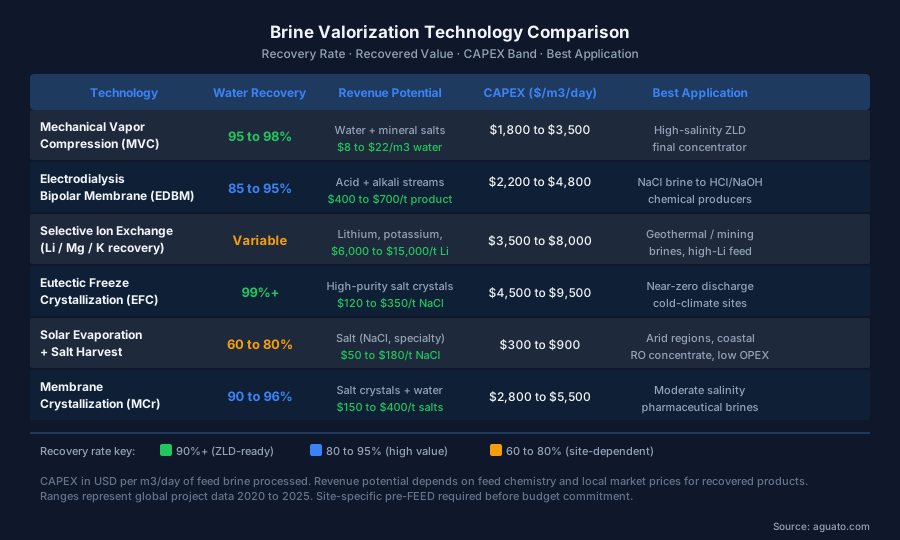
The table below compares the four main valorization technology pathways. Each can be deployed independently or in series as a staged valorization train.
| Technology | Water Recovery | Product Revenue | CAPEX ($/m3/day) | OPEX ($/m3 feed) | Key Risk | Best For | |---|---|---|---|---|---|---| | High-Recovery RO (HPRO) | +20 to 40% permeate | Water at $0.50 to $4.00/m3 | $400 to $900 | $0.80 to $2.50 | Membrane scaling at high TDS | Sites needing volume reduction, water-scarce regions | | NF Fractionation | Splits divalent/monovalent | Enables dual product trains | $600 to $1,500 | $0.40 to $1.20 | Divalent fouling if pre-treatment under-designed | Pre-stage for any crystallization or EDBM pathway | | MVC Brine Concentrator | +90 to 95% cumulative recovery | Distillate + near-saturated brine | $1,800 to $3,500 | $6 to $12 | Silica/sulfate scaling; electricity price escalation | ZLD first stage, large volumes, access to firm power | | Forced-Circulation Crystallizer | 99%+ (true ZLD) | Salt cake $80 to $250/t NaCl | $4,000 to $9,000 | $18 to $35 | Salt market price risk; scaling in boiling zone | Final ZLD stage, tightest discharge permits |
The combination of MVC plus crystallizer at a 50,000-cubic-metre-per-day seawater RO plant eliminates approximately 15,000 cubic metres per day of concentrate disposal and generates roughly 220 to 280 tonnes per day of dry salt at $100 to $250 per tonne market value, a gross revenue of $22,000 to $70,000 per day depending on product grade and logistics costs. The capital outlay is $110 million to $200 million at that scale. Payback at the midpoint of both ranges is 8 to 12 years without water tariff credit, and 5 to 7 years when avoided disposal cost of $12 to $25 per cubic metre is factored in. See [zero liquid discharge](/zero-liquid-discharge) for the full ZLD economics comparison across sectors.
## Electrodialysis bipolar membrane and chemical product recovery
Electrodialysis bipolar membrane (EDBM) is the most underused valorization technology in the current industry portfolio, and it solves a problem that thermal evaporation cannot: converting a sodium chloride brine stream into separate hydrochloric acid and sodium hydroxide product streams at 15 to 35% concentration. For any desalination plant that purchases caustic soda and hydrochloric acid for pre-treatment, pH adjustment, or CIP cleaning, EDBM converts a disposal cost into a direct procurement offset.
The economics are specific. An EDBM unit processing 500 cubic metres per day of 50,000 mg/L NaCl concentrate can produce approximately 8 to 12 tonnes per day of HCl at 30% concentration and 10 to 15 tonnes per day of NaOH at 30% concentration. At $300 to $500 per tonne for commercial-grade HCl and $400 to $700 per tonne for NaOH, the gross revenue is $5,000 to $14,000 per day. CAPEX for that scale is $1.8 million to $4.5 million. Energy consumption is 1.8 to 3.5 kWh per kilogram of salt split, which at $0.07 per kWh industrial tariff costs $0.13 to $0.25 per kg of product, competitive against commercial chemical purchasing at $0.30 to $0.70 per kg delivered.
The deployment constraint is that EDBM membranes require a relatively clean, low-scaling feed. Calcium and magnesium at concentrations above 50 mg/L in the EDBM feed will cause scaling on the bipolar membrane surface within 200 to 500 operating hours, degrading current efficiency and increasing voltage requirements. The NF fractionation stage described in the previous section is therefore a precondition for EDBM, not an option. The combination NF-plus-EDBM architecture at medium scale (1,000 to 5,000 cubic metres per day of concentrate) is currently achieving payback periods of 4 to 7 years at sites with significant on-site chemical purchasing budgets.
[Brine disposal costs and regulatory context](/brine-management-disposal) are already driving adoption of this architecture at Gulf desalination plants, where caustic import logistics make on-site production particularly attractive. Industrial water treatment providers with EDBM experience are still a relatively thin market globally, which is a procurement risk worth factoring into your RFP timeline.
## Selective mineral extraction: lithium, magnesium, and potassium
The selective mineral extraction pathway is commercially viable at far lower scale than evaporative crystallization, and it generates unit revenues that crystallization cannot match: $6,000 to $15,000 per tonne for battery-grade lithium carbonate versus $80 to $350 per tonne for commodity sodium chloride. The trade-off is selectivity complexity, resin or membrane fouling risk, and a narrower set of feed compositions that support the economics.
Lithium extraction from brine using selective sorbents, principally lithium manganese oxide and lithium iron phosphate adsorbents, operates at Li feed concentrations of 50 mg/L and above with a single-pass recovery of 60 to 85% and a product purity after downstream processing of 99.5%+ Li2CO3. The specific CAPEX for a 1,000-kg-per-day Li2CO3 facility is $35,000 to $80,000 per kilogram of daily capacity, meaning the capital commitment is $35 million to $80 million. At $8,000 per tonne Li2CO3 and 1 tonne per day, the annual gross revenue is $2.9 million. With a 40% EBITDA margin after OPEX and reagent costs, the payback period is 12 to 25 years, which is too long for most industrial CAPEX hurdle rates unless lithium prices sustain above $10,000 per tonne or the feed concentration exceeds 150 mg/L Li.
Magnesium hydroxide extraction from seawater concentrate is a more immediately commercial proposition for large-scale plants. Seawater concentrate at 2,000 to 2,500 mg/L Mg2+ can yield magnesium hydroxide at a production cost of $150 to $250 per tonne when lime precipitation is used and the resulting sludge is dewatered and calcined to MgO. The industrial-grade MgO market price of $400 to $800 per tonne supports a positive margin at plants exceeding 5,000 cubic metres per day of concentrate with adequate dewatering infrastructure. Several plants in the Gulf region have validated this at operating scale since 2020, with co-location at existing lime-dosing infrastructure reducing the incremental CAPEX by 25 to 40%.
The [desalination energy consumption](/desalination-energy-consumption) profile of the site matters here: selective extraction adds 2 to 8 kWh per cubic metre of concentrate processed depending on the target mineral and the concentration factor required, and that energy cost needs to be folded into the margin calculation before committing to the design. A site-wide energy audit is a prerequisite, not an afterthought.
## Failure modes and the real cost of getting it wrong
Every major valorization project failure in the last decade traces back to one of four root causes: wrong feed characterisation, underfunded pre-treatment, a revenue assumption that did not survive first contact with the salt market, or an energy cost assumption that was benchmark rather than site-specific. Understanding the decision that led to each failure is more useful than the technology post-mortem.
Failure 1: Scale precipitation in the MVC concentrator. A large desalination plant in the Arabian Gulf commissioned an MVC concentrator without a dedicated silica removal stage. Feed silica at 28 mg/L in the primary RO feed concentrated to 190 mg/L at the MVC inlet. Silica polymerisation fouled the heat exchange surfaces at 12 months, requiring a six-week chemical clean costing $280,000 in descaling reagents plus 15% reduction in rated throughput for the following 18 months. The silica pre-treatment stage that was omitted at design would have cost $600,000 installed. Decision: save $600,000 now. Outcome: $1.9 million in lost production and remediation over 30 months.
Failure 2: Salt market collapse. A brackish RO plant in Texas commissioned a forced-circulation crystallizer in 2019, producing 40 tonnes per day of mixed NaCl/Na2SO4 salt cake. The assumed off-take price was $80 per tonne based on regional quotes at design. By commissioning, local oversupply and logistics costs reduced the realised price to $30 per tonne, turning a $1.2 million per year revenue forecast into a $450,000 per year actuality and extending payback from 9 years to 23 years. Commodity-grade salt trades in a narrow price band, and specialty-grade certification commands a 3 to 5x premium that requires a separate production quality management investment. Modelling salt revenue at $40 per tonne stress-test is non-negotiable.
Failure 3: Energy cost underestimation. An operator in California who modelled MVC OPEX at $0.07 per kWh in 2018 was paying $0.14 per kWh by 2022, doubling the OPEX contribution from $5.80 per cubic metre to $11.60 per cubic metre and turning a positive-margin operation into a subsidised compliance cost. Energy price indexing in the valorization business case is required. If you cannot model the scenario at 2x your current tariff and still reach acceptable payback, the project is not fundable.
Failure 4: Overscaled initial deployment. Going directly to ZLD at full plant capacity in the first capital project rather than piloting at 10 to 20% scale is the most expensive mistake pattern in the industry. A Middle Eastern operator who installed full-scale ZLD at 50,000 cubic metres per day capacity in 2020 spent approximately $95 million, hit 14 months of performance below guarantee due to combined scaling and crystallizer fouling, and spent a further $18 million in remedial works. A 5,000-cubic-metre-per-day pilot would have surfaced the same problems at 8% of the capital risk. The [industrial water reuse and recycling](/industrial-water-reuse-recycling) model of starting with the smallest viable stage and proving before scaling applies with particular force to ZLD capital decisions.
[cta:nepti-dark]
## Decision framework: when brine valorization pencils out
The go/no-go decision on brine valorization reduces to three financial gates: avoided disposal cost must exceed minimum viable OPEX, revenue from recovered products must be demonstrably contracted or hedged, and the capital payback must sit within the plant owner's CAPEX hurdle rate. None of these gates can be evaluated without site-specific data, but the following threshold framework identifies where each technology pathway is viable.
Gate 1: Volume and TDS thresholds.
- If concentrate volume is below 500 cubic metres per day: thermal valorization is not economic. Focus on HPRO only; payback is 3 to 5 years on water recovery alone in water-scarce regions. - If TDS exceeds 70,000 mg/L: evaporative technologies are preferred over membrane stages as the primary concentration step. - If TDS is between 8,000 and 40,000 mg/L: HPRO followed by NF fractionation is the preferred first stage, with a downstream pathway selected after the product stream chemistries are confirmed.
Gate 2: Energy cost gate.
- If local electricity costs exceed $0.10 per kWh: MVC OPEX becomes $10 to $18 per cubic metre and the business case depends heavily on disposal cost or product revenue. Model sensitivity at $0.06, $0.10, and $0.14 per kWh before committing. - If waste heat is available at below $5 per MWh equivalent: thermal evaporation OPEX drops 40 to 60% and ZLD becomes viable at smaller scales than the electric-only benchmark suggests.
Gate 3: Revenue certainty.
- Commodity salt revenue should be stress-tested at $40 per tonne (half the midpoint market price) before the project IRR is presented to a capital committee. - EDBM chemical revenue should be modelled against on-site procurement cost rather than spot market price, capturing the offset value which is typically 20 to 40% higher than traded prices. - Mineral extraction projects (Li, Mg, K) should not proceed to front-end engineering design without a minimum 5-year off-take agreement or a confirmed internal consumption pathway.
The right valorization technology for your site depends on concentrate chemistry, energy tariff structure, logistics to product markets, and regulatory timeline. Use the framework above as a screening filter, then engage qualified specialists for the full pre-FEED economics. [Post your project](/post-project) with your concentrate analysis data and volume figures for a scoped technology comparison from providers with demonstrated full-scale references.
## How to procure: scope definition, RFP structure, and vendor evaluation
Procuring a brine valorization system is not the same as procuring a conventional desalination extension, and RFPs written to the wrong scope produce responses that are not comparable, not defensible at audit, and not bankable. The three most common procurement failures are: issuing a design-build RFP without a pre-FEED study, specifying a single technology rather than a performance outcome, and omitting product off-take risk from the vendor evaluation criteria.
The correct procurement sequence starts with a characterisation study ($15,000 to $45,000, 8 to 12 weeks) that produces the feed analysis, scaling simulation, and preliminary technology screening. This precedes any RFP. The output is a functional specification, not a technical specification: "produce 95% water recovery from concentrate at TDS 35,000 mg/L with scaling probability below 5% for 8,000 operating hours" is a defensible performance outcome. "Install a mechanical vapor compression unit of 2,000 cubic metres per day" forecloses better technology options the vendor community may offer and removes the competitive tension that drives price.
Vendor evaluation for valorization projects should weight four criteria beyond price: a demonstrated full-scale reference site at comparable feed TDS and volume (not pilot data only); a performance guarantee structure with liquidated damages tied to water recovery rate and product quality; an energy consumption guarantee at the stated electricity tariff; and scaling remediation responsibility for the first 36 months of operation. Vendors who resist energy and scaling guarantees are pricing the performance risk into your operating budget rather than their contract. That is a red flag, not a negotiating position.
[According to the IWA Desalination and Water Reuse journal](dofollow:https://www.iwa-network.org/journals/desalination-water-reuse/), procurement leads who write their RFP around performance outcomes rather than technology specifications consistently report 15 to 30% better lifecycle cost outcomes and significantly fewer post-commissioning disputes. The [industrial water treatment companies](/industrial-water-treatment-companies) who operate in this space range from equipment vendors with limited process integration experience to full-lifecycle EPC contractors, and the evaluation criteria above separate them cleanly.
## FAQ
### What is brine valorization in desalination?
Brine valorization is the process of extracting commercial value from desalination concentrate streams instead of disposing of them. Value recovery pathways include additional freshwater recovery via high-pressure RO, salt crystallization to produce industrial-grade sodium chloride, electrodialysis bipolar membrane conversion of NaCl brine to hydrochloric acid and sodium hydroxide, and selective sorbent extraction of lithium, magnesium, or potassium from the mineral-rich concentrate. The approach converts a disposal liability of $5 to $55 per cubic metre into a revenue stream ranging from $0.50 per cubic metre of recovered water to $15,000 per tonne of specialty mineral.
### How much does brine valorization cost compared to ocean disposal?
Ocean disposal costs $5 to $15 per cubic metre for near-shore coastal outfalls and $20 to $55 per cubic metre for deep-well injection or long-distance pipeline disposal. High-recovery secondary RO valorization costs $0.80 to $2.50 per cubic metre incremental OPEX and often pays for itself through water recovery savings alone. Full ZLD with crystallization costs $8 to $35 per cubic metre of feed processed but eliminates disposal entirely. The break-even point versus ocean disposal depends on regulatory trend and local water scarcity value, but most operators facing disposal costs above $12 per cubic metre will find at least one valorization stage economically superior within a 10-year horizon.
### Which minerals can be recovered from desalination brine?
Seawater RO concentrate contains commercially relevant concentrations of sodium chloride, magnesium, calcium, potassium, sulfate, and in some geographies lithium. Sodium chloride is the primary product at most sites ($80 to $350 per tonne for industrial grade). Magnesium hydroxide and magnesium oxide command $400 to $800 per tonne and are viable at concentrate volumes above 5,000 cubic metres per day. [Lithium extraction from brines](/resources/lithium-extraction-brine-dle) requires feed concentrations above 100 mg/L and a long-term off-take agreement before the CAPEX of $35 to $80 million per 1,000 kg-per-day Li2CO3 capacity is defensible. [According to the US Department of Energy's Water Security Grand Challenge](dofollow:https://www.energy.gov/eere/water), lithium extraction from produced water and desalination brines is a priority development area with demonstrated pilot-scale recoveries above 85%.
### What is the difference between a brine concentrator and a crystallizer?
A brine concentrator, typically a mechanical vapor compression evaporator, reduces concentrate volume by 85 to 95%, producing a near-saturated brine and a clean distillate. A crystallizer takes that near-saturated brine and drives it to the eutectic point, precipitating dissolved salts as solid crystals while recovering the remaining water fraction. The two units operate in series as the final ZLD stages. The concentrator handles bulk volume reduction at lower OPEX ($6 to $12 per cubic metre). The crystallizer handles the small remaining volume at higher OPEX ($18 to $35 per cubic metre) but achieves true zero-liquid discharge. Most ZLD projects under-budget the crystallizer stage because it is a smaller vessel, but it carries disproportionate scaling risk and the highest maintenance cost per cubic metre in the entire train.
### What is EDBM and how does it apply to desalination brine?
Electrodialysis bipolar membrane (EDBM) uses an electric field across a stack of cation-exchange, anion-exchange, and bipolar membranes to split a sodium chloride feed into separate hydrochloric acid and sodium hydroxide streams. For desalination operators who purchase both reagents for pre-treatment, pH adjustment, and CIP cleaning, EDBM converts a disposal stream into a procurement offset worth $5,000 to $14,000 per day at 500 cubic metres per day of feed. The CAPEX payback period is 4 to 7 years for operators with significant on-site chemical purchasing budgets, making it one of the fastest-payback valorization pathways available at medium scale.
### Does brine valorization qualify for ESG or sustainability reporting credits?
Yes, across several major ESG reporting frameworks. Water volume recovered via valorization reduces absolute water withdrawal intensity under GRI 303 and SASB sector-specific water metrics. Elimination of marine concentrate discharge reduces marine ecosystem impact disclosures under TNFD frameworks. Salt and mineral revenue from valorization can be reported as circular economy throughput under several voluntary frameworks including the Ellen MacArthur Foundation circularity metrics. Critically, a company that installs valorization can report a reduction in wastewater generated per unit of output, which is a direct input to CDP Water Security scores and increasingly to Scope 3 water-accounting disclosures used in sustainability-linked loan covenants.
### How long does a brine valorization project take from concept to commissioning?
A high-recovery RO addition, the simplest valorization stage, can be designed, procured, and commissioned in 12 to 18 months. An EDBM system at 500 to 2,000 cubic metres per day takes 18 to 30 months including the NF pre-treatment stage. A full ZLD system with MVC concentrator and crystallizer at medium scale (5,000 to 50,000 cubic metres per day) requires 36 to 60 months from pre-FEED study to commercial operation, with the critical path running through long-lead heat exchange equipment (36 to 48 weeks) and evaporator vessel fabrication (52 to 72 weeks). Operators who receive tightened discharge permits with a three-year compliance timeline should begin the pre-FEED study immediately, because the procurement timeline leaves no schedule contingency if pre-FEED is not already complete at the point the permit is formally served.