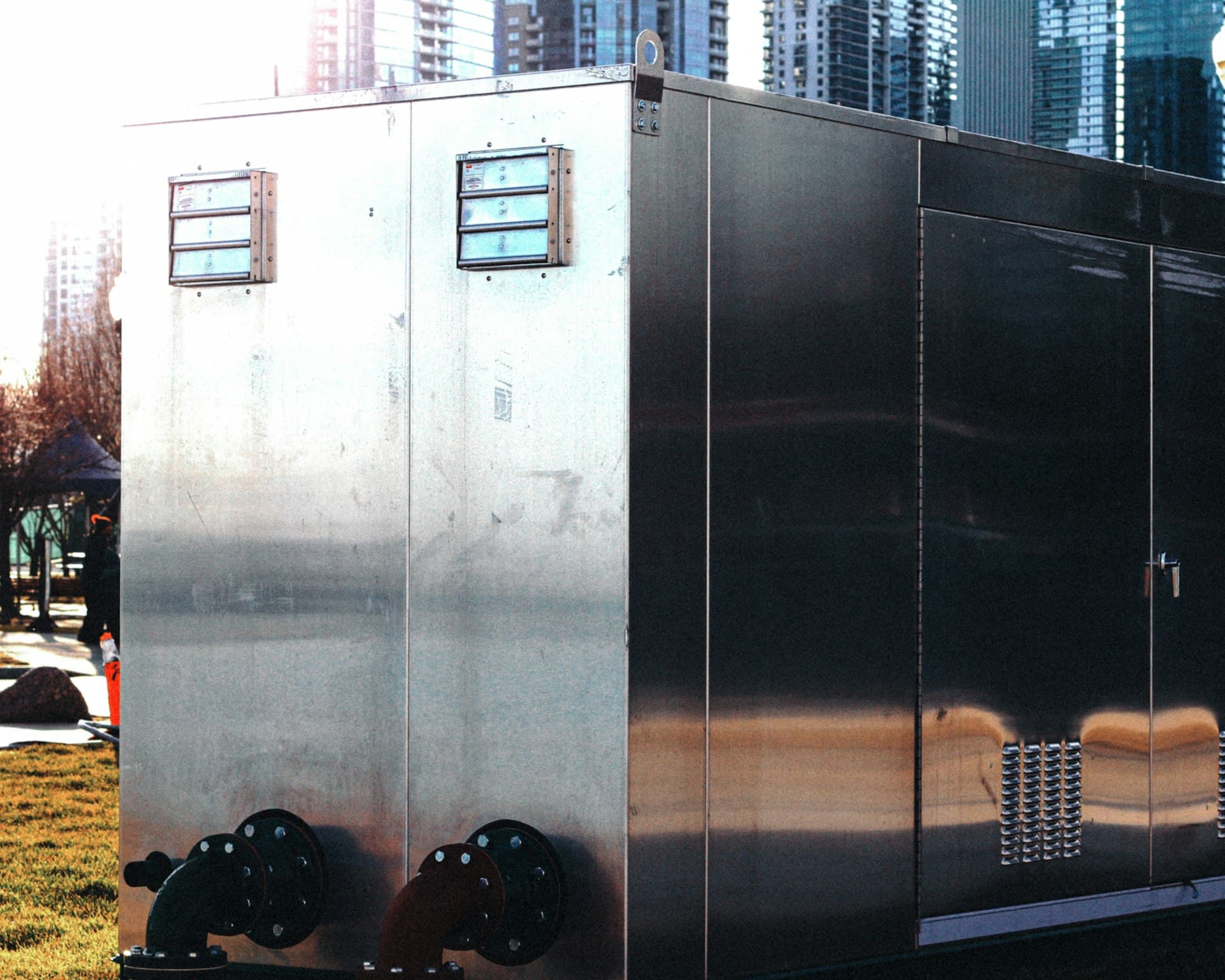
Containerized desalination wins for temporary, remote, and emergency supply, not permanent base-load. The decision framework, cost crossover, and pitfalls.
Containerized desalination promises a plant in a box: a pre-engineered, factory-built desalination unit shipped in a standard ISO container, craned onto a pad, and producing water in weeks rather than the two years a conventional build takes. For the right application that promise is real and valuable. For the wrong one it is an expensive way to buy a system you will outgrow or over-pay to run. The decision turns on volume, duration, and site permanence, not on the appeal of fast deployment.
The marketing around containerized units leans hard on speed and simplicity, which obscures the actual trade-off. A containerized plant trades the lower unit cost and optimisation of a bespoke build for modularity, speed, and relocatability. That trade is excellent for temporary, remote, or rapidly scaling needs and poor for a large, permanent, base-load supply where a conventional plant's lower cost per cubic metre compounds over 20 years.
This article gives operations managers, capital projects leads, and emergency-response planners a clear decision framework: what containerized desalination actually is, the applications where it wins decisively, the situations where a conventional build is cheaper, and the specification and operating factors that separate a sound container deployment from a regretted one.
## The decision in brief
- Deploy a container only for a temporary or remote need. If the need is genuinely temporary or remote and under seven to ten years, you save the 12 to 24 months and the stranded-asset risk a conventional build would impose. - Emergency supply justifies the premium. For emergency supply, the value of water within days dwarfs the unit premium entirely, so the speed of deployment outweighs the extra cost of the unit. - Do not buy a container for permanent base-load supply. Buying a container because the fast deployment looked attractive means paying a per-cubic-metre premium and an energy-efficiency penalty that compounds into several million dollars over a 15-year life a bespoke plant would have avoided.
The biggest cost of doing nothing runs in reverse here: a container bought for permanent base-load supply compounds into several million dollars of avoidable premium over a 15-year life.
## What containerized desalination actually is
A containerized desalination unit is a complete SWRO or brackish-water RO plant pre-assembled inside one or more ISO shipping containers: pre-treatment, high-pressure pumps, membrane racks, energy recovery, dosing, and controls, all wired, plumbed, tested, and shipped as a unit. On site it needs only a feedwater connection, a power supply, a brine outfall, and a product-water tie-in. Commissioning takes days to a few weeks rather than the months a stick-built plant needs. The [US EPA's emergency water supply planning guidance](dofollow:https://www.epa.gov/waterresilience) recognises rapidly deployable treatment units as a core element of resilience to supply-disruption events.
Capacities range widely. A single 40-foot container typically houses a unit producing 100 to 1,000 m3/day; multiple containers can be ganged to reach several thousand m3/day. Beyond roughly 5,000 m3/day the containerized format loses its advantage, because the number of containers and the inter-connection complexity start to approach the cost and effort of a conventional build without its optimisation benefits. The [International Desalination Association](dofollow:https://idadesal.org/) documents that modular and containerized capacity has grown fastest in remote, emergency, and temporary applications rather than in large permanent base-load supply.
The defining features are modularity, speed, and relocatability. The unit can be deployed fast, expanded by adding containers, and, crucially, picked up and moved when the need ends or shifts. That relocatability is the feature conventional plants cannot match, and it is the heart of the decision: if you will need to move or scale the plant, containerization is worth its premium; if the plant will sit on one pad at one capacity for 20 years, it usually is not. The underlying technology choices are the same [SWRO versus thermal](/resources/swro-vs-thermal-desalination) and membrane decisions any desalination project faces, just packaged differently.
## Where containerized desalination wins
Containerized desalination wins decisively in four situations, and each is about temporariness, remoteness, speed, or uncertainty, the conditions a fixed plant handles badly.
Emergency and disaster response. When a drought, a contamination event, or infrastructure damage cuts a community's or a site's water supply, a containerized unit can be trucked in and producing potable water within days. No conventional plant can respond on that timescale, and the value of water during a supply crisis dwarfs the unit premium.
[cta:nepti-dark]
Remote and off-grid sites. Mines, construction camps, islands, and remote industrial facilities often have no piped water and no realistic prospect of one. A containerized unit, sometimes solar-powered, delivers self-contained supply where extending infrastructure would cost far more. The relocatability matters here too: a mine's water need moves with the operation.
Temporary and bridging supply. A site awaiting a permanent plant, a seasonal operation, or a project with a defined end date needs water for a known finite period. Buying or leasing a containerized unit for that window is far cheaper than building a permanent plant that will be stranded when the need ends.
Rapid or uncertain scaling. A new operation unsure of its eventual water demand can start with one container and add capacity as the need proves out, avoiding the over-build risk of committing to a large fixed plant before the demand is confirmed. This modular-growth logic mirrors the [decentralized water treatment](/resources/decentralized-water-treatment) case more broadly.
## Where a conventional plant wins
A conventional, purpose-built desalination plant wins wherever the supply is large, permanent, and base-load, because its lower cost per cubic metre compounds over a long life and its bespoke design extracts efficiencies a standardised container cannot.
Large permanent supply. Above roughly 5,000 m3/day on a permanent site, a conventional plant is almost always cheaper per cubic metre, both to build and to run. The container premium and the inefficiency of ganging many standard units outweigh the speed benefit when the plant will run flat-out for 20 years.
Energy optimisation at scale. A bespoke plant can specify large, high-efficiency pumps, optimised energy recovery, and pre-treatment tuned to the exact feedwater, achieving energy figures a standardised container cannot match. On a large base-load plant, where energy is the dominant lifetime cost, that efficiency gap is decisive. The full [desalination energy consumption](/resources/desalination-energy-consumption) picture favours the optimised bespoke plant at scale.
Difficult feedwater requiring custom pre-treatment. A standardised container ships with standardised pre-treatment. A site with challenging feedwater (high fouling, high turbidity, unusual chemistry) often needs custom pre-treatment that a container format cannot accommodate, forcing either under-treatment and fouling or a hybrid that loses the container's simplicity advantage.
The right answer depends on your volume, site permanence, and feedwater. [Browse verified desalination providers](/providers), filter by capability and region, and request scoped proposals so you can compare containerized and conventional options on the same basis.
## The cost comparison that decides it
The decision reduces to cost per cubic metre over the actual deployment period, and the crossover depends heavily on duration and scale. The table normalises the comparison.
| Factor | Containerized | Conventional build | |---|---|---| | CAPEX per m3/day | $1,500 to $3,500 | $900 to $2,000 | | Deployment time | Days to weeks | 12 to 24 months | | Energy efficiency | Standardised, moderate | Optimised, best at scale | | Relocatable | Yes | No | | Best capacity range | Under 5,000 m3/day | Above 5,000 m3/day | | Best for duration | Temporary to medium-term | Long-term, permanent | | Custom feedwater handling | Limited | Full |
The container's higher CAPEX per unit is offset by its speed and relocatability for short and uncertain deployments, and overwhelmed by the conventional plant's lower unit cost for long permanent ones. The single most useful test: divide the deployment into "will this plant run on this pad at this capacity for more than about seven to ten years?" If yes, lean conventional; if no, lean containerized. Below that horizon the speed, flexibility, and relocatability usually justify the premium; above it, the unit-cost advantage of the bespoke plant compounds past the container's benefits.
## Specifying a containerized unit correctly
A containerized unit is still a desalination plant, and specifying it loosely produces the same failures as any under-scoped plant. The specification must pin down feedwater, output, energy, and support exactly as a conventional RFP would.
Specify the worst-case feedwater, not the brochure case. Containerized units are sold against standard seawater. If your feedwater is harsher, the standard pre-treatment will foul. Either confirm the unit's pre-treatment handles your worst case or specify an upgraded pre-treatment module, accepting the cost. This mirrors the [membrane fouling prevention](/resources/membrane-fouling-prevention) discipline that governs all RO reliability.
Specify guaranteed output and energy at your conditions. A unit rated for 1,000 m3/day on 35,000 mg/L seawater at 20 degrees C will produce less on warmer, saltier water. Get the guaranteed output and energy at your actual feedwater and temperature, in writing, with the same liquidated-damages logic a conventional plant warrants.
Specify the brine outfall and the product-quality target. The container produces brine that still needs compliant disposal, the same [brine disposal](/resources/brine-disposal-desalination) problem a fixed plant faces. And confirm the product purity meets your use, including boron if the water serves irrigation. A container does not exempt the project from these constraints; it just packages the plant.
## Operating and support realities
Containerized units are simpler to operate than bespoke plants but they are not maintenance-free, and the support model is where deployments succeed or fail. A unit on a remote site with no local technical capability and no firm service contract is one membrane-fouling event away from sitting idle.
The support questions to settle before purchase: Who operates it, and do they have the training? What is the spares-holding and lead time for membranes and pumps at this remote location? What is the supplier's response-time commitment, and can they support a unit on this site, in this country? A containerized plant's relocatability and speed are wasted if it sits offline waiting for a part or a technician.
For temporary deployments, leasing with full operate-and-maintain support is often the better model than purchase, because it transfers the operating risk to the supplier for a defined period and avoids being left with a stranded asset when the need ends. This is the same [build-versus-buy-versus-outsource](/resources/water-treatment-om-outsource) logic that governs any water-treatment operating decision, sharpened by the container's inherent temporariness. The [World Bank's water resilience work](dofollow:https://www.worldbank.org/en/topic/water) highlights service-based water provision as a way to transfer operating risk for finite-duration needs.
## Where container deployments go wrong
Failure 1: buying a container for a permanent base-load supply. A site buys a containerized plant for the speed, then runs it flat-out on one pad for fifteen years, paying a unit-cost premium and an energy-efficiency penalty that compounds into millions over the life. The fix is the seven-to-ten-year horizon test: permanent base-load belongs in a conventional plant.
Failure 2: under-specifying feedwater against the brochure. A unit sold on standard seawater is deployed on harsher feedwater, the standard pre-treatment fouls, and the plant underperforms or stops. The fix is to specify worst-case feedwater and confirm or upgrade the pre-treatment module before purchase.
Failure 3: no support model for a remote site. A unit is deployed remotely with no local capability and no firm service contract, then sits idle after the first fault waiting weeks for a part or a technician. The cost is the lost water supply for the duration, which on a critical site can be severe. The fix is a firm support or full O&M lease arrangement settled before deployment.
To choose correctly between containerized and conventional, model the deployment against your real volume, duration, feedwater, and site conditions before buying. Nepti characterises your requirement and produces a ranked comparison of containerized and conventional options with cost projections over your actual deployment period. Start at [Nepti](/nepti).
## FAQ
What is containerized desalination? A complete RO desalination plant pre-built inside ISO shipping containers, shipped as a unit, and commissioned on site in days to weeks. It needs only feedwater, power, a brine outfall, and a product tie-in.
What capacity can a containerized unit produce? A single 40-foot container typically produces 100 to 1,000 m3/day; multiple containers can reach several thousand m3/day. Above roughly 5,000 m3/day the format loses its advantage over a conventional build.
When is containerized desalination the right choice? For emergency response, remote and off-grid sites, temporary or bridging supply, and rapidly scaling or uncertain demand. The common thread is temporariness, remoteness, speed, or the need to relocate.
When is a conventional plant cheaper? For large (above 5,000 m3/day), permanent, base-load supply on a fixed site, where the conventional plant's lower cost per cubic metre and optimised energy efficiency compound over a 20-year life.
Does a containerized unit still produce brine? Yes. It is a desalination plant, so it produces concentrate that needs compliant disposal exactly as a fixed plant does. The brine pathway must be confirmed for the deployment site.
Should I buy or lease a containerized unit? For temporary deployments, leasing with full operate-and-maintain support often beats purchase, because it transfers operating risk to the supplier and avoids a stranded asset when the need ends.
What is the biggest risk with containerized desalination? Buying one for a permanent base-load supply it is not economic for, or deploying it on a remote site with no support model so it sits idle after the first fault. Both are avoided by matching the format to the deployment.