Membrane fouling accounts for up to 24% of RO plant OPEX. Biofouling, scaling, colloidal and organic foulants each demand a different response. Full cost breakdown inside.
Membrane fouling is the single largest controllable cost driver in any plant built around [reverse osmosis](/resources/reverse-osmosis-systems), [ultrafiltration](/resources/ultrafiltration), or [nanofiltration](/resources/nanofiltration). A well-documented study of full-scale RO and NF installations published in the journal Desalination found that fouling-related costs account for roughly 24% of total OPEX in RO systems, with early membrane replacement the dominant cost factor, followed by incremental energy penalty and then chemical cleaning. For a 5,000 m3/day industrial RO plant operating at $1.20 per m3 total cost, that 24% fouling overhead represents approximately $530,000 per year in avoidable spend.
The problem is that most operators treat fouling reactively. Flux drops, differential pressure climbs, the operations team schedules a clean-in-place event, the membranes recover partially, and the cycle repeats at shorter intervals until a replacement order is raised earlier than the design life. By that point, the capital and chemistry budgets have absorbed costs that a properly engineered pretreatment programme would have prevented for a fraction of the price. Vendors who sell membranes are not strongly incentivised to tell you that. The buyer's job is to model the lifecycle cost of both approaches before signing a supply agreement.
This guide covers the four primary fouling mechanisms and how to distinguish them from operating data, the pretreatment strategies that address each, the cleaning protocols and their costs, a decision framework for when to clean versus when to replace, and the real-world failure modes that push plants into accelerated deterioration cycles. It is written for operations leads who own the membrane maintenance programme and procurement teams who have to defend a pretreatment capital line in a bid.
## The decision in brief
- Invest $150,000 in UF pretreatment and antiscalant discipline. A plant that invests $150,000 in UF pretreatment and a disciplined antiscalant programme avoids approximately $400,000 to $600,000 in avoidable fouling costs over a 5-year operating cycle at a 1,000 to 2,000 m3/day scale. - Know where the avoided cost sits. That figure is roughly $200,000 in avoided early membrane replacement, $120,000 in reduced energy penalty, and $80,000 to $100,000 in fewer CIP events and associated downtime. - Chronic biofouling is the biggest cost. The biggest cost-of-doing-nothing is chronic biofouling that renders membranes irreversible before year 3, which forces a full re-element and weeks of compromised production capacity.
That full re-element costs $30,000 to $80,000 plus weeks of compromised production capacity.
A plant that invests $150,000 in UF pretreatment and a disciplined antiscalant programme avoids approximately $400,000 to $600,000 in avoidable fouling costs over a 5-year operating cycle at a 1,000 to 2,000 m3/day scale: roughly $200,000 in avoided early membrane replacement, $120,000 in reduced energy penalty, and $80,000 to $100,000 in fewer CIP events and associated downtime. The biggest cost-of-doing-nothing is chronic biofouling that renders membranes irreversible before year 3, forcing a full re-element at $30,000 to $80,000 plus weeks of compromised production capacity. Use [Nepti's decision-intelligence modelling](/nepti) to simulate your specific fouling cost trajectory before deciding how much pretreatment capital is justified.
## What membrane fouling is and why it costs so much
Membrane fouling is the accumulation of unwanted material on or inside a membrane surface that reduces its permeability, selectivity, or both. The result is lower output for the same energy input, or the same output at higher pressure and cost. Every membrane system fouls to some degree; the question is always rate of fouling versus cost of control.
The commercial stakes are direct. A 15% normalised flux decline translates to a 15% shortfall in permeate production unless the operator increases feed pressure, which increases energy consumption and accelerates membrane degradation. A plant designed to produce 2,000 m3 per day at 55 bar that is operating with 15% fouled flux must now run at 62 to 65 bar to hold output, adding roughly 12 to 18% to pump energy costs. At $0.10 per kWh, that energy penalty on a mid-sized plant runs $40,000 to $70,000 per year before accounting for any cleaning or replacement costs.
The second cost pathway is membrane lifespan. Clean, well-maintained RO membranes typically last 5 to 7 years. Chronically fouled membranes that experience repeated aggressive CIP cycles and operate at elevated pressure are often replaced at 2 to 3 years. The capital cost difference, spread across a fleet of 200 to 400 elements in a typical industrial RO train, is $80,000 to $300,000 in early replacement spend per cycle. Procurement teams who approved the original capital budget on a 7-year replacement assumption are often unpleasantly surprised when the O&M team requests a full re-element at year 3.
[Browse verified membrane filtration providers](/membrane-filtration-companies) who can scope a pretreatment upgrade against your current operating data before fouling dictates the timeline.
## The four fouling types and how to identify them
Understanding which mechanism is active determines every subsequent decision: cleaning chemistry, pretreatment investment, and operating adjustments. Treating biofouling with acid will accomplish nothing; treating scaling with a biocide is equally pointless.
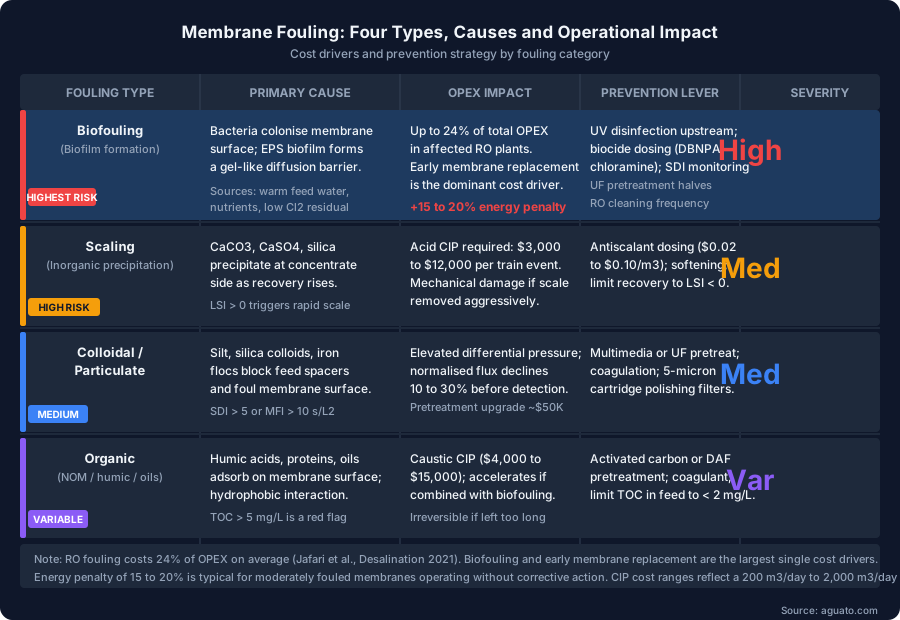
Biofouling forms when bacteria in the feed water attach to the membrane surface and secrete extracellular polymeric substances that build into a gel-like biofilm. The biofilm creates a diffusion barrier that reduces permeate flux and, over time, causes localised pH changes that degrade membrane materials. Biofouling is particularly insidious because it progresses behind normal monitoring thresholds: a biofilm thick enough to cause serious flux decline may not trigger differential pressure alarms for weeks. The diagnostic signal is that caustic cleaning restores flux significantly, while acid cleaning delivers minimal improvement.
Scaling occurs when sparingly soluble salts, most commonly calcium carbonate, calcium sulphate, barium sulphate, and silica, exceed their solubility limits in the concentrate stream and precipitate on the membrane surface. Scaling is a function of recovery rate and feed water chemistry. A system operating at 75% recovery concentrates dissolved solids fourfold; at 85% recovery, sixfold. If the Langelier Saturation Index (LSI) of the concentrate exceeds zero without antiscalant, calcium carbonate precipitation is thermodynamically certain. The diagnostic signal is that acid cleaning restores flux well, while caustic cleaning delivers minimal improvement.
Colloidal and particulate fouling results from fine suspended material, typically silt, iron flocs, silica colloids, and clay particles, accumulating in feed spacers and on the membrane surface. The Silt Density Index (SDI) is the primary feed water indicator: SDI above 5 is generally incompatible with direct RO feed without upgraded pretreatment. Colloidal fouling typically manifests as rising differential pressure with relatively stable salt rejection, because the foulant is blocking flow channels rather than compromising membrane selectivity.
Organic fouling covers a broad category of dissolved or colloidal organic material, including natural organic matter (humic acids, fulvic acids), proteins, oils, and surfactants. Organic foulants adsorb onto membrane surfaces through hydrophobic interaction, forming a gel layer that resists removal. The diagnostic signal is a combination of flux decline and elevated TOC in the permeate, and organic fouling frequently co-occurs with biofouling because the organic layer provides a nutrient substrate for bacterial colonisation.
A pattern that recurs across industrial installations is that operators diagnose the wrong fouling type because they rely on a single indicator. Differential pressure alone does not distinguish biofouling from colloidal fouling. Autopsy data from a pulled membrane element is the most reliable diagnostic: visual inspection, scanning electron microscopy, and energy-dispersive X-ray spectroscopy together identify the dominant foulant within hours. The cost of a membrane autopsy, typically $500 to $2,000 per element at a specialist lab, is minor relative to the cost of repeatedly applying the wrong cleaning protocol.
## Pretreatment: the cheapest fouling prevention tool
Every dollar invested in upstream pretreatment returns two to five dollars in avoided CIP costs, energy penalty, and membrane replacement over a 5-year operating cycle. This is not a speculative claim; it is a straightforward lifecycle calculation that most project teams fail to run at the design stage because pretreatment capital adds to the upfront number and the savings only appear in the O&M budget years later.
The pretreatment decision is driven by feed water characterisation. SDI, turbidity, TOC, LSI, and microbiological counts are the five parameters that define the appropriate pretreatment train. Skipping this characterisation and specifying pretreatment from a catalogue is the most common single mistake in membrane project design. A system designed for clean groundwater (SDI below 3) that later receives a blended surface water supply (SDI 4 to 6) will foul aggressively even with a correctly maintained pretreatment train designed for the original specification.
Cartridge filtration alone is appropriate for clean groundwater with SDI below 3 and turbidity below 0.5 NTU. Five-micron nominal cartridge filters ahead of the RO high-pressure pump intercept residual particulates. This is the minimum pretreatment scenario, not a general-purpose solution.
Multimedia filtration with dual-media (anthracite over sand) or tri-media (anthracite, sand, garnet) is suitable for feed water with SDI in the 3 to 5 range and turbidity up to 5 NTU. A well-designed multimedia filter operating at 8 to 12 meters per hour hydraulic loading rate will typically reduce SDI by 2 to 3 units and turbidity to below 1 NTU. Capital cost for a multimedia filter sized for a 1,000 m3/day RO system runs $30,000 to $80,000 installed.
Ultrafiltration as RO pretreatment is now the preferred approach for surface water, seawater, and wastewater reuse applications with SDI above 5 or turbidity above 5 NTU. UF consistently delivers SDI below 2 to the RO feed, which reduces RO CIP frequency by 30 to 50% and can extend membrane life by 1 to 2 years. The CAPEX premium over multimedia filtration is $80,000 to $250,000 for a 1,000 m3/day equivalent UF train, but the 5-year lifecycle benefit in avoided RO maintenance typically exceeds the incremental capital. Browse [ultrafiltration system providers](/ultrafiltration) to compare UF pretreatment configurations for your specific feed conditions.
Dissolved air flotation (DAF) plus activated carbon is required when feed water contains oils, high TOC, or algae loads that would rapidly blind any downstream filter. This configuration is common in industrial wastewater reuse and some surface water applications with seasonal algal events. The capital cost for a DAF unit for a 1,000 m3/day application is $100,000 to $300,000, with activated carbon contactors adding another $40,000 to $120,000.
Not sure which pretreatment train matches your feed water profile? [Post your project on Aguato](/post-project) and verified membrane specialists will scope a solution against your actual SDI, turbidity, and TOC data.
## Antiscalant dosing and chemical prevention
Antiscalant dosing is the single most cost-effective chemical intervention in a membrane system. A correctly selected and dosed antiscalant programme costs $0.02 to $0.10 per m3 of permeate produced and can prevent scaling completely at recovery rates where precipitation would otherwise be inevitable.
The LSI is the starting point. For every proposed operating recovery rate, calculate the concentrate-side LSI. If it exceeds zero, antiscalant is not optional, it is required. The specific antiscalant formulation must match the dominant scaling ion: phosphonate-based antiscalants are effective against calcium carbonate and calcium sulphate; polymer-based products are better suited to silica and barium sulphate. Specifying the wrong product and dosing it correctly achieves nothing.
Dosing precision matters. Underdosing by 20% relative to the optimum leaves the concentrate at risk of breakthrough precipitation, typically at the tail-end elements where concentration is highest. Overdosing increases chemistry cost without proportionate benefit and, for some chemistries, can contribute to organic fouling. Precision metering pumps with flow-proportional control are the minimum specification for antiscalant dosing; batch-and-inject approaches in variable-flow systems reliably produce concentration excursions at the worst possible moments.
[Water treatment chemical providers](/water-treatment-chemical-companies) supply the full range of antiscalant, biocide, and coagulant chemistries needed for a complete fouling control programme. Requesting a dosing calculation from the chemical supplier based on your feed water analysis is standard practice and should be part of any bid process.
Biocide programmes address the biological fouling vector. Chloramine dosing ahead of the RO system is the most common approach for surface water and municipal feed applications. The RO membrane must be rated for chloramine exposure; most modern polyamide membranes tolerate chloramine but have zero tolerance for free [chlorine](/elements/chlorine) above 0.1 mg/L. A dechlorination stage with sodium bisulphite is typically required after chloramine treatment if free chlorine residuals are present. [dofollow:https://www.epa.gov/watersense/wastewater-technology-fact-sheet-membrane-bioreactors] The US EPA's membrane technology guidance confirms that biological pretreatment control is the most cost-effective lever for reducing biofouling in RO systems, ahead of membrane material selection or CIP frequency.
## Operating parameters that control fouling rate
The three operating parameters with the greatest influence on fouling rate are recovery, flux, and crossflow velocity. Each one is a direct handle that operators and engineers control; none of them requires capital investment to adjust.
Recovery rate drives concentrate-side scaling potential. Every 5 percentage points of additional recovery approximately doubles the concentration factor of sparingly soluble salts at the tail-end elements. A system that operates cleanly at 70% recovery may experience rapid calcium carbonate precipitation at 80% recovery if the antiscalant programme is not recalculated for the new condition. The commercial pressure to squeeze higher recovery from an existing system is understandable, given water costs and effluent discharge fees. The engineering response is to re-verify the scaling index at the proposed recovery before changing the operating point, not afterward.
Flux rate directly determines foulant accumulation rate at the membrane surface. [dofollow:https://www.awwa.org/Portals/0/AWWA/ETS/Resources/AWWA_M46_3E_Sample.pdf] The American Water Works Association's membrane filtration guidance (AWWA M46) establishes design flux benchmarks by feed water type: 12 to 17 litres per m2 per hour (LMH) for RO treating secondary effluent, 17 to 22 LMH for surface water, and 22 to 30 LMH for high-quality groundwater. Operating consistently above the upper design flux for a given feed water quality accelerates all fouling mechanisms and is the fastest path to shortened membrane life. The temptation to push flux to compensate for fouled-membrane capacity loss creates a self-reinforcing deterioration cycle.
Crossflow velocity in the feed spacer channels determines the shear force that opposes foulant deposition. Low crossflow allows the concentration polarisation layer at the membrane surface to thicken, which both increases osmotic back-pressure and creates conditions favourable for colloidal and biological deposition. Maintaining a crossflow velocity above 0.1 metres per second in RO feed spacers is a minimum operating discipline; many operators reduce feed flow during low-demand periods without recognising that they are also reducing the anti-fouling shear force.
## When and how to run a clean-in-place event
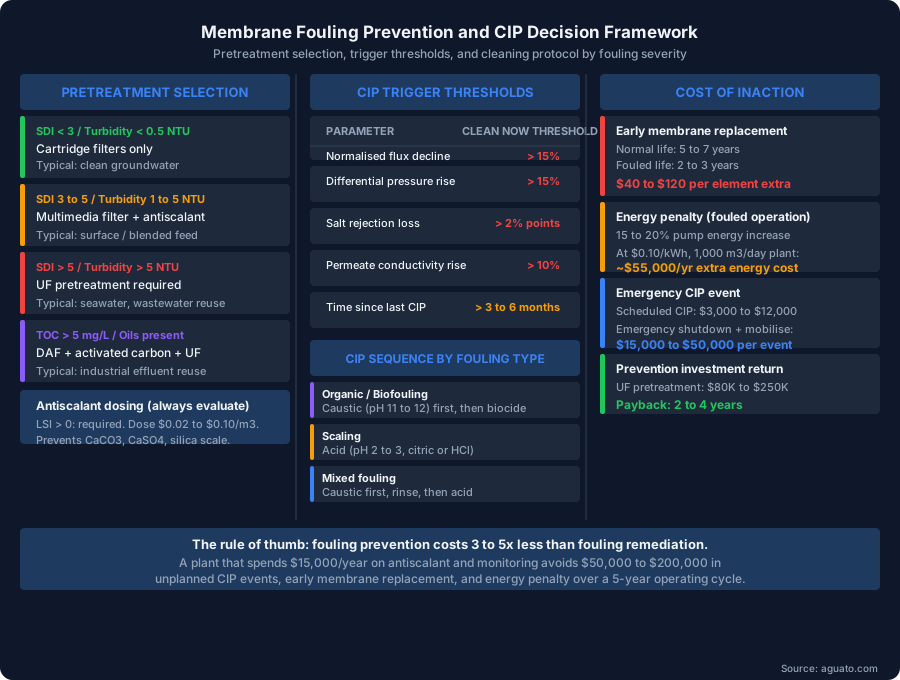
The decision to run a CIP should be triggered by performance data, not by a calendar date. The four standard triggers are: normalised permeate flux decline of 15% from baseline, feed-to-concentrate differential pressure rise of 15% from baseline, salt rejection decline of 2 percentage points or more, and permeate conductivity rise of 10% or more. Any one of these individually warrants investigation; two or more simultaneously demands immediate CIP.
The sequence of a CIP event matters as much as the chemistry. For organic and biofouling, a high-pH caustic wash (pH 11 to 12, sodium hydroxide with or without surfactant) is applied first and allowed to soak for 30 to 60 minutes at the element temperature limit, typically 35 to 45 degrees Celsius. The caustic solution saponifies organic foulants and disrupts biofilm structure. A thorough permeate flush follows before a low-pH acid wash (pH 2 to 3, citric acid or hydrochloric acid at controlled concentration) is applied to dissolve any inorganic scale that was masked by the organic layer. For pure scaling cases, the acid wash is applied first and the caustic step is omitted.
The cost of a scheduled, properly executed CIP on a 200 to 500 element RO system runs $3,000 to $12,000 in direct costs: cleaning chemicals ($1,500 to $5,000), labour ($500 to $1,500), membrane rinse water, and energy for recirculation pumping. The downtime cost, typically 8 to 24 hours for a full system CIP, is the figure that operations teams often underestimate. For a plant producing 2,000 m3 per day of product water worth $0.80 per m3, 16 hours of downtime costs approximately $1,100 in lost production, modest in isolation but meaningful when CIP frequency rises to monthly events.
An emergency CIP, triggered by a fouling event that has progressed past normal operating thresholds, costs significantly more. Mobilising specialist cleaning contractors, sourcing concentrated chemistry at short notice, and managing unplanned downtime on a production-critical system typically pushes total event costs to $15,000 to $50,000. The difference between a $6,000 scheduled CIP and a $35,000 emergency response is almost always traceable to the absence of a disciplined monitoring programme.
[cta:nepti]
## Membrane replacement: the real cost model
Membrane replacement is the largest single cost item in fouling-related OPEX, accounting for the majority of the 24% OPEX impact identified in peer-reviewed research on full-scale installations. The replacement cost model that most procurement teams use is the design-life model: assume 5 to 7 years, budget accordingly. The operational reality is that replacement frequency depends almost entirely on fouling management quality.
A standard 8-inch diameter, 40-inch long RO element costs $150 to $400 depending on the manufacturer, rejection specification, and fouling-resistance membrane chemistry. A 500 m3/day plant typically contains 50 to 80 elements. Full re-element at the 2 to 3 year mark due to uncontrolled fouling costs $7,500 to $32,000 in elements alone, plus installation labour, system downtime, and performance testing. Versus full re-element at the 6-year mark in a well-managed system, the fouling-driven scenario generates $15,000 to $64,000 in additional capital cost over a 12-year plant life.
The element manufacturer's warranty does not cover fouling damage. Membrane autopsies routinely reveal that elements returned under warranty claims were victims of preventable scaling or biofouling, not manufacturing defects. Operators who have not characterised their feed water, do not run antiscalant, and do not maintain a normalised performance log have no warranty claim and no data to support a vendor dispute. The documentation discipline that prevents fouling also protects the capital investment in the event of a genuine material failure.
[Browse reverse osmosis system providers](/reverse-osmosis-companies) for current element pricing and replacement supply options. Comparing lifecycle cost across element brands on a cost-per-m3-produced basis, factoring in the supplier's stated rejection decay rate over time, is the correct procurement framing rather than unit element price.
## Technology comparison: pretreatment options by feed water type
The selection of pretreatment technology is the highest-leverage design decision in a membrane system. Over-specification wastes capital; under-specification destroys the membrane investment in a fraction of the design life. The comparison below covers the main options from the perspective of a procurement lead or capital projects team making the initial design call.
| Pretreatment Option | Typical Feed Water | SDI Reduction | CAPEX (1,000 m3/day) | OPEX ($/m3) | Fouling Risk to RO | Best For | |---|---|---|---|---|---|---| | Cartridge filters only | Clean groundwater SDI < 3 | Minimal | $5,000 to $15,000 | $0.01 to $0.03 | Low | Groundwater with low turbidity and stable chemistry | | Multimedia filtration | Surface/blended SDI 3 to 5 | 2 to 3 SDI units | $30,000 to $80,000 | $0.03 to $0.08 | Medium | Municipal supply, moderate surface water | | UF pretreatment | Surface/seawater SDI > 5 | To SDI < 2 | $80,000 to $250,000 | $0.06 to $0.14 | Low-Medium | Seawater, wastewater reuse, variable quality | | DAF + carbon + UF | Industrial effluent, high TOC/oils | SDI < 2, TOC reduction 70 to 90% | $200,000 to $500,000 | $0.12 to $0.25 | Low | Process effluent reuse, algae-impacted sources | | Softening + cartridge | Hard groundwater LSI > 1 | Negligible SDI, LSI to < 0 | $40,000 to $120,000 | $0.04 to $0.10 | Low for scale | High hardness groundwater where biofouling risk is low |
The table illustrates a procurement principle that recurs across projects: the cheapest pretreatment option is never the cheapest total-cost option when the feed water quality is moderate or variable. A $50,000 multimedia filter that prevents $200,000 in accelerated membrane replacement over 5 years has a payback measured in months, not years. The projects that get this calculation wrong are typically the ones where pretreatment capital was value-engineered out of the original scope.
Across projects in sectors ranging from pharmaceutical water production to food and beverage process water, a consistent pattern emerges: the plants with the best long-term membrane performance are the ones where the pretreatment design was led by a feed water characterisation programme rather than a catalogue specification. That requires sampling the actual source water across seasons, not just at commissioning.
## Antiscalant and membrane cleaning chemistry: what to specify
The chemistry specification for both antiscalant programmes and CIP events is an area where operators frequently rely on the membrane manufacturer's generic recommendations rather than site-specific optimisation. Generic recommendations are conservative by design; they protect the manufacturer from warranty disputes, not the operator from unnecessary cost.
An antiscalant selection programme for a new system should start with a computer-based scaling calculation using actual feed water analysis data, proposed recovery rate, temperature, and pH. The output is a scaling potential profile across all ions of concern, which then drives formulation selection. For most freshwater RO systems, a phosphonate-based antiscalant at 2 to 5 mg/L provides adequate protection against [carbonate](/elements/carbon) and sulphate scaling at recoveries up to 75 to 80%. Silica-dominated waters require polymer-based products and careful recovery limitation, because no commercial antiscalant can fully prevent silica polymerisation above approximately 180 mg/L in the concentrate.
CIP chemistry should be tailored to the fouling type identified by operating data and, ideally, membrane autopsy. [dofollow:https://www.sciencedirect.com/science/article/pii/S0011916420315435] Research published in Desalination (Jafari et al., 2021) on full-scale RO and NF plants confirms that the cost of cleaning chemicals is actually a minor fraction of total fouling cost, typically 5 to 10% of the fouling OPEX. The dominant costs are early membrane replacement and energy penalty. This means that spending more on higher-quality, site-optimised cleaning chemistry is almost always justified by the protection it offers to the far more valuable membrane investment.
A pattern that recurs across pharmaceutical and semiconductor water treatment installations is that operators who switch from generic CIP chemistry to site-specific formulations, at a cost increase of $500 to $2,000 per CIP event, extend CIP intervals from every 3 months to every 6 to 9 months. The chemistry upgrade pays for itself in the first year through reduced downtime and slower membrane degradation.
[Explore nanofiltration technology](/resources/nanofiltration) as an alternative or complement to RO in applications where full salt rejection is not required, because NF membranes typically operate at lower pressure and exhibit lower fouling propensity than tight RO membranes for the same feed water quality.
## Failure modes that cause the worst damage
The most expensive fouling failures are not the ones that trigger CIP events. They are the ones that accumulate silently until the damage is irreversible.
Irreversible biofouling occurs when a biofilm has been allowed to develop for long enough that standard CIP protocols cannot restore flux to more than 50 to 60% of original baseline. The biofilm matrix becomes physically embedded in the membrane leaf structure, and aggressive caustic cleaning causes membrane material degradation before the biofilm is removed. This failure mode typically follows a period of inadequate biocide control, often triggered by a dosing pump failure that goes undetected, or by a feed water change that increases biological load without a corresponding adjustment to the biocide programme. A plant with 200 elements that reaches this state faces a replacement cost of $30,000 to $80,000 plus 1 to 3 weeks of reduced production capacity.
Silica scaling is the fouling failure mode with the lowest reversibility. Unlike carbonate and sulphate scales that dissolve readily in acid CIP, amorphous silica polymerises on the membrane surface into a form that resists standard cleaning chemistry. Plants operating in regions with high-silica feed water, typical of many volcanic geology zones where silica concentrations of 50 to 100 mg/L in the feed translate to 300 to 600 mg/L in the concentrate at 80% recovery, must limit recovery or invest in silica-specific treatment (pH elevation, coagulation, or silica-selective antiscalants). The failure mode is rapid and expensive: flux can drop 30 to 40% within weeks, and the only remedy is element replacement. A typical event costs $20,000 to $60,000 in elements plus extended downtime.
Feed spacer plugging from colloidal fouling causes channel blockage that CIP chemistry cannot address because the foulant is physically lodged in the spacer geometry rather than deposited on the membrane surface. This failure mode is diagnosed by elevated differential pressure that does not respond to either acid or caustic CIP. The only remediation is element replacement. The prevention is SDI control: a feed water SDI consistently above 5 will cause spacer plugging in tight spiral-wound RO elements within 6 to 18 months. UF pretreatment is the most reliable preventive investment for this specific failure mode.
CIP chemical damage is a failure mode caused by the operator rather than the feed water. Exceeding the pH limits specified by the membrane manufacturer (typically pH 1 to 13 at 25 degrees Celsius, with temperature-dependent narrowing) or applying free chlorine above 0.1 mg/L to polyamide membranes causes permanent membrane material degradation. Salt rejection drops and permeate conductivity climbs permanently, requiring element replacement. This failure mode is underreported because operators are reluctant to document self-inflicted damage, but membrane autopsy labs encounter it regularly.
## Real-world sector examples
Food and beverage water reuse, high-TOC feed. A pattern that recurs across food processing plants that implement water reuse programmes is that process water recovered from pasteurisation or cleaning-in-place circuits carries TOC loads of 20 to 60 mg/L, far above what a conventional cartridge-plus-RO system can handle. One common outcome is that the RO trains foul within 4 to 8 weeks of startup, cleaning fails to restore performance, and the reuse programme is abandoned. The solution, as demonstrated across multiple dairy and food processing installations, is DAF followed by biological activated carbon (BAC) contact and UF before the RO. TOC entering the RO drops to below 2 mg/L, CIP interval extends to 4 to 6 months, and the RO membranes operate within design parameters. The pretreatment capital, $250,000 to $500,000 more than the bare RO configuration, pays back in 2 to 4 years through avoided membrane replacement and lower CIP frequency.
Seawater desalination with seasonal biofouling pressure. Coastal industrial facilities with seawater intake RO systems routinely encounter biological fouling events coinciding with algal bloom seasons, typically spring and autumn in temperate climates. The pattern is that UV disinfection alone, specified at commissioning, proves insufficient during high bloom periods because algal debris increases the biological load beyond the UV system's inactivation capacity at design throughput. The operations teams that manage this successfully run online SDI monitoring continuously and implement automatic coagulant dosing rate adjustments triggered by SDI exceedances. Facilities that rely on periodic manual SDI measurements miss bloom events by days, and the membrane trains foul in the interval. The instrumentation upgrade, $15,000 to $40,000 for online SDI monitoring on a typical seawater RO train, prevents CIP events costing $20,000 to $60,000 per occurrence. [See the broader context of membrane filtration system design](/resources/membrane-filtration-system) for a discussion of how seawater intake design influences fouling risk.
## FAQ
### What is membrane fouling and how does it affect plant performance?
Membrane fouling is the accumulation of biological material, inorganic scale, colloidal particles, or dissolved organic compounds on or within a membrane surface, reducing its permeability and in some cases its selectivity. Operationally, fouling manifests as declining normalised flux, rising differential pressure, or falling salt rejection. A moderately fouled RO system operating without corrective action typically consumes 15 to 20% more pump energy to maintain the same output, and can reach the end of recoverable membrane life 2 to 4 years ahead of the design replacement schedule, adding $30,000 to $80,000 in avoidable capital cost on a mid-sized plant.
### What causes biofouling in reverse osmosis membranes?
Biofouling forms when bacteria present in the feed water attach to the membrane surface and produce extracellular polymeric substances (EPS) that build into a structured biofilm. Warm feed water, elevated organic carbon, and inadequate biocide control all accelerate this process. Biofouling is the fouling type most resistant to complete removal by CIP: once the biofilm has been established for several months without treatment, standard caustic cleaning restores only 60 to 80% of original flux, and repeated aggressive cleaning accelerates membrane material degradation. Upstream UV disinfection, biocide dosing, and reducing feed water TOC below 2 mg/L are the primary prevention levers.
### How much does membrane fouling cost in a typical industrial RO plant?
Research on full-scale RO installations establishes fouling-related costs at approximately 24% of total OPEX in affected plants. For a plant with total water production costs of $1.00 to $1.50 per m3, that translates to $0.24 to $0.36 per m3 in avoidable fouling overhead. The dominant cost components are early membrane replacement (the largest single item), incremental energy cost from elevated operating pressure (15 to 20% above clean-membrane baseline), and cleaning events costing $3,000 to $12,000 each. Emergency cleaning responses following uncontrolled fouling episodes add $15,000 to $50,000 per event on top of scheduled maintenance.
### What is the difference between scaling and biofouling in membranes?
Scaling is the precipitation of inorganic salts, most commonly calcium carbonate, calcium sulphate, or silica, on the concentrate-side membrane surface when their solubility limits are exceeded. It is a thermodynamic process driven by recovery rate and feed water chemistry, and it responds well to acid CIP. Biofouling is biological in origin, driven by bacterial colonisation and biofilm formation, and it responds to caustic CIP and biocide treatment. The two can co-occur, with the organic biofilm acting as a nucleation site for inorganic precipitation, which makes mixed fouling harder to clean and more expensive to remediate than either mechanism acting alone.
### How often should RO membranes be cleaned?
Cleaning frequency should be set by performance data, not by a fixed calendar schedule. The industry standard trigger is a 15% decline in normalised flux or a 15% rise in differential pressure from the established baseline, both measured under normalised temperature and pressure conditions. For well-designed systems with appropriate pretreatment and chemical control, this threshold is typically reached every 3 to 6 months. Systems with inadequate pretreatment or marginal feed water quality may require monthly cleaning. Increasing CIP frequency is a symptom of a system operating outside its design envelope, not a sustainable maintenance strategy.
### Can fouled membranes always be restored by cleaning?
No. Three fouling scenarios lead to irreversible performance loss: silica polymerisation on the membrane surface, which resists standard acid CIP; long-established biofilms that have penetrated the membrane leaf structure; and physical spacer plugging from colloidal material lodged in the feed channel geometry. In all three cases, CIP chemistry cannot restore flux because the foulant is no longer accessible or removable without mechanical damage to the membrane. Prevention through pretreatment and early intervention is the only reliable strategy. An autopsy on a pulled element, costing $500 to $2,000, confirms whether a cleaning intervention is likely to succeed before a full system CIP is committed.
### What is the payback period for upgrading from multimedia to UF pretreatment?
For surface water and wastewater reuse applications where SDI consistently exceeds 5, upgrading from multimedia filtration to UF pretreatment typically achieves payback in 2 to 4 years. The calculation is: incremental UF capital cost of $80,000 to $200,000 versus avoided RO costs including extended membrane life by 1 to 2 years (saving $15,000 to $60,000 per avoided early re-element), reduced CIP frequency by 30 to 50% (saving $5,000 to $20,000 per year in avoided cleaning events and downtime), and lower energy cost from sustained RO flux near design baseline. The payback is faster for plants with higher product water value or more frequent fouling events, and slower for clean groundwater applications where multimedia filtration is already adequate.