Water treatment technical due diligence failures cost $200k to $2M. A 5-phase framework turns vendor selection into a defensible, CFO-ready CAPEX decision.
Skipping the water treatment technical due diligence on a major capital project is not a budget decision. It is a risk transfer to the worst possible creditor: your own operations budget. Industrial buyers who commission plants without structured pre-investment evaluation are spending, on average, 15 to 40% more over a 10-year horizon than buyers who front-load the assessment work, according to independent lifecycle studies on water infrastructure projects. In concrete terms, a $1.2 million water treatment plant that underperforms because of inadequate pre-selection work can cost $200,000 to $2 million in rework, chemical overconsumption, or early asset replacement before it ever pays back its original CAPEX.
The uncomfortable reality is that most vendor proposals are built to win a capital budget approval, not to survive a five-year operational review. Specifications are padded to accommodate uncertainty. Recovery rates are quoted at clean-water conditions that will never match your actual feed. Energy figures exclude ancillaries. A structured water treatment technical due diligence process does not just protect you from dishonest vendors. It forces even well-intentioned suppliers to work from your real site data, not from their standard design curve.
This guide is written for procurement leads putting together RFPs for greenfield or replacement water treatment systems, operations directors evaluating proposals for their plant, and sustainability leads who need to translate a capital decision into defensible ESG metrics. It covers the five-phase assessment framework, the critical decision thresholds that drive technology selection, how to structure a vendor comparison that will survive a CFO audit, and the failure modes that routinely destroy project value after commissioning.
## The decision in brief
- Complete the five-phase due diligence before committing CAPEX. If you complete the five-phase water treatment technical due diligence process before committing CAPEX, you save $200,000 to $800,000 over 10 years for a 500 m3/day plant, primarily through avoided OPEX premiums and avoided rework costs. - Budget $25,000 to $75,000 for the review itself. The due diligence process, at $25,000 to $75,000 for an independent technical review including pilot testing, delivers a return of 3x to 10x within the first two years of operation. - Do not select the lowest-CAPEX vendor without a lifecycle model. The biggest cost-of-doing-nothing is the failure mode documented in Scenario 3: selecting the lowest-CAPEX vendor without a lifecycle model, then spending more over 10 years than the higher-CAPEX, better-performing alternative would have cost.
That failure mode costs $1.8 to $2.1 million more over 10 years than the higher-CAPEX, better-performing alternative would have.
## Why Water Treatment Due Diligence Fails
Water treatment technical due diligence fails most often not because buyers lack technical knowledge, but because they ask the wrong questions at the wrong stage. The typical failure pattern is: issuing an RFP before completing a feed water characterisation, evaluating vendors on CAPEX alone, and treating the pilot test as optional.
The consequences are predictable. A reverse osmosis system specified for a nominal TDS of 800 mg/L that sees seasonal spikes to 2,200 mg/L from agricultural runoff will foul membranes 3x faster than the vendor's design assumption. Membrane replacement intervals compress from 5 to 7 years to 18 to 24 months. At $40,000 to $90,000 per replacement set for a 500 m3/day RO train, that is a $30,000 to $60,000 annual hidden cost that never appeared in the original business case.
A pattern that recurs in industrial installations is the "specification gap": the vendor quotes to a design basis document that the buyer drafted from desk research rather than from actual feed water sampling. The vendor is not technically wrong. They delivered what was specified. But the specification never matched reality.
Most due diligence failures are process failures, not knowledge failures. The fix is a structured five-phase framework that enforces the right sequence: characterise before specifying, pilot before committing, and model before approving.
## Phase 1: Feed Water Characterisation and Baseline Audit
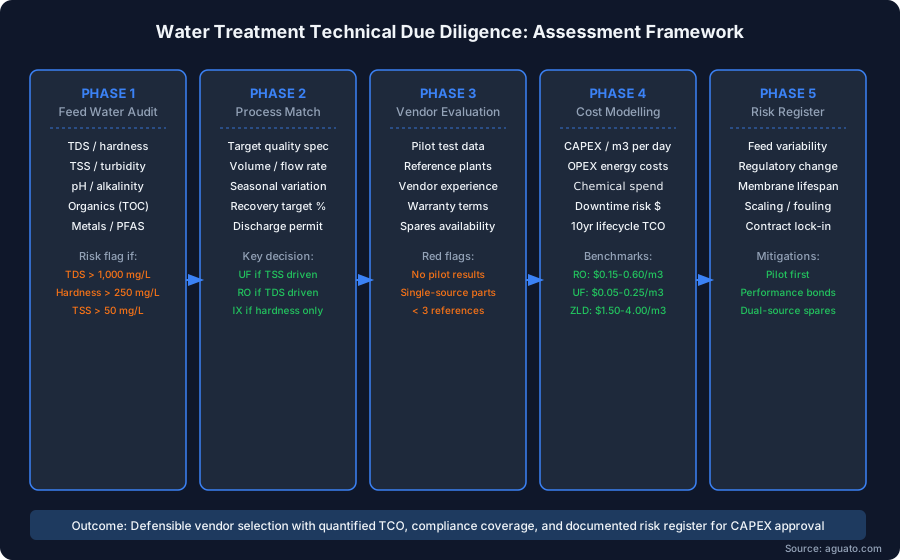
Feed water characterisation is the bedrock of any credible water treatment technical due diligence exercise. Without it, every downstream decision, including technology selection, sizing, chemical dosing, and recovery rate, rests on assumption rather than data. The characterisation must cover not just average conditions but the full envelope of variability, seasonal, diurnal, and event-driven.
The minimum analytical panel for a pre-investment feed water audit:
- TDS (total dissolved solids), measured by gravimetric or conductivity proxy - Hardness (as CaCO3), calcium, and magnesium individually - Total suspended solids (TSS) and turbidity (NTU) - pH and alkalinity (mg/L as CaCO3) - Total organic carbon (TOC) and chemical oxygen demand (COD) - Silica (reactive and colloidal) - [Iron](/elements/iron) and manganese - Emerging contaminants where applicable: PFAS, nitrates, heavy metals - Biological activity: heterotrophic plate count (HPC) and Legionella where recirculation is involved
The decision thresholds that drive technology selection flow directly from this data. If TDS exceeds 1,000 mg/L, nanofiltration or reverse osmosis is required for demineralisation. If TSS exceeds 50 mg/L, pre-treatment media filtration or dissolved air flotation is needed before any membrane stage. If silica exceeds 20 mg/L in a high-recovery RO application, anti-scalant dosing and recovery capping become mandatory design constraints. If iron exceeds 0.3 mg/L, an oxidation and filtration pre-treatment step is essential before softening or RO.
Sampling must cover a minimum of three seasonal data points, or 12 months of grab samples if the feed is from a surface source. A single-day sample that is then extrapolated to an annual design basis is one of the most common and costliest shortcuts in the industry. The analysis cost for a comprehensive feed water panel runs $800 to $2,500 per sample set. That investment, multiplied across three seasonal points, is $2,400 to $7,500. It is the cheapest insurance available against a $500,000 plant design error.
The [U.S. EPA's water quality guidelines for industrial water use](dofollow:https://www.epa.gov/waterreuse/water-reuse-and-recycling) provide a solid reference framework for minimum characterisation requirements before process design. For operations dealing with reuse or recycle streams, EPA guidance on parameter ranges by end-use application is directly applicable to the design basis document.
[cta:nepti-dark]
## Phase 2: Process and Technology Selection Framework
Technology selection is the most consequential decision in the due diligence process, and it is also where the most capital is destroyed through shortcutting. The correct sequence is: characterise, then match technology to quality gap, then size, then cost. Reversing that sequence, which happens when procurement leads issue RFPs without completing Phase 1, invites vendors to set their own design basis.
Threshold-based technology selection logic:
- TSS-dominated feed (TSS > 50 mg/L): dissolved air flotation (DAF) or media filtration as primary treatment; ultrafiltration as polishing. - Hardness-dominated feed (hardness 150 to 500 mg/L as CaCO3, TDS < 500 mg/L): ion exchange softening is the cost-optimal path. Reverse osmosis is overspecified and over-expensive for hardness removal alone. - TDS-dominated feed (TDS 500 to 2,000 mg/L): nanofiltration can achieve 80 to 95% TDS removal at lower energy than RO. For TDS above 2,000 mg/L, RO is the minimum threshold technology. - Biological risk (HPC > 1,000 cfu/mL, recirculation systems): UV disinfection combined with residual biocide dosing. Chlorination alone at high TOC loads creates disinfection byproduct (DBP) risk. - Trace organics, pharmaceuticals, PFAS: activated carbon adsorption (GAC) pre-treatment upstream of RO or NF. - High-recovery, zero-discharge mandate: RO brine concentration followed by mechanical vapour recompression (MVR) or thermal evaporation; CAPEX $1.5 to $4 million for a 500 m3/day duty.
The important caveat is that real industrial duties are rarely single-parameter problems. A pharmaceutical water system may face TDS at 600 mg/L with TOC at 8 mg/L and strict endotoxin limits. An electronics fab ultrapure water system faces TDS at 200 mg/L but requires resistivity above 18.2 MOhm-cm. The correct technology train for these duties is not derivable from a single threshold. It requires a multi-parameter matrix model and, where the operational envelope is wide, a pilot test.
The [how to choose industrial water treatment](/resources/how-to-choose-industrial-water-treatment) guide provides a complementary framework for matching technology selection to process duty requirements, including sector-specific decision trees for food and beverage, pharmaceutical, and power generation applications.
The right answer for your specific feed water and process duty requires qualified engineering input. [Post your project](/post-project) and experienced water treatment providers will scope the technology train against your actual feed data and operating constraints.
## Technology Comparison: Cost, Risk, and Best-Fit Matrix
Technology selection trade-off table for a 500 m3/day industrial plant:
| Technology | CAPEX Range | OPEX (energy + chemicals) | Scaling/Fouling Risk | Best For | |---|---|---|---|---| | Media filtration + clarification | $120k to $250k | $0.02 to $0.08/m3 | Low (inert media) | TSS removal, pre-treatment | | Ion exchange softening | $180k to $380k | $0.08 to $0.22/m3 (salt) | Low to medium (resin fouling) | Hardness removal, boiler makeup | | Ultrafiltration (UF) | $280k to $600k | $0.05 to $0.18/m3 | Medium (organic fouling) | Pathogen barrier, SDI reduction for RO feed | | Nanofiltration (NF) | $380k to $750k | $0.12 to $0.35/m3 | Medium to high (scale) | TDS 500 to 2,000 mg/L, hardness + organics | | Reverse osmosis (RO) | $500k to $1.2M | $0.15 to $0.60/m3 | High (CaCO3, SiO2 scale) | TDS > 1,000 mg/L, demineralised water | | UF + RO combined | $700k to $1.5M | $0.20 to $0.65/m3 | Medium (pre-treatment protects RO) | High-purity, pharma, electronics | | Zero liquid discharge (ZLD) | $1.2M to $3.5M | $1.50 to $4.00/m3 | High (brine crystalliser fouling) | Regulatory zero-discharge mandate |
The table above flags a principle that is often inverted in RFP processes: more treatment does not mean more protection. Specifying RO for a duty that requires only softening adds $300,000 to $800,000 in CAPEX, doubles OPEX, and introduces a high-maintenance asset into a system that was adequately served by ion exchange. The business case for over-specification rarely survives a proper lifecycle model.
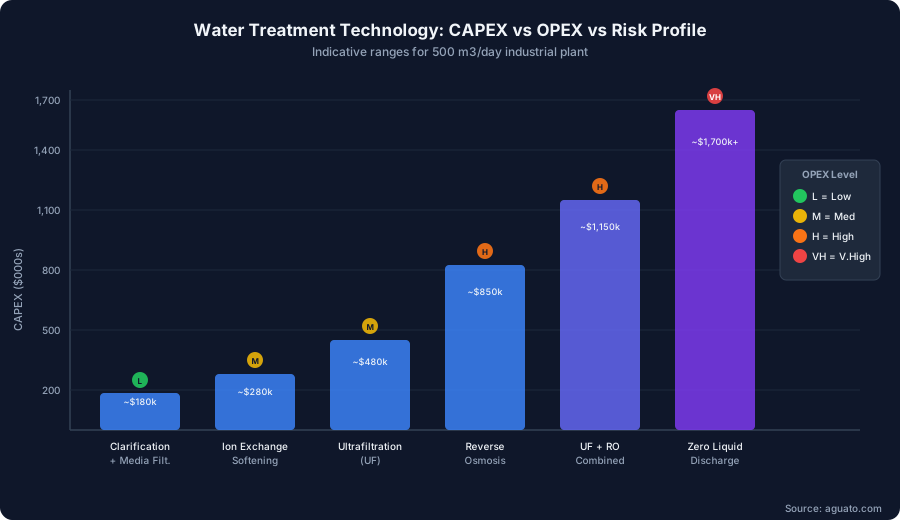
For the [water treatment plant design](/resources/water-treatment-plant-design) decisions that follow technology selection, the cost ranges above provide a realistic CAPEX basis for early-stage budgeting, before detailed engineering has been completed.
## Phase 3: Vendor Evaluation and Pilot Testing Standards
Vendor evaluation is where procurement discipline separates effective capital allocation from expensive optimism. The single most important rule: never approve a capital expenditure above $500,000 on a water treatment system that has not been piloted against your actual feed water. Vendor performance guarantees are not a substitute for pilot data. They are a legal backstop after the money has been spent and the system is underperforming.
The structured vendor evaluation scorecard covers five dimensions:
Technical credibility: does the vendor have documented operating references for plants of comparable duty, treating comparable feed water, in a comparable industry? Minimum threshold: three references with demonstrable performance data. A single large reference in a different sector is not equivalent.
Pilot test rigour: does the pilot plan specify minimum test duration (recommended: 90 days for membrane systems, 30 days for media or IX), feed variability coverage, and clean performance benchmarks? Vendors who propose 14-day pilots on municipal-quality water while your feed is industrial effluent are not providing meaningful data.
Spares and service independence: single-source proprietary consumables (membranes, cartridges, specialist chemical formulations) represent long-term OPEX risk. A vendor lock-in on membrane consumables can add $30,000 to $80,000 per year to OPEX relative to open-market equivalent specifications.
Warranty and performance bond structure: performance guarantees should specify the design basis parameters explicitly. A guarantee that references "normal operating conditions" without defining them is not enforceable. Look for guarantees that specify TDS removal efficiency (typically 95 to 99% for RO), recovery rate at stated feed conditions, and energy consumption per m3 at design flow.
Integration and commissioning track record: the most technically capable vendor is not necessarily the best partner for a complex multi-stage system. Evaluate commissioning timelines (typical for 500 m3/day membrane plant: 8 to 16 weeks from delivery), control system integration experience, and operator training provisions.
The [consulting-services](/consulting-services) category on Aguato connects buyers with independent water treatment engineers who can structure vendor evaluation scorecards and review proposals against a neutral technical standard, rather than relying on self-reported vendor data.
## Phase 4: Lifecycle Cost Modelling for CAPEX Approval
CAPEX is the number that appears in the board paper. Total cost of ownership (TCO) is the number that matters. The gap between them, accumulated over 10 years, routinely exceeds the original CAPEX figure for high-maintenance treatment technologies.
The 10-year TCO model structure for a water treatment plant:
- Year 0 CAPEX: equipment supply, civil works, electrical installation, commissioning, and first-fill consumables. For a 500 m3/day RO plant, typical all-in CAPEX is $850,000 to $1.4 million. - Annual OPEX breakdown: energy (typically 30 to 45% of OPEX for RO, 10 to 20% for IX), chemical consumption (anti-scalants, biocides, CIP chemicals), membrane or media replacement (provisioned at 5 to 7 year intervals for RO elements at $35 to $60 per m2 of membrane area), labour (operations and maintenance), and scheduled servicing. - Downtime cost provision: at $50,000 to $200,000 per day of production loss for continuous-process industries, even a 2-day annual downtime provision adds $100,000 to $400,000 to the annual risk-weighted cost. - End-of-life residual value and decommissioning: rarely modelled, but for plants with hazardous chemical handling, decommissioning costs of $50,000 to $150,000 should appear in the lifecycle model.
A 500 m3/day RO plant with $1.1 million CAPEX and $0.35/m3 OPEX accumulates $638,000 in treatment costs annually at 5,000 operating hours. Over 10 years, the TCO is approximately $7.5 million, of which CAPEX represents only 15%. The procurement decision based on the cheapest upfront bid is optimising the smallest cost component.
The most common lifecycle modelling error is using vendor-provided energy and chemical consumption figures without adjusting for real-world fouling factors. Clean-water RO energy consumption is typically quoted at 0.25 to 0.45 kWh/m3. Under industrial feed conditions with partial fouling, real-world consumption is typically 0.50 to 0.90 kWh/m3. At $0.08/kWh and 500 m3/day, that difference costs $7,300 to $16,000 per year in energy alone.
The [most efficient water solution](/resources/most-efficient-water-solution) comparison provides quantified benchmarks for energy consumption across treatment technologies, which should be incorporated into the OPEX modelling rather than relying on vendor datasheets.
## Phase 5: Risk Register and Contractual Protections
A credible risk register for a water treatment capital project captures four categories of risk: technical performance risk, supply chain and vendor risk, regulatory change risk, and feed water variability risk. Each should be quantified by probability and impact, with a named mitigation and a residual risk rating.
Technical performance risk covers the scenario where the installed system does not achieve the specified output quality at design flow. Mitigation: pilot test data, performance bond with liquidated damages at $5,000 to $20,000 per week of underperformance, and a design basis document that is incorporated into the contract.
Feed water variability risk is systematically underestimated. Industrial feed water quality can change due to upstream process changes, seasonal variation, catchment events, or regulatory changes in discharge from neighbouring facilities. Mitigation: design basis with stated variability envelope (e.g., TDS 600 to 2,400 mg/L, TSS 10 to 80 mg/L), and confirmed vendor performance guarantee at worst-case conditions.
Regulatory change risk is growing in relevance as PFAS discharge limits tighten, water abstraction licensing becomes more restrictive, and industrial wastewater standards are revised. The [ISO 14001 Environmental Management System standard](dofollow:https://www.iso.org/iso-14001-environmental-management.html) provides a framework for embedding regulatory foresight into capital project governance. Buyers in jurisdictions with anticipated tightening of discharge limits should model the cost of a technology upgrade (typically $150,000 to $600,000 for a treatment stage addition) as a scenario in the risk register.
Vendor lock-in risk materialises when a supplier specifies proprietary consumables, custom control software, or unique membrane elements that are not available from alternative sources. The cost of breaking vendor lock-in mid-contract can range from $80,000 to $250,000 in system modifications and recommissioning.
Contractual protections that should be non-negotiable in any water treatment supply contract: performance bond, guaranteed throughput and quality at design conditions, clear definition of the design basis envelope, open-specification consumables (or equivalent performance equivalence clause), and a commissioning acceptance test protocol with measurable pass/fail criteria.
## Failure Scenarios: What Goes Wrong After Commissioning
The failure mode library below is drawn from documented industrial installation patterns. Each scenario follows the structure: decision made, operational outcome, quantified cost, correct decision.
Scenario 1: Membrane bioreactor specified without biological pre-characterisation Decision: a food and beverage plant specified a membrane bioreactor (MBR) for wastewater reuse based on a BOD loading from nominal production volumes. Operational outcome: seasonal production peaks drove BOD loading 2.4x above design, causing membrane fouling within 8 months and complete system shutdown at month 11. Quantified cost: $340,000 in emergency membrane replacement and 22 days of production water trucking at $8,000/day. Correct decision: pilot at peak loading condition, design to 1.5x peak, and include a buffer holding tank for load equalisation.
Scenario 2: RO system sized for current demand without growth provision Decision: a pharmaceutical manufacturer installed a 200 m3/day RO system at tight capacity based on current WFI demand. Operational outcome: 3 years later, a new product line required 340 m3/day. System operated at 170% design capacity for 8 months while replacement was procured. Quantified cost: $180,000 in emergency RO rental, $420,000 in accelerated system replacement (the original plant was 5 years from book-end). Correct decision: size for 10-year demand projection with a modular expansion provision that adds capacity at $200 to $350/m3 per day rather than full replacement.
Scenario 3: Lowest-CAPEX vendor selection without lifecycle modelling Decision: a mining operation selected the lowest-bid vendor for a 1,200 m3/day wastewater treatment plant. CAPEX saving versus the second-ranked bid was $280,000. Operational outcome: the selected system consumed 40% more energy than specified, chemical consumption was 2.8x the vendor estimate due to proprietary formulations, and membrane life was 2 years rather than the guaranteed 5 years. Quantified cost: $210,000 annual OPEX premium over 10 years equals $2.1 million. Net loss versus the higher-CAPEX bid: $1.82 million. Correct decision: lifecycle model at the procurement stage, with OPEX penalty clauses where vendor-supplied consumables exceed a capped volume rate.
The [membrane fouling prevention](/resources/membrane-fouling-prevention) guide details the specific pre-treatment design and operating protocol changes that would have prevented Scenario 1 and Scenario 3, with a focus on feed characterisation requirements for organic-loaded water.
## How Decision-Intelligence Tools Change the Evaluation
The conventional approach to water treatment due diligence is expert-dependent: an engineering consultancy reviews the feed data and recommends a technology train based on their experience and vendor relationships. The structural problem with that approach is selection bias. A consultant with deep RO experience will tend toward RO-based solutions. A consultant with strong IX relationships will find softening adequate for duties that might benefit from membrane polishing.
Decision-intelligence platforms like [Nepti](/nepti) take a different approach. Nepti models your water matrix, including feed quality envelope, target quality specification, recovery requirement, and discharge constraints, and produces a ranked comparison of technology options with cost projections across the full CAPEX-to-TCO range. The model runs scenario analysis on feed variability, so the buyer sees not just the baseline performance case but the stress-tested performance under worst-case feed conditions.
This changes the procurement dynamic in two important ways. First, the technology selection conversation starts from a model that is neutral to vendor relationships. Second, the output of the model is a document, a scored technology comparison with cost ranges and risk flags, that can go directly into a CAPEX approval pack without needing to be translated by a consultant.
The output is not a recommendation to buy from Nepti. It is a ranked shortlist of technology options, with quantified cost and risk, that a buyer can then take to market with a well-defined specification. That specification improvement alone typically reduces RFP response variability by 30 to 50%, which makes vendor comparison more rigorous and defensible. [Run your feed water parameters through Nepti](/nepti) before issuing your RFP and the technology selection phase moves from 6 to 8 weeks of consultant-dependent work to 2 to 3 weeks with a model-validated output.
## ESG and Regulatory Considerations in Technology Selection
ESG-driven water strategy is no longer a parallel track to capital procurement. For multi-site industrial operators under CDP Water Security or GRI 303 reporting obligations, the choice of water treatment technology is a direct input to disclosable metrics: water withdrawal by source, water consumption, and wastewater discharge quality.
A reverse osmosis plant operating at 75% recovery withdraws 1.33 litres for every litre of product water. A ZLD system withdraws close to 1.0 litre per litre of product water, but consumes 6 to 10x more energy. For an operator with a water reduction target, RO plus brine recirculation (recovery at 90 to 95%) achieves a 10 to 15% reduction in withdrawal versus standard RO at comparable CAPEX to a full ZLD system. That trade-off, documented in a technology selection report, is directly reportable as a capital allocation decision supporting the corporate water stewardship target.
The regulatory picture is tightening faster than most capital project timelines allow. PFAS discharge limits are being formalised across EU member states under the Water Framework Directive and in US states under state-level PFAS action plans. Industrial operators whose current discharge permit does not explicitly address PFAS are carrying a regulatory change risk that should appear in the Phase 5 risk register. Adding GAC adsorption to an existing treatment train costs $120,000 to $380,000 for a 500 m3/day system. Retrofitting after a permit violation costs $800,000 to $2 million when enforcement timelines, legal fees, and emergency procurement are included.
The [WHO guidelines for industrial water use and discharge](dofollow:https://www.who.int/publications/i/item/9789241546768) provide the internationally recognised reference standard for acceptable contaminant levels that should anchor the design basis for any plant with a public water supply interface or shared watershed discharge.
The [industrial water reuse and recycling](/resources/industrial-water-reuse-recycling) framework details how technology selection decisions translate into measurable water efficiency improvements that satisfy both operational targets and external ESG reporting requirements.
For multi-site operators, the technology selection process should include a site portfolio review: standardising on a common treatment platform across sites reduces spares holding costs by 20 to 35%, simplifies operator training, and consolidates vendor commercial relationships. That standardisation benefit is only achievable if the initial technology selection is done against a portfolio-wide feed water characterisation, not site-by-site.
The right answer for your ESG reporting baseline and regulatory compliance requirements depends on your site-specific operating permits and discharge context. [Connect with a qualified water treatment provider](/post-project) who has experience with regulatory compliance documentation in your jurisdiction.
## FAQ
### What does water treatment technical due diligence involve?
Water treatment technical due diligence is a structured pre-investment evaluation that verifies a proposed treatment technology will perform against your actual feed water conditions, at your required flow rate, within your operational cost envelope. It covers feed water characterisation, technology selection, vendor evaluation, lifecycle cost modelling, and contractual risk allocation. A full due diligence process for a $500,000 to $2 million plant typically runs 10 to 16 weeks and costs $25,000 to $75,000 in independent engineering fees, which is 2 to 5% of the capital value and a fraction of the downside risk from a poorly specified system.
### How many feed water samples do I need before specifying a treatment system?
The minimum is three seasonal samples from the actual feed source, analysed against a comprehensive panel covering TDS, TSS, hardness, pH, TOC, silica, metals, and biological indicators. For surface water sources or feeds influenced by upstream industrial discharge, 6 to 12 monthly samples are strongly recommended. A single sample is inadequate for any system design basis. The cost of additional sampling, $800 to $2,500 per sample set, is negligible relative to the cost of a system that underperforms because the design basis did not capture seasonal variability.
### When is a pilot test mandatory for a water treatment system?
A pilot test is mandatory for any membrane-based system treating feed water with high organic load, high silica, variable TDS, or biological content. Recommended minimum pilot duration is 90 days for RO and NF systems, and 30 days for UF and IX systems. Pilots should be run on the actual feed, not on municipal water or a synthetic proxy. Skip the pilot and you are funding the real-world learning curve with production capital: the cost of a failed first-year membrane system is typically $120,000 to $400,000 in replacement and lost production.
### What is the typical CAPEX range for an industrial RO water treatment system?
For a 500 m3/day reverse osmosis plant in an industrial setting, all-in CAPEX including civil works, electrical, control system, pre-treatment, and commissioning runs $850,000 to $1.4 million in the United States and Western Europe. Smaller package units at 50 to 100 m3/day run $150,000 to $380,000. Larger systems at 2,000 to 5,000 m3/day scale to $3 million to $7 million depending on pre-treatment complexity and recovery requirements. These are all-in project costs. Equipment-only quotes from vendors are typically 40 to 60% of the all-in figure.
### How do I compare water treatment vendor proposals on a like-for-like basis?
The only rigorous basis for vendor comparison is a normalised 10-year total cost of ownership (TCO) model applied consistently to each proposal, using the same design flow, the same feed water characterisation, and the same OPEX assumptions. Require all vendors to quote against a defined design basis document, including feed quality envelope, target product quality, recovery rate, and operating hours. Proposals that do not specify the assumed feed conditions are not comparable and should be returned for clarification. A procurement scorecard that allocates 40% weight to TCO, 30% to technical credibility and pilot data, 20% to vendor track record, and 10% to contract terms will produce a defensible selection rationale for a CAPEX approval board.
### What contractual protections should I require from a water treatment vendor?
The non-negotiable contractual protections are: a performance guarantee specifying removal efficiency and throughput at stated feed conditions, a performance bond with liquidated damages for underperformance, open-specification or equivalent-performance consumables clauses, a design basis document incorporated by reference into the supply contract, and a commissioning acceptance test protocol with defined pass/fail criteria. Performance guarantees that reference "normal operating conditions" without defining those conditions are legally unenforceable. Insist on quantified parameters. A $10,000 to $20,000 legal review of the vendor contract is cheap relative to a $300,000 dispute over what "design performance" means.
### How does water treatment technology selection affect ESG reporting?
Technology selection directly determines three GRI 303 water metrics: withdrawal volume by source, consumption, and discharge quality. A standard RO system operating at 75% recovery withdraws 33% more water than product volume. High-recovery RO at 92% recovery reduces withdrawal to 9% above product volume. Zero liquid discharge eliminates wastewater discharge entirely but increases energy consumption 6 to 10x. For operators under CDP Water Security, Science-Based Targets for water (SBTi-W), or EU sustainability disclosure obligations, the technology selection report is a primary source document for the capital allocation disclosure. Building the ESG metrics into the Phase 4 TCO model, alongside CAPEX and OPEX, ensures the sustainability benefit is quantified in financial language for the CAPEX approval pack.