Most industrial water treatment decisions are made by letting vendors set the agenda, and that is why so many systems underperform. A guide to characterising your challenge first, understanding what each major industry segment actually requires, and using AI to reach a data-backed specification before engaging the market.
The wrong industrial water treatment solution costs more to correct than it did to specify in the first place. Membrane replacements triggered by incorrect pre-treatment, Legionella incidents in inadequately controlled cooling systems, pharmaceutical water loops that fail USP specification months after commissioning, these are not failures of technology. They are failures of the decision process that preceded it.
The industrial water treatment market is worth over $48 billion annually and growing, yet most procurement decisions are still made the same way they were twenty years ago: a vendor is called in, proposals arrive based on limited feed water data, and the contract goes to the provider with the most familiar name or the most persuasive sales representative. The technology choice is effectively made by the vendor, not the buyer. Finding the right provider through conventional methods, trade shows, consultancy firms, cold LinkedIn searches, takes 2 to 6 weeks and costs $10k, $30k just to identify who to talk to. The full selection cycle, from problem assessment through water sampling, lab analysis, and feasibility testing to a technology decision, consumes another 4 to 6 months and $20k, $50k. For a system the plant will operate for 15 to 25 years, this is an extraordinary delegation of time, money, and responsibility.
[Nepti](/nepti) is Aguato's AI-powered decision intelligence tool built to fix this. It characterises your water challenge before any vendor is engaged, modelling your water matrix, mapping it against 1,000+ provider capabilities, and producing a ranked comparison of technology options with cost projections. This guide covers what good industrial water treatment decisions look like, where they most commonly fail, and how AI-assisted analysis is changing outcomes for plant managers and engineers across every major industrial sector. For a deeper look at the intelligence layer itself, see [Nepti: The Intelligence Layer Industrial Water Has Been Missing](/resources/nepti-decision-intelligence-water-treatment). To understand the full procurement ecosystem, see [what a water marketplace is and how it works](/resources/water-marketplace).
## Why Industrial Water Treatment Decisions Go Wrong
Industrial water treatment selection suffers from a specific and well-documented problem: the people with the most information about what you should buy are the people who profit from selling it to you.
This creates several predictable failure modes:
Vendor-led specifications. In most procurement processes, the initial technical specification is written by or heavily influenced by potential suppliers. The supplier's preferred technology appears in the specification. Alternative approaches, potentially more appropriate, lower cost, or better suited to the specific water matrix, never reach the evaluation stage because the decision process is structured to exclude them.
Carry-forward bias. "We used X technology at our last site" is not a specification. Feed water chemistry, discharge requirements, energy costs, and regulatory context differ between sites. A system that performed well in Manchester may be over-specified, under-specified, or simply wrong for a facility in Arizona or Singapore. Each water challenge requires fresh analysis, not a copy of the last project.
Insufficient feed water data. The single most important input to any water treatment specification is a comprehensive feed water analysis. TDS, hardness, alkalinity, silica, organic content, microbial load, seasonal variation, these parameters determine everything: membrane type and configuration, chemical dosing rates, pre-treatment requirements, and expected performance. Most procurement processes begin with inadequate water data and end with a system designed around assumptions.
Time pressure and over-delegation. Plant managers and operations directors are rarely water treatment specialists. When a water challenge lands on their desk, the path of least resistance is to call a known supplier and delegate the technical decision. This is understandable but expensive. Without independent technical analysis, there is no basis for evaluating whether a proposal is appropriate for the challenge.
## The Cost of Getting It Wrong: Quantified Failure Cases
The [2024 UN World Water Development Report](dofollow:https://unesdoc.unesco.org/ark:/48223/pf0000388948) identifies water management failures in industry as a growing source of operational cost, with water-related downtime, regulatory penalties, and treatment system underperformance combining into losses that consistently exceed the original treatment programme investment.
When technology selection produces the wrong outcome, the downstream costs are severe. A failed pilot and redesign costs $275k, $2.2M. Retrofitting or replacing an incorrectly specified system costs $1.1M, $5.5M. Production downtime during remediation costs $110k, $550k per week. Permit delays and compliance remediation add another $275k, $2.2M. Across the roughly 20,000 to 30,000 regulated industrial facilities globally, these failures aggregate to an estimated $22B+ lost annually from wrong or delayed industrial water treatment decisions.
Three representative failure patterns recur across the industries Aguato works with:
Oversized RO where NF would have sufficed. A food processing facility specified a two-pass RO system for borehole water with TDS of 650 mg/L and no trace organics of concern. A [nanofiltration](/resources/ro-vs-nf-vs-uf-comparison) system would have met the process water specification at 40% lower CAPEX and 30% lower energy consumption. The RO system operated at 78% recovery with unnecessary energy expenditure for the entire service life. No independent feed water analysis was conducted before procurement.
Undersized biocide programme in a cooling tower. A manufacturing plant with a 3,000 m3/hr cooling tower ran biocide dosing based on the original system design from 2009. Water consumption had increased 35%, organic load had increased with process changes, and the cooling circuit had been extended twice. A routine Legionella test returned a count of 48,000 cfu/L, immediate shutdown, emergency remediation, regulatory notification, and legal review followed. Total cost: over $120,000 for what would have been a $3,200 annual programme review.
Pharmaceutical purified water loop failing TOC specification. A pharmaceutical CMO commissioned a purified water system for tablet production. Nine months post-commissioning, TOC was consistently at 520 to 580 µg/L against a USP limit of 500 µg/L. The cause: the UV 185 nm photooxidation stage was undersized for the actual organic load of the municipal supply, which had not been fully characterised at design. Corrective CAPEX exceeded the original UV system cost by 3×, with two months of production disruption for revalidation.
Each failure traces to the same root cause: technology selection made without adequate data and independent analysis.
## Five Industry Segments, Five Distinct Water Challenges
Industrial water treatment is not a homogeneous market. The challenges facing a pharmaceutical CMO are categorically different from those facing a steel plant, a food processor, or a semiconductor fab. The right solution in one context is the wrong solution in another.
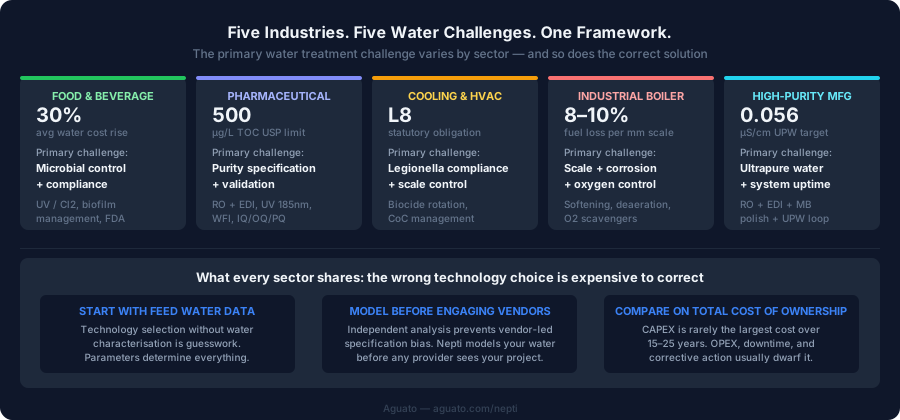
Food and beverage. Process water must meet potable standards at point of use, with additional constraints on taste, odour, and microbiological consistency. The primary challenges are microbial control (UV or chlorination with ongoing biofilm management), scale in heating and pasteurisation equipment, and compliance with food safety regulations. Water cost is increasingly material, food processors in water-stressed regions report costs rising 15 to 30% over the past three years.
Pharmaceutical and life sciences. Water specification is defined by pharmacopoeia: USP Purified Water requires conductivity below 1.3 µS/cm and TOC below 500 µg/L; WFI additionally requires endotoxin below 0.25 EU/mL. A system outside specification triggers an investigation, a CAPA, and potential production hold. The procurement challenge is matching system design to the validation regime, a system that passes PQ in the first 12 months, not one that performs at FAT and fails in service.
Cooling towers and HVAC. The dominant challenge is Legionella risk management, a statutory obligation under ASHRAE Standard 188 in the US and HSE ACoP L8 in the UK. The [ASHRAE 188 standard](dofollow:https://www.ashrae.org/technical-resources/bookstore/ansi-ashrae-standard-188-legionellosis-risk-management-for-building-water-systems) requires a documented Water Management Plan for any building with at least one Legionella risk system. Beyond compliance, the operational challenge is managing scale and corrosion across mixed-metallurgy systems. Poor treatment in a [cooling tower](/resources/cooling-tower-water-treatment) costs $0.08, $0.25/m3 more in make-up water and chemicals than an optimised programme.
Industrial boilers. Boiler feedwater quality determines scale deposition rate, corrosion rate in the steam circuit, and carry-over into steam. 1 mm of calcium carbonate scale on a boiler tube increases fuel consumption by approximately 8 to 10%. The treatment challenge combines pre-treatment (softening, degassing, RO for high-pressure systems) with internal chemical dosing (oxygen scavengers, alkalinity control). Mis-specified feedwater treatment on a high-pressure boiler can cause tube failure, a safety event, not just an operational cost.
High-purity manufacturing. Semiconductor and electronics fabrication require water where dissolved solids are measured in parts per trillion, conductivity below 0.056 µS/cm, TOC below 1 µg/L. A fully integrated UPW system for a semiconductor fab costs $15 to 60M and requires continuous recirculation to prevent biofilm establishment. The selection challenge is not which technology works, it is which configuration, at what redundancy level, validates reliably at production scale.
## What Feed Water Characterisation Actually Requires
No credible water treatment specification can be written without a complete feed water analysis. Technology selection without feed water data is guesswork wearing the costume of engineering.
A complete characterisation for industrial water treatment specification includes:
- Physical: temperature, turbidity, colour, conductivity, TDS, TSS - Inorganic chemistry: [calcium](/elements/calcium), magnesium, [sodium](/elements/sodium), bicarbonate, sulphate, chloride, silica, iron, manganese - Organics: TOC, BOD, COD, THM precursors, any application-specific trace contaminants - Microbiology: total viable count, coliforms, Legionella (cooling/HVAC), specific pathogens if relevant - Scaling indices: Langelier Saturation Index, Ryznar Stability Index, silica saturation - Variability: seasonal fluctuations, especially critical for surface water and municipal supplies with infrastructure-dependent quality variation
This data set determines everything: whether softening is required before an RO membrane, what pre-treatment configuration achieves acceptable SDI for the membrane feed, what UV dose is required at the actual water's UVT, and what chemical programme controls corrosion and scale at the actual operating chemistry.
Most procurement processes start with a subset of this data. The vendor fills gaps with assumptions, typically conservative ones that produce over-engineered, over-priced systems. Nepti's Diagnose workflow is built around this data set: it accepts your feed water parameters, maps them against validated performance data, and returns technology recommendations calibrated to your actual water, not a generic profile.
[Use Nepti to characterise your water challenge](/nepti) before engaging any vendor. The analysis takes under an hour and produces a ranked technology comparison that you own, independent of any provider's commercial interest.
[cta:nepti-dark]
## How AI Changes the Industrial Water Treatment Selection Process
The application of AI to industrial water treatment is not about replacing engineering judgment. It is about giving plant managers and engineering teams the analytical depth that historically only large consultancies with deep project databases could provide.
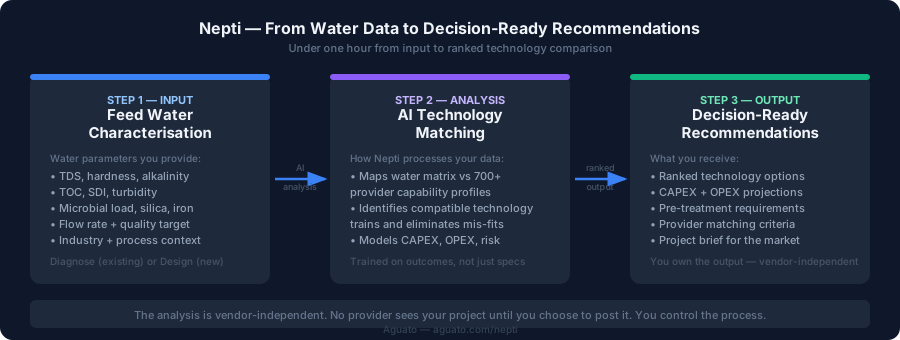
What Nepti actually does:
Diagnose, for existing systems or defined treatment challenges. Input: feed water chemistry, flow rate, quality target, operational constraints. Output: ranked technology options matched against your water matrix, with performance projections, CAPEX and OPEX ranges, and pre-treatment requirements.
Design, for new systems or significant upgrades. Input: project parameters including feed water, target output quality, site constraints, industry type. Output: system design recommendations including process flow sequence, sizing parameters, and technology combinations optimised for cost and reliability.
The AI layer is trained against outcomes, not just specifications. Systems that looked correct on paper but failed due to water matrix edge cases, seasonal variability, or technology incompatibilities inform the recommendation engine. This is the operational intelligence that takes years to accumulate on individual projects, now accessible in under an hour.
The ROI case for AI-assisted selection is quantified. The traditional technology selection process costs $20k, $50k and takes 4 to 6 months from problem assessment to a defensible decision. Nepti compresses time-to-decision to 2 to 4 hours of structured validation and reduces selection cost to approximately $1k, $3k. That is 70 to 90% lower cost per technology selection, with savings of $19k, $47k per selection cycle, before accounting for the reduced probability of selecting the wrong technology entirely.
The decision quality difference is also structural. Traditional approaches produce marketing-driven decisions with high risk of wrong selection. Nepti produces performance-based recommendations with confidence scores, scenario comparison across best and alternative configurations, and risk quantification per technology option.
What AI does not replace: on-site survey and sampling, hydraulic design, commissioning, and regulatory compliance review. Nepti produces a decision-ready brief that an engineer can act on, not a construction-ready drawing. The value is in compressing the pre-specification phase from weeks to hours and ensuring that when vendors are engaged, the specification is built on data, not delegation.
According to [EPA guidance on industrial water reuse](dofollow:https://www.epa.gov/waterreuse/guidelines-water-reuse), treating water as a recoverable resource, rather than a disposal problem, requires exactly this kind of systems-level analysis: understanding the full water cycle, the treatment options at each stage, and the cost trade-offs between recovery and discharge. AI-assisted analysis makes this practical for facilities that do not have a dedicated water chemistry team.
## From Analysis to the Market: Getting Independent Proposals
The Nepti output is a starting point for market engagement, not a replacement for it. Once your water challenge is characterised and technology options ranked, the next step is receiving proposals from providers who specialise in your specific application.
The Aguato marketplace currently hosts over $3M in live industrial water projects, from cosmetic-grade RO capacity upgrades in France to high-salinity algal bloom treatment in Saudi Arabia and greenhouse irrigation quality optimisation in Spain. Each project followed the same sequence: Nepti analysis first, specification defined second, market engagement third.
The platform connects your characterised challenge with 1,000+ verified water treatment providers across every technology category. The difference from standard procurement:
- You define the specification before vendors see your project, based on independent analysis, not vendor-led framing - Multiple independent proposals are received against a consistent brief, enabling genuine comparison - Provider capability is matched to your water matrix, specialists in your specific challenge, not generalist providers
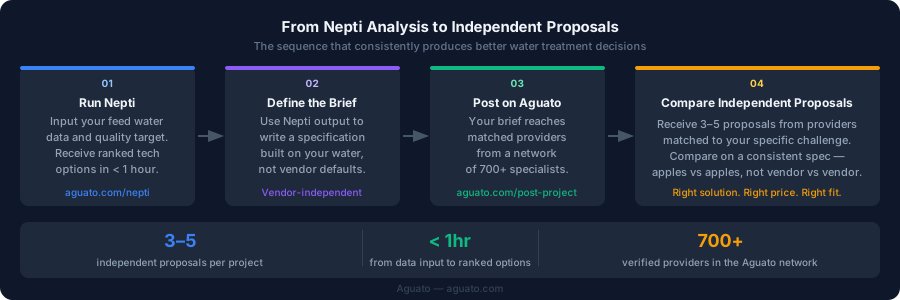
This is the sequence that consistently produces better decisions: characterise the challenge with Nepti, define the specification, engage the market through Aguato, compare independent proposals. At no point does a vendor define what your water challenge is.
[Post your water treatment project on Aguato](/post-project) after running a Nepti analysis, and receive 3 to 5 independent proposals against your characterised specification.
[Browse providers by technology specialisation](/providers) if you already have a specification and want to identify qualified suppliers in your sector.
## FAQ
### What is the best industrial water treatment solution for manufacturing?
There is no universal answer, the right solution depends on your feed water chemistry, process quality requirements, discharge constraints, and operational context. A facility on municipal supply with moderate hardness has categorically different needs from a facility on high-silica borehole water. The starting point is always feed water characterisation. Use Nepti to model your specific water against technology options before any vendor engagement.
### How much does industrial water treatment cost?
CAPEX varies significantly by technology and scale. A sodium hypochlorite dosing system for a small cooling tower costs $3,000, $8,000 installed. A full two-pass RO system for pharmaceutical purified water costs $150,000, $500,000 depending on flow rate. An ultrapure water system for semiconductor fabrication can exceed $15M. OPEX, chemicals, energy, membrane replacement, monitoring, is often the larger lifetime cost: systems with low CAPEX and poorly specified chemistry can generate OPEX 3 to 4x higher than a correctly specified programme over 15 years.
### What is the most common industrial water treatment mistake?
Over-specifying RO where NF or softening would suffice. RO is the most widely specified membrane technology, and vendors default to it. For many industrial applications, process heating, cooling make-up, general utility water, lower-energy alternatives perform identically at significantly lower cost. The second most common mistake is under-specifying pre-treatment, causing membrane fouling and performance degradation that the system never recovers from.
### Do I need Legionella risk management if I don't have a cooling tower?
Yes, in most jurisdictions. ASHRAE 188 in the US and HSE ACoP L8 in the UK both define the duty of care in terms of any water system that creates risk of Legionella exposure, including HVAC hot and cold water systems, humidifiers, and process systems that generate aerosols. The absence of a cooling tower does not remove the obligation if other at-risk systems are present.
### What data do I need before requesting a water treatment system quote?
At minimum: feed water analysis (TDS, hardness, alkalinity, silica, iron, pH, TOC, microbiology), flow rate requirements, target treated water quality specification, and discharge consent constraints. Without this data, any quote is based on assumptions, and assumptions in water treatment typically produce over-priced or incorrectly specified systems. Run a Nepti Diagnose session first to understand what your water analysis reveals about your technology options before inviting proposals.
### How does Nepti differ from asking a water treatment consultant?
A consultant brings project experience and on-site capability. Nepti brings data-driven analysis across 1,000+ provider capabilities, available in under an hour, at no cost, with no commercial interest in which technology you choose. The two are complementary: Nepti for the pre-specification analysis and technology shortlisting, a qualified engineer for site survey, hydraulic design, and compliance review. Most facilities benefit from both, in that sequence.
### How quickly can I get proposals through the Aguato marketplace?
Typically 3 to 7 working days from posting a project brief to receiving initial proposals from matched providers. The timeline improves significantly when the brief is well-characterised, providers respond faster and more specifically when feed water data and quality targets are clear. A Nepti analysis before posting reduces proposal turnaround time and improves proposal quality because providers receive a specification they can act on immediately.