Industrial water reuse cuts freshwater intake by 40 to 70% with payback in 2 to 5 years. Technology routes, full CAPEX/OPEX breakdown, and the failure modes that kill projects.
A manufacturing site that treats and recycles its own process water instead of buying municipal supply can cut freshwater intake by 40 to 70%, and the payback on the capital to do it typically runs 2 to 5 years. For a mid-size industrial facility drawing 5,000 m3/day, that translates to $600,000 to $1.4 million per year in avoided water and discharge costs, at current municipal rates of $0.50 to $1.40 per m3 for supply and $0.80 to $2.50 per m3 for wastewater discharge. Industrial water reuse is no longer a sustainability gesture. It is a measurable OPEX lever with a defined business case.
The industry has a problem with how vendors frame this. A membrane supplier will model a reuse project around membrane revenue. A chemical company will model it around chemical dosing. The buyer's job is to model the full lifecycle cost of each route, including pre-treatment, brine management, and the energy bill, and then pick the configuration that minimises total cost of water under the site's specific feed quality and discharge permit. Vendors will recommend whatever they sell.
This guide covers what industrial water reuse and recycling actually means operationally, the technology routes available and when each makes sense, how to build a defensible CAPEX and OPEX case, the failure modes that kill projects in years two and three, and a threshold-based framework for deciding which approach fits your site. It is written for the operations engineer who owns the uptime numbers, the procurement lead who signs the EPC contract, and the ESG director who needs a reuse rate the board can report with confidence.
## The decision in brief
- Displace the supply and discharge cost. A 5,000 m3/day industrial water reuse system that displaces $1.20/m3 in combined supply and discharge cost delivers $2.2 million per year in avoided water cost alone. - A 44% annual return before the risk case. Funded at $5 million CAPEX, that is a 44% annual return before accounting for avoided regulatory risk, ESG reporting value, or the production resilience premium at a water-stressed site. - The biggest cost of doing nothing is not the water bill. It is the $500,000 to $5 million production curtailment event when intake water is restricted during a drought, combined with the five to ten year trajectory of rising tariffs.
That tariff trajectory makes the project economics better every year you wait and worse every year you act late.
## What industrial water reuse means in practice
Industrial water reuse is the capture, treatment, and re-application of water that would otherwise be discharged as effluent or blowdown. It is distinct from water recycling (closed-loop internal reuse within a single process) and from water reclamation (municipal treated wastewater reused off-site). In practice, most industrial reuse programmes combine all three: internal loops to capture condensate and cooling tower blowdown, on-site treatment to upgrade effluent to process-usable quality, and sometimes municipal reclaimed water as a supplemental source.
The water that flows out of an industrial site is rarely as contaminated as it looks. A [study published by the Water Research Foundation](dofollow:https://www.waterrf.org/research/projects/water-reuse-industrial-applications) shows that the majority of industrial effluent streams fall into one of three tractable contaminant categories: dissolved solids (TDS), suspended solids and turbidity, and residual organics (BOD/COD). Each of these has established, cost-predictable treatment routes. The challenge is not chemistry. It is the decision about which route to apply, at what scale, integrated into which part of the existing process. That decision is where most projects get it wrong.
The other common misconception is that reuse requires a complete greenfield system. Many industrial sites already have partial infrastructure, cooling towers, clarifiers, or biological treatment, that can be extended with membrane polishing or ion exchange to create a viable reuse loop. Starting with what you have and adding the missing link is almost always cheaper than building from scratch.
The right starting point is a complete water audit: map every intake point, every internal use, every blowdown and drain by volume, quality, and temperature. Without that map, you are designing a treatment system for an assumed feed, not the actual one. A pattern that recurs across industrial installations is that the water audit itself cuts 10 to 20% of water use before any equipment is procured, simply by identifying leaks, uncontrolled blowdowns, and unmetered drains.
## The economics: where the ROI comes from
The business case for industrial water reuse has three independent value streams, and most assessments only count one of them.
Avoided freshwater cost is the most visible: every cubic metre of reclaimed water displaces a cubic metre of purchased supply. At typical industrial tariffs of $0.50 to $1.40/m3 for municipal supply, a 3,000 m3/day reuse system saves $550,000 to $1.5 million per year in raw water costs alone. In water-scarce regions, especially California, the Middle East, and parts of Australia, industrial tariffs now regularly exceed $3 to $5/m3 for non-potable industrial supply, pushing the annual saving above $3 million for the same capacity.
Avoided discharge cost is the second stream, often underestimated. Industrial effluent discharge fees range from $0.80 to $2.50/m3 for standard trade effluent, rising steeply when concentrations of TDS, phosphorus, nitrogen, or heavy metals trigger surcharge bands. A 3,000 m3/day plant at $1.50/m3 average discharge cost avoids $1.6 million annually if it can eliminate the discharge by reusing that volume internally. Facilities operating in jurisdictions with volume-based discharge permits face a binary incentive: stay under the permitted volume or trigger a step-change in fees and compliance obligations.
Regulatory and operational resilience is the third stream, and it is the hardest to model but often the largest. A site that draws 10,000 m3/day from a stressed aquifer or a drought-affected surface source faces a real curtailment risk. In 2021 and 2022, several European manufacturing plants in the Rhine and Po basins were forced to reduce production or shut down because intake water temperatures exceeded process limits during drought. The avoided production loss from a reuse-driven reduction in intake dependency is worth $500,000 to $5 million per curtailment event for a mid-size plant, depending on the product margin.
Procurement teams building the CAPEX case should model all three streams, with the third expressed as an expected value (probability of curtailment multiplied by cost of a curtailment day). For most water-stressed sites, that calculation alone justifies the investment without the supply and discharge savings.
Industrial water reuse also intersects directly with [zero liquid discharge systems](/resources/zero-liquid-discharge), which represent the extreme end of the reuse spectrum: full recovery with no net discharge. ZLD is not always necessary or cost-effective, but understanding where the reuse target sits on the discharge-volume axis is essential for sizing the treatment train correctly.
## Technology routes for industrial water reuse
There is no universal reuse treatment train. The right route depends on the quality of the recovered water, the required quality of the reuse application, and the economics of the gap between the two. Most industrial reuse projects combine two to four unit processes in series.
### Biological treatment (activated sludge, MBR)
Membrane bioreactors (MBRs) combine biological treatment with membrane filtration in a single unit. They produce a high-quality effluent, typically turbidity below 0.5 NTU, BOD below 5 mg/L, and TSS near zero, suitable for most industrial reuse applications without further polishing. CAPEX for MBR systems runs $800 to $1,800 per m3/day of design capacity. OPEX is $0.30 to $0.70/m3, dominated by aeration energy (typically 0.3 to 0.5 kWh/m3) and membrane cleaning chemicals.
MBR is the first choice when the feed stream has significant BOD (above 200 mg/L) and the target application is cooling tower makeup, process wash water, or irrigation. The biological step degrades organics that would otherwise foul a downstream RO membrane, making the whole train more stable and cheaper to run.
### Membrane filtration: ultrafiltration and reverse osmosis
For reuse applications demanding low TDS, such as boiler feed, ultrapure process water, or product-contact rinse water, an RO stage is required after biological or media filtration pre-treatment. [Reverse osmosis systems](/resources/reverse-osmosis-systems) reject 95 to 99% of dissolved ions, reducing TDS from a typical secondary effluent of 800 to 1,500 mg/L to below 50 to 100 mg/L in the permeate. The challenge is brine: RO operating at 75% recovery produces a concentrate stream at 3 to 4x the feed TDS, which must be managed separately. An [industrial wastewater treatment](/resources/industrial-wastewater-treatment) programme that does not have a brine plan before commissioning an RO stage is building a future compliance problem.
Ultrafiltration (UF) as a standalone pre-treatment step removes suspended solids, bacteria, and colloids to a silt density index (SDI) below 3, protecting downstream RO membranes from particulate fouling. UF adds $200 to $500/m3/day CAPEX and $0.05 to $0.15/m3 OPEX, but it typically doubles RO membrane life, making it net-positive for any system running above 1,000 m3/day.
Not sure which membrane configuration fits your feed water quality and reuse target? [Browse verified membrane and water treatment providers](/industrial-water-treatment-companies), filter by technology and capability, and request scoped proposals from three to five specialists with experience in your sector.
### Ion exchange and advanced polishing
Ion exchange (IX) is the right choice when the feed is already low in suspended solids but has specific ionic contaminants, hardness, ammonia, or nitrates, that RO would not remove efficiently or that are above the tolerance of the target application. Deionisation by IX produces conductivity below 1 microsiemens/cm, suitable for boiler feed and high-purity rinsing. Operating cost is driven by resin regeneration frequency, typically $0.20 to $0.60/m3 for strong-acid/strong-base resin systems, rising significantly with heavy contamination loads.
### Constructed wetlands and polishing lagoons
For lower-quality reuse applications, agricultural irrigation, dust suppression, and landscape watering, constructed wetlands or polishing lagoons after secondary biological treatment can produce effluent meeting most irrigation-grade standards at OPEX below $0.20/m3. CAPEX is low ($100 to $400/m3/day equivalent), but they require significant land area, typically 3 to 10 m2 per m3/day, and their performance varies with temperature and season. They are not viable in cold climates without a covered system and rarely appropriate for high-value industrial reuse where consistent quality is required year-round.
## Technology comparison: cost, risk, and fit
The table below is the starting point for a technology selection conversation, not the end. Every figure shifts with feed quality, climate, discharge permit terms, and the cost of water at your specific site.
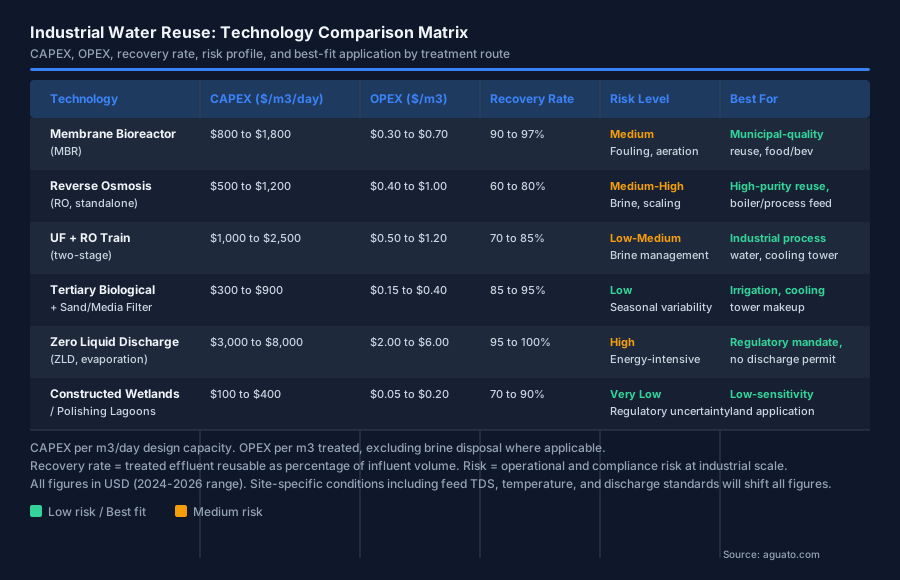
The technology comparison above shows the full cost and risk range across six treatment routes. Three patterns stand out.
First, ZLD carries CAPEX three to five times higher than an MBR or UF+RO system. If your discharge permit allows a partial reduction, a partial reuse programme with ZLD only on the most problematic streams is almost always more cost-effective than full ZLD across the whole site. Zero liquid discharge is the right answer when regulators or site conditions remove the partial option, not as a default.
Second, the recovery rate column matters as much as the cost columns. A system that recovers 97% of influent volume but produces a concentrated brine that triggers disposal costs of $5 to $15/m3 can have a higher real OPEX than a system that recovers 80% and discharges the remaining 20% within permit. Run the numbers on the full water balance before committing to a recovery rate target.
Third, constructed wetlands and lagoons look attractive on CAPEX and OPEX but carry the highest regulatory uncertainty. Regulatory guidance on the reuse quality they deliver is inconsistent across jurisdictions, and a permit change can strand the investment. They are appropriate for irrigation applications in stable regulatory environments, and almost nothing else in an industrial context.
[cta:nepti]
## How to choose: a threshold-based decision framework
The right technology route is determined by five variables: feed TDS, feed BOD, target reuse quality, required recovery rate, and brine disposal options. This framework gives numeric cut points for the most common decisions.
If feed TDS is below 1,000 mg/L and the target is cooling tower makeup or irrigation: tertiary biological treatment plus media filtration is sufficient. No membrane polishing required. OPEX stays below $0.40/m3. This covers the majority of secondary effluent reuse projects in food processing, textiles, and municipal-adjacent manufacturing.
If feed TDS is 1,000 to 5,000 mg/L and the target is process water or boiler makeup: an MBR or UF pre-treatment stage followed by a single-pass RO is required. Design for 70 to 75% RO recovery and plan the brine disposal route before specifying the RO system. OPEX $0.50 to $1.20/m3.
If feed TDS exceeds 5,000 mg/L: standard RO recovery falls to 60 to 65% due to scaling risk. Either a high-recovery RO system with antiscalant dosing optimisation, or a two-pass system with interstage brine concentration, is needed. Consider whether [zero liquid discharge systems](/resources/zero-liquid-discharge) are required by permit or by site constraints before investing in a high-recovery configuration that may be obsolete when the next permit review tightens the discharge standard.
If feed BOD exceeds 200 mg/L: biological pre-treatment is mandatory before any membrane stage. Running RO directly on high-BOD feed will produce biofouling within three to six months, cutting membrane life from five to seven years to two to three years and raising CIP chemical costs by $30,000 to $80,000 per train per year.
If the site has no brine disposal route: consider ZLD or a crystalliser/evaporator to eliminate liquid discharge. CAPEX is high ($3,000 to $8,000/m3/day), but the alternative in a zero-discharge permit zone is non-compliance, with fines ranging from $50,000 to $500,000 per violation and potential production curtailment.
The [operations and maintenance](/operations-and-maintenance) teams who will run the system after commissioning should be involved in technology selection. A technology that is optimal on paper but requires specialised membrane cleaning protocols that the on-site team cannot execute will underperform by year two.
## CAPEX and OPEX: what a reuse system actually costs
A fully scoped industrial water reuse system is not a single equipment purchase. It includes civil works, pre-treatment, the core treatment train, instrumentation and control, brine management, and the integration into existing plant utilities. CAPEX estimates that omit civil works and integration typically understate total project cost by 30 to 50%.
Typical CAPEX ranges (all USD, 2024 to 2026):
- MBR system, 1,000 to 5,000 m3/day: $1.2M to $6.5M installed, including civil works and I&C - UF+RO two-stage system, 1,000 to 5,000 m3/day: $1.5M to $8M installed - ZLD evaporation/crystallisation, 500 to 2,000 m3/day: $4M to $20M installed - Media filtration plus disinfection only, 2,000 to 10,000 m3/day: $500K to $3M installed
OPEX breakdown by line item (per m3 treated):
- Energy: $0.05 to $0.25/m3 for biological systems; $0.20 to $0.80/m3 for RO-inclusive trains; up to $2.00 to $5.00/m3 for ZLD thermal systems - Chemicals (antiscalants, coagulants, biocides, pH adjustment): $0.05 to $0.25/m3 depending on feed quality and system type - Membrane replacement (RO, UF): $0.05 to $0.15/m3 amortised over a five to seven year replacement cycle - Labour: $0.10 to $0.30/m3 for a staffed industrial system, lower with remote monitoring and automated dosing - Brine disposal (where applicable): $2 to $15/m3 of brine volume, which at 75% RO recovery equates to $0.50 to $3.75/m3 of product water
The brine disposal line is the one that most CAPEX presentations understate. Vendors model OPEX as energy plus chemicals plus membranes. They rarely model brine haulage or concentrate disposal at realistic cost, because doing so makes some projects look less attractive than they are. Demand a fully loaded OPEX model that includes the full cost of every litre that leaves the reuse system boundary, including concentrate.
Payback periods depend on the combination of avoided supply cost, avoided discharge cost, and regulatory risk value. A food-processing site in a water-scarce US state, paying $3.50/m3 for supply and $1.80/m3 for discharge, will typically see payback in 18 to 30 months on a well-designed MBR system. A site in a low-tariff jurisdiction with permissive discharge rules may see payback of five to eight years, at which point the regulatory optionality value becomes the primary justification.
The right answer depends on your feed water chemistry, discharge permit terms, and site water tariff. [Post your project on Aguato](/post-project) and qualified industrial water treatment providers will scope the capital and operating cost against your actual numbers.
## Real-world sector patterns
Food and beverage manufacturing. A pattern that recurs consistently in food processing is the split between high-BOD process wash water and lower-TDS cooling water blowdown. The highest-value intervention is usually an MBR on the wash water streams (BOD 500 to 3,000 mg/L) to produce effluent suitable for equipment rinse or non-contact reuse, combined with a simple side-stream softening system on the cooling tower to reduce blowdown volume. A large dairy or beverage plant drawing 8,000 to 15,000 m3/day and implementing this combination typically reduces net freshwater intake by 35 to 55%, with a payback of two to four years. The trade-off is consistent feed quality control. Food processing streams vary significantly with production schedules, and a biological treatment system sized for average loads will underperform during production peaks, creating quality excursions that require bypass and divert capacity.
Semiconductor and electronics manufacturing. This sector uses ultrapure water (UPW) in volumes of 2,000 to 20,000 m3/day per fab, and rinse-water recovery is one of the most established reuse applications in any industry. Rinse water from wet bench operations contains low concentrations of acids, bases, and trace metals but is otherwise very low in TDS. A conventional recovery train, UF plus RO plus mixed-bed ion exchange, can recover 70 to 85% of rinse water volume and return it to the UPW system, reducing both intake and high-purity water production costs. The challenge is the trace metal content. Even a single batch of copper or nickel-contaminated rinse water reaching the reuse loop can contaminate an entire reclaim tank and require disposal of several hundred cubic metres of otherwise recoverable water. Continuous inline metal monitoring is not optional in this application. The [industrial water quality testing](/resources/industrial-water-quality-testing) protocol must include real-time sensors at every recovery point, not just periodic laboratory analysis.
## Where industrial water reuse projects fail
Most industrial water reuse projects that underperform do not fail on the core treatment technology. They fail on pre-treatment, monitoring, and operational execution. The failure modes are predictable and preventable.
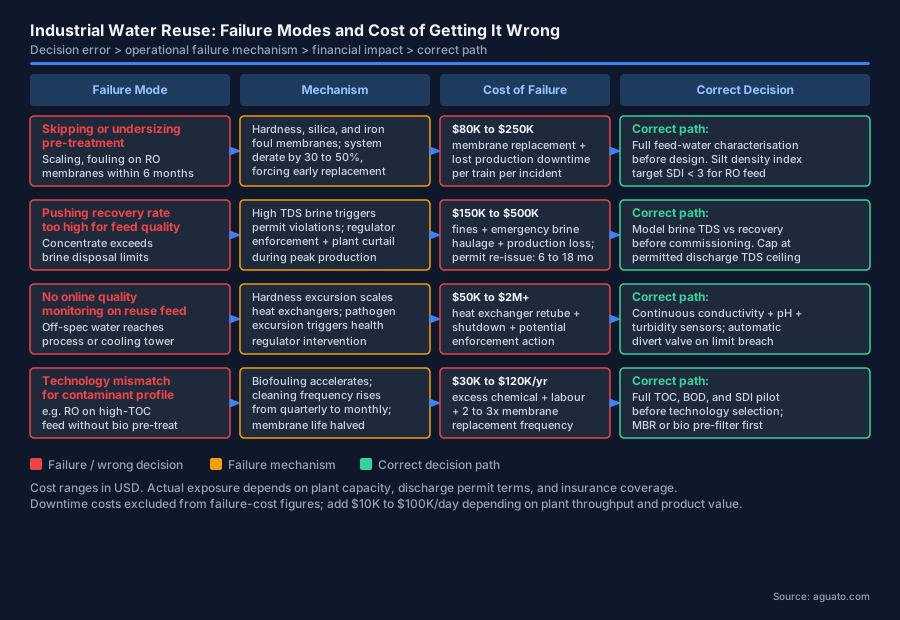
The failure mode diagram above maps the four most common project failures to their mechanism, cost, and correction. Two observations from the operational side of these failures.
Skipping pre-treatment design is a vendor-incentivised error. Equipment suppliers who are paid on the core treatment system have limited financial incentive to stress-test your pre-treatment. The system gets specified to the average feed quality, not the worst-case feed quality during production changeovers or seasonal variation. Within six to eighteen months, the average feed quality has been exceeded multiple times, and the core system is fouled or scaled. Correct pre-treatment design requires a minimum of twelve months of representative feed-water sampling data, not a single grab sample on the day the vendor visits.
Online monitoring is treated as optional when it is structural. A reuse system without continuous quality monitoring at the point of re-introduction into the process is not a reuse system. It is a liability. The cost of a single off-spec batch of product contaminated by out-of-specification reuse water exceeds the entire capital cost of a monitoring system in most manufacturing environments. [Online water quality monitoring versus lab analysis](/resources/water-quality-monitoring-online-vs-lab) is not a cost debate. For any reuse application that touches a production-quality water circuit, online monitoring is the only viable approach.
Brine management is planned last and costs the most. The pattern across dozens of industrial reuse feasibility studies is the same: brine disposal appears as a line item late in the project, is underestimated, and becomes the dominant OPEX line once the system is running. A 5,000 m3/day UF+RO system at 75% recovery produces 1,250 m3/day of concentrate. At 8 mg/L TDS, that concentrate may not meet trade effluent standards and will require either further treatment (ZLD), approved discharge via a deep-well injection or brine pipeline, or haulage at $5 to $15/m3. None of these options is cheap or administratively simple. Model the brine route before you model the rest.
Technology mismatch with feed quality is a selection-stage failure. Applying RO directly to a high-BOD industrial effluent without biological pre-treatment is the most common single error in industrial reuse projects. Biofouling builds on the membrane surface within months, increasing transmembrane pressure, reducing flux, and forcing more frequent chemical cleaning cycles. The [EPA water reuse guidelines](dofollow:https://www.epa.gov/water-reuse/guidelines-water-reuse) are explicit that secondary biological treatment should precede membrane polishing in all industrial reuse applications with BOD above 30 mg/L. A pilot test of the actual feed water through a representative membrane element is the only reliable way to validate the design assumption. Pilots of four to twelve weeks are standard practice and cost $20,000 to $80,000, a fraction of the cost of a mis-specified system.
## Regulatory and ESG considerations
Industrial water reuse sits at the intersection of environmental regulation, water law, and corporate sustainability reporting. The regulatory landscape is more complex than many engineering teams expect, and it is tightening. The [European Union Water Framework Directive](dofollow:https://environment.ec.europa.eu/topics/water/water-framework-directive_en) and its associated regulations on water reuse in agriculture and industry set minimum quality standards for reclaimed water that now directly affect industrial facilities discharging to or receiving water from catchments under water stress classification.
In the United States, water reuse is regulated at the state level, and standards vary significantly. California, Texas, and Florida have the most developed industrial reuse frameworks. Several other states have no specific industrial reuse regulations, creating both opportunity and uncertainty. Facilities planning reuse systems should engage with the relevant state environmental agency before completing a design, not after. A permit condition that requires pathogen reduction to a specific log-removal value will determine whether you need UV disinfection or ozone in the treatment train, and getting that answer wrong adds $200,000 to $800,000 in capital cost.
On the ESG side, water reuse directly supports CDP (Carbon Disclosure Project) water security reporting, GRI 303 water and effluent standards, and the water targets embedded in most major corporate sustainability frameworks. The key metrics boards want to see are the reuse rate (reclaimed volume as a percentage of total intake), the reduction in discharge volume, and the avoided freshwater withdrawal in absolute terms. A reuse programme that reduces intake by 40% and discharge by 60% at a site in a water-stressed basin is a material ESG disclosure, not a footnote. It also affects the site's water risk profile, which now appears in investor due diligence at major institutional investors.
The ESG director and the plant manager rarely share a view of the same reuse project. The plant manager sees OPEX savings and uptime resilience. The ESG director sees reporting metrics and reputational risk reduction. Both views are correct, and both belong in the business case. Companies that build the ESG value into the internal rate of return calculation, using shadow water pricing at stress-scenario tariffs, typically find that projects which barely clear the hurdle rate on operational cost alone clear it comfortably on the blended basis.
## Operations and long-term performance
A well-designed reuse system that is poorly operated will underperform within two years. Operations is not a post-commissioning afterthought. It is a design input.
The critical operational parameters to specify at design stage are cleaning-in-place (CIP) frequency and protocol for any membrane stages, chemical dosing control philosophy (automated or manual, and at what response threshold), and the alarm and divert logic that protects the reuse application from off-spec water. Each of these has cost implications: a system designed for monthly CIP may need weekly CIP under actual feed conditions, and the additional chemical and labour cost can add $50,000 to $150,000 per year per train if it was not budgeted.
Staff capability is underestimated on almost every industrial reuse project. Running a membrane bioreactor with downstream RO and a brine management system is a skilled task. The operators need to understand membrane fouling indicators, CIP chemistry, and process control logic. A 24/7 operation without at least two fully trained reuse system operators per shift is a reliability risk. [Specialist operations and maintenance providers](/operations-and-maintenance) for industrial water treatment can bridge the capability gap during the first two to three years of operation while in-house skills develop, and they often carry performance guarantees that transfer the operational risk to the service provider.
Long-term performance tracking should be built into the SCADA system from day one. The key performance indicators are: specific energy consumption per m3 treated, normalised membrane flux (corrected for temperature and feed TDS), chemical consumption per m3, and reuse quality compliance rate (percentage of hours when reuse water met the specification). These four metrics will tell you whether the system is ageing normally or showing early signs of a fouling, scaling, or operational discipline problem. A system that is running above design energy consumption by more than 15% at year three needs a root-cause investigation, not a budget increase.
Experienced [industrial water treatment companies](/industrial-water-treatment-companies) will typically offer performance-based maintenance contracts that tie service fees to these metrics. These contracts are worth the small premium over time-and-materials service because they align the service provider's incentives with system performance rather than with the volume of chemicals and consumables sold.
## FAQ
### What is industrial water reuse and how is it different from recycling?
Industrial water reuse refers to capturing treated effluent or process water streams and re-applying them to a different use within or adjacent to the same facility, for example, using treated cooling tower blowdown as boiler makeup or irrigation water. Recycling is typically a closed-loop reuse within a single process step, such as recirculating cooling water within a chiller circuit. The distinction matters operationally because reuse involves treating water to a different quality standard for a new application, while recycling often involves minimal or no additional treatment. Most industrial water programmes combine both, and the terms are often used interchangeably in regulatory documents. What matters for engineering purposes is the quality gap between the available water source and the target application, and the treatment cost of closing that gap.
### How much does an industrial water reuse system cost to build?
CAPEX depends heavily on the treatment route and the capacity. A membrane bioreactor system for 1,000 to 5,000 m3/day typically costs $1.2 million to $6.5 million installed, including civil works and instrumentation. A UF plus RO two-stage system for the same capacity range runs $1.5 million to $8 million. Zero liquid discharge systems are in a different cost category, $4 million to $20 million for 500 to 2,000 m3/day, reflecting the energy-intensive evaporation and crystallisation equipment. The most common CAPEX underestimate is excluding civil integration costs, which add 25 to 50% to the equipment-only price. Always request a fully installed cost with civil, electrical, and commissioning included.
### What is a realistic payback period for an industrial water reuse investment?
Payback ranges from 18 months to 8 years depending on local water tariffs, discharge fees, and the capital intensity of the technology chosen. Sites in water-scarce regions paying combined supply and discharge costs above $2.50/m3 typically see payback in 2 to 4 years on well-designed systems. Sites in low-tariff regions with permissive discharge permits may see 5 to 8 year payback on the operational savings alone, at which point the regulatory resilience value and ESG reporting value need to be included in the business case to justify the investment. The best payback cases combine avoided supply cost, avoided discharge cost, and a credible model of the avoided curtailment risk in a single internal rate of return calculation.
### What water quality can an industrial reuse system reliably achieve?
An MBR system producing secondary biological treatment followed by UF polishing will typically deliver turbidity below 0.5 NTU, TSS near zero, and BOD below 5 mg/L. Adding a single-pass RO reduces TDS to 50 to 150 mg/L from a typical secondary effluent of 800 to 1,500 mg/L. A full UF plus RO plus mixed-bed deionisation train can produce conductivity below 1 microsiemens/cm, suitable for boiler feed and high-purity applications. The guarantee-able output quality depends on feed water consistency. Variable feed quality requires a larger pre-treatment buffer or a more conservative system design, and the operating specification should always be written around the 95th-percentile worst-case feed condition, not the average.
### What are the main risks of operating an industrial water reuse system?
The four most common operational risks are: membrane fouling from inadequate pre-treatment (most frequent), brine disposal compliance failure when concentrate TDS exceeds discharge permit limits, off-spec water reaching a sensitive process application due to a sensor or control failure, and biofouling from organic-rich feeds that were not adequately characterised at design stage. Each risk has a defined mitigation: rigorous feed characterisation and pre-treatment design, an explicit brine management plan, continuous inline monitoring with automatic divert, and a biological pre-treatment stage for any feed with BOD above 30 mg/L. The risks are manageable. The pattern that drives project failures is treating pre-treatment and monitoring as value-engineering targets rather than structural requirements.
### How does industrial water reuse affect ESG reporting?
Industrial water reuse directly reduces two GRI 303 metrics: total water withdrawal and total water discharge. A programme that reduces withdrawal by 40% at a site in a water-stressed basin is a material quantitative disclosure under CDP water security reporting and TCFD physical risk assessment. The reuse rate (reclaimed volume divided by total intake) is the most commonly reported metric and should be calculated on a net basis, excluding water that passes through a closed-loop cooling circuit without leaving the system boundary. ESG-focused investors and corporate procurement teams increasingly scrutinise site-level water data, and facilities with a documented, metered reuse programme carry lower water-related risk ratings than comparable sites without one.
### When does industrial water reuse make more sense than zero liquid discharge?
Zero liquid discharge makes sense when the discharge permit prohibits any liquid effluent to surface water or sewer, when brine disposal costs are prohibitively high due to site geography, or when regulatory trajectory makes current partial discharge volumes likely to be restricted within the permit cycle. For most industrial sites, a partial reuse programme that reduces discharge volume by 60 to 80% and manages the remaining concentrate within permit is significantly more cost-effective than full ZLD, with OPEX one-third to one-fifth of a ZLD system. The decision threshold is the cost and regulatory reliability of the brine disposal route. If you have a permitted, cost-stable brine disposal route, design for high recovery rather than zero discharge. If you do not, ZLD deserves serious evaluation despite the capital and energy premium.